







Abstract
The relationship of political actors and journalists is a central topic in political communication research. However, it remains challenging to explain the different patterns of interaction observed in different contexts. To address that challenge, this study draws theoretically on the concept of “political communication cultures” and transfers the logic of internationally comparative research to the local level to analyze patterns and causes of politics–media interactions in a large number of diverse contexts. To this end, micro-level empirical data from a representative survey of more than 600 local political actors and journalists in fifty-two German cities were integrated with macro-level data describing the social, political, and media contexts of those cities. This allows us, first, to describe patterns of politics–media relations at the notoriously under-researched local level in terms of proximity, dependency, and seclusiveness of the politics–media milieu. Second, we are able to investigate various potential micro- and macro-level causes of those patterns. We show that different dimensions of relationships are variously affected by different factors; among these, media and political competition seem to be significant predictors of politics–media relations.
The relationship between political actors and journalists is a central topic in political communication research, as these are the “two types of actors without whom no political public sphere could be put to work” (Habermas 2006: 416). Discussions about a “crisis of political communication” (Blumler and Gurevitch 1995), declining media quality, and dysfunctional intrusion of media logic into the political process raise questions about the quality of interactions between political actors and journalists. It is therefore appropriate that various empirical studies have sought to describe politics–media interactions and the factors that influence them, such as role perceptions and frequency of contact or conflict between political actors and journalists (e.g., Ekman and Widholm 2015; Pfetsch 2001; Schwab Cammarano and Medrano 2014; Van Aelst et al. 2010).
While those studies broaden our knowledge of the politics–media relationship in a specific context—country, region, or city—the investigation and explanation of differences among contexts remains challenging. This requires comparative research that can take account of contextual differences as possible explanatory factors. However, country comparisons often encounter difficulties that include a low number of cases, as well as a lack of theoretical explanations of patterns in politics–media relationships. The concept of “political communication cultures” offers a promising means of addressing these problems by linking the orientations (norms, attitudes, and values) of political actors and journalists to structural aspects of the political and media contexts in which they operate (e.g., Pfetsch 2014).
Against this backdrop, the present study aims to contribute to a better understanding of the dimensions and causes of patterns in politics–media relationships by analyzing local political communication cultures. From a theoretical point of view, an analysis of a large number of politico-communicative spaces varying in contextual factors and a large number of actors varying in individual characteristics is especially well suited to test theoretical assumptions about the impact of those factors on politics–media relationships. To do so, we integrate micro-level data from a survey of more than 600 local political actors and journalists with macro-level data on the social, political, and media environments of the fifty cities these actors are situated in. By using a multi-level approach to analyze the data gathered, we are able (1) to describe key dimensions of politics–media relations (i.e., proximity, dependency, seclusiveness) relevant at all levels of politico-communicative systems (local, regional, national, international), (2) to show that politics–media relations below the national level are much more diverse than internationally comparative research seems to suggest, and (3) to provide evidence that although various micro- and macro-level factors affect these relationships, media and political competition are most important.
From a substantial point of view, we also chose the local level because of a general lack of research on local politics–media interactions and relationships. Although the local level is often regarded a key to a flourishing democracy, research on media–politics relations at local level is rare and consists predominantly of case studies that lack a comparative perspective (Baugut and Reinemann 2013b; Lang 2003; Nielsen 2015). Bringing in a truly comparative perceptive here thus seemed to be especially promising.
Theoretical Framework
Developed by Pfetsch (2004) on the basis of Blumler and Gurevitch (1995), the concept of political communication cultures considers political communication as a process of interaction between political actors and media actors in relation to a common public audience. These interactions are informed by the orientations, attitudes, and norms of political actors and journalists, and this subjective dimension is assumed to be affected by structural aspects of the political and media system. The aggregated attitudinal patterns are referred to as a “political communication culture” (Pfetsch 2004), in which the understanding of “culture” is psychologically grounded and can be explored by quantitative as well as qualitative interviews with political actors and journalists (e.g., Baugut 2017). The concept invites comparative research exploring the extent to which the attitudes and interactions of political actors and journalists vary under differing structural conditions in political and media systems (Pfetsch and Esser 2014).
The concept of political communication cultures seems to be especially well suited for an investigation of local media–politics relations for several reasons. First, it is applicable not only at the national level but also at the local level, where structural conditions may vary from city to city. Second, the concept focuses on the process of news production by political actors and journalists, whereas ecological approaches also consider the circulation of news, taking more actors into account—for example, how citizens receive the news (e.g., Anderson 2010; Coleman et al. 2016). Third, the concept of political communication culture aligns with the new institutionalist approach that encourages scholars to regard the news as an outcome of the interaction between journalists and other political actors (Cook 2006).
In general, the relationships between political actors and journalists can be described on different dimensions. Research based on the concept of political communication culture has focused on such characteristics as proximity versus distance as one dimension of the role-oriented self (Pfetsch 2004; Pfetsch, Mayerhöffer, and Moring 2014). In addition, the approach examines inputs to the political communication system (e.g., the perceived meaning of polls), as well as outputs from that system (e.g., political actors’ strategies to attract public attention) (Pfetsch, Mayerhöffer, and Moring 2014). Deriving mainly from Hallin and Mancini’s (2004) typology of western political media systems, media factors of potential relevance include degree of political parallelism and media professionalism. Political factors that potentially influence political communication cultures include those derived from Lijphart’s (2012) distinction between consensus and majoritarian models of democracy.
The present paper focuses on three key dimensions of political communication cultures that also have not yet been empirically or systematically analyzed in a comparative fashion at the local level: proximity versus distance, dependency versus autonomy, and seclusiveness versus responsiveness (cf. Baugut and Reinemann 2013b). We concentrate on these dimensions because they (1) refer to political actors’ and journalists’ norms of action, (2) seem of particular importance at the local level, and (3) link to previous research.
Dimensions of Political Communication Cultures
Proximity versus distance
For a number of reasons, the proximity versus distance-dimension seems highly relevant at the local level (Baugut and Reinemann 2013b). First, political actors and journalists are often citizens of the same municipality, which means that they may be especially prone to role conflicts because they may share similar interests, are very often in personal contact, and develop personal relationships. Second, content analyses showing that local elites dominate political news coverage (e.g., Ekström et al. 2006; Kaniss 1999; O’Neill and O’Connor 2008) raise concerns that these relationships are too close. However, it is difficult to find a “yardstick for ‘appropriate’ proximity or distance” (Pfetsch 2004: 352). On the one hand, journalists are supposed to be public watchdogs and to keep a distance from those in power, as emphasized in particular by Anglo-American journalism research (e.g., Davis 2010; Schudson 2003). On the other hand, there is no doubt that proximity to political sources is a prerequisite for the access to in-depth information that enables journalists to fulfill that watchdog function. Clearly, then, the term “proximity” is complex. It is more than simply the problematic opposite of “distance.” In fact, empirical studies have investigated very different indicators of proximity, such as frequency of contact (e.g., Schwab Cammarano and Medrano 2014) or friendships and mutual advice (e.g., van Dalen and Van Aelst 2012). While previous research has characterized relationships between local political actors and journalists as rather close (e.g., Larsson 2002), most of those findings are based on a relatively small number of cases (e.g., Larsson 2002). Given the inconsistency and vagueness of research in this area, we put forward our first research question:
Dependency versus autonomy
This dimension refers to actors’ perceptions of their mutual dependency and autonomy. At the micro level, political actors can be characterized as being interested in publicity while journalists need high-level source access to exclusive information (Davis 2009). With regard to the local level, one might question politicians’ dependency on journalists, as interpersonal communication practices seem more important here than at the national level (Lang 2003). On the contrary, local issues can be considered relatively obvious, so reducing journalists’ dependency on in-depth information. However, mutual dependency may be based on more than just the need for information or publicity. For example, journalists may also be seen as information sources by virtue of their insights into the processes and strategies of other political actors (Davis 2009). Previous research has suggested that local journalists’ dependence on politicians has decreased over time, to be replaced by more symbiotic and symmetric relationships (e.g., Ekström et al. 2010; Larsson 2002). However, most of these findings are from some time ago and were based on a low number of cases. For that reason, we pose our second research question:
Seclusiveness versus responsiveness
Local political communication cultures can also be characterized by the extent to which the relationships between political actors and journalists are public-oriented (Baugut and Reinemann 2013b). As both groups are supposed to work in the public interest, it would be problematic if they were found to be a secluded elite, lacking in responsiveness to their audiences and citizens. This kind of elitist politics–media milieu can be created by actors who are strongly oriented toward each other and are uninterested in the transparency of informal contacts between them (Baugut and Reinemann 2013b). In particular, metropolitan politics–media milieus have repeatedly been described as a self-contained universe (Wahl-Jorgensen 2014)—a view that is often also shared by the actors themselves (Baugut and Reinemann 2013a). Empirical evidence for the dominance of elites in local news coverage points to a secluded and elite politics–media milieu (e.g., Ekström et al. 2006; Kaniss 1999; O’Neill and O’Connor 2008). However, there is a need to explore the relationships on the basis of a large number of cases, prompting our third research question:
Causal Factors Shaping Political Communication Cultures
In this section, we examine the contextual factors explored in previous theoretical and empirical research, and we discuss to what extent they may explain the nature of local political communication cultures. Such causal influences on political communication cultures can be located at the macro level (factors describing the political and media systems) and on the micro level (individual characteristics of political actors and journalists). We assume that the patterns of these influences should be similar across the different levels of politico-communicative systems. This means, for example, that we think there is good reason to assume that the intensity of competition should affect politics–media relations in similar ways no matter whether we look at the local, regional, national, or international level.
Macro-level factors
At the macro level, one of the most widely cited frameworks for comparative analyses of media–politics relationships is Hallin and Mancini’s (2004) typology. However, findings from empirical comparative studies suggest that Hallin and Mancini’s dimensions do not in themselves suffice to explain observed variations in the relations between political journalists and politicians (e.g., Schwab Cammarano and Medrano 2014; van Dalen and Van Aelst 2012). Also, Hallin and Mancini’s approach focuses on the national level, calling into question its explanatory power at the local level. For example, political parallelism and external pluralism are not applicable in municipalities where often only one newspaper regularly reports on local issues.
In fact, the ongoing concentration of media ownership has led to an increasing number of local media monopolies in Germany, raising concerns about diversity in the local media system (e.g., Murphy 1998; Schuetz 2012). As Hallin and Mancini (2004) characterized national media systems by their degree of commercialization (among other features), it seems reasonable to investigate media competition or concentration at the local level. Early findings from Germany indicated that while journalists in areas where there are local newspaper monopolies feel less dependent on political sources, there is more apprehension about a potential loss of access to exclusive political information in areas where newspapers must compete (Benzinger 1980; Koller 1981). The prevailing level of media concentration seems to affect both political actors’ feelings of dependence on journalists and, conversely, how close journalists need to be to political actors. In addition, media competition seems to affect the responsiveness dimension, as elite and secluded politics–media milieus are commonly found in capital cities, where political actors and journalists are exposed to strong competition. Competition for audiences and citizens’ acceptance may foster responsiveness, but as this is a characteristic of secluded politics–media milieus in capitals (e.g., Baugut and Reinemann 2013a; Wahl-Jorgensen 2014), it remains unclear whether these findings can be transferred to the local level. On that basis, we advance our fourth research question:
Competitive structures are as well taken into consideration when it comes to explain national political communication cultures (Lijphart 2012; cf. Pfetsch, Maurer, et al. 2014; Schwab Cammarano and Medrano2014). At the local level, political systems exhibiting high levels of political conflict and party competition among numerous factions can be distinguished from systems with a consociational, consensus-oriented character (Holtkamp 2008; Lijphart 2012). International comparative research suggests that consensual politics, in combination with an absence of state intervention in the media sector, is associated with a lower frequency of contacts and conflicts between political actors and journalists (Schwab Cammarano and Medrano 2014). It can be assumed that consensual politics makes political actors feel less dependent on journalists, as they do not need that closeness to promote their interests. Concerning the responsiveness dimension, the effects of political competition could be going into different directions: While actors who compete for public acceptance may generally be more responsive, political competition may also result in interaction patterns in which actors are predominantly oriented toward each other. This prompts our next research question:
Municipalities can also be characterized in terms of social indicators such as number of inhabitants, debt per capita, and unemployment rates. International comparative research often neglects the impact of these sociopolitical features. While economic problems may prompt journalists to keep their distance from the responsible political actors, those political actors might want to be close to journalists, whom they need for public acceptance. With regard to the number of inhabitants, one might assume that relationships are more responsive in less populous municipalities because of the smaller distance between politics and citizens. In larger cities, characterized by more complex political processes, local elites were found to regard newspapers as indispensable for information acquisition (Arzberger et al. 1981). This finding indicates closer politics–media relations in more populous cities. On that basis, we pose our sixth research question:
Micro-level factors
It cannot be assumed that political communication cultures are completely determined by structural conditions. Individual characteristics of political actors and journalists must also be taken into account, especially at the municipal level, where the number of actors is lower than at the national level. Internationally comparative research has sought to explain aspects of political communication cultures in terms of individual characteristics, such as profession, working experience, role preferences, or age (e.g., Esmark 2014; Maurer 2011). To systematize these individual factors, we distinguish here between (1) personal characteristics (e.g., age, work experience, profession), (2) professional perceptions (e.g., media’s importance for one’s work, presumed media influence, role perceptions), and (3) individual perceptions of structural conditions (e.g., competitive structures and one’s own resources).
With regard to personal characteristics, international comparative research has shown, for example, that in a number of Western European countries, parliamentary experience increases the frequency of contacts between members of Parliament (MPs) and journalists (Van Aelst et al. 2010). Older and more experienced actors may also have closer private relations and feel less dependent on each other. There is also evidence that experienced journalists who work for elite media have less difficulty in achieving the goals of interaction; the same is true for prominent politicians (Baugut and Reinemann 2013a). Experienced actors may also be more likely to be part of a secluded politics–media milieu that lacks in responsiveness. Another personal characteristic—the actor’s profession—also seems influential, as research has shown how political actors and journalists differ in their perceptions of the media’s power to set the political agenda (Lengauer et al. 2014). Moreover, an actor’s profession may influence how he or she perceives and evaluates the politics–media relationships, because politicians and journalists might have different professional norms when it comes to dimensions like, for example, distance and responsiveness. These issues inform the following research question:
With regard to professional perceptions, research on presumed media influence (Gunther and Storey 2003) has shown that political actors who believe in the power of the media tend to increase their efforts to appear in media coverage (Cohen et al. 2008). It can therefore be assumed that the greater the influence actors ascribe to the media, the more they will be likely to see political actors as being dependent on journalists. Moreover, perceptions of media importance should be associated with proximity. For example, politicians who think the media are important should have a greater interest in having close contacts with journalists. Perceptions of media importance may also affect the responsiveness dimension. The more important an actor thinks, the media are the more he might be oriented toward them, probably at the cost of citizens’ needs. Role perceptions may be another influencing factor (Donsbach 2008). Actors with passive role perceptions are likely to value distance and autonomy while those with active role perceptions may favor responsiveness and standing up for citizens.
Overall, comparative research at national level shows that individual characteristics exert little if any influence on political communication cultures (e.g., Brants et al. 2010; Pfetsch 2014). However, this is not necessarily true for the local level with its specific conditions, prompting our next research question:
Finally, perceptions of structural conditions (such as competitive structures and resources) seem important here, as it can be argued that it is not the objective situation but the actor’s perceptions of such conditions that influences politics–media interactions (Thomas and Thomas [1928] 1970). Any potential impact of competitive structures on political communication cultures (as discussed earlier) may depend on how political actors and journalists perceive those working conditions and define their situation. This invites our final research question:
Figure 1 summarizes the potential causes and dimensions of local political communication cultures outlined above.
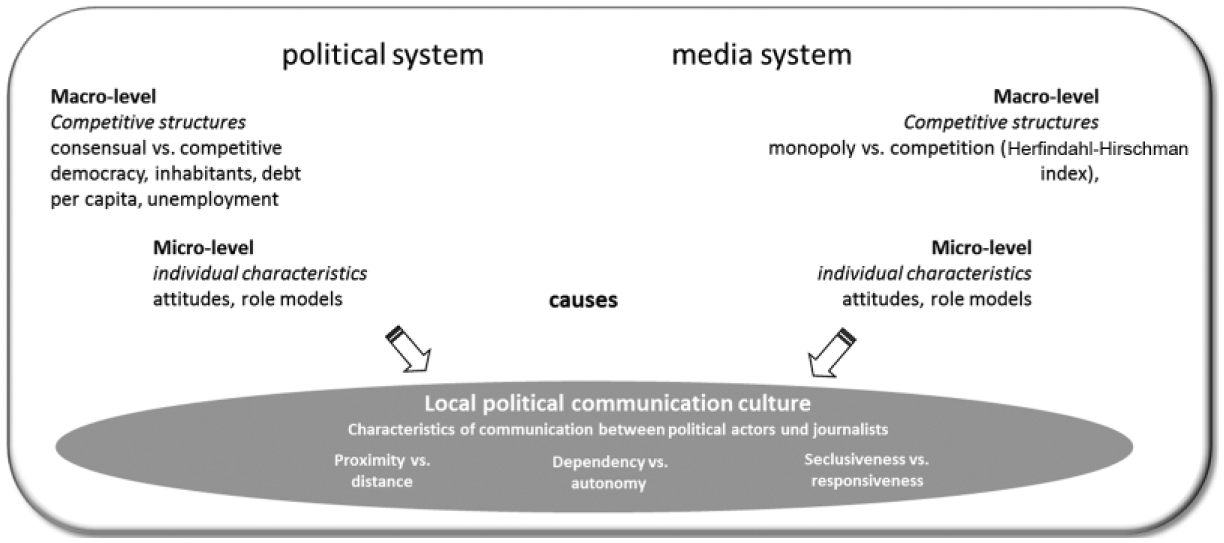
Characteristics and causes of local political communication cultures.
Method
Being interested in political communication culture on municipal level, we considered the elites from local politics and media as relevant actors for our study. We relied on a quantitative survey as this method allows insights into the internal perspective of the relevant actors, into their subjective perceptions of politics–media relationships, of the norms governing them, of the effects those interactions have, and so on. In line with previous research (e.g., Pfetsch 2014; Van Aelst et al. 2010), we argue that those perceptions form the basis of the overt behavior of political and media actors and are therefore relevant.
The political actors surveyed include representatives of the local government (the mayor and department heads) and leaders of the city council factions (the chairman and his or her deputy), as well as the municipal administration’s Public Relations employees. In each city, we chose every mayor, all department heads, one spokesperson, and ten members of the local parliament. On the media side, we focused on journalists from regional newspapers, as they regularly report on local politics and are still by far the most important source of political information for citizens (see, for example, Hasebrink and Schmidt 2013). In addition to the managing editors, we chose all journalists covering local political issues.
The sampling procedure involved two steps. First, we randomly selected every second city from Germany’s 104 urban municipalities (kreisfreie Städte [Urban municipality]; N = 52). These cities are largely independent from surrounding county boroughs and hold more political competences than smaller cities. Second, we identified the relevant actors as described above, using a database of journalists and the official city websites. This process yielded 1,191 actors, including 280 mayors and department heads, fifty-two city spokespersons, 530 city councillors, and 328 journalists, providing a representative sample of political actors and newspaper journalists at the local city level in Germany.
Between March and July 2014, we conducted a quantitative paper-and-pencil survey. The questionnaire was sent to participants by post and included a stamped addressed envelope. After a follow-up, 626 persons responded, representing a response rate of 52.6 percent, which did not differ substantially among the groups of actors (local government: 50.0 percent, spokespersons: 54.7 percent, city councillors: 55.1 percent, and journalists: 45.7 percent). For the following analysis, we compared the political actors group (local government, city councillors, and spokespersons) with the journalists group.
Dependent Measures
In this study, political communication cultures were measured in terms of the individual perceptions of political actors and journalists regarding three dimensions of their relationships. Almost all items on the ten-sided questionnaire had to be answered on 5-point Likert scales. The dimension proximity versus distance was measured by four items that were partly inspired by Kepplinger and Maurer (2008). Participants had to assess the extent to which four statements applied to their city: “Journalists who report favorably on a politician receive more often interesting information from him or her”; “Local politicians and journalists with similar political convictions are in close contact with each other”; “There are friendship-like relationships between local politicians and journalists”; and “There are more private contacts between local politicians and journalists in our city than citizens suspect” (M = 3.37, SD = 0.80, α = .72).
The dimension dependency versus autonomy included two items measuring politicians’ dependency on journalists and vice versa: “Politicians are dependent on journalists” (M = 4.04, SD = 0.87), and “Journalists are dependent on politicians” (M = 3.66, SD = 0.94). As the items correlated only weakly (r = .254), we analyzed the dimension dependency separately for politicians and journalists. Seclusiveness versus responsiveness was measured by four items: “Politicians deal sufficiently with the concerns of citizens”; “Journalists deal sufficiently with the concerns of citizens”; “Politicians and journalists often discuss issues which have no relevance for citizens”; and “Politicians and journalists deal too much with each other and too little with citizens” (M = 3.12, SD = 0.47, α = .65).
Independent Measures: Micro Level
In terms of independent micro-level variables, participants were asked about their personal characteristics, including age (M = 53.6, SD = 9.97), gender (76.8 percent male), years of professional experience (M = 19.5, SD = 9.98), and their professional attitudes, including the importance of different media for their work (1 = not important, 5 = very important, 9 = doesn’t exist in our city; seven media, for example, local newspapers, local broadcasting, blogs; M = 3.11, SD = 0.66, α = .61), the presumed media influence on citizens (PMI, “local media strongly influence citizens”; M = 3.75, SD = 0.82), and their role perceptions, in which higher agreement implies a more active role model (eight items; for example, “It is important for me . . .,” “. . . to make the political process transparent,” “. . . to improve the living conditions in our city,” “. . . to stand up for the disadvantaged in the population”; M = 4.05, SD = 0.54, α = .68).
In terms of individual perceptions of structural conditions, participants were asked to assess both media and political competition in their city, as well as their own resources. Media competition included three items: “The local media compete strongly for scoops from local politics,” “the local media compete strongly for personal contacts to local politicians,” and “the local media compete strongly for readers or audiences” (M = 3.15, SD = 1.11, α = .82). Political competition was measured by six items (e.g., “There is a strong competition among the council city factions”; “in the case of political disputes, the city government approaches the smaller factions”; M = 3.16, SD = 0.45, α = .65). Own resources at work was measured by the item, “I have enough time for my tasks” (M = 2.80, SD = 1.07).
Independent Measures: Contextual Macro-Level Data
To investigate the effects of the social, political, and media context in the selected cities, we collected information on media and political competition, as well as political and economic statistics like number of inhabitants (M = 186,171, SD = 165,921), debt per capita (M = €2,447.00, SD = €1,980.44), unemployment rate (M = 7.60 percent, SD = 2.89 percent), and number of political factions (M = 4.90, SD = 1.06). These data were collected from the city’s official websites and from statistics published by the Federal Statistical Office. Political competition was measured using a 3-point scale developed by Holtkamp (2008) for the German local level—It takes account of different municipal codes and distinguishes three ensuing models of local democracy: a consensus model (32 percent of the investigated cities), a competitive model (33 percent), and a mixed model (35 percent). To analyze media competition, we referred to the Herfindahl–Hirschman index (HHI), which is calculated by summing the squares of the individual market shares of all local newspapers in the city. Market shares for each city were collected from the German Newspaper Marketing Association (ZMG). The HHI maximum of 1 represents a monopoly (M = 0.84, SD = 0.22).
Analysis
To explain individual perceptions of the three dimensions of local political communication cultures, we performed a two-level regression analysis for each dimension. On the city level, the following contextual variables were included: political competition (dummy coded with mixed model as reference category), number of factions, number of inhabitants, unemployment, debt per capita, and press competition (HHI). The individual level included such personal characteristics of participants as age, working experience, and profession (dummy coded: political actors vs. journalists); perceptions of structural conditions (perceived media and political competition, personal resources for work); and individuals’ perceptions of such professional factors as media’s importance for work, presumed media influence, and role.
Findings
Characteristics and Causal Influences on Political Communication Cultures
Proximity versus distance
Both local politicians and journalists perceived a strong mutual proximity at a professional level, interacting regularly with each other (e.g., during council meetings, by telephone, or during events like receptions and city festivals). They also reported strong proximity at a cooperative level: A majority of both politicians (63 percent) and journalists (56 percent) agreed that journalists who report favorably on a politician will receive interesting information more often. Furthermore, according to most politicians (55 percent), there is a close relationship between politicians and journalists who share similar political views. But journalists (37 percent) differ significantly from political actors: A majority of political actors believe that relations are not influenced by political convictions. There was also no consensus concerning personal relations between journalists and politicians; while half of political actors (50 percent) reported friendships between politicians and journalists, fewer journalists (40 percent) agreed. They disagreed still more in their assessment of whether there is more private contact between politicians and journalists “than the public suspects.” While a large proportion of politicians (42 percent) agreed with this statement, only one in four journalists (26 percent) agreed (Table 1). In summary, the relationship between journalists and politicians at the municipal level cannot simply be described as close or distant, and politicians and journalists seem much closer at a professional than at a private level. In addition, our results suggest that politics–media relations are not necessarily homogeneous within a given country when you move from the national to the subnational level and look at different politico-communicative contexts.
Proximity versus Distance: Comparing Politicians’ and Journalists’ Perceptions.
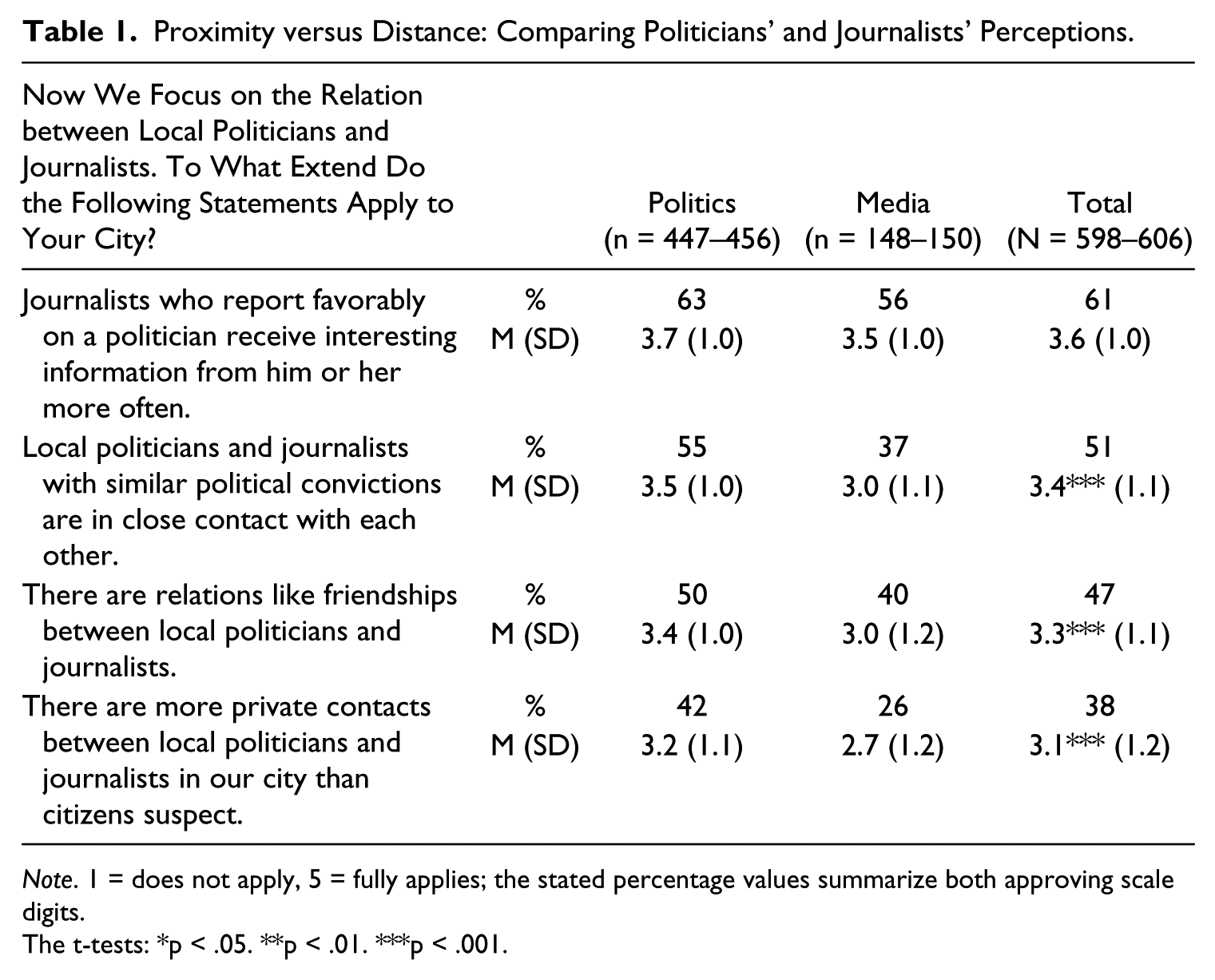
Note. 1 = does not apply, 5 = fully applies; the stated percentage values summarize both approving scale digits.
The t-tests: *p < .05. **p < .01. ***p < .001.
What factors drive perceptions of proximity? In terms of structural conditions, press competition, number of inhabitants, and debt per capita have significant effects. The lower the level of media competition in a city, the closer the relationship between politicians and journalists is perceived. In addition, the bigger the city and the better the economic situation, the closer relationships are perceived to be. At the individual level, personal characteristics like age or working experience are not influential. However, the participants’ professions help to explain the perceived proximity between both groups: Political actors perceive relationships to be significantly closer than journalists. In terms of structural conditions, perceived media competition, resources for work, and perceived political competition have a significant effect. Individuals who perceive media and political competition as stronger assess relationships as closer. Furthermore, political actors and journalists who evaluate their resources as lower tend to perceive relationships as closer. Finally, presumed media influence has a significant influence on this dimension of political communication culture: The more influential the media are seen to be, the closer relations between politicians and journalists are perceived to be (Table 2).
Results of a Two-Level Regression Model Explaining Local Political Communication Cultures.
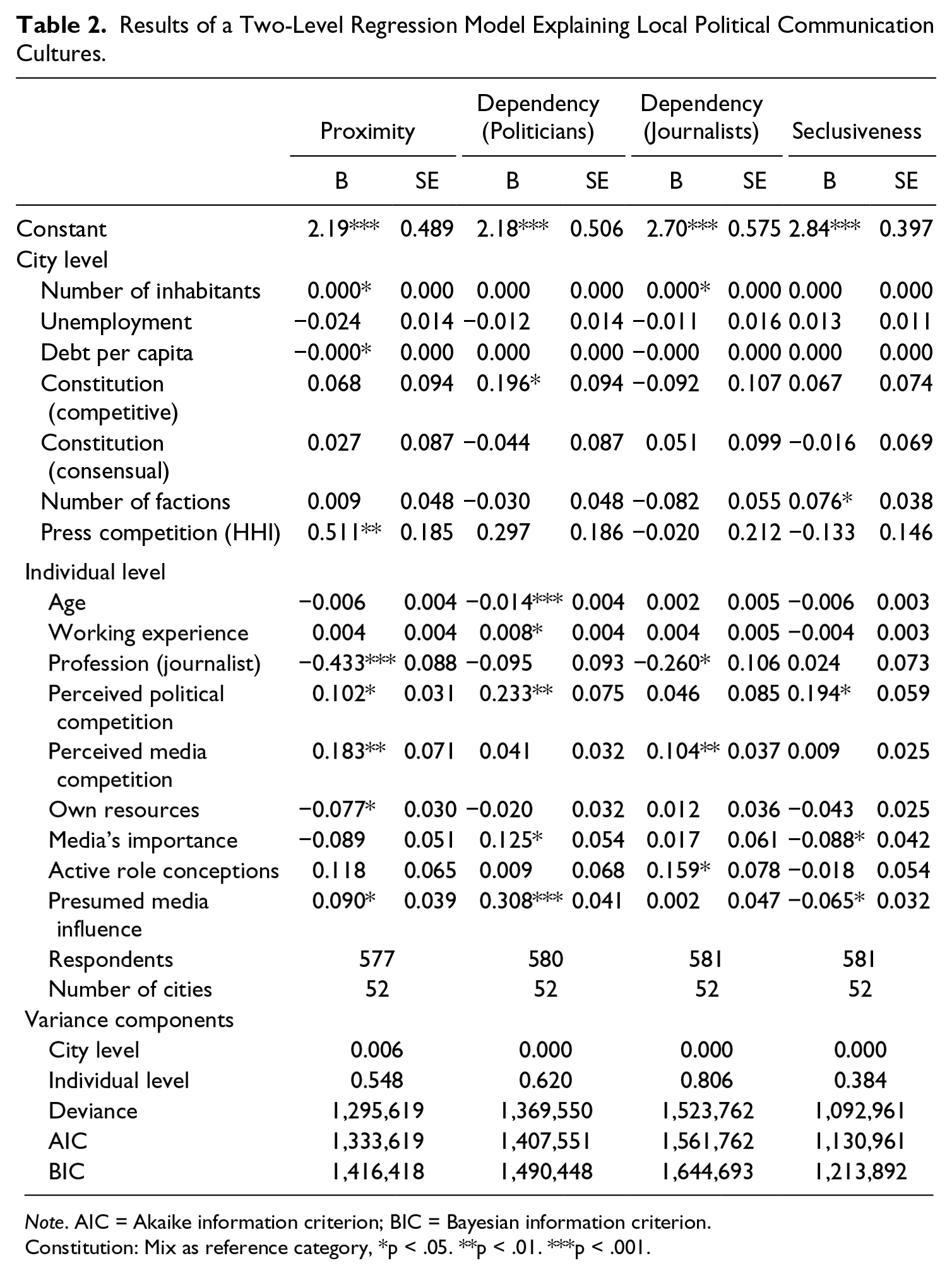
Note. AIC = Akaike information criterion; BIC = Bayesian information criterion.
Constitution: Mix as reference category, *p < .05. **p < .01. ***p < .001.
Dependency versus autonomy
Our interest in this second dimension relates to the mutual dependence or autonomy of politicians and journalists. The literature presents arguments both for and against a strong dependence of politicians on the media at the local level. Our findings show that both politicians (78 percent) and journalists (75 percent) perceive politicians to be highly dependent on journalists. Clearly, then, perceptions of media dependence are not unique to the national level. In contrast, politicians and journalists differ in terms of their perceptions of journalists’ dependence on politicians. While most political actors (63 percent) think that journalists are dependent on them, 49 percent of journalists perceive themselves as more autonomous, which aligns with normative role perceptions in journalism. With respect to the power relations between politics and media, local journalists are seen to be in a stronger position, despite increasing economic pressure on the local press and despite the opportunities provided by social media that increasingly enable politicians to communicate directly with citizens (Table 3).
Dependency versus Autonomy: Comparing Politicians’ and Journalists’ Perceptions.
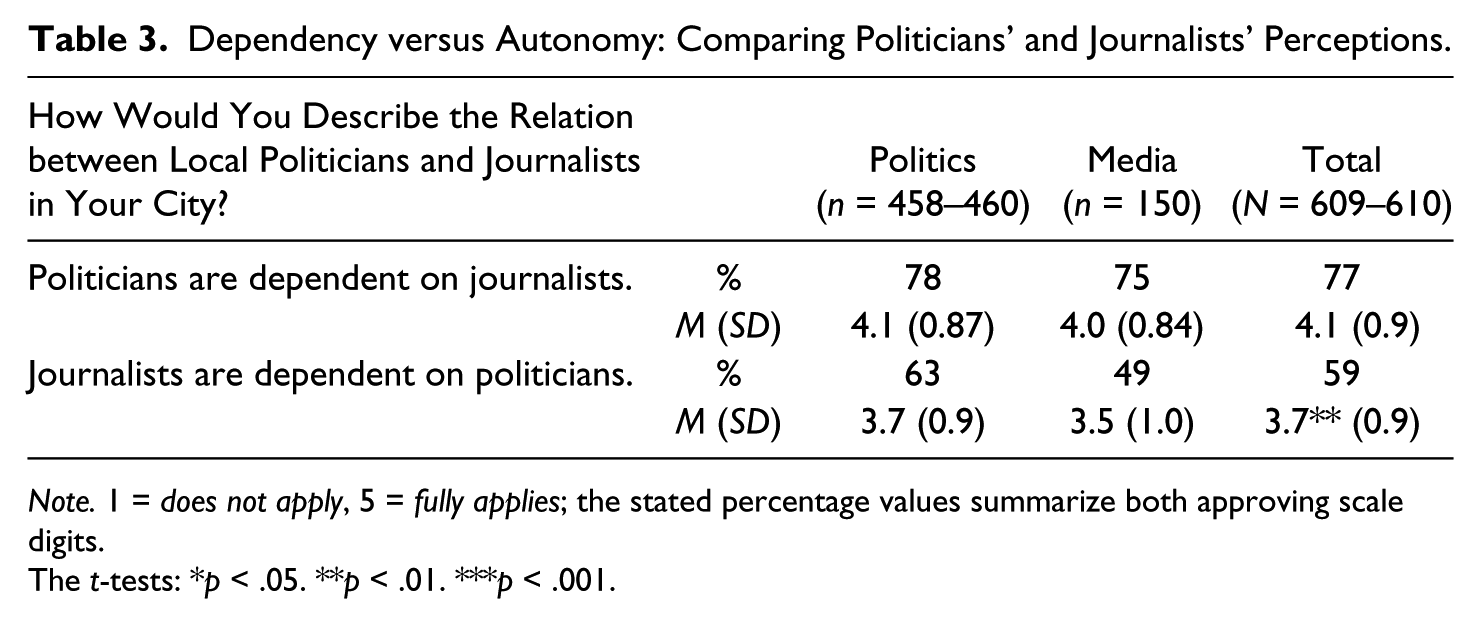
Note. 1 = does not apply, 5 = fully applies; the stated percentage values summarize both approving scale digits.
The t-tests: *p < .05. **p < .01. ***p < .001.
To explain perceptions of dependency versus autonomy, we calculated two regression models: one for dependency of politicians and one for dependency of journalists. In terms of dependency of politicians, only political competition (with competitive democracy as the reference category) had a significant influence at city level. In cities where a local constitution fostered political competition, politicians were perceived as more dependent on journalists. At the individual level, among personal characteristics, age had a negative influence and working experience a positive influence on dependency, which seems contradictory at first glance. On one hand, younger participants perceived a higher dependence of politicians; on the other hand, the more working experience they had, the higher they assessed that dependence to be. In line with the macro-level factors, perceived political competition enhanced the perception that politicians are dependent on the media. Finally, in terms of professional perceptions, presumed media influence and media’s importance for work also had a significant impact. The stronger individuals assessed media influence to be and the more important they considered the media for their daily work, the more dependent they perceived politicians to be on the media.
The perception that journalists are dependent on politicians is explained by completely different factors. At the city level, only the number of inhabitants affects perceived journalistic dependence: The bigger the city, the more dependent on politicians journalists are perceived to be. At the individual level of personal characteristics, the differences between professions are significant, as political actors are more likely than journalists themselves to perceive journalists as dependent on politicians. In terms of the perception of structural conditions, only perceived media competition significantly influences perceptions of journalists’ dependence: The stronger media competition is assessed to be, the more dependent journalists are perceived to be. In terms of professional perceptions, role conceptions exert a significant influence: Respondents who assess their professional role as more active also perceive journalists to be more dependent on politicians (Table 2).
Seclusiveness versus responsiveness
This dimension reflects the extent to which relationships between political actors and journalists are oriented toward each other or toward citizens. The results show that both journalists and politicians regard each other’s responsiveness as quite low. Only a third of journalists (33 percent) believed that politicians engage sufficiently with the public’s concerns, and only a few more political actors (36 percent) thought that journalists do so. However, the groups are less critical of themselves—59 percent of political actors perceived politicians to be responsive toward citizens, and 61 percent of journalists considered journalists to be responsive (Table 4).
Seclusiveness versus Responsiveness: Comparing Politicians’ and Journalists’ Perceptions.
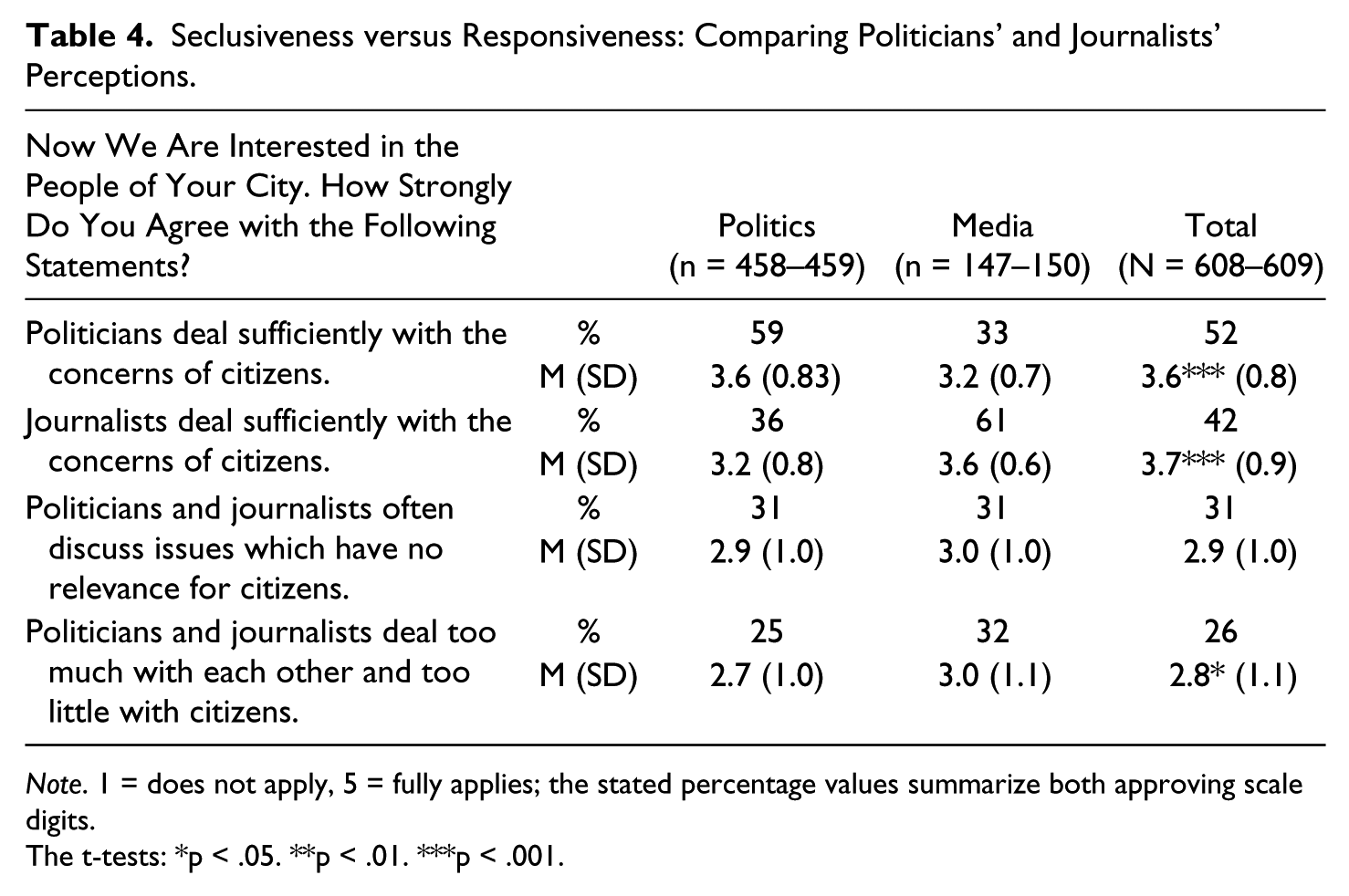
Note. 1 = does not apply, 5 = fully applies; the stated percentage values summarize both approving scale digits.
The t-tests: *p < .05. **p < .01. ***p < .001.
In terms of the politics–media milieu, there were no significant differences between the two groups, but there was considerable variance within groups. A third of political actors (31 percent) and journalists (31 percent) said that they often discussed issues of no relevance for citizens, but a similar number in both groups disagreed about this. In addition, one in three journalists (32 percent) and one in four political actors (25 percent) perceived politicians and journalists to be quite nonresponsive while a much larger percentage of both groups (45 percent of politicians and 67 percent of journalists) believed that they do not focus too much on themselves. Taken as a whole, there is no clear evidence for overall secluded politics–media milieus at the local level. Moreover, the tendency to emphasize one’s own responsiveness while attributing a lack of responsiveness to the other profession highlights the normativity of that dimension.
The responsiveness of political actors and journalists is explained by only two political variables in the two-level analysis. Among the city-level variables, number of factions positively influences the seclusiveness of the political media elite: The more factions in the city council, the less responsive politicians and journalists assess their group to be. In line with this result, perceived political competition also affects this dimension: The stronger participants perceive political competition to be, the less responsive they perceive themselves to be. In terms of professional perceptions, both media’s importance for work and presumed media influence are influential predictors. Increased perception of media’s importance for work and of media’s influence on the public leads to a more secluded politics–media milieu. Personal characteristics have no significant influence (Table 2).
Discussion
This paper investigated three dimensions of politics–media relations in a large number of politico-communicative spaces on the subnational level and analyzed the macro- and micro-level factors affecting them. The present study is the first to transfer the comparative logic from the international to the local level of politics–media interactions, combining contextual macro-level information with micro-level representative survey data for both descriptive and explanatory analyses. The descriptive findings provide insights into the under-researched relationships between local political actors and journalists in a Western European country. More importantly, this study wants to underline that the impact of structural and individual characteristics on the relationships between journalists and politicians can be investigated both theoretically and empirically on any level of political and media systems. We want to highlight five overarching lessons that can be learned from our results.
First, the two-level regressions reveal unique patterns of influence for the different dimensions investigated here, underlining the need to distinguish those dimensions in any investigation of political communication cultures. Typically, when taken together, individual characteristics seem to be more influential than contextual factors.
Second, we observed significant differences between journalists and political actors for two dimensions: proximity and journalists’ dependency. This shows that while it may take “two to tango,” perceptions of how the dancing goes might still differ. In general, political actors perceive relationships to be significantly less distant than journalists, indicating the relevance of distance as an integral part of journalists’ conception of their role. The fact that journalists see themselves as less dependent on political actors than vice versa may also be accounted for by the norm of media autonomy.
Third, along with perceived political competition, presumed media influence is the most frequent predictor influencing three of the four dimensions, emphasizing the importance of the public’s role in politics–media relations. The more powerful the media are perceived to be, the closer relationships, the higher politicians’ dependency on journalists, and the more responsive the politics–media milieu.
Fourth, the relevance of real-world situations also stands out. Two dimensions (proximity and dependency of journalists) are influenced by city size and one (proximity) by the economic situation. The finding that relationships are seen as closer in bigger cities and that journalists are seen as more dependent can be explained by the higher density of political action. As the range of issues and the number of actors are higher here, journalists must try to get as close to their contacts as possible, making them more dependent on politicians. Moreover, mass media are likely more important in bigger cities because actors cannot rely as much on personal experience and interpersonal communication as in smaller towns. With regard to the impact of the economic situation, it is reasonable to assume that journalists want to keep their distance from political actors that are confronted with a high city debt and who will therefore have to make unpopular decisions.
Finally, the most consistent and probably most important finding is that the competitiveness of the media and the political environment has various significant effects upon politics–media relations. Generally, media competition seems to contribute to politics–media relations that are closer and to make journalists more dependent on politicians. Political competition seems to foster closeness, too, but it also increases politicians’ dependence on journalists and the seclusiveness of politics–media relations. 1 Given these results, extant typologies of western media systems that often do not explicitly pay attention to competitiveness (Brüggemann et al. 2014; Hallin and Mancini 2004) should pay more attention to this factor. So far, the explanatory power of Hallin and Mancini’s typology is limited when it comes to explaining specific patterns of relationships between political actors and journalists (van Dalen and Van Aelst 2012).
In addition to our substantial findings, we think that our study also has further, more general implications for comparative political communication research:
First, we encourage researchers to transfer the research design used here to other levels of the political and media system, too. As we have seen, the logic of comparative research does not have to be restricted to studies at the international level. It can be transferred to any level, be it international, national, regional, local, or even sub-local. The greater the variety of contexts and levels taken into account, the more convincing our theories about the impact of structural conditions and individual factors will become.
This study shows how valuable the analysis of the local level can be for comparative research in general, which at the international level is often confronted with difficulties because of a rather small number of heterogeneous cases. In contrast, politicians and journalists in different cities work under rather similar conditions provided by a common national political and media system. These factors—such as the national political culture, the constitutional role of parties, and media legislation—can impact the relationships between local politicians and journalists. For example, it can be assumed that norms of autonomy and distance between political actors and journalists mirror media policy and the collective belief that freedom of the press is essential for a flourishing democracy. As a consequence of these constant conditions on the national level, it seems possible to disentangle the effects of (local) contextual factors on the relationships between political actors and journalists. As comparative research at the local level is less afflicted by confounding variables, the present findings about the impact of contextual factors on politics–media relationships can be of interest to researchers interested in any kind of comparative research, be it at the international, the national, the regional, or the local level.
Second, our findings show how problematic it is to assume that national media systems are internally homogeneous. Typologies like Hallin and Mancini’s (2004) focus on the national level and therefore tend to neglect the fact that national media systems can be composed of very heterogeneous subnational units varying, for example, in size, competitiveness, and economic situation. Our overall finding that local contexts matter shows that the national level does not fully determine politics–media interactions. This finding is in line with research showing the effects of local media market characteristics on news exposure (e.g., Althaus et al. 2009; Prior 2007)
Third, our results should alert researchers to possible differences between objective structural conditions and their perceptions by the actors confronted with them. As we have seen, those perceptions may be more important than seemingly objective circumstances (see also Thomas and Thomas [1928] 1970).
Fourth, although we argue that comparative research on media–politics relations can and should be done at any political level, we think exploring the local level is especially important and relevant in countries in which the local level is actually politically powerful. For example, in Europe, a southern and a northern type of local government systems can be distinguished (John 2001; Page and Goldsmith 1987). As the northern type is characterized by important functions allocated to local government and by a high level of legal discretion open to local policymakers (Heinelt and Hlepas 2006), studies of politics–media relations and their conditions may be especially valuable here. But even when local conditions are strongly affected by the national level and therefore quite similar within a country, comparative research can reveal diverging patterns of politics–media relationships. In this case, nonstructural explanations like individual characteristics or local history come into play.
Clearly, this study has limitations. First of all, in arguing that politicians’ and journalists’ actions are based on individual perceptions, the study relied on a quantitative survey to answer the research questions, and those perceptions may not fully represent actual media–politics relations. This is a problem for almost all studies of the relationships between political actors and journalists, but as an alternative to surveys, observations are both difficult and inadequate in exploring patterns like friendships and conflicts between groups. For that reason, research has usually relied on surveys of perceptions (e.g., van Dalen and Van Aelst 2012), and it is important to bear in mind that such surveys may be influenced by effects of social desirability. This is why we mainly asked rather general questions, addressing politicians and journalists as experts (e.g., concerning the private contacts between both sides) and not asking actors about their individual behavior. In addition, data were collected anonymously which should also reduce effects of social desirability.
As it is hard to completely avoid effects of social desirability, the validity problem can only be reduced. For example, validation of journalists’ and politicians’ perceptions might be undertaken by third-party actors (such as nonpolitical local elites who are in touch with both politicians and journalists) or by linking perceptions to the media content that journalists produce (van Dalen and Van Aelst 2012). But even if the perceptions of political actors and journalists do not fully mirror “real” relationships, those perceptions can impact behavior (Thomas and Thomas [1928] 1970).
Second, in measuring the “dependency versus autonomy” dimension, we had to rely on single-item measurements. Third, it is important to acknowledge possible nonresponse and coverage biases. Although the response rate was quite satisfactory for an elite survey, almost half of our sample did not participate. However, there are no peculiar peaks or lows in response rates across the fifty-two participating municipalities. In terms of coverage bias, identification of the basic population was elementary, but we had to rely on journalist databases and city websites.
In conclusion, despite its limitations, this study has demonstrated that the concept of political communication culture and the integration of contextual data can inform comparative investigations at the local level and that comparative political communication must not and should not be restricted to the national level.
Footnotes
Declaration of Conflicting Interests
The author(s) declared no potential conflicts of interest with respect to the research, authorship, and/or publication of this article.
Funding
The author(s) disclosed receipt of the following financial support for the research, authorship and/or publication of this article: The authors received financial support by the German Research Foundation (DFG) for the research of this article.