







Abstract
Individuals’ political internet use has been identified as a determinant of democratic attitudes. But awareness of online government surveillance and content restrictions may prohibit citizens from freely using the internet for democratic socialization. Using a comparative survey in the United States and Russia, this study explores how perceived internet freedom influences support for democracy by relatively constraining or expanding citizens’ worldviews. Implications for global democratic backsliding are discussed.
Scholars have sounded the alarm on democratic erosion around the world (Kirsch and Welzel 2019; Levitsky and Ziblatt 2018; Plattner 2015). This special issue speaks directly to it. To our credit, the tide has turned from democracy’s fourth wave (Howard and Hussain 2013) to an autocratic undercurrent (Lührmann and Lindberg 2019; Varieties of Democracy 2019) where countries have objectively enjoyed fewer freedoms and more restricted media environments over the past decade (Freedom House 2019). But to what extent are average citizens aware of these macro-political changes? Does the rise of digital authoritarianism and surveillance states deepen or disrupt their overall favorability of democratic governance? And how may such sentiments impact the development of democracy overall?
This study turns to relative deprivation theory to help address these questions. Unlike academics, average citizens form judgments based on their subjective, personal experiences with their political environments. And research shows that most do not feel deprived until they are made aware of their group’s social standing in comparison to others (Pettigrew 2015)—a process that can be initiated through deliberative internet use, which are mediated activities that prompt reflection on and evaluation of one’s own political system. Because the internet affords individuals a more diverse menu of information than domestic media (Bailard 2014; Gainous et al. 2016), it can facilitate such comparative assessments. However, these assessments are also likely to be colored by government censorship and surveillance practices that obscure free use of the platform. Through a comparative survey in the United States and Russia, this study explores the relationships between individuals’ deliberative internet use, perceived threats to internet freedom, democratic dissatisfaction, and demand for democratic reform. Findings reveal how internet-enabled relative deprivation is associated with swelling democratic support under Russia’s autocratic rule but has regressed in the United States. These competing findings are discussed in the context of democratic instability trends.
Internet and Democratic Support
As Levitsky and Ziblatt (2018) extensively document in their latest book, democracies no longer extinguish magnificently. Instead, they slowly suffocate under authoritarian tendencies, enacted both among elites and throughout the populace. Coups are out; chilling is in. This particular type of democratic demise illuminates the importance of democratic norms, even within the West, and calls for revisiting how citizens’ support for democracy can either be reinforced or abandoned.
A multitude of 20th-century scholars (e.g., Almond and Verba 1963; Dahl 1971; Easton 1957) established the now widely accepted belief that democracies cannot consolidate, or remain consolidated, in the absence of citizen support. Democracy is optimized when citizens demand political freedoms and leaders guarantee their supply (Nisbet et al. 2012). Over the years, model democratic citizens have been characterized by their support for legitimizing the political system, their active civic engagement, and their emancipatory, liberal values (Kirsch and Welzel 2019; Mattes 2018). And while there is certainly slippage between support for democracy in the abstract and actual democratic practice (Teti et al. 2019), citizen demand is a necessary and significant predictor of long-term democratic survival (Breuer and Groshek 2014; Claassen 2020).
Because this paradigm developed alongside rapid technological expansion, the internet’s influence played an important role in cultivating democratic support, especially in countries deficient of press freedom (Bailard 2014; Barnidge et al. 2018; Behrouzian et al. 2016; Gainous et al. 2016; Leung and Lee 2014; Nisbet et al. 2012; Shen 2017). Initial access to these technologies was theorized to break down barriers to information and provide more opportunities for reflective, independent political thought. Specifically, a global internet would open up new reference points on how one’s government ought to function, allowing citizens to evaluate their own political institutions and procedures in comparison to those around the world (Bailard 2014; Gainous et al. 2016). This meant citizens would no longer be constrained to information in their national media narrative to form judgments about the state of their governing structures; Internet use can shift individuals’ understandings of democracy, and support for it, from a singular experience to a relative one.
Bailard (2014) identified two complementary internet affordances that advance this goal: mirror holding, or online information seeking that allows citizens to critically examine the functioning of one’s government, and window opening, wherein the internet provides global metrics to evaluate political progress. When used together, these functions facilitate a deliberative process that prompts individuals to carefully assess their government’s democratic standing in relation to others around the world.
This type of deliberative internet use complements the long-standing tradition of deliberative democracy, which prioritizes citizen involvement in political decision-making (Fishkin 2016; Gutmann and Thompson 2009; Habermas 1996). Theorists of this approach contend that the most effective and legitimate democratic policies arise when citizens come together to thoughtfully exchange ideas, acknowledging that access to accurate and complete information is “the engine that drives the deliberative wheels” (Landa and Meirowitz 2009: 428).
Perceived Internet Interference
Notions about the internet’s democratic potential stem from a Western view of how the internet ought to be governed. The U.S. and other democracies promote a one-internet perspective, wherein a unified free internet connects regions across the globe (Shen 2017). But other world powers, including China and Russia, view governance differently. They advance a many-internets approach, which aspires to grant each country sovereignty over internet flow within its borders. Thus far, proponents of many-internets are among the world’s most despotic, embracing extraordinary measures that restrict and monitor online content (Nisbet et al. 2017). For example, Russia recently adopted a law that seeks to mandate internet service providers use only servers inside the country, allowing it to entirely disconnect from external—and democratic—forces (Jee 2019).
The rollout of such provisions is still largely experimental, and every country exerts a varying degree of control over the internet, which manifests through local law and infrastructure. Even one-internet advocates, like the United States, have been heavily criticized for creeping surveillance practices and their effects on the democratic process (Couldry 2017; Keller 2017; Stoycheff 2016). This, coupled with the growing vitality of autocratic regimes, has made the one-Internet/many-Internets a fiercely contested issue both within and between countries.
While citizens are likely unaware of this theoretical debate, previous research shows that they are highly perceptive to tangible government interference with their media, which subsequently changes the way they use it (Behrouzian et al. 2016; Mou et al. 2016; Nisbet and Stoycheff 2013; Shen 2017; Stoycheff et al. 2018). For example, Stoycheff (2016) argues that cues in one’s online environment, like the presence (and absence) of various social networking sites, news stories, and cookie permissions, routinely alert individuals to internet interference. Perceived censorship can also disrupt one’s online flow or fluidity, which leads individuals to try to evade it (Mou et al. 2016). And Behrouzian and colleagues (2016) show that citizens may even experience a psychological reactance to censorship, whereby threats to information freedom trigger affective and cognitive responses to regain what was lost. These sensitivities to various forms of online monitoring and content restrictions indicate that citizens are acutely aware of disadvantages in their information environments and, when threatened, will actively work to correct them.
Relative Deprivation
Scholars tend to study absolute internet freedom and democratization, examining the process through which countries meet objective institutional benchmarks, like affordable access, free elections, limits on executive power, and equal rights among citizens (Marshall et al. 2017), often relying on indices from Polity, Freedom House, or other summary country reports. But without such data, citizens aren’t likely to use absolute thresholds to form evaluations and judgments. Rather, relative deprivation theory (Pettigrew 2015; Stouffer et al. 1949) suggests they base decisions on their own experiences and reference points.
Borrowed from social psychology, relative deprivation acknowledges that there is a fundamental disconnect between objective and subjective measures of individual well-being (Greitemeyer and Sagioglou 2016; Helsper 2017). Individuals’ social satisfaction hinges on comparisons made within their immediate environments (Pettigrew 2015), which helps explain why many autocratic leaders enjoy widespread internal legitimacy despite failing to meet the international community’s thresholds of political freedom, economic development, and human rights protections (e.g., Guriev and Treisman 2017). This internal support breaks down when individuals begin to compare their rights to those of others, finding that they may not be afforded the same privileges. Smith and colleagues (2012) outline three conditions for a state of relative deprivation: First, individuals must draw comparisons between social groups; second, these comparisons must lead individuals to believe their group is disadvantaged; and third, the perceived disadvantage must be viewed as unsatisfactory. Once achieved, feelings of relative dissatisfaction work alongside other cognitive and affective processes to motivate collective action and social movements (Pettigrew 2015).
This theoretical approach has been applied to a range of social phenomena including judgments of one’s economic well-being (Walker and Mann 1987), identity threats (Meuleman et al. 2019), and now here, democratic development. Like wealth and identity, democracy is a social construct, valued in some form by nearly 80 percent of the world’s population (Wike et al. 2017). Shared governance, and the individual rights that accompany it, are so prized that a majority of developing countries now rule via electoral authoritarianism, which operates under the pretense of liberalism via multiparty elections (Schedler 2009). While experts understand—and even classify—variances between democratic and nondemocratic systems (Anckar and Fredriksson 2019), many citizens only have experience with a singular political regime. The internet’s deliberative affordances—like international exposure—can help expand their purview, enabling comparative judgments that may be critical of one’s own government performance (Bailard 2014; Christensen and Groshek 2019; Gainous et al. 2016; Stoycheff et al. 2016).
These deliberative affordances are equally important to citizens in weakened democracies, like the United States, and autocratic strongholds, like Russia, to reveal democratic deprivation and prompt political change. While the United States has a storied legacy of self-governance and remains a consolidated democracy, it has fallen out of the world’s top quartile of countries in upholding freedom of expression (Reporters Sans Frontières 2020), and unchecked government surveillance deprives citizens of an open internet for the third year running (Freedom House 2019). To a greater extent, Russia employs a multipronged approach to restrict individuals’ internet use, combining traditional censorship tactics with expansive criminal penalties, online disruptions, financial barriers, increased surveillance, and even plans to disconnect from the global internet (Freedom House 2019; Jee 2019). Thus, deliberative internet use should reveal these tangible democratic deficits to citizens in both countries.
Because not all individuals and societies equally value democracy, relative deprivation theory also contends that these comparisons must reveal how an individual’s group, or country, is disadvantaged. One such marker of adverse conditions is government interference with media used to access external reference points, as exhibited in the many-internets approach (Shen 2017). This may take the form of invasive online surveillance or outright censorship, which curb citizens’ ability to freely employ the Internet for democratic ends. While not all individuals may perceive these inequities equally (Helsper 2017), sensitivity to Internet interference may engender unfavorable attitudes of democratic performance and dampen the relationship that Internet use has on these judgments.
Lastly, a state of relative deprivation, or the differences between one’s own political system and a more privileged political system, produces displeasure and motivates individuals to demand change (Walker and Mann 1987). When the disparity is perceived to affect an entire group or country, it assumes group responsibility (Ellemers et al. 1993), like collective demand for greater democratic reform (Nisbet et al. 2012). Because both the United States and Russia exhibit perceptible democratic challenges, dissatisfaction with one’s state of democracy should be positively associated with support for democratic demand. In sum, this results in a conditional, indirect process whereby deliberative internet use directly and indirectly strengthens individuals’ overall attitudes toward democracy. Figure 1 summarizes these hypothesized relationships in a moderated mediation model.
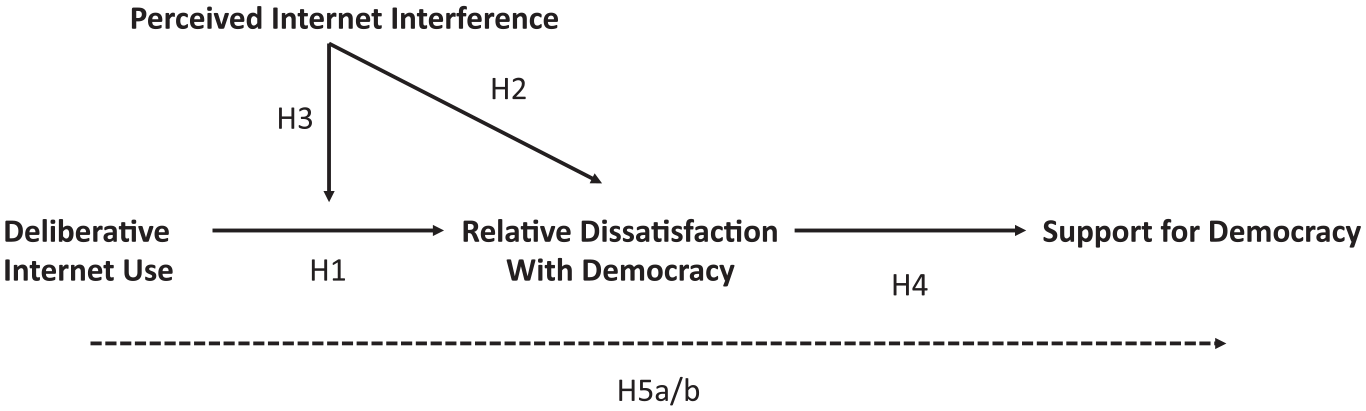
Hypothesized moderated mediation model.
Method
Sampling and Procedure
To empirically test the relationships depicted in Figure 1, a large-scale comparative survey was simultaneously administered in Russia and the United States during April 2019. These two countries were selected as case studies because they represent a consolidated digital autocracy and a vulnerable democratic system that endorse opposing positions on internet governance. Their political systems have adopted different internet restrictions, which directly affect citizens’ abilities to gain access to political information and perceptions about internet freedom. Russia seeks to maintain and extend its influence through extensive online censorship and monitoring procedures, which it justifies as necessary for public security (Nisbet et al. 2017), whereas the United States advocates for an open internet but contradicts this position with problematic surveillance and widespread data collection (Couldry 2017; Keller 2017).
Respondents in each country were recruited using Qualtrics panels, a survey firm that enlists online convenience samples in countries around the world. While its population parameters are not generalizable, Qualtrics tends to be more representative than other online recruitment methods—even mirroring probability samples on important political variables (Boas et al. 2018)—making it well suited to investigate this hypothesized political communication process. Each sample obtained general population quotas for age and education; gender was attempted but achieved only in the United States, for a total Russia n = 501 and the United States n = 529.
The survey was administered in the dominant language of each country (English and Russian respectively). The survey instrument was developed in English with regular consultation from Russian natives on semantic choices and cultural sensitivity. Using an ask-the-same question approach, an American Translators Association (ATA)–certified translator translated the survey to Russian. Then, a Russian native back-translated the questionnaire to English to ensure the process preserved the researcher’s original intent.
Measures
Support for democracy is a slippery concept that has been measured in a variety of ways (see Mattes 2018), but scholars generally agree that it requires a commitment to democratic institutions and renouncing likely threats to democratic order. Thus, this study combined Bratton and colleagues’ (2005) widely used rejection of democratic alternatives (strongman, one party, and military rule) with Levitsky and Ziblatt’s (2018) more recent conceptualization in which citizens support a governing structure where democracy is preferred, leaders always follow the country’s constitution, and politicians do not tolerate violence against their opponents (U.S. Chronbach’s α = .75; Russian Chronbach’s α = .70). This hybrid, six-item measure encompasses both traditional and contemporary ways in which democracy is threatened, providing a wholistic and modern measure of citizen support.
The study’s principle independent variable, deliberative internet use, intended to capture the degree to which individuals reflect on and assess one’s own political system, which was measured with self-reports on their likelihood to use the internet to (1) criticize the government, (2) search for sensitive political information, or (3) visit international web sites within the next week (U.S. α = .67; Russian α = .62). Deliberative internet use was predicted to affect individuals’ relative dissatisfaction with democracy, measured as a single item that asked respondents how satisfied or dissatisfied they were with their country’s democratic performance, dependent on perceived internet interference, which used a two-item construct to capture the degree to which respondents thought their government (1) censored online content and (2) surveilled their internet use (U.S. Pearson’s r = .50, Russian Pearson’s r = .45).
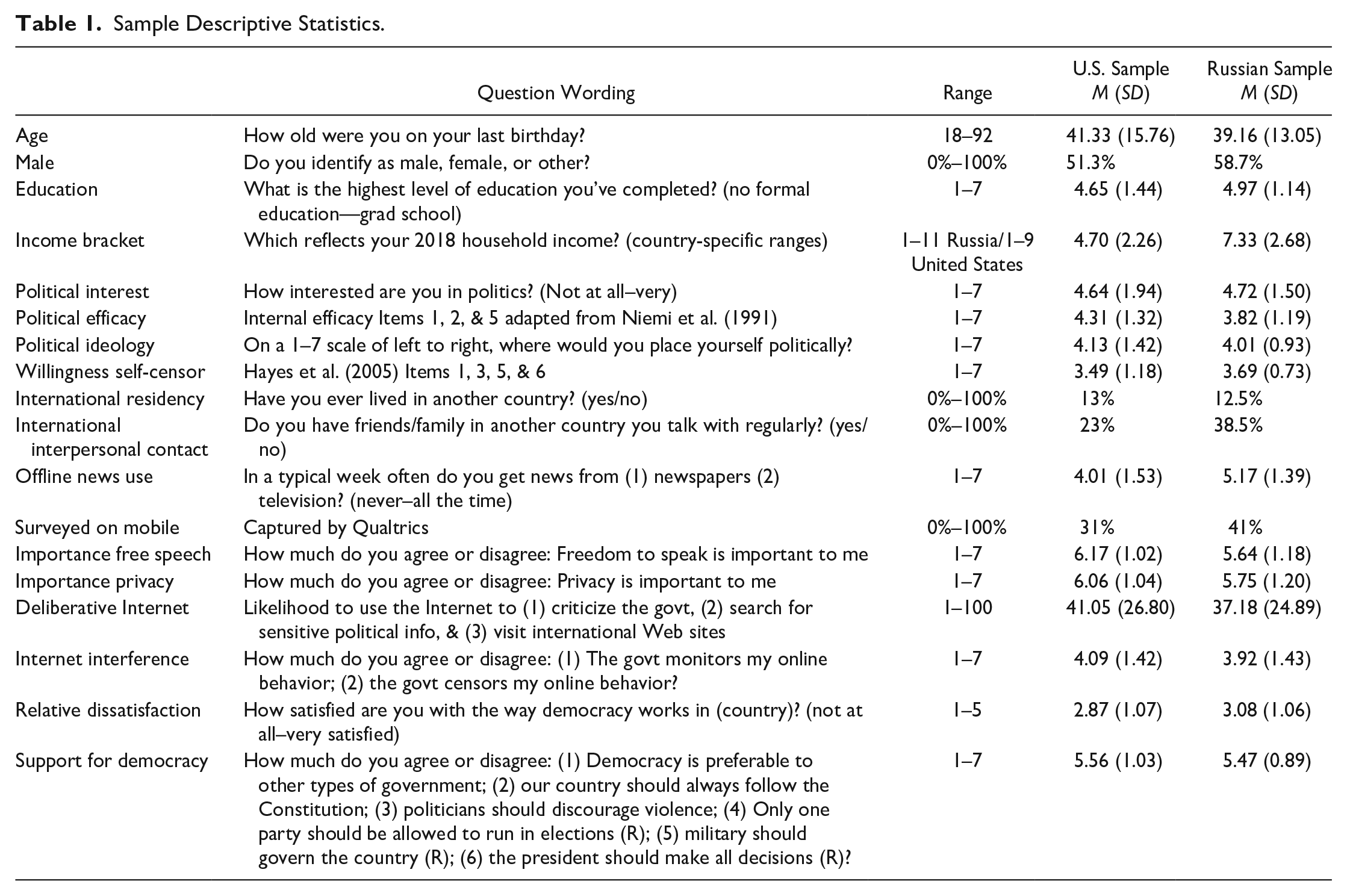
Analysis of cross-sectional surveys requires a host of control variables to ensure the hypothesized effects explain unique variance in citizens’ support for democracy. This study employed a robust battery, which included demographics (age, gender, education, income), known political antecedents (political interest, efficacy, ideology, support for freedom of speech/freedom of privacy), lived experiences and personality traits (international residency, international interpersonal contact, willingness to self-censor traits), and media use variables (offline news frequency, mobile survey administration). Question wording and descriptive statistics for all study variables can be found in Table 1.
Sample Descriptive Statistics.
Results
To observe direct relationships, ordinary least squares (OLS) regression models predicting dissatisfaction with democracy were fitted with deliberative internet use, perceptions of internet interference, and all control variables. Analyses were run separately for each country. Among both U.S. and Russian respondents, internet use was positively associated with democratic dissatisfaction, suggesting that deliberative internet use does indeed encourage comparisons that dampen contentment, lending support for the theorizing behind H1. Internet interference also had a positive association among respondents in both countries, such that obstacles to internet freedom were unsatisfactory cues of democratic performance, as predicted in H2. In the United States, older (β = 0.01, p < .05), left-leaning respondents (β = −0.07, p < .05), those who were more efficacious (β = 0.17, p < .001), less interested in politics (β = −0.07, p < .05), and less likely to consume television and newspapers (β = −0.07, p < .05) were similarly more critical of the state of U.S. democracy. In Russia, democratic satisfaction hinged on individuals’ socioeconomic status (β = −0.05, p < .01), offline news consumption (β = −0.15, p < .001), and their individual commitments to free speech (β = 0.17, p < .001).
To test the overall direct and indirect effects of the moderated mediation model hypothesized in H3–H5a/b, two additional models were fit using Hayes’ (2017) PROCESS 3.0 macro, model 7 with 5,000 bootstrap samples. The Russian model explained 34.6 percent of the variance in citizens’ support for democracy, whereas these same predictors only accounted for only 8.4 percent in the U.S iteration. This sizable difference may be attributable to country-level factors, like historical democratic inertia, and may help explain the competing findings that follow.
In both countries, perceived internet interference significantly moderated the relationship between individuals’ political online use and dissatisfaction with democracy. However, the directionality of this relationship diverged. For Russian respondents, threats to internet freedom amplified the positive effects that their use had on dissatisfaction; respondents became more dissatisfied as they sought political information online and perceived their online environment was at a disadvantage. This dissatisfaction, in turn, generated greater support for democracy, confirming H4 and the indirect pathway theorized in H5. For Americans, perceived threats to internet freedom dampened the effect of internet use on dissatisfaction; when these individuals felt deprived of a free information environment, their Internet use was less associated with democratic dissatisfaction. And this waning dissatisfaction led to less support for democracy overall, running counter to H4. Here, the direct pathway between internet use and democratic support was significantly negative, and the indirect effect produced no effect, lending only partial support for H5b. Furthermore, these data were consistent with previous research (see Mattes 2018), wherein age, education, political interest, and efficacy were positively related to democratic support in both samples. Abbreviated results from the OLS and moderated mediation models are presented in Table 2; full models appear in the study’s appendix.
Direct and Indirect Effects.
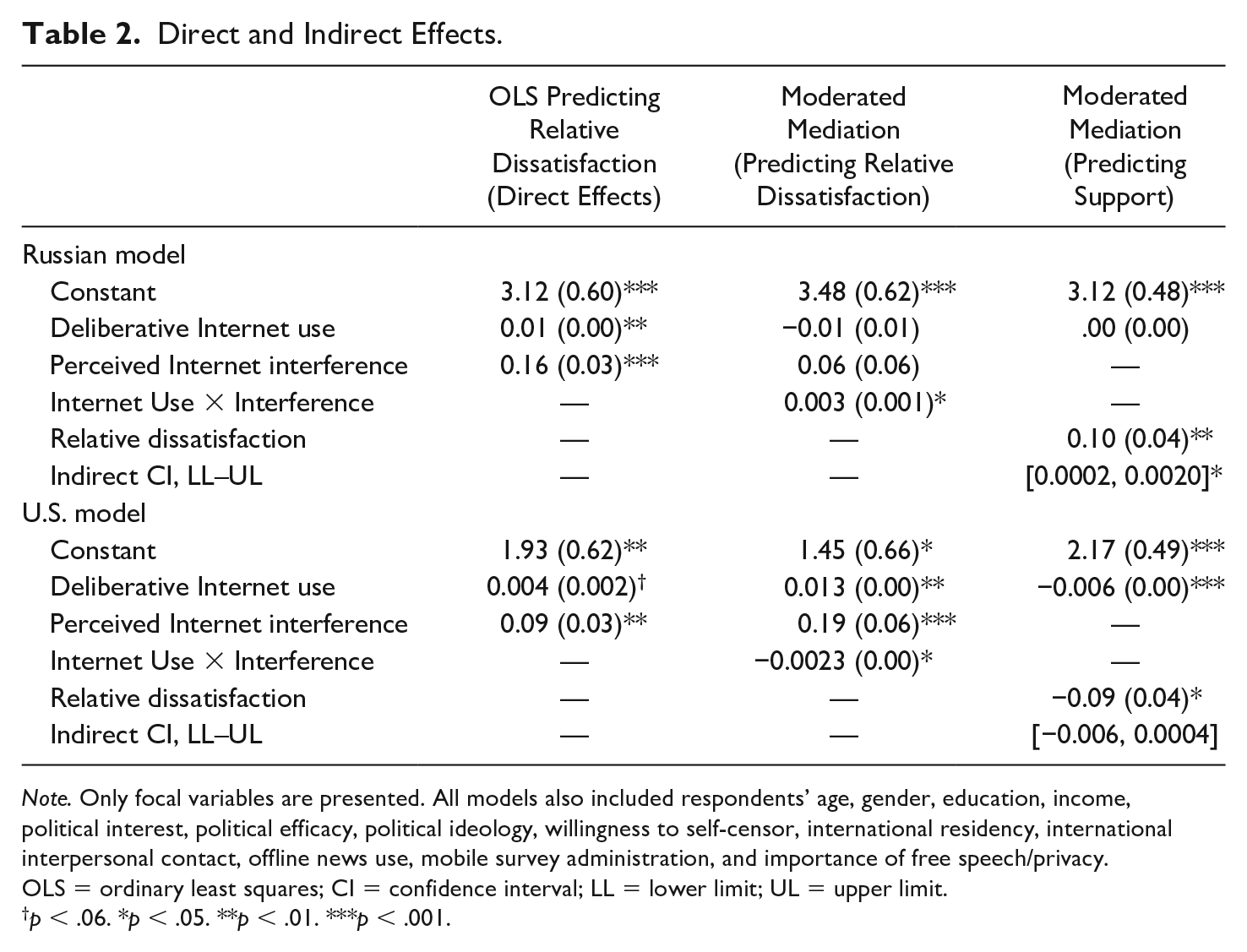
Note. Only focal variables are presented. All models also included respondents’ age, gender, education, income, political interest, political efficacy, political ideology, willingness to self-censor, international residency, international interpersonal contact, offline news use, mobile survey administration, and importance of free speech/privacy. OLS = ordinary least squares; CI = confidence interval; LL = lower limit; UL = upper limit.
p < .06. *p < .05. **p < .01. ***p < .001.
Discussion
These findings add to the body of literature that identifies political internet use as a fickle and highly conditional predictor of democratic attitudes. From these data, Russian responses move in accordance with relative deprivation theory: Individuals use the internet to make comparisons, wherein they find that their political system is at a disadvantage and believe this disadvantage to be unsatisfactory, which leads to mobilization and support for democratic reform. Meanwhile, the American data tell a different story. Overall, U.S. respondents were highly critical of the government’s online interference, perceiving less internet freedom than the Russian sample despite strong evidence to the contrary (Freedom House 2019). Here, too, respondents used the internet to draw downward comparisons, but the more internet interference they perceived, the less important these comparisons became. Where the process really unraveled is that online deliberation had a negative, direct effect on support for democracy, wherein the more individuals used Internet for these purposes, the less they valued democratic principles. While these findings may prove troubling for democratization scholars, they are not unlike the story that’s unfolding on the world stage. As democracy continues to be an aspiration for billions who live under political oppression, support for it has declined in consolidated democracies where citizen influence commands the most power.
Limitations
This study’s results should be interpreted accounting for its limitations. Primarily, readers should recognize that the relationships delineated here are based on cross-sectional data and cannot demonstrate causality. It certainly may be true that individuals who are dissatisfied with the state of their democracy turn to the internet for political use or are more critical of their information environments. The relationships between these constructs are very likely fluid and dynamic, wherein support for democracy may affect individuals’ satisfaction and Internet use, which in turn reinforces support for that system. That, however, does not detract from the usefulness of these proposed relationships, illustrating how they—during a snapshot in time—align with and depart from relative deprivation’s well-established theorizing. Cross-national panel or experimental designs, each with their own methodological limitations, are needed to truly tease apart the sequential order at play.
This study offers a comparison of a weakened consolidated democracy and a thriving autocratic regime. While comparative work lends tremendous advantages over single-case studies (Esser 2013), these countries occupy only two positions on the democratic spectrum. As more detailed Internet use and political attitude data become available, it will be important to examine how Internet freedom and relative deprivation affect democratic support in other governing arrangements—especially in places like Tunisia, Malaysia, and Turkey that have recently undergone political transformations. However, the selection of Russia and the United States was strategic: They exhibit different approaches to Internet governance, are highly influential in shaping global information environments, and are likely to do so for decades to come.
Implications
To return to the questions posed at the onset of this study, the individuals surveyed here are attuned to the flaws in their political systems and are sensitive to government internet interference—especially in the United States. More importantly, it is clear that individuals form democratic evaluations subjectively, via their online interactions, rather than relying on institutional benchmarks. Much like Bailard’s (2014) concepts “mirror holding” and “window opening,” deliberative internet use encourages citizens to make comparative evaluations of their political environments. But relative deprivation extends this explanatory framework to explain why individuals who perceive disadvantages in their political systems may mobilize to demand democratic reform.
The Russia findings defend the importance of a one-internet world—an open global internet does indeed provide new perspectives that citizens can use as a barometer of their own government’s performance. And while citizen support alone is insufficient to transition a deeply autocratic country (Claassen 2020), it may undermine leaders’ legitimacy should the political climate change. However, evidence from other authoritarian states shows that attitudes toward censorship and other undemocratic practices normalize over time (Wang and Mark 2015), where dissatisfaction may fade into apathy or ambivalence. This strongly suggests that now is the time to have the fight for a singular global internet—while users can still remember it.
Objectively, the United States is no longer the pillar of democracy it once was (Freedom House 2019). And while its government publicly advocates for an open-internet world, the United States undermines this position through legislation that breaches individuals’ privacy, disregards disinformation that jeopardizes a fair electoral process, and has overturned a key instrument in open access—net neutrality (Morgus and Sherman 2018). Data here and elsewhere (Stoycheff et al. 2018) suggest citizens are aware of these interferences and are grappling with what to make of them. On one hand, such changes appear to make Americans less satisfied with how democracy operates; but on the other, they are not unique to the U.S. system. Deliberative internet use may reveal that in a world of growing autocracy, the United States is still faring better than many other countries, which relatively, it is.
While these data show that Americans generally still support democracy as their preferred form of governance, it would be negligent not to recognize that a one-internet model also provides individuals exposure to new, nondemocratic alternatives. In contemporary world politics, authoritarians have excelled in projecting their own institutions as powerful and secure (Babayan 2016)—a message that may be attractive to Americans who feel frustrated with inefficiencies or hypocrisy in their democratic system. The best way for democracies to maintain citizen support is for leaders to actively practice the values they tout on the world stage—ensuring the internet does indeed remain open via transparent oversight of online monitoring and content removal, regulations that ensure some content is not privileged over others, and provisions that protect users’ data and privacy.
Sustaining citizen support is now more important than ever. Today’s democratic reversal is not a grandiose political upheaval, but rather a quiet and persistent chipping away at its core norms and values. It is citizens losing hope when their leaders fail; demanding less and abiding more. The fight for democracy has moved online, where liberal freedoms of privacy and free speech have met illiberal substitutes (Lührmann and Lindberg 2019). Democracy can be an inconvenient and challenging political arrangement. Inclusive governing becomes more difficult as populations fractionalize, progress can be slow and mired in bureaucracy, and new technology presents an unrelenting barrage of dilemmas about how to balance individual rights with those of the collective. But democratic forms of governance are still the best pathway for protecting an open information infrastructure, improving human rights and sustainable economic prosperity—relatively speaking.
Footnotes
Appendix
U.S. Full Direct and Indirect Effect Models.
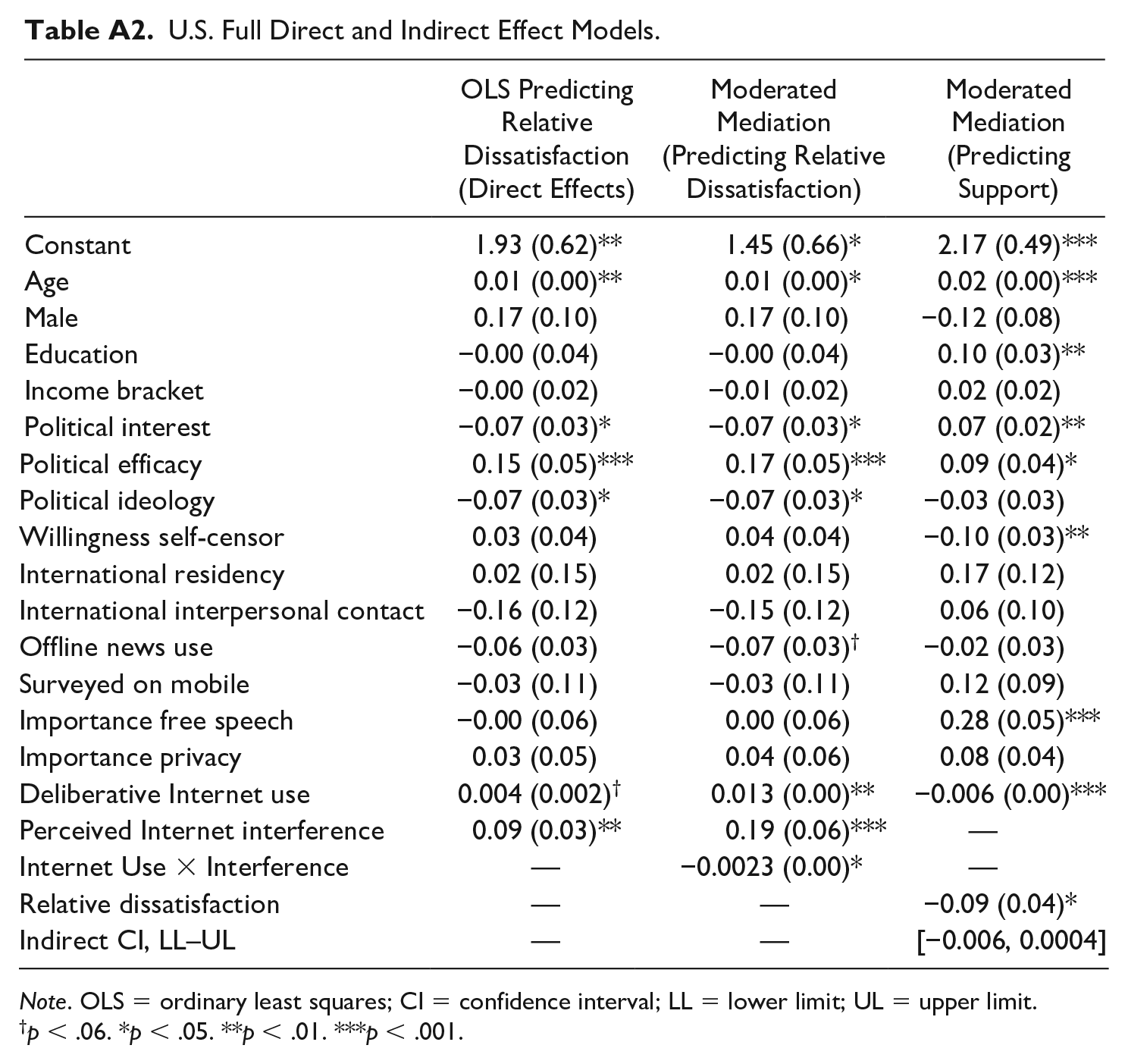
| OLS Predicting Relative Dissatisfaction |
Moderated Mediation |
Moderated Mediation |
|
|---|---|---|---|
| Constant | 1.93 (0.62)** | 1.45 (0.66)* | 2.17 (0.49)*** |
| Age | 0.01 (0.00)** | 0.01 (0.00)* | 0.02 (0.00)*** |
| Male | 0.17 (0.10) | 0.17 (0.10) | −0.12 (0.08) |
| Education | −0.00 (0.04) | −0.00 (0.04) | 0.10 (0.03)** |
| Income bracket | −0.00 (0.02) | −0.01 (0.02) | 0.02 (0.02) |
| Political interest | −0.07 (0.03)* | −0.07 (0.03)* | 0.07 (0.02)** |
| Political efficacy | 0.15 (0.05)*** | 0.17 (0.05)*** | 0.09 (0.04)* |
| Political ideology | −0.07 (0.03)* | −0.07 (0.03)* | −0.03 (0.03) |
| Willingness self-censor | 0.03 (0.04) | 0.04 (0.04) | −0.10 (0.03)** |
| International residency | 0.02 (0.15) | 0.02 (0.15) | 0.17 (0.12) |
| International interpersonal contact | −0.16 (0.12) | −0.15 (0.12) | 0.06 (0.10) |
| Offline news use | −0.06 (0.03) | −0.07 (0.03) † | −0.02 (0.03) |
| Surveyed on mobile | −0.03 (0.11) | −0.03 (0.11) | 0.12 (0.09) |
| Importance free speech | −0.00 (0.06) | 0.00 (0.06) | 0.28 (0.05)*** |
| Importance privacy | 0.03 (0.05) | 0.04 (0.06) | 0.08 (0.04) |
| Deliberative Internet use | 0.004 (0.002) † | 0.013 (0.00)** | −0.006 (0.00)*** |
| Perceived Internet interference | 0.09 (0.03)** | 0.19 (0.06)*** | — |
| Internet Use × Interference | — | −0.0023 (0.00)* | — |
| Relative dissatisfaction | — | — | −0.09 (0.04)* |
| Indirect CI, LL–UL | — | — | [−0.006, 0.0004] |
Note. OLS = ordinary least squares; CI = confidence interval; LL = lower limit; UL = upper limit.
p < .06. *p < .05. **p < .01. ***p < .001.
Declaration of Conflicting Interests
The author(s) declared no potential conflicts of interest with respect to the research, authorship, and/or publication of this article.
Funding
The author(s) disclosed receipt of the following financial support for the research, authorship, and/or publication of this article: Funding for this project was provided by the Waterhouse Family Institute at Villanova University and the College of Fine, Performing, and Communication Arts at Wayne State University.
