







Abstract
Experts are prevalent and persuasive in modern media coverage of politics. The perceived competence of experts makes them popular sources in the media, and their statements can in some cases move citizens’ policy opinions substantially. However, men are generally used far more as experts than women are. Because of this predominance of male experts and general biases against women, we theorize that media audiences may find women to be less competent and consequently less persuasive as experts on policy issues. We investigate this through two experiments embedded in a survey with more than 2000 respondents in Denmark. Despite advances in gender equality, women are still in the minority among experts used in the Danish news media. However, despite this current gender imbalance, we find no gender biases against women as policy experts among the Danish news media audience. There are no significant differences in the perceptions of the competence of male and female experts, and the persuasiveness of the experts are also unrelated to the gender of the expert. These results hold across different policy issues, and across practically all demographics within the media audiences. These results are relevant both to the study of gender representation in the mass media, and to the study of gender biases more generally. Furthermore, the results are important for discussions on news media selection of experts.
Introduction
Experts play a key role in modern news media coverage and politics. In recent decades the media's use of experts has increased almost exponentially (Albæk et al. 2003). When experts participate in the news, their statements may affect audience attitudes, not least their opinions on policy issues (Druckman 2001; Page et al. 1987). Thus, the voices of experts clearly matter in media and politics. However, some voices may matter more than others. In particular, male experts may have stronger effects than female experts on the perceptions and attitudes of the audience.
Whether the effects of experts on media audiences are gendered is so far unanswered. There are, however, good reasons to presume that gender may influence how experts in news reporting affect media audiences. When we, as humans, perceive others, gender inevitably plays a role (Bornstein 2013: 161; Lorber 2013: 113). Gender biases have been shown in, for example, teaching evaluations (MacNell et al. 2015), evaluations of the quality of academic articles (Goldberg 1968; Knobloch-Westerwick et al. 2013; Paludi and Bauer 1983), and in the academic peer-review system as such (Wennerås and Wold 1997; Witteman et al. 2019).
Drawing on expectation state theory, this paper therefore investigates whether audiences attribute less competence to female experts and consequently are less persuaded by their arguments when they appear as sources in news coverage. Due to the evidence of gender biases across different domains, we theorize that news audiences may be persuaded more by male than by female experts. Such differential effects of male and female experts may be driven by a general perception of male experts as being more competent than female experts, which again may be explained by gender stereotypes (Ridgeway 2011) or by the unequal exposure to female and male experts in the media (Jørndrup and Bentsen 2016).
Using two experiments, we test whether audiences respond differently to male and female experts. Our study is conducted in Denmark with a large sample of more than 2000 participants, which are approximately representative of the Danish adult population. We include in our experiment only a very specific subset traditionally considered to be experts in both academic and lay discourse: scientific researchers working at independent research institutions. In both experiments we present audiences to an excerpt from a mock newspaper article featuring a fictional expert in either a male-dominated domain (economics) or a gender-neutral domain (health). We manipulate gender by changing the first name of the expert and pronouns. We investigate two outcomes, first whether the audiences perceive the competence of male and female experts differently. Second, whether the policy opinions of the audience are affected differently by the male and female experts. We find that media messages from experts do indeed affect audiences’ policy opinions substantially, but we find no statistically significant effects of the expert's gender. Thus, we conclude that male and female experts do not affect audiences to a substantially different degree, nor do audiences perceive the competence of male and female experts to differ substantially. These two findings hold both across policy issues and when investigating potential interactions between expert and audience genders.
The Pervasiveness and Persuasiveness of Experts
The use of experts in news reporting has risen dramatically in recent decades. To our knowledge, the increase has been documented in only one longitudinal study (Albæk et al. 2003), but there is an intensive scholarly interest across countries in the use of experts, indicating that experts are indeed playing an increasingly important role in news reporting (e.g., Boyce 2006; Merkley 2020; Summ and Volpers 2016). Today, experts communicate research results much less than earlier and are instead increasingly used to comment on political and administrative decisions. One reason for this is that a change from merely descriptive towards interpretative and investigative journalism has increased journalists’ need to consult experts to help them interpret and explain the news, as well as to legitimize the framing of a topic (Albæk 2011; Wien 2014).
However, the use of experts in the media is clearly biased on gender. Journalists select their news sources by weighting different actors according to their relative importance, and in Western democracies, relatively powerful sources are predominantly men (cf. Bennett 2015). This is also true when it comes to experts. The Global Media Monitoring Project showed that on a random day in 2015 only 32 percent of experts and commentators used in the Danish media were women (Jørndrup and Bentsen 2016). Similar results are found in other Western democracies (Howell and Singer 2017; Niemi and Pitkänen 2017).
The lack of female experts may to some degree be ascribed to the lack of women in professions usually used as experts, for example, university professors (Niemi and Pitkänen 2017). However, journalistic practices may also contribute to the overwhelming use of male experts. Male academics are contacted more often than female academics—a difference that is not solely explained by the academic seniority of male researchers (Ibid.). Just as journalists, when they set frames, tend to reflect dominant frames in society (Scheufele 1999), their news reporting also reflects dominant social stereotypes. Thus, journalists may tend to contact male more than female scientists when looking for experts, because male scientists reflect archetypical ideas about scientific research being a “masculine” domain (Van den Brink and Benschop 2014). In this way, journalists may contribute to the symbolic annihilation of women in the media by either largely ignoring women or portraying them in stereotypical or traditional roles (Tuchman 1978). The use of male experts could also be partly driven simply by homophily, journalists preferring experts with the same gender as themselves. If that were the case, the heavy use of male experts should eventually vane, as women outnumber men in the Danish journalism study programs. However, men still dominate decision making and management in the Danish media (Andreassen 2015). This may mean that such male-centered norms still prevail in editorial decision making and news room culture, including sourcing strategies (Armstrong 2004; Rodgers and Thorson 2003). Additionally, when journalists contact researchers, a Matthew effect comes into play: journalists often use researchers that they have used before (Albæk 2011; Howell and Singer 2017) and find the best experts to be the ones already well known and well used (Niemi and Pitkänen 2017). Thus, the overrepresentation of male experts may be self-perpetuating. Finally, women may be more reluctant to participate as experts when contacted by journalists as shown in a British context (Howell and Singer 2017), although a Finnish study suggests no difference between male and female academics’ willingness to appear as experts in the media (Niemi and Pitkänen 2017). Journalists may therefore find it difficult to recruit female expert sources.
Thus, the gender imbalance in the use of experts in news coverage is well documented. But how are experts perceived from the audience's point of view? Are experts persuasive to the audience? Findings from the literature on framing effects suggest so. Framing theory stipulates that how something is presented to an audience (i.e., “framed”) influences the way people process that information (Lecheler and de Vreese 2019). Central to our study is the argument that such framing effects occur partly because citizens seek guidelines from credible elite sources about what to believe (Druckman 2001). Hence a frame becomes ineffective when its source is considered noncredible. In other words, not only does the frame in itself affect the audience. The framing sponsor, that is, who presents something to the audience, also affects how the audience perceives the information (Chong and Druckman 2007). In line with these findings, Page et al. (1987) added crucial insights to the field of political communication, finding that experts believed to possess expertise and nonpartisan credibility significantly affect citizens: Policies which are called ineffective by credible experts, lose support, while policies deemed effective by experts receive increased support (Ibid.). When we take the recent increase in the usage of experts into account, these insights suggest that experts have a great potential for influencing voters’ policy opinions.
Summarized, we have forwarded two arguments above: First, that expert usage and sourcing strategies are gender biased. Second, that experts influence voters’ policy opinions, although not unconditionally. Sponsor credibility affects whether frames are influential or not (Chong and Druckman 2007). Combining these two insights raises the question of whether an expert's gender affect their sponsor credibility? Specifically, we investigate whether male and female experts’ competence is perceived the same way and whether they equally affect policy opinions.
Gender Bias in Perceived Competence and Persuasiveness of Experts
To understand why gender may condition expert credibility, we turn our focus to expectation state theory and the concept of “status beliefs,” as presented by Ridgeway (2011, 2014). Ridgeway (2014) argues that in order to understand social inequality we must account for the effects of status. According to Ridgeway (2014) there is a status hierarchy between men and women in modern societies, which stems from differences in how resources and positions have been distributed historically. From observing a social group having more resources people concludes that this group is “better” and more competent than social groups with less resources, thus creating certain “status beliefs” about societal groups (Ridgeway 2014). When a group is overrepresented in high-status jobs, for instance, at prestigious universities, people tend to perceive this to be a result of the group's competence (Cuddy et al. 2008: 94). Empirically, judgements of a group's societal status and perceived competence have also been shown to correlate strongly (Fiske and Durante 2016). Consequently, a man and woman otherwise equal in terms of position and resources will be viewed differently because of status beliefs and social stereotypes tied to gender (Ridgeway 2014). Consequently, we may expect a gender bias in the perceived competence of experts. As men generally have occupied—and still do occupy—the majority of positions as experts in media and professors in the university, an audience will likely perceive male experts to be more competent than female experts.
The gender stereotyping that connects men to more competence can be prevalent also in settings with high societal status. Even at university level gender has empirically been found to bias the assessment of competencies, where men are perceived as more competent than women despite equal positions and capabilities. For example, in teaching evaluations (Boring et al. 2016; MacNell et al. 2015), grading of university students (Jansson and Tyrefors 2020), assessments of academic abstracts (Knobloch-Westerwick et al. 2013), and peer reviewing of research proposals (Wennerås and Wold 1997; Witteman et al. 2019) 1 . Hence, the professors used as experts in the media are perceived differently due to their gender even on their own turf, strengthening the argument that they may also be perceived differently when appearing as experts in news media. This would also be in line with the finding that news audiences have been found to rate male newscasters more credible and competent than female newscasters (Brann and Himes 2010; Weibel et al. 2008).
Following Ridgeway's argument that status beliefs cause audiences to perceive men and women differently and following the empirical findings of gender bias in the assessment of men and women's competence, we propose the following hypothesis:
Given that we expect female experts to be perceived as less competent than male, we may also expect them to be less persuasive than men. As previously noted, the characteristics of a sponsor of a frame matter for the frame's ability to change the recipients’ opinions (Chong and Druckman 2007; Druckman 2001). If women are perceived less competent as experts, we may accordingly also expect that the effect of an expert message on the audience's policy opinions will depend on the gender of the expert. In other words, audiences will tend to agree more with the position of the expert, if the expert is a man. We therefore test the following hypothesis:
The Effects of Expert Gender Across Different Policy Areas
Because gender acts in combination with other identities, the degree to which gender stereotypes affect people's judgement varies from situation to situation, depending on gender's relevance or salience in the concrete situation. Specifically, the gender of a person may be more salient in settings culturally linked to gender or gender stereotypic skills (Ridgeway 2011). As previously noted, the role of expert or scientist may, in itself, be considered to be archetypical “masculine” (Van den Brink and Benschop 2014). However, when experts contribute to the news on specific policy areas, these policy areas may also differ in the degree to which they are considered masculine or feminine.
A key determinant of whether an area is considered to be masculine or feminine is simply the gender composition of the actors within this area. For example, an area with a predominance of men will typically be considered a masculine area (Wolbrecht and Campbell 2007). Consequently, the gender of female experts within this area will be more salient, which may exacerbate gender biases.
The notion that gender bias may differ across contexts, specifically in contexts typically considered masculine or feminine, has been empirically supported in several studies. Looking across different industries, women in biotech seem to be met with less negative expectations regarding their competence than women in IT, since the biotech industry is more gender balanced than the IT industry (Ridgeway 2011). Similarly, in simulated civil trials male experts were significantly more persuasive and received more favorable judgements of their testimonies than female experts when the case dealt with a “masculine” issue. In contrast, female experts were not perceived to be more persuasive in a “feminine” case (Schuller et al. 2001). Finally, the general tendency to assess academic abstracts to be of higher quality when ostensibly written by men rather than women, also differ across contexts. The tendency is particularly strong when the abstracts deal with typically male-typed topics (Knobloch-Westerwick et al. 2013).
Based on this line of reasoning and previous empirical results, we therefore also expect gender biases against female experts to be stronger when they serve as experts within fields with male predominance. In contrast, gender biases can be expected to be weaker in fields with a more equal gender representation. We expect this mechanism to be present both when audiences assess the competence of the expert, and when they subsequently form their own policy opinion. Specifically, we test the following two hypotheses:
The Effects of Audience Gender
In addition to the gender of the expert, the gender of the audience may also matter. Specifically, the gender of the audience may affect perceptions of the audience due to a gender affinity effect (Dolan 2008; Sanbonmatsu 2002). Several politician assessment studies have found a gender affinity effect among voters, meaning that voters tend to prefer political candidates with the same gender as themselves (Fulton 2014). This effect has also been found in Denmark, the context of our study. Danish women systematically assess female party leaders more positively than male party leaders, while Danish men perceive male party leaders to be more knowledgeable and competent as prime ministers than women party leaders (Kosiara-Pedersen and Hansen 2015). It should be noted that there is some heterogeneity in the findings on gender affinity affects within politics, with some studies finding no such effects, but a recent meta-analysis of sixty-seven studies find overall empirical support for the effect (Schwarz and Coppock 2020).
Importantly, the gender affinity effect is not just found when focusing on politicians. Studies on ads have found credibility ratings to be higher when the gender of a message source matches the gender of the receiver (Bochner 1994). Similarly, the perceived credibility of newspaper columnists may be subject to a gender affinity effect (White and Andsager 1991). The results on gender affinity effects are not unequivocal (e.g., Bagues and Esteve-Volart 2010; Knobloch-Westerwick et al. 2013). However, there are sufficient theoretical and empirical basis of the gender affinity effect to suggest investigating the following two hypotheses:
Experiments
Using two parallel experiments, we test whether audiences respond differently to male and female experts. The exact delineation between experts and nonexperts can be difficult, in particular in the context of the news media, where journalists often interview their fellow colleagues and in doing so cast them in the role of an expert. In order to avoid any ambiguity, we include in our experiment only a very specific subset traditionally considered to be experts in both academic and lay discourse: scientific researchers working in independent research institutions. In doing so, we maximize the likelihood that participants regard these individuals as proper experts.
We conduct our experiment in Denmark. With its long history of women participating fulltime in the paid labor force, including major institutions such as academia, media, and politics, and its strong norms on gender equality; Denmark ranks second in the EU gender equality index (European Institute for Gender Equality 2020). In Hofstede's terms, Denmark has a “feminine culture,” that is, it is a society in which social female and male roles overlap (Hofstede 2001: 297). On the one hand, Denmark may therefore be viewed as a least-likely case for gender bias towards female experts. On the other hand, women in Denmark still remain underrepresented in several elite domains, for example, in politics (Kjaer and Kosiara-Pedersen 2019) and in academia, in particular at the professor level (Styrelsen for Forskning og Uddannelse 2020), and they continue to be underrepresented among the experts used by the media (Jørndrup and Bentsen 2016).
The two parallel experiments were embedded in the same survey. The survey was fielded in a commercial web panel (YouGov). Panelists are continuously recruited to this panel. For their participation, panelists receive points redeemable for lotteries, gift certificates, etc. Crucially, it is not possible for panel members to self-select into specific surveys. Instead, they are randomly invited by email to complete particular surveys. A total of 2026 respondents completed the entire survey (2244 respondents started the survey, yielding a completion rate of 90.3 percent). More importantly, drop-off after exposure to the treatments was very limited (5.9 percent) and did not differ significantly across experimental conditions (p > .05 for both experiments). The final sample exhibited ample variation on demographic variables (female: 53.1 percent, mean age: 49.9, some college or higher education: 32.7 percent), and was approximately representative of the Danish population (for additional sample characteristics, see table A1 in Supplemental Information file). In the following subsections, we first describe the design of the experiments and, second, elaborate on the measures.
Design
At the start of the survey, respondents were randomly assigned (with equal probability) to one of the two experiments. While experiment 1 featured an expert on euthanasia, experiment 2 featured an expert on entrepreneurship. The two policy issues are first and foremost chosen because of news sources’ gender distribution across different areas reported in Danish media (health being the most, economics the least gender-neutral policy topic, cf. below). Apart from the different policy issues both experiments had the exact same setup (The sequence of the survey experiments are illustrated in figure A1 in Supplemental Information file). Respondents assigned to the experiment on euthanasia started the survey by answering the policy opinion questions on entrepreneurship. (Conversely, respondents assigned to the experiment on entrepreneurship started the survey by answering questions on euthanasia.) Since respondents in each experiment were asked these questions before being exposed to their assigned treatment, they can serve as each other's control group. Next, the respondents were asked to read an excerpt from a mock newspaper article, which featured a fictional expert on the issue (euthanasia or entrepreneurship). Respondents were randomly exposed to an article with either a female or a male expert. Gender was manipulated by changing the first name of the expert, “Søren”/“Sanne” and “Per”/“Pia” (four common Danish names without any clear connotations of socioeconomic background), and by changing the pronouns (“he”/“she”). Apart from these variations in names and pronouns, the articles were completely identical. The expert on euthanasia was presented as doctor and professor at a major university hospital to signal expertise and was critical towards the use of euthanasia. The expert on entrepreneurship was presented as an economics professor from a Danish university and was skeptical about the need for additional actions specifically meant to stimulate entrepreneurship. After exposure to the article, respondents were asked about their opinions regarding the issue which the expert had addressed (i.e., euthanasia or entrepreneurship) and their perceptions of the competence of the expert. Finally, they were asked to recall the gender of the expert as a manipulation check. The entire survey questionnaire is included in table A2 in Supplemental Information file).
Our design with two experiments in one survey has two key advantages. First, by conducting parallel experiments on two different policy issues, respondents exposed to the article on euthanasia can serve as a control group for respondents exposed to the article on entrepreneurship (and vice versa), as described above 2 . Second, by conducting two experiments within the same survey, our study is in a position to assess whether gender biases may depend upon the policy issue at hand, which we claim in our third and fourth hypotheses. Specifically, gender bias may depend on the gender distribution within a policy area, some being clearly male dominated, others having a more equal gender representation. Since the experiments in this study focus on experts commenting on policy in the news, we therefore based our selection of policy areas on news sources’ gender distribution across different areas reported in Danish media: A recent analysis of experts in Danish media found that health was reported the most gender equal area in this aspect, whereas economy was the least gender equal area (Jørndrup and Bentsen 2016). Therefore, we chose these two policy areas. The more specific issues of euthanasia in health policy and entrepreneurship in economic policy were chosen with regards to two additional criteria: (1) The issues do not have any clear party cues, that is, they have no clear association to a specific political party or ideology in Denmark (cf., Druckman et al. 2013), and (2) the issues are not too high on the media agenda, as this could reduce the effect of our experiments’ treatments (Gaines et al. 2007) 3 . We intentionally made the experts take a somewhat controversial standpoint about the policy (euthanasia/entrepreneurship) to avoid ceiling effects, that is, that we could not detect an expert effect because the expert expressed policy opinions already widely held by the recipients.
Measures
Respondents’ opinions on euthanasia were measured with four agree-disagree items (e.g., “Euthanasia should be legal in Denmark”), which were answered on 7-point Likert scales. Together, these four items formed a highly reliable index (Cronbach’s α = .78). Similarly, opinions on entrepreneurship were also measures with four items (e.g., “The tax rate for entrepreneurs should be lowered in Denmark”). These four items also formed a reliable index (Cronbach's α = .70). We rescaled the index into a continuous measure ranging from 0 to 1, where higher values indicate policy opinions aligned with the expert and thus indicate higher expert persuasiveness.
Respondents’ perceptions of the experts’ competence were measured by asking respondents to evaluate the expert on four traits associated with competence (intelligent, competent, credible, and knowledgeable). These four traits have all previously been used in studies on perceived competence (Funk 1996; Koch and Obermaier 2016; Schneider and Bos 2014), including studies conducted in a Danish context (Pedersen 2017; Pedersen et al. 2019). The four items also formed reliable scale, both in the euthanasia experiment (Cronbach's α = .91) and in the entrepreneurship experiment (Cronbach's α = .92)
Finally, to ensure that our manipulation of the experts’ gender had not gone unnoticed by the respondents, the final question in the survey asked about the gender of the expert. For all experiments and conditions, 87.3–90.2 percent of respondents gave the correct answer, clearly indicating that our manipulation of expert gender had worked as intended 4 .
Results
All analyses are based on regression models (ordinary least squares), and we apply the standard 95 percent level of statistical significance (two-tailed). All regression models used for our analyses are shown in Supplemental Information file.
Is Perceived Competence of Experts Affected by Expert Gender?
In order to test hypothesis 1 that male experts will be perceived to be more competent than female experts, we compared respondents exposed to a male expert with respondents exposed to a female expert. The results of this comparison are shown in Figure 1.
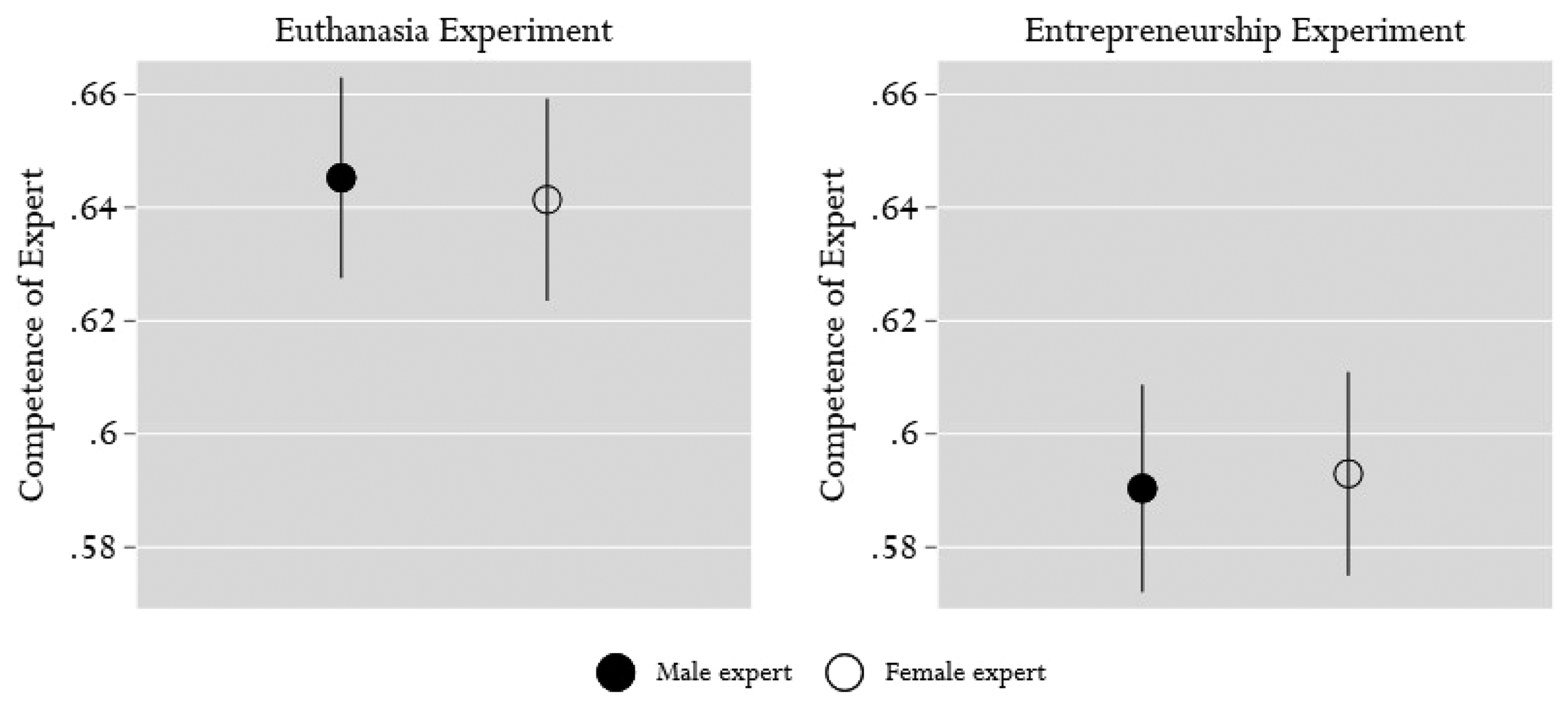
Expert gender and perceived competence. Note. Mean competence of the expert conditional on treatment (with 95 percent confidence intervals) based on models 5 and 6.
From Figure 1, it is clear that the data yield no support for this hypothesis. Respondents in the euthanasia experiment generally have a higher assessment of the competence of the experts than respondents in the entrepreneurship experiment, but there are no significant differences in respondents’ assessments of the competence of male versus female experts.
With no statistically significant effects of expert gender on perceived competence, we must also reject hypothesis three, which proposed that gender biases on perceived competence of experts were greater in a male dominated issue area than in a more gender-balanced issue area. Our results suggest that, at least for the two policy issues included in our study, gender has no discernable impact on the audience's perceived competence of the expert.
Are Effects on Policy Opinions Affected by Expert Gender?
Figure 2 shows the test of our second hypothesis, which states that audience policy opinions are more affected by male compared to female expert media messages.
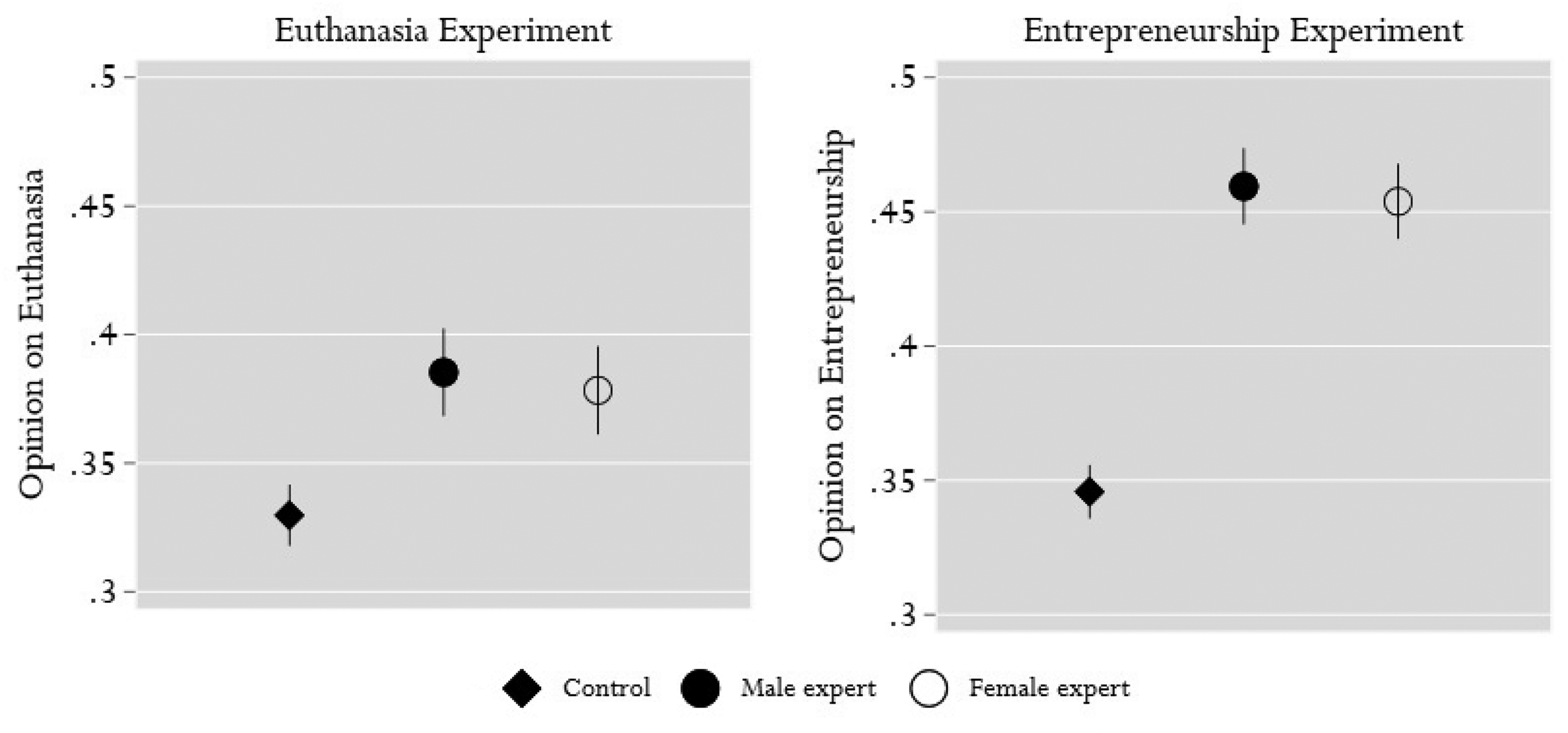
Expert gender and policy opinion. Note. Mean policy opinion conditional on the experimental treatment (with 95 percent confidence intervals) based on models 2 and 4.
We find no support for this hypothesis. As one can see, there are no significant differences in policy opinions between respondents exposed to a male expert versus respondents exposed to a female expert. It is important to note, however, that the statements from the experts do have substantial and significant effects on the policy opinion among the audience. Respondents exposed to statements from an expert have substantially different subsequent policy opinions than respondents in the control condition. However, while we did find that expert media messages substantially affect audience policy opinions, Figure 2 illustrates that these effects do not differ substantially nor significantly between male and female experts. Subsequently, we do not find support for our fourth hypothesis either: that a gender bias in policy opinion effects would be greater in a male dominated policy area compared to a more gender-balanced policy area.
Do Treatment Effects Depend on the Respondent's Gender?
So far, we have found that expert media messages move respondents’ policy opinion substantially, but the effect does not depend on the gender of the expert. In addition, the assessment of a male expert's competence is not significantly different from the assessment of a female expert's competence. In the following, we will test our fifth and sixth hypothesis to check whether treatment effects are conditional on the respondents’ own gender. In other words, whether the respondent's own gender is moderating the assessment of competence and moderating expert media messages’ ability to move policy opinions.
Figure 3 shows that, regardless of policy area, female and male respondents do not assess competence for male and female experts significantly differently. This suggests that the perceptions of male and female experts’ competence are not moderated by the audients’ own genders. Altogether, we find no support for our fifth hypothesis: that men should find male experts more competent than female experts and vice versa for women.
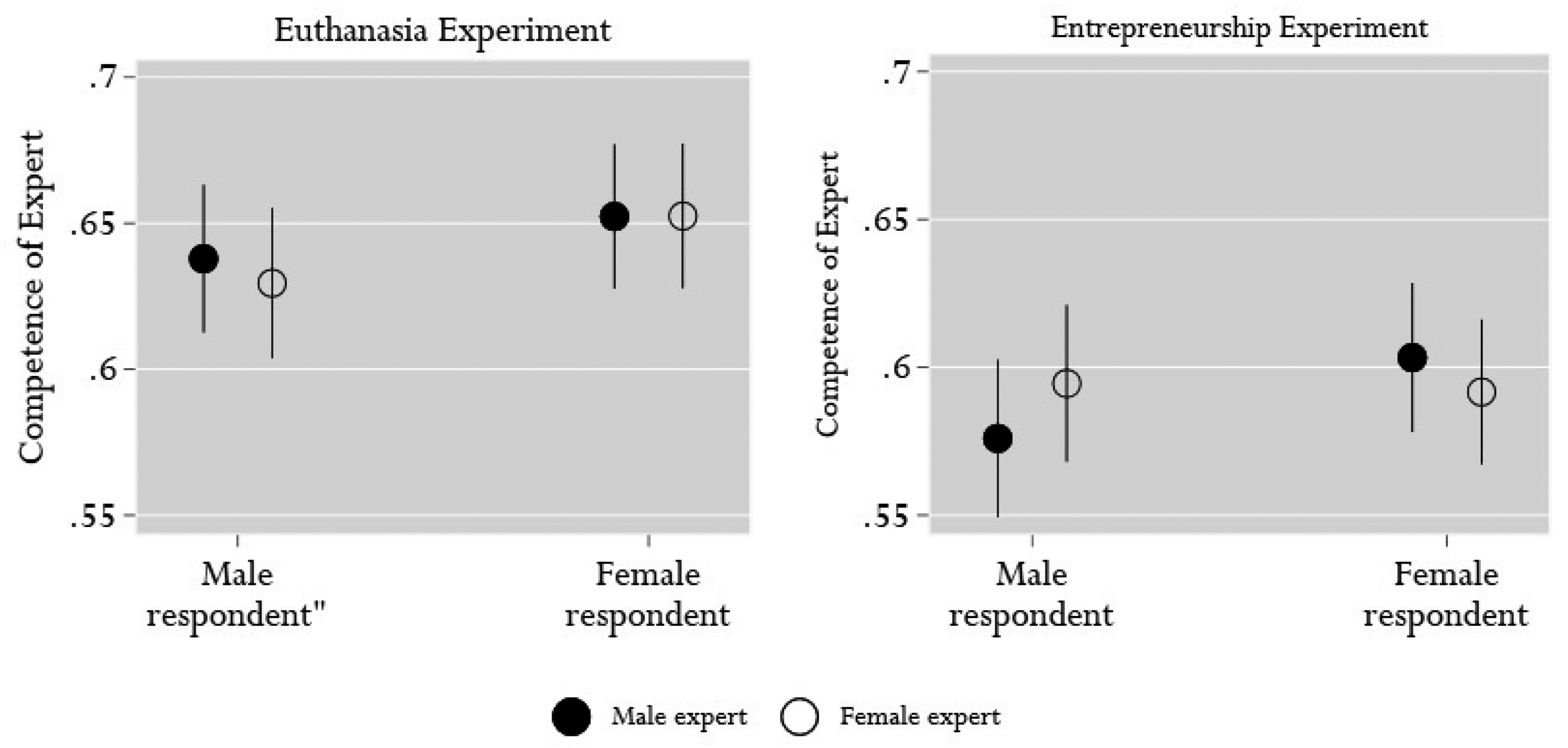
Perceived competence, experimental treatment, and respondents’ gender. Note. Mean competence conditional on treatment and respondent gender (with 95 percent confidence intervals) based on models 9 and 14.
Figure 4 shows that for both experiments policy opinions are not significantly different after exposure to a male versus a female expert, even when accounting for the gender of the audient. In sum, there is no indication that the effect of the expert's gender is moderated by the respondents’ own gender. As such, we find no support for our sixth hypothesis.
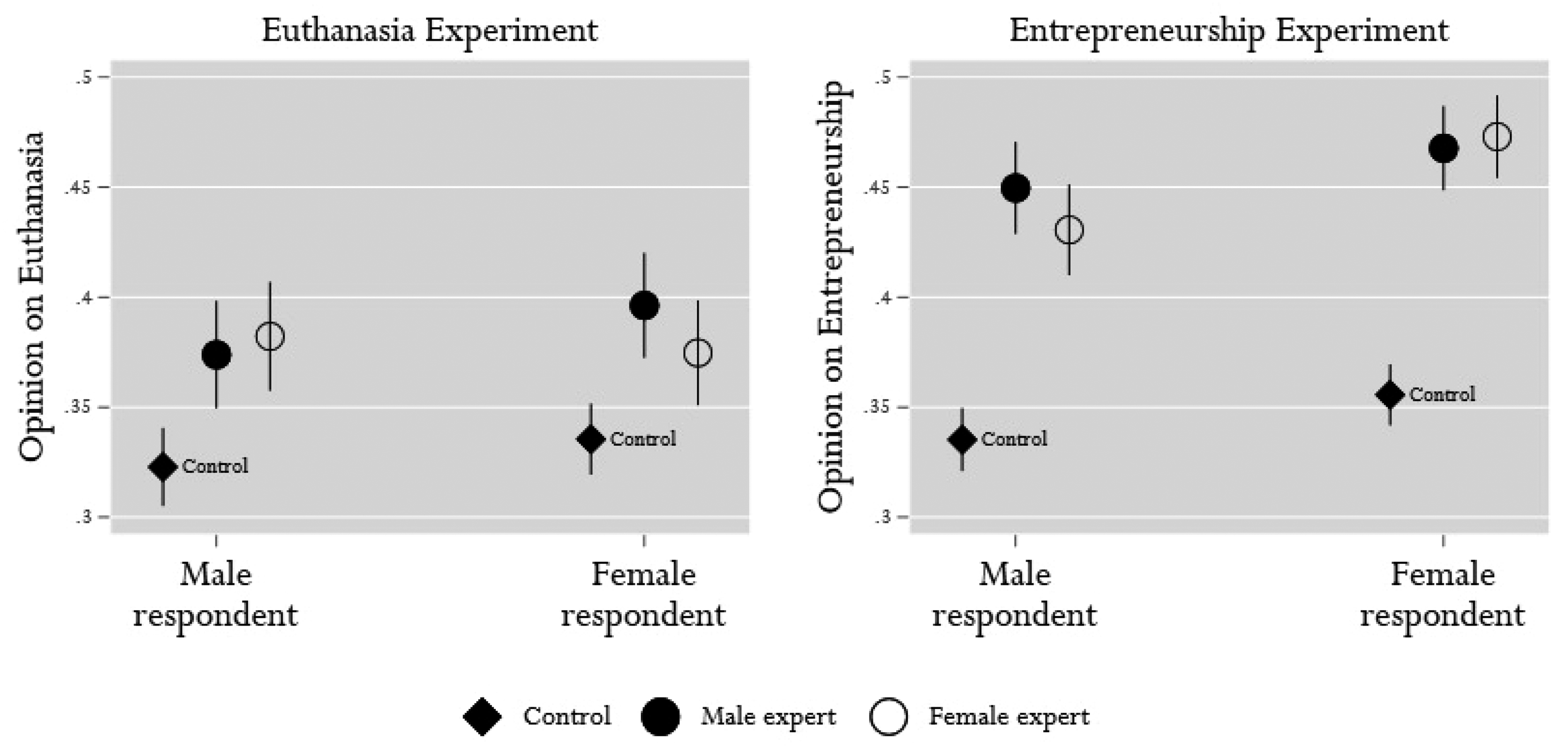
Policy opinion, experimental treatment, and respondents’ gender. Note. Mean policy opinion conditional on treatment and respondent gender (with 95 percent confidence intervals) based on models 19 and 24.
Could Treatment Effects Perhaps Depend on Other Respondent Characteristics?
A possible objection to the apparent null-findings could be that such effects are conditional on other respondent characteristics, for example, that gender biases might be present among older respondents. This is a relevant objection, and respondent gender is not necessarily the only relevant background variable. As an additional check, we therefore also conducted exploratory analyses, in which we analyzed whether the effects are conditional on several other respondent characteristics. In short, we find this not to be the case. There are no significant differences in the perceived competence of the male and female experts nor are there significant differences in the experts' effects on policy opinions when we interact the experimental treatments with the respondent's age (both linear and nonlinear), education, and occupation. Different educational groups assess the competence of the expert differently, but again we find no statistically significant differences attributable to the experts’ gender. Regarding occupation, the difference among the “unemployed/other” group is borderline significant (p = .052) in the entrepreneurship experiment, but there is no such difference found in any of the other groups. We do find that opinions on the two policy issues clearly differ across age—but again the opinions are not significantly affected by the gender of the expert (for details, see, figures A2–A9 in Supplemental Information file). Altogether, we find no evidence for conditional treatment effects. This suggests that the absence of an overall effect is not due to moderating effects from respondent characteristics working in different directions.
Could the Nonsignificant Effects of Expert Gender Still be Substantial?
It is important to note that the absence of a statistically significant effect is not in itself proof of absence of an effect, and it is not possible to demonstrate that the true effect size of a random variable is exactly zero (Lakens 2017). Therefore, another potential objection to our apparent null-findings on the effects of expert gender could be that there may still have been true gender effects, even though our effect estimates were statistically insignificant. To address this objection, Table 1 presents estimated effect sizes expressed as Hedges G, along with 95 percent confidence intervals for these effect size estimates (Hedges G essentially express the effect size as a percentage of the standard deviation, cf., Lakens 2013). As is seen from the table, the estimated effect sizes of expert gender are all very small (g < 0.05), and the confidence intervals for these estimates all bracket zero (which they would necessarily do, as the effects are statistically insignificant). In comparison, the general expert effects for the euthanasia experiment and entrepreneurship experiment are g = 0.270 and g = 0.698, respectively (based on models 1 and 3 in Supplemental Information file). Even taking uncertainty of these estimates into account (as reflected in the 95 percent confidence intervals), it is clear that any gender effect would be dwarfed by the general expert effect. Thus, while we can never rule out the possibility of small gender effects, these results indicate that if any such gender effect exists, it must be very small—especially compared to the overall expert effect.
Effect Sizes Across Experiments and Conditions.
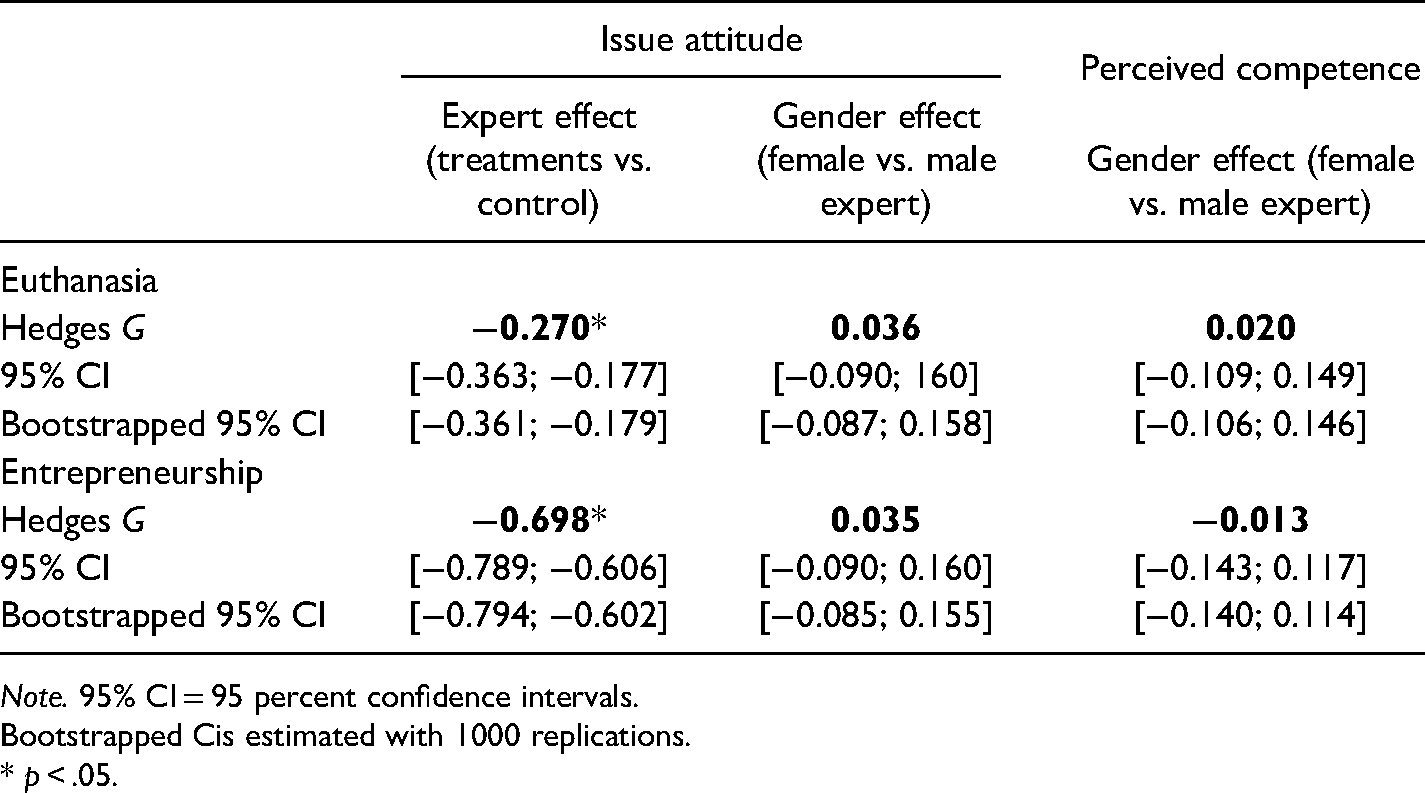
Note. 95% CI = 95 percent confidence intervals.
Bootstrapped Cis estimated with 1000 replications.
* p < .05.
Conclusion and Discussion
All in all, our study found no gender biases from media audiences against women as experts. Media audiences do not perceive the competence of male and female experts differently. While experts persuade audiences, the ability to persuade is not significantly different for female and a male expert. The gender effects were absent for both policy issues, and the absence remained when interacting the treatment with respondent characteristics. Respondents of both genders, of all ages and almost all occupations seemingly react similarly to male and female experts. Thus, surprisingly, while our experiments were able to show that respondents were strongly affected by experts, the experiments do not find support for any gender biases among audiences.
Does this result mean that mass media audiences are always unbiased when exposed to male or female experts? No, clearly not. First of all, it is important to note that respondents in our experiments were exposed to written statements from experts. While this is a realistic treatment, in so far as experts often contribute to newspapers, it is different from experts encountered in TV and radio, which are situations where the gender of an expert would be more apparent (from voice and look) and hence might trigger a gender bias in the audience. The written presentation of gender simply may not be enough to invoke gendered status beliefs. Future studies should investigate whether audiences react in the same way to male and female experts on TV and radio. Second, it is important to note that our experiment took part in Denmark, a Scandinavian country with a long history of women participating fulltime in the paid labor force and strong norms on gender equality. Consequently, our results may only generalize to countries with similar “feminine cultures,” mostly in Scandinavia and Northern Europe, scoring high on international indices of gender equality; they do not necessarily generalize to countries with dissimilar gender norms. Here, more comparative research is needed. Finally, even if audiences react in an unbiased way to men and women, this does not rule out other types of biases. Future studies may therefore still want to investigate whether audience perceptions of experts in the media are biased by, for example, the ethnicity of the expert.
However, our results do suggest that at least when it comes to gender, media audiences may be less biased than what researchers and media actors may have assumed. These results also have important implications for expectation state theory. They suggest that status beliefs about gender may not come into play and influence judgements when dealing with high status groups such as university professors, in particular in “feminine cultures.” This may be because the expert cue simply crowds out the gender cue when audiences form their judgements.
The lack of a media audience bias is, we think, clearly good news, and it is also a result, which should inform media practices: Journalists should not be tempted to choose male over female experts because of a fear that female experts would be considered less competent and persuasive by the audience—at least in countries with a history of gender equality. However, there are other good reasons to encourage journalists to increase the number of female experts appearing in the media. For instance, a lower share of female experts in the media compared to the share of female experts in a given field of expertise indicates that journalists may not make full use of the expertise available when conveying relevant, complex matters to the audience. Likewise, female experts in the media may function as role models thus contributing to greater gender equality in tomorrow's society.
Supplemental Material
sj-docx-1-hij-10.1177_19401612211025499 - Supplemental material for No Gender Bias in Audience Perceptions of Male and Female Experts in the News: Equally Competent and Persuasive
Supplemental material, sj-docx-1-hij-10.1177_19401612211025499 for No Gender Bias in Audience Perceptions of Male and Female Experts in the News: Equally Competent and Persuasive by Katrine Greve-Poulsen, Frederik K. Larsen, Rasmus T. Pedersen and Erik Albæk in The International Journal of Press/Politics
Footnotes
Declaration of Conflicting Interests
The authors declared no potential conflicts of interest with respect to the research, authorship, and/or publication of this article.
Funding
The authors received no financial support for the research, authorship, and/or publication of this article.

Supplemental Material
Supplemental material for this article is available online.
Notes
Author Biographies
References
Supplementary Material
Please find the following supplemental material available below.
For Open Access articles published under a Creative Commons License, all supplemental material carries the same license as the article it is associated with.
For non-Open Access articles published, all supplemental material carries a non-exclusive license, and permission requests for re-use of supplemental material or any part of supplemental material shall be sent directly to the copyright owner as specified in the copyright notice associated with the article.
