







Abstract
This study examines the authoritarian conditioning of political expression on social media in three Chinese societiesby analyzing three parallel surveys comprising 6942 respondents from mainland China, Hong Kong, and Taiwan. Results demonstrate that the use of social media to gather political information triggers politically expressive use of social media and indirectly predicts offline non-institutionalized political participation. Individuals' authoritarian orientation, however, moderates such indirect effects. Only people who demonstrate low or moderate adherence to authoritarian value systems exemplify this mediation model. Those with high levels of authoritarian orientation are not exemplary. Furthermore, the extent to which social media use interacts with authoritarian orientation to build a relationship with political participation presents two different patterns across three Chinese societies. The moderated mediating effect described here exists in Hong Kong and Taiwan but not in mainland China. Finally, we discuss the implications of these findings.
Keywords
Since the turn of the millennium, the rapid development of internet technologies has transformed political participation (e.g., Boulianne, 2009, 2015; Xenos and Moy, 2007). Scholarship on digital communications has generally found that social media use exerts a positive impact on both online and offline political participation (Boulianne 2015; Gil de Zúñiga et al. 2014). Scholars have since expanded upon this “instrumental” view that asserts a direct but oversimplified relationship between social media use and political participation (Boulianne 2009). First, the relationship between social media use and political participation may vary depending on individuals' preexisting psychological traits (e.g., Kim et al. 2013; Zhang and Lin, 2018). Second, cross-national differences require attention to institutional nuances in order to avoid unconditionally extending results derived from well-established democracies to other social and political systems (Boulianne 2015).
In this study, we argue that few studies have considered whether some psychological traits associated with unique aspects of a political culture might modify the relationship between social media use and political participation. A critical facet of political culture in Chinese societies, authoritarianism inevitably bears some relation to many Chinese individuals' political attitudes and behaviors (Shi 2001). Responding to the call for more culturally sensitive methodologies, this study asks: (1) How does an individual's authoritarian orientation modify the relationship between social media use and political participation in three Chinese societies (i.e., mainland China, Hong Kong, and Taiwan)? Beyond the cultural impact, this study considers social and institutional differences among three Chinese societies and further asks: (2) How do the moderating effects of authoritarian orientation on the mediation relationship vary across three Chinese societies?
Conceptualization
Non-institutionalized Political Participation
Based on the previous definition on political participation (Verba et al. 1995), this study defines non-institutionalized political participation as citizen’s attempts or activities that aim to influence governmental decisions and communicate and express their interests and concerns with the government through a range of non-institutionalized ways. Different from the traditional institutionalized political participation directed by the political elite and based on well-established political systems (e.g., voting during the election) (Inglehart 1977), those non-institutionalized participatory methods represent a “elite-challenging political participation” ranging from contacting governmental officials to making petitions or demonstrations (Inglehart 1977: 300).
Particularly, social media in particular has birthed new online forms of political participation that currently vie for dominance with the old offline forms (Vissers and Stolle 2014). Before the widespread private adoption of internet technology, political participation had two venues: interpersonal interaction and official corporate or government-controlled mass media outlets. Such offline political participation, a cornerstone of the world’s well-known democracies, still exerts great power over social and political life (Verba et al. 1995). Although offline political participation has been challenged by the advent of digital technologies (Tolbert and McNeal 2003), it remains a focus of researchers, who have begun examining the relationship between offline and online forms of political participation (Conroy et al. 2012).
This study focuses on offline non-institutionalized political participation for two reasons. First, focusing on offline political participation helps researchers build connections between offline and online political life, illuminating the conditions under which online political engagement triggers political participation offline (Skoric and Zhu 2016). Second, non-institutionalized political participation provides people with various and flexible channels to engage in politics throughout their daily lives and allows researchers to better know and understand how people participate in political issues (Zhang and Lin 2018).
Politically Informational Use, Politically Expressive Use, and Political Participation
Informational social media use is widespread and is often associated with online news consumption (Beam et al. 2016). This study defines politically informational social media use as the search for and consumption of political information through social media platforms. Moreover, social media platforms are not just repositories of information. They also provide individuals with a critical channel for expressing their own political opinions (Hyun et al. 2014). This study defines politically expressive social media use as the expression of one's own political views through social media platforms. Previous theoretical and empirical studies outline two opposing patterns in their attempts to define the relationships among politically informational use, politically expressive use, and offline political participation.
The first school claims that politically informational use can positively predict political participation directly or else function via politically expressive use. The “information-knowledge-efficacy” mechanism helps to explain the positive relationship between politically informational use and political participation (Gil de Zúñiga et al. 2014; Shah et al. 2005; Zhang and Lin 2018). Social media platforms function as powerful information hubs enabling individuals to gather political information or news and share political interests and issues within their own trusted social networks (Boulianne 2015). Such frequent and rapid news consumption and information exchange may increase an individual's knowledge of social or political issues (David 2009; Scheufele et al. 2006), which further promotes political efficacy and empowers individuals to participate in political activities (David 2009; Eveland et al. 2003). Similarly, this mechanism can also explain the positive relationship between politically informational use and politically expressive use as the political expression can be a lower-threshold form of online political engagement (Vaccari et al. 2015).
Similarly, the positive association between politically expressive use and political participation can be also supported by the “discussion-knowledge-efficacy” mechanism that is tightly associated with individuals' inner motives (e.g., Gil de Zúñiga et al. 2014). Politically expressive use is likely to trigger an online political conversation with other social media users who are interested in similar issues. Such interpersonal communication through social media serves a political learning function (Kim and Chen 2016), influencing individuals' political attitudes, knowledge, and sense of efficacy by encouraging them to exchange various political arguments and reflect on previously attained information (Huckfeldt and Sprague 1995). A high frequency of online political participation can ultimately lead to more engaged political participation offline (Boulianne and Theocharis 2020). Meanwhile, another mechanism underlying this positive relationship is known as “discussion-networks-mobilization.” Reading political discussions on social media may raise individuals’ political awareness and in so doing cause them to change from mere observers to participants in political debates (Lim 2008). Participants' self-perception as political activists as well as their connections with others may grow and subsequently encourage them to participate more actively in online political networks and communities, in which individuals are more likely to be mobilized and engage in political activity (Gil de Zúñiga and Valenzuela 2011; Shah et al. 2005).
In contrast, a competing view proposes that politically informational and expressive use may also build a negative relationship with political participation. This pessimistic view focuses on the negative impact of an individual’s received or consumed information content on political knowledge and participation and develops two mechanisms: “information-ambivalence-discouragement” and “information-low-quality-discouragement.” With regard to the former mechanism, when individuals use social media to seek political information, the frequent exposure to cross-cutting or competing political views may make them ambivalent about their own political views, further discouraging political participation (Mutz 2002, 2006). With regard to the latter mechanism, the quality of online political information that individuals seek is largely low, and this type of information consumption may not contribute to political knowledge and participation (Conroy et al. 2012).
In addition, recent research based on selection theory holds a neutral standpoint, that is, personal preference or predispositions can determine their selective exposure to or consumption of different kinds of political information, which can further modify how the internet or social media use can positively or negatively influence political participation (Bennett and Iyengar 2008; Boulianne and Theocharis 2020; Scheufele and Nisbet 2002). From this perspective, the relationships between politically informational or expressive use and political participation are relatively contingent on personal preference affecting which kinds of political information people seek and the extent to which people engage in online political discussion.
Generally, it is plausible to argue that politically informational use can build a relationship with political participation through politically expressive use, although there are some competing arguments and the direction of these relationships is unclear. Therefore, this study hypothesizes:
The Moderating Role of Authoritarian Orientation
Apart from exploring the indirect effects of politically informational use on political participation, this study also investigates the moderating role of authoritarian orientation on the hypothetical relationships outlined above. In Chinese societies, authoritarian social structures have long influenced the socialization of individuals and shaped the so-called “Chinese mentality” (Shi 2001; Solomon 1973). Authoritarianism can refer to an individual psychological tendency regardless of national origin or residence (e.g., Adorno et al. 1950). It can also represent the political culture of a nation-state with a particular governance style (Steele 2009). Flanagan and Lee (2003) synthesized these two concepts and proposed that authoritarian values in society can affect individuals’ psychological tendencies. Reared in authoritarian cultures, individuals “tend to conform to group attitudes and traditional customs and beliefs, are distrustful of new ideas and intolerant of different ethnic or religious groups, are theistic, and believe in absolute truth” (p. 238). Hence, this study focuses on individuals' authoritarian orientation as a psychological trait shaped by Chinese social or political culture.
Authoritarian orientation may moderate the relationship between politically informational use and politically expressive use based on the “information-knowledge-efficacy” mechanism. Individuals who have a strong authoritarian orientation may conform to traditional political ideas and distrust new or opposing ones. Therefore, they would not grant much consideration to diverse political views encountered on social media. In those situations, it is difficult for individuals with a strong authoritarian orientation to update and increase their political knowledge. Maintaining such strict stability of political knowledge would likely prevent any increase in one's sense of political efficacy. In contrast, it is plausible to assume that individuals who display weak authoritarian orientation would be more open to diverse political views encountered on social media, which can expand their political knowledge and sense of political efficacy.
In contrast, authoritarian orientation may also moderate the relationship between politically informational use and politically expressive use based on the “information-ambivalence-discouragement” mechanism. When individuals acquire political information via social media, they are exposed to diverse political viewpoints. A strong authoritarian orientation may decrease an individual's ambivalence about their political views, in turn decreasing their intentions to express political issues offline and possibly motivating them to avoid the online political discussion as well. Such individuals have a steadfast grounding in received political ideas and easily filter out any diverse news items or new ideas that might shake their beliefs. However, weak authoritarian orientation may increase an individual's ambivalence about their political views and decrease their intentions to discuss political issues online. Considering these competing arguments of reasoning, we pose the following question:
As discussed above, authoritarian orientation can similarly moderate the relationship between politically expressive use and political participation by influencing the “discussion-knowledge-efficacy” mechanism. Also, such moderating effect can be achieved through the “discussion-network-mobilization” mechanism. Notably, the extent to which individuals' online political expression can promote their participation in online political discussions is still unclear as two competing rationales exist. Previous research has indicated that individuals with strong authoritarian orientation display relatively less openness to new experiences (Sibley and Duckitt 2012) and may even avoid the online political discussion altogether (Mondak and Halperin 2008). In comparison, individuals with a weak authoritarian orientation would be more willing to participate in online political discussions even when they encounter opposing political views. These individuals are not as limited by political norms or taboos against the free exchange of clashing political ideas. Therefore, compared with individuals with strong authoritarian orientation, it is optimistically assumed that individuals with weak authoritarian orientation are more willing to participate in online political discussions, through which they increase their political knowledge, political efficacy, and opportunities for political mobilization online, although the negative function of online political discussion is also possible as mentioned above.
In contrast, there is also a rationale to assume that individuals with strong authoritarian orientation may be more willing to participate in online political discussions especially when they cannot bear some contradictory views online and are eager to defend their own political opinions via political discussions. Nevertheless, such individuals may still gain less political knowledge or grasp fewer opportunities to be mobilized in online social networks as they do not have such motivations. Thus, for the individuals with this cultural personality, their online political discussion may not increase their political knowledge, political efficacy, and future opportunities for connecting to a larger network and mobilizing politically. In comparison, individuals with weak authoritarian orientation would be less willing to participate in online political discussions as they are more open and inclusive to diverse political views online rather than urging to participate in online discussions to defend their political opinions.
On the other hand, it is reasonable to assume the moderating effect of authoritarian orientation on the negative relationship between politically expressive use and political participation based on the “information-ambivalence-discouragement” mechanism. Strong authoritarian orientation may be more likely to decrease an individual's ambivalence about their political views and increase their intentions to participate in offline political issues. However, weak authoritarian orientation may have decreasing effect as it contributes to an unsteady grounding in deeply held political beliefs, which may discourage political participation. Considering these competing arguments of reasoning, we pose the following questions:
Social and Political Variances Among Mainland China, Hong Kong, and Taiwan
Beyond general assumptions regarding the role of individuals' authoritarian orientation in the relationship between social media use and political participation in Chinese societies, we further argue that the moderating effect of authoritarian orientation can also vary based on the institutional differences among the three Chinese societies. Specifically, although authoritarian orientation is shared culturally by mainland China, Hong Kong, and Taiwan (Shi 2001), it may be strengthened or weakened under their different social or political contexts. The Communist Party in China overturned Nationalist Party rule in 1949, which halted any possible development of democratic institutions on the mainland. However, Taiwan, the island republic to which remnants of the Nationalist Party on the mainland exiled themselves, has gradually developed into a modern democracy. The British ruled Hong Kong as a colony for many years before China reassumed control in 1997, after which Hong Kong became a special administrative region within China based on the “one country, two systems” formula. Differing internet regulation in these three Chinese societies may reflect their different political systems. China's government tightly controls information flow to hinder the Internet's liberalizing or democratizing potential within its borders (Mou et al. 2011). It is a delicate dance, with the Chinese internet allowing some western social media but not all, as China also seeks to boost economic development through openness to global information (Zhao 2008). In contrast, Hong Kong and Taiwan maintain a broadly free Internet that resembles the levels of access that western countries enjoy. Both countries favor minimal government intervention when it comes to the online flow of information. As a market-oriented society, Hong Kong seeks to guarantee the free exchange of ideas and open media systems that make its economy competitive. Along with its full democratic transformation during the 1990s, Taiwan has formed a diversified media system in which various forms of communication and participation regarding political issues can be conducted (Chang 2009). Based on this rationale, it is plausible to assume that an individual's authoritarian orientation is more likely to be weakened in a highly democratic society like Taiwan and relatively democratic society like Hong Kong, but it is less likely to be weakened in a more authoritarian society like mainland China. Therefore, this study poses a further research question:
Method
Sample
We used the secondary data provided by the Asian Barometer Survey (ABS), which was facilitated by the Program for East Asia Democratic Studies held by the College of Social Sciences at National Taiwan University. ABS as a well-designed comparative survey mainly focused on Asian's political attitudes and behaviors. ABS features high levels of transparency, internal validity and reliability, and external validity in its research design. We adopted the fourth wave of ABS data that was released in 2016 and mainly analyzed three parallel surveys and data sets from mainland China (4068 respondents), Hong Kong (1217 respondents), and Taiwan (1657 respondents), respectively.
Variables
Dependent variable: Non-institutionalized political participation. This measurement scale of noninstitutional political participation was based on previous Chinese-context-related research (Lee 2017; Zhang and Lin 2018). ABS asked its respondents to indicate, on a 4-point scale (1 = never and would not do regardless of the situation, 4 = more than once) (reversed), “In the past 3 years, have you never, once, or more than once done the following because of personal, family, or neighborhood problems, or problems with government officials and policies.” This question contained seven sub-items including “Contacted other influential people outside the government,” “Contacted news media,” “Got together with others to try to resolve local problems,” “Got together with others to raise an issue or sign a petition,” and “Attended a demonstration or protest march.” This subscale had satisfactory reliability across three Chinese societies studied here (α = 0.7 in mainland China, α = 0.83 in Hong Kong, α = 0.72 in Taiwan).
Independent variable (politically informational use) and mediating variable (politically expressive use). Two questions asked respondents about the frequency of their social media use. First, respondents were asked to answer the question regarding politically informational social media use, “How often do you use the Internet, including social media networks, to find information about politics and government?” (1 = practically never, 5 = everyday) (reversed). Second, respondents were asked to answer the question regarding politically expressive social media use, “How often do you use the internet or social media networks to express your opinion about politics and government?” (1 = practically never, 5 = everyday) (reversed).
Moderating variable: Authoritarian orientation. Eight questions in ABS were used to measure authoritarian orientation based on prior research (Flanagan and Lee 2003; Zhang 2012): “Government leaders are like the head of a family; we should all follow their decisions”; “The government should decide whether certain ideas should be discussed in society”; “Harmony of the community will be disrupted if people organize lots of groups”; “When judges decide important cases, they should accept the view of the executive branch”; “If the government is constantly checked (i.e., monitored and supervised) by the legislature, it cannot possibly accomplish great things”; “If we have political leaders who are morally upright, we can let them decide everything”; “If people have many different ways of thinking, society will be chaotic”; “When the country is facing a difficult situation, it is ok for the government to disregard law and order to deal with the situation.” Respondents were asked to answer these questions on a 4-point scale (1 = strongly disagree, 4 = strongly agree) (reversed). We combined these eight items into one variable with satisfactory reliability (α = 0.73 in mainland China, α = 0.83 in Hong Kong, α = 0.74 in Taiwan).
Control variables. Based on previous research, this study controlled several variables to minimize their extraneous effects. First, we controlled some socio-demographic variables including gender, age, education level, and income level. Second, we controlled some variables that have been proven to trigger or promote political participation in previous research including individual's political interest (Xenos and Moy 2007), discussion network size (Mutz 2002), internal and external political efficacies (Chen et al. 2019), and political news consumption (Gil de Zúñiga et al. 2014). Specifically, ABS asked its respondents about their political interest, “How interested would you say you are in politics?” (1 = not at all interested, 4 = very interested) (reversed). ABS asked its respondents about their discussion network size, “On average, about how many people do you have contact with on a typical weekday?” (1 = 0–4 people, 5 = 50 or more people). ABS asked its respondents about their internal political efficacy, “To what extent you agree or disagree with this statement: Sometimes politics and government seems so complicated that a person like me can’t really understand what is going on.” (1 = strongly agree, 4 = strongly disagree). ABS asked its respondents about their external political efficacy, “To what extent you agree or disagree with this statement: People like me don’t have any influence over what the government does.” (1 = strongly agree, 4 = strongly disagree). ABS asked its respondents about their political news consumption, “How often do you follow news about politics and government?” (1 = practically never, 5 = everyday) (reversed).
Results
To test the hypotheses and research questions (see Figure 1), a three-step data analysis was performed. First, we tested the mediation relationships to answer H1. Second, we tested the moderation effects of authoritarian orientation on those relationships to answer RQ1, RQ2, and RQ3. Third, we examined the difference of our moderated mediation model across three Chinese societies to answer RQ4. Specifically, for the regression analysis at each step, we used PROCESS macro models 4 and 58 (Hayes 2013), respectively. Compared to the conventional regression tools, PROCESS macro can analyze mediation and moderated mediation relationships quickly, easily and effectively (Hayes 2013).
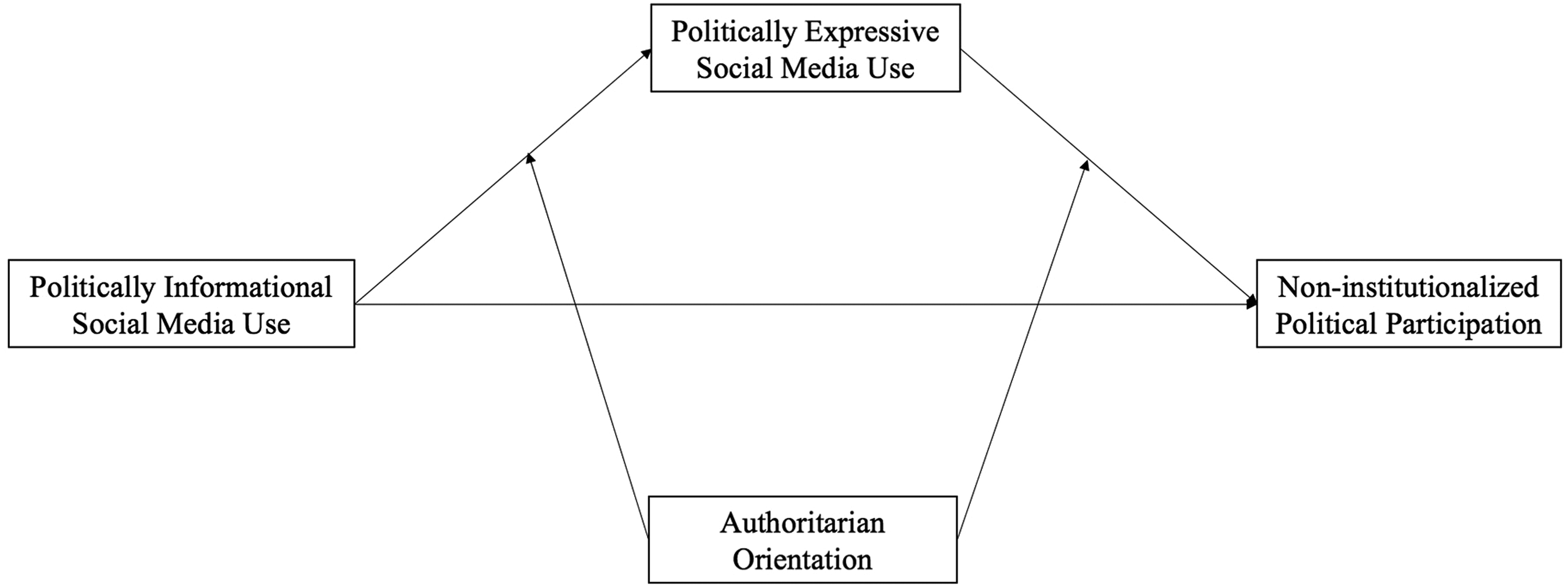
The effect of politically informational social media uses, politically expressive social media use, and authoritarian orientation on non-institutionalized political participation.
Descriptive Statistics
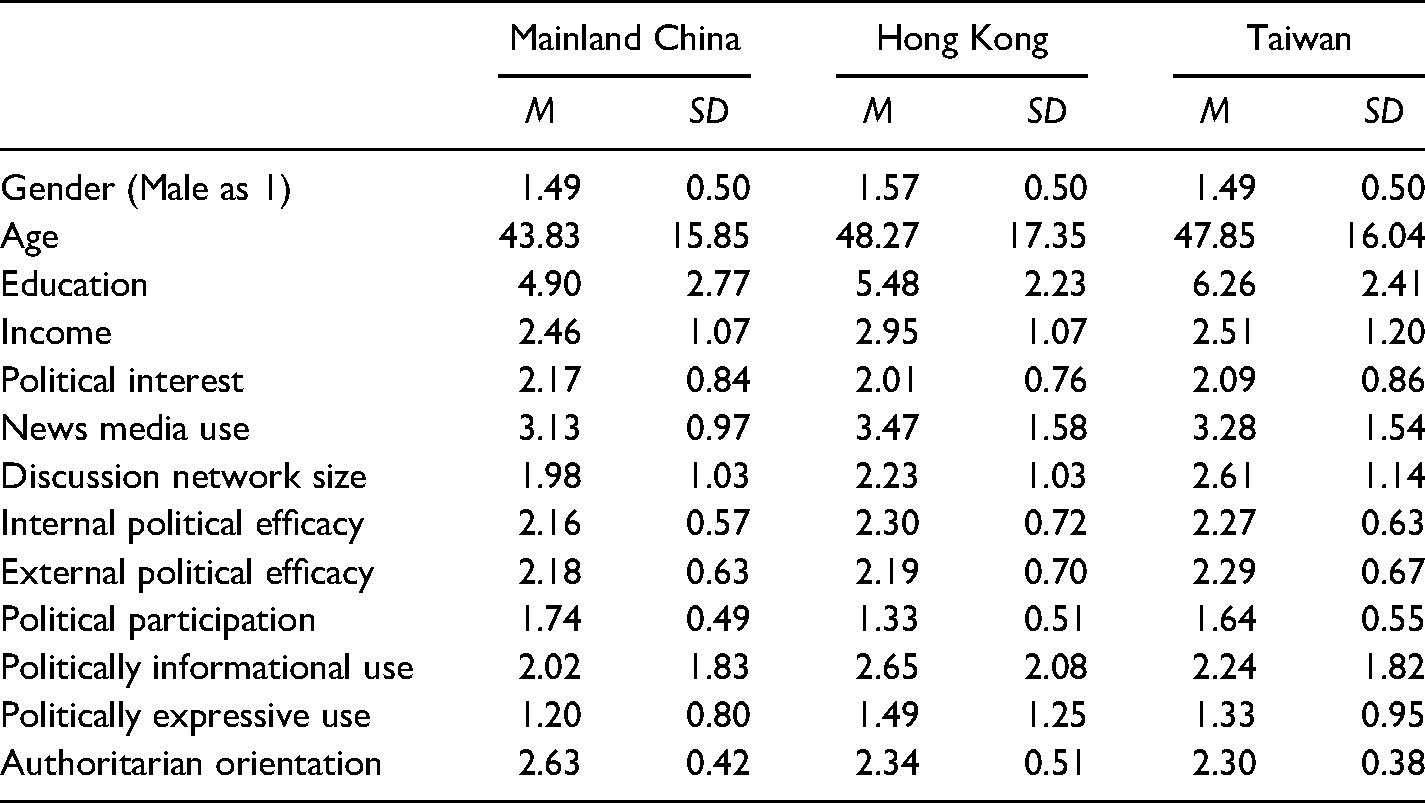
Table 1 reports the descriptive statistics and illustrates the differences of major variables across three Chinese societies. Respondents in mainland China (M = 1.74, SD = 0.49, N = 3952) and Taiwan (M = 1.64, SD = 0.55, N = 1652) more actively engaged in offline non-institutionalized political participation than their counterparts in Hong Kong (M = 1.33, SD = 0.51, N = 1207), F (2, 6808) = 301.78, p < 0.001. Respondents in Hong Kong (M = 2.65, SD = 2.08, N = 1181) more actively sought for political information online than their counterparts in mainland China (M = 2.02, SD = 1.83, N = 4042) and Taiwan (M = 2.24, SD = 1.82, N = 1657), F (2, 6877) = 52.84, p < 0.001. Respondents in Hong Kong (M = 1.49, SD = 1.25, N = 1182) more actively expressed a political opinion online than their counterparts in Taiwan (M = 1.33, SD = 0.95, N = 1655) and mainland China (M = 1.20, SD = 0.80, N = 4040), F (2, 6874) = 49.75, p < 0.001. Respondents in mainland China (M = 2.63, SD = 0.42, N = 3853) showed stronger authoritarian orientation than their counterparts in Hong Kong (M = 2.34, SD = 0.51, N = 1172) and Taiwan (M = 2.30, SD = 0.38, N = 1635), F (2, 6857) = 441.57, p < 0.001.
Descriptive statistics of variables.
Testing Mediation Effects
We expected that politically informational use, via politically expressive use, would show an indirect relation to offline non-institutionalized political participation. Table 2 presents the regression results for the mediation analysis across three Chinese societies. First, individuals' politically informational use directly built a positive relationship with their political participation in Hong Kong (B = 0.03, SE = 0.01, p < 0.01) and Taiwan (B = 0.02, SE = 0.01, p < 0.01), while this positive association did not exist in mainland China (B = 0.01, SE = 0.01, p > 0.05). Second, individuals' politically informational use was positively correlated with their political expression in mainland China (B = 0.16, SE = 0.01, p < 0.001), Hong Kong (B = 0.24, SE = 0.02, p < 0.001), and Taiwan (B = 0.21, SE = 0.01, p < 0.001). Third, individuals' politically expressive use was positively correlated with their political participation in mainland China (B = 0.03, SE = 0.01, p < 0.05), Hong Kong (B = 0.09, SE = 0.01, p < 0.001), and Taiwan (B = 0.09, SE = 0.01, p < 0.001). Finally, individuals' politically informational use built a positive relationship with their political participation through politically expressive use in mainland China (B = 0.004, SE = 0.002, 95 percent CI = [0.001–0.008]), in Hong Kong (B = 0.02, SE = 0.005, 95 percent CI = [0.01–0.03]), in Taiwan (B = 0.02, SE = 0.004, 95 percent CI = [0.01–0.03]). Therefore, evidence from three Chinese societies we studied supported H1.
Regression results from mediation analysis across three Chinese societies.
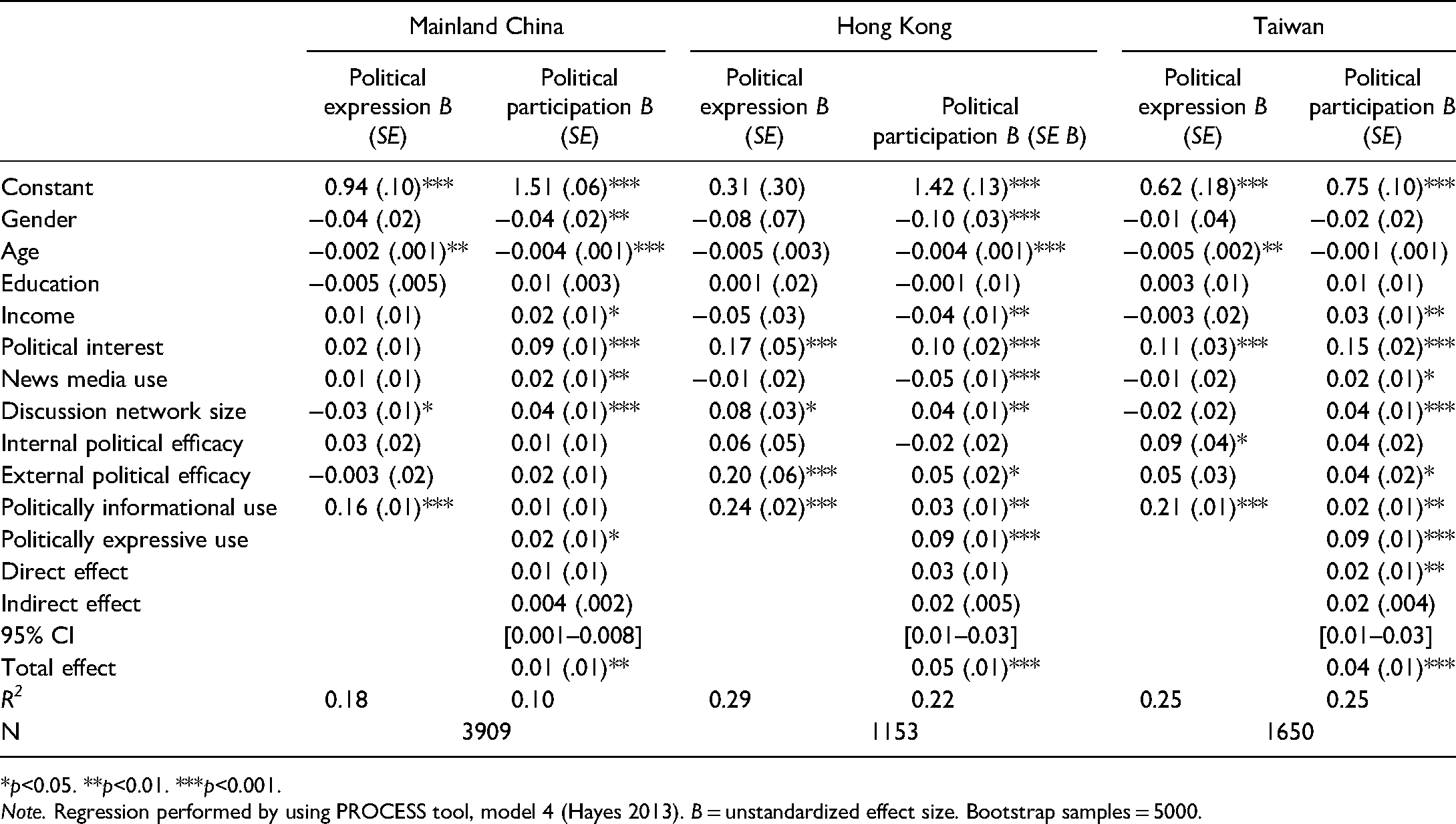
*p<0.05. **p<0.01. ***p<0.001.
Note. Regression performed by using PROCESS tool, model 4 (Hayes 2013). B = unstandardized effect size. Bootstrap samples = 5000.
Testing Moderated Mediating Effects
We expected that individuals' authoritarian orientation would moderate the mediating effect of politically expressive use by influencing two separate paths. Table 3 summarizes the regression results for this moderated mediation analysis across three Chinese societies. First, the interaction effect of politically informational use and authoritarian orientation on politically expressive use (answering RQ1) was significantly negative in Hong Kong (B = −0.20, SE = 0.03, p < 0.001) and Taiwan (B = −0.15, SE = 0.03, p < 0.001), while not in mainland China (B = −0.02, SE = 0.02, p > 0.05). As shown in Figure 2, based on the Hong Kong sample, probing this interaction showed that the association between politically informational use and politically expressive use was larger among those with weak authoritarian orientation (Mean − 1SD) (B = 0.33, SE = 0.02, p < 0.001) than among those at the mean (B = 0.23, SE = 0.02, p < 0.001) and those with strong authoritarian orientation (Mean + 1SD) (B = 0.12, SE = 0.02, p < 0.001). As shown in Figure 3, based on the Taiwan sample, similarly, the association between politically informational use and politically expressive use was larger among those with weak authoritarian orientation (Mean − 1SD) (B = 0.24, SE = 0.02, p < 0.001) than among those at the mean (B = 0.18, SE = 0.01, p < 0.001) and those with strong authoritarian orientation (Mean + 1SD) (B = 0.13, SE = 0.02, p < 0.001). Thus, RQ1 was answered.
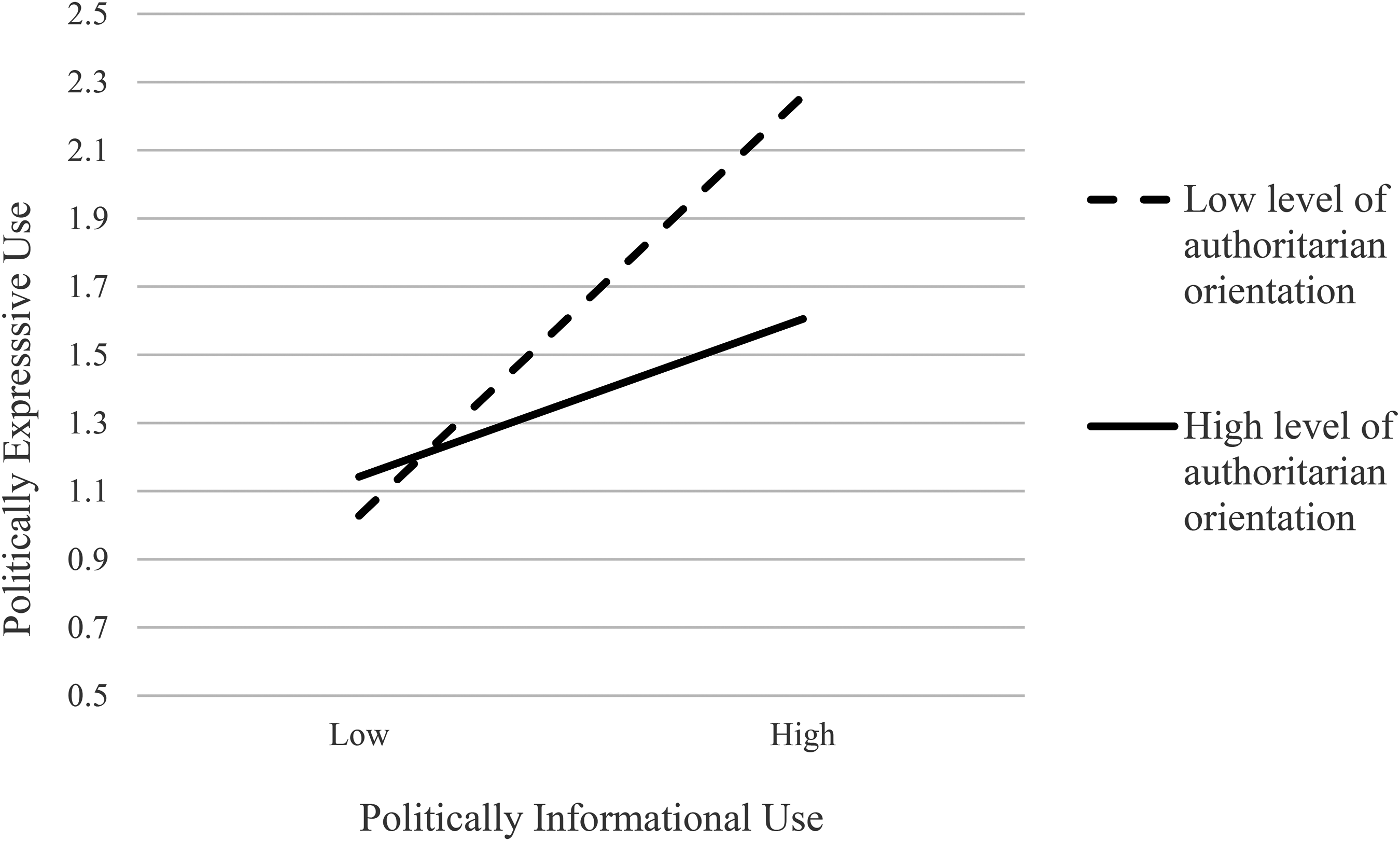
Interaction relationship of politically informational use and authoritarian orientation on politically expressive use in Hong Kong.
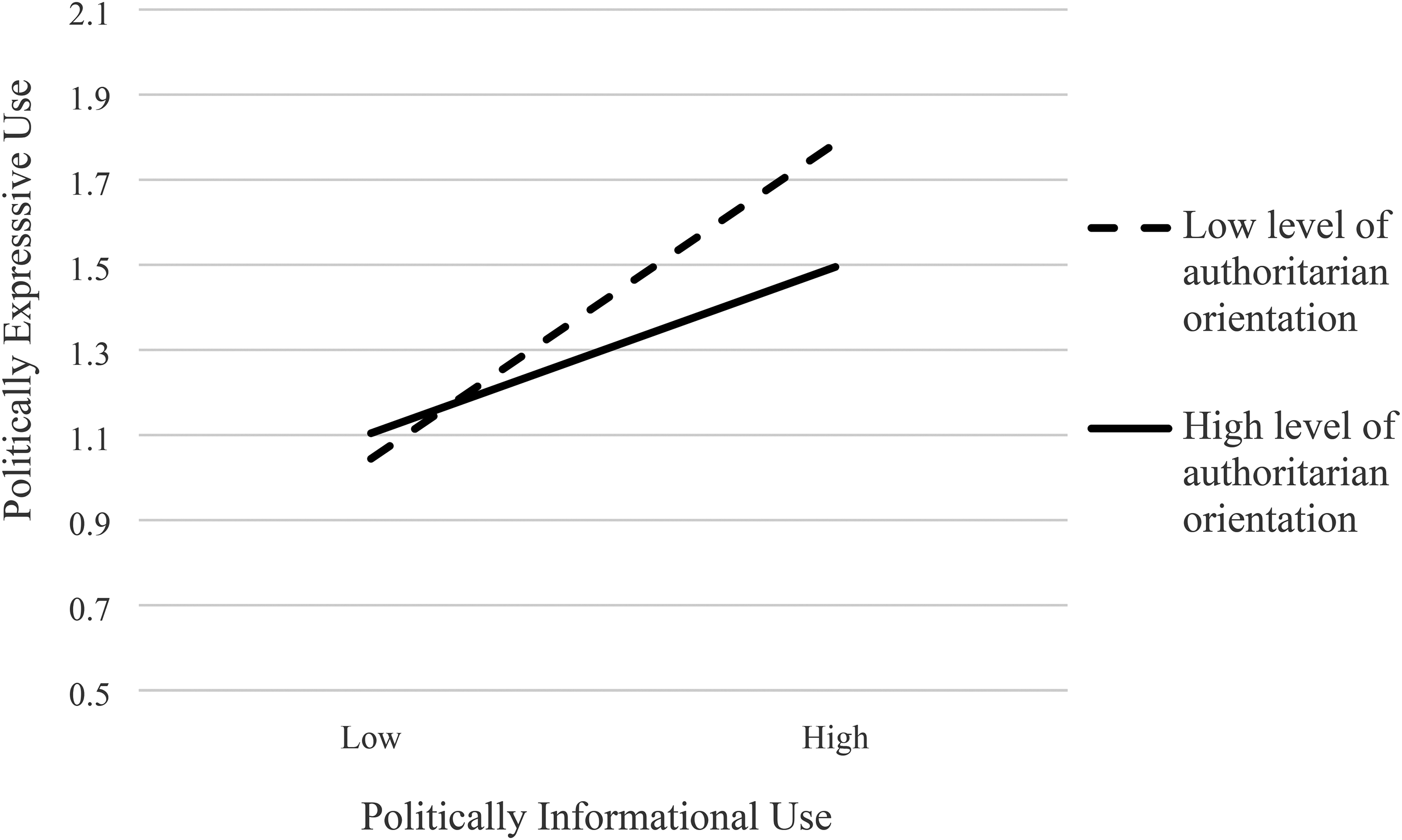
Interaction relationship of politically informational use and authoritarian orientation on politically expressive use in Taiwan.
Regression results from moderated mediation analysis across three Chinese societies.
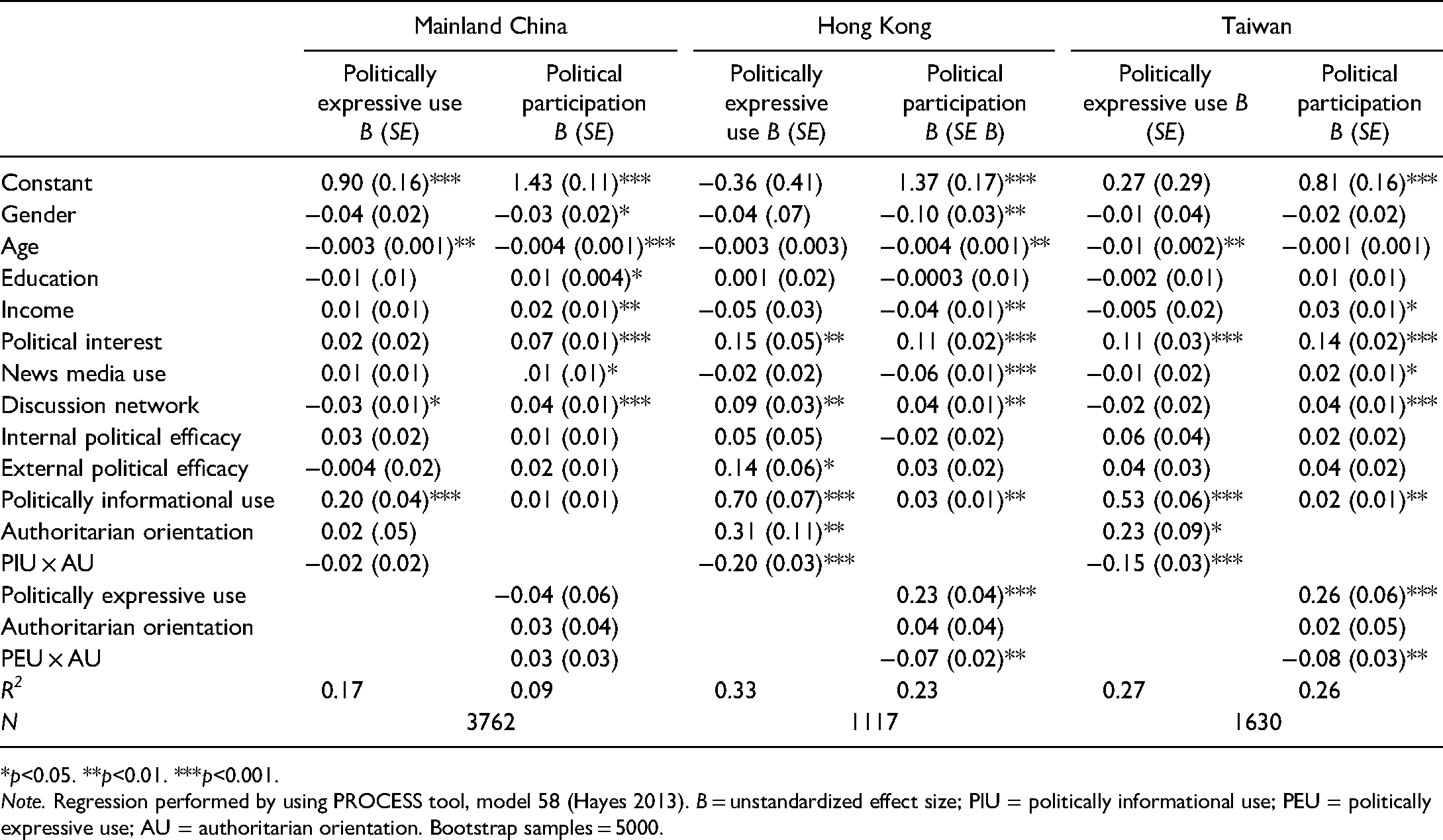
*p<0.05. **p<0.01. ***p<0.001.
Note. Regression performed by using PROCESS tool, model 58 (Hayes 2013). B = unstandardized effect size; PIU = politically informational use; PEU = politically expressive use; AU = authoritarian orientation. Bootstrap samples = 5000.
Second, the interaction effect of politically expressive use and authoritarian orientation on offline non-institutionalized political participation (answering RQ2) was significantly negative in Hong Kong (B = −0.07, SE = 0.02, p < 0.01) and Taiwan (B = −0.08, SE = 0.03, p < 0.01), while not in mainland China (B = 0.03, SE = 0.03, p > 0.05). As shown in Figure 4, based on the Hong Kong sample, probing this interaction showed that the association between politically informational use and politically expressive use was larger among those with weak authoritarian orientation (Mean − 1SD) (B = 0.10, SE = 0.01, p < 0.001) than among those at the mean (B = 0.07, SE = 0.01, p < 0.001), while such association was not significant among those with strong authoritarian orientation (Mean + 1SD) (B = 0.03, SE = 0.02, p > .005). As shown in Figure 5, based on the Taiwan sample, similarly, the association between politically informational use and politically expressive use was larger among those with weak authoritarian orientation (Mean − 1SD) (B = 0.10, SE = 0.01, p < 0.001) than among those at the mean (B = 0.07, SE = 0.01, p < 0.001), while such association was not significant among those with strong authoritarian orientation (Mean + 1SD) (B = 0.02, SE = 0.02, p > 0.05). Thus, RQ2 was answered.
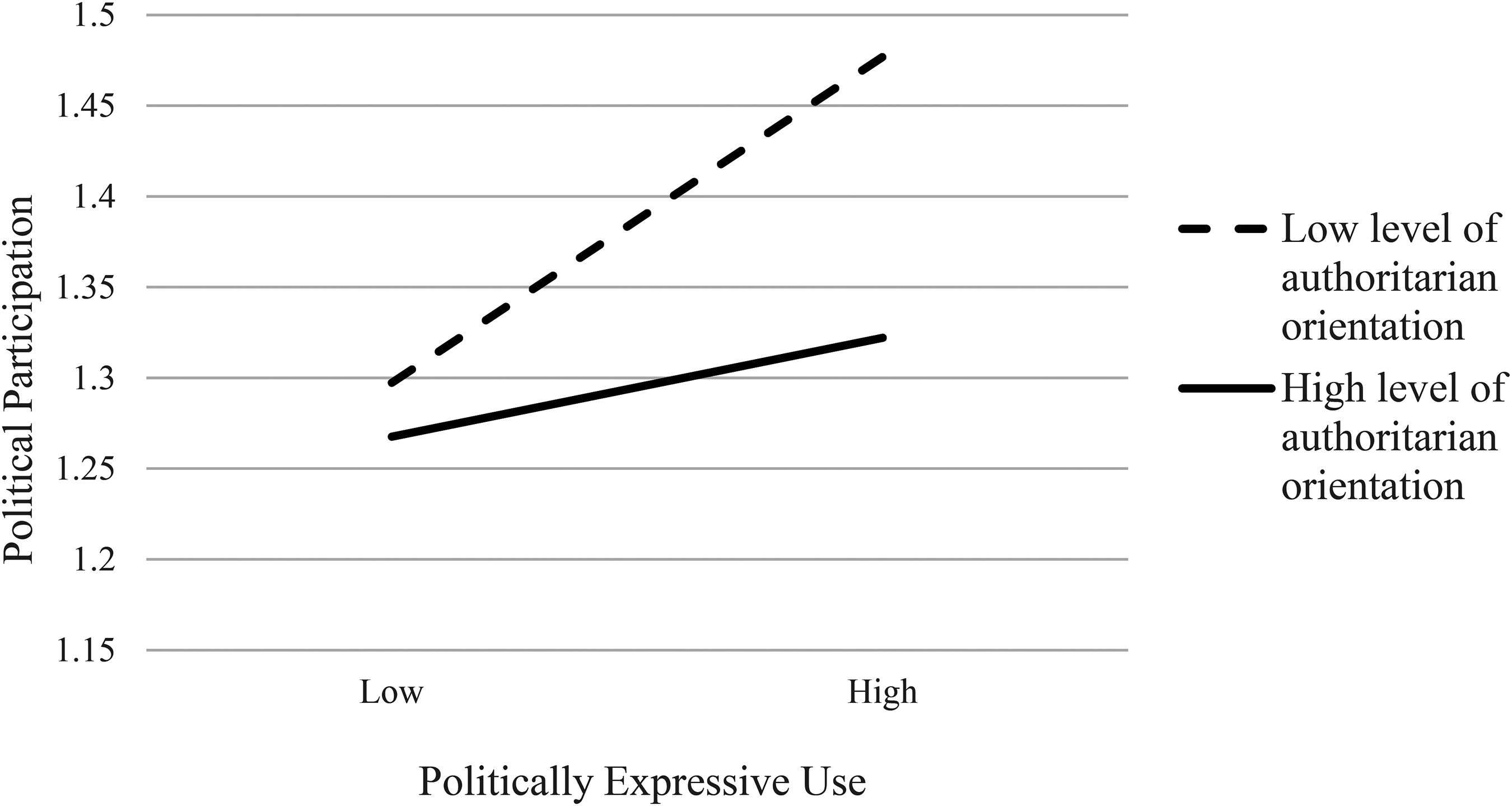
Interaction relationship of politically expressive use and authoritarian orientation on political participation in Hong Kong.
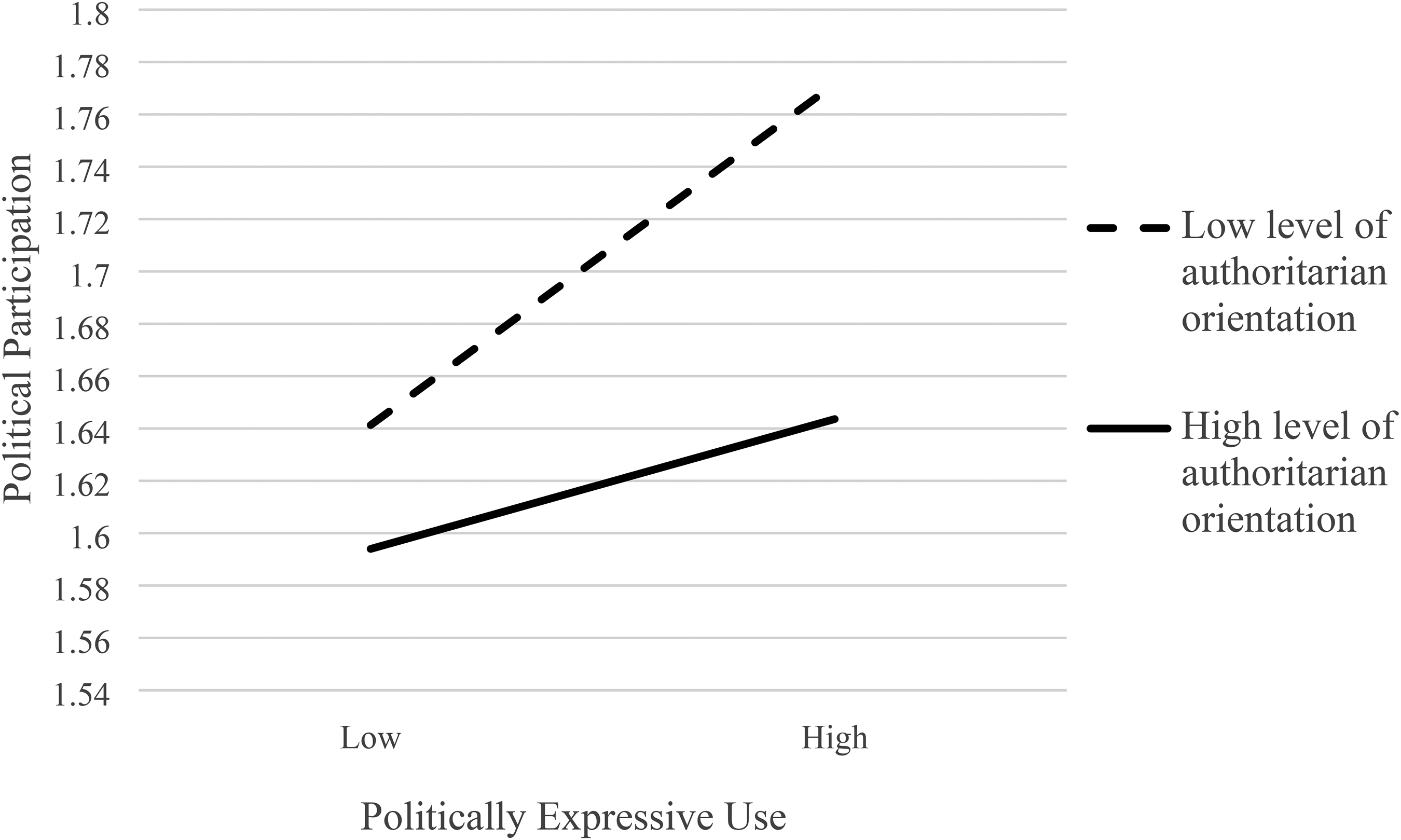
Interaction relationship of politically expressive use and authoritarian orientation on political participation in Taiwan.
Third, the mediating effect of politically expressive use (answering RQ3) was contingent on authoritarian orientation in Hong Kong and Taiwan, while not in mainland China (see Table 4). Based on the Hong Kong sample, the indirect effect of social media use for political expression was larger among those with weak authoritarian orientation (Mean − 1SD) (B = 0.03, SE = 0.01, 95 percent CI = [0.02–0.05]) than among those at the mean (B = 0.01, SE = 0.004, 95 percent CI = [0.006–0.02]), while such indirect effect was not significant among those with strong authoritarian orientation (Mean + 1SD) (B = 0.004, SE = 0.004, 95 percent CI =[−0.004 to 0.01]). Based on the Taiwan sample, similarly, the indirect effect of social media use for political expression was larger among those with weak authoritarian orientation (Mean − 1SD) (B = 0.02, SE = 0.01, 95 percent CI = [0.01–0.03]) than among those at the mean (B = 0.01, SE = 0.004, 95 percent CI = [0.006–0.02]), while such indirect effect was not significant among those with strong authoritarian orientation (Mean + 1SD) (B = 0.005, SE = 0.004, 95 percent CI = [−0.002 to 0.01]). Thus, RQ3 and RQ4 was answered.
Regression results from conditional indirect effect across three Chinese societies.

Discussion and Conclusion
Summary of the Findings
We investigated whether politically informational and expressive forms of social media use promoted offline non-institutionalized political participation in three Chinese societies. Our results confirmed a positive indirect relationship in which politically expressive use mediates the positive relationship between politically informational use and political participation in all three Chinese societies. More importantly, we further found that such a positive mediation effect is not universally applicable as it can be conditioned by the level of an individual’s authoritarian orientation. That is, weak authoritarian orientation magnified the mediating effect of politically expressive use, while strong authoritarian orientation weakened such a mediating effect. More interestingly, such cultural dynamics varied in three Chinese societies as the moderated mediating effects only existed in Hong Kong and Taiwan, but they did not exist in mainland China.
The Indirect Positive Effects of Social Media Use on Political Participation in Chinese Societies
Gil de Zúñiga et al.’s (2014) positively mediated pathway (i.e., informational social media use → expressive social media use → political participation) was generally supported in three Chinese societies. This finding extends most extant research based primarily on Western democracies. The existence of the mediating model in Chinese societies suggests that the positive effects of social media use on political participation occur not only in democratic societies but also emerge in authoritarian regimes (Tufekci and Wilson 2012). This positive relationship supports the “gateway” assumption that endorses the “information/discussion-knowledge-efficacy” and “discussion-networks-mobilization” mechanisms (Boulianne and Theocharis 2020; David 2009; Lim 2008; Scheufele et al. 2006). However, the negative impact of internet or social media use on political knowledge and participation was not applicable in the context of Chinese societies. This indicates that, in Chinese societies, the potential exposure to cross-cutting or low-quality political information may not induce ambivalent political views (Mutz 2002, 2006) or negatively shape the formation of political knowledge (Conroy et al. 2012).
Authoritarian Orientation Modifies the Expression-Mediating Model
Similar moderating effects of authoritarian orientation were found in Hong Kong and Taiwan, while not in mainland China. Specifically, one mediating relationship and two direct relationships were contingent on authoritarian orientation. For individuals with weaker authoritarian orientation, there existed a larger mediating effect of politically expressive use. However, for individuals with stronger authoritarian orientation, there was no mediating effect of politically expressive use. The moderating effects of authoritarian orientation on the relationship between politically informational use and politically expressive use and the relationship between politically expressive use and political participation also presented a similar pattern. These findings suggest that an individual's authoritarian orientation is indeed negatively associated with: (1) how they process political information and form political knowledge when seeking for political information online and (2) the extent to which they get opportunities to be mobilized or engage in online political discussion when expressing a political opinion online. Thus, the “information/discussion-knowledge-efficacy” and “discussion-network-mobilization” mechanism can provide proper explanations in the context of Hong Kong and Taiwan. Meanwhile, it was not evident that individuals with strong authoritarian orientation would be more likely to participate in the online political discussion to defend their own opinions than individuals with weak authoritarian orientation. Theoretically, these findings also advance previous research on how psychological traits might modify the relationship between social media use and political participation (e.g., Kim et al. 2013; Zhang and Lin, 2018). Future studies might adopt a cultural perspective with a particular grounding in specific cultural or political dynamics in order to shed further light on the explanatory power of psychological traits vis-a-vis political participation. Meanwhile, the important intervening role of an individual's authoritarian orientation in Chinese societies should remind scholars that importing existing models derived from democracies to other social and political systems should be done with great care (Boulianne 2015).
Beyond the Cultural Impact: Differences Among Three Chinese Societies
By demonstrating the variances of our moderated mediation model across three Chinese societies, we also expand previous findings to show that the intervening role of cultural orientation may also be contingent on specific social or political contexts. The moderating effects of authoritarian orientation largely differ between mainland China and two other societies (i.e., Hong Kong, Taiwan). The reason why the moderating effects of authoritarian orientation disappeared in mainland China may derive from the comparison of authoritarian-orientation level across three Chinese societies. The moderate level of authoritarian orientation in mainland China (M = 2.63, SD = 0.42) is an outlier relative to the authoritarian orientation reported in Hong Kong (M = 2.34, SD = 0.51) and Taiwan (M = 2.30, SD = 0.38). As such, compared with the respondents in Hong Kong and Taiwan, the majority of respondents in mainland China have a relatively high level of authoritarian orientation. Moreover, results based on Hong Kong and Taiwan samples also showed that the moderating effects of authoritarian orientation similarly disappeared for individuals with strong authoritarian orientation.
Generally, the evidence that strong authoritarian orientation disconnects the relationships between politically internet/social media use and political participation may challenge the classical view holding either positive or negative relations between the two. More importantly, this empirical anomaly can provide a unique window on how the impacts of politically internet/social media use and political participation can fail in certain contexts. One possible explanation is that individuals with strong authoritarian orientation demonstrate less motivation to express their own political opinions on social media and less involvement in political participation. This group of people holds government in higher esteem, displays obedience to social control as well as conformity to traditional ideas, and distrusts new ideas. As such, they maintain stable political ideas even when confronted with opposing ideas, which helps maintain the observed stability of the effects of social media use on political participation.
In contrast, although authoritarianism as a traditional culture is shared among mainland China, Taiwan, and Hong Kong, the reported levels of authoritarian orientation were relatively lower in Hong Kong and Taiwan, in which authoritarian orientation can negatively moderate the effects of social media use on political participation. Therefore, in societies with fewer constraints on civil rights (i.e., freedom of speech), the positive effects of social media use on political expression and participation are magnified by individuals' psychological conditioning within a political culture that emphasizes individual rights rather than traditional ideas of harmony and stability (Zhang and Lin 2018).
Limitation and Future Research Directions
In this study, the first limitation is related to the causal relationships among the variables examined. The cross-sectional data we used cannot guarantee the causality. Moreover, from the perspective of conceptualization, this moderated mediation model cannot provide a full explanation since authoritarian orientation can be treated as an independent variable and two types of internet/social media use can be treated as mediator. Based on the orientation–stimulus–orientation–response model (McLeod et al. 2002), it is also plausible to examine the association between authoritarian orientation and political participation through internet/social media use, though the existing literature did not show that authoritarian orientation can be treated as an appropriate political orientation (antecedent) influencing internet/social media use. Particularly, a post hoc analysis conducted in this study showed that authoritarian orientation cannot directly build a relationship with political participation, while there is a negatively indirect association between the two variables via politically informational use and politically expressive use in three Chinese societies. Nevertheless, our statistical model is largely based on the theoretical construction that we are interested in; that is, a scholarly conversation with the debate focusing on the impacts of internet/social media use on political participation. The second limitation is that the mediation model tested by the PROCESS tools was examined in a nonexperimental setting in which both independent variable and mediators were not randomly assigned. This nonrandomization may lead to a potential confounding between independent variable and mediator and nonstatistically independence between independent variable/mediator and dependent variable. The third limitation is related to the reliability and validity of measurement of some key variables. Since the Asian Barometer Survey's secondary data was used in this study, we measured the independent variable (i.e., politically informational use) and mediating variable (i.e., politically expressive use) with a single item based on their usage frequency. Such single-item measurement may negatively influence the reliability and validity of this research as well as the robustness of the statistical analysis. By specifying different dimensions of politically informational use and politically expressive use, previous research has constructed a more reliable and valid measurement based on multiple items (e.g., Gil de Zúñiga et al. 2014).
Despite this limitation, our findings provide a robust starting point for future research. First, future research should use the panel data of the Asian Barometer Survey to verify the causal relationships through which different theoretical models will be tested and compared. Second, future research should examine the possibility that other aspects of cultural context and psychological orientation influence the link between social media use and political participation. Third, future research should construct or use multiple items to measure politically informational use and politically expressive use based on more nuanced and more fully developed measurement scales.
Footnotes
Acknowledgment
The authors sincerely thank the Asian Barometer Survey (ABS) for granting us to use its data.
Declaration of Conflicting Interests
The authors declared no potential conflicts of interest with respect to the research, authorship, and/or publication of this article.
Funding
The authors received no financial support for the research, authorship and/or publication of this article.
