







Abstract
While the number of U.S. residents who speak non-English languages at home is on the rise, little is known about the sociopolitical implications of exposure to minority languages among multilingual speakers in the United States. This study analyzes whether exposure to Spanish, a U.S. minority language, impacts perceptions of linked fate among bilingual Latinos, and if so, whether the consumption of ethnic media amplifies this effect. Through a population-based survey experiment among bilingual Latinos, this study finds that Latinos who are exposed to content in Spanish are more likely to report in-group linked fate than their counterparts exposed to the same message in English. Moreover, these effects are stronger among consumers of Spanish-language news. This study contributes to our understanding of the role of minority languages and ethnic media on pan-ethnic identities and highlights the importance of the growing linguistic diversity in the United States.
Keywords
Introduction
En este país también se habla español. Este debate se realiza en un momento muy difícil para los Latinos en Texas y en todo Estados Unidos. Pero es importante que ellos sepan… que este también es nuestro país
1
(Jorge Ramos during the third 2020 Democratic presidential debate in Houston, Texas).
On September 12, 2019, Jorge Ramos began the third Democratic presidential debate for the 2020 elections with a statement in Spanish. Besides delivering a message in the most spoken minority language in the United States, Ramos highlighted the relevance of Spanish-speaking voters in one of the most prominent political events in the country. Although speaking Spanish seemed like a natural fit for Ramos, a naturalized American and native Spanish speaker, he was far from the only one delivering messages in languages other than English. Throughout the 2020 elections, linguistic appeals in Spanish and other minority languages were consistently used in campaigns, rallies, advertisements, and debates across candidates from both partisan affiliations. From Beto O’Rourke, Julián Castro and Pete Buttigieg conducting interviews in Spanish, to President Trump's advertisements in Spanish-speaking television and YouTube, candidates and elected officials continuously use linguistic appeals to mobilize minority voters (Caliendo and McIlwain 2006; Flores and Coppock 2018; Ostfeld 2017).
With the highest number in record of Americans speaking a language other than English at home and a growing number of political campaigns targeting linguistic minorities, the importance of minority languages in the United States is at its highest point. Today more than one in every five U.S. residents speak non-English languages at home, almost doubling the 11% of linguistic minorities in 1980 (US Census Bureau 2018). This phenomenon is relevant not only among the most populated and diverse states in the country, such as California and Texas, but also nontraditional immigrant destinations with fast-growing populations such as Nevada, Utah, and North Carolina, each of which experienced over a 20% growth of residents who speak non-English languages at home in the past decade (US Census Bureau 2018). This growing linguistic diversity is crucial not only because today’s political environment is highly competitive, as the 2020 elections showed, but also because the U.S. is home to over 35 million eligible voters who speak non-English languages at home (US Census Bureau 2018).
For several decades, Spanish has been the most spoken and widely taught minority language in the United States (US Census Bureau 2015, 2018). With an estimated 41 million U.S. residents who speak Spanish at home, the U.S. is currently the second-largest Spanish-speaking country in the world, with studies estimating the U.S. will become the largest Spanish-speaking country in the world by 2050 (Instituto Cervantes 2016; US Census Bureau 2018). Latinos, who are the largest ethnic group in the country, have the largest proficiency in Spanish in the country. Today, almost three in every four U.S. Latinos are proficient in Spanish, whereas only a minority of them (28%) are monolingual English speakers (US Census Bureau 2018). This issue serves as a factor of commonality among Latinos, setting them apart from other ethno-racial groups with linguistically diverse backgrounds such as Asian Americans and American Indians, who are collectively proficient in more than a dozen of languages (Ramakrishnan and Ahmad 2014). Hence, Spanish proficiency among Latinos provides a unique opportunity to analyze the sociopolitical effects of exposure to minority languages among linguistically diverse groups in the United States.
Along with the growing share of Americans who speak Spanish at home, nontraditional media has increasingly been engaged in the dissemination of social and political information in languages other than English. Spanish-language (SL) news media, for example, has been increasingly engaged in political events and debates at all levels of government in the past few years (Mann et al. 2020); moreover, studies have found major sociopolitical implications of SL news consumption among U.S. Latinos, ranging from greater civic engagement and turnout (Garcia-Rios and Barreto 2016) to attitude formation (Abrajano and Singh 2009) and higher attachment to ethno-racial groups (Moran 2006; Subervi-Velez 1999). Besides lowering information costs to Spanish-speaking Latinos to access information in their preferred language, the availability of SL media highlights the prominence of Latinos and linguistic minorities in the United States (Fowler et al. 2009; Gomez-Aguinaga 2021).
While scholars have explored some of the sociopolitical implications of the use of minority languages and the consumption of ethnic media independent of each other, several questions remain unanswered in the area of identity formation. Hence, this study explores whether exposure to content in Spanish, a U.S. minority language, influences perceptions of linked fate among bilingual Latinos and, if so, whether SL news consumption amplifies these effects among them. I address these questions through a population-based survey experiment, finding that bilingual Latinos who are exposed to content in Spanish are more likely to report higher levels of ethnic linked fate than those who received the same message in English. Moreover, this study finds that while exposure to content in Spanish impacts bilingual Latinos at large, the identity effects are stronger among SL news consumers, a finding that is in line with the linguistic accommodation theory (LAT) and identity priming literature (Brown Givens and Monohan 2005; Giles et al. 1973; Levendusky 2013). This study contributes to our understanding of the role of minority languages on pan-ethnic identities, which are strong predictors for attitude formation and political behavior among ethno-racial groups (Garcia-Rios and Barreto 2016; Sanchez and Gomez-Aguinaga 2017; Schildkraut 2013), and highlights the growing prevalence of the linguistic diversity in the United States.
Literature Review
A handful of studies explore the political implications of minority languages in the United States. One of the most prominent areas of study among minority languages is the effectiveness of the Voting Rights Act (VRA), particularly its 1975 extended provisions on linguistic minority groups. The 1975 amendments to the VRA aimed to increase turnout among linguistic minorities by prohibiting laws requiring ballots and voting information to be exclusively in English in jurisdictions where linguistic minorities comprise more than 5% of the voting-age population. Studies find that these provisions have had positive turnout effects on linguistically diverse groups such as U.S. Latinos and Asian Americans (Marschall and Rutherford 2016; Tucker 2006). Moreover, studies find that the increasing prevalence of multilingual elections and campaign advertising can result in higher levels of civic engagement and voter turnout among Spanish speakers in the United States (Hopkins 2011; Soto and Merolla 2006).
In addition to civic engagement, studies have explored the extent to which Spanish and other minority languages are associated with different attitudes and perceptions. Recent studies find that attitudes toward political issues vary by exposure to minority languages and the demographic characteristics of the subjects (Lee and Pérez 2014; Pérez 2011; Wong et al. 2011). On the one hand, studies find that among the U.S. majority group (non-Hispanic White, English speakers), exposure to minority languages can create feelings of threat and negativity toward minority groups such as Latinos and immigrants (Hopkins 2014). On the other hand, these effects can be substantially different among ethno-racial groups with linguistically diverse backgrounds (Carroll and Luna 2011; Koslow et al. 1994). Ostfeld (2017) finds that Latinos who are exposed to SL political ads have higher perceptions of collective political power than their Latino counterparts who are exposed to the same ads in English. Flores and Coppock (2018) find that campaign ads conducted in Spanish can increase the electoral support of some candidates by up to five percentage points among bilingual Latinos. Similarly, in the field of marketing and advertising, Carroll and Luna (2011) find that U.S. bilingual Latinos who consume ads in Spanish have more positive evaluations of products than those who are exposed to the same content in English. Koslow et al. (1994) find similar results, arguing that language and identity effects are contingent on Latinos’ perceptions of advertiser sensitivity to the Hispanic culture.
Studies also find that surveys conducted in minority languages can yield different responses among individuals with similar backgrounds (Lee and Pérez 2014; Welch et al. 1973). Among U.S. Latinos, those who respond to surveys in English tend to have higher levels of political knowledge than their Latino counterparts who respond to surveys and polls in Spanish, even after controlling for other factors that affect political knowledge such as education and citizenship (Fraga et al. 2006; Lee and Pérez 2014). Other scholars find that the structure of languages can shape speakers’ perspectives on the assessment of time of public policies. Pérez and Tavits (2017), for example, find that Estonian speakers “view the future as temporally closer to the present, causing them to discount the future less and support future-oriented policies more.”
Studies have suggested that languages may impact the group identity of linguistic minorities (Dubois and Melançon 2000; Pérez 2011, 2016). For example, Latinos who are interviewed or choose to take surveys or polls in Spanish tend to report higher levels of group attachment than their counterparts who respond to surveys in English (Flores and Coppock 2018; Pérez 2011). Similarly, Dubois and Melançon (2000) find that African Americans in Louisiana who are proficient in Creole language are significantly more likely to identify as Creole than their counterparts who are only proficient in English. Nevertheless, it is unknown why these results occur, and whether the sole exposure to minority languages or dialects impacts the ethno-racial identity of linguistic minorities, who currently account for more than 20% of the U.S. population (US Census Bureau 2018).
Theory and Hypotheses
Studies in multiple fields such as linguistics, psychology, marketing, and advertising find that exposure to minority languages can shape the opinions and preferences of message receivers. Existing studies suggest that there are three theoretical backgrounds that help explain this phenomenon: LAT, social identity, and priming.
Linguistic Accommodation Theory
The LAT examines the extent to which messengers use different communication techniques—including the use of minority languages—to deliver information more effectively to distinct groups (Giles et al. 1973). This theory relies on the premise that audiences are more receptive to information that comes from messengers who successfully appeal to members of their group by alluding to shared backgrounds, identities, and languages or dialects (Giles et al. 1973). Scholars, for example, have repeatedly found that advertisements in Spanish can not only increase the perception of advertiser sensitivity among U.S. Latinos and Spanish speakers, but also retrieve thoughts of families, friends, and homelands; these feelings and memories, at the same time, can lead to more positive evaluations of the ads under certain circumstances (Koslow et al. 1994; Luna and Peracchio 2005). These findings are in line with recent studies arguing that exposure to non-English languages is associated with higher feelings of inclusion, belonging, and empowerment among linguistic minorities in the United States (Casillas 2014; Luna and Peracchio 2005; Ostfeld 2017). These findings, however, can be contingent on multiple conditions such as perceptions of social identities and types of priming (Hutchings and Jardina 2009).
Social Identity and Priming
Scholars in multiple fields have extensively examined the role of social identities in social and political outcomes. One of the most prominent theories in this area is the social identity theory (SIT), which defines social identity as a “part of the individual's self-concept which derives from [their] knowledge of their membership of a social group together with the value and emotional significance attached to that membership” (Tajfel 1978). In this way, a social identity is based on the identification of people's in-groups versus out-groups (individuals who do not belong to the group), leading to warmer feelings toward in-group members (McClain et al. 2009). Among the most commonly studied identities in sociopolitical contexts are gender, race, ethnicity, partisanship, and more recently parental status (Bryant and Hellwege 2019; Huddy, Mason and Aarøe 2015; Gershon et al. 2019; Klar 2013).
Studies have shown that priming social identities can have important implications on political behavior. Priming is a technique that increases the salience of an identity, changing “the standards that people use to make political evaluations” (Iyengar and Kinder 1987). This concept is based on the idea that individuals form an opinion with the information (including identities) that is salient and readily available in their minds (Diamond 2020; Zaller 1992). For example, when an ethnic identity is primed in political messages, individuals are likely to respond in line with such cue, whereas the role of ethnicity in the evaluation of a message can be lower or null if this social identity is excluded (Hutchings and Jardina 2009; Valenzuela and Michelson 2016). Priming has substantive effects in multiple political areas including support or opposition to public policies, candidate evaluation, vote choice, and intergroup relations (Gomez-Aguinaga et al. 2021; Jackson 2011; Ortiz and Behm-Morawitz 2015; Valenzuela and Michelson 2016).
Identity Priming Through Minority Languages
While the main function of languages is to serve as instruments of communication, languages can also serve as social identity cues, particularly for linguistic minorities (Dieckhoff 2004). A shared minority language in a dominant society can be “the ideal vehicle to express the unique character of a social group, and to encourage common social ties on the basis of a common identity” (Jaspal 2009). In line with SIT (Tajfel 1978), minority languages can prompt perceptions of group membership among colingual speakers and out-group perceptions for speakers of dominant languages. This in-group-out-group dynamic through minority languages is not only easily distinguishable in the U.S. context, but also has been associated with important sociopolitical implications across the board, including ethno-racial groups, monolingual English speakers, and linguistic minorities (Darr et al. 2020; Ostfeld 2017; Panagopoulos and Green 2011).
In the U.S. context, Spanish serves as a factor of commonality and group membership among Latinos for multiple reasons. First, the vast majority of U.S. Latinos are proficient in Spanish (US Census Bureau 2018). Additionally, Latinos reside in areas with a high concentration of Spanish speakers, allowing for acceptability and continual use of the language (Davis and Moore 2014; Gomez-Aguinaga et al. 2021). The growing availability of SL media in the United States through new information technologies also allows Latinos to consume news and information in their language of choice. 1 And, unlike other linguistic minorities with other ethnic backgrounds, proficiency in Spanish among Latinos is preserved longer than in other immigrant languages (Rumbaut et al. 2006). These issues, in conjunction with the racialization and politicization of non-English languages, 2 present the opportunity to examine whether random exposure to messages in Spanish can prime the ethnic identity of bilingual Latinos in the United States.
Given that SL serves as a factor of commonality among U.S. Latinos, and that exposure to minority languages can prime identities and warm feelings among linguistic minorities, I present the following hypothesis:
Minority Languages, Ethnic Media, and In-Group Linked Fate
Beyond language, studies have examined how factors such as media consumption impact perceptions of group identity among racial and ethnic minorities in the United States. Scholars differentiate between mainstream and ethnic media, which has been defined as “broadcast, print, and digital communication” alternatives to mainstream media designed to “serve a particular cultural or racial group” (Johnson 2010; Jeffres 2000). SL news, for example, is a type of ethnic media aimed to serve Spanish-speaking Latinos.
Beyond the dissemination of information in a U.S. minority language, SL news media has elements that help retrieve consumers’ memories, thoughts, and feelings that emerge from affective backgrounds such as family, ethnic groups, and minority status. Studies have consistently found that SL news media has greater coverage of issues that are pertinent to U.S. Latinos such as immigration and health care, when compared to mainstream media (Abrajano and Singh 2009; Gomez-Aguinaga 2021; Subervi-Velez 1999); these news stories, at the same time, highlight the minority status of Latinos and Spanish speakers in the United States. SL news media also incorporates a large proportion of social and political news from Latin America, where most U.S. Latinos trace their heritage (Eshbaugh-Soha and Balarezo 2014). Additionally, compared to mainstream media, SL media has an abundant presence of Latino anchors and reporters, and it portrays Latinos more positively, continuously presenting them as family members, successful community members, and opinion leaders (Fowler et al. 2009; Negrón-Muntaner et al. 2014). These distinctive elements are important because they can help retrieve memories and knowledge structures that emerge from affective backgrounds such as family, ethnic groups, and minority status, as LAT posits (Giles et al. 1973).
In addition to LAT, the literature on priming suggests that the unique elements of SL media—including the dissemination of content in a minority language—can lead to greater group identity effects among Latino consumers of SL news. Studies have found that one of the most prominent implications of SL news consumption is an increasing sense of collective identity (Moran 2006; Subervi-Velez 1999; Jeffres 2000); this issue occurs because SL media tends to “de-nationalize” Latinos to create a larger pan-ethnic identity and a sense of linked fate among U.S. Latinos and Spanish speakers (Dávila 2011). Since the content of SL media continuously promotes a pan-ethnic identity among Latinos, disseminating this information in a U.S. minority language, I expect that the priming effects of exposure to content in Spanish on Latino-linked fate will be amplified by consumption of SL news. Based on that, I present the second hypothesis of the study:
Research Design and Methods
To test whether exposure to content in Spanish leads to higher levels of pan-ethnic identity among U.S. bilingual Latinos, this study uses a population-based survey experiment (Mutz 2011). The experiment was embedded in the Center for Social Policy National Policy (CSPNP) Survey, which was conducted from April 5, 2019, to May 2, 2019, in the United States. The survey focuses on ethno-racial minorities, oversampling African Americans (n = 705) and Latinos (n = 2,024). It was conducted online in English and Spanish to capture a wider segment of U.S. Latinos. For this study, I analyze respondents who self-identified as Hispanic/Latino and were proficient in English and Spanish (n = 749). Bilingual Latinos 3 and SL news media consumers were identified from a series of screening and demographic questions at the beginning of the survey. To avoid priming subjects with the design of the study, these questions were followed by multiple questions that served as distractors, such as additional screening and general opinion questions administered to all survey respondents. 4
Bilingual Latinos were randomly assigned to a stimulus, which consisted of a short, nonpolitical, and nonracialized text. 5 Bilingual respondents who were randomly assigned a short message in English served as the control group (coded 0) while those assigned to the message in Spanish comprised the treatment group (coded 1). The subjects of the experiment were exposed to the same content, with language (English/Spanish) being the only variation. I assessed the random assignment of participants to treatment and control groups with a series of balance and equivalence tests (Hartman and Hidalgo 2018). The results of the tests, which are presented in the Supplemental Information File A, show that the treatment and control groups are statistically similar across categories such as educational attainment, gender, income, SL news consumption, party identification, and nativity. The equivalence tests indicate that the treatment and control groups differ only in terms of age, with a small difference in means. Besides attesting to the stochasticity of the experiment, these results show that potential multicollinearity or confounding issues in the multivariate analyses of this study are not problematic because “randomized groups are sufficiently balanced on all potential confounding variables” (Vetter and Mascha 2017).
The theme of the stimulus was exercise. 6 This nonpoliticized issue was chosen to isolate the effect of exposure to a minority language as previous literature has found that heavily politicized topics or racialized issues can prime sociopolitical effects such as identity salience, belonging, and hostility (Darr et al. 2020; Hopkins 2014). For example, besides racialized issues such as immigration and race relations, content related to student activism, gubernatorial races and election interference have been proven to have implications on perceptions of belonging among U.S. Latinos when presented in Spanish (Casillas 2014; Darr et al. 2020). Hence, presenting a nonpoliticized or racialized message allows us to isolate the effects of language as the sole identity prime. A two-part linked fate question, which is the standard way to capture the concept, followed the experiment. 7 While Latino-linked fate served as the dependent variable of the study, the random exposure to the message in English or Spanish served as the independent variable of the study.
Another important independent variable of the study is the consumption of SL news. To capture this item, respondents were asked: “When it comes to news and current affairs, would you say you watch TV or online news….” The responses were operationalized as (1) mostly/more English, (2) English and Spanish pretty equally, (3) mostly/more Spanish, and (4) never watch TV or online news. This is an approach that the previous literature has used to capture survey participants’ consumption of ethnic media relative to mainstream media (Fraga et al. 2006; Ostfeld 2017). 8
This study uses multiple bivariate and multivariate analyses to capture the identity effects of exposure to a minority language among bilingual Latinos in the United States. To test the exposure to the SL hypothesis (H1), I first conducted a chi-square difference test to analyze whether a statistical relationship between exposure to messages in Spanish and linked fate existed among bilingual Latinos (Yuan and Chan 2016). This analysis was complemented with a Fisher's exact test to examine the robustness of the chi-square test (Agresti 1992). Due to the stochastic nature of the data, bivariate analyses allow us to draw the causal implications of language exposure on group identity. The Supplemental Information File (Figure B1) presents the distribution of the reported linked fate by the random exposure to the message in English and Spanish.
To complement the bivariate analyses testing H1, I conducted a multivariate analysis with covariates that the literature has identified as important predictors of public opinion and group identity. This approach ensures that the “fundamental scientific principle of holding all other factors constant or equal” in experiments is met (Mutz 2011). Hence, I conducted a multinomial logistic regression analysis with in-group linked fate as the dependent variable, with the value “no linked fate” as a reference group, 9 and the random exposure to the message in English or Spanish as the main independent variable of the study. The covariates include education, gender, age, news consumption, income, partisanship, language congruence, and nativity (Masuoka 2008; Meuter and Allport 1999; Ostfeld 2017; Portes 1999). 10 Table C1 in the supplemental information file presents the descriptive statistics of the variables. Testing the relationship between exposure to content in Spanish and linked fate in bivariate and multivariate analyses allows us to examine the robustness of the findings.
Finally, to test H2, I conducted a multinomial logistic regression analysis with an interaction between random exposure to the message (English/Spanish) and the type of news media consumption. 11 To illustrate the effects of the interaction, I present the predicted probabilities of the interaction in multiple figures. 12
Results
First, I present the results of the bivariate analyses conducted for this study. The results of the chi-square test indicate a positive and significant relationship between exposure to messages in Spanish and linked fate among bilingual Latinos (chi-square with 3 degrees of freedom = 3.991, p = .049). Furthermore, the results of Fisher's exact test show a significant difference in the distributions of linked fate among those who received the message in English and Spanish (p = .035). These results of both analyses suggest that bilingual Latinos exposed to content in Spanish are significantly more likely to report higher levels of linked fate than their counterparts who were exposed to the same message in English. Hence, the results of the bivariate analyses provide support for H1, highlighting the substantial implications of exposure to a minority language among multilingual speakers.
Next, I present the results of the multinomial logistic regression analysis predicting in-group linked fate. Figure 1 presents the predicted probabilities of the multivariate analysis by the randomly assigned language of the message. 13 Figure 1 shows that bilingual Latinos who received the message in English (control group) are significantly more likely to report not having linked fate than those who received the message in Spanish (treatment group). Specifically, the effect of receiving the message in Spanish decreased the predicted probability of reporting “no linked fate” by 72 percent (corresponding with a difference of 15.2 percentage points) compared to bilingual Latinos who received the same message in English. Conversely, exposure to messages in Spanish among bilingual Latinos leads to a greater sense of commonality. Figure 1 shows that the effect of exposure to a message in Spanish increases the predicted probability of reporting a lot of linked fate by 25 percent (corresponding with a difference of about 8.9 percentage points). These results provide support for H1, showing that the language effects persist even after accounting for multiple covariates that the literature has found relevant for identity formation and public opinion.
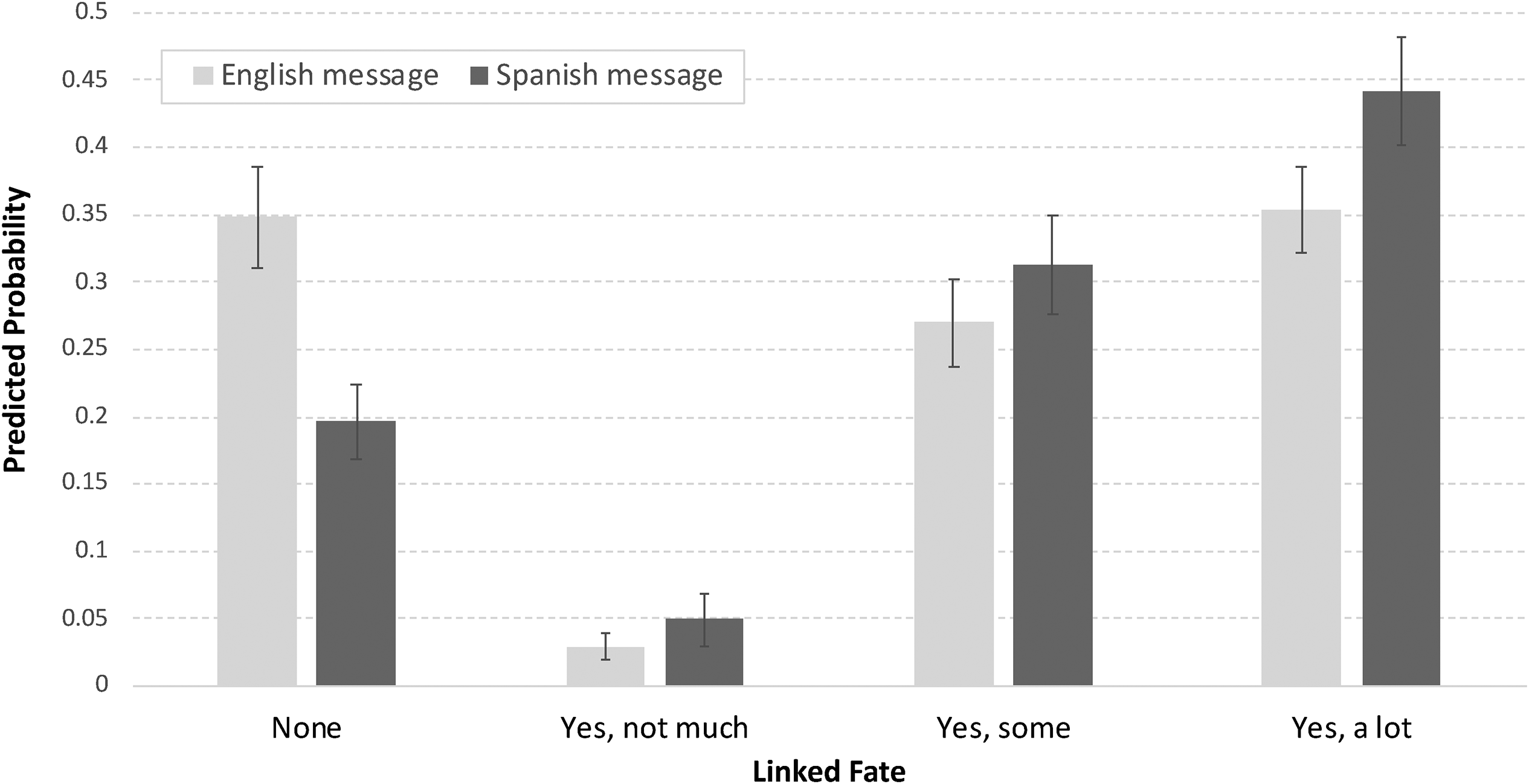
Predicted probability of reporting linked fate by language of message. Notes: Author’s analysis using 2019 Center for Social Policy National Policy (CSPNP) Survey; full results are presented in Supplemental Information File D.
Next, I present the results of the multinomial logistic regression analysis with an interaction between language exposure and news consumption, testing H2. 14 Figure 2 shows the predicted probabilities of reporting no linked fate by the interaction between the language of message exposure and type of news consumption among bilingual Latinos. The results show that across all types of news consumption bilingual Latinos who received the message in Spanish were significantly less likely to report having no linked fate than their counterparts who received the same message in English. The results show that the greatest difference occurs among bilingual Latinos who consume SL news as this group was virtually unlikely to report not having linked fate (pr = 1.30 × 10⁻⁷). Among consumers of both English and SL news, the effect of exposure to content in Spanish decreased the predicted probability of reporting no linked fate by 15.8 percentage points. Similarly, the effect of SL exposure among bilingual Latino consumers of English news decreased the predicted probability of reporting no linked fate by 49% (corresponding with a difference of 16.1 percentage points. These findings provide support for H2.
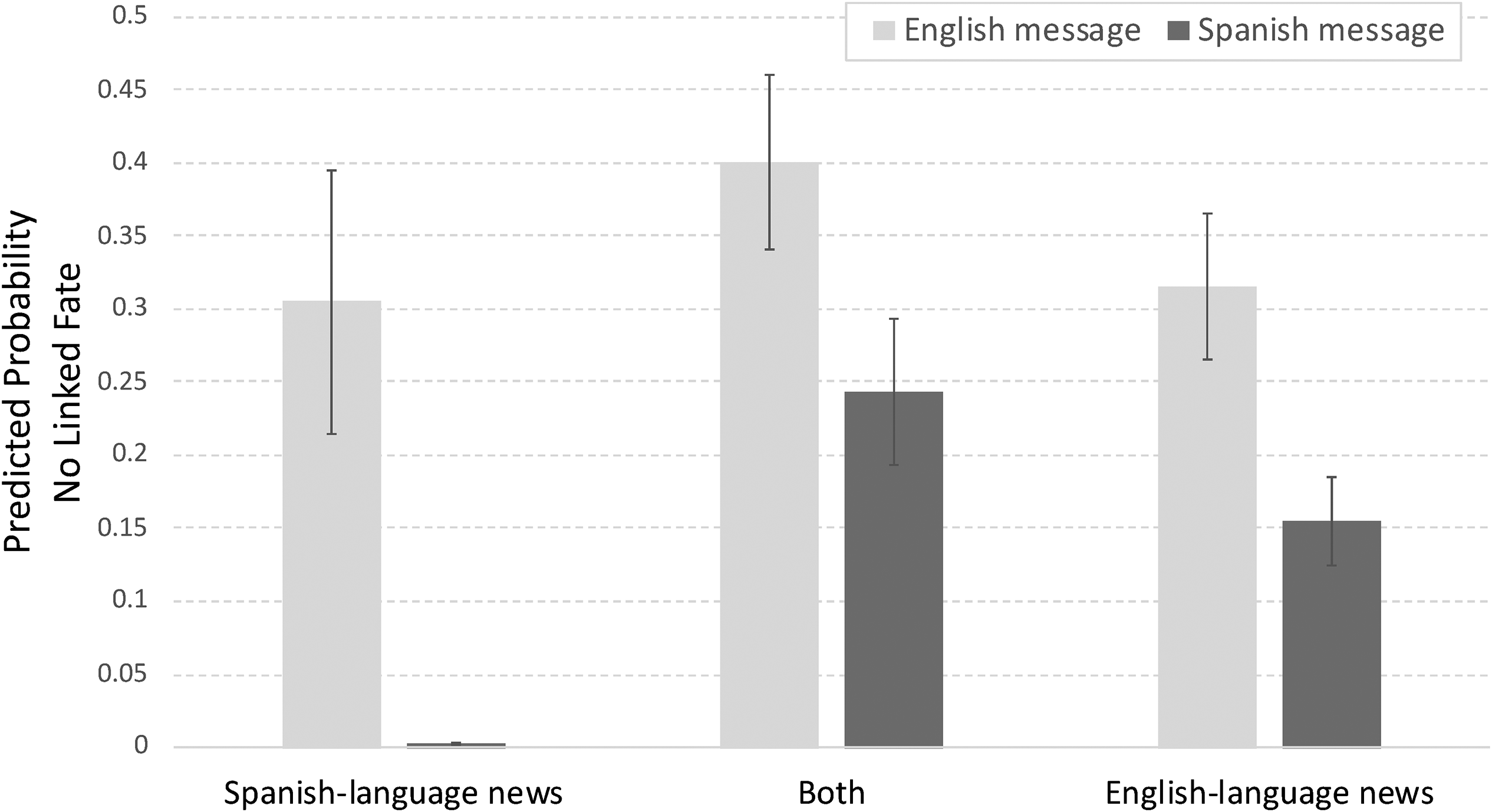
Predicted probability of multinomial logistic regression of Latinos reporting No linked fate, interaction between language of message and type of news consumption. Notes: Author's analysis using 2019 Center for Social Policy National Policy (CSPNP) Survey; full results presented in Supplemental Information File E.
Figure 3 shows the predicted probabilities of reporting some linked fate from the interaction between the language of message and type of news consumption among the subjects. Consistent with H2, the results show that among bilingual Latinos who consume SL news to some extent (SL news only or both equally) are significantly more likely to report having some linked fate than their counterparts who were exposed to the message in English. More specifically, the effects of exposure to content in Spanish among bilingual Latinos who consume SL news doubled the predicted probability of reporting some linked fate (corresponding with a difference of 16.7 percentage points). Similarly, the effects of exposure to Spanish among consumers of both English and SL news increase the predicted probability of reporting some linked fate 10.2 percentage points. These results suggest that exposure to a minority language has the strongest identity effects among bilingual Latinos who consume SL news because ethnic news, along with exposure to minority languages, can jointly retrieve consumers’ memories, thoughts, and knowledge structures as the LAT posit (Koslow et al. 1994; Noriega and Blair 2008). These findings provide support for H2 and highlight the importance of mediating mechanisms of language effects such as the consumption of ethnic media. 15
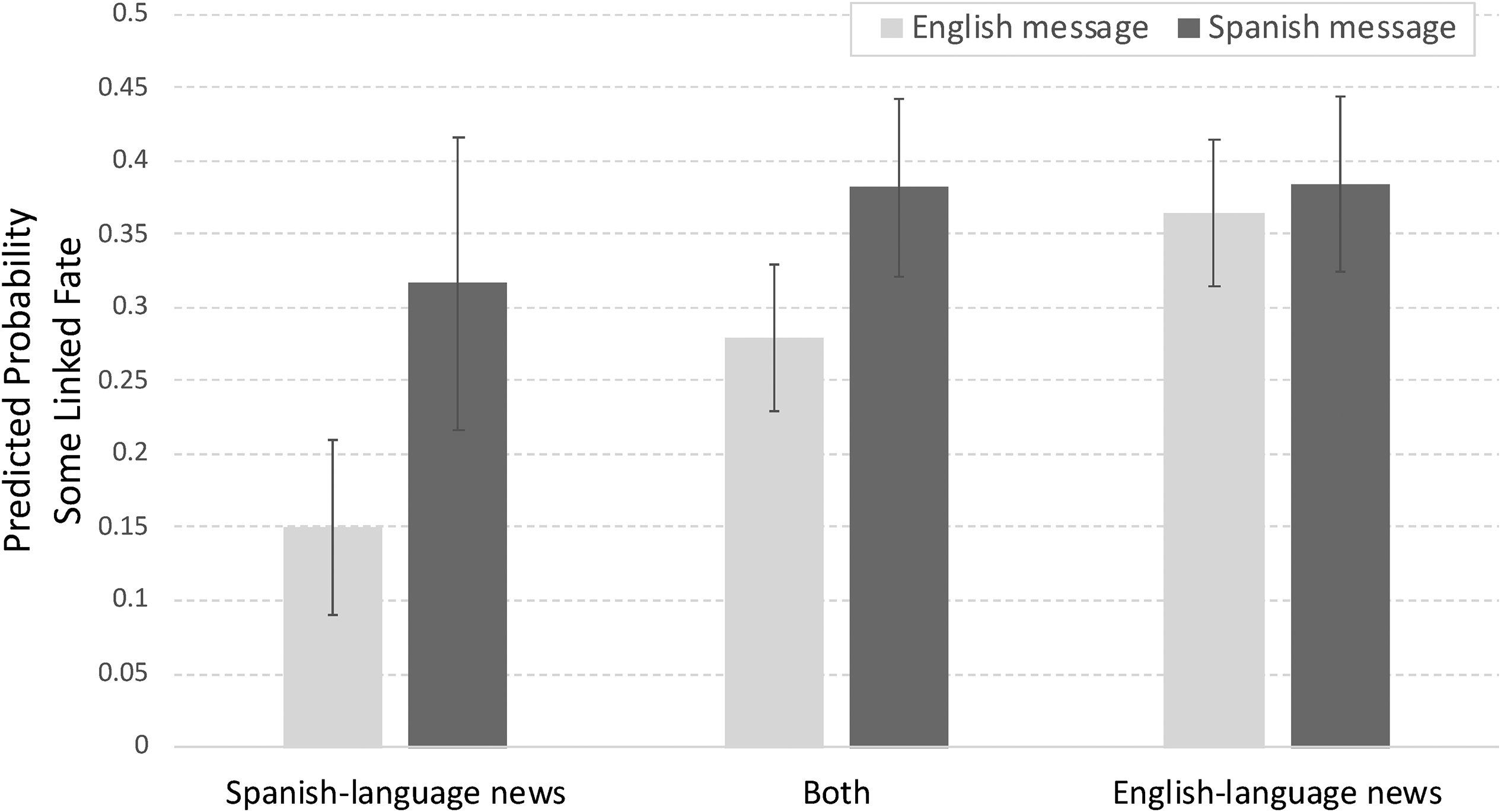
Predicted probability of multinomial logistic regression of Latinos reporting some linked fate, interaction between language of message and type of news consumption. Notes: Author's analysis using 2019 Center for Social Policy National Policy (CSPNP) Policy Survey; full results presented in Supplemental Information File E.
Discussion
This study examined the role of SL on the linked fate of bilingual Latinos, and whether the consumption of SL news media mediates such linguistic effects. Through a series of bivariate and multivariate analyses and a model with interaction effects, this study finds substantial effects of exposure to SL among bilingual Latinos. The results show that the effect of receiving a message in Spanish decreases the predicted probability of reporting no group affinity by 72%, and increases the predicted probability of reporting the highest level of linked fate by 25%. The results are robust as they are consistent among bivariate and multivariate analyses. Besides providing support for H1, these findings show the importance of Spanish, a U.S. minority language, on the identity of U.S. Latinos, whose presence has continuously grown in the past decades (US Census Bureau 2018).
This study also analyzes the extent to which ethnic media consumption impacts the identity effects that result from exposure to content in Spanish. Through a multivariate model with interactions between exposure to content in Spanish and type of news consumption, the results show that SL news media consumption amplifies these effects among bilingual Latinos. The predicted probabilities of the interaction show that bilingual Latinos who consume SL news have the greatest identity effects from exposure to Spanish. Figure 3 shows that among SL news consumers, the exposure to a message in Spanish doubles the predicted probability of reporting some linked fate among bilingual Latinos. These results are in line with LAT and identity priming, which suggest that SL news media consumption can prime Latinos’ group affinity through exposure to a minority language (Koslow et al. 1994; Noriega and Blair 2008). These results provide support for H2 and improve our understanding of the conditions in which minority languages are able to prompt perceptions of linked fate.
The incorporation of identity priming and LAT helps understand the role of minority languages on the identity of linguistic minorities, such as bilingual Latinos in the United States. The results of this study show that exposure to minority languages can prime perceptions of linked fate among bilingual Latinos and that these effects are amplified by the consumption of SL news. This finding may occur because SL news media consumers are regularly exposed to content that helps retrieve their connections to family members and countries of ancestry, creating affinity and warm feelings toward members of their ethnic group, as LAT posits.
This study also draws attention to the determinants of linked fate, which is a strong predictor for social and political attitudes and behavior, among U.S. Latinos (Masuoka 2006; Schildkraut 2013). Existing theories, such as SIT, have been widely tested among African Americans in the United States, who have a common historical background and shared discrimination experiences (Dawson 1994). Nevertheless, the determinants of group identity and linked fate across other ethno-racial groups such as Latinos and Asian Americans can be substantially different because of their distinct history, intragroup backgrounds, and integration process (Garcia Bedolla 2005; Masuoka 2008). While existing literature contends that linked fate and group identity among U.S. Latinos is formed through multiple traits such as nativity (Portes 1999; Sanchez and Masuoka 2010), discrimination (Masuoka 2008), educational attainment and socioeconomic status (Masuoka 2006), and consumption of ethnic media (DeSipio and Henson 1997; Subervi-Velez 1999), this study finds that exposure to SL has the ability to prime perceptions of linked fate. Future studies should explore whether exposure to minority languages has a long-term impact on identity formation, and whether this effect propagates across ethno-racial groups with linguistically diverse backgrounds such as Asian Americans, American Indians, and Middle Eastern and North African Americans.
Given that the vast majority of U.S. Latinos are proficient in Spanish and that one in every 5 Americans speaks a non-English language at home (US Census Bureau 2018), it is important to continue to study the implications of minority languages in our growingly diverse society. Today, the U.S. is home to more than 35 million linguistic minority adults who are eligible voters, representing over 15 percent of the voting-eligible population of the country. This issue is particularly important for Latinos and Spanish speakers not only because of the growing use of minority language appeals in U.S. campaigns and elections, but also because the United States is expected to be the largest Spanish-speaking country in the next decades (Instituto Cervantes 2016). Hence, this area of study has important implications at the national and international levels.
Supplemental Material
sj-docx-1-ijpp-10.1177_19401612211050889 - Supplemental material for Messaging “en Español”: The Impact of Spanish Language on Linked Fate Among Bilingual Latinos
Supplemental material, sj-docx-1-ijpp-10.1177_19401612211050889 for Messaging “en Español”: The Impact of Spanish Language on Linked Fate Among Bilingual Latinos by Barbara Gomez-Aguinaga in The International Journal of Press/Politics
Footnotes
Declaration of Conflicting Interests
The authors declared no potential conflicts of interest with respect to the research, authorship, and/or publication of this article.
Funding
The authors received no financial support for the research, authorship, and/or publication of this article.

Supplemental Material
Supplemental material for this article is available online.
Notes
Author Biography
References
Supplementary Material
Please find the following supplemental material available below.
For Open Access articles published under a Creative Commons License, all supplemental material carries the same license as the article it is associated with.
For non-Open Access articles published, all supplemental material carries a non-exclusive license, and permission requests for re-use of supplemental material or any part of supplemental material shall be sent directly to the copyright owner as specified in the copyright notice associated with the article.
