







Abstract
Social media news sharing has become a central subject of scholarly research in communication studies. To test current theories, it is of an utmost importance to estimate the meaningful parameters of news sharing behavior from observational data. In this article, we retrieve measures of ideological congruence, issue salience, and media reputation to explain news sharing in social media. We describe how the proposed statistical model connects to different strands of the news sharing literature. We then exemplify the usefulness of the model with an analysis of the relationship between ideological congruence and issue salience. Results show that if ideology and salience correlate with each other, the preferences of ideologues (i.e., users who give higher weight to ideological congruence) will be overrepresented in observational data. This will result in the heightened perceptions of polarization. We test the performance of the model using data from Brazil, Argentina, and the United States.
Introduction
Why do users share news articles 2 with social media peers? How important are ideological considerations, issue salience, and the reputation of a news organization in the decision to embed and share news hyperlinks? News sharing is a complex phenomenon that combines attitudinal and reputational traits with the broad effects on the propagation of news, exposure to news, and on journalistic professional practices (Boehmer and Tandoc 2015; Choi and Lee 2015; Kümpel et al. 2015; Strömbäck et al. 2013). As interest grows to explain the mechanisms underlying news sharing, scholars require workable empirical strategies to measure sharing behavior using the observational data.
This article advances a statistical model to derive the news sharing behavior from the observational social media data. Our method decomposes news sharing in three sets of parameters: (i) user-specific issue salience, (ii) news media reputation; and (iii) ideological congruence. These three sets of parameters align with three different and well-established research areas in the communication’s literature—described in Kümpel et al. (2015)—which focus on the individual incentives to share content (
To exemplify the usefulness of our statistical approach, we use Twitter data and test the relationship between ideological congruence and issue salience (Weaver 1991). Researchers have documented a positive correlation between political position-taking and news sharing (Delli Carpini 2004; Strömbäck et al. 2013), tested using survey and experimental data (Oosterhoff et al. 2018). If ideological congruence and user specific issue-salience 5 are positively correlated, ideologues would share news at higher rates than non-ideologues. The result would be that the preferences of ideologues would be overrepresented in observational data. We test for this relationship, finding support for a positive and statistically significant correlation between ideological congruence and issue salience in the observational data. We test our statistical approach with the data from the election of Bolsonaro in Brazil, the disappearance of the activist Santiago Maldonado in Argentina, and the TravelBan enacted by Donald Trump in the United States. 6
The organization of the article is as follows: in the next section, Section 2, we describe the importance of retrieving sensible behavior information from social media embeds to test current theories of news sharing using the observational data. In Section 3, we present a formal description of the statistical model and exemplify how to interpret the parameters of interest. We then, in Section 4, discuss the current research that argues why we should expect a positive correlation between ideological congruence and issue salience, a hypothesis that we can test using our estimation strategy. In Section 5, we describe our parameter estimates. Finally, in Section 6, we report a support for the hypothesized relationship between ideology and issue salience. We show that ideologues are not only more likely to share content from a narrower set of news outlets but they are also unconditionally more likely to share more news.
Our results contribute to the ongoing debate about the formation and dynamics of echo chambers in social media (Barbera 2020; Flaxman et al. 2016; Guess 2021; Sikder et al. 2020). The positive correlation between ideological congruence and issue salience explains why the content preferred by ideologues is overrepresented in social media networks. Even if partisan sorting is modest (Guess 2021), users may still perceive echo chambers when ideology and salience correlate with each other (Bail 2021).
Theory: A Statistical Description of News Sharing in Social Media Data
Why Is it Important to Develop a Statistical Model of News Sharing?
cIn a recent article, Kümpel et al. (2015) conduct a meta-analysis of 461 articles on news sharing published between 2004 and 2014. The authors note that the number of news sharing articles published every year in peer-reviewed journals increased from ten in 2004–2005 to over two hundred in 2013–2014. Nowadays, news sharing is a key phenomenon that shapes journalistic and editorial practices (Blanchett Neheli 2018; Russell 2019); forges reciprocal ties among journalists (Hanusch and Nölleke 2019), and is an important source for journalistic content (Von Nordheim et al. 2018). Indeed, with the rise of social media, news sharing and news sharing behavior have become central topics in the communication’s literature (Lee and Tandoc 2017).
The emerging research on news sharing centers on three distinct but interrelated phenomena is summarized by Kümpel et al. (2015) in their review of the literature. The authors group different strands of news sharing research into three types or families: First, there are user-level traits that explain the users’ preference for sharing content (“why do some users share more news than others?”). Second, Kümpel, Karnowski, and Keyling describe a burgeoning literature that focuses on content features that increase the likelihood of news being shared (“why is some content shared more frequently by users?”). Finally, a third strand of research focuses on group-specific features that segment news sharing (“why do these groups of users share these particular sets of news”?).
These different concerns yield a vast number of literature studies on the subjective, social, rational, and emotional factors that explain the individual behavior (Boehmer and Tandoc 2015; Boyd et al. 2010; Rudat et al. 2015; Scheufele and Nisbet 2013); the content-level features that facilitate news sharing (Karnowski et al. 2020; Macskassy and Michelson 2011; Suh et al. 2010; Trilling et al. 2017; Wang et al. 2012); and the group differences (ideology, partisanship, and network structures) that segment the audiences (Barbera 2020). As we propose below, these three different agendas correspond to distinct features of a news-sharing matrix of observational social media embeds, which may be jointly estimated and serve communication scholars working on the subject.
Modeling News Sharing Behavior: An Intuitive Description
We begin with a formal description of the three sets of parameters and their connections to the existing literature. Consider an individual user
Much of the earlier research on news sharing focused on the individual level incentives to share news. The Users and Gratification Approach (UGA) is a prime example, later extended to more general theories describing the norms, motives, and attitudes of users (Karnowski et al. 2018). We define this dimension of news sharing as issue salience: Def.1: Issue salient is the utility of sharing content on an issue that the user considers more important (row feature). Def.2: Reputation is the utility of sharing content from news outlets recognized as higher quality by peers (column feature). Def.3: Ideological congruence is the utility a user derives from sharing content that is consistent with her/his prior beliefs (cell feature).
How to Interpret Aggregate News Sharing Data
Consider a vector of social media users (rows) that embed hyperlinks to news published by media organizations (columns).
8
Table 1 of Figure 1 provides an example, with each user
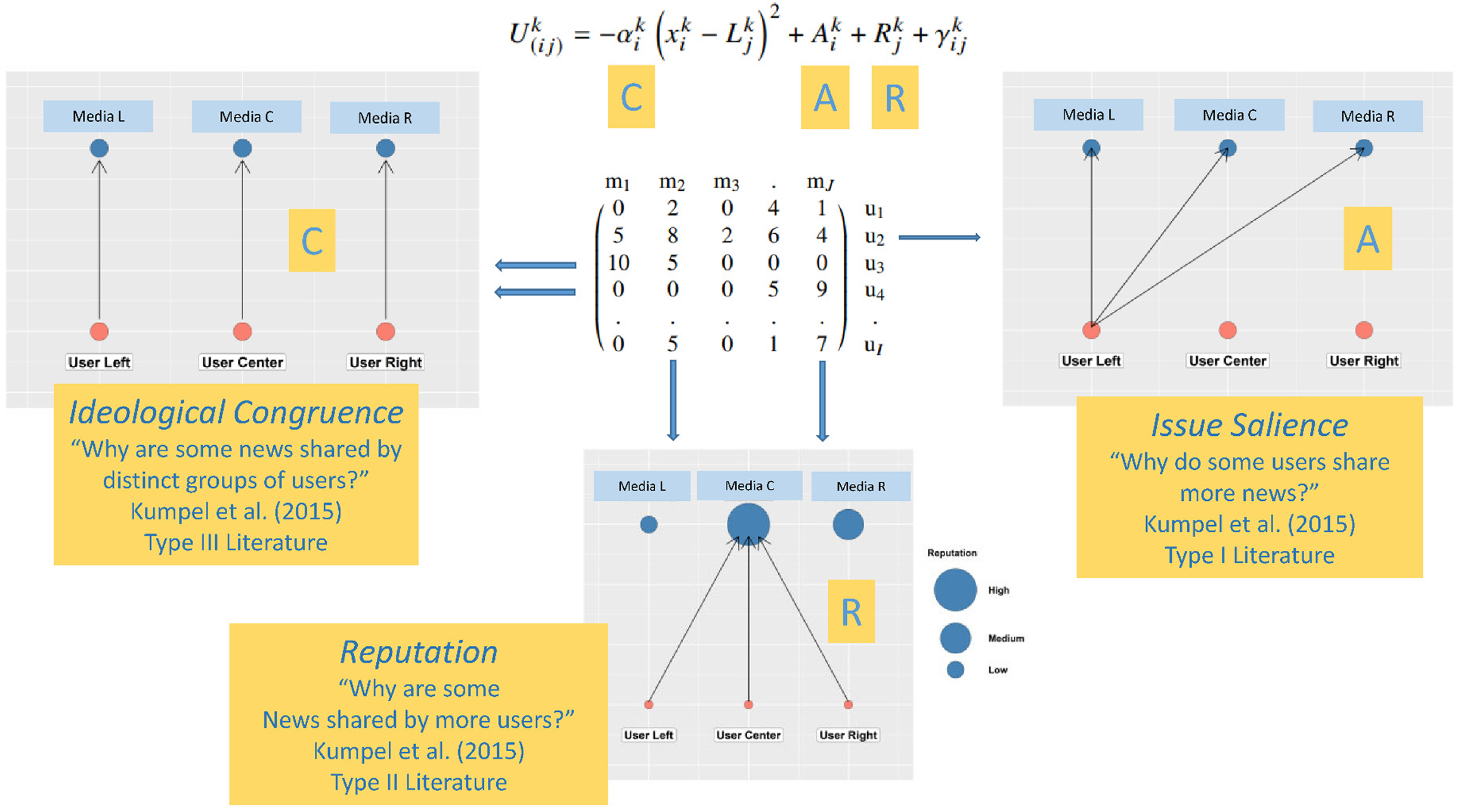
Theoretical model for news sharing. Notes: Table with counts of news embeds by user (rows) and media organizations (columns) is used to extract parameter issue salience, reputation, and ideological congruence.
In Table 1 of Figure 1, user
As political communication scholars, we value this information because knowing that some users really want to share content on an issue (rows) is conceptually different than knowing that content from some outlets is widely shared (columns). This is also conceptually different than knowing that some users share information from only some outlets (cells). Demand for news on an issue by users and prevalence of news by a source are conceptually different (Karnowski et al. 2020; Kümpel et al. 2015; Scheufele and Nisbet 2013; Trilling et al. 2017).
The Statistical Model: Nuts and Bolts
We now provide a detailed description of the statistical model. Consider a utility function where each social media user
The utility of user
By assumption, ideological dissonance is negative while reputations are positive. That is, users are less likely to share posts that disagree with their ideological beliefs and see a declining utility from news that is further removed or openly challenges those beliefs. While it is possible that users “ironically” share news that is cognitively dissonant, there is no empirical evidence that shows systematic sharing of dissonant content in social media. However, if users shared news that is cognitively dissonant (across the aisle), the model would describe such behavior.
Users also receive a positive utility for information they agree with if it is published by reputable news organizations. The reputation and the ideological leaning of news organizations may or may not be correlated with each other. Readers of Fox News, for example, may consider that its publications are of high reputation precisely because they minimize ideological dissonance. 10 Readers of the New York Times, on the other hand, may perceive that Fox News is both biased and of low quality because news published by this organization fail to align with the individual’s preferences. Other readers, however, may perceive that ideology and reputation are separate dimensions and are orthogonal to each other. For example, a conservative reader may perceive that the NYT and Fox News are of high reputation and that the New York Post, while conservative and congruent with her/his beliefs, is of low reputation. The extent to which ideology and reputation are interrelated is something that we can test for empirically.
Both ideology and reputation are issue-dependent. That is, users may perceive the New York Times as leftist when reading world news, but see this same organization as centrist when reading real state News. Readers may also perceive that reputation varies by issue, considering the book reviews of the New Yorker as being of higher reputation than those of the New York Times, even if they do not differ in ideological terms. Therefore, ideological proximity and reputation may vary by issue as well as by organizations.
Issues may also be more or less important to each user. We identify this behavioral parameter as the variable

Equation (1) also shows that news published by a more reputable actor,
Equation (1) also includes a stochastic term that captures overdispersion,
Sharing news can take many forms, such as reading (clicking), liking, or sharing content (retweeting). For simplicity, we consider the number of times users share content as the dependent variable. Multilevel estimation of the proposed model proceeds as in Zheng et al. (2006). Readers may readily observe that Equation (1) has a very large number of parameters and imposes significant computational demands. In the Supplementary Information File, we describe a strategy to reduce computational demands, binning issue salience—the row parameters—in quantiles. 11
Testing the Model: Are Ideologues Over Represented in Observational Data?
Table 2 summarizes our parameter definitions and measurement strategy. Readers may immediately notice that interesting questions emerge when considering the relationship between different parameter sets. For example, if the importance or weight that a user gives to ideology increases, will she/he also perceives the issue as more salient? Readers will immediately notice that if salience and ideological congruence are positively related to each other, ideologues would be more active and more readily observed in social media data. 12 Therefore, the content they share will be overrepresented, resulting in a network that appears more politicized (and likely polarized) than its average user. If ideologues preferences are over represented in news sharing data, therefore, the network will display heightened perceptions of polarization among the public. As it was described by Scheufele and Nisbet (2013): “Our social networks, that is, the people we are surrounded by in most of our daily activities, tend to be extremely like-minded and homogenous in their demographic and ideological makeup.” (Scheufele and Nisbet 2013: 46). Such perception, however, may be the result of how different users differ in their behavior rather than being a feature of their social compositions and network prevalence.
News Sharing Model - Parameters, Theory and Measurement.
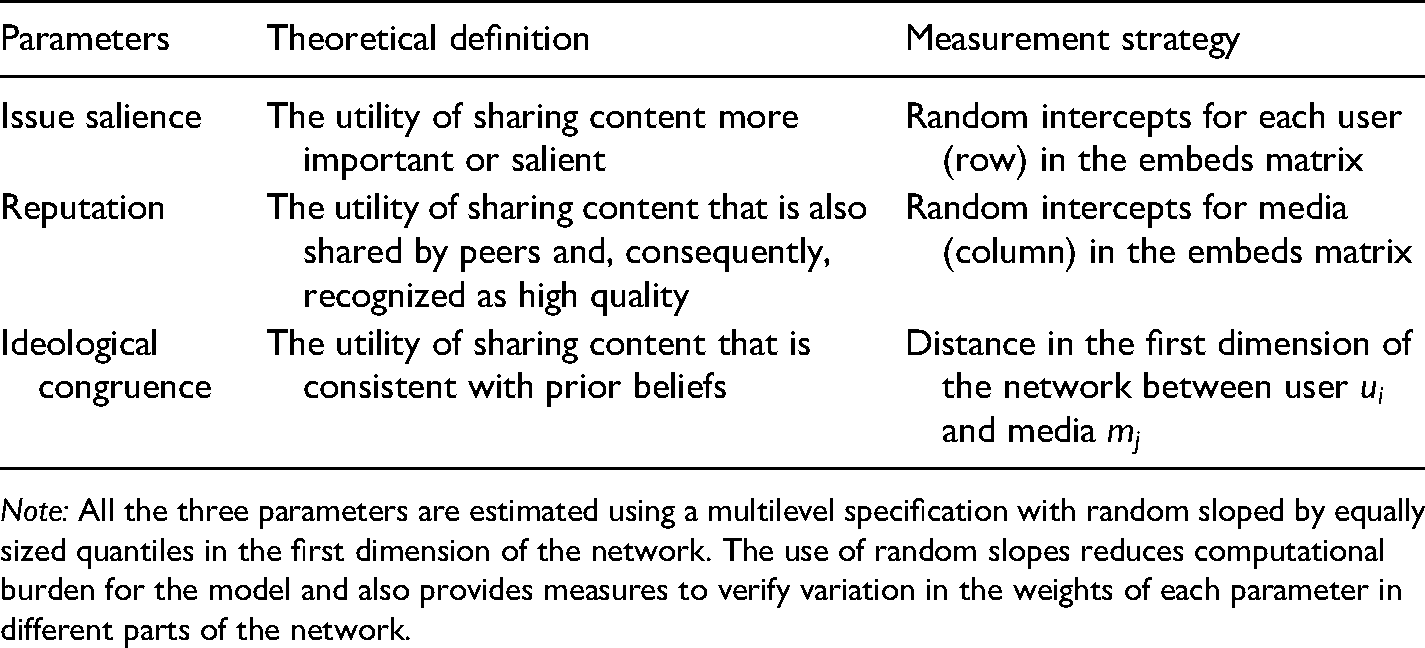
Note: All the three parameters are estimated using a multilevel specification with random sloped by equally sized quantiles in the first dimension of the network. The use of random slopes reduces computational burden for the model and also provides measures to verify variation in the weights of each parameter in different parts of the network.
The over-representation of ideologues in social networks is a variation on the well-known Friendship Paradox (Feld 1991), with more connected and more active nodes resulting in subjective perceptions of polarization that differ from mean polarization. If more extreme users differ from less extreme users on how frequently they share news, the result will be observational data that is more polarized than its users.
A broad literature on affective polarization has shown that intense ideologues are also unconditionally more motivated to participate in politics and in social media (Barberá 2020; Guess 2021; Huddy et al. 2015; Mason 2018). Similar findings—this time related to sharing fake news—in a recent study by Osmundsen et al. (2020), show negative partisan effects yielding large increases in the likelihood of sharing news. If negative and positive evaluations of political events result in users seeking and delivering information that is consistent with their preferences, motivated users will be both more enthusiastic as well as more attuned to particular types of evidence, which will positively correlate ideological beliefs and issue salience (Weaver 1991). Therefore, the hypothesis to be tested states the following:
Three Social Media Events: #Bolsonaro, #Maldonado, and #TravelBan
We provide evidence of the usefulness of the proposed model considering three different social media events in Brazil, Argentina, and the United States. 13 All three events took place in deeply divided political contexts and garnered significant political attention. In all three cases, we have a larger showing by users with more progressive leanings, who are protesting against right-wing shifts in the status quo.
The data collection for the three cases followed similar procedures. We collected data using both APIs available on Twitter: the forward stream and the backward search. The streaming API collects live data, letting users capture a portion of tweets in real time. The search API allows users to access a repository of tweets published seven days prior to the query. Our search used both APIs with three search terms: Bolsonaro, Maldonado, and TravelBan. By collecting data from both APIs we increase our sample (both in terms of size and source), therefore avoiding risks of messages’ removals and algorithmic bias made arbitrarily by Twitter for each API (Timoneda 2018).
After collecting the data, we limit our sample to a network of all retweets from the original data, and retrieve information about the edges (retweet), the author of the tweet (authority) and the users who retweeted the original message (hubs). We then retained the largest connected cluster of the network, eliminating users with less than two retweets (out-degree> = 2). With the thinned network, we draw users’ [x,y] coordinates implementing the Fruchterman-Reingold algorithm in igraph-R (Csard et al. 2006). We then ran the walk.trap algorithm to identify the main clusters in the network. We label these clusters as communities in our network, and we validate them with qualitative analysis of the main authorities in each cluster (see appendix C, Supplementary Information file). We describe below these communities, and the data collection for each case.
First, we consider the Bolsonaro network in Brazil, using 2,943,993 tweets published by 162,107 high activity accounts the week prior to the election of President Jair Bolsonaro, from September 26 through October 2, 2018. Bolsonaro is widely considered as a fringe right-wing candidate, who has stacked his administration with military officers, celebrated the use of torture by the 1964–1985 military regime, and introduced extreme legislation to reverse social policies in areas such as LGBT rights and welfare insurance. Jair Bolsonaro has been an extremely divisive political figure and, more important for this research, used a vast network of intelligence and “fake news mills” to support his presidential candidacy (Aruguete et al. 2021). Consequently, there are significant differences in the reputation of traditional media outlets and new extremely conservative ones.
The upper-left plot of Figure 2 describes the basic layout of the Bolsonaro network, with pro-Bolsonaro users in blue and anti-Bolsonaro users in red. Of the more than 2.9 million retweets analyzed in the data, 432,591 (14.7 percent) included hyperlinks. The number declines to 387,841 (13.2 percent) if we do not consider hyperlinks to other tweets. The most frequent news outlet embedded in the data is the pro-Bolsonaro O’ Antagonista, which represents 63,862 hyperlinks, 14.7 percent, and is intensively retweeted by core supporters of the current president.
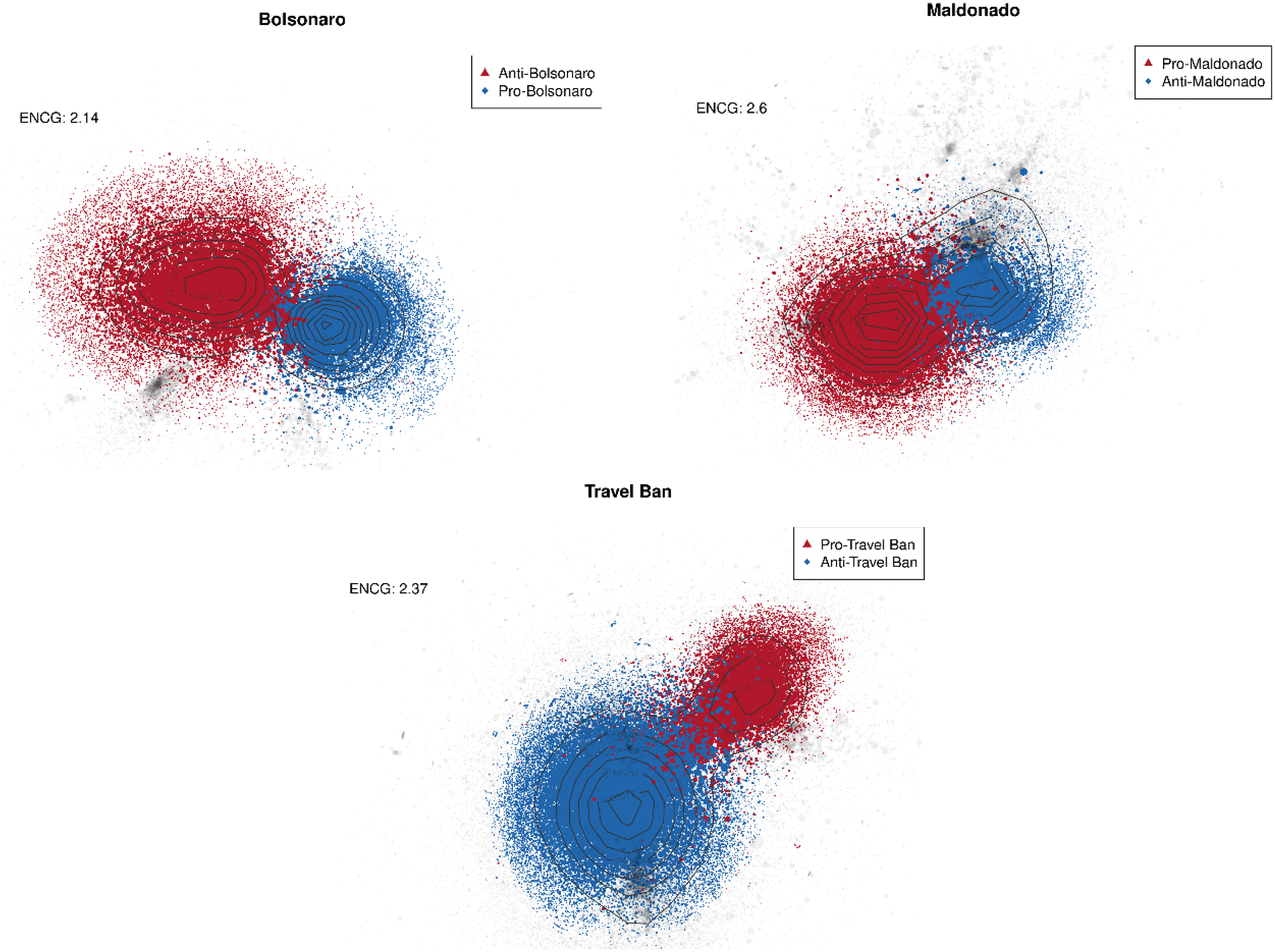
Visualization of all retweets in the bolsonaro network (upper-left), maldonado (upper-right), and travelBan (lower). Notes: Layout (Fruchterman-Reingold) and community detection (Random Walk) for the Bolsonaro, Maldonado, and TravelBan networks. Igraph in R 3.6.
In the case of Maldonado in Argentina, the upper-right plot in Figure 2, we analyze 5,325,240 tweets posted by 196,066 high activity accounts in the seventy-eight days that followed the disappearance of activist Santiago Maldonado, from August 1 to October 18, 2017. The disappearance of Maldonado was a deeply polarizing event. Different media outlets aligned for and against the government, which the opposition portrait as responsible. Of the more than five million retweets analyzed in the data, 816,694 (15.3 percent) included hyperlinks. The number declines to 513,659 (9.6 percent) if we eliminate hyperlinks to other tweets.
In the case of the TravelBan in the United States, lower-left plot of Figure 3, we analyze 2,031,518 retweets from 241,271 high activity accounts on January 30 and 31, 2017, following the decision of the Trump administration to restrict travel from seven majority Muslim countries. The basic layout of the TravelBan network shows pro-TravelBan users in blue and anti-TravelBan users in red. Of more than two million retweets analyzed in the data, 641,719 (31 percent) included hyperlinks. The number declines to 485,560 (23.9 percent) if we do not consider hyperlinks directed to other tweets. 14
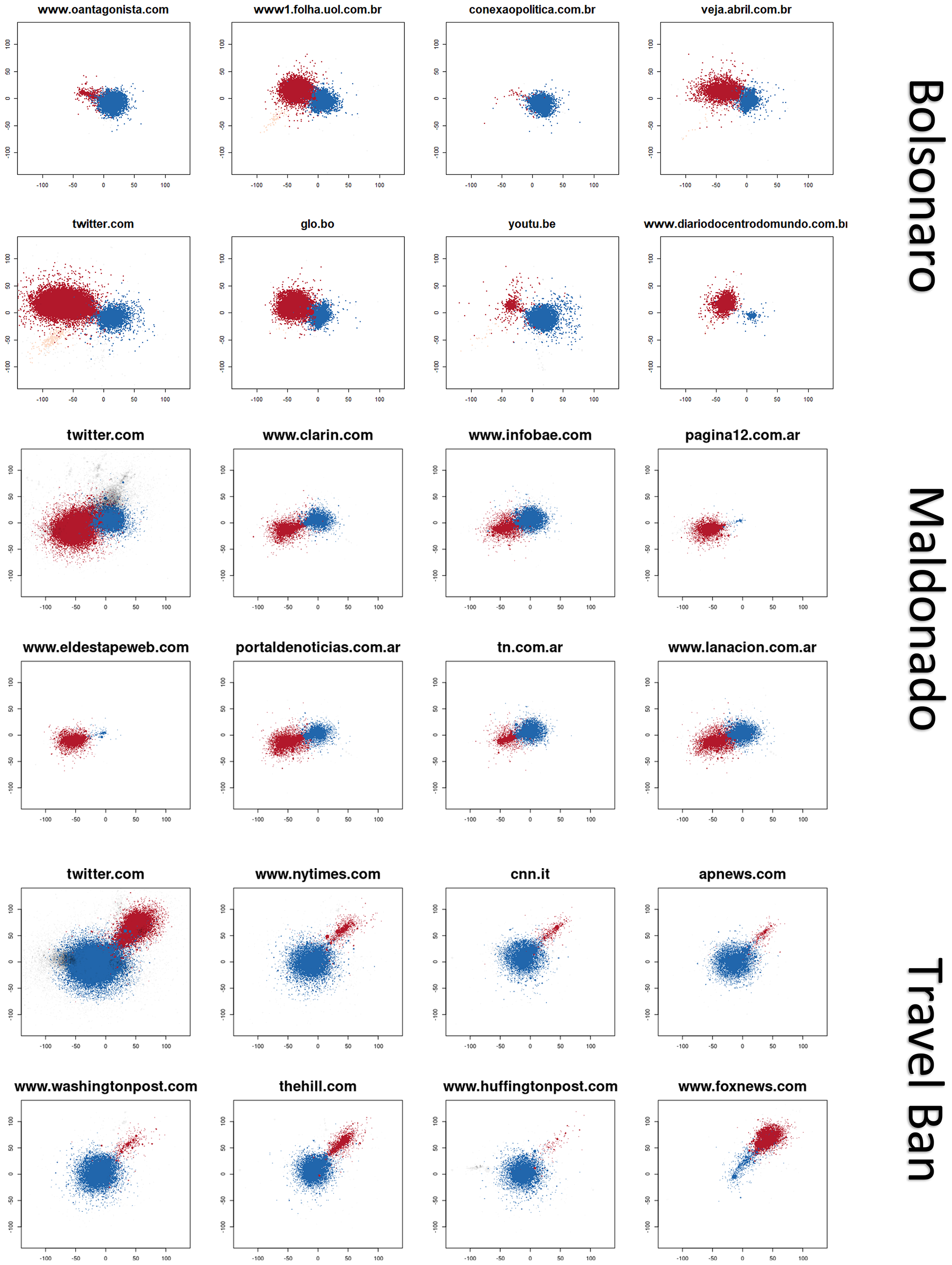
News sharing in bolsonaro (top), maldonado (middle), and travelBan (bottom).
For each of the three networks we retrieve the matrix of users (rows) and media organizations (columns), keeping only the twenty-four most frequently embedded news outlets. We retrieve the first dimension value for each user (horizontal axes in figures each plot of Figure 2), as a proxy for
A Visual Inspection of Media Embedding
Figure 3 presents twenty-four plots that describe the areas of the network activated by the top eight media outlets in Bolsonaro, Maldonado, and the TravelBan. The other forty-eight media outlets can be found in the Supplementary Information file. In all three of our cases, the activated nodes describe the region of the network where news sharing is more active.
The top plot of Figure 3 shows activation in Brazil, with O’ Antagonista and Conexão Politica activated more readily by users on the right of the political spectrum. The former was recently founded by three prominent conservative journalists that abandoned the weekly news magazine Veja. Meanwhile, Folha, Veja, and Globo are more readily embedded by users on the center and center-left of the political spectrum. Readers may also note a much larger share of links to Twitter on the left and more frequent links to YouTube on the right of the political spectrum.
Such is the result of the decision by Twitter to suspend accounts from the conservative group Movimiento Brasil Libre, who engaged from within YouTube on a very active campaign of misinformation. The decision by Twitter was mirrored by Facebook, who suspended over 100,000 WhatsApp accounts on what is without a doubt the largest astroturfing campaign in any election in the region.
The middle plot in Figure 3 shows distinct activation by Argentine outlets on the left (Página/12) or right (TN) of the political spectrum. However, other outlets such as La Nación are embedded by most of the conservative users but also by a significant number of moderates on the center of the political spectrum. Finally, in the case of the TravelBan, lower plot in Figure 4, we see outlets with a higher than average readership on the left of the political spectrum (New York Times) as well as those with a wider right leaning readership (Fox News).
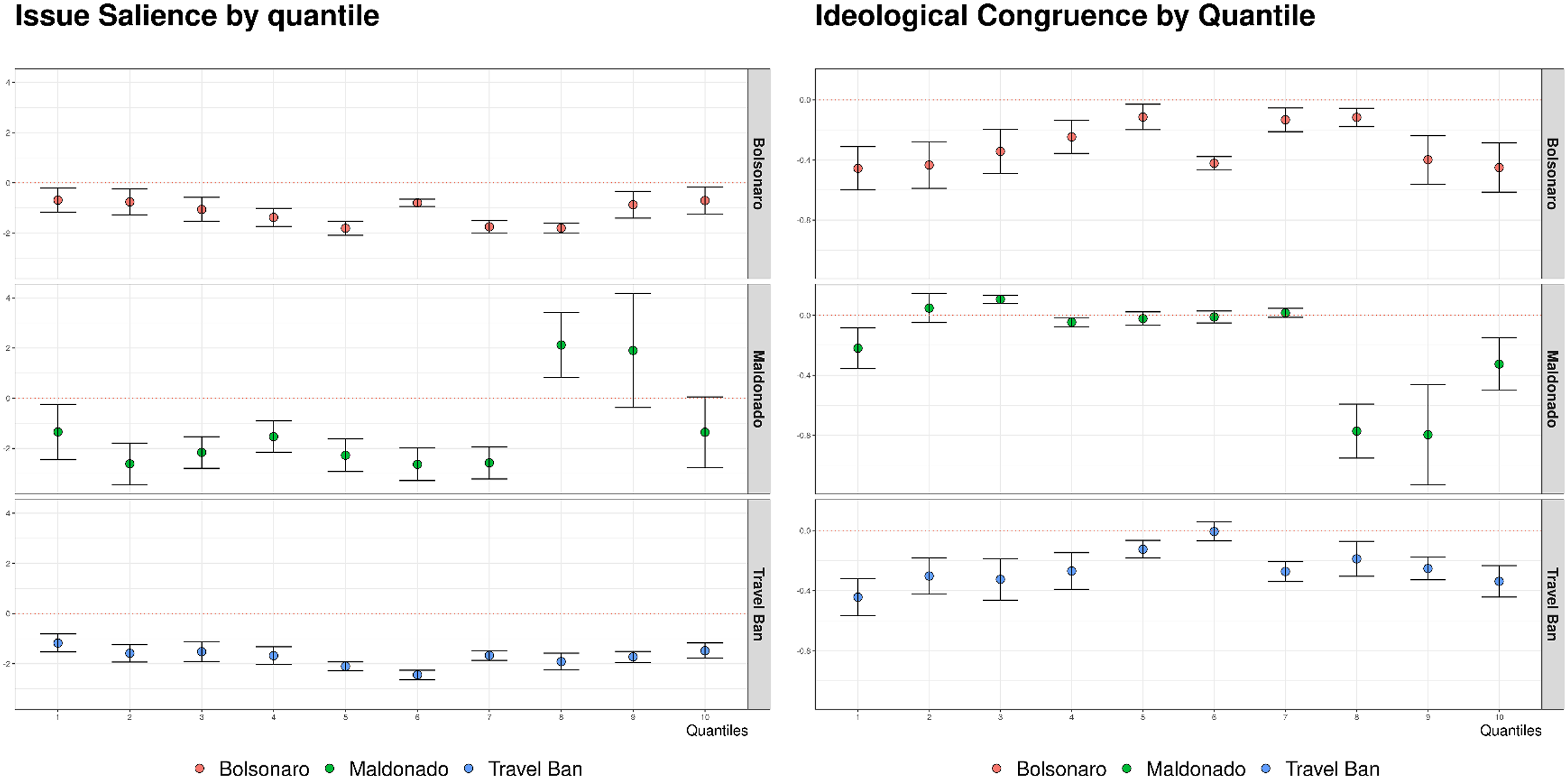
Ideology by quantile (left) and issue salience by quantile (right). Note: Parameters of ideology and salience by quantile estimated from Equation (1).
More important for our purpose, all twenty-four plots provide evidence of significant variation within and across networks, with some media outlets being more widely shared by all users, some media outlets more intensely shared by users in a particular region of the network, as well as other users more actively sharing links on the Bolsonaro, Maldonado, and the TravelBan networks.
Ideological Congruence, Issue Salience, and Reputation
Figures 2 and 3 describe the data captured in the three RxC matrices of news embeds of Bolsonaro, Maldonado, and the TravelBan. Using Equations 1 and 2, as well as the binning strategy proposed in Section 3.1, we proceed to estimate all three sets of parameters (ideological congruence, issue salience, and reputation). Figure 4 provides a visual comparison of the ideology and issue salience parameters by quantile for each of our three cases.
Because ideological distance is cognitively costly, larger negative values indicate that ideological congruence matters more. In the particular case of Maldonado, for example, users in the 8th, 9th, and 10th quantile, which corresponds to the core of the pro-Government sub-network, display large negative estimates, reflecting a high demand for congruent news. As it is also the case with survey data, ideological congruence tends to be more modest for users in the center of the network and it increases centrifugally as we move to the extremes.
If we compare our results with similar estimates in survey data, we will see that ideological congruence has a significantly larger weight in these networks. In effect, most estimates of ideological congruence in survey data fall in the range of [-.05, -.12], four times smaller than the estimates in observational social media data (Calvo and Hellwig 2011).
The right plot in Figure 4 provides estimates of issue salience by quantiles, with larger values indicating a higher propensity to embed links on the collection terms we use for each case. Consistent with the visual inspection of the data in the previous section, we see that users on the left and right of the political spectrum are more likely to pay attention to #Bolsonaro, #Maldonado, and the #TravelBan. Particularly interesting is the very high issue salience of users to the right of the political spectrum in #Maldonado, with activity that is orders of magnitude above the rest of the network. While users on the right of the political spectrum were fewer in number in the #Maldonado network, they still shared news on the issue at much higher rates.
Figure 5 provides estimates of the model’s reputation parameter. As described in section three, these parameters capture that propensity of users to embed links to media organizations once we control for issue salience and ideology. As expected, readers can observe that niche organizations on the left and right of the political spectrum are at the bottom of the list, given that most of the news sharing incentives is explained by the users’ ideological affinity with the media. By contrast, most traditional news organizations are more broadly shared once we control for the other factors.
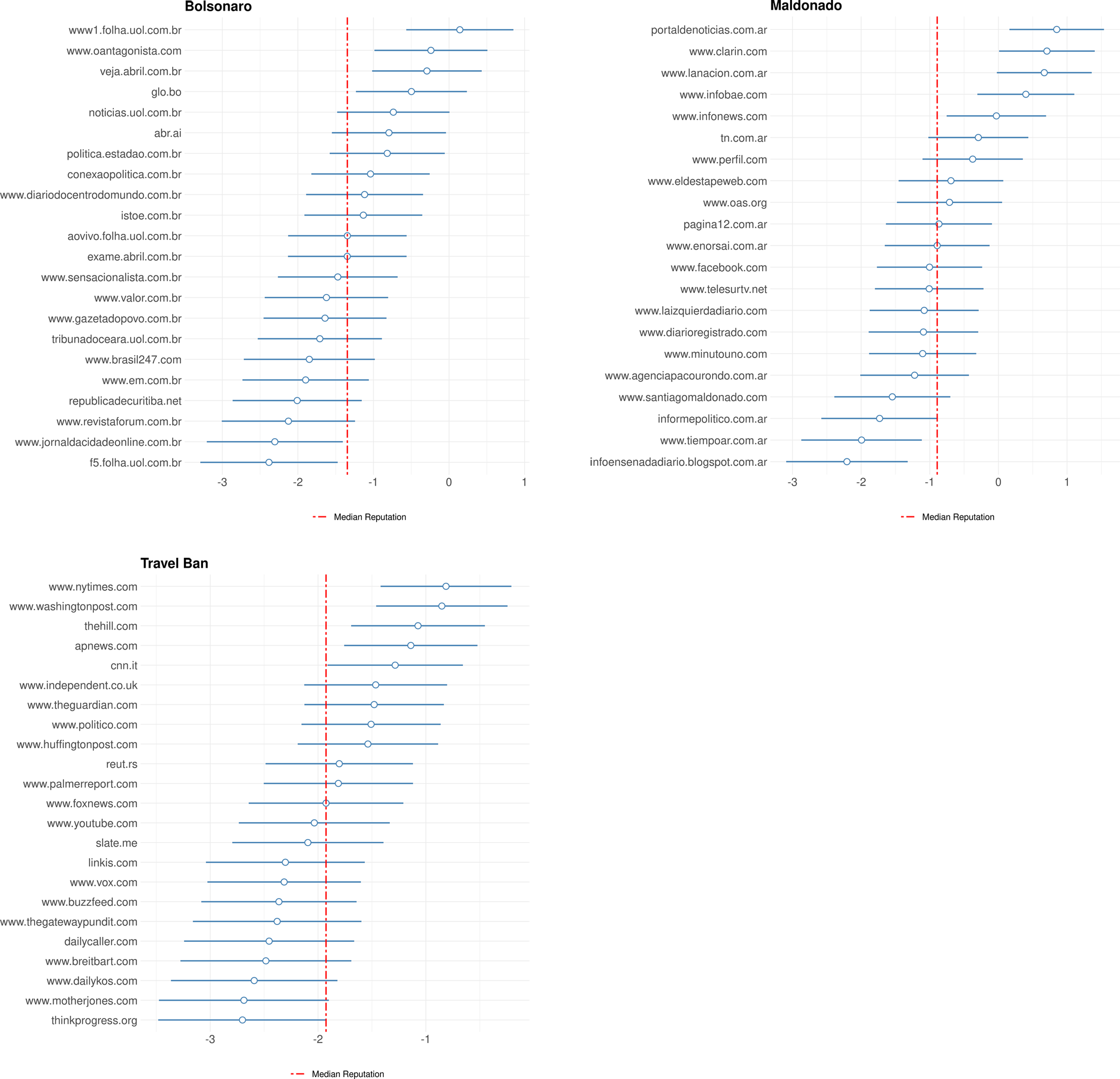
Reputation parameters by news organization in, Brazil, Argentina, and United States.
Notes: Estimates describe the
In the next section, we use the estimated parameters to evaluate the hypothesis that test for a positive correlation between ideology and issue salience.
Are More Intense Users Over Represented in Observational Data?
Once we estimate the importance of ideology, issue salience, and reputation in observational data, we may use our parameter estimates to test the hypotheses in Section 4, which asked whether more ideological users were over-represented in observational data. As it was presented, if issue salience and ideology are positively correlated, then political news shared in social media will appear to be more polarized than they actually are. That is, the preferences of intense ideologues would be over-represented in observational data.
Visual inspection of Figure 4 in the previous section hinted of a relationship between ideological preference and issue salience. The salience parameters in Bolsonaro, Maldonado, and the TravelBan closely align with the ideology parameters. It is worth reminding that while issue salience increases sharing behavior, ideological distance measures dissonance and, consequently, reduces sharing behavior. To simplify the interpretation of the results, we display
Results displayed in Figure 6 strongly support Hypothesis 1, with a close fit between issue salience and ideology in all three countries. Country correlations of 0.82 for the United States, 0.86 for Brazil, and 0.92 for Argentina validate the hypothesis for all three cases, showing clear support in observational social media data.
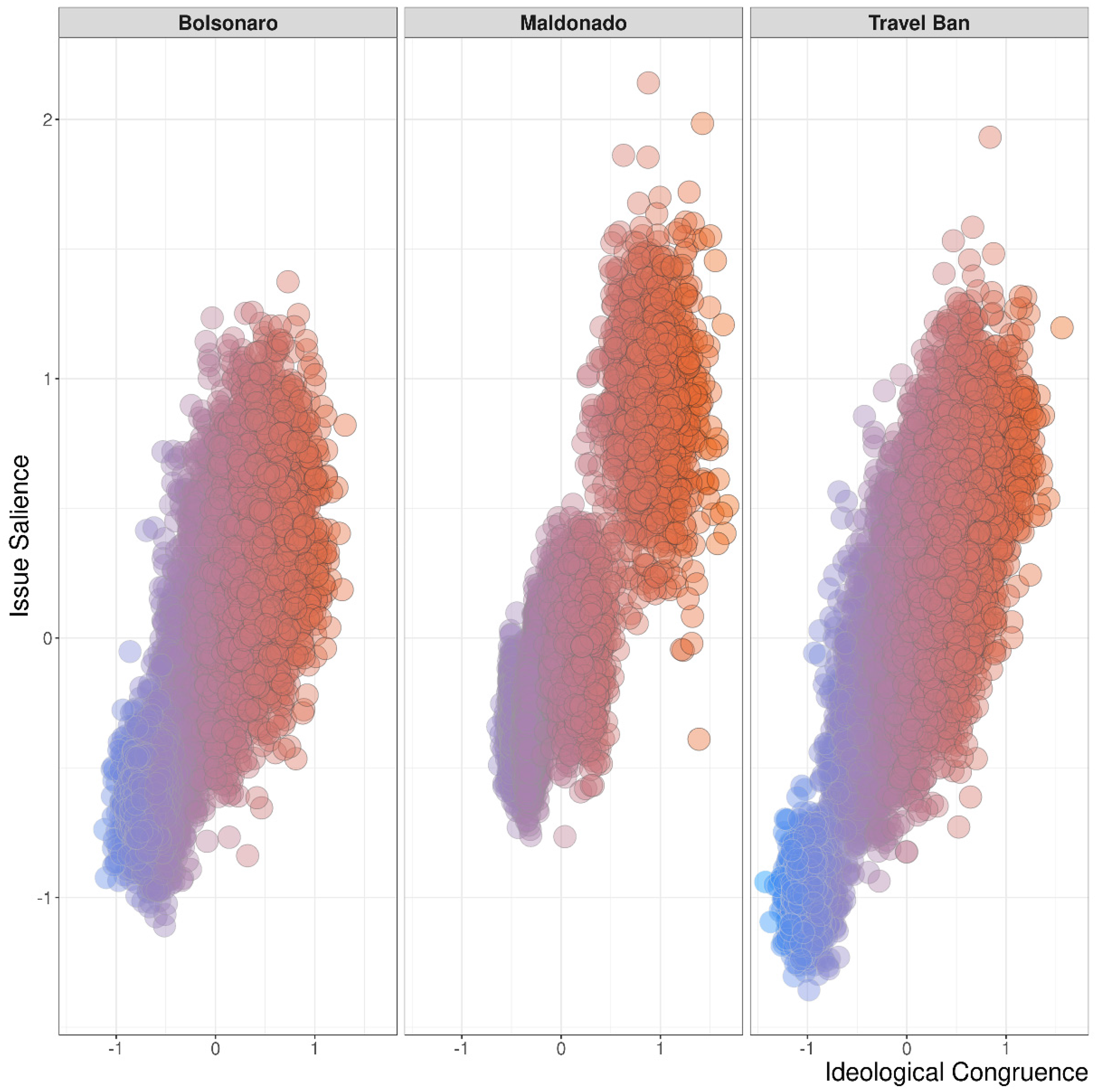
Relationship between the ideology and issue salience parameters, all three networks. Notes: The figures use augmented data from the parameter estimates in Equation (1). To provide a more intuitive understanding, we inverted the value of the ideology parameter; therefore, positive values for issue salience and ideological congruence means higher weights on both dimensions. The Pearson correlation between ideology and issue salience using the augmented data is 0.84, 0.92 and 0.86 for each network, respectively.
The joint effect of ideology and issue salience in Figure 6 provide a clear mechanism to explain the appearance of high ideological sorting in social media data (Aruguete and Calvo 2018; Barberá 2020; Flaxman et al. 2016; Osmundsen et al. 2020), which reflects the outsized weight of ideologues’ news sharing behavior on politically salient issues.
Figure 6 provides support for
Concluding Remarks
This paper describes a statistical strategy to study news sharing behavior using observational social media data. We propose a simple model that takes a matrix of embeds as inputs and estimates the importance of ideological congruence, issue salience, and reputation in social media data. Our model provides a path to test existing theories of news sharing using observational social media embeds. We exemplify this method with Twitter data from three major social media events in Argentina, Brazil, and the United States, although the model could use as input any
The model allows researchers to estimate meaningful parameters of interest from observational data. While there have been extraordinary computational advances in the study of large social networks, designs that answer practical communication theory problems receive considerably less issue salience. Our analysis combines computational tools with multilevel modelling to fill this gap, focusing on the behavioral determinants of news sharing.
As it pertains to the cases of Bolsonaro, Maldonado, and the TravelBan, results show that users on the left and right of the political spectrum are both more attentive to the issues and more likely to share ideologically congruent news. The proposed model allows us to test for a positive correlation between issue salience and ideology, which explains why ideologues are overrepresented in social media data.
The parameters retrieved from the matrix of news embeds may also be used to test other important communication problems, such as the editorial incentives to cater to extreme users (gatekeeping). Alternative specifications of the proposed model may also be used to explore the linkages between ideology and reputation. Finally, future extensions of this model may expand the matrix formulation to issue dimensions, with users (rows), media (columns), cognitive congruence (cells), and issues (layers). These are computationally tractable extensions that will allow researchers to work with flexible and scalable models to better understand news sharing behavior.
Supplemental Material
sj-pdf-1-ijpp-10.1177_19401612211057068 - Supplemental material for News by Popular Demand: Ideological Congruence, Issue Salience, and Media Reputation in News Sharing 1
Supplemental material, sj-pdf-1-ijpp-10.1177_19401612211057068 for News by Popular Demand: Ideological Congruence, Issue Salience, and Media Reputation in News Sharing 1 by Natalia Aruguete, Ernesto Calvo and Tiago Ventura in The International Journal of Press/Politics
Footnotes
Correction (May 2023):
This article has been updated with style corrections since its original publication.
Declaration of Conflicting Interests
The author(s) declared no potential conflicts of interest with respect to the research, authorship, and/or publication of this article.
Funding
The author(s) received no financial support for the research, authorship and/or publication of this article.

Supplemental Material
Supplemental material for this article is available online.
Notes
Author Biographies
References
Supplementary Material
Please find the following supplemental material available below.
For Open Access articles published under a Creative Commons License, all supplemental material carries the same license as the article it is associated with.
For non-Open Access articles published, all supplemental material carries a non-exclusive license, and permission requests for re-use of supplemental material or any part of supplemental material shall be sent directly to the copyright owner as specified in the copyright notice associated with the article.
