







Abstract
This study examines whether and how public media systems contribute to the health of democracies in 33 countries in Europe, Africa, Asia, North America, the Middle East, Latin America, and South America. We gather national economic data and public media funding levels, audience shares, and regulatory data, primarily for 2018 and 2019 but in some cases earlier, due to lack of available data. We then assess correlations with strength of democracy indices and extend Hallin and Mancini's typology of North American and European media systems through hierarchical cluster analysis of these 33 countries. We find five models of public media systems around the world, ranging from “state-administered” systems with low levels of independence (Botswana and Tunisia) to systems aligning with Hallin and Mancini's “Democratic Corporatist” model, with strong and secure (multiyear) funding, large audience shares, and strong regulatory protection for their independence. In between, we identify three mixed models: a “Liberal-Pluralist” model, a “Direct Funding” model, and a “Commercial–Public” model. Correlations and cluster analyses show that high levels of secure funding for public media systems and strong structural protections for the political and economic independence of those systems are consistently and positively correlated with healthy democracies.
As questions about journalism's future rise to the fore and mounting media-related challenges face democratic societies—from the proliferation of dis/misinformation to the collapse of local journalism and growing news deserts—attention has increasingly turned to the potential of publicly funded media for meeting information needs (Allern and Pollack 2019; Aufderheide 2020; Benson et al. 2017; Pickard 2020). Yet despite public media systems continuing to receive high levels of trust (Ali et al. 2021; Saurwein et al. 2019), the idea that governments should help fund media is still controversial (Overholser 2006; Nordenson 2007; Sehl et al. 2020). Suspicions toward media subsidies are especially pronounced in the U.S., where public media historically have faced various economic and political pressures (Aufderheide 1996; Pickard 2020).
A growing body of academic literature links strong public media (also known as “public service media”) to a range of social benefits. Public media systems have been shown to enhance public knowledge of public affairs, reduce inequalities in news provision, and produce more diverse and critical news coverage than commercial news outlets, particularly when these public systems are well-funded and protected from political interference (Aalberg and Curran 2012; Benson et al. 2017; Curran et al. 2009; Iyengar et al. 2010). Less is known about how specific dimensions of public media—such as funding levels, regulatory structures, and audience shares—strengthen crucial components of democracies, including levels of political participation, public attitudes about democracy (political cultures), and the free and open functioning of governments.
In this article, we correlate public media (1) funding levels, (2) audience shares, (3) funding structures, and (4) regulatory structures with the strength of democracy indices (Economist Intelligence Unit [EIU] 2020a) and economic activity (gross domestic product [GDP] 1 ) in 33 countries in Europe, Africa, Asia, North America, the Middle East, Latin America, and South America. Our comprehensive analysis of these 33 public media systems shows that funding mechanisms that deliver high levels of secure (multiyear) funding and regulatory structures that establish “arm's-length” relationships between public media and governments consistently go hand in hand with strong support for and engagement with democratic processes.
What the Research Tells us
The relationship between media and democracy is a central concern of a large body of normative theories proposing diverse roles for mass media, from fulfilling a basic need for information about public affairs to empowering democratic publics to express their views and mobilize for political action (Christians et al. 2009; Ferree et al. 2002). Given a large number of intervening variables, direct causal links between media and the strength of democracies are difficult to prove, though researchers have argued that significant correlations indicate “virtuous circle” relationships between the health of media and democracies (Holtz-Bacha and Norris 2001: 138).
In support of a virtuous circle between specifically public media and the health of their democracies, research shows that public media produce news with more breadth (diversity) and depth (substance) than their commercial counterparts. 2 Public media tend to produce programming that more broadly serves poorer households, communities of color, linguistic and ethnic minorities, and other groups and regions that for-profit media often neglect (Picard and Pickard 2017). Public media also have been shown to focus more on international news and public affairs, with less sensationalism than their commercial counterparts (Aalberg and Curran 2012; Curran et al. 2009; Cushion 2012; de Vreese et al. 2006). This higher volume of substantial news fosters greater public knowledge in these areas, encourages higher levels of news consumption, and shrinks the knowledge gap between economically advantaged and disadvantaged citizens (Curran et al. 2009; Holtz-Bacha and Norris 2001; Iyengar et al. 2010). Public television also correlates with less extremist views, as shown in a study finding that those who consume more commercial news hold more negative views toward immigrants (Jacobs et al. 2016).
However, relationships between media and democracy vary from one country to another and from one region to another, as shown by an expanding body of comparative research drawing on Hallin and Mancini's (2004) typology of Western media systems. This research indicates that large-scale democratic benefits most often are found among the world's best-funded public media systems, which also tend to have higher audience shares (Saurwein et al. 2019). People living in countries with strong public media systems have high levels of political knowledge, voting, and democratic engagement (Aarts and Semetko 2003; Albæk et al. 2014; Esser et al. 2012). Such effects remain after controlling for the possibility that more knowledge of current affairs leads to more public media consumption, rather than public media consumption increasing current affairs knowledge (Soroka et al. 2013).
As independence is considered a “core” requirement for any public media system (Council of Europe 2012), researchers have explored how an “arm's-length” relationship can be established between public media and governments through specific regulatory frameworks. The European Broadcasting Union (2015) has argued that public media must exist within legal frameworks that establish them as independent institutions; supervisory bodies must be separate from management and executive functions; and supervisory boards must be appointed in pluralistic processes, such as parliamentary proceedings that assure directors are not unilaterally appointed by elected officials. While critics often claim that public media are likely to be government mouthpieces, research shows that public media and government-subsidized private media are actually no less critical of government than nonsubsidized, privately owned media (Benson 2011; Benson and Powers 2011; Benson et al. 2017; Hallin and Mancini 2004). The Nordic public media model in particular has demonstrated a high degree of political autonomy (Carlsson 2013; Syvertsen et al. 2014).
Funding mechanisms, typically specified in laws establishing public media as independent institutions, also are important regulatory frameworks. Secure streams of multiyear funding, rather than annual appropriations, enhance public media systems’ independence, enabling them to strategically plan for future years without being compelled to plead their cases for funding each year in processes that can be highly politicized (Benson et al. 2017; Warner 2019). Direct funding linkages to the public through license fees or equivalent taxes also have been shown to enhance the independence of public media (Klimkiewicz 2015).
Among these correlations between funding and regulatory frameworks, national economic activity is an important intervening variable. Large public media audience shares and high levels of funding, commonly composed of both public and private revenue sources, are positively correlated with strong economies (Saurwein et al. 2019). Recent proposals for addressing journalism's crisis have foregrounded the importance of this variable by advocating the allocation of 0.1 percent of a country's GDP to fund media (Forum on Information and Democracy 2021).
Despite this growing literature, important questions remain. First, research is weighted toward Western European public media systems and rarely puts findings in relationship to democracy indices or ratings. One partial exception is a European Broadcasting Union (2019) report including EIU democracy indices for European, North African, and Middle Eastern nation-states, finding that well-funded public media with large audience shares are correlated with higher levels of political participation, political stability, and government oversight. Correlations with public media in other regions, such as sub-Saharan Africa, Asia, Latin America, and South America have remained largely unexamined.
Second, there has been little attempt to flesh out the nature of correlations between strong democracies and strong public media in a systematic fashion that not only includes a broader set of countries but also includes the broad array of key variables identified in prior research: funding levels, funding mixes, audience shares, regulatory and funding frameworks, and national economic strength.
Third, though media system typologies are prevalent in international comparative research, they generally assess public and commercial media together despite research demonstrating that these types of media have important differences. A comparative typology specific to public media systems can aid the development of new configurations of public support—both in terms of funding and regulatory frameworks—that can effectively address journalism's present crisis.
With these gaps in mind, our research questions (RQs) are:
Methods and Data Selection
To address these questions, we conduct a comparative analysis of public media systems in 33 countries. Comparative analysis recognizes that variations in studied phenomena occur across different media, political, economic, and cultural systems, and therefore observations within any single system are inadequate for generalization beyond that system (Aalberg and Curran 2012; Esser and Pfetsch 2004: Hallin and Mancini 2004).
We also acknowledge that our comparative analysis of public media systems and democracies cannot show clear causal relationships. However, comparative analysis enables us to find patterns across public media systems that are deserving, at a minimum, of further research. Furthermore, we agree with other researchers that correlations allow for “interpretations on the basis of plausibility,” and when correlations are found it is plausible to argue that a “virtuous circle” exists between aspects of media and democratic health (Holtz-Bacha and Norris 2001: 138).
Our analysis builds on Benson et al.'s (2017) research comparing public media in 12 democracies by examining connections between funding, audience shares, and regulation of public media and the healthy functioning of democracies in 33 countries spanning each of the seven global regions in the EIU's 2019 Democracy Index (EIU 2020a): Asia and Australasia; Eastern Europe; Latin America and the Caribbean; the Middle East and North Africa; North America; sub-Saharan Africa; and Western Europe. The EIU Democracy Index is a recent arrival among a large number of indices that take different approaches to assess democratic health such as Freedom House's freedom scale emphasizing rights and liberties (Freedom House 2021); Polity rankings emphasizing democratic versus autocratic authority (Center for Systemic Peace 2020); University of Zurich's “Democracy Barometer” emphasizing freedom, equality, and control (Bühlmann et al. 2012); and University of Gothenberg's Varieties of Democracy Project emphasizing freedom of elections, association, and expression (Alizada et al. 2021).
Since its debut in 2006, the EIU index has increasingly been adopted by researchers examining correlations with data of interest to different fields, such as public media, health care, and international relations (Brusis 2008; European Broadcasting Union 2019; Walker et al. 2015). We use the EIU index because it aims to provide “thick” measures of democracy encompassing many dimensions of democratic processes, including the functioning of government, political engagement and cultures, and civil liberties (EIU 2020a: 51).
As with other rankings of democratic health, the EIU Democracy Index is based on expert assessment (EIU 2020a). These assessments are supplemented by results of public surveys, in particular the Word Values Survey. Survey data are particularly important for EIU's political participation and political culture subcategories. The main EIU index (referred to in this study as the “Democracy Index”) is a number between 1 and 10 that is calculated from five subcategories, each with its own set of markers (60 in total) of the strength of democratic processes, cultures, and freedoms: (1) electoral process and pluralism, assessing the freeness and fairness of electoral systems; (2) functioning of government, assessing the degree to which freely elected leaders to determine policy without undue influence by other powers and corruption; (3) political participation, assessing the degree to which citizens are engaged and active in political processes; (4) political culture, assessing the degree of public support for democracy; (5) civil liberties, assessing freedom of media systems, citizens’ ability to freely associate, and support for human rights. EIU aggregates the results of these five indices to produce the overall Democracy Index for each country. In this article, we focus on countries ranked as “full democracies” (Democracy Index scores of 8.1 to 10) and countries ranked as “flawed democracies” (Democracy Index scores of 6.1 to 8). Lower ranked countries are classified as either hybrid authoritarian–democratic regimes or fully authoritarian regimes.
We gather from annual reports, news reports, and academic literature the most recently available data on the funding levels (public, commercial, and other revenue), funding composition (percent of funding from public vs. private/commercial sources), and audience market shares (see Supplemental Information file for a complete list of sources). Most data are from 2018 and 2019, though lack of availability in some cases prompted us to include funding data as old as 2012 and audience share data as old as 2007. Much of our data is used to produce proportions, which aids comparability between years (e.g., populations and funding levels tend to rise over time, and so proportions such as per capita funding levels show less variation than absolute values). Using data from different time periods is a potential limitation in our analysis, but it enables us to include a large variety of countries from around the globe. We conduct bivariate correlations using this data and the EIU's 2019 Democracy Index and its five subcategories to assess the strength of relationships between the health of each country's democracy and the public media system's funding and market footprint (RQ1).
Prior research recognizes a country's economic strength may affect the functioning of its public media (Saurwein et al. 2019) and recent analyses peg public media to proportions of GDP (Forum on Information and Democracy 2021). Accordingly, we take per capita GDP for each country for the year corresponding to our funding data and divide it by per capita overall revenue for each public media system to create a ratio of GDP per capita to overall revenue per capita (GDP–funding ratio). The higher the GDP–funding ratio, the larger the disparity between the level of a country's economic activity, as measured by GDP per capita, and the funding level for its public media, as measured by total revenue per capita. We also assess bivariate correlations between GDP per capita and per capita public funding to assess correlations between economic activity and public funding of media, and between GDP per capita and the EIU democracy indices (RQ2).
All funding level and GDP data are adjusted by purchasing power parity (PPP) calculations, which account for the fact that a dollar goes further (has more purchasing power) in some countries than in others. PPP calculations for funding are done by taking the amount of funding in each nation's local currency and dividing it by that country's PPP factor, giving the funding level in international dollars (Eurostat and OECD 2012: 30). For most countries, PPP factors and PPP-adjusted GDP data are from the World Bank (see Supplementary Information file for all sources).
Because testing showed that variables for funding, audience, and GDP are not normally distributed, we use Spearman's coefficients, which provide accepted measurements of the significance of correlations for such variables (Dellinger 2017). Positive and negative correlations of 0.2 to 0.39 are considered “weak”; correlations of 0.4 to 0.59 are considered “fair”; correlations of 0.6 to 0.79 are considered “moderate”; correlations of 0.8 to 1 are considered “strong” (Chao 2017: 270).
We also comb through annual reports, charters, and other legislative decrees to gather data on the regulatory and funding frameworks for each public media system. We use this regulatory data to produce five dichotomous variables that mark the presence or absence of these positive dimensions of regulatory frameworks: (1) the existence of a license fee or equivalent funding source that directly ties the funding of public media to the public; (2) multiyear funding allotments that provide stable revenue streams largely immune from yearly interventions from governments in the form of annual appropriations; (3) the existence of a legal decree or charter that establishes the public media system as an independent institution with its own funding mechanisms and oversight structures; (4) the legal separation of supervisory bodies, such as boards of directors, from direct executive management of the public media system, typically through legal provisions for appointing executives by boards of directors; (5) the existence of legal frameworks that mandate at least nominally collective, pluralistic selection of all members of a public media system's board of directors and executive (management) officers (i.e., no unilateral appointment by executive power of a member of the system's board of directors or executive officers). 3 These are minimal formal requirements for independence drawn from published guidelines for public media systems and regulatory bodies (Council of Europe 2012; European Broadcasting Union 2015; European Commission 2011; Thatcher 2002), and we acknowledge that meeting these criteria, which reflect a primarily European perspective on regulatory frameworks, does not alone guarantee autonomy.
Because these are minimal formal regulatory requirements, we do not expect that any one of them is sufficient to enhance the contributions of public media to democratic health. We therefore combine all five regulatory variables in multiple regression analyses that take the EIU's Democratic Index and its five subcategories as separate dependent variables (i.e., each analyzed individually in separate multiple regression analyses) to assess how regulatory structures may strengthen democracies (RQ3).
Finally, we conduct a hierarchical cluster analysis of these 33 public media systems to develop a comparative typology of funding and regulatory arrangements that can help inform policy debates about strengthening public media and democracies (RQ4). Following procedures in prior analyses (see Brüggemann et al. 2014), we z-standardize our variables for overall funding per capita, percentage of revenue from public sources, audience shares, and our five dichotomous regulatory variables. We include these variables in a cluster analysis using Ward's method and squared Euclidean distances and descriptively label the resulting groups of public media systems.
Our selection criteria for countries are designed to produce a broad geographic spread while favoring the inclusion of higher functioning democracies, as well as countries that enable a comparative analysis that aligns with research on national media systems (Hallin and Mancini 2004). The bias toward stronger democracies is intended to exclude, to the largest possible extent, public media that primarily are organs of government communication, often referred to as “state-administered” media (Bermejo et al. 2014). Our criteria for selecting a country's public media for analysis are (1) strength of democracy: the country must be ranked as a “full” or “flawed” democracy in the EIU's 2019 Democracy Index; (2) geographic spread: up to four of the highest-ranked countries selected per region, except Western Europe, where we include the U.K. as a fifth country due to the strength of the BBC as an exemplar of public media systems, and Asia and Australasia, where we include Taiwan and India as fifth and sixth countries due to the vast geographic and geopolitical sweep of this region and due to India's large international footprint in terms of population and economy; (3) indication that quality data is available: the country must be included among prior public media research produced by Benson et al. (2017), Benson and Powers (2011), Bermejo et al. (2014), or the Public Media Alliance (Warner 2019). 4
We also include stronger democracies included in each of Hallin and Mancini's three media system typologies: Democratic Corporatist (blending commercial and state/civic logics, high journalistic professionalism, media parallelism with civic groups); Polarized Pluralist (higher state intervention in media markets, lower journalistic professionalism, strong parallelism among media and political parties); and Liberal (strong commercial logics, limited state intervention, high journalistic professionalism, low political parallelism).
Our final selection includes the following countries spanning EIU's seven defined geographic regions and Hallin and Mancini's (2004) three media system models: New Zealand, Australia, South Korea, Japan, Taiwan, and India (Asia and Australasia); Estonia, Czech Republic, Lithuania, and Latvia (Eastern Europe); Uruguay, Chile, Colombia, and Argentina (Latin America and the Caribbean); Israel and Tunisia (Middle East and North Africa); Canada and United States (North America; Liberal model); Mauritius, Botswana, Cabo Verde, and South Africa (sub-Saharan Africa); Norway, Sweden, Finland, Iceland, Denmark, and Germany (Western Europe; Democratic Corporatist model); France, Spain, and Italy (Western Europe; Polarized Pluralist model); and the United Kingdom and Ireland (Western Europe; Liberal model).
Correlations in Public Media Systems Around the World
We run bivariate correlation and multiple regression analyses on our variables to determine whether there are any notable (weak, fair, moderate, or strong) relationships between EIU's 2019 democracy indices for our 33 countries and our data on funding levels, the mix of public and commercial funding sources, audience shares, GDP per capita, and multiple dimensions of regulatory frameworks.
Funding Levels, Audience Shares, and GDP per Capita
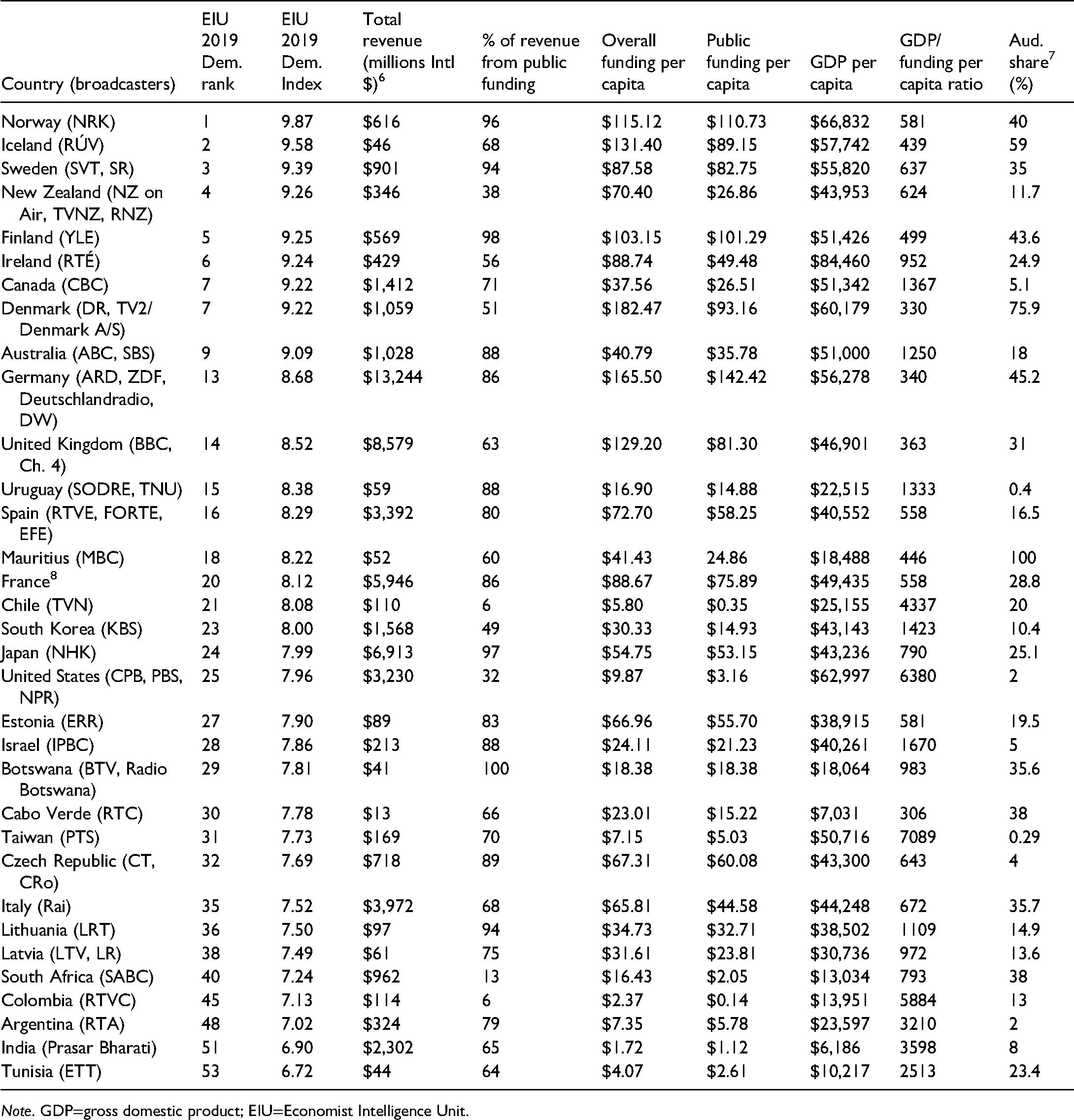
Table 1 shows data on each of our 33 public media systems’ overall funding level, per capita funding level (both overall funding per capita and public funding per capita), television market audience share, and GDP per capita, as well as each country's overall EIU Democracy Index score and ranking.
Democracy Indices, Public Media Funding Levels, GDP, and Audience Shares.
Note. GDP=gross domestic product; EIU=Economist Intelligence Unit.
Western European nations, and in particular Nordic countries such as Norway, Sweden, and Finland, lead the EIU's democracy ratings, and public media in these countries also enjoy high levels of per capita funding and large audience shares. Countries in EIU's Latin America and Caribbean region tend to have public media that heavily rely on commercial revenue, either in the form of advertising on public channels or in the form of revenues from commercial broadcasters that the state gathers and disburses to public media. These countries have very low proportions of public funding (6 percent in both Chile and Colombia).
Average per capita funding is $55.86, while average per capita public funding is $41.62. Western European countries tend to greatly exceed these averages (e.g., $115.12 per capita funding overall for Norway and $129.90 per capita funding in the U.K.), while countries in sub-Saharan Africa and Latin America, and the Caribbean tend to have much lower per capita funding levels (e.g., $18.38 in Botswana; $16.43 in South Africa; $5.80 in Chile; and $2.37 in Colombia).
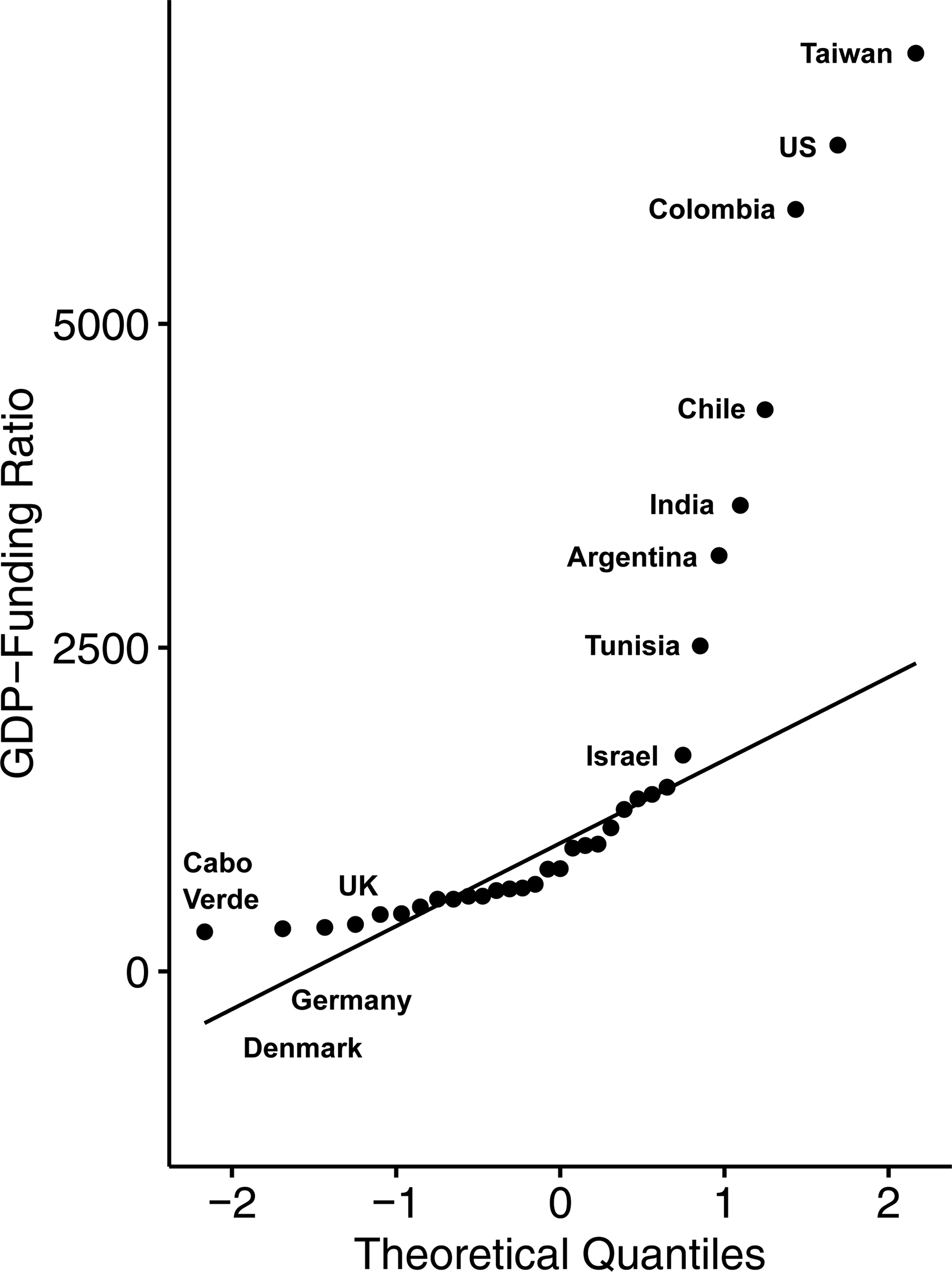
The U.S. is a clear outlier in having the world's largest GDP (Worldometer 2020) while its public media receives a well-below-average of $9.87 in per capita funding and $3.16 in per capita public funding. Figure 1 shows how countries compare in their support for public media as a proportion of GDP. Higher ratios show larger disparities between public media funding per capita and GDP per capita.
Distribution of countries by gross domestic product (GDP)–funding ratios.
Only Taiwan's GDP–funding ratio (7,089; Table 1) exceeds the U.S. ratio (6,380). Figure 1 also shows that countries in Latin America and South America have exceptionally large ratios. Two of these countries—Chile and Colombia—have primarily commercial-funded public media systems. Most ratios in other countries in our study remain within a narrow range (Cabo Verde's 306 and Israel's 1,670).
Audience share data also show great disparities among the world's public media, with shares again tending to be higher in Western European countries (e.g., 40 percent in Norway and 35 percent in Sweden) but also in sub-Saharan Africa (e.g., 35.6 percent in Botswana, 38 percent in Cabo Verde, and 38 percent in South Africa). Countries in Latin America and the Caribbean have public media with far lower market shares (e.g., 0.4 percent in Uruguay and 2 percent in Argentina). North American public media also are outliers (5.1 percent share in Canada and 2 percent share in the U.S.).
Bivariate Correlation Findings
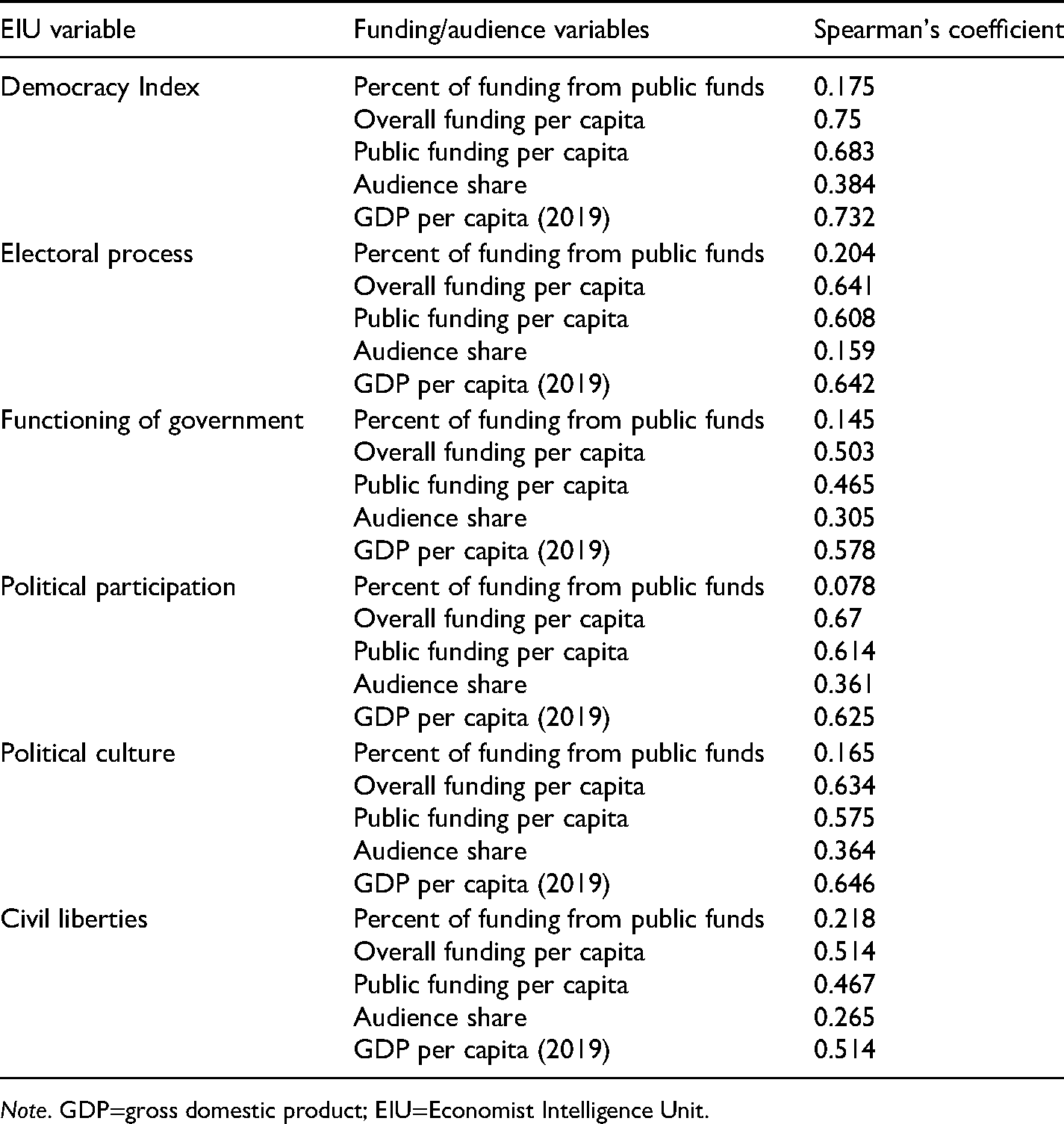
Our bivariate correlation analyses of relationships between EIU's democracy indices and the data in Table 1 consistently show positive correlations.
Among variables specific to public media, funding levels produce the strongest positive correlations, often rising to the moderate level (RQ1). The EIU's overall Democracy Index has a nearly strong positive correlation with overall funding per capita (0.75) and a moderate correlation with public funding per capita (0.683), which is a portion of overall funding per capita. 5 EIU's political participation and political culture indices are moderately and positively correlated with funding per capita (0.67 and 0.634, respectively). Fair or moderate correlations are found for funding per capita and electoral process (0.641), functioning of government (0.503), and civil liberties (0.514). Finally, weak positive correlations are noted for audience share for most of EIU's democracy indices, with the exception of the negligible correlation with the electoral process. The mix of public and private funding (percent of funding from public funds) shows negligible or weak positive correlations with EIU's democracy indices.
GDP per capita (2019) shows fair to moderate positive correlations with all of the democracy indices (RQ2). We also conduct bivariate correlations for GDP per capita and per capita public funding levels (government sources only; correlated according to years for which data was gathered), finding a moderate positive correlation (0.692, not in Table 2).
Correlations Between EIU Democracy Indices and Public Media Funding Levels, Audience Shares, and GDP per Capita (2019) in 33 Countries.
Note. GDP=gross domestic product; EIU=Economist Intelligence Unit.
Regulatory and Funding Frameworks
To assess the degree to which the regulatory and funding frameworks that enhance a public media system's independence are related to the strength of these countries’ democracies, we gather data (Table 3) on whether each system has stable funding directly linked to a citizenry (dichotomous variables signaling the presence of license fees, or equivalents, and multiyear funding) and whether the system has a degree of legal autonomy and pluralism in the appointment of its supervisors and managers (dichotomous variables signaling the presence or absence of a legally enshrined institutional framework, separation of supervisory and management functions, and collective appointment of top directors and managers).
Public Media System Regulatory Frameworks.
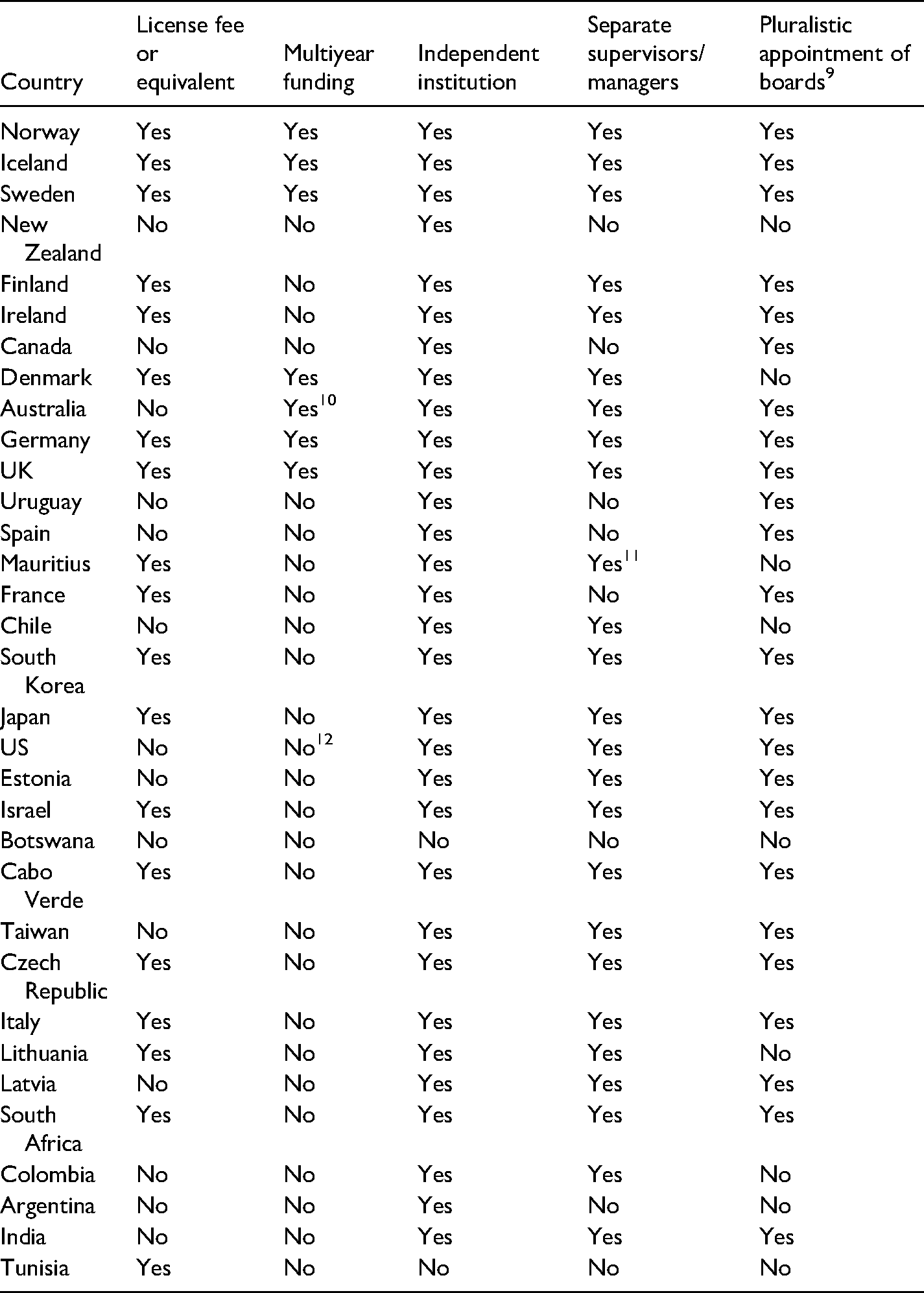
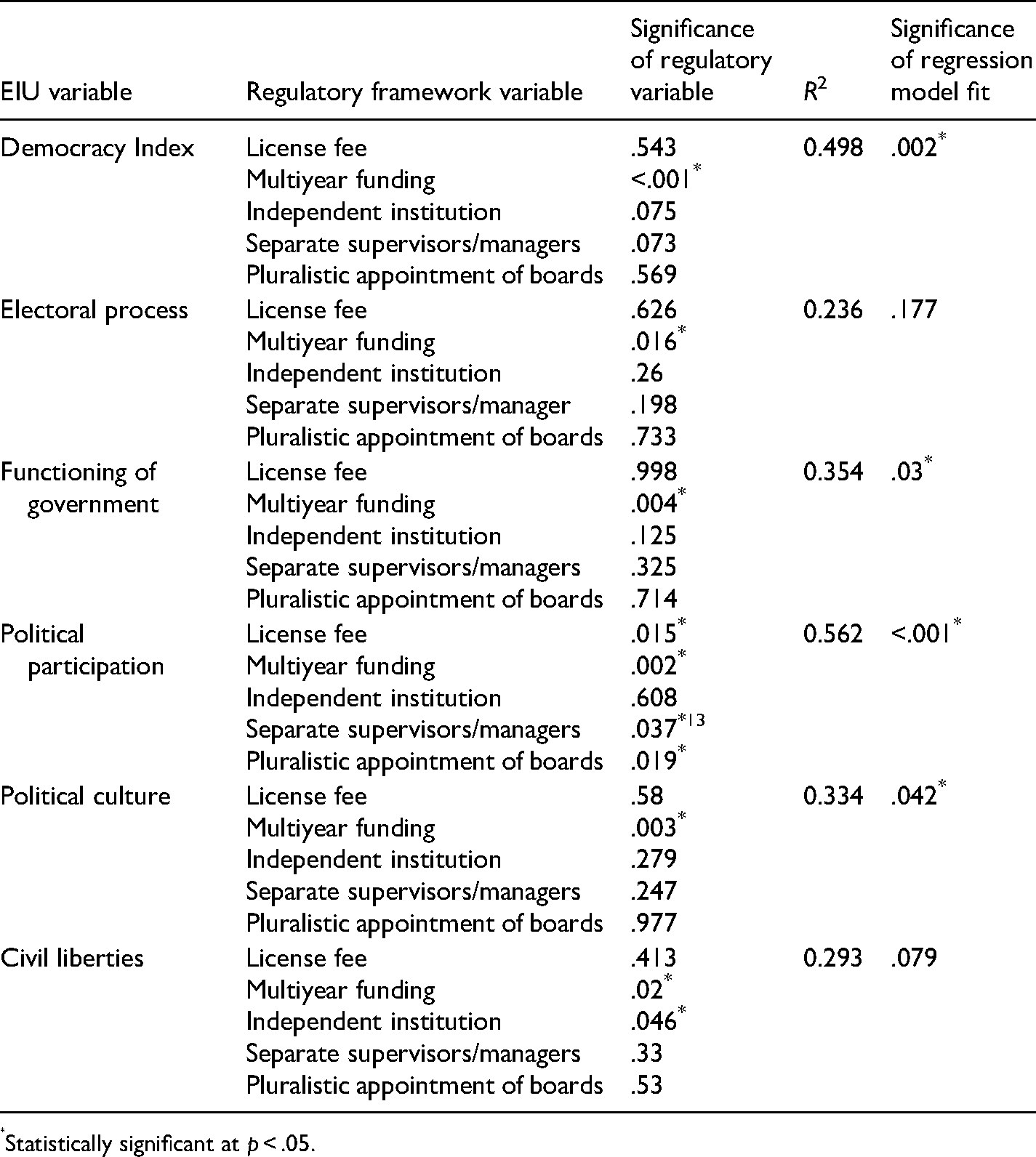
Table 4 shows the results of multiple regression analyses using all five of these dichotomous variables as explanatory variables and each of the EIU's democracy indices as dependent variables.
Multiple Regression of Regulatory Variables with Economist Intelligence Unit (EIU) Democracy Index Variables.
Statistically significant at p < .05.
Regulatory framework variables show significant relationships with EIU's functioning of government (p = .03), political participation (p < .001), and political culture (p = .042) indices (RQ3). Four of our five regulatory variables have significant relationships with political participation. Multiyear funding shows a significant relationship for all of the indices, as well as for the overall Democracy Index (p < .001). Our regression model achieves a significant fit with the overall Democracy Index (p = .002).
Cluster Analysis
We combine funding (overall funding per capita and percentage of revenue from public sources), audience share, and all five regulatory variables in a hierarchical cluster analysis of all 33 countries (RQ4). Figure 2 is a dendrogram showing clusters according to these variables.
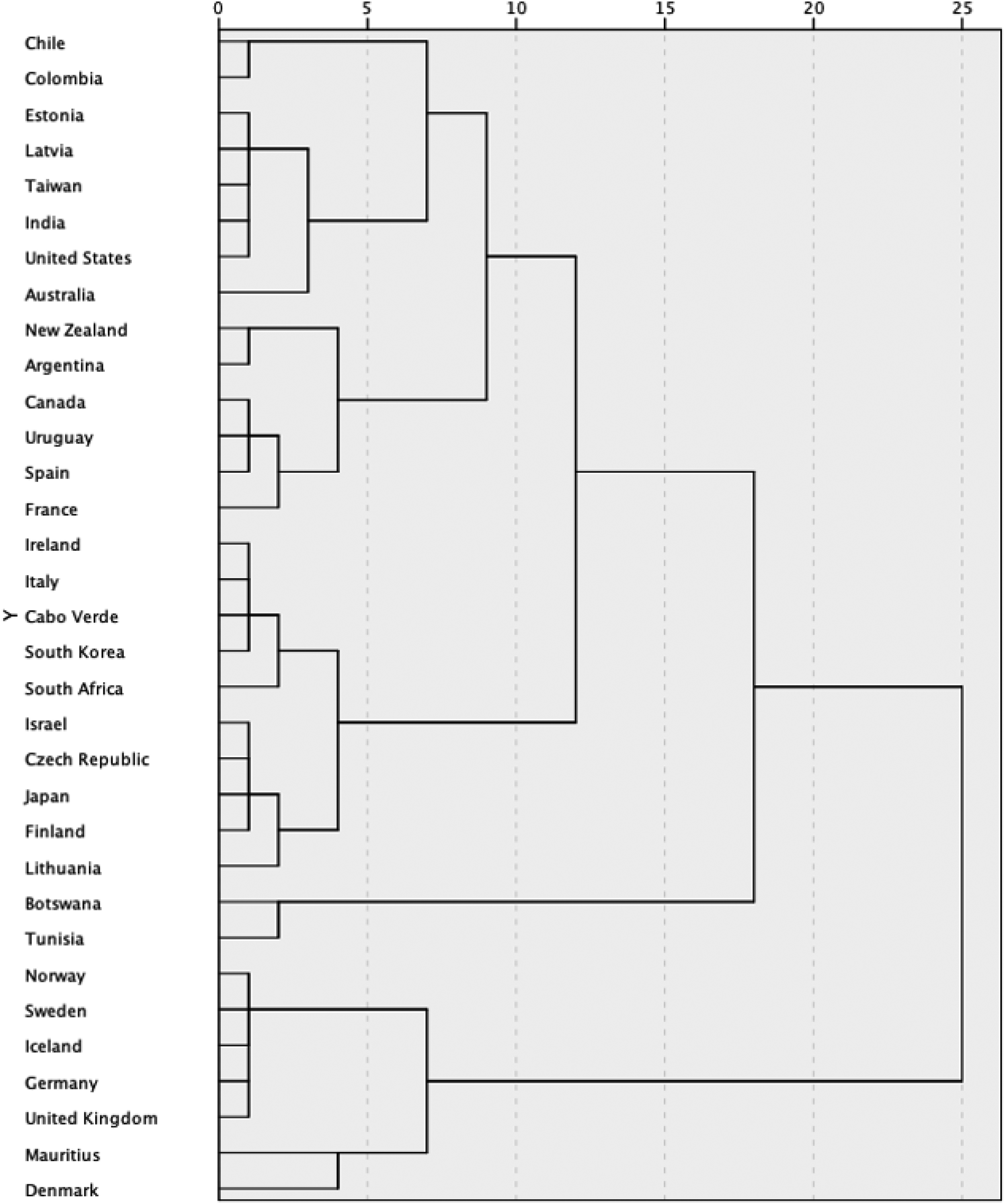
Hierarchical cluster analysis dendrogram.
This analysis shows five clusters of public media systems, which we have descriptively labeled. These range from “State-administered” systems with low levels of independence (Botswana and Tunisia) to systems aligning with Hallin and Mancini's “Democratic Corporatist” model, with generally strong and secure (multiyear) funding, large audience shares, and strong regulatory protection for their independence (Norway, Sweden, U.K., Iceland, and Germany, with Mauritius and Denmark as outliers with less public funding as a proportion of revenues and weaker regulatory protection). In between, we identify three mixed models: a “Liberal-Pluralist” model, which mixes countries in Hallin and Mancini's “Liberal” and “Polarized Pluralist” models and includes public media systems that have, on average, moderate levels of less secure funding, weaker regulatory protections, and small audience shares (New Zealand, Canada, Uruguay, Argentina, Spain, and France); a widespread “Direct Funding” model encompassing most of the other public media systems in this study with funding directly linked to their publics in the form of license fees or equivalent taxes (though this funding is at a moderate level and is less secure than funding in the Democratic Corporatist model) and which is accompanied by generally strong regulatory protections and high audience shares (Ireland, Italy, Cabo Verde, South Korea, and South Africa in a subgroup with less public funding as proportion of all funding; Israel, Czech Republic, Japan, Finland, and Lithuania in a subgroup with more public funding as proportion of all funding); a “Commercial–Public” model, often found among EIU's “flawed” democracies, in which public media systems are, on average, more reliant on commercial funding and have small audience shares (U.S., Australia, Estonia, Taiwan, Latvia, and India, with strongly commercial Chile and Colombia outliers in this cluster). Table 5 shows cluster averages for all variables used in this analysis and cluster averages for the Democracy Index.
Cluster Averages, by Variable.
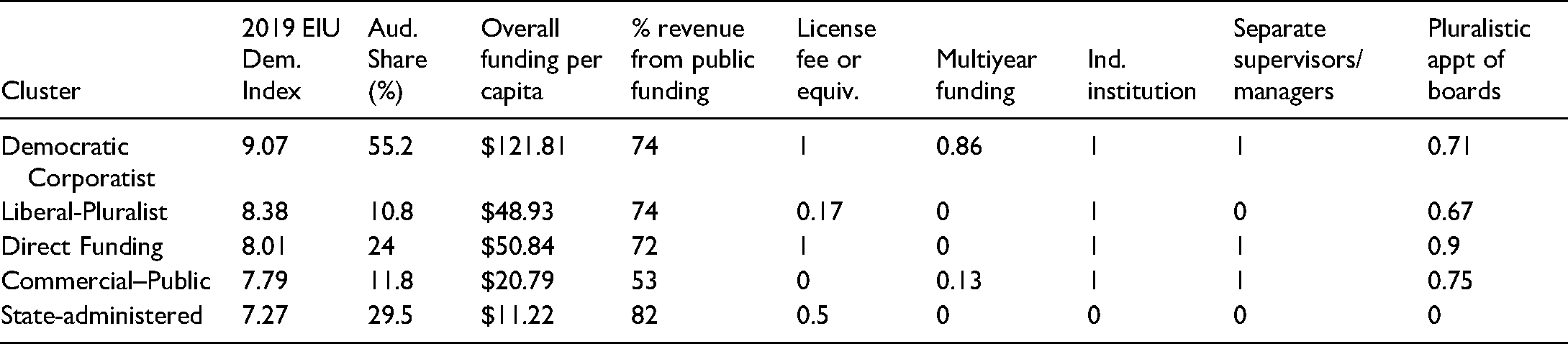
Democratic Corporatist public media systems stand out in this analysis for high audience shares, funding levels, and strong regulatory protections, as well as for a high average Democracy Index for the countries in which they are located.
Implications for the Journalism Crisis
These findings shed light on ongoing debates about the growing journalism crisis. With for-profit journalism around the world facing varying degrees of economic distress—especially as commercial journalism's advertising revenue model has collapsed and digital subscriptions largely fail to compensate for resultant losses—one increasingly common proposal to address this market failure is to expand public-funded media (Pickard 2020). Given concerns about state funding of media, especially in the U.S., it is noteworthy that our data show that countries with strong public media systems—measured in terms of funding levels, audience shares, and regulatory and funding structures—are far from despotic.
Indeed, our research shows that countries near the top of EIU's Democracy Index have well-funded public media with substantial footprints in their national media systems, and these public media tend to meet minimal criteria for regulatory and funding frameworks that assure autonomy and stable financial support. Even as revenues for commercial media organizations dropped precipitously over the past two decades, countries with robust public media systems maintained strong positions in EIU's rankings. However, the U.S. dropped from “full democracy” to “flawed democracy” in 2016 (EIU 2020b) and has continued to decline (score of 8.22 in 2006 and 7.96 in 2019). Such patterns, if broadly understood, may compel American citizens—and especially policymakers—to reexamine commonly held assumptions about the relationships between media subsidies and democracy.
Conclusions and Future Research
Our findings suggest that seeking “public options” to address commercial journalism's economic crisis also stands to improve the health of democracies around the globe. In particular, well-funded and institutionally secure public media can enhance public engagement with political processes, a crucial dimension of any “virtuous circle” relationship between public media and their democracies (Holtz-Bacha and Norris 2001: 138). High levels of public engagement are promoted when public media have secure public funding streams that help them achieve larger audience shares. This funding support should be accompanied by regulatory frameworks that ensure arm's-length relationships to governments by establishing public media as independent institutions with separate supervisory and executive functions, and pluralistic methods of selecting top leadership.
In terms of funding and audience shares (RQ1), we find compelling connections between high levels of funding and two of EIU's indices that assess the public's engagement with and perception of democracy: political participation and political culture. In most of our 33 countries, public media operate under a different set of rules and expectations than commercial media: they have mandates to serve the public interest, broadly defined rather than narrowly cast in terms of the most commercially lucrative audiences. Our findings also show that this mission consistently and positively correlates with a politically knowledgeable and engaged citizenry that highly values democratic forms of government. Audience shares also show positive correlations with the strength of democracies, suggesting that broader swaths of the public stand to benefit as well-funded public media gain larger footprints in their media systems.
We furthermore find evidence that public funding does make a positive difference, even though most correlations with our percent of public funding variable were weak or negligible. There are two countries in our analysis in which public media are not independent of their governments (Botswana and Tunisia). Additionally, New Zealand diverges from other leading democracies, as New Zealand on Air primarily distributes funds to cultural producers and partners with commercially funded but publicly owned Television New Zealand. These divergences are reflected in New Zealand's different regulatory frameworks and low proportion of public funding (Tables 1 and 3). Excluding these three countries from our analysis increases positive, though still weak (>0.2) correlations between proportion of public versus private funding and most of EIU's democracy indices, with the exception of political culture (0.186). In addition, we do not directly measure how public funding enables public media to maintain a focus on public service rather than on competing for audiences in a marketplace increasingly dominated by global media players (Warner 2019). 14 More research is needed to flesh out relationships between mixes of public and non-public funding and the health of public media and their democracies.
National economic activity (GDP per capita), an intervening variable in our analyses, is moderately correlated with democracy indices and public funding levels (RQ2). We cannot claim that public funding levels are more important than a country's economic health for the strength of democracies, but it is plausible that these correlations reflect a virtuous circle in which economic, public media, and democratic health reinforce each other. Here the U.S. situation is both striking and illustrative, as its world-leading GDP does not substantially trickle down to what remains a poorly funded public media system, and the country continues to decline in EIU's democracy rankings. Previous research suggests that public media in countries with larger populations can spread the relatively fixed costs of media production more broadly, and therefore per capita funding in these countries may tend to be lower than in less populous countries (Grossenbacher et al. 2015: 56). Regardless, the U.S. GDP–funding ratio of 6,380 (Table 1) remains a clear outlier in our analysis considering far smaller GDP–funding ratios in much more populous countries (India, GDP–funding ratio of 3,598) and in countries that also rank high in terms of population (U.K., 363; Japan, 790; South Africa, 793). Also troubling is the potential for the other side of a virtuous circle: a spiral of decline in which weaker support for public media in countries with lower GDPs and lower democracy indices further erodes democratic health.
Findings regarding regulatory structures that meet minimum needs for autonomy indicate that the security provided by multiyear funding arrangements—a funding structure that reduces uncertainty and helps suppress undue political pressure related to the need to seek annual appropriations—is particularly important for the health of democracies (RQ3). Political participation also has significant correlations with most of our regulatory variables.
Our cluster analysis suggests that there are five dominant models for public media systems around the world (RQ4). This analysis also reinforces our conclusion that high levels of public media funding, coupled with strong regulatory protections for public media's independence exist in a virtuous circle relationship to democratic health. Systems corresponding with Hallin and Mancini's Democratic Corporatist media system model, all of which are ranked as “full” democracies, starkly contrast with outliers in our cluster analysis: the U.S., Chile, and Colombia (all heavily funded by commercial or other non-public sources in the Commercial–Public model) and Botswana and Tunisia (heavily publicly funded in the State-administered model). In the first case, Democratic Corporatist systems have high levels of public funding and a large footprint in their media systems in terms of audience share, while their Commercial–Public counterparts are underfunded and occupy smaller niches in their media systems. In the latter case, Democratic Corporatist systems are distinguished from State-administered systems by a range of regulatory protections that ensure they are not used as government mouthpieces.
The prevalence of the “Direct Funding” public media model among both strong and weak democracies also indicates that in the absence of secure, multiyear funding streams, license fees do not always meet their full potential to support the health of public media and their democracies. Altogether, our cluster analysis shows that it is the combination of high funding levels, secure multiyear funding offers, direct links to the public in the form of license fees or their equivalents, the separation of supervisory and management functions, and the pluralistic election of supervisory boards that enable public media to provide strong support for political engagement and the overall health of their democracies.
Our study is limited to 33 countries, all categorized as full or flawed democracies by the EIU rankings, and we cannot claim that our findings apply to a different set of countries. We also acknowledge that our variables cannot capture all of the ways that public media systems are enhanced or undermined nor all of the ways they support complex and widely varying democratic processes around the globe. Future research could put funding levels, audience shares, regulatory structures, and other measures of public media health in relationship to other measures of democratic health and in more countries. For example, while we include some countries in the EIU's Eastern European region (Estonia, Lithuania, Latvia, and Czech Republic), our analysis does not include major Eastern European countries where public media have come under intense political pressure, such as Poland and Hungary. It also is critical to study such correlations over time, as countries rise and fall in such rankings each year. We also have focused on public television and radio, rather than online media, though in most cases the online offerings of public media are produced by these longstanding television and radio organizations. Future research should examine whether these new online offerings are changing the relationships we identify between public media and democratic health. Finally, our study focuses on a structural assessment of how public media support democracies, but other research shows that the cultures of public media systems may also influence their performance and independence (Sehl et al. 2016).
Another consideration for our future research is the relationship between public media institutions and local journalism, which is especially impacted by a “systemic market failure” as commercial journalism collapses (Pickard 2020). While some countries’ public media systems are moving into the gaps being left by receding print news media and responding to the local journalism crisis (U.K. and New Zealand), others are constrained (Germany) from competing with legacy publishers. As the journalism crisis worsens across the globe, these concerns will become more urgent, and empirically based research on these problems is increasingly useful.
Supplemental Material
sj-docx-1-ijpp-10.1177_19401612211060255 - Supplemental material for Funding Democracy: Public Media and Democratic Health in 33 Countries
Supplemental material, sj-docx-1-ijpp-10.1177_19401612211060255 for Funding Democracy: Public Media and Democratic Health in 33 Countries by Timothy Neff and Victor Pickard in The International Journal of Press/Politics
Footnotes
Acknowledgments
The authors thank our reviewers for their helpful contributions and Rodney Benson for his insightful comments and suggestions on an early draft of this article.
Declaration of Conflicting Interests
The authors declared the following potential conflicts of interest with respect to the research, authorship, and/or publication of this article: Timothy Neff’s postdoctoral research fellowship is supported, in part, by the Independence Public Media Foundation.
Funding
The authors received no financial support for the research, authorship, and/or publication of this article.

Supplemental Material
Supplemental material for this article is available online.
Notes
Author Biographies
References
Supplementary Material
Please find the following supplemental material available below.
For Open Access articles published under a Creative Commons License, all supplemental material carries the same license as the article it is associated with.
For non-Open Access articles published, all supplemental material carries a non-exclusive license, and permission requests for re-use of supplemental material or any part of supplemental material shall be sent directly to the copyright owner as specified in the copyright notice associated with the article.
