







Abstract
Research in political communication has recently begun to explore the role of non-Western English-language state-funded international broadcasters (NEIBs) in influencing international audiences. Despite this, there has been little attention given to understanding how NEIBs engage and influence young people in ‘Western’ democracies. Our article addresses this gap by providing a detailed analysis of RT's English-language, youth-orientated news product ICYMI. Launched in 2018, ICYMI is a social media-based news brand that consists of a series of 2–3-min videos that deliver satirical takes on recent global events including military conflict, financial scandals, and culture clashes. Our findings, which examine the first year of the platform's activity, show that ICYMI is a novel form of engagement, one that is not easily categorised as either public diplomacy or propaganda, nor can it be described as traditional journalism. Instead, we label this approach as geopolitical culture jamming. In this article, we conduct a discourse analysis of 45 videos published on YouTube by ICYMI over its first year to examine how the platform attempts to influence how young people relate to traditional foreign policy discourses. Our empirical analysis centres on how viewers engage with and interpret ICYMI's videos with the aim of addressing how RT may be influencing younger audiences, particularly its core demographic of Anglophone white males whose comments reflect an attachment to ICYMI's populist, anti-elite worldview.
Introduction
Despite burgeoning research into the content and influence of non-Western state-funded English-language international broadcasters (NEIBs) such as RT, Al Jazeera, TRT World, and CGTN (cf. Seib 2008; Orttung and Nelson 2019; Wang 2020; Elswah and Howard 2021), little attention has been paid to how these organisations target young people, or to their efficacy at influencing these audiences. Given that youth express low levels of trust in news (Madden, Lenhart, and Fontaine 2017: 4), are attracted to alternative and partisan news sources (Newman et al. 2020: 17), and predominately seek news on digital platforms (Newman et al. 2020: 31), there is an urgent need to understand how NEIBs influence young people in the age of social media. Consequently, our article addresses this gap by theorising NEIBs’ attempts to influence young people online as a form of geopolitical culture jamming.
Whereas public diplomacy involves states promoting the positive aspects of their culture to international audiences in credible ways (Cull 2008), and propaganda is understood to entail the ‘deliberate manipulation of representations’ (Briant 2014: 9) to influence an audience, we argue that the ways in which NEIBs attempt to influence young people can better be understood through the lens of politically-orientated culture jamming. Moving beyond culture jamming's art-based origins, we apply and develop the concept in the context of NEIB media targeted at young audiences because, rather than simply providing a positive image of their sponsor nations (i.e. Russia, Qatar, Turkey, or China), or producing misleading, one-sided content that will be penalised by the host states in which these broadcasters operate (i.e. the US and UK), 1 NEIBs increasingly employ the culture of their host states to critique and subvert that very same culture. These activities do not simply promote further reasoned engagement or deliberation with news, nor are they deliberately misleading. Instead, they use humour, satire, and an ‘aestheticized… parodic discourse’ (Warner 2007: 17) to engage audience emotions, including mistrust of state actors, corporations, non-governmental organisations, the press, and other political entities.
We develop our contribution to the theorisation of NEIBs and youth news by first discussing non-Western forms of public diplomacy in the age of social media (including efforts targeting younger audiences), before highlighting how the concept of geopolitical culture jamming can help us to make sense of the contemporary practices of NEIBs. To demonstrate the salience of our argument, we then provide an empirical analysis of the RT ‘news’ brand ICYMI: a youth-focused series of videos distributed on social media, featuring brief satirical stories about global politics. Launched across multiple social media platforms in 2018, ICYMI features RT's London correspondent Polina ‘Polly’ Boiko, who presents short reports on world events in a youth-friendly way that ‘looks and sounds like the kind of online news millennials love’ (Collins 2018). Trading in satirical anti-elitism and dismissing ‘Western’ politicians as self-interested actors whose policies inevitably make everything worse, Boiko mimics satirists such as Stephen Colbert, Samantha Bee, and Jonatan Spang (cf. Combe 2015; Kilby 2018; Saunders and Bruund 2020). 2 ICYMI is largely consistent with RT's broader span of transnational outputs (see Orttung and Nelson 2019); however, in playing to disaffected youth (particularly English-speaking heterosexual white males), ICYMI exemplifies NEIB attempts to engage younger audiences, specifically through the blurring of news and comedy. Whilst ICYMI has a relatively small audience (10k subscribers and 1.5 million video views on YouTube), it is a case worthy of study as it was, until its closure in 2020, RT's primary vehicle for attempting to reach young Anglophone audiences. Moreover, as research has shown, the political communication efforts of non-Western states such as Russia do not necessarily need to reach a large audience to be effective. Rather, when those efforts are directly targeted to mobilise small groups of certain voters and to demobilise others, they can be extremely effective in their influence (Hall Jamieson 2018: 211) (Figure 1).
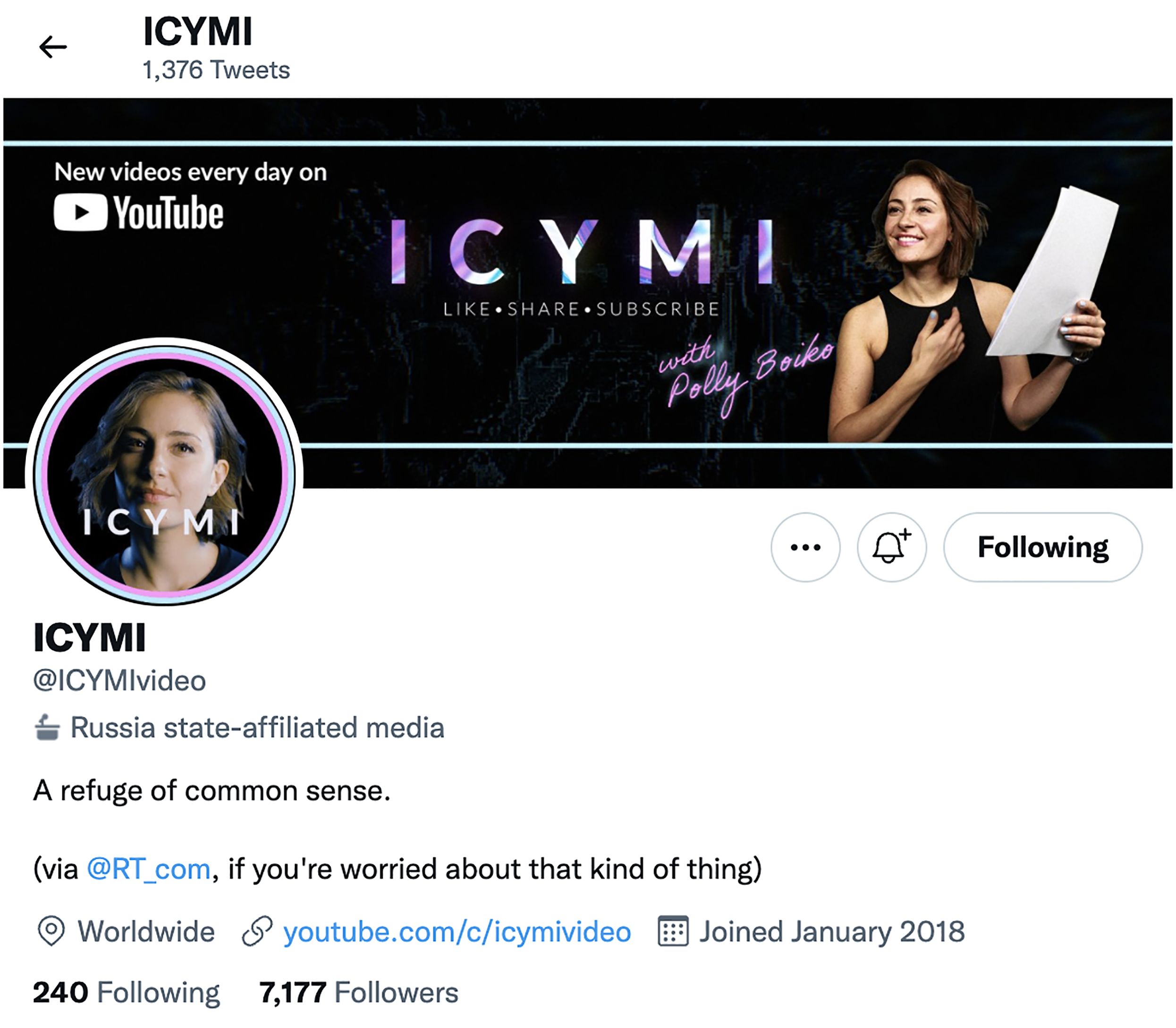
ICYMI twitter feed featuring Polly Boiko.
Through an analysis of how ICYMI represents global affairs, alongside an assessment of audience comments on ICYMI's videos, we highlight how the technique of culture jamming is used to engage young audiences by using satire, pastiche, and parody to subvert dominant foreign policy discourses, whilst simultaneously discouraging reasoned engagement with them. We find that by utilising the aesthetics of pop-culture production associated with the ‘West’, employing ideologically-ambiguous rhetorical techniques, and making use of social media channels, ICYMI is primed for an audience of young internet users who are less interested and less active in engaging with traditional forms of news journalism (see Sveningsson 2015). Here, we argue that RT's attempts to engage young people through culture jamming rely upon a millennial aesthetic that engenders a cynical form of antipolitics based on individuals’ opinion-driven, or so-called ‘critical thinking’, capabilities and the rejection of mainstream media discourses (in the case of ICYMI, our analysis suggests that viewers who hold libertarian or right-leaning, anti-‘woke’ orientations are the primary target).
Our findings suggest that ICYMI (even when it fails to connect with its intended audience) evidences that NEIBs attempt to ‘disrupt the transmission’ of the dominant form of (geo)political messaging by enabling ‘competing conversations’ (Warner 2007: 18). These efforts challenge the conventional messages through which the ‘Western’ dominated liberal international order is constructed, maintained, and legitimated. With its irreverent conspiratorial bent and demeaning of international norms, ICYMI echoes the style of satirical news shows such as The Daily Show, podcasts like the Joe Rogan Experience, and alternative digital media aggregators such as reddit and 4chan, all of which have become increasingly popular ‘news sources’ for young people by blending reporting, informal analysis, and satire (Schofield Clark and Marchi 2017: 82). Given the cognitive and emotional power inherent in the consumption of pop-culture-infused political content, interrogating the influence of transgressive ‘news’ outlets – especially those that are state-funded – is vital to understanding how global politics, journalism, and youth culture align in news-adjacent spaces on the internet.
Non-Western English-language International Broadcasters and Public Diplomacy in the Age of Social Media
In the digital age, states now employ a broad repertoire of activities to inform and influence overseas audiences. Efforts to sway foreign publics are often viewed in a dichotomous sense: attempts to manipulate others in malign ways through misrepresentations are viewed as propaganda, and efforts to promote a nation and its culture through credible representations are understood as public diplomacy. This dichotomy is problematic because there is an implicit understanding that ‘our’ public diplomacy is inherently different from ‘their’ propaganda (Ross 2002), and because various similarities between these concepts make this distinction a value-laden one (Melissen 2005: 11). The line is further blurred given that many states’ contemporary public diplomacy programmes are rooted in the legacy of past propaganda efforts. Whilst the detailed substance of this terminological debate is beyond the remit of this paper, we refute the idea that a purely analytical and non-pejorative application of the term ‘propaganda’ (Cull, Culbert, and Welch 2003) is possible given the concept's loaded history. We also recognise that in a digital age when hypodermic-needle models of propaganda are outdated due to the participatory nature of the hybrid media system (Chadwick 2013), public diplomacy activities simultaneously seem to resonate with and build upon the propaganda activities of yesteryear. Consequently, analytical purity and neat categorisation are difficult to agree on. Regardless, given that ‘public diplomacy’ is both an acknowledged component of so many contemporary states’ foreign policy activities as well as a field of academic study, we use this term and now demonstrate how we build upon it.
The global proliferation of internet access and social media use has led to an increased public interactivity with news media, and this has influenced the development of public diplomacy initiatives of non-Western states (Bjola, Cassidy, and Manor 2019). Whilst such states have rich histories of promoting themselves to foreign publics long before ‘public diplomacy’ was written into their national doctrines, the rise of the internet and social media has led states such as Qatar, Russia, and China to use international broadcasters as the key tool to influence overseas publics by countering negative reporting and promoting positive perceptions of themselves (see Rawnsley 2015). The rise of non-Western state international broadcasting began in earnest in the early twenty-first century, as China began broadcasting its English-language channel CCTV overseas in 2003, followed by Russia Today (2005), Qatar-based Al Jazeera English (2007), Iran's Press TV (2007), and Turkey's TRT World (2015). The expansion of international broadcasting capabilities among non-Western states constituted a fundamental change to the global public diplomacy landscape, with NEIBs since becoming important actors in their own right (Seib 2010). These NEIBs share the general objective of challenging a perceived Western media hegemony and bringing to the fore alternative perspectives on global politics that align with their state sponsors (Rawnsley 2015).
The success of NEIB public diplomacy efforts is far from guaranteed, and has even undermined overall public diplomacy efforts: China's international broadcasters maintain low credibility with foreign audiences (Y. Wang 2008); shifting alliances of adversarial online publics can cooperate to challenge state legitimacy (Zaharna and Uysalb 2016); and Russia's international broadcaster has been repeatedly criticised for breaching impartiality rules whilst whitewashing negative elements of Russian foreign policy. Despite such controversies alongside focused academic attention on NEIBs, there is limited scholarship on how these broadcasters target younger news consumers. This lacuna is surprising, particularly since much of the influential literature on public diplomacy refers to ‘young people’ as a prime audience to be engaged and influenced (Nye Jr. 2008: 104; Payne 2009: 596; see also Snow and Cull 2020). We argue that in the current environment of youth-focused public diplomacy efforts, geopolitical culture jamming provides a potential vehicle for better understanding novel forms of political communication from NEIBs.
Social Media: The New Frontier of Youth-Targeted Public Diplomacy?
The digitisation of public diplomacy has triggered a sea change for international political communication as states seek to burnish their images abroad through digital technologies and emerging platforms. Freed from the regulatory, financial, and logistical limitations of broadcast media such as newspapers, radio, and (satellite) television, the ubiquity of internet access and the proliferation of social media networks lowered barriers to entry for delivering content to targeted audiences abroad (Manor 2019). Given the increasing preference of young people to consume ‘news’ via the internet, and more specifically sites like YouTube, reddit, and Twitter, the media ecosystem has now opened up in novel ways for NEIBs. The phenomenon of sharing creates a multiplier-effect for public diplomacy outreach efforts, effectively enmeshing social media users as part of the programme of content distribution. Moreover, as young people account for the largest share of internet users, and will age into political decision-makers over time, NEIBs have sought to establish mechanisms to reach these future voters (Mazumdar 2021). Indeed, practitioners of public diplomacy have reported that when it comes to targeting young people, they use ‘more innovative messages and means’ (Payne 2009: 596). This innovation is by necessity because youth across the ‘Western’ world have grown increasingly disillusioned with traditional forms of journalism, and have embraced a jaundiced form of antipolitics (Farthing 2010; see also Beveridge and Featherstone 2021). Hence, engaging young audiences through subversion, satire, and the stylistic conventions of digital youth culture (especially parodic ‘news’) offers outreach potential for NEIBs.
The recent actions of several NEIBs evidence efforts to reach younger audiences. Take for instance Qatar's AJ + launched in 2014, a news brand that describes itself as: the trailblazing brainchild of the young-and-restless creative minds of Al Jazeera's Incubation and Innovation Unit, who earlier than most saw the emerging opportunity to reach a millennial audience with a video news product delivered via social media platforms.
By creating short videos designed to be shared on social media, AJ + ‘primarily targets a young “mobile-first” generation of intensively connected users whose communication and social habits revolve around mobile technology’; using informal language, colourful visuals, and a focus on humorous headlines, AJ + attempts to subvert the dominant culture of ‘Western’ media by blurring news and entertainment to appeal to young audiences (Zayani 2021: 32–33). Whilst China's CGTN has yet to launch a youth-specific brand, it has sought to engage younger audiences through its ‘V Studio’ offerings which feature political cartoons and human interest stories alongside a cartoon mascot ‘Panda Mo’ with the purpose of ‘softening and polishing China's image overseas’ (Hernández and Madrid-Morales 2020: 1088). Ultimately, the turn to NEIBs using short, social media-specific videos that are often humorous does not fit neatly into the category of public diplomacy or propaganda. Instead, such outputs evidence a form of geopolitical discourse that harnesses the affordances of social media to subvert ‘Western’ media practices, critique ‘Western’ politics and culture, and engage youth and young adult audiences. However, as we discuss below, we are now seeing evidence of this type of content going into new arenas of political communication, specifically practices that undermine rather than develop international relations narratives. In the employment of satire to excite younger viewers via carefully curated ridicule of democratic norms, global governance, humanitarian efforts, and the like, we see NEIBs using social media as a new frontier for geopolitical action. We now turn to the case of RT's ICYMI ‘news’ brand as a distinct and important example of a NEIB engaging in what we term geopolitical culture jamming.
Geopolitical Culture Jamming and the Case of RT's ICYMI
Originally applied to specific forms of art-based activism during the 1980s, culture jamming is a concept that refers to politically engaged acts of cultural production intended to ‘scramble the signal’ of dominant (originally corporate-generated) discourses by injecting the unexpected, and spurring audiences to ‘think critically and challenge the status quo’ (DeLaure and Fink 2017). Drawing on the satirical practice of ‘subvertising’ (i.e. subverting marketing messaging to affect a social critique), culture jammers such as the Yes Men notoriously targeted corporations like Exxon and McDonald's by altering existing, recognisable imagery or discourses in order to ‘amplify’ their own alternative messages, while other groups such as the Guerrilla Girls employed discursive détournement (i.e. the creative disfigurement of iconic imagery) to wither embedded practices of gender discrimination and male privilege. Culture jamming, therefore, relies upon leveraging an ‘extensive, pre-existing groundwork of brand-building’ to be intelligible to its audience (Winters 2020). However, in recent years, culture jamming has regularly crossed the threshold from anti-corporate activism to embrace geopolitical critiques, with activists taking aim at the World Trade Organisation, the Kremlin, and the US political establishment. The proven ability of contemporary consumers of popular culture to recognise and subsequently make sense of such satire suggests that the practices of culture jamming are far from confined to the realm of artistic activism as we discuss in relation to RT's ICYMI.
RT launched in 2005 with a twinned brief to: positively represent Russia to the world and present a Russian perspective on global affairs. RT brands itself as an anti-establishment media pariah, and its use of humour and sarcasm is crucial to ostensibly acknowledge – whilst avoiding substantively addressing – specific negative claims about Russia or the broadcaster itself (Crilley and Chatterje-Doody 2021). Whilst humour has been integral to RT as a brand, we argue that the creation of ICYMI to target young audiences marks a significant point of departure in the network's efforts at (geo)political culture jamming. The name ICYMI is based on a social media colloquialism that stands for ‘In Case You Missed It’. The nomenclature of the channel reflects RT's attempts to engage an internet-savvy audience well versed in digital culture, and it is also a subtle dismissal of ‘mainstream media’, as it suggests that important topics may have been ‘missed’ in other news reporting (or – more conspiratorially – purposely hidden from view). Subsequently, ICYMI taps into a novel form of youth culture that embraces ‘new communication tools [and] social networks for articulating forms of subjectivity’ that move beyond those framed by traditional forms of ‘resistance politics’ (McVicker 2014: 79).
While ICYMI delivers various forms of content, its most prominent outputs are videos hosted by Polly Boiko, who presents against a green screen animated with a pastiche of videos, altered images, sound effects, and memes providing humorous commentary about a timely issue in world politics or a cultural controversy. ICYMI brands itself as taking: a sideways glance at the details you missed lurking in the crevices of the world's big stories. If you’re easily triggered or crave safe spaces, do not click on this link!
Such language evokes the populist discourse associated with the anti-political correctness (anti-PC) movement – and more recently the ‘anti-woke’ movement – that has come to define much of the culture wars debate in the ‘West’ in recent years (Nagle 2017). ICYMI thus positions itself as sort of ‘pirate radio’ for the digital era, offering an alternative for audiences resistant to the dominant news paradigm of the ‘West’.
Central to geopolitical culture jamming is the subversion of ‘emotional and aesthetic modalities similar to those employed in contemporary political branding’ to interrupt political messaging ‘from within’ (Warner 2007: 19). ICYMI's videos are often limited to a few minutes in length, and feature the presenter expressively talking to camera using sarcasm to frame global issues. This is done in ways that allow for core messages to be conveyed through visual imagery alone when the video is auto-played without sound. This style of video is produced and shared by other digital news sources aimed at Millennials and members of Generation Z (those born between 1981–1996 and 1997–2012, respectively, see Andersen et al. 2020) such as Buzzfeed, BBC Three, LADbible, and VICE. This furthers the ‘intelligibility’ of the ICYMI format within a particular sub-genre of media content which has found purchase among young ‘Western’ media consumers (Canter 2018).
Upon its initial launch, ICYMI had no identifiable association to RT, with no logo, branding, or links placed anywhere within ICYMIs online presence. This led to consternation among several UK-based news sources which exposed ICYMI as being produced by RT, despite its seemingly innocuous appearance as a ‘normal’, social media-based, news brand (Collins 2018). In their critiques, commentators suggested that ICYMI's failure to declare itself as an RT offshoot was an attempt to avoid its videos being labelled by YouTube as being ‘funded in whole or in part by the Russian government’ (as is the case with RT's other videos). After the publication of these exposés, YouTube began to label ICYMI's videos as Russian state-funded, and ICYMI updated its Twitter biography and YouTube description to playfully state: ‘via RT, if you’re worried about that kind of thing’. Such a response to being ‘outed’ by traditional news outlets only served to reinforce the transgressive allure of the ICYMI brand which revels in its opposition to the ‘mainstream media’ that so many young media consumers distrust, preferring to employ their own ‘affective and intuitive tactics rooted in tacit knowledge’ to parse reporting of politics and world affairs (Swart and Broersma 2021, 1).
ICYMI's embrace of controversy and its articulation of political content with a patina of youth oriented snarkiness evidence that ICYMI represents the vanguard of RT's efforts to reach younger audiences (Collins 2018). However, after several years of production, Boiko announced in February 2020 that after ‘a rollercoaster ride of sarcasm, of silliness… sadly all good things have to come to an end and the ICYMI ride is shutting down’ (ICYMI 2020). Despite this announcement, ICYMI social media channels have remained active, publishing videos that feature Boiko talking directly to the camera and satirising global events such as the COVID-19 pandemic, Black Lives Matter protests, and the 2020 US elections in a similar style to earlier ICYMI videos (now featuring the hashtag #PollyBites). Even though the ICYMI platform may no longer be officially operational, it has an afterlife as it is still used to publish and share content, as well as appearing to have subsequently influenced the style of videos produced by Boiko and her colleagues at RT. Despite its relatively small audience and short existence, an analysis of ICYMI gives valuable insight into NEIB use of geopolitical culture jamming as it was RT's first experiment with packaging content as satirical shorts to attract young audiences, one from which the network appears to have drawn valuable lessons especially through the use of gendered representation to build its young (male) audience.
Methods
With the goal of interpreting how NEIBs such as RT attempt to influence young audiences through geopolitical culture jamming efforts such as ICYMI, as well as understanding how audiences respond to such attempts, we focus on a data set of videos published on YouTube over a one-year period from 1 August 2018, when ICYMI first launched, to 31 July 2019. We examined the subject matter, geographic scope, visuals, and ideological orientations of the 45 two-to-three-minute videos published during this period (these continue to be available on the ICYMI YouTube channel). Through a discourse analysis of these videos, we first draw attention to the stylistic aesthetics of ICYMI, before then analysing which actors, actions, and issues ICYMI focuses on in its coverage of global politics. Influenced by Dittmer and Gray (2010), our analysis begins with an inductive thematic coding of visual and narrative media content, with one member of the research team coding each video for its main topic and which locations and actors were depicted. Thereafter, we met as a team for the purpose of ‘investigator triangulation’ to determine and confirm the thematic codes, interpret our data, and collectively outline shared findings (see Archibald 2015: 228–229). Subsequently, we used discourse analysis to draw attention to the political significance of these representations by focusing on: a) what knowledge the videos deemed to be true; b) how subjects of the videos were labelled with certain attributes; and c) how subjects were positioned in relation to one another. Doing so enables the exploration of how ICYMI represents identities and power relations, and helps to make sense of how, as an example of geopolitical culture jamming, ICYMI attempts to appeal to young audiences through various forms of reproducing newsworthy content through the lens of satire, while retooling artistic efforts at subverting corporate messaging in line with RT's established modus of creating geopolitical dissensus (Crilley and Chatterje-Doody 2021).
We then investigated audience engagement figures with each ICYMI video on YouTube, and explored which videos proved most popular, whilst also analysing comments made in response to these videos to investigate how audiences interpret ICYMI's content. We conceptualised audience engagement and influence as situated, complex, and multidimensional, and our analysis of engagement figures provides an insight into the broad popularity and online performance of ICYMI's output (see Ksiazek, Peer, and Lessard 2016). However, an analysis of engagement figures does not tell us much about how audiences actively make sense of and feel about the content of ICYMI's videos, so we complemented this with a qualitative analysis of the first ten ‘Top Comments’ for each ICYMI YouTube video (providing a data set of 450 comments). The ‘Top Comments’ are determined by YouTube's algorithm which accounts for: the time the comment was posted; like/dislike ratios; number of replies generated; and who posted the comment. These comments are therefore not representative of ICYMI's entire audience, the majority of whom do not comment on videos; however, they demonstrate how an engaged audience of viewers actively interpreted and responded to ICYMI's framing of the world. Moreover, their prominence as ‘Top Comments’ suggests that their sentiment resonates with other YouTube users. Whilst it is possible that some comments are from inauthentic accounts or ‘bots’, YouTube claims to be successful in identifying and removing automated accounts, and others have noted that the problem with bogus accounts on YouTube is not fake comments but the inflation of viewing figures (Keller 2018). Our process for analysing these comments began with one researcher inductively coding the topics, figures, and places in each comment, as well as whether the comments expressed support for ICYMI's ideological representation of the world, i.e. its geopolitical codes, visions, and frameworks (see Dijkink 1996). Then, as a team, we discussed the data to triangulate and analyse how the comments constructed truths, attached labels, and positioned identities vis-à-vis one another. In analysing the content of ICYMI videos alongside comments made in response to them, we aimed to draw attention to how ICYMI attempts to appeal to young audiences as well as conveying understanding of how those representations resonate with its viewers.
In Case You Missed It: An Overview of RT's Framing and Content Selection Practices
During the time frame of our analysis, ICYMI addressed a wide array of targets ranging from transgender athletes and politicians in blackface to leadership changes at 10 Downing Street and war in the Middle East. Whilst ICYMI published videos on a plethora of topics, ridiculing actors and actions from across the globe, our research demonstrates a clear preference for ICYMI to cover stories that even politically disengaged young people would be familiar with. This portfolio included videos skewering high-profile personalities, or providing humorous commentary on events that went viral online (see Supplementary Information file). It is then perhaps unsurprising that the most popular target for ICYMI's videos during this time period was the Trump administration, which was prominent in the news cycle over the course of our study through a combination of policy decisions, scandals, personal foibles, and the president's use of Twitter (see Wells et al. 2020). President Donald J. Trump appeared in 23 of the 45 videos published by ICYMI, or more than half of them, and he was the primary focus of six episodes (with another dedicated to his daughter Ivanka Trump). The former British Prime Minister Theresa May (10 appearances), her successor Boris Johnson (7 appearances), and the French President Emmanuel Macron (8 appearances) were also popular targets for scorn, with each being the focus of at least one episode. Russian president Vladimir Putin rounds out the most-referenced figures; importantly, though he appears on screen in seven videos, he is only mentioned by name once in reference to the G20 summit (28 June 2019). He thus serves more as a visual than a discursive presence in ICYMI's geopolitical framework, especially given that he is never lampooned like the aforementioned leaders. Other heads of state such as Angela Merkel, Recep Tayyip Erdoğan, and Xi Jinping were also profiled by ICYMI, typically being subjected to similar sorts of mocking. Indeed, the selection of such figures for satirical barbs demonstrates a rather conservative bent of ICYMI's programming choices, distancing it from the antics of Bee, Spang, and other leaders in the genre whose humour often targets lesser-known figures.
Besides world leaders, other individuals embroiled in significant global spectacles, such as the murdered Saudi journalist Jamal Khashoggi, the jailed WikiLeaks-founder Julian Assange, and the teenage Swedish climate activist Greta Thunberg, garnered the attention of ICYMI. In each of these cases, the persons involved had become subject of intense controversy and viral news coverage immediately prior to being featured on ICYMI. Therefore, all would likely be at the forefront of the consciousness of Millennial audiences active online. In each case, the actors covered were relevant either for occupying pre-existing positions of power in the political or corporate sphere, or – as in the cases of Thunberg and Assange – explicitly for the challenge they posed to the status quo of international affairs. This suggests that RT attempts to harness trending news topics to engage young audiences, therein seeking to ‘jam’ a particularly strong signal at time when it is reverberating across the global media ecosystem.
The geographical coverage of ICYMI videos over this period followed similar logics, reflected in a focus on geopolitically powerful states. Unsurprisingly given the preoccupation with Trump, the US was the most referenced state actor in the videos under analysis, featuring in three-quarters of the episodes, followed by the UK, which appeared in more than one-third of ICYMI's videos. These were closely followed by references to Russia, which appeared in 16 of the 45 videos (such appearances thus tracked well with Putin's own ‘absent presence’ on ICYMI). Trailing Russia, we find China, the European Union, Iran, France, Syria, and Saudi Arabia all being the focus of their own episodes, and each appearing in at least five of all the videos analysed. Important non-state actors covered in the period included the G20, the United Nations, NATO, Islamic State, and al Qaeda. A consistent, albeit latent theme across the geographical span covered was that of hypocrisy behind US and EU involvements in each of the cases discussed, and their attempts to wield power over other geopolitical actors. This feature of the coverage not only helps to relate viral stories to broader discussions of the politics of contemporary ‘Western’ democracies, it also subverts the norms of mainstream media coverage of world affairs by subtly infusing satirical reportage with counter-messaging that aligns well with the Kremlin's position and makes use of RT's characteristic joking aesthetic.
The framing of newsworthy global events, therefore, was often linked to consistent underlying narratives about the unequal and hypocritical exercise of power in the international system – but rendered as light-hearted ridicule rather than political point-scoring or calls to action. With regards to the geopolitically inflected topics addressed over the 12 months under analysis, the most recurrent theme was that of US troop deployments (including the stationing of aircraft carriers near volatile areas) and/or the use of deadly military force (e.g. missile strikes). Explicit references were made in 14 videos (with single episodes dedicated to actions in Somalia and Iran), with allusions in others. Taking a page from the methods of prominent political culture jammers, the hypocrisy of Washington's casual militarism provided a consistent subtext to these videos. With nearly as many appearances, the topic of international finance and trade policy – a frequent target of artistic culture jammers of the 1990s and 2000s (see Sandlin and Milam 2008) – peppered ICYMI's videos throughout the period, ranging from manipulation of markets to nefarious ‘global bankers’ and the influence of George Soros (an anti-Semitic ‘dog whistle’ invoking a global conspiracy theory of Jewish influence in global politics). While the targets might be similar, the tone is decidedly different in this shift from artistic to geopolitical culture jamming, with the latter tapping the fear of the Other rather than antipathy towards a corporatist Big Brother. Such an identitarian (as opposed to solidarity-based) focus reflects RT's tendency to employ a sophisticated range of populist communication techniques and conspiratorial logics in its representations of global affairs (Crilley and Chatterjee-Doody 2021). In pinning its satirical coverage to contentious topics at the height of the rapidly-evolving news cycle, ICYMI expanded the reach and relevance of often polarising topics to online audiences of young people by turning world politics into a joke, quite literally in this case.
How Do Audiences Engage with and Interpret ICYMI's Videos?
In order to understand how audiences interact with ICYMI's videos, and to thereby begin to make sense of its efficacy in engaging youth, we analysed the audience engagement figures on each YouTube video published during our period of analysis. At the time of our data collection in September 2019, the ICYMI videos in our study received a total of 428,893 views, 2874 comments, 9190 upvotes, and 784 downvotes. On average, an ICYMI video would attract 9747 views, 65 comments, 208 upvotes, and 17 downvotes. These figures demonstrate that ICYMI has been effective in reaching almost half-a-million views and over 10,000 subscribers on YouTube within a one-year period – a relatively small but nonetheless significant audience (Hall Jamieson 2018: 211). By ranking videos in order of most views, we can observe the dynamics of audience engagement with ICYMI's coverage of global politics. Here, there are higher levels of audience engagement with videos pertaining to: 1) ICYMI's attempts to deflect criticism of Russia through humour; 2) ICYMI's critiques of the Trump administration; 3) ICYMI's challenge of progressive values, foreign policy norms, and international cooperation; and 4) ICYMI's coverage of issues beyond Russia and the ‘Western’ world. Our analysis of the comments made on these videos reveals that audiences express a gendered attraction to the presenter of the videos (i.e. Polly Boiko), subsequently borne out by the rebranding of ICYMI's successor media product as #PollyBites (now focusing almost exclusively on the anchor herself). Whilst there is at times an emotional investment in RT as an alternative media source, other comments challenge RT as a source of propaganda, thus suggesting that ICYMI is not always effective in engaging audiences to adopt its framing of the world. The following section provides a discussion of the core themes arising from our discourse analysis of the comments made across the 45 ICYMI videos studied (Table 1).
Top 10 Most-Viewed ICYMI Videos on YouTube as of 1 June 2019.
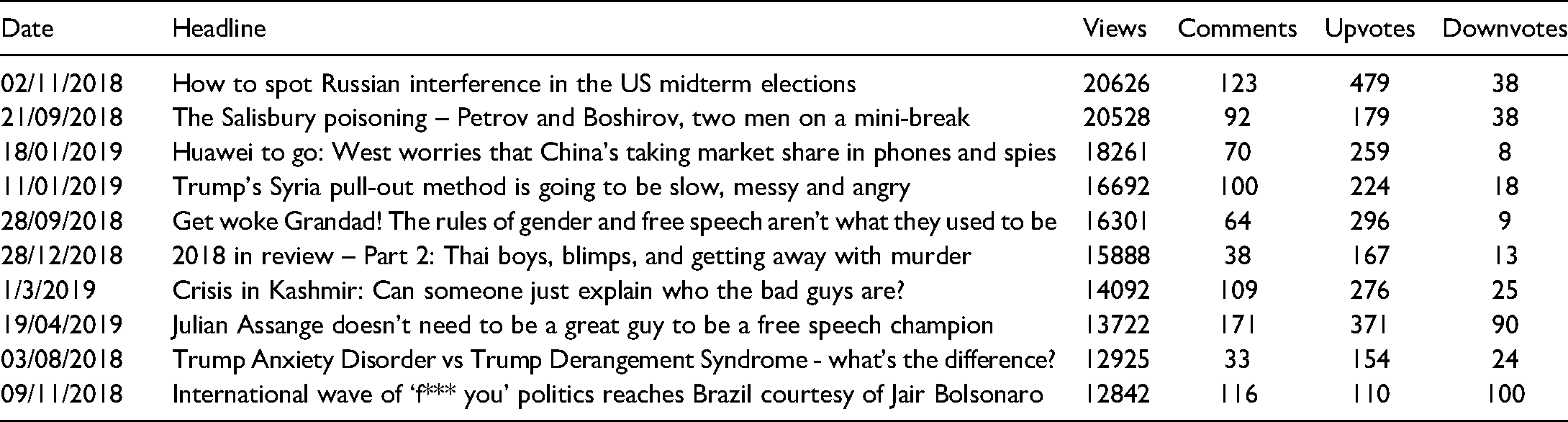
The two most viewed videos published during our period of analysis feature ICYMI spoofing criticism of Russia, joking about Russian intervention in US elections, and the poisoning of the Skripals in Salisbury, England. It is perhaps no coincidence that these interventions proved most popular, given how RT revels in a sarcastic engagement with issues of profound geopolitical import (Tolz et al. 2021). Here, it is important to note that while ICYMI employs the style, grammar, and aesthetics of satirical news programmes, the antipolitical subtext of its Russia-focused videos encourages the viewer to assume a wink-and-nod approach to the use of power, wherein the ‘hilarity’ of the topics negates the impetus to actually care who controls the levers of world politics or has been poisoned by a nerve agent in a civilian setting. As such, Boiko makes a sharp departure from the satirical practice of comedians whose modus operates at the edge of ‘advocacy journalism’ (Kilby 2018: 1935). Importantly, ICYMI courts political apathy, not advocacy.
ICYMI appears to be effective in engaging some audiences with its coverage. Comments on its videos mirror the jesting sentiment about Russian actions presented in the videos, suggesting that ICYMI's codes and visions of the world resonate with certain viewers. One comment on the video concerning Russian election meddling suggests: ‘In a year this video will be presented to the US Senate as an undeniable proof that RF [Russian Federation] has meddled in ‘Murica's elections!’ Other comments such as ‘hahaha Nice job! I guess humour is the only weapon against this rampant elite-sponsored russophobia!’ mirror ICYMI's style and tone, and highlight how ICYMI's audiences gain satisfaction from performing their enjoyment via their online posts. The oft-seen use of derisive humour about key actors that appears in the comments on ICYMI's videos are indicative of the audiences ‘affective investment’ (Solomon 2014, 720) in the representations presented by ICYMI, while also serving as a poignant reminder that many young people hold ‘deeply cynical and sceptical popular perspective[s] on democratic political systems’ which colour their reception of geopolitical representations (Dittmer and Bos 2019, xiii). These reactions imply that the audience members who comment on these videos are unconvinced by ‘Western’ accusations of nefarious Russian actions, and support ICYMI's resistance to dominant geopolitical narratives, therein paralleling the pro-resistance reception of critically engaged audiences who support the subvertising practices of art-based culture jammers.
Comments in response to ICYMI's videos featuring Trump also demonstrate that the audience is critical of the US presidency and American foreign policy. Given RT's well-established tendency to engage with popular conspiracy theories (Yablokov 2015), it is significant that many comments express conspiratorial reasoning. One comment on Trump's foreign policy in Syria states ‘How cute, the goy thinks he can decide to end endless wars’. Here, ‘goy’ (Yiddish for a ‘non-Jew’) makes reference to the nation of Israel, and suggests that Trump is a pawn of the Jewish State. This anti-Semitic trope plays out in other conspiratorial comments on videos about Trump, as one person states ‘You’re not talking about POTUS for rent? Are you? Because Likud have rented him when they paid for his campaign’. Considering the extent to which RT's main broadcast and social media output engages with sometimes outlandish theories about secret plots, the conspiratorial focus of these comments suggests that the sceptical, ‘critical’ edge of ICYMI's videos resonates with audiences who are invested in the notion of the US having an evil and deceitful identity – the ultimate geopolitical culture jam for a country that takes pride in its reputation as a force for good and uses its dominant position as producer of popular culture to ensure others believe it as well (see Laderman and Gruenewald 2018).
ICYMI's jocular appeal to conspiracy culture may well drive the platform's popularity with its young audience, as well as helping to cement RT's greater conceptual geopolitical framework. Viewer comments tend to reflect ICYMI's challenge of ‘Western’ hypocrisy: ‘This is the West saying to the rest of the world this: “The spying business is OUR business! No one elses! So bug off!”(giving my middle finger here..)’. Others are critical of ‘Western’ corporate culture, as one states, ‘corporate america cannot stomach this. Even their humanitarian interventions and oscars are political-economic warfare’. In response to ICYMI's videos critical of ‘Western’ political correctness and free speech, commentators reply that ‘This video is spot-on, I love our English satire, sadly it's disappearing quickly as the Orwellian Thought Police stomp across the Western world.’ In comments that make reference to the ‘thought police’ stomping across the ‘West’ (themes that have long been a staple of artistic culture-jam projects), there is a seething dissatisfaction with the politics and culture of ‘Western’ states expressed by ICYMI audiences. Such sentiments highlight how the viewers at times revel in ICYMI/RT's positioning as an actor that ‘questions more’ and draws attention to the ‘West's’ hypocritical double standards on certain geopolitical issues (see Miazhevich 2018).
Alongside these geopolitical issues, an exploration of the comments made in response to ICYMI's videos reveals important dynamics around gender, bodies, and political communication. Many of the comments on ICYMI's videos make explicit reference to the presenter being physically attractive. In contrast to the self-deprecating characteristics of much satire, RT has explicitly traded off Boiko's good looks in videos with titles such as 'Who's hotter, right-wingers or left-wingers?' (see Crilley and Chatterje-Doody 2021, 280). Whilst various comments refer to the presenter as ‘hot’, or the show as the ‘Sexiest Propaganda Eva!!’, others resist such a take, encouraging the presenter to ‘ignore the pervs below, there's many more people appreciating you for your brains’, or lamenting that despite their opinion that ‘the presenter has pitch perfect delivery and is probably the brains behind the show… 80% of the comments is just men drooling over her looks'. Here, Boiko's gender and appearance entice the (heterosexual, male) audience into engaging with ICYMI's geopolitical framing practices and seem to reinforce the larger goal of sowing dissensus.
Other comments on these videos reify the audience's attraction to ICYMI/RT as an alternative news source. Comments such as ‘Omg … someone with a sense of humour … she’d never be on the air in America… this kind of irreverence is why I subscribe to RT', actually highlight audience engagement with RT as a source of news that uses humour and reports global politics in a style that other news sources do not, therein strategically tapping into affect and intuition as means of persuasion for youthful validation of truthfulness (see Swart and Broersma 2021). However, there are comments that challenge RT's perspective and argue that it is ‘another disinfirmation [sic] channel on Youtube paid for by the Russian taxpayers!’. This view of RT as a source of propaganda is further emphasised by comments such as ‘Keep on going, it's nice to know what Putin would like us to believe’ reveal that some of those who view ICYMI's videos are critical of them and are not convinced by their content, although these comments are often challenged by other audience members. One exchange is particularly revealing as it demonstrates that even though viewers are aware of ICYMI's connection with the Russian state they do not care:
You do all realise that this channel is sponsored by Russia? Look for very subtle messages designed to help confuse facts.
So what?
Such a frank response is telling about the geopolitical culture(s) of populism in the age of social media: for many younger consumers of ‘news’ content, it is not the provenance of the information nor its ideological framing that is of importance – the only thing that matters is if it satisfies. Here, culture jamming's predictable reliance on the reproduction and/or détournement of existing signals and signs proves to be its critical strength, thus allowing it – in a state-based form via RT's ICYMI – to become a mechanism of influence in twenty-first century geopolitics by promoting dissensus and apathy rather than activist outrage or a commitment to political engagement. In a post-truth environment, aesthetics and style – when combined with anti-elite appeals to intuition or ‘common sense’ – serve as the defining factors of attraction for certain audiences, particularly young, straight, white males who see the 'Western'-dominated status quo as corrupt.
Conclusion
ICYMI's videos harness the conventions of short satirical social media videos and reveal the importance of affect via fluency in certain genres (e.g. satire) in projecting power in the global media ecology, particularly among younger audiences. Drawing on the activist practices of culture jamming and melding these with the advocacy journalism-based tactics of satirical ‘reporters’ (though distorting both praxes), the Russian broadcaster RT has developed a useful, if transitory adjunct to its mainstream, non-youth-oriented content streams. Ultimately, the efficacy of ICYMI's geopolitical culture jamming lies not in what is said, but how it is presented – through highly stylised content aimed at a specific audience of internet-savvy young people. Despite appearing to be a peripheral output of RT, ICYMI is surprisingly coherent in its content with RT's standard practices: its predominant focus is the actions of formal political institutions (i.e. governments, NATO, G7), alongside a particular concern with the US as a bad actor, and ‘Western’ politics as an object of critique and ridicule (Orttung and Nelson 2019). This also chimes with RT's overall brand identity as a supposedly counter-hegemonic critical voice of reason (Miazhevich 2018), while at the same time expanding the reach of the network via material specifically designed for consumers weaned on satirical news shows and digital snippet culture.
Despite ICYMI's claim to counter-hegemony, and its ostensible distinctiveness as a youth-orientated source of ‘cool’ content, we find that ICYMI is remarkably conservative (thus distinguishing it from the artistic interventions of other culture jammers like the Yes Men and the Guerrilla Girls). This conservatism lies in its (parodic) privileging of high politics and its key figures, and also in lampooning those political movements whose primary concern is with subverting the white/hetero/male status quo through progressive action – for example via videos critical of feminists, trans rights supporters, veganism, and anti-racism in representation. Therefore, ICYMI troubles existing geopolitical codes and hierarchies in appearance only, while in substance it reinforces them. Whilst a youth-orientated, style-over-substance approach may temporarily attract an audience of anti-‘woke’ Millennial males, this focus could ultimately prove to be too narrow a demographic given that today's young audiences in the Anglophone world tend to be much less conservative than their older peers (PEW 2019).
In terms of reception, we find that comments on ICYMI's videos do at times reflect the audience's attachment to and support of ICYMI's antipolitical ethos. They reproduce the core claims of ICYMI's videos, making use of humour, critiquing the US and ‘Western’ actors and actions, expressing conspiratorial thinking, and displaying a support for the conservative view of political correctness gone too far (whilst also reproducing the populist-toned claims of anti-government/anti-elite/anti-Semitic sentiments). Alongside this, the prevalence of comments expressing affection for/attraction to Boiko, and those that view ICYMI/RT as a source that covers global politics in ways that other media sources do not, all highlight ICYMI's use of social media aesthetics to draw Millennial/Gen-Z audiences into adopting ICYMI's worldview. In trading in dissatisfaction with ‘Western’ actors and actions through sarcastic humour, ICYMI appears to target – and seems to be effective in engaging – an audience of young males who are fluent in the mediated grammar of satirical news: indicative of this are comments such as ‘‘Polly Boiko, I don’t care if you’re a Russian agent, you’re hot AF [as fuck]'. Even those audiences who are aware (and perhaps critical) of ICYMI and RT as sources of Russian political communication are attracted – intellectually, aesthetically, and somatically – to the content of ICYMI's videos, therein demonstrating the significance and ideological allure of geopolitical culture jamming as a praxis to engage young people.
To understand contemporary youth-orientated political communication we need to acknowledge how NEIB practices do not fit neatly into conceptualisations of either public diplomacy or propaganda, and as we have demonstrated, geopolitical culture jamming offers one way of theorising how NEIBs such as RT attempt to engage young audiences. In light of this, we need further research acknowledging and interrogating the importance of how digitally delivered ‘news’ infused with humour, satire, and social media aesthetics appeals to young audiences, and, moreover, how this engagement is underpinned by the affordances of platforms, the dynamics of genre, and intersecting identities of nationality, gender, sexuality, race, and class. Such a need demands further analyses – across different ‘news’ sources, delivery platforms, sharing practices, and political cultures – exploring the significance of ‘alternative’ media in shaping the worldviews of a generation that will one day dominate the (geo)political landscape.
Supplemental Material
sj-docx-1-ijpp-10.1177_19401612211072771 - Supplemental material for ICYMI: RT and Youth-Oriented International Broadcasting as (Geo)Political Culture Jamming
Supplemental material, sj-docx-1-ijpp-10.1177_19401612211072771 for ICYMI: RT and Youth-Oriented International Broadcasting as (Geo)Political Culture Jamming by Robert A Saunders, Rhys Crilley and Precious N Chatterje-Doody in The International Journal of Press/Politics
Supplemental Material
sj-docx-2-ijpp-10.1177_19401612211072771 - Supplemental material for ICYMI: RT and Youth-Oriented International Broadcasting as (Geo)Political Culture Jamming
Supplemental material, sj-docx-2-ijpp-10.1177_19401612211072771 for ICYMI: RT and Youth-Oriented International Broadcasting as (Geo)Political Culture Jamming by Robert A Saunders, Rhys Crilley and Precious N Chatterje-Doody in The International Journal of Press/Politics
Supplemental Material
sj-docx-3-ijpp-10.1177_19401612211072771 - Supplemental material for ICYMI: RT and Youth-Oriented International Broadcasting as (Geo)Political Culture Jamming
Supplemental material, sj-docx-3-ijpp-10.1177_19401612211072771 for ICYMI: RT and Youth-Oriented International Broadcasting as (Geo)Political Culture Jamming by Robert A Saunders, Rhys Crilley and Precious N Chatterje-Doody in The International Journal of Press/Politics
Supplemental Material
sj-docx-4-ijpp-10.1177_19401612211072771 - Supplemental material for ICYMI: RT and Youth-Oriented International Broadcasting as (Geo)Political Culture Jamming
Supplemental material, sj-docx-4-ijpp-10.1177_19401612211072771 for ICYMI: RT and Youth-Oriented International Broadcasting as (Geo)Political Culture Jamming by Robert A Saunders, Rhys Crilley and Precious N Chatterje-Doody in The International Journal of Press/Politics
Footnotes
Declaration of Conflicting Interests
The author(s) declared no potential conflicts of interest with respect to the research, authorship, and/or publication of this article.
Funding
The author(s) received no financial support for the research, authorship and/or publication of this article.

Supplemental Material
Supplemental material for this article is available online.
Notes
Author Biographies
References
Supplementary Material
Please find the following supplemental material available below.
For Open Access articles published under a Creative Commons License, all supplemental material carries the same license as the article it is associated with.
For non-Open Access articles published, all supplemental material carries a non-exclusive license, and permission requests for re-use of supplemental material or any part of supplemental material shall be sent directly to the copyright owner as specified in the copyright notice associated with the article.
