







Abstract
The paper contributes to the study of institutional trust by making a connection to “cultural backlash” theory and analyzing more recent forms of news consumption. We examine how trust in politics, media, and science is shaped by “cultural backlash” and media use in nine European countries. We employ representative survey data collected in 2021 in Croatia, Denmark, Finland, France, the Netherlands, Serbia, Spain, Switzerland, and the United Kingdom as part of a large European research project. The results suggest that both exogenous (or “cultural”) and endogenous (or “institutional”) dimensions of cultural backlash matter for explaining institutional trust. Trust benefits from progressive–liberal values and less ideological extremism, but is hindered by discontentment with societal developments and political disengagement. Using public television is positively, and social media negatively associated with trust. While we find distinctions across institutions, there is huge consistency across countries.
Keywords
Introduction
Trust in political and societal institutions is a crucial foundation for the well-functioning of open democratic societies since the size and complexities of modern states require mechanisms of social order that can function based on legitimacy (Fukuyama 2015). Despite the apparent development of Western societies toward more democracy and welfare, the past decades witnessed a decline in citizens’ trust in various types of authorities and institutions such as politics, science, and professional journalism (Enli and Rosenberg 2018; Pharr et al. 2000). Although there is a long tradition of studies of what influences institutional trust (cf. Listhaug and Jakobsen 2018; Strömbäck et al. 2016), recent societal developments raise new questions. On the one hand, political polarization and the rise of right-wing populism have led to a “cultural backlash” against progressive–liberal values and even democratic principles (Carreras et al. 2019; Inguanzo et al. 2021; Norris and Inglehart 2019). On the other hand, the diversification and digitalization of the media has led to new types of media use, some of which are associated with lower institutional trust (Mari et al. 2021; Verboord 2023). Yet, it is not fully clear how these trends affect institutional trust, and which elements of the cultural backlash and the media diversification perspective are most important.
This paper contributes to the study of institutional trust—comprising politics, media, and science—by scrutinizing the role of culture more in-depth than previous analyses, which tend to focus on economic aspects (see Listhaug and Jakobsen 2018). We first unpack the various dimensions of cultural backlash that are associated with the concept (rejection of postmaterialist and cosmopolitan values, support for authoritarian values, voting for extreme right-wing political parties, cultural grievances, etc., Norris and Inglehart 2019; Sachweh 2020). We argue that it is useful to keep the distinction between exogenous (or “cultural”) and endogenous (or “institutional”) explanations (Mishler and Rose 2001), since this signals the extent to which trust is linked to deeply engrained personal convictions or more influenceable evaluations of political performance. Second, we update the examination of how institutional trust is associated with news consumption, by comparing traditional mass media with various forms of internet-based media, including digital news consumption, social media, and video sharing platforms.
This paper also contributes to the cross-national study of institutional trust. Recent comparative studies have emphasized the importance of societal contexts for trust and the ability to compare variations in dominant cultural values and institutional performances, levels of media use, and political ecologies (e.g., Ariely 2015; Hanitzsch et al. 2018; Liu and Lu 2020; Norris 2011; Norris and Inglehart 2019; Tsfati and Ariely 2014). In many countries, political viewpoints have become more polarized (Norris and Inglehart 2019) and social media have been associated with the rise of especially right-wing populism in which mistrust is often present (Engesser et al. 2017). But these trends play out differently across Europe. Most existing works draw on secondary analyses of World Value Survey (WVS) and European Value Survey (ESV) data which do not always allow for the incorporation of recent developments in media and politics. In contrast, we employ new, original survey data from nine European countries: Croatia, Denmark, Finland, France, the Netherlands, Serbia, Spain, Switzerland, and the United Kingdom. These countries differ in, among other things, dominant sociocultural value orientations, political constellations, media systems, (social) media use, and degrees of trust (e.g., Norris and Inglehart 2019; Van der Meer and Hakhverdian 2017).
In summary, our first research question reads: To what extent do cultural backlash indicators and media use contribute to the explanation of institutional trust in selected European countries?
Followed by the second research question: Which dimensions of cultural backlash are the most important predictors of institutional trust: endogenous (discontent with societal developments, political party support) or exogenous (sociocultural value orientations, ideological extremism) indicators?
The third research question is as follows: How do the explanations of trust differ between various types of institutional trust?
Theoretical Background
Institutional and Cultural Explanations of Institutional Trust
Political trust is often seen as the quintessential type of institutional trust, as trust in political institutions undergirds the stability and well-functioning of society at large (Hooghe 2011; Mishler and Rose 2001). Citizens who have confidence that political institutions function to their best interests are more likely to make constructive contributions and engage in cooperative social behavior (Misztal 1996). Society has other often knowledge-based institutions, such as science and news media (Gil de Zúñiga et al. 2019; Saarinen et al. 2020). Trust in these institutions is often strongly correlated with political trust, but while sharing a legitimacy claim to competence, knowledge, and expertise, they differ in function, logics, and social impact (Cook and Gronke 2001). Following previous studies (Hanitzsch et al. 2018; Misztal 1996; Van der Meer 2018), we conceive of institutional trust as evaluative in nature, while implicating expectations of future behavior: the confidence of citizens that a specific institution performs in a competent and satisfactory way and will continue to do so.
Institutional trust is often examined via institutional or cultural explanations (Liu and Lu 2020; Mishler and Rose 2001). Institutional explanations emphasize that the performance of institutions themselves triggers trust (Hanitzsch et al. 2018; Liu and Lu 2020; Mishler and Rose 2001; Van der Meer and Hakhverdian 2017). This accords with the notion that authorities tend to be viewed as legitimate if their actions are perceived as fair and desirable (Van der Meer and Dekker 2011; Van der Toorn et al. 2011). Studies of political trust often focus on economic performance, either via subjective or objective evaluations, evaluations of the democratic process (Noordzij et al. 2021; Van der Meer and Hakhverdian 2017), or political performance (Listhaug and Jakobsen 2018).
Cultural explanations on the other hand elucidate trust through more exogenous factors (Mishler and Rose 2001). Here, sociocultural values of individuals, learned through socialization and often context specific, are considered to shape the way people perceive institutions (Catterberg and Moreno 2006; Liu and Lu 2020; Norris and Inglehart 2019). This line of work—often drawing on longitudinal and comparative data—emphasizes that trust levels show more between-country than within-country difference, regardless of how specific governments or other institutions perform (Misztal 1996: 196ff; Norris and Inglehart 2009). Yet, while institutional explanations tend to focus mostly on impacts of socioeconomic developments, and cultural explanations emphasize long-term predispositions, responses to sociocultural changes are studied less (but see Noordzij et al. 2021).
Cultural Backlash Theory
Trust in institutions appears to have been tainted in recent years due to polarization in the political domain (e.g., Citrin and Stoker 2018; Skorini 2020). Populist movements have become more widespread in Western societies and build their following to a considerable degree on cultivating people-centrism and anti-elitism, including distrust in the political establishment, media, and sometimes science (e.g., Kristensen and Mortensen 2021; Mudde 2004; Müller 2016). Norris and Inglehart (2019) consider these developments—referring particularly to the election of Donald Trump as US president in 2016, Brexit, and the growing popularity of populist parties in various European countries—as a reaction to the increase of postmaterial and socially liberal values in Western societies since the 1960s. They interpret the rise of populism as a “cultural backlash” against value change, seeing cultural grievances as the main catalysator and leading to growing support for authoritarian values. The extent to which cultural backlash affects political trust is not immediately clear as they consider “political trust, as an indicator of the appeal of populist rhetoric” (Norris and Inglehart 2019: 92), making it impossible to disentangle the two concepts.
Bringing together institutional and political trust literature and cultural backlash theory, we make advancement by distinguishing four dimensions of cultural backlash, which can be categorized as more endogenous (institutional) and more exogenous (cultural).
The main component of cultural backlash concerns the sociocultural values that individuals adhere to. Norris and Inglehart (2019) see cultural backlash particularly as a rejection of “postmaterial values [with] emphasis on environmental protection, peace movement, sexual liberalization, democracy and human rights, gender equality, cosmopolitanism, and respect for the rights of homosexuals, immigrants, handicapped people, and ethnic/racial minorities” (p. 33), also referred to as “socially liberal values” (p. 33) or reflecting a “progressive agenda” (p. 43). At the same time, cultural backlash incorporates authoritarian values, anti-elite stances, and, in the European context, Euroscepticism (Carreras et al. 2019; Sachweh 2020). Particularly, the populist rhetoric that in contemporary society “the corrupt elite” has too much power, which should be handed over to “the people” (Golder 2016: 479), suggests lower levels of trust in institutional actors, such as politicians and media agents, among those supporting cultural backlash. We thus expect that more liberal–progressive sociocultural values will be associated with more trust in institutions. We formulate this hypothesis:
H1: The more individuals adhere to liberal–progressive values, the higher their institutional trust.
A second component associated with cultural backlash concerns ideological polarization. By taking extreme and non-compromising positions on a scalable attitudinal distribution, individuals contribute to polarization. Not only has populism been linked to more radical or extremist opinions (hence “far-right parties”) (Golder 2016). It has also been argued that how people credit information is increasingly defined by the cultural groups—which can include political parties—they identify with (Prior 2013). Consequently, social debates on controversial issues will further polarize when people feel part of cultural groups where strong opinions are the norm (Kahan 2017). Examples include the climate change skepticism among Donald Trump supporters or the anti-vaccine sentiments during the COVID-19 crisis among many European populist voters. While various US studies have related the partisan polarization in American politics to the decline in political trust (e.g., Hetherington and Rudolph 2015), effects of individual ideological polarization on institutional trust have not often been examined, and if so, mostly with data prior to the rise of populism. Catterberg and Moreno (2006) find a negative effect of political radicalism on political trust, and Hanitzsch et al. (2018) find a negative effect on media trust. Based on these theoretical and empirical considerations, we expect a negative association between ideological extremism and institutional trust.
H2: The more individuals display ideological extremism, the lower their institutional trust.
Sociocultural values and ideological polarization are in principle exogenous—linked to processes of socialization, peer contacts, and long-term social change rather than sudden developments—leading Norris and Inglehart (2019) to focus on generational shifts. However, we argue that cultural backlash is also endogenous—in line with institutional or performance-based studies of trust. This leads us to the third component of cultural backlash which is based on discontentment with political or policy performance. Particularly regarding political institutions, there is strong evidence that trust is “related to perceptions of performance, accountability, corruption, and so on” (Van der Meer and Hakhverdian 2017: 82, original emphasis; see also Listhaug and Jakobsen 2018; Mishler and Rose 2001). However, most studies focus on (evaluations of) the macro-economic outcomes (Listhaug and Jakobsen 2018), and less on cultural matters (but see Simon 2023 for a recent exception related to immigration). Given the importance of “cultural grievances”—including, for example, criticism of immigration policies and Euroscepticism—for supporting populist and far-right parties (Carreras et al. 2019; Golder 2016), we argue that cultural backlash also contains an evaluative element regarding culture—a discontent with sociocultural developments in society that fosters feelings of alienation, exclusion, and anti-elitism (Hochschild 2016; Jarness and Flemmen 2019). We thus specify evaluation of political and other institutions in line with cultural backlash theory as discontent with societal developments (both economic and cultural) and expect a negative relationship with institutional trust (net of sociocultural values).
H3: The more discontent individuals are about societal developments, the lower their institutional trust.
The fourth component of cultural backlash concerns political party support. Whereas Norris and Inglehart (2019) see support of populist leaders mainly as outcomes of cultural backlash, voting for “challenger parties” can signal dissatisfaction with mainstream parties (Bélanger 2017). Supporting political parties with radical standpoints might thus be a different way of expressing polarization rather than an indicator of long-term ideological affiliation, and, indeed, the relationship between the left-right ideology and institutional trust is often curvilinear (Listhaug and Jakobsen 2018). Political trust tends to be lower particularly among voters of the populist right, but also the populist left (Saarinen et al. 2020; Van der Waal and De Koster 2018) and non-voters (Hadjar and Beck 2010).
H4a: The more individuals can be placed in the middle of the right–left ideology, the higher their institutional trust.
H4b: Individuals who do not vote or vote blank have lower institutional trust.
News Media Use and Institutional Trust
In the modern age, individuals mostly inform themselves about current affairs via various types of media. As a knowledge-based institution, especially news media have a double role: they shape the trust in institutions they report on, yet they are also subjected to trustfulness evaluations based on their own performance. While extant research shows how media and news use are related to trust in politics, (news) media, or other institutions, media effects are also dependent on the current media ecology (Curran et al. 2014; Norris 2000). The contemporary media landscape is divided by a strong cleavage between what are often labeled “mainstream” or “legacy” news media (traditional television broadcasters, newspapers, radio) and alternative (or non-mainstream), often internet-based media or digital-born outlets 1 which emerged roughly over the last twenty years (Edgerly et al., 2018; Kalogeropoulos et al. 2019). Particularly on social media, the boundaries between serious news production, partisan views, and dissemination of disinformation (“fake news”) have become porous (Mari et al. 2021; Rogers and Niederer 2020; Strömbäck et al. 2020).
In this new high-choice media ecology, the relationship with institutional trust is arguably more difficult to establish. Still, trust in science is often found to be increasing with higher levels of media use (e.g., Ashley et al. 2009), even for social media (e.g., Huber et al. 2019). Political trust is generally higher among regular users of legacy media such as television, radio, and newspapers (Brosius et al. 2022; Norris, 2000: 243; Norris and Inglehart 2010; Strömbäck et al. 2016). Trust in traditional news media and the press is often positively related to using radio and television and reading newspapers, but negatively related to using the Internet and, more specifically, social media (Kalogeropoulos et al. 2019; Liu and Lu 2020; Tsfati and Ariely 2014). The relationship between political trust and the use of Internet-based media is yet not fully clear, also because of a lack of fine-grained measures of media consumption in many comparative analyses of political trust. Ceron (2015) presents evidence that—in Europe—news consumption that relies strongly on news websites/online media is positively associated with higher political trust, whereas reliance on social media has a negative impact on trust. Enders et al. (2021) find a positive relationship between social media use and beliefs in conspiracy theories (see also Mari et al. 2021), and Walter and Drochon (2022) show that conspiracy thinking is linked to political distrust. Video formats play an important role in this context as well: Younger media users in particular are more trusting of news on social media if the information is presented in video format (Kalogeropoulos 2018; Swart 2021), and Quiring et al. (2021) find that the use of video sharing platforms and alternative media sites for news is related to higher levels of media cynicism. It is therefore important to distinguish between different media types’ and formats’ impact on institutional trust. In line with the extant literature, we hypothesize:
H5: The more individuals use (a) legacy media and (b) digital news media/news sites to find news, the higher their institutional trust.
H6: The more individuals use (a) social media and (b) video sharing platforms to find news, the lower their institutional trust.
Methodology
We use survey data from Croatia, Denmark, Finland, France, the Netherlands, Serbia, Spain, Switzerland, and the United Kingdom to test our hypotheses and answer our research questions. These European countries differ, among other things, in terms of their media systems (Hallin and Mancini 2004) and dominant sociocultural value orientations (Norris and Inglehart 2019), yet—compared to WVS data—they are also not that far apart in terms of economic development and democratic functioning. In each country, the data were collected by a specialized national survey agency between mid-April and early July 2021 as part of a large European research project (INVENT). 2 Due to financial restraints and availabilities of research agencies, the surveys were distributed in different ways across countries. We included dummy variables in the models to control for the mode of distribution. In total, 13,356 persons between the age of eighteen and eighty years participated. In some countries, there was an overrepresentation of women and/or higher educated respondents (see Supplemental Table A1). Therefore, weight variables were applied in the multivariate analyses.
Measurements
Trust in institutions was measured for (a) the national government, (b) The European Union (EU), (c) news media, and (d) science and scientists. These were selected as they represent core institutions in terms of governance and knowledge production and dissemination (Gil de Zúñiga et al. 2019; Saarinen et al. 2020), yet they are all increasingly distrusted by populists (Norris and Inglehart 2019). The survey asked respondents “To what extent do you trust the following institutions or agents?” on a scale from 0 (completely distrust) to 6 (completely trust). The items form a reliable scale (Cronbach’s α = 0.77) (see Supplemental Table A2 for a factor analysis). We calculated the mean score (M = 3.37; SD = 1.25). Additional analyses were conducted on the separate items (trust in national government: M = 3.20; SD = 1.86; trust in the EU: M = 3.02; SD = 1.67; trust in news media: M = 2.89; SD = 1.60; trust in science: M = 4.36; SD = 1.34).
Cultural Backlash
The four components of cultural backlash were measured as follows: Sociocultural values probed attitudes on socially liberal and socially conservative policy issues. The survey contained nine statements on current societal issues, such as support for climate change measures, agreeing with same-sex marriages, and preference for strong leadership above democracy. Respondents could agree or disagree on a five-point Likert-type scale. The statements were inspired by existing questionnaires from the ESV and the European Social Survey. We conducted a Categorical Principal Component Analysis (CATPCA) 3 to find underlying dimensions (see Table 1). Overall, respondents who agree with the more liberal and progressive statements (e.g., supporting measures against climate change) have more positive centroid coordinates, while supporters of more conservative and populist values (e.g., favoring a strong leader) have more negative ones. The first dimension thus indicates a more progressive–liberal value orientation. The reliability of the variable is acceptable (Cronbach’s α = 0.65). We saved the object scores—which use the loadings of all items on the factor—and rescaled them starting from 0 (M = 2.19; SD = 0.64).
Results CATPCA Sociocultural Values.
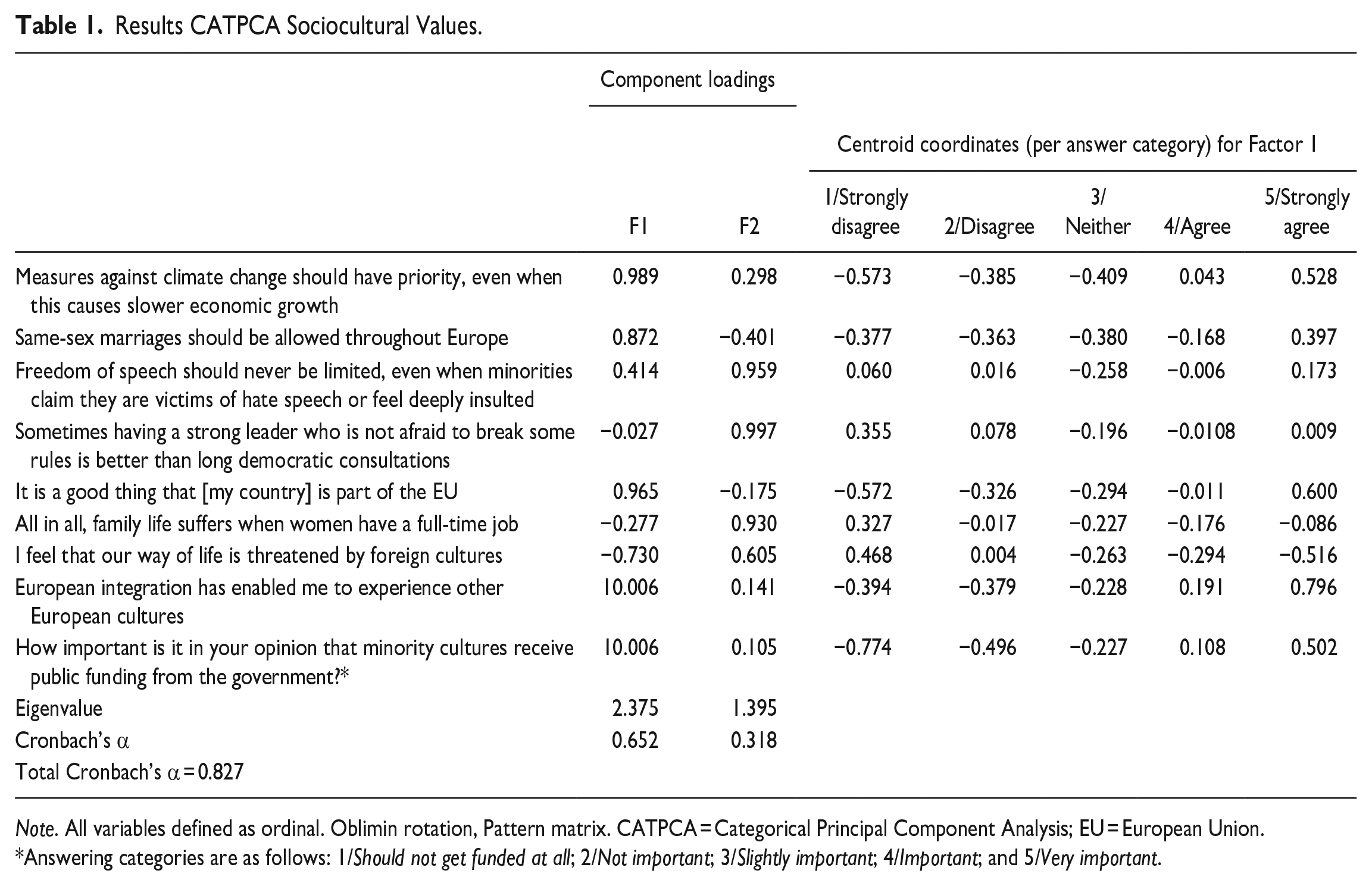
Note. All variables defined as ordinal. Oblimin rotation, Pattern matrix. CATPCA = Categorical Principal Component Analysis; EU = European Union.
Answering categories are as follows: 1/Should not get funded at all; 2/Not important; 3/Slightly important; 4/Important; and 5/Very important.
As an additional indicator of sociocultural values, we have a measurement of cultural cosmopolitanism, which some authors see as quintessential to what cultural backlash opposes (e.g., Sachweh 2020: 374). While this indicator is correlated with progressive–liberal value orientation (see Supplemental Table A3), it probes a more general openness toward other cultures and countries. This variable was measured via four items taken from Cleveland et al. (2014) on a five-point Likert-type scale (see Supplemental Table A2). The outcome variable is reliable (Cronbach’s α = 0.92) (M = 2.87; SD = 0.94).
Following Hanitzsch et al. (2018), ideological extremism is measured by taking the most extreme scores on nine items: seven used in the measure on sociocultural values and two on economic viewpoints (see Supplemental Table A3). We calculated a score by giving 2 points for every strongly disagree/agree answer, 1 point for disagree/agree, and 0 for neutral answers on the statements. The outcome variable is an index ranging from 0 to 18 (M = 10.13; SD = 3.65).
Since many current discussions on sociocultural values have become part of political debates between more progressive–liberal and more conservative-populist fractions (Norris and Inglehart 2019), we also measure political orientation. The survey asked which political party the respondent would support, if there were a General Election tomorrow, from a list of all parties represented in the national parliament of their country and recently established parties. Respondents could also indicate that they would not vote or would vote blank, or mention another party not presented in the answer menu. All mentioned political parties were coded for their overall ideological left–right position via the NRGEN score from the Chapel Hill Expert Survey (CHES) (Jolly et al. 2022) with higher scores indicating a more right-wing position (M = 5.16; SD = 2.12). Parties not present in the CHES data received—if found—imputed scores relative to present parties based on online descriptions and consulting country experts. For not voting/voting blank, voting other parties (without information), and not answering, dummy variables were added (with the CHES score coded in the middle).
Institutional Explanations
Discontentment with societal developments was operationalized by asking respondents how they view (a) changes in their country in the past five to ten years and (b) the current state of affairs in their country for sixteen items (five-point Likert-type scales). In line with cultural backlash theory (Norris and Inglehart 2019: 33), these items addressed immigration, inequality, anti-elitism, Euroscepticism, digitalization, globalization, democracy, and solidarity (see Supplemental Table A3). We calculated the mean score of the degree of negativity (positive items were reversed) so that respondents were scaled from being positive about (changes in) society to being negative. Importantly, these statements were designed to cover a variety of themes important in cultural backlash theory. Thus, the measures should be considered as indexes rather than scales, and do not have a reliability score. Two variables were computed: being negative toward changes in society (M = 2.33; SD = 0.39) and being negative toward the situation in one’s own country (M = 2.17; SD = 0.53).
Media Use
Media use was measured via the question “How often do you use the following media to stay informed about current affairs?” with answering categories (0) (almost) never, (1) less than once a month, (2) at least once a month, (3) at least once a week, and (4) (almost) daily. The following six items are used in the analysis: (a) public service television (M = 3.05; SD = 1.40), (b) commercial television (M = 2.38; SD = 1.60), (c) printed press (M = 2.01; SD = 1.58), (d) domestic digital news sites (M = 2.75; SD = 1.52), (e) social media (M = 2.68; SD = 1.66), and (f) video sharing platforms (M = 2.03; SD = 1.54).
Control Variables
In addition to respondents’ gender and age, we control for various individual sociodemographic variables: the highest level of education of the respondent (no formal/only primary: 6.3%; lower secondary: 14.8%; upper secondary general: 13.4%; upper secondary vocational: 21.9%; vocational tertiary: 15.1%; university degree: 28.6%). In addition, we take into account that institutional trust may be fostered by religious belonging (Van der Meer and Hakhverdian 2017), cultural capital (Noordzij et al. 2019), living in a more densely populated area (Mitsch et al. 2021), and having an ethnic minority background (Wilkes and Wu 2018). Religion is measured by asking respondents if they belong to any religion or denomination (0 = no; 1 = yes) (68.3%). Cultural capital is measured via the level of educational attainment of the parents (mean of both parents, on a scale of low (0), middle (1), or high (2); M = 0.71; SD = 0.69). Population density of the living area of the respondent ranges from 1 = House or farm in the countryside to 9 = Capital city of the country). Ethnicity is probed by asking respondents how they would describe their ancestry. Respondents could mention a maximum of two ancestries from a pre-coded list with the option to add an ancestry themselves to the list. Based on these answers, the variable Non-Western ancestry (0 = no; 1 = yes) was constructed (8.2%).
In the multivariate analyses, we control for how satisfied respondents currently are with their life in general since this may influence their assessment of society (Catterberg and Moreno 2006). Although we explicitly asked for both pre-COVID-19 and the current situation, analyses in which a difference score was included did not yield significant results. In the analyses, we therefore only model current satisfaction with life, measured on a scale from 0 (very dissatisfied) to 6 (very satisfied) (M = 3.93; SD = 1.56).
Results
Descriptive Analyses
Table 2 shows the mean values of the key dependent and independent variables per country. Institutional trust is highest in Denmark, Finland, Switzerland, and the Netherlands, and lowest in France and the United Kingdom. Disentangling the four institutions shows that trust in science has the highest average scores in all countries, but the other three institutions have mixed results. In Spain and Croatia, trust in national government is lowest; in Denmark, France, Serbia, and the United Kingdom this concerns news media; and in Finland, Netherlands, and Switzerland it is the EU.
Estimated Marginal Means Key Dependent and Independent Variables.
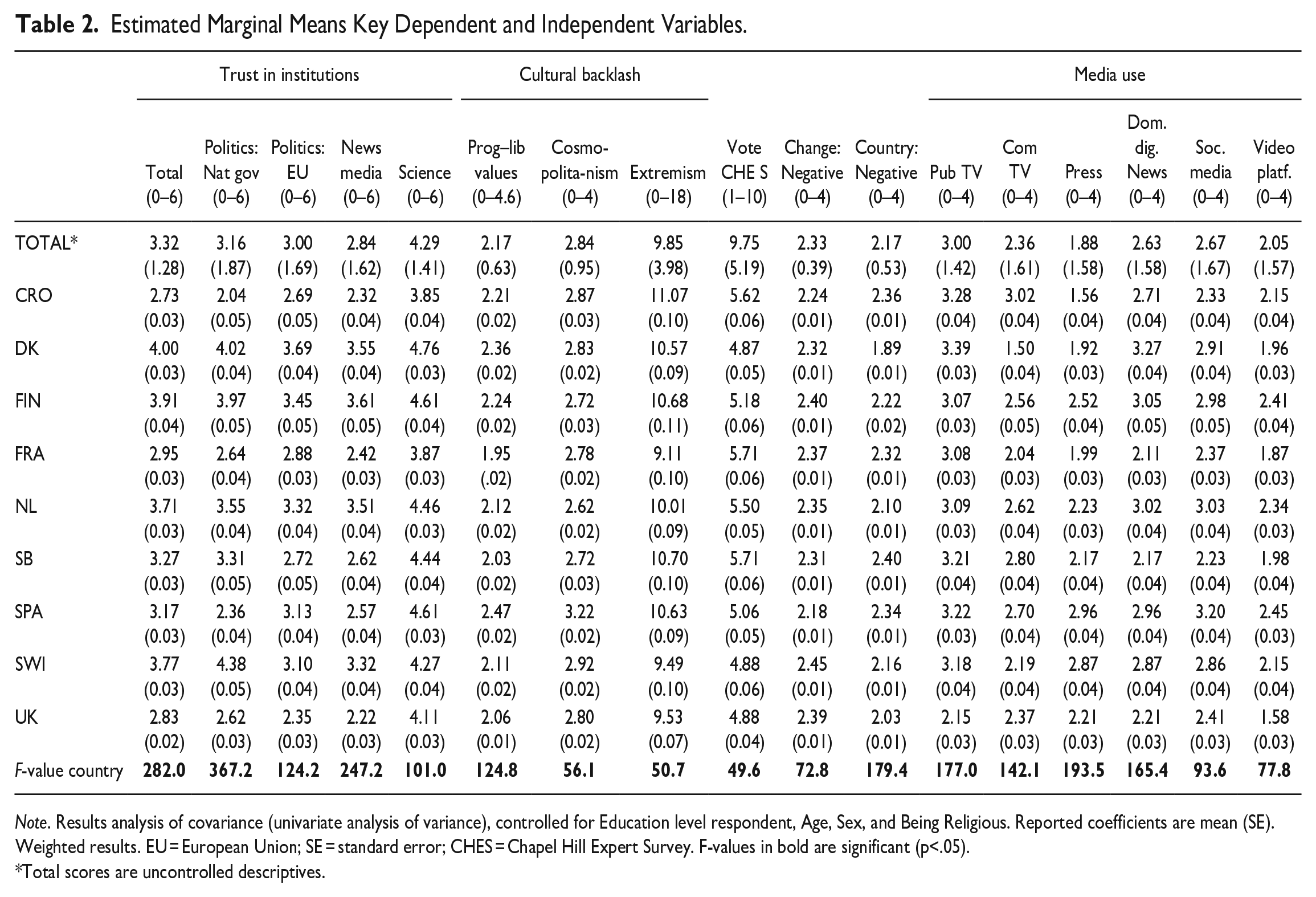
Note. Results analysis of covariance (univariate analysis of variance), controlled for Education level respondent, Age, Sex, and Being Religious. Reported coefficients are mean (SE). Weighted results. EU = European Union; SE = standard error; CHES = Chapel Hill Expert Survey. F-values in bold are significant (p<.05).
Total scores are uncontrolled descriptives.
Cultural backlash indicators do not show clear patterns. Respondents from France, Switzerland, and the United Kingdom seem least extreme and most nuanced; the most progressive viewpoints are found in Denmark and Spain. Perceptions on changes in society and the situation in one’s own country do not show huge differences, suggesting that the country level is of less importance. Media use patterns do differ across countries. In most countries, public service television is used most frequently, with the exception of the United Kingdom (where all types of reported media use are low). Printed press scores highest in Finland, Spain, and Switzerland, while digital media use is most common in Denmark, Finland, the Netherlands, Spain, and Switzerland.
Explanatory Analyses
We applied multilevel regression analysis since the data concern individuals nested in country contexts (Hox et al. 2017). 4 Unless indicated differently in the tables, explanatory variables are grand-mean centered. In the first step, we estimated the null models with only a random intercept but no independent variables. Based upon variances at the individual and country levels, we can assess how much of the explained variance is situated at each level by calculating the intraclass correlation coefficient (ICC). The ICC for trust in institutions is (0.241/0.241 + 1.368) = 15.0 percent. This implies that we find substantial country effects which can be further explored in follow-up analyses. 5
Table 3 presents four models: first only sociodemographic variables, then exogenous cultural backlash variables are entered, followed by endogenous cultural backlash variables, and finally media use. We report the findings per type of explanation and model.
Multilevel Analyses of Trust in Institutions (N = 13,176).
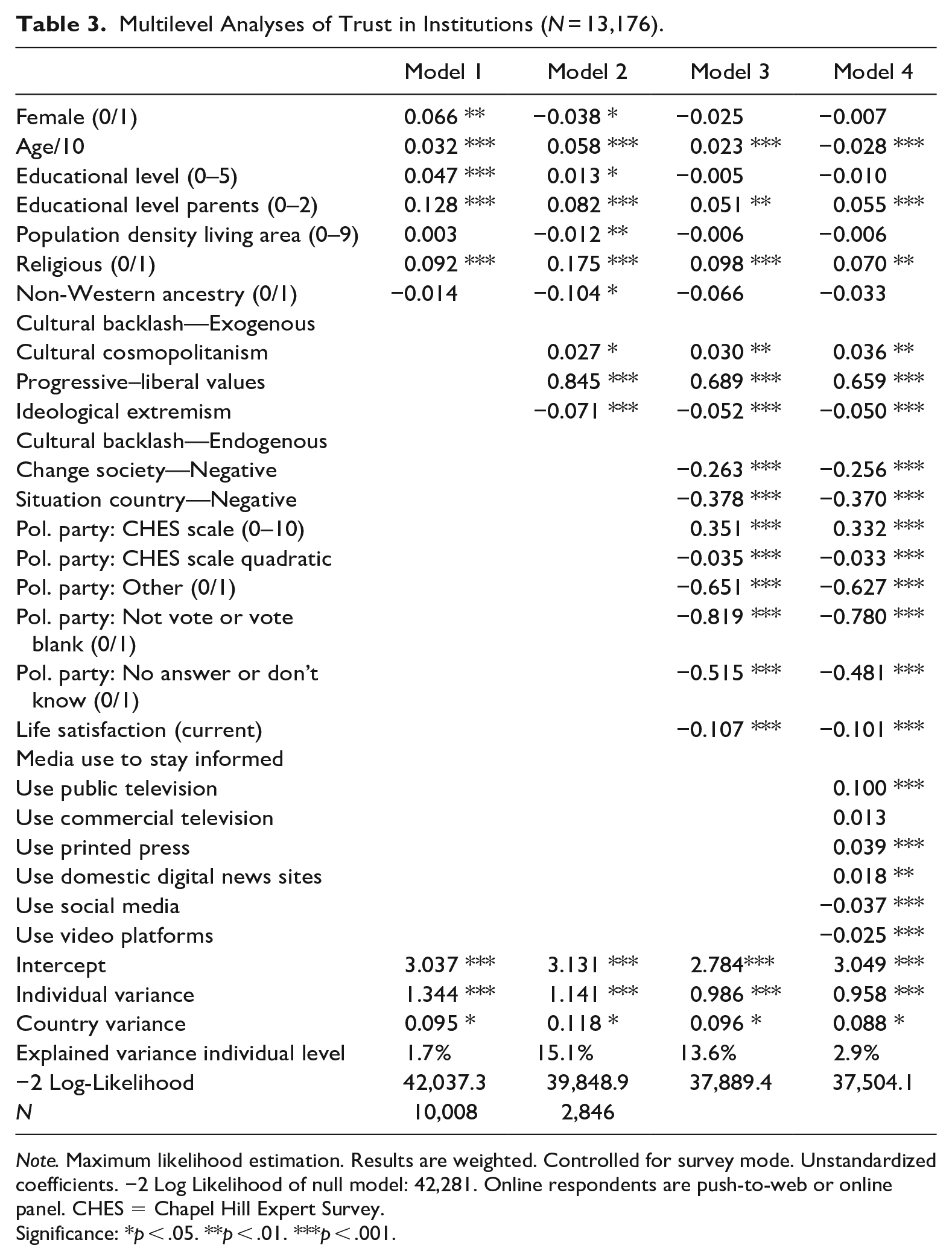
Note. Maximum likelihood estimation. Results are weighted. Controlled for survey mode. Unstandardized coefficients. −2 Log Likelihood of null model: 42,281. Online respondents are push-to-web or online panel. CHES = Chapel Hill Expert Survey.
Significance: *p < .05. **p < .01. ***p < .001.
Model 1 only contains control variables and explains 1.7 percent of the variance at the individual level. Comparing the effects of this model with later models, it points at the relevance of age, (parental) education, and religion. More religious citizens have more trust, as is also the case for citizens with more cultural capital (higher parental education). The positive effect of age turns negative in the final model when media use is included, and the impact of educational level vanishes in Model 2.
Model 2 gives evidence that all exogenous cultural backlash variables are associated with institutional trust. Compared to Model 1, it adds 15.1 percent explained variance. Citizens with more progressive–liberal value orientations display more institutional trust (supporting H1). The additional measure of cosmopolitanism also has an—albeit smaller—significant effect (B = 0.024). The extent to which citizens are more extreme in their ideological orientation is negatively associated with institutional trust (supporting H2). These effects remain significant in later models.
In Model 3, the endogenous indicators of cultural backlash are added, which yields an additional 13.6 percent explained variance. All included variables are significant. First, we see that the more negative citizens are about changes in society, the lower their institutional trust (B = −0.263). Being negative about the current situation in one’s own country has an additional negative association with trust (B = −0.378) (supporting H3). Political party support is modelled via five variables. The main effect of CHES is positive (B = 0.351), but the quadratic term is negative (B = −0.035), implying that there is a curvilinear effect: first the association between more right-wing voting and trust is positive, but then it becomes negative. The more extreme values of political party support are associated with the lowest institutional trust (supporting H4a). The dummy variables for other political parties, not voting, or no answer all have negative relationships with trust (supporting H4b).
Model 4 adds the media use variables, resulting in a 2.9 percent increase in explained variance. Using public service television and the printed press is positively associated with institutional trust, but using commercial television is not (which partly supports H5a). At the same time, we find differences for the internet-based media. Citizens who more often use domestic digital news sites have higher levels of institutional trust (supporting H5b), while using social media and video sharing platforms is negatively related to trust (supporting H6a and H6b).
Overall, the exogenous variables appear to be slightly more important than the endogenous variables in terms of explained variance (15.1 vs. 13.6%). Particularly, progressive–liberal values are most strongly associated with institutional trust (B = 0.659 in the final model).
Differences Across Institutions
Comparing the full model for the four institutions that make up institutional trust shows large consistencies in how individual variables are associated with trust, yet also point at different relationships with cultural backlash (see Supplemental Table A5). Trust in national government is explained far better by endogenous cultural backlash variables (14.6% explained variance) than by exogeneous indicators (2.7%). For trust in the EU and in science, however, it is the other way around: exogenous components contribute 23.5 and 11.8 percent, respectively, while endogenous components comprise 9.2 and 3.7 percent. Trust in news media sees a balance between the two (6.9 vs. 6.7%), and—understandingly—a higher explanation for media use variables (4.0%).
Differences Across Countries
Supplemental Table A6 presents the results of multilevel analyses of institutional trust per country. There are three main findings. First, there is a huge consistency of the direction and strength of the coefficients for most independent variables. In all countries, progressive–liberal values are positively associated with trust, and a negative assessment of the situation in the country. Ideological extremism, perceptions of change, and political party support have similar results in most countries. Second, in all countries except Serbia (and France with minimum difference), exogenous variables have a higher explained variance than endogenous variables. The relatively important role of endogenous explanations in Serbia and France seems to result from the stronger-than-average link between political party support and trust. Exogeneous cultural backlash is most important in Finland (31.7% explained variance), suggesting that here progressive–liberal values very frequently coalesce with institutional trust.
Third, we cannot discern very clear distinctions between countries based on the type of media system (which should have set France and Spain apart from Denmark, Finland, Netherland, and Switzerland, and from the United Kingdom, e.g., Hallin and Mancini 2004), general trust levels (which should have set Denmark, Finland, and the Netherlands as high-trust countries apart from the other countries, e.g., Norris 2011), or economic performance and corruption levels (Van der Meer 2018: 603–05) (which should have set Serbia and Croatia, followed by Spain, apart from the other countries). 6
Robustness Checks
We performed a number of robustness checks, reported in Supplemental Tables A7–A9. First, we employed Ordinal Regression Analysis for the four institutions (Supplemental Table A7). The results were highly similar to ordinary least squares regressions. Second, we conducted multilevel analysis of the overall measure of institutional trust using slightly different measures, including values variable without Euroscepticism items and dummy variables for political party preference (see Supplemental Table A8). The alternative measures for progressive–liberal values and extremism are very much in line with the earlier models. For political party preference, we find a clear negative effect of support political right-wing parties (B = −0.404). Finally, we did separate analyses for respondents answering via the internet versus answering by telephone or face-to-face. Again, for the main variables, the results are highly consistent with our main analyses (see Supplemental Table A9).
Conclusion
The importance of institutional trust has become more salient than ever in recent years as the political landscape has become more polarized and seen the rise of populism throughout the Western world—trends which have been captured as “cultural backlash” (Norris and Inglehart 2019). This paper makes advancement on previous studies of institutional trust—as well as their components political, media, and science trust—by examining how cultural backlash and its dimensions are related to trust, and by updating the media use perspective. Drawing on new survey data collected in the Spring and Summer 2021 within a large international research project, we show that both endogenous (institutional) and exogenous (cultural) factors shape institutional trust. The former are most strongly associated with trust in national government (Mishler and Rose 2011); the latter are most strongly related to trust in the EU and in science. Which media Europeans consult is less important than the cultural backlash variables for trusting institutions, except for trust in media themselves. Relying on social media and video sharing platforms is negatively associated with most forms of trust, whereas the use of public service television, the printed press and to some degree digital news sites have a positive relationship with trust. This partly confirms previous studies (Hameleers and Schmuck 2017; Mazzoleni and Bracciale 2018), but points to the importance of separating not only legacy media and social media but also digital news sites and video sharing platforms when examining institutional trust.
While the observation that Europeans with the most negative evaluations of how their society functions tend to have the lowest levels of trust may not be unexpected, our analyses do signal important details. First, this association works independently of the sociocultural and political stances of individuals: these have large additional effects which imply that cultural explanations of trust are also relevant (Norris and Inglehart 2019). Second, being negative about societal developments cannot be equated to political party support: this forms a separate component of cultural backlash. Third, we find that more progressive–liberal values and being less extreme seem to foster trust, implying that more postmaterialist values do not necessarily generate more critical citizens (Norris, 2011), and fighting polarization would be beneficial for trust (see also Anderson et al., 2023). The European countries we studied here are—compared to for example those in the WVS data—relatively similar in terms of GDP, democratic functioning, and digitalization levels, which implies we were able to zoom in on a part of the world that is stable yet increasingly affected by political turmoil. Our study also contributes to media system theory (Hallin and Mancini 2004): the positive role of public television appears very consistent across countries while printed press has limited effect. The differences between media systems are marginal.
Finally, while our study was conducted during the COVID-19 pandemic, we did not find a clear impact of these critical circumstances—perhaps because our measure of pandemic-related influences (changes in life satisfaction) was not distinctive enough. The trust in science remained high in all countries studied.
Some limitations need to be addressed. Since this survey is part of a larger research project on social and cultural developments in Europe, we did not have multi-item measures of trust (see for critiques on survey questions of trust: Fisher 2018). For the same reason, the number of statements on politics and social change is limited. However, we were able to include statements regarding current societal issues not available in other surveys. Another limitation concerns the cross-sectional nature of the data: while we predict levels of trust using various explanatory variables, it is likely that the relationship is reciprocal and that trust also affects media use and perceptions of change. Furthermore, we point out that the theoretical distinction between endogenous and exogenous variables is not always easy to make; for example, political party support has traditionally links to cultural values related to social class but is more and more used as an evaluative signal (Bélanger 2017). Future research could investigate the differences between the countries we studied in more depth by including more countries and country-level variables. Some preliminary findings in our data indicate that institutional trust is still highest in the smaller Northern/Western countries (Denmark, Finland, Netherlands, Switzerland) where progressive–liberal values are also relatively high. It would be important to further investigate these differences also in relation to other country-specific circumstances.
Supplemental Material
sj-docx-1-hij-10.1177_19401612231187568 – Supplemental material for Institutional Trust and Media Use in Times of Cultural Backlash: A Cross-National Study in Nine European Countries
Supplemental material, sj-docx-1-hij-10.1177_19401612231187568 for Institutional Trust and Media Use in Times of Cultural Backlash: A Cross-National Study in Nine European Countries by Marc Verboord, Susanne Janssen, Nete Nørgaard Kristensen and Franziska Marquart in The International Journal of Press/Politics
Footnotes
Acknowledgements
We want to thank the editor and reviewers for their constructive feedback and helpful suggestions regarding previous versions of this article.
Declaration of Conflicting Interests
The author(s) declared no potential conflicts of interest with respect to the research, authorship, and/or publication of this article.
Funding
The author(s) disclosed receipt of the following financial support for the research, authorship, and/or publication of this article: This project has received funding from the European Union’s Horizon 2020 research and innovation program under grant agreement No. 870691.

Supplemental Material
Supplemental material for this article is available online.
Notes
Author Biographies
References
Supplementary Material
Please find the following supplemental material available below.
For Open Access articles published under a Creative Commons License, all supplemental material carries the same license as the article it is associated with.
For non-Open Access articles published, all supplemental material carries a non-exclusive license, and permission requests for re-use of supplemental material or any part of supplemental material shall be sent directly to the copyright owner as specified in the copyright notice associated with the article.
