







Abstract
While extant research on news avoidance has been conducted mainly in democratic societies, this article examines intentional news avoidance in a society undergoing severe democratic backsliding. Given the decline of political freedom and democratic institutions, citizens in such contexts may become frustrated with ongoing political change and withdraw from public affairs and the news. This could result in a form of intentional, politically driven, and topical news avoidance. At the individual level, such news avoidance is likely to be influenced by political attitudes, ability to adapt, and news affect and cognition. Analysis of survey data from post-National Security Law Hong Kong finds that negative news affect and perceived news efficacy explain intentional avoidance of news about social and political change, whereas political trust, belief in civil liberties, and adaptiveness relate to news avoidance only indirectly through negative news affect and perceived news efficacy. Theoretical implications of the findings are discussed.
Keywords
Recent years have seen increasing research attention on the phenomenon of news avoidance. Studies are often driven by a concern with the possible negative impact of news avoidance on citizens’ ability to stay informed and engage in meaningful deliberation (Skovsgaard and Andersen 2020). However, some studies have suggested that news avoidance does not necessarily contradict civic engagement (Woodstock 2014). News avoidance relates only weakly to news use (Palmer et al. 2023) and may be beneficial to people’s mental well-being during crises (Mannell and Meese 2022; Moe et al. 2024).
Nonetheless, the above debate is framed with the assumption of a democratic society. Although non-democracies have been included in cross-national analyses (Kalogeropoulos et al. 2024), there is a lack of studies focusing squarely on news avoidance in autocratic societies or societies undergoing democratic backsliding, that is, societies experiencing the shrinkage of civil liberties and decline of democratic institutions (Bermeo 2016). This is a major limitation of the literature, not least because of the prominence of backsliding in the contemporary world (Croissant and Haynes 2021; Diamond 2021; Hyde 2020).
The news audience in societies under democratic backsliding faces a distinctive situation. Many citizens can find the ongoing political change highly frustrating and develop a sense of inefficacy and alienation. They may respond by withdrawing from the world of public affairs. This can include intentionally avoiding the news, especially news related to the ongoing social and political change. Hence, this study is concerned with a specific type of news avoidance that is particularly prominent under a specific type of political contexts; it is politically driven, intentional, and topical in character.
The focus on intentional avoidance of news about social and political change under democratic backsliding requires considerations pertinent to the phenomenon and the context. This study treats several factors as possible predictors of intentional news avoidance: political attitudes are examined because they can represent the degree to which people are aligned with the existing regime; the psychological concept of secondary control is examined because it captures whether people are capable of adapting to difficult and challenging situations; news affect and cognition are examined because they are likely to drive news avoidance most directly. In addition to treating these as parallel independent variables, this study also explores whether news affect and cognition mediate the relationships between political and psychological beliefs and news avoidance behavior.
The empirical analysis focuses on Hong Kong, where the enactment of the National Security Law (NSL) in 2020 signified a paradigm shift in the Chinese government’s approach to govern the city (Lee and Chan 2023). This study shall contribute to the literature by extending analysis to a distinctive type of politically driven news avoidance behavior. The following starts by further explicating the phenomenon under examination. It then explicates the proposed antecedents and sets up the hypotheses. Description of the survey method and presentation of data analysis follow. The concluding section discusses the theoretical implications of the findings.
The Concept of News Avoidance and Democratic Backsliding as Context
While the meaning of the phrase news avoidance seems intuitively clear, Skovsgaard and Andersen (2020) pointed toward inconsistencies in how the concept is employed in empirical studies. They distinguished between intentional and unintentional news avoidance. The former refers to people consciously tuning out because they dislike the news, whereas the latter refers to people not consuming news “without having an explicit dislike for the news and without making an active choice” (p. 460). Unintentional news avoidance is typically operationalized as low levels of news consumption (Edgerly 2022; Lindell and Båge 2022), whereas intentional news avoidance is operationalized through self-report of such behavior (Newman and Fletcher 2017; Toff and Kalogeropoulos 2020).
Scholars vary in their conceptualization of the relationship between news avoidance and news consumption. Some studies equated avoidance to non-consumption of news and then differentiated between those who did so intentionally and unintentionally (Gorski 2023). Others suggested that intentional avoidance does not entail non-consumption of news (Ohme et al. 2022). Analyzing data from forty-six countries, Palmer et al. (2023) showed only a weak relationship between intentional news avoidance and news use. Staying away from the news occasionally can be a means to keep oneself calm and efficacious (Woodstock 2014).
Conceptually, the non-equivalence between intentional news avoidance and non-consumption of news partly resides in the fact that the former can be topical in character (Ohme et al. 2022). People may be particularly motivated to avoid news on specific topics if they find those topics irrelevant or frustrating, but they may still be consuming news on other topics. The current study focuses exactly on a form of intentional and topical news avoidance, and this form of news avoidance occurs particularly prominently under the context of democratic backsliding.
Bermeo (2016: 5) defined democratic backsliding as “state-led debilitation or elimination of any of the political institutions that sustain an existing democracy.” It can occur at different speeds and take a society toward different endpoints. In addition to the weakening of existing democracies, the term may also be applied to describe the weakening of democratic elements in hybrid regimes. Democratic backsliding often proceeds with executive aggrandizement and the shrinkage of civil liberties (Thompson 2021). In such societies, the decline of democratic institutions implies the closing down of opportunities for institutionalized political participation by citizens, whereas non-institutionalized forms of participation, such as protests, can also be curtailed. People may therefore find public affairs information less relevant because of the weakening role of public opinion in the political process. This could dampen people’s interest in the news.
Besides, the demise of independent and critical journalism typically constitutes part of the decline of democratic institutions (Haggard and Haufman 2021). Media censorship and self-censorship can prevail. Indeed, Toff and Kalogeropoulos’s (2020) cross-national analysis finds that countries with lower levels of press and political freedom exhibit higher levels of news avoidance. They noted that the news in such societies “may be perceived as less accurate and therefore less valuable, leading many to avoid it” (p. 383).
Moreover, a specific type of negative news—news about political repression, the demise of civil society, and the decline of civil liberties—could become prominent when backsliding occurs. This can further aggravate the feelings of frustration, inefficacy, and fear, thereby leading people to avoid the news, especially news about social and political change.
The above paragraphs thus outlined several reasons for the emergence of news avoidance under backsliding. This form of news avoidance is a response to the ongoing political change. It is intentional and can be mainly topical in scope, that is, people are particularly motivated to avoid news about social and political change. Whether such topical news avoidance would become generalized into rejection of all kinds of news is not the concern of this article.
Antecedents of Intentional Topical News Avoidance
Extant research has identified several major predictors of intentional news avoidance in democratic societies. Skovsgaard and Andersen (2020) identified news distrust, perceived negativity of the news, and news overload as the three major reasons for intentional news avoidance (Goyanes et al. 2023; Newman and Fletcher 2017; Park 2019; Song et al. 2017; Toff and Kalogeropoulos 2020). In addition, news avoidance has been shown to relate to soft news preference (Toff and Kalogeropoulos 2020), lack of political interests (Goyanes et al. 2023), and a strong news-finds-me perception (Goyanes et al. 2023). Chan et al. (2022) showed that concern with fake news does not lead directly to news avoidance, but it could strengthen the relationship between news fatigue and news avoidance.
This study does not aim at replicating these findings, however, because the form of news avoidance being examined is different. For instance, given information censure and self-censorship, politically driven news avoidance under democratic backsliding is theoretically unlikely to result from “overload.” Rather, an examination of politically driven news avoidance should require us to examine the potential relevance of political attitudes. Besides, to the extent that democratic backsliding presents a challenging situation to many citizens, people’s ability to adapt to difficulties may matter. Besides, the role of news affect and cognitions cannot be ignored as we are examining tendency to avoid the news. In line with the idea of backsliding being a challenging situation to both citizens and professional journalism, this study examines the negative news affect and perceived news efficacy as potential predictors of intentional news avoidance.
Political Attitudes: Political Trust and Support for Liberal Values
As explicated above, democratic backsliding implies the closing of participation opportunities, and this applies to citizens of all political predilection. However, not all citizens are equally affected psychologically by the ongoing political change. After all, citizens vary in the degree to which they are aligned with the current regime. To the extent that people are aligned with the existing regime in their attitudes and/or value orientations, the ongoing political change may not be too frustrating. In other words, avoiding news about social and political change can be politically driven not only in the sense of being a response to contextual change, but also in the sense of being tied to individual-level political beliefs.
Specifically, this study examines the impact of political trust and support for liberal values on news avoidance. Political trust can be defined in terms of the degree to which people feel that they can rely on the political system to produce their preferred outcomes without themselves participating in it (Hetherington 2004; Levi and Stoker 2000). Notably, political trust is seldom examined as a predictor in the extant literature. An exception is Schäfer et al. (2022), yet they did not find a robust relationship between political trust and news avoidance. Nevertheless, people who trust the political system are, by the above definition, less worried about their own lack of participation in the policy-making process. Hence, they should be less likely to find democratic backsliding a problematic trend. Besides, political trust is an indicator of regime support, and regime supporters should be less likely to find the ongoing political change undesirable. Therefore, they should be less motivated to avoid news about the ongoing social and political change.
Besides political trust, this study also examines people’s value orientation. Political values are the normative principles and belief assumptions about government, citizenship, and society (McCann 1997). They are prescriptive and abstract in character and meant to be applied across a range of concrete situations (Goren 2005). Therefore, political values “facilitate position taking in more concrete domains by serving as general focal points in an otherwise confusing political environment” (McCann 1997: 565). While political scientists have identified multiple values as important in shaping public opinion, this study focuses specifically on people’s belief in civil liberties. Conceptually, belief in civil liberties implies support for people’s rights to act and think in the way they deem most appropriate (Jacoby 2006). It is a value violated when backsliding occurs. Hence, supporters of such values should be particularly likely to be frustrated and stay away from relevant news.
The above arguments lead to the first two hypotheses:
H1: Political trust relates negatively to intentional topical news avoidance.
H2: Belief in civil liberties relates positively to intentional topical news avoidance.
Adaptiveness or Secondary Control
People have to adapt to a new environment when rapid social and political changes occur. Adaptation can be difficult for people who see the changes as highly undesirable. But individuals can have different levels of ability to adapt. Here, the psychological concept of secondary control becomes relevant. In Rothbaum et al.’s (1982) seminal formulation, primary control refers to attempts to alter the environment with one’s efforts, whereas secondary control refers to attempts to fit into the environment and flow with the current. Secondary control implies adjustment, though it does not entail changing one’s basic values. It allows people to find meanings in difficult situations. Psychologists have employed the concept to study, for instance, AIDS patients (Thompson et al. 1994), parents of sick children (Grootenhuis et al. 1996), and people facing natural disasters (Wadsworth et al. 2009).
Applied to politics, individuals can be considered as trying to exercise primary control when they take actions aiming at changing the society. But facing the advance of a powerful state, people may be compelled to exercise secondary control. People’s capability to exercise secondary control can then have consequences on one’s behavior. Analyzing public opinion in Hong Kong, Kobayashi and Chan (2022a) found that people with higher levels of secondary control are less likely to consider emigration. For this study, people having higher levels of secondary control should be more capable of adjusting their expectations and focus on what remains possible for the media and society to do. This should alleviate their tendency to avoid news about social and political change. Hence, the third hypothesis is:
H3: Secondary control relates negatively to intentional topical news avoidance.
Negative News Affect and Perceived News Efficacy
In addition, news avoidance can certainly be influenced by factors more directly about the news. Extant research suggests that news avoidance can be grounded in both cognitive and affective factors (Gorski 2023; Palmer et al. 2020; Villi et al. 2022). This study focuses on two news-related variables: negative news affect and perceived news efficacy.
Conceptually, negative news affect refers to the extent to which people harbor negative feelings when consuming the news. Negative affect is widely noted as a key factor or motivation behind news avoidance. Toff and Nielsen (2022), in particular, noted the role of anticipated anxiety in news avoidance. The negative affect can come from various sources. Some news avoiders might see the news as biased; some see the news as cynical; some find the news focusing too much on negative events (Toff and Nielsen 2022; Woodstock 2014). Negative news affect does not necessarily come from a negative judgment of the media. The news media need to provide adequate coverage of important events. When the important events are highly emotionally draining, the news would also be emotionally draining (Mannell and Meese 2022; Ytre-Arne and Moe 2021) even if the audience sees the media as doing a competent job. No matter what makes news consumption an uncomfortable experience, negative affect could be an immediate predictor of news avoidance.
When cognitive factors are concerned, extant research often focuses on information overload (Goyanes et al. 2023; Song et al. 2017). But as noted, overload is theoretically unlikely to be pertinent to the type of news avoidance examined in this study. Instead of facing an abundance of information, given the likelihood of censorship when state power increases, people may be facing less, rather than more, information about the society.
This study posits that, under democratic backsliding, the perception of whether the media can retain their social functions and significance matters. This article uses perceived news efficacy to refer to a belief in the capability of the news media to serve certain important social functions. This conceptualization differs from that by Park (2019), who follows Bandura’s (1977) notion of self-efficacy and treats news efficacy as an individual’s belief in his/her ability to get the news and understand it. Park’s conception concerns an individual’s efficacy when handling the news, whereas this study is concerned with people’s perception of the efficacy of the news media. Theoretically, if people believe in the ability of the press to carry out its functions, they should be more likely to follow the news. In contrast, when press freedom declines, the media can become less capable of playing certain normative roles (such as monitoring the government). When people perceive the situation as such, they should be more likely to tune out.
Notably, Kalogeropoulos et al. (2024) have tested a similar hypothesis. They posited that evaluation of the media’s watchdog performance should relate negatively to news avoidance because people should continue following the news when they see the media as capable of carrying out their normative roles. However, their analysis unexpectedly found a positive relationship between evaluation of the media and news avoidance. Nevertheless, Kalogeropoulos et al. (2024) did not address the context of democratic backsliding. This study retains the expectation of a negative relationship between perceived efficacy of the news media and news avoidance. H4 and H5 are stated as follows:
H4: Negative news affect relates positively to intentional topical news avoidance.
H5: Perceived news efficacy relates negatively to intentional topical news avoidance.
The Possible Mediating Role of News Affect and Cognition
H1–H5 posit five factors that might explain intentional topical news avoidance under democratic backsliding. In addition to treating them as parallel independent variables, this study is also interested in exploring if news affect and cognition mediate the relationship between the political and psychological factors and news avoidance. After all, political trust, belief in civil liberties, and secondary control are broad political psychological factors, whereas negative news affect and perceived news efficacy are more closely tied to the news. In their classic study on the American voter, Campbell et al. (1960) used the metaphor of a funnel to explicate how variables may form layers of factors influencing vote choice. For instance, demographic variables may influence basic political beliefs, which then influence the vote. Similarly, it is plausible that the political psychological factors might first influence the news-related affect and cognitions, which then influence news avoidance behavior.
To elaborate, people with higher levels of political trust and lower levels of support for civil liberties are less likely to see the current political change as problematic. Hence, they are less likely to have negative news affect and more likely to see the media as remaining efficacious. These factors may then lead them to avoid the news less. In other words, negative news affect and perceived news efficacy may be the mechanisms through which political trust and values matter. Similarly, people more capable of adapting to difficult environments should be relatively less likely to have persistent negative feelings about the political environment and the news. Besides, their capability of finding meanings and purposes can lead them to appreciate what the news media can still achieve even under difficult circumstances. These may lead them to avoid the news less.
These considerations can be formulated as several indirect effect hypotheses, for example, political trust indirectly negatively affects news avoidance through lowering negative news affect and enhancing perceived news efficacy. Mediation analysis can therefore provide important insights into how the political psychological variables relate to news avoidance. Nevertheless, a cross-sectional survey cannot authoritatively deal with causal relationships, let alone causal chains. Hence, the mediation analysis is exploratory. Instead of a full set of indirect effect hypotheses, an overall research question is posed:
Q1: Do negative news affect and perceived news efficacy mediate the relationship between the political psychological factors and intentional topical news avoidance?
Method and Data
This study is conducted in Hong Kong, where democratic institutions and the hitherto largely free press were significantly tarnished after the establishment of the NSL in June 2020. The NSL is criticized for being broad and vague (Hernandez 2021). The government also activated the sedition clause of the Crimes Ordinance to prosecute private citizens and media organizations. In addition to the worsening problem of self-censorship, journalists and news outlets have to engage in constant risk assessment and management to navigate the environment (Lee 2023). Hong Kong’s ranking in Reporters without Borders’ press freedom index dropped abruptly from 80 in 2021 to 148 and 140 in 2022 and 2023, respectively.
Against this background, commentators have noted the tendency of Hong Kong citizens to avoid the news (Leung 2022). Some citizens seemingly took the approach of “lying flat,” a term borrowed from public discourse in mainland China, meaning “doing nothing.” Hong Kong thus provides a suitable case for examining the issues and hypotheses of this study.
Survey Method and Sampling
Data analyzed below comes from a telephone survey conducted by the Center for Communication and Public Opinion Survey at the Chinese University of Hong Kong in February and March 2023. The target respondents are Cantonese speaking Hong Kong residents aged eighteen or above. For sampling, a phone number database was created by matching all four-digit prefixes in use (both landlines and mobile) with the full set of 10,000 four-digit suffixes (i.e., from 0000 to 9999). Numbers were then randomly drawn by computer. For landline numbers, the target respondent was selected by the upcoming birthday method. The sample size is 1,015. The response rate is 33% following AAPOR response rate formula 3.
A total of 52.2% of the respondents were females; 18.9% aged 18–29, whereas 26.2% aged 60 or above; 46.8% had tertiary degree education; 17.7% had household monthly income less than HK$20,000. The sample is younger, better educated, and more economically well-off than the corresponding population (13.9% aged 18–29, 29.6% had tertiary degree education, and 25.1% had household income less than HK$20,000). The sample was weighted according to the sex x age x education distribution of the population.
Political change has led to concerns about selective non-participation and preference falsification in surveys. While recent research has found some evidence of the problem (Kobayashi and Chan 2022b), the extent is not extreme. Comparative analysis has suggested that questions about regime assessment may not really be that sensitive in authoritarian contexts (Shen and Truex 2020). In any case, preference falsification, if present, should undermine the predictive value of those “sensitive variables.” If the expected relationships are upheld, it would suggest that preference falsification is not serious.
Operationalization of Key Variables
Intentional topical news avoidance is the average of respondents’ agreement, expressed through a five-point Likert scale (1 = strongly disagree, 5 = strongly agree), with two statements: (1) sometimes you want to avoid news about the changing social environment in Hong Kong; (2) sometimes you want to avoid news about the changing political environment in Hong Kong (r = 0.81, M = 3.21, SD = 1.09). Strictly speaking, the variable represents motivation or intention to avoid the news rather than actual avoidance behavior.
Political trust is the average of respondents’ trust, expressed through a 0-to-10 scale (0 = absolutely not trust, 10 = absolutely trust), in four entities: (1) the Hong Kong Special Administrative Region government, (2) the Chinese Central Government, (3) the judicial system, and (4) law enforcement (α = 0.95, M = 4.28, SD = 2.68).
Belief in civil liberties was measured by asking the respondents to indicate, using a five-point Likert scale (1 = strongly disagree, 5 = strongly agree), if they would agree that: (1) protecting citizens’ freedom is very important to the Hong Kong society, and (2) everyone should have the freedom to accept and express views that might not be found agreeable in the society. The statements were derived from Schwartz et al. (2014), with the wordings adjusted to fit the context. They were averaged to form the index (r = 0.36, M = 4.01, SD = 0.87).
Secondary control was measured by Brandtstädter and Renner (1990) flexible goal adjustment scale, which has been widely adopted in relevant research (Hajek and Konig 2015; Kobayashi and Chan 2022a). Only four items from the original scale—chosen based on how intuitively understandable they are in Chinese—were used due to constraints on length of questionnaire. The survey asked the respondents to indicate, using a five-point Likert scale (1 = strongly disagree; 5 = strongly agree), if they would agree that: (1) when everything seems to go wrong, I can usually find a positive side, (2) faced with a disappointment, I remind myself that other things in life are just as important, (3) I find that even life’s troubles have a bright side, and (4) I adapt quite easily to changes in plans or circumstances. The items were averaged for the index (α = 0.67, M = 3.59, SD = 0.67).
Negative news affect is the average of respondents’ agreement, expressed through the same five-point Likert scale, with two statements: (1) news related to changes in Hong Kong’s social environment makes you feel unhappy; (2) news related to changes in Hong Kong’s political environment makes you feel depressed (r = 0.59, M = 3.40, SD = 0.94).
Perceived news efficacy is the average of respondents’ agreement, expressed through the same five-point Likert scale, with four statements, all starting with “news reporting by the Hong Kong media can”: (1) influence the society; (2) influence the government; (3) keep an important historical record for the society; and (4) help dissidents or marginal communities to express their voices (α = 0.73, M = 3.23, SD = 0.77).
Control variables include four demographics (sex, age, education, and family income), internal efficacy, collective efficacy, mainstream news consumption, alternative media exposure (alternative media is defined as outlets challenging the established mainstream media and power structure, see Couldry and Curran 2003), and political communication via social media. Details of operationalization are included in the Supplemental information file available online.
Analysis and Findings
Multiple regression analysis was employed to examine the hypotheses regarding the predictors of intentional topical news avoidance. The results are summarized in Table 1. Among the controls, better educated people and people who regard themselves as capable of understanding public affairs are less likely to avoid the news, whereas people with higher income are more likely to avoid news about social and political change.
Predicting Intentional Topical News Avoidance.
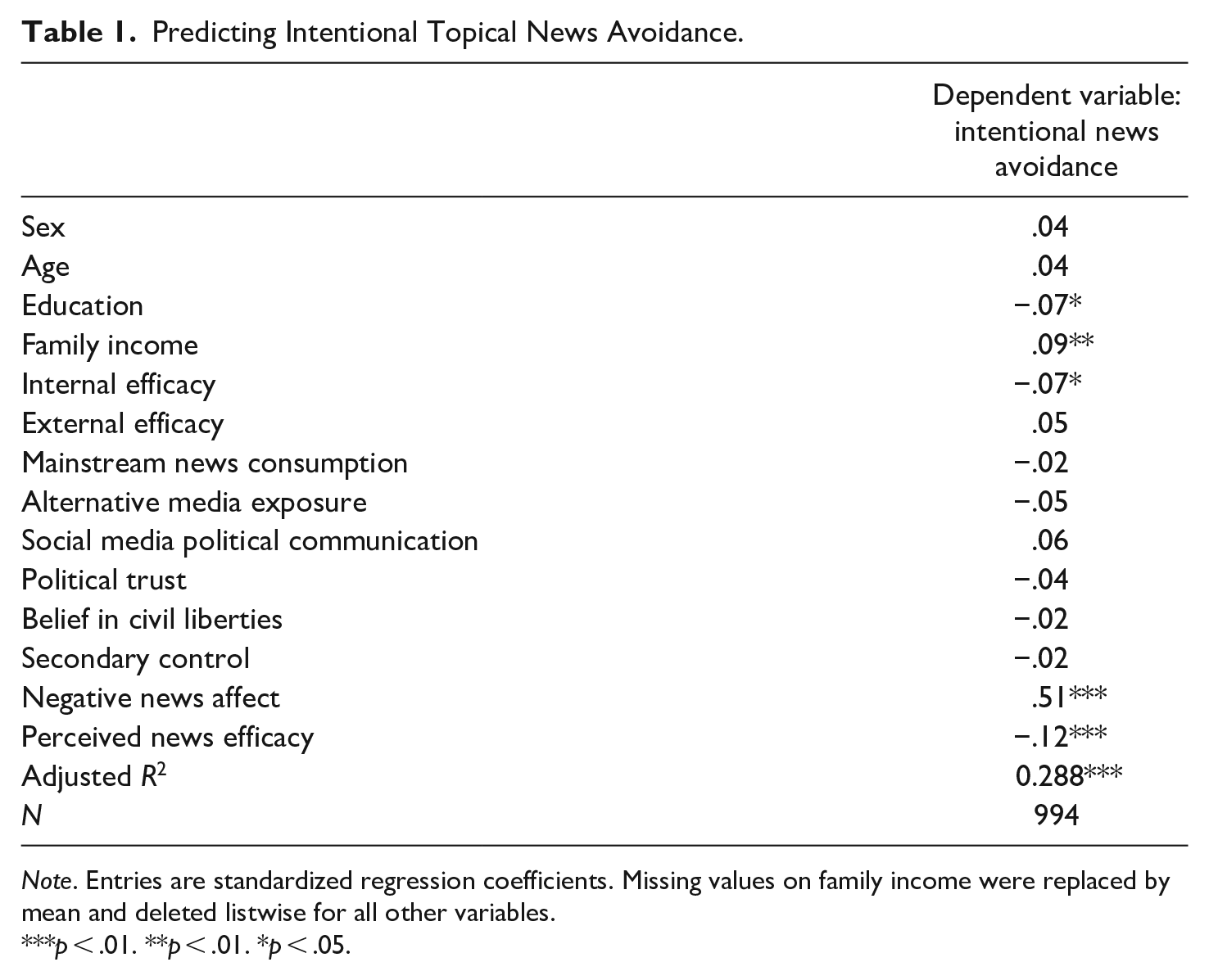
Note. Entries are standardized regression coefficients. Missing values on family income were replaced by mean and deleted listwise for all other variables.
p < .01. **p < .01. *p < .05.
Regarding the key variables, although political trust obtains a negative coefficient, the coefficient does not reach the conventional level of statistical significance. Belief in civil liberties and secondary control also do not relate significantly to the dependent variable. H1–H3 are not supported. The three political and psychological factors do not significantly predict news avoidance in a full model when everything is controlled.
In contrast, negative news affect is very strongly related to intentional topical news avoidance, while perceived news efficacy significantly negatively relates to the dependent variable. H4 and H5 are supported. As expected, people are more likely to avoid news about social and political change if they have strong negative feelings when seeing such news and if they see the news media as less capable of performing various normative roles.
However, the lack of relationships between the political and psychological factors and news avoidance may be the result of mediation by the two news-related variables. Indeed, if negative news affect and perceived news efficacy are not included, although belief in civil liberties and secondary control remain insignificant, a substantial negative relationship between political trust and intentional news avoidance emerges (β = −0.21, p < .001).
This finding points to the value of exploring Q1, which deals with the possible mediating role of the two news-related variables. To examine the question, multiple regression analyses were first conducted by using negative news affect and perceived news efficacy as the dependent variables. As Table 2 summarizes, all three focal political psychological factors relate highly significantly with negative news affect and perceived news efficacy. People who trust the current regime are less likely to feel negative when seeing news about social and political change, and they are more likely to see the news media as capable of playing various normative roles. People with stronger beliefs in civil liberties are more likely to have negative news affect and perceive the news media to be efficacious. Level of secondary control does not relate significantly to negative news affect, but it relates significantly positively to perceived news efficacy. People more adaptive to difficulties are more likely to see the news media as remaining efficacious.
Predicting Negative News Affect and Perceived News Efficacy.
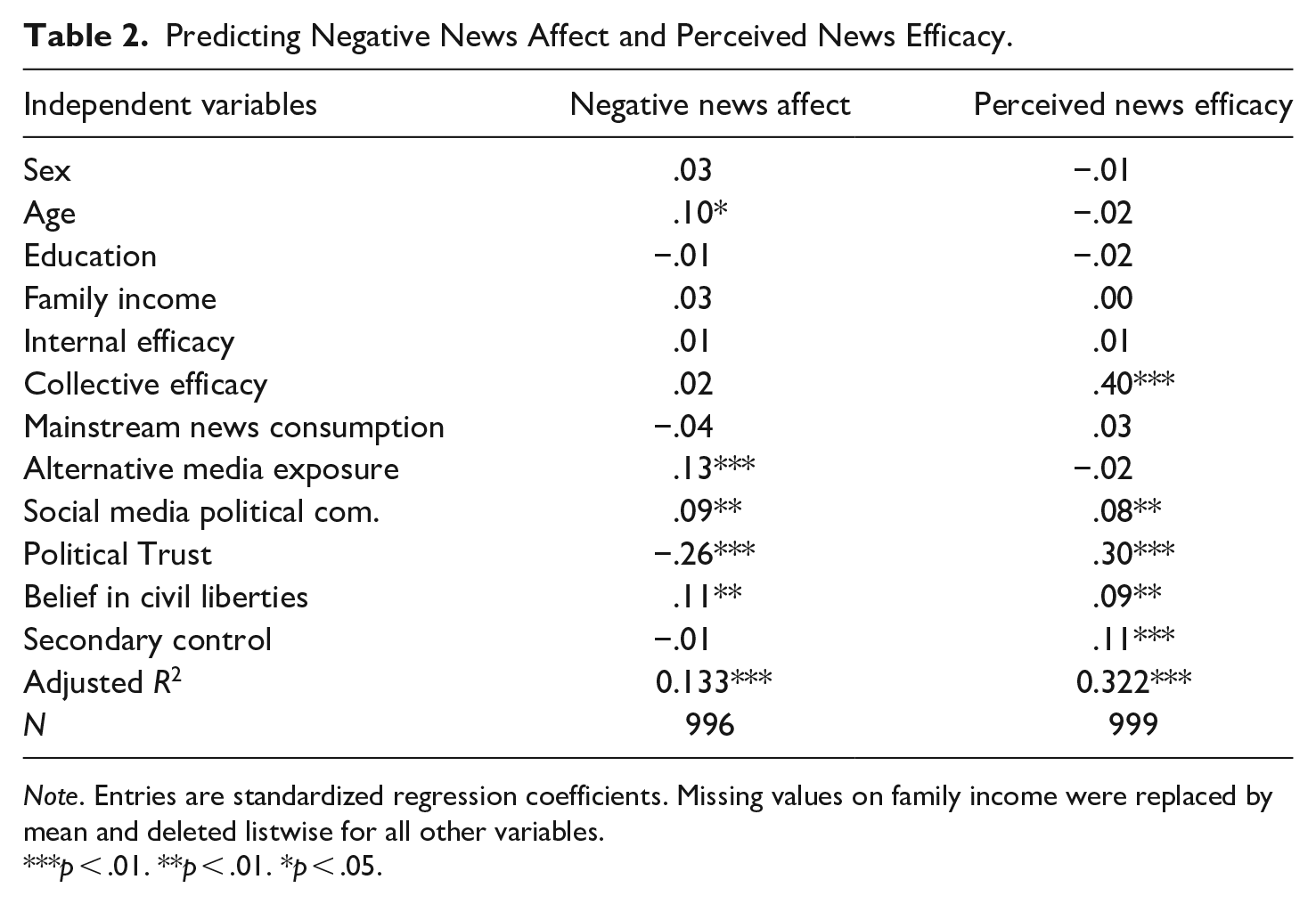
Note. Entries are standardized regression coefficients. Missing values on family income were replaced by mean and deleted listwise for all other variables.
p < .01. **p < .01. *p < .05.
Combining the statistically significant results from Tables 1 and 2, there are five possible indirect relationships between the political psychological factors and intentional news avoidance mediated by news affect or cognition: (1) political trust relates to news avoidance negatively via negative news affect, (2) political trust relates to news avoidance negatively via perceived news efficacy, (3) belief in civil liberties relates to news avoidance positively via negative news affect, (4) belief in civil liberties relates to news avoidance positively via perceived news efficacy, and (5) secondary control relates to news avoidance negatively via perceived news efficacy.
Formal testing of these indirect relationships was conducted using PROCESS MACRO. Political trust, belief in civil liberties, and secondary control were used as the main independent variable in turn. Negative news affect and perceived news efficacy were used as parallel mediators. All other variables were used as covariates.
As Table 3 summarizes, all five indirect relationships stated above are statistically significant. The two indirect relationships between political trust and intentional topical news avoidance are in the direction suggested by H1, that is, people with higher levels of political trust are less likely to be motivated to avoid news about social and political change, though the effect is mediated by negative news affect and perceived news efficacy. The indirect relationship between secondary control and intentional topical news avoidance is also in the direction suggested by H3, that is, more adaptive people are less likely to avoid the news, with the effect mediated by perceived news efficacy. The two indirect relationships between belief in civil liberties and intentional topical news avoidance are in contrasting directions, however. Nevertheless, overall speaking, the mediation analysis shows that the political psychological factors are not irrelevant to intentional topical news avoidance, as they may shape news avoidance motivation indirectly through news affect and cognition. 1
Indirect Effects via Negative News Affect (NNA) and Perceived News Efficacy (PNE).
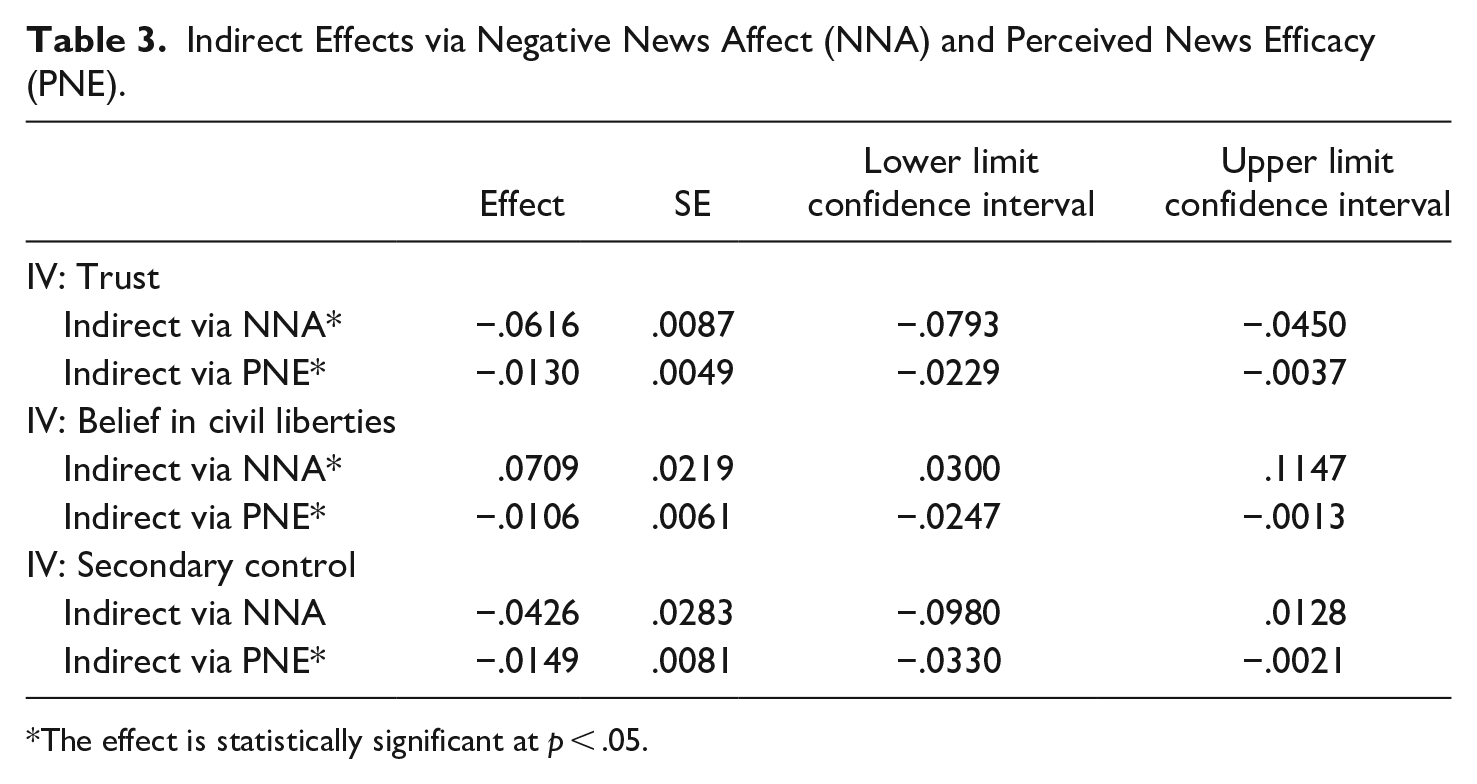
The effect is statistically significant at p < .05.
Concluding Discussion
This article examines intentional topical news avoidance in a society undergoing serious democratic backsliding. In such societies, as democratic institutions decline and civil liberties and press freedom are curtailed, the role of public opinion in the political process is weakened. People may find fewer reasons to pay attention to public affairs. Moreover, the changing social and political environment can be suffocating, especially for people who value civil liberties. People may, therefore, develop a tendency to withdraw from public affairs and avoid the news, especially news about social and political change. In fact, in the current survey, 38.1% and 36.6% of the respondents agreed or strongly agreed that they would want to avoid news about social change and political change, respectively. Substantial proportions of Hong Kong citizens were motivated to avoid the news (Leung 2022).
Certainly, extents of intentional topical news avoidance vary across individuals. The analysis posits five factors that might help understand such individual-level variations. Since avoiding news about social and political change under democratic backsliding can be politically driven, and backsliding constitutes a challenging situation to many, this study is interested in the possible impact of political trust, belief in civil liberties, and secondary control. Besides, consistent with the general principle that news avoidance is driven by news-related affect and cognition (Goyanes et al. 2023; Song et al. 2017), this study treats Negative News Affect (NNA) and Perceived News Efficacy (PNE) as predictors.
The analysis shows that both NNA and PNE significantly predict intentional topical news avoidance. Such findings should not be surprising. The very strong relationship between NNA and intentional topical news avoidance is fully consistent with the explication of why many people can develop the tendency to avoid the news under democratic backsliding, that is, ongoing social and political change can be regarded as highly undesirable, and events signifying such changes, such as the trials of activists, closure of civil society organizations, or the enactment of restrictive laws, can cause anxieties, anger, and fear. People may, therefore, avoid the news to maintain mental well-being. This is similar to what people do in other kinds of crises, such as the recent COVID-19 pandemic (e.g., Mannell and Meese 2022).
Meanwhile, democratic backsliding presents challenges to the news media. Journalists who used to value their watchdog role might find the environment increasingly hostile to their practices. Citizens may recognize that the media can no longer carry out the normative roles outlined by a liberal conception of the press. This could dampen people’s sense of the relevance of the news and explain why, at the country level, places with lower levels of press and political freedom exhibit higher levels of news avoidance (Toff and Kalogeropoulos 2020). This study adds that, at the individual level within a society where press freedom is under siege, perceptions of the capability of the news media to play their normative roles can explain whether people are motivated to avoid news about social and political change.
The three political psychological factors do not relate significantly to intentional topical news avoidance when all variables are included. Nevertheless, there are reasons to examine if these factors relate to news avoidance indirectly via news affect and cognition. NNA and PNE are directly about how citizens see the news. Given their strong relationships with news avoidance, it is plausible that they would mediate the relationships between news avoidance and other social, psychological, and political attitudinal factors. The mediation analysis shows that this is indeed the case. Political trust, belief in civil liberties, and secondary control all relate indirectly to intentional topical news avoidance when NNA and PNE are posited as mediators.
Specifically, people with higher levels of political trust are less likely to feel negative when consuming news about social and political change and more likely to see the media as capable of carrying out a range of functions. As a result, they are also less likely to avoid news about social and political change. As explicated, regime supporters have their attitudes and beliefs aligned with the political power. They do not necessarily see “backsliding” as problematic. In Hong Kong, for instance, the government hailed the establishment of the NSL as allowing the society to return to order. Citizens who trust the government are more likely to agree with this judgment. They are, therefore, less likely to see the ongoing political change as undesirable and have fewer reasons to avoid news about social and political change.
The impact of belief in civil liberties is more complicated than expected. People who value civil liberties are more likely to feel negative about news regarding social and political change, which can in turn make them more likely to avoid such news. This is consistent with the conceptual argument that people who are not politically aligned with the regime would be more likely to exhibit intentional topical news avoidance. However, people who value civil liberties are also more likely to feel relatively positive about the capability of the news media to play certain normative functions. This in turn can make them less likely to avoid the news. One plausible explanation is that, even as the society undergoes serious backsliding, there are still professional journalists and independent online media continuing their practices (Lee 2023). People who value civil liberties are more likely to recognize such continual efforts. Hence, they are more likely to see that the media are not completely incapable of playing certain normative roles. As the two indirect relationships are in contrasting directions, belief in civil liberties does not relate to intentional topical news avoidance straightforwardly.
This study draws upon the social psychological concept of secondary control (Rothbaum et al. 1982) to examine how people’s ability to adapt to difficult environments shapes their news avoidance motivation. People who are more capable of finding meanings in difficulties should be more capable of handling their emotions and seeing values in persistence. Empirically, people more adaptive toward difficult environments are more likely to perceive the media as efficacious, which in turn makes them less likely to avoid news about social and political change. This indirect relationship is consistent with the conceptual arguments about why adaptiveness should matter. The analysis thus confirms the utility of paying attention to the notion of adaptiveness to study political and communication behavior under political transformation (Kobayashi and Chan 2022a).
Overall, this study contributes to our understanding of an important form of intentional news avoidance that is particularly prominent in a specific type of political context. This study does not impose an established model of news avoidance onto the phenomenon. It examines the factors that should be theoretically more pertinent to the phenomenon at hand. For instance, political trust is rarely addressed in the literature on news avoidance in democratic societies, and one relevant study came up with a null finding (Schäfer et al 2022). Nevertheless, the study of politically driven news avoidance under democratic backsliding requires us to pay attention to political attitudes and beliefs, and the current study suggests that political attitudes and values do matter, albeit indirectly. Similarly, this study does not evoke the notion of news overload. Given information censure, “overload” is theoretically a lesser cognitive concern than whether people still see the media as capable of playing their normative roles.
Certainly, to what extent the manifestation, character, and predictors of intentional topical news avoidance vary across well-functioning democracies and societies undergoing democratic backsliding is open for further comparative research. It should be noted that politically driven news avoidance may also exist in democracies, though the dynamics driving the phenomenon can be something other than autocratization, such as polarization or the rise of populism. The latter trends can also frustrate certain groups of citizens and lead them to avoid certain types of news. This article, therefore, does not claim that there is no commonality between different types of polities. But as a general principle, it is important for researchers to extend the analyses of news avoidance to varying social and political contexts and, when doing so, pay attention to the actual manifestation of the phenomenon and its probable predictors in different circumstances.
Three limitations of the present study need to be noted at the end. First, the measure of intentional news avoidance in this article is phrased in terms of motivation instead of actual behavior. Although there are no strong reasons to suspect the findings to be different if the questions were phrased in terms of behavior, this remains a caveat to bear in mind.
Second, with a cross-sectional survey, the analysis cannot demonstrate the causal direction in the relationships among the variables. However, given the nature of the variables, the proposed causal directions should be theoretically more plausible than the other way round. In the mediation analysis, for instance, it is more plausible to see the basic political psychological factors as preceding news affect and cognition. Having said that, given the dynamic evolution of a society and its media landscape, longitudinal studies about how news avoidance and other factors co-evolve could add to our understanding of news avoidance.
Third, this study focuses on intentional news avoidance only. How intentional avoidance of news about social and political change relates to actual news consumption remains an issue to be addressed. In fact, both mainstream news media consumption and alternative media exposure are used as controls. Both do not relate significantly to intentional topical news avoidance. This should not be too surprising given this study’s focus on a form of topical news avoidance (Ohme et al. 2022). Nevertheless, would the relationship between intentional topical news avoidance and news consumption vary across individuals? Under what conditions would people turn their topical news avoidance into a more generalized form of news rejection? These are issues to be addressed in future analysis.
Supplemental Material
sj-docx-1-hij-10.1177_19401612241253196 – Supplemental material for Politically Driven Intentional News Avoidance under Democratic Backsliding
Supplemental material, sj-docx-1-hij-10.1177_19401612241253196 for Politically Driven Intentional News Avoidance under Democratic Backsliding by Francis L. F. Lee in The International Journal of Press/Politics
Footnotes
Declaration of Conflicting Interests
The author declared no potential conflicts of interest with respect to the research, authorship, and/or publication of this article.
Funding
The author received no financial support for the research, authorship, and/or publication of this article.

Supplemental Material
Supplemental material for this article is available online.
Notes
Author Biography
References
Supplementary Material
Please find the following supplemental material available below.
For Open Access articles published under a Creative Commons License, all supplemental material carries the same license as the article it is associated with.
For non-Open Access articles published, all supplemental material carries a non-exclusive license, and permission requests for re-use of supplemental material or any part of supplemental material shall be sent directly to the copyright owner as specified in the copyright notice associated with the article.
