







Abstract
The integration of entertainment and politics has become an increasingly important feature of governance worldwide. Yet we know little about how states institutionally recruit celebrities to serve political purposes. This study provides the first empirical analysis of the political cooptation of entertainment celebrities in China, drawing on an original dataset of 2,898 individuals active from 1993 to 2023. We identify a sequential process of political cooptation through which the state initially offers access to regime-curated performances, which function both as material rewards and as ideological screening devices, and then appoints some of the celebrities to formal political bodies. The determinants of selection vary by institutional affiliation and leadership era. These findings extend theories of elite cooptation by showing how states convert media visibility into political capital and embed political control within popular culture as a strategy of regime resilience.
Introduction
Over the past decade, influential figures in the entertainment market, such as Taylor Swift, Oprah Winfrey, and Priyanka Chopra in North America and Europe, along with K-pop idols in Asia, have increasingly leveraged their media visibility to engage in political discourse. They have endorsed candidates, shaped public opinion, and raised awareness about contentious policy matters (Abidin et al. 2020; Abramowitz 1988; Horiuchi et al. 2020; Majic et al. 2020; Pease and Brewer 2008). This phenomenon, which is commonly referred to as “celebrity politics” (Marsh et al. 2010) or “political star power” (Thrall et al. 2008), reflects the growing entanglement between political authority and entertainment culture in shaping public engagement.
Although scholarship on celebrity influence has centered on democratic contexts, the political relevance of celebrities is equally salient in authoritarian regimes, where media and cultural industries operate under pervasive political oversight (Bellotti 2023; Lerner 2021). In such a media landscape, major broadcasters, film studios, and digital platforms often feature state equity stakes, politically connected shareholders, or Party committees within firms, allowing authorities to steer content decisions, investment strategies, and talent promotion (Repnikova 2017; Shirk 2011). Market-oriented reforms, therefore, do not always expand autonomy; instead, political constraints become woven into commercial incentives, making adherence to ideological “red lines” a prerequisite for career success in the entertainment industry (Stockmann 2013; Zhao 1998). This fusion of political oversight and commercial dependence turns the media landscape into an effective mechanism for disciplining elites (Stockmann and Gallagher 2011). Within this environment, celebrities occupy a uniquely visible position: they reach mass audiences while relying on state-controlled platforms for professional advancement. This configuration reflects classic power-dependence dynamics, in which the state’s control over key resources—visibility, endorsement, and market access—enables it to shape the behavior of celebrities, making them potential targets for cooptation. Yet despite this, we still know little about the modus operandi of how authoritarian states harness entertainment celebrities to support regime objectives.
Understanding the dynamics of cooptation thus requires tracing the incentives that channel celebrity behavior toward regime goals. Authoritarian regimes offer entertainment celebrities a range of benefits that reward compliance and draw them into closer alignment with official expectations. One such incentive is preferential access to state-owned platforms such as televised galas, patriotic films, and national publicity campaigns, which significantly enhances public visibility and generates lucrative commercial returns for the entertainer (Wang et al. 2024; Xu and Yang 2021). Because career advancement in the entertainment industry depends largely on obtaining state approval and gaining access to these platforms, favored celebrities receive disproportionate exposure through government-controlled media. This allows them to achieve levels of popularity, especially among the young generation, that unaffiliated peers cannot match. The resulting inequality in visibility creates an asymmetric dependency, linking the professional ambitions of cultural elites to the political objectives of the regime (Emerson 2019).
Another incentive involves political appointments, often to high-profile consultative or legislative bodies. In many authoritarian systems, these posts are reserved for public figures who have demonstrated consistent support for official narratives. In China, for example, some prominent writers, artists, singers, and movie stars, such as Jackie Chan and Ziyi Zhang, have been appointed to the Chinese People’s Political Consultative Conference (CPPCC) or the National People’s Congress (NPC). For celebrities, such roles offer political status, elite credentials, and durable ties to the state, all of which are benefits that can stabilize and extend their careers. Thus, many entertainment figures have become willing political actors, strategically leveraging their popularity to obtain institutional power within the authoritarian system (Chen and Gao 2023).
Nonetheless, recruiting celebrities for political purposes carries inherent risks. Although celebrities can amplify state narratives through their broad media reach, their prominence can also distract public attention from leader-centered messaging and complicate efforts to maintain ideological control (Alam 2020; Bennett 2014). Scandals ranging from tax evasion to politically sensitive remarks involving state-endorsed celebrities further threaten the regime’s credibility (Ng 2022). To limit such risks, authorities tend to choose individuals who pair professional credibility with a carefully managed public image, thereby reducing the likelihood of reputational fallout (Jeffreys and Xu 2023). In this sense, the careful selection of celebrities is not only about promoting official narratives but also about managing the risks that accompany high-profile figures. By filtering for reputationally stable and politically dependable figures, authorities use selection itself as a governance tool to enforce ideological discipline within the entertainment sector (Barghoorn 2015; Xu and Yang 2021). Yet despite the prominence of these practices, we lack systematic evidence on which celebrities are selected for engagement and whether participation in state-sponsored activities boosts the likelihood of subsequent political involvement.
To address these gaps, we conduct two studies of celebrity cooptation in China. As an authoritarian regime with a rapidly expanding entertainment sector, China offers a valuable setting for analyzing how elites are incorporated under conditions of political constraint. We draw on an original dataset of 2,898 celebrities active between 1993 and 2023, covering detailed information on their demographics, professional backgrounds, market performance, personal histories, and political affiliations.
The first study examines which types of celebrities are more likely to receive performance opportunities—defined as participation in regime-curated events such as state-organized galas, patriotic films, and public advocacy campaigns. These high-visibility roles mark the initial stage of cooptation: they reward celebrities who signal political alignment while giving officials a low-cost way to evaluate loyalty, discipline, and reputational stability. Our analysis shows that political loyalty consistently outweighs professional credentials and market appeal in predicting selection. The state also applies different criteria depending on a celebrity’s institutional background. Those affiliated with state-run cultural institutions (“insiders”) are assessed differently from commercially successful entertainers (“outsiders”). Finally, the patterns vary across leadership eras from 1993 to 2023, reflecting shifts in political priorities and in the regime’s approach to managing the entertainment sector.
The second study evaluates whether early participation in state-curated cultural activities predicts later political incorporation. We find that prior engagement in regime-sponsored events is associated with a substantially higher likelihood of appointment to consultative or legislative bodies. Performing for the state in the previous year increases a celebrity’s probability of receiving a political appointment by roughly 103 percent relative to those who did not perform, controlling for political background, market success, and professional credentials. These results remain consistent across a series of robustness checks. Taken together, the findings align with a sequential cooptation logic: participation in government-curated cultural activities gives officials a chance to observe loyalty and discipline, and only a small subset of consistently reliable entertainment celebrities are eventually offered institutional roles.
Our research provides the first empirical analysis of how authoritarian regimes integrate entertainment celebrities into political institutions, extending the study of celebrity politics beyond its predominant focus on liberal democracies (Archer et al. 2020; Majic et al. 2020). We show that these regimes engage cultural elites not only through coercive pressure but also by offering performance-based incentives and selective political opportunities. Rather than assessing how much celebrity power changes a regime’s legitimacy, our findings highlight how participation in state-curated cultural activities and subsequent institutional incorporation operate as mechanisms of cultural governance. Through these processes, the state manages public influence, shapes cultural production, and maintains ideological discipline within the entertainment sector. By channeling media visibility into structured political pathways, the regime turns entertainment celebrities into willing political actors whose public roles align with official priorities.
Beyond the empirical contribution, the study advances cooptation theory by outlining a sequential process through which cultural elites are integrated into the political system. While existing research emphasizes how selective rewards and sanctions ensure elite compliance (Gandhi and Przeworski 2006; Magaloni 2008; Meng et al. 2023; Svolik 2009), we demonstrate that early-stage opportunities, such as participation in state-sponsored performances, function both as material inducements and as screening devices for ideological reliability and reputational stability. Celebrities who receive more such opportunities are significantly more likely to be appointed to national political institutions, suggesting that cultural engagement constitutes a structured pathway to elite status. These findings show how authoritarian regimes institutionalize public visibility as part of a broader toolkit for coordinating entertainment celebrities, thereby bolstering resilience through expanded symbolic authority and structured inclusion.
Literature Review
Why to Coopt: From Threat Containment to Capacity Building
Authoritarian resilience relies not only on coercion but also on the strategic incorporation of elites (Gerschewski 2013). Repression, although central to autocratic rule, is risky. Coercive actions can provoke backlash, encourage preference falsification that distorts information flows, and trigger unpredictable mobilization, all of which are risks that are heightened when repression targets high-profile public figures (Davenport 2007; Honari 2018; Kuran 1995). Censorship can similarly backfire as efforts to suppress information often generate compensatory demand, especially among celebrity fan communities, increasing rather than reducing political attention (Hobbs and Roberts 2018; Wang and Huang 2021; Xu 2021; Zhu and Wang 2021). These tradeoffs make cooptation a rational alternative. By rewarding rather than punishing socially influential actors, regimes can draw on their symbolic capital at relatively low cost while avoiding the reputational consequences that accompany overt coercion. From a cost-benefit perspective, cooptation frequently represents the more predictable and sustainable strategy for securing compliance.
Given the importance of cooptation to authoritarian governance, existing research has sought to explain which regimes choose to incorporate and for what political purposes. Much of this scholarship conceptualizes cooptation as a response to potential threats (e.g., Gandhi 2004; O’Donnell 1973). Authoritarian regimes selectively incorporate individuals capable of mobilizing opposition, such as rival elites, protest leaders, or politically ambitious entrepreneurs, to neutralize challenges and redirect incentives toward collaboration (Gandhi and Przeworski 2006; Magaloni 2008). Institutions such as consultative assemblies and ruling parties serve as channels for this incorporation, distributing resources and career opportunities in ways that secure elite cooperation and reinforce regime stability (Gandhi 2004; Malesky and Schuler 2010). This threat-containment framework provides a foundation for understanding who tends to be targeted and why their inclusion serves the regime’s interests.
Yet the political landscape in many contemporary autocracies has evolved. As censorship, surveillance, and calibrated coercion suppress overt dissent (Pu et al. 2025), the pool of genuine challengers has narrowed (Liu 2023). With fewer threats to neutralize, authoritarian leaders increasingly deploy cooptation to strengthen governance capacity rather than simply manage opposition. Capacity-building cooptation targets individuals whose expertise, credibility, or symbolic authority can extend the regime’s reach into social, economic, or cultural domains. In China, institutions such as the United Front system and the “Three Represents” embody this logic by drawing entrepreneurs, professionals, and cultural producers into the political fold while preserving centralized control (Groot 2004; Holbig and Gilley 2010).
Within this broader shift, entertainment celebrities have become especially attractive targets of cooptation. Although they rarely pose direct political threats, their extensive influence in literature, art, and popular culture, particularly among younger, digitally networked audiences, makes them important intermediaries for shaping attitudes and diffusing regime-aligned narratives (Chen and Gao 2023; Sullivan and Kehoe 2019; Xia 2024). Participation in patriotic performances, publicity campaigns, and state-sanctioned productions allows regimes to convert celebrity visibility into symbolic governance, embedding political cues into everyday cultural consumption (Cai 2019: 20; Chen 2024). In this sense, the cooptation of celebrities exemplifies the broader transition from threat-containment strategies toward capacity-building forms of elite incorporation.
How to Coopt: The Sequential Logic of Cooptation
This shift in targeted elites prompts a reconsideration not only of why authoritarian regimes cooptbut also how they do so. Existing scholarship identifies material incentives and institutional appointments as the two main spoils of elite incorporation, but these are often treated as parallel strategies (Frantz and Kendall-Taylor 2014; Gandhi and Przeworski 2006; Magaloni 2006). In the case of entertainment celebrities, however, this view misses an important dynamic: regimes may deploy these spoils in a staged fashion, first granting performance-related opportunities to test loyalty, and only later extending political opportunities to those deemed consistently reliable.
We build on existing literature by theorizing that these spoils can be offered sequentially. The governments often start by offering material incentives such as access to state media, invitations to official galas, or endorsement opportunities as a way to screen lasting supporters. These early-stage incentives create dependency and public alignment, allowing the government to monitor an individual’s discipline, ideological reliability, and reputational risk over time. Only a small subset of celebrities—those who consistently support the state’s discourse and avoid controversy—are eventually elevated to political opportunities such as appointments to consultative or legislative bodies (Gandhi and Przeworski 2007). In this framework, performance opportunities function as a probationary stage preceding formal political incorporation.
Sequencing spoils in this manner helps regimes address two core challenges. First, political appointments are limited and confer substantial prestige; awarding them without adequate vetting risks reputational fallout or internal friction (Blaydes 2008). Second, regimes face commitment problems in maintaining elite loyalty, particularly when performance opportunities are short-term or discretionary (Boix and Svolik 2013; Frantz and Kendall-Taylor 2014; Magaloni 2008). A staged structure offers authorities an extended opportunity to screen genuine supporters while simultaneously creating a reversible endorsement mechanism—one that lets the regime confer provisional approval that can be withdrawn if some celebrities later prove unreliable—thereby reducing political risk and reinforcing ideological cohesion (Truex 2014). Under this logic, celebrities who receive more extensive exposure to performance opportunities should be more likely to advance into formal political institutions.
Who to Coopt: Selecting State-Favored Celebrities in China
China offers a representative case where the cooptation of entertainment celebrities is governed by a deeply institutionalized political logic rooted in the Chinese Communist Party’s (CCP) long-standing approach to cultural control and ideological alignment. Since Mao Zedong’s 1942 Yan’an Forum on Literature and Art, the CCP has emphasized that artists must serve the Party’s political purpose. This principle has evolved into a formal system in which celebrities are not just entertainers but strategic actors in the Party’s broader project of cultural governance.
At the core of selecting or cultivating a state-favored cultural talent is the enduring standard of being “both red and expert” (you hong you zhuan), a phrase originally used to evaluate technocrats in the 1950s and 1960s (Ray 1970). “Red” (hong) signifies political loyalty, ideological conformity, and moral discipline aligned with the Party’s values. “Expert” (zhuan) refers to professional talent, cultural influence, and public appeal. Together, these qualities define the ideal celebrity for state cooptation: someone who is both politically trustworthy and artistically accomplished.
To enforce this standard, the CCP’s Publicity Department and the National Radio and Television Administration oversee a rigorous vetting process (zhengzhi shencha) that extends beyond traditional officials to include public figures in the entertainment sector. Celebrities who appear on national television, perform in state-sponsored productions, or participate in patriotic events are subject to scrutiny regarding their political reliability, ideological alignment, and even personal conduct (Xu and Yang 2021). Those affiliated with military bands, who have starred in government-commissioned patriotic projects, or who openly express support for the regime on social media, are typically viewed as “red” (Chen and Gao 2023), while those with wide popular recognition and professional success may qualify them as “expert.” 1
Meanwhile, to uphold the “both red and expert” standard, the government also implements strict exclusion mechanisms to discipline those who fall short of these expectations. Celebrities who breach the state’s guidelines, whether through scandals, ideological deviation, or signs of disloyalty, face repercussions such as being blacklisted, removal of their content, and damage to their reputations. These measures are not aimed at organized opposition; rather, they are enforcing boundaries, ensuring that only those who are ideologically aligned and professionally disciplined remain within the pool of cooptable elites (Sullivan and Kehoe 2019). Together, these selective and exclusionary mechanisms reinforce a broader logic of authoritarian cooptation.
Methods
Data and Samples
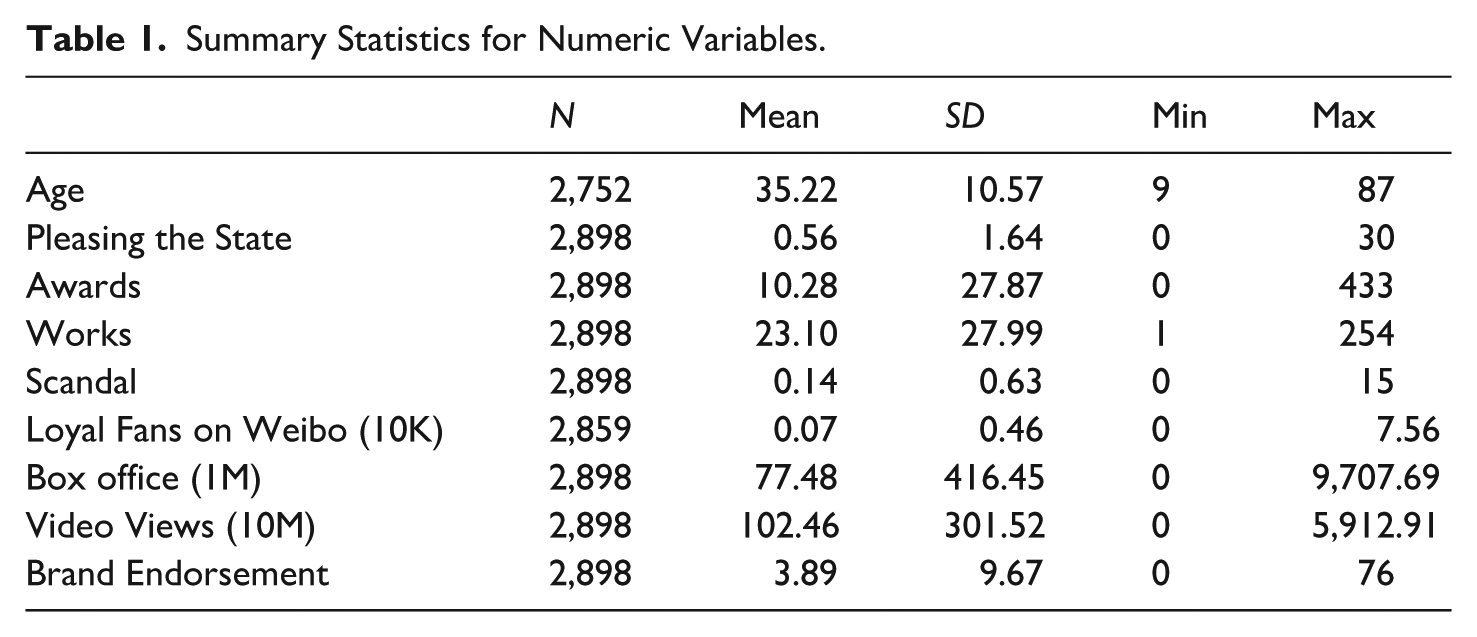
We construct our dataset from two widely used Chinese-language sources: Endata and Baidu Baike. Endata, akin to IMDb, offers comprehensive coverage of the Chinese film and television industry, including detailed records of actors, singers, and performers. Its scope includes not only A-list celebrities but also emerging pop idols and variety show participants, introducing considerable variation in professional visibility and career trajectory. 2 Baidu Baike, China’s largest user-generated online encyclopedia, supplements this information by providing extensive biographical and career histories. Both sources have been validated in prior studies on Chinese elites and political institutions (e.g., Fisman et al. 2020; Landry et al. 2018), allowing us to construct a dataset suitable for analyzing patterns of state engagement with entertainment celebrities. Figure 1 and Table 1 summarize the demographic and career variation across the individuals in our sample. 3
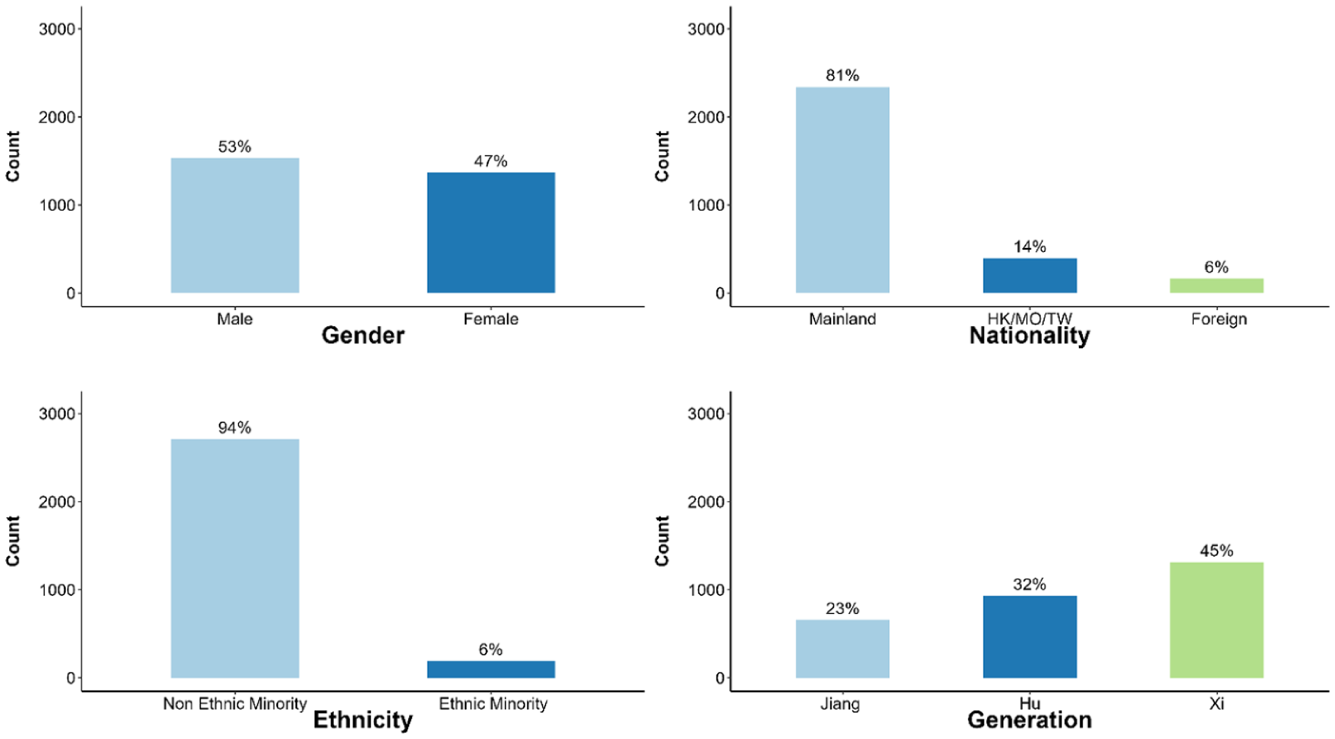
Summary statistics for categorical variables.
Summary Statistics for Numeric Variables.
Our dataset includes 2,898 publicly recognized entertainment celebrities—actors, singers, dancers, and comperes—active in mainland China between 1993 and 2023. We code each celebrity’s biographical and career information, including awards, public appearances, affiliations, and social media presence, by extracting and verifying content from their Baidu Baike profiles. While not an official registry, our dataset covers a broad and diverse range of the celebrity landscape and captures substantial variation across political status, market influence, and career trajectories. 4 By examining celebrities from the market-oriented entertainment sector instead of state-employed performers, we assess how authoritarian regimes recruit celebrities in support of political and ideological objectives.
Measures
Our measurement strategy follows two methodological principles. First, we include only activities that are directly organized or formally endorsed by government agencies and can be verified through authoritative sources. Second, we rely on indicators that are quantifiable and consistently coded to ensure systematic and replicable analysis. Because many aspects of cooptation are opaque or anecdotal, we adopt a more cautious and precise approach that focuses only on observable and traceable state actions (Chen and Gao 2023). For example, although rumors sometimes spread about some celebrities joining the Party or holding dual citizenship, we only code them when this information is publicly confirmed, such as by appearing on Baidu Baike. This strategy allows us to identify concrete and measurable pathways through which authoritarian regimes incorporate entertainment celebrities into the political system.
As for the dependent variables, the first study examines the initial stage of cooptation, operationalized as celebrities’ participation in state-curated performance activities. Through such participation, the regime assesses political reliability, behavioral discipline, and communicative utility as public-facing conveyors of state narratives. By observing compliance with official propaganda, alignment with state-sponsored messaging, and avoidance of controversy or dissent, authorities evaluate individuals’ suitability for deeper political integration. These activities typically involve collaboration with bureaucratic actors, exposure to political rituals, and performance under conditions of ideological scripting and public scrutiny, functioning both as visible signals of alignment and as screening devices for identifying credible and disciplined symbolic representatives. The second study examines whether participation in state-curated performance activities predicts subsequent formal political incorporation, measured by appointments to the CPPCC and NPC at the local and national levels—institutions that serve as elite integration platforms in authoritarian systems and confer symbolic political status.
Our independent variables fall into three domains: (1) political loyalty, measured by a celebrity’s experience serving in art troupes 5 and pleasing the state through participation in pro-regime commercial productions, 6 primarily patriotic dramas; (2) professional qualifications, including artistic works, professional education, and membership in art associations; and (3) market influence, captured by media awards, scandals, social media followings, box office earnings, video views earnings and brand endorsements. We control for demographics such as age, gender, ethnicity, nationality, and kinship ties, which may affect access to state-backed opportunities (Fisman et al. 2020; Jiang and Zhang 2020). Summary statistics are provided in Table 1 and Figure 1. To address multicollinearity, Appendix A Figure A2 presents a correlation heatmap confirming low collinearity across key covariates.
Analytical Strategy
We use two analytical approaches corresponding to the two stages of celebrity cooptation. In the first stage, we estimate regression models in which participation in state-curated performances is the outcome variable, with political loyalty, professional qualifications, and market influence as the main predictors. These models examine variation in selection across institutional affiliation and leadership eras. In the second stage, we estimate Cox proportional hazards models within an event-history framework to assess whether participation in state-curated performances predicts subsequent formal political appointments. Given the rarity and temporal ordering of appointments, participation is modeled as a time-varying covariate.
Selection into State-Curated Performances
Study 1 examines the determinants of participation in state-curated performances (full results see Table A1). As shown in Figure 2, the findings suggest that the Chinese state adheres closely to the principle of being “both red and expert.” Political loyalty is a strong predictor of selection. Celebrities with backgrounds in art troupes are significantly more likely to be chosen, reflecting institutional trust in their ideological reliability. Likewise, celebrities who voluntarily accept roles in commercially produced patriotic films or dramas, often at the expense of broader market appeal, signal loyalty through their professional choices and are correspondingly more likely to be favored by the state.
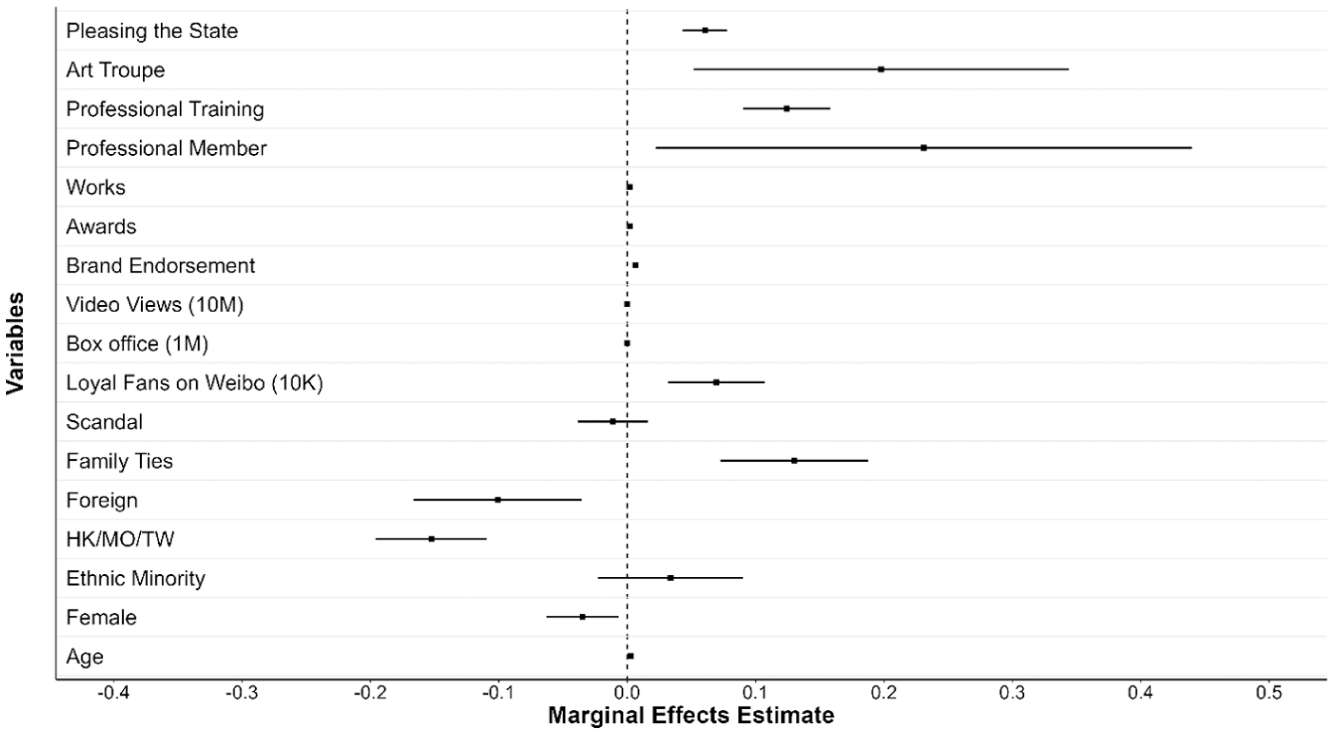
The marginal effects on performing for the state.
Professional credentials also matter. Celebrities with official membership in professional associations or formal training in art institutions are more likely to be selected, suggesting that the regime continues to value artistic credibility and technical expertise when endorsing cultural figures. Market-based influence plays a complementary role. Celebrities with large social media followings, especially on platforms such as Weibo, have higher odds of cooptation, reflecting the state’s strategy to harness fan-driven visibility. Box office earnings and brand endorsements show positive but less consistent associations.
Demographics also shape cooptation patterns. Celebrities with strong familial ties in the industry or who are of prime working age are more likely to be selected, highlighting the role of social capital and age alignment with state messaging. Female celebrities are selected less frequently than males, and those from Hong Kong, Macau, Taiwan, or holding foreign citizenship face a lower likelihood of selection, underscoring the regime’s concern with ideological controllability and national loyalty.
Insiders Versus Outsiders
Unlike the liberalized entertainment markets in most democratic societies, China’s cultural sector operates within a distinctive institutional arrangement known as the tizhi system. A legacy of the planned economy, the tizhi delineates formal boundaries between state-affiliated and market-based actors, creating a dual-track structure within the entertainment industry. In this framework, “insiders” refer to celebrities formally affiliated with state-run organizations, such as national or provincial film studios, television stations, or military bands, who enjoy privileged access to political resources, ideological vetting, and stable career paths. In contrast, “outsiders” are market-oriented entertainers who rise to fame through private studios and commercial platforms. While both groups may achieve national visibility, they face distinct political incentives and institutional constraints.
To examine how cooptation criteria vary across these groups, we compiled a supplementary dataset of 208 state-affiliated insiders, identified through formal ties to state cultural institutions. As shown in Appendix A Table A2, which lists the top 10 most prominent individuals from each category, insiders generally enjoy substantially more performance opportunities than their outsider counterparts. We compare the insiders with the 2,898 commercial outsiders in our main dataset to assess whether predictors of selection into state-curated performance activities differ by institutional affiliation. This design tests whether political loyalty, professionalism, and popularity carry different weights depending on a celebrity’s embeddedness in state structures.
As shown in Figure 3, the marginal effects of political loyalty and professional qualifications differ sharply. For outsiders, signals of ideological conformity, such as prior service in art troupes or participation in commercial patriotic productions, are crucial for compensating for their lack of state affiliation. These indicators significantly raise their likelihood of selection. For insiders, whose political reliability is presumed, the same variables have limited predictive power.

The marginal effects of performing for the state between insiders and outsiders.
Professional credentials exhibit a similar divide. Among outsiders, credentials like industry association membership and formal artistic training are strong predictors, reflecting the need to signal both competence and discipline in a competitive field. Among insiders, however, such qualifications matter less; advancement is shaped more by internal party mechanisms than market recognition.
The most notable divergence lies in the role of online popularity. For outsiders, a large social media following can significantly increase the probability of being selected for early-stage engagement, with each additional 10,000 loyal fan followers raising selection probability by 6.9 percent. These celebrities offer the regime a valuable channel to amplify propaganda through commercially cultivated popularity, enabling it to reach broader and younger audiences without formal institutional absorption. By contrast, for insiders, the same fandom becomes a liability, reducing selection probability by about 12 percent. Embedded within formal state institutions, these celebrities are expected to embody political discipline and ideological consistency. A massive online following may magnify reputational risk, as any misstep or scandal would not only tarnish the individual but also reflect poorly on the institutions they represent. Consequently, the state exercises greater caution with highly popular insiders, preferring that they maintain a low commercial profile and focus on institutional performance rather than cultivating mass appeal (Ma 2020).
These findings reveal a dual-track cooptation strategy. Outsiders—those beyond the tizhi system—face a higher threshold for selection, requiring demonstrable political loyalty, professional credentials, and mass appeal to compensate for their distance from formal structures. Insiders, by contrast, benefit from embedded trust and institutional proximity but face stricter reputational oversight that constrains their commercial reach. Notably, the same attribute, a large fan base, can function as either an asset or a liability, depending on one’s institutional position.
This heterogeneity reflects the regime’s adaptive logic: by tailoring selection criteria to insider-outsider distinctions, the state maximizes both ideological control and cultural penetration. The result is a bifurcated model of elite incorporation in which insiders provide political reliability, and outsiders offer access to broader audiences, each reinforcing the regime’s capacity to manage public-facing influence through different channels.
Leadership Variation and Shifting Priorities
Popular culture in China has long served as a barometer of shifting policy priorities and ideological orientations (Chen 2024). Over the past three decades, leadership transitions have not only shaped national agendas but also redefined the state’s approach to coopting cultural elites (Choi et al. 2021). To examine how evolving political climates recalibrate cooptation strategies, we analyze heterogeneity in the selection criteria across three leadership tenures: Jiang Zemin (1993–2002), Hu Jintao (2003–2012), and Xi Jinping (2013–2023).
Figure 4 presents the marginal effects of key predictors across these three periods. During Jiang’s tenure, the state’s strategy was relatively rudimentary. Art troupe experience stands out as the sole consistent predictor, suggesting reliance on legacy institutions to signal political reliability in an era when the entertainment sector was only beginning to commercialize. Other indicators, such as market influence or professional credentials, had limited explanatory power, consistent with the early-stage, unsystematic nature of celebrity cooptation at the time.
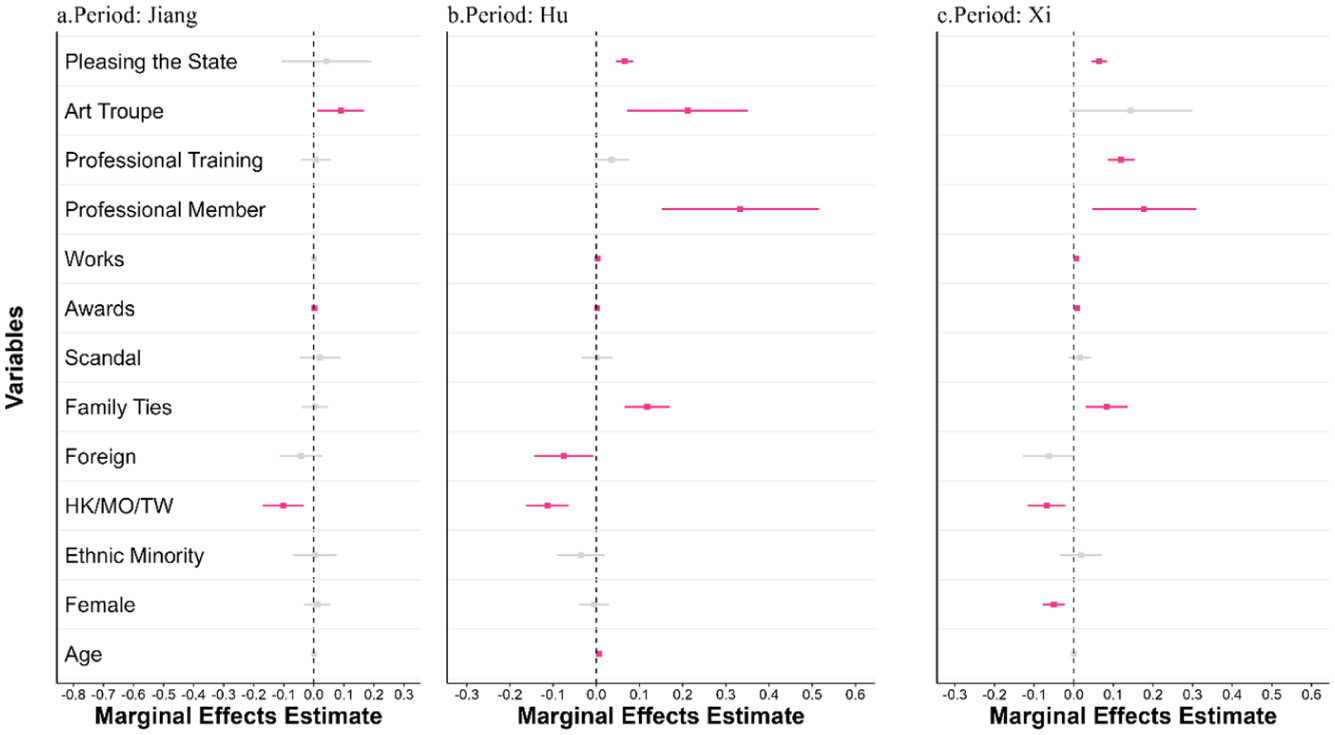
The marginal effects on performing for the state across different leaderships.
Under Hu’s tenure, the state introduced a more structured and merit-based selection logic (Chen and Chan 2023). As the entertainment industry matured, professional competence gained salience: both formal training and professional association membership significantly increased the likelihood of selection. At the same time, the state bolstered its political signaling mechanisms by rewarding celebrities who participated in patriotic commercial productions, indicating a dual emphasis on expertise and loyalty. This institutionalization of criteria during Hu’s tenure marked a critical turning point in operationalizing the “red and expert” framework under marketized conditions.
Xi’s tenure continues this trajectory with sharper ideological tightening and new demographic filters. Political loyalty remains crucial: participation in regime-aligned content strongly predicts selection. Professional credentials and market indicators also remain influential, indicating continued value placed on competence and visibility. However, female celebrities have faced a statistically significant penalty under Xi’s leadership, reflecting new exclusionary dynamics. In addition, the previous preference for older individuals disappears. Together, these shifts underscore Xi’s emphasis on ideological discipline, nationalism, and more stringent criteria for both celebrity endorsement and political incorporation.
From State-Curated Performances to Political Appointments
The second study examines whether early participation in state-curated cultural activities predicts subsequent appointments to formal political institutions. In authoritarian settings, such appointments allow the state to oversee the cultural sector, cultivate cooperative public figures, and enhance its capacity to steer cultural and ideological messaging. When celebrities appear in national galas, patriotic productions, or state-organized campaigns, they signal political discipline and demonstrate an ability to conform to official expectations. These activities create a structured opportunity for authorities to observe celebrities over time, evaluate their reliability, and determine whether they merit advancement into more formal political roles.
To evaluate the validity of this predictive factor, we constructed a panel dataset tracking each commercially active celebrity annually from their debut year or 1993 (whichever is later) until either (a) their first political appointment (coded as 1) or (b) the end of the observation window in 2023 without appointment (coded as 0). This event-history structure allows us to examine how time-varying characteristics, especially recent participation in government-curated cultural activities, affect the rate of receiving a formal political role over time.
Our panel includes 2,898 market-based celebrities, those unaffiliated with state-run cultural institutions, consistent with the outsider group analyzed in Study 1. Among these, only twenty-five individuals were ultimately appointed to formal political bodies during the observation period. This extremely low appointment rate highlights the regime’s tight rationing of institutional power and underscores the highly selective nature of formal cooptation, thereby establishing a visible, though rare, career trajectory for others to emulate.
To model the temporal relationship between state performances and political incorporation, we employ Cox proportional hazards models. This approach estimates the probability that a celebrity receives a political appointment in a given year while appropriately accounting for right-censoring when an appointment never occurs. By incorporating time-varying covariates, the model allows us to trace how changes in a celebrity’s symbolic engagement—such as new state-curated performances—alter the hazard of subsequent political appointment.
Figure 5 displays Kaplan-Meier survival curves comparing the likelihood of remaining outside formal political institutions for celebrities with and without prior state performance experience. The divergence between the two curves provides preliminary visual evidence consistent with the logic of sequential cooptation: celebrities who participate in state-curated performances transition into political appointments at higher rates, particularly after the first decade of their careers.
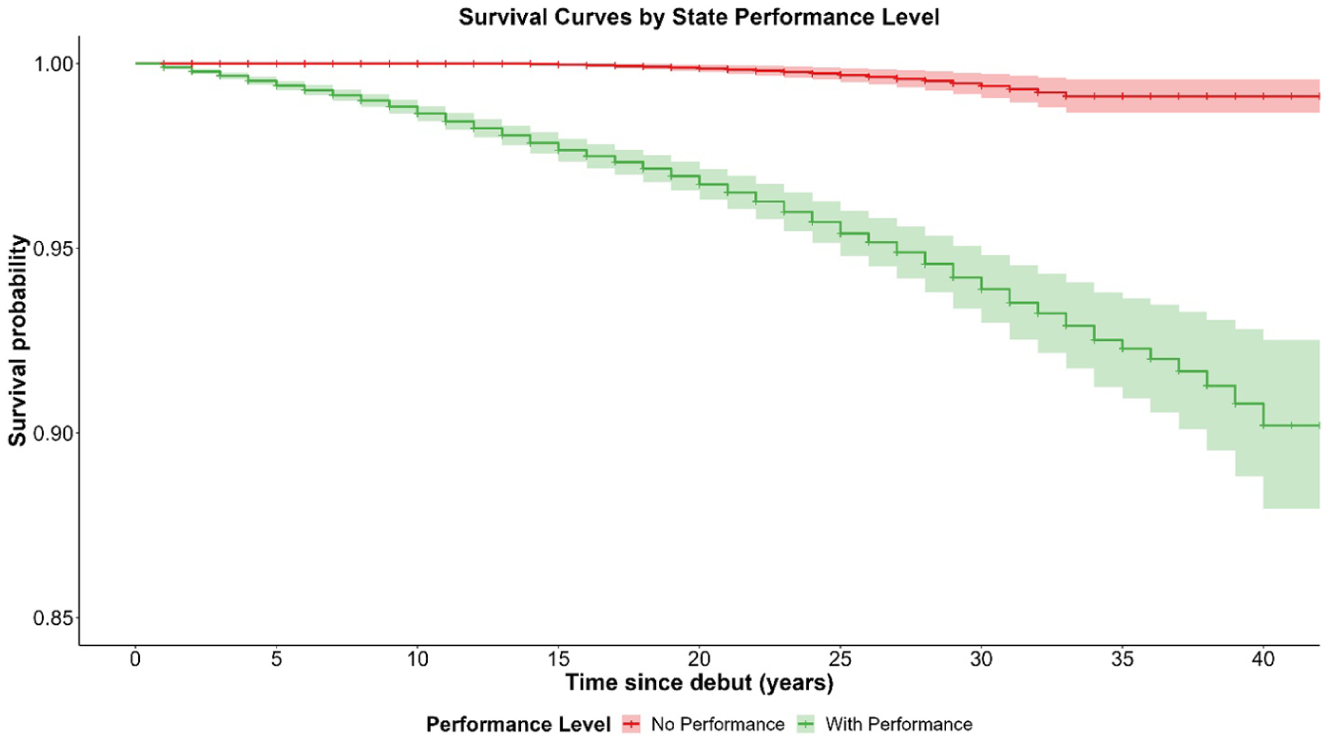
Kaplan-Meier survival curves comparing the career survival probabilities between celebrities with and without state performances.
Table 2 presents the results from a series of Cox proportional hazards models. Model 1 includes only the key explanatory variable, state performance in the previous year (State Performancet−1). Model 2 adds year strata to account for the cyclical nature of political appointments, which often align with scheduled legislative sessions. Models 3 through 5 sequentially introduce controls for political background, market activity, professional qualifications, and demographic characteristics. Across all specifications, prior participation in state performances is positively and significantly associated with the likelihood of receiving a political appointment. These findings support the theoretical expectation that state performances serve as a preliminary vetting stage, increasing the probability of subsequent institutional incorporation.
Explaining Variation in Political Appointments. a .
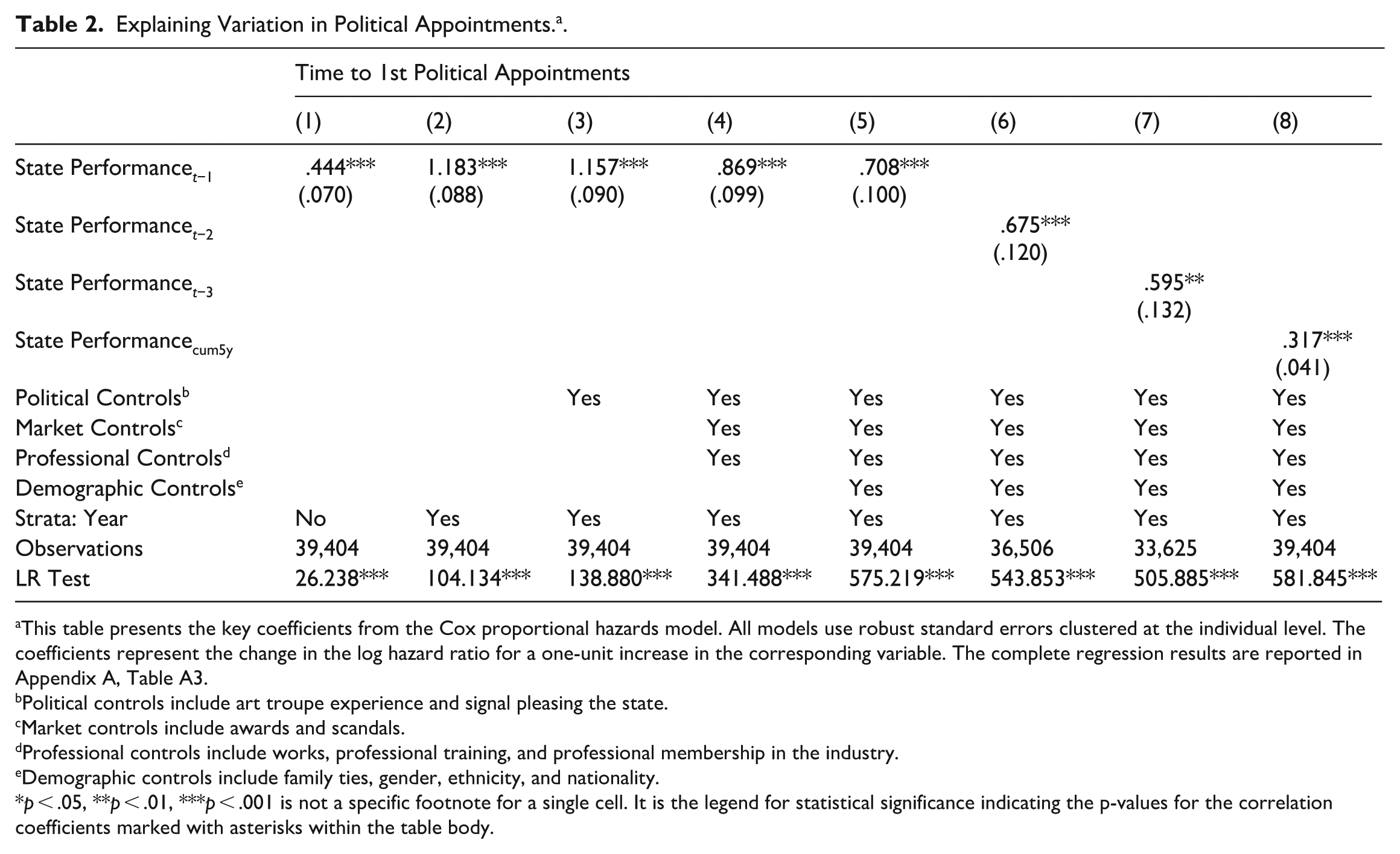
This table presents the key coefficients from the Cox proportional hazards model. All models use robust standard errors clustered at the individual level. The coefficients represent the change in the log hazard ratio for a one-unit increase in the corresponding variable. The complete regression results are reported in Appendix A, Table A3.
Political controls include art troupe experience and signal pleasing the state.
Market controls include awards and scandals.
Professional controls include works, professional training, and professional membership in the industry.
Demographic controls include family ties, gender, ethnicity, and nationality.
p < .05, **p < .01, ***p < .001 is not a specific footnote for a single cell. It is the legend for statistical significance indicating the p-values for the correlation coefficients marked with asterisks within the table body.
In the fully specified model (Model 5), the coefficient for the prior-year state performance variable is .708. Interpreted within the Cox framework, this implies that celebrities who performed at state events in the previous year are approximately 103 percent more likely to receive a political appointment in the following period (hazard ratio = e.708 ≈ 2.03), all else being equal. This magnitude is substantively meaningful given the extreme selectivity of such appointments: out of 2,898 celebrities tracked in our dataset, only twenty-five were ultimately incorporated into formal political institutions. These results underscore the regime’s use of state performances as a stepping stone for identifying, testing, and eventually integrating trusted celebrities into its political apparatus.
Robustness Check
To ensure the reliability of our findings, we conducted robustness checks across multiple dimensions. First, we examine alternative temporal specifications of state performances. Using performance counts from two years prior (t – 2), three years prior (t – 3), and cumulative participation over the previous five years (cum5y), we find consistently positive and significant effects across Models 6–8 of Table 2. These results suggest that the relationship between state performances and political appointments is not driven solely by recent activity; rather, longer-term participation also has predictive value. This supports the idea that sustained loyalty signaling can accumulate symbolic capital over time.
Second, we conduct a sensitivity test to assess the robustness of the estimated effect to potential unmeasured or uncontrolled confounding (VanderWeele and Ding 2017). For the hazard ratio associated with lagged performance (t – 1), the E-value is 3.51 (see Appendix A Table A4), implying that an unobserved confounder would need to be associated with both the treatment and outcome by a risk ratio of at least 3.51, conditional on all measured covariates, to nullify the observed effect. Given the extensive political, professional, market, and demographic controls already accounted for, the existence of such a strong confounder is unlikely, lending credibility to a causal interpretation.
Third, we address concerns about the rarity of political appointments. Because only twenty-five of the 2,898 celebrities in our sample ever receive an appointment, standard maximum likelihood estimation may be vulnerable to small-sample or separation bias. To mitigate this issue, we re-estimate our main specification using Firth’s penalized likelihood approach and Cox regression techniques designed for rare events (Firth 1993; Zorn 2005). These alternative models yield results consistent with our primary estimates, strengthening confidence that our findings are not driven by rare-event bias (see Appendix A Table A5).
Finally, we conduct a series of auxiliary robustness checks. Tests confirm that the proportional hazards assumption is satisfied for our key independent variable. Stratifying baseline hazards by celebrities’ birth provinces produces substantively unchanged estimates. Subsample analyses—excluding individuals with influential family ties in the entertainment industry and estimating models separately for Hu and Xi’s tenures—likewise continue to show a positive association between state performances and subsequent political appointments (see Appendix A Table A6 and A7).
Conclusion
This study examines how authoritarian regimes coopt entertainment celebrities through a sequential process of political incorporation. Using an original dataset of 2,898 celebrities active between 1993 and 2023, we identify a two-stage pattern of political cooptation. In the first stage, participation in regime-curated performances, such as televised galas and patriotic films, serves both as a reward and as a screening mechanism, favoring celebrities who display political loyalty, professional competence, and public appeal. In the second stage, event-history analysis shows that early participation in these activities is associated with a higher likelihood of subsequent appointment to formal political institutions, consistent with a sequential logic of elite incorporation.
Although so far only a limited number of celebrities have attained formal political appointments, this rarity does not diminish their political relevance. Appointments to political advisory bodies are highly selective and prominently visible, thereby enhancing their signaling value within the entertainment sector. These instances delineate a recognizable career trajectory, highlighting the attributes that the regime rewards, including political reliability, discipline, and sustained compliance. Instead of acting as broad incentives, these political appointments create a visible—but rare—career trajectory that other celebrities might aspire to emulate.
Heterogeneity analyses indicate that progression along this pathway can be contingent upon institutional embeddedness. State-affiliated performers, or insiders, benefit from presumed loyalty, which leads to fewer barriers to advancement. In contrast, market-based performers, or outsiders, need to actively demonstrate their ideological alignment, professional credibility, and media value. Social media visibility further emphasizes this distinction: while a large online following can improve selection prospects for outsiders, it may be seen as a liability for insiders if their popularity conflicts with organizational discipline.
More broadly, this study highlights the importance of examining how authoritarian power operates through cultural and entertainment domains. As entertainment media have become central to political communication and regime image management, these arenas offer insight into how states regulate visibility, evaluate symbolic actors, and manage elite behavior. By tracing the link between symbolic participation in state-curated performances and subsequent institutional incorporation, this study shows how cooptation unfolds over time and complements more familiar instruments of coercion and material inducement.
The focus on elite selection and incorporation opens up valuable opportunities to explore how audiences perceive and respond to regime-endorsed celebrity performances. While our study highlights the political co-optation within broader processes of policy promotion and united front work in China, it does not examine how audiences interpret these performances. This gap presents constructive avenues for future research. Scholars could investigate the effects of celebrity-driven communication to determine whether it enhances regime legitimacy or unintentionally sparks public resistance. Comparative studies could also assess whether similar mechanisms are present in contexts beyond China. As various nations, international organizations, and nongovernmental organizations increasingly employ celebrities in public diplomacy, examining these practices would provide insights into how celebrity politics functions as a distinct form of political communication across different regime types and transnational environments.
Footnotes
Appendix A
Acknowledgements
The authors would especially like to thank Jiangnan Zhu, Xiaoyu Pu, Jianhua Xu, Meng U IEONG, Weiwen Yin, Wei Pan, Zijie Shao, Kaiping Zhang, Yuhua Wang, Yusong Su, Yiran Li, Tao Li, Yue Hou, Dan Cheng, Gensong Gao, Donghe Wang, Rong Wang, Danyi Wang, and Wei Tian; the three anonymous reviewers and editors of the International Journal of Press/Politics; and the participants and discussants of the 2024 PPA Talk series at the University of Hong Kong, the 2024 APSA Chinese Politics Mini-Conference, the 2024 HKUST Empirical Social Science workshop, and the 17th Annual Meeting of the Chinese Community of Political Science and International Studies at Tsinghua University.

Funding
The authors disclosed receipt of the following financial support for the research, authorship, and/or publication of this article: MYRG-GRG2024-00226-FSS.
Declaration of Conflicting Interests
The authors declared no potential conflicts of interest with respect to the research, authorship, and/or publication of this article.
Data Availability Statement
Data will be made available on request.