







Abstract
The rise of right-wing alternative media across many Western democracies has been discussed as a challenge to democratic institutions and processes, contributing to the erosion of political trust. Political trust scholars, as well as previous research on alternative media use, have both recognized that emotions play a crucial role in their subject of study. However, research investigating this affective component is extremely sparse. Drawing from appraisal theory and affective intelligence theory, this study investigates the role of anger and anxiety in the nexus between right-wing alternative media use and political trust. The study relies on data from a three-wave panel survey conducted in Austria (N = 1,504) to estimate a random intercept cross-lagged panel model distinguishing within- and between-person relationships. Results suggest that right-wing alternative media use increased political anger over time. Further, anger reduced political trust over time. For anxiety, the picture is more nuanced: Political anxiety was not affected by right-wing alternative media use. Anxiety reduced political trust between wave 1 and wave 2, but not between wave 2 and wave 3. Neither anger nor anxiety increased right-wing alternative media use over time. Implications are discussed.
Introduction
In recent years, right-wing alternative media have been discussed as outlets that may significantly reshape the political landscape, influencing public opinion, democratic processes, and citizens’ trust in the political system (e.g., Klawier et al. 2022; Müller and Freudenthaler 2022; Tuomola and Wahl-Jorgensen 2023). Scholars have voiced concerns that (right-wing) alternative media may propel polarization and lead to a misinformed public (de León et al. 2024; Strömbäck 2023; Thorbjørnsrud and Figenschou 2022). Indeed, previous research suggests that there is a causal relationship in which (right-wing) alternative media use negatively affects evaluations of mainstream media. Multiple longitudinal studies found support for this pattern (Andersen et al. 2023; Strömbäck et al. 2025; Tsfati et al. 2025). Further, lower evaluations of mainstream media have been linked to less mainstream media use (Strömbäck et al. 2025; Tsfati et al. 2025), introducing the risk that individuals start relying on alternative media sources, contributing to the spread of misinformation and distrust in mainstream media.
This study aims to advance previous research in this area threefold. First, one of the larger remaining questions in the study of right-wing alternative media is whether their impact extends beyond eroding media trust to also undermine general political trust. It has been argued that right-wing alternative media typically does not limit its criticism to mainstream media but challenges mainstream politics and potentially the political system as a whole (e.g., Barnidge and Peacock 2019; Hameleers and Yekta 2025; Klawier et al. 2022; Strömbäck 2023). This study addresses this gap by investigating the effect of right-wing alternative media consumption on one of the core variables in research on politics: political trust.
Second, the broader field of journalism and political communication research has seen what some have called an “emotional turn” (Wahl-Jorgensen 2020; see also Lecheler et al. 2015). Research in both areas, political trust as well as (right-wing) alternative media, has widely recognized that emotions play a crucial role in their subject of inquiry. For instance, anger and fear appeals are recurring tropes in alternative media content (Boberg et al. 2020; Tuomola and Wahl-Jorgensen 2023). Similarly, in interview studies, alternative media users cite fear about the current situation as a driver of them turning away from the mainstream towards alternative media (Ihlebæk and Holter 2021; Thorbjørnsrud and Figenschou 2022). Taken together, this implies a reciprocal relationship between negative emotions and alternative media use. Still, hardly any studies investigating alternative media have considered emotions as a driver of media selection, as a consequence of media use, or both (but see Andersen et al. 2024). This is particularly surprising since the most prominent emotional appeals, such as fear and anger, are well-known and influential drivers of a variety of political behaviors, such as information-seeking (MacKuen et al. 2010; Valentino et al. 2011). In the field of political trust, a similar picture emerges (Theiss-Morse and Barton 2017). While affective influences on trust are well-recognized, the vast majority of empirical research focuses on the cognitive underpinnings of trust (but see, e.g., Webster 2018). Drawing from appraisal theory and affective intelligence theory (AIT), this study aims to close this gap by examining the emotional links between right-wing alternative media use and political trust.
Third, a substantial share of evidence investigating alternative media use has relied on cross-sectional or two-wave panel data (e.g., Brems 2024; de León et al. 2024; Schulze 2020), which constrains researchers’ ability to investigate causal relationships. More recently, this limitation has been addressed through studies employing multi-wave panel designs (Andersen et al. 2023; 2024; Tsfati et al. 2025). This study contributes to this line of research by using data from a three-wave panel survey to strengthen causal analysis.
In what follows, I outline the scope of this study with regard to right-wing alternative media, two prominent theoretical approaches for studying emotions, and the study’s expectations for the effects of alternative media and emotions on political trust. Then, I present results from a random intercept cross-lagged panel model drawing from data of a multi-wave panel survey conducted in Austria (N = 1,504), utilizing three waves. Findings suggest that right-wing alternative media use indeed increased individuals’ anger. In turn, anger decreased political trust. For anxiety, more nuanced effects emerged, differing between the two time periods. After presenting robustness checks, I discuss implications for the field of research and democratic societies.
Defining Right-wing Alternative Media
Alternative media has become a major area of interest within the field of political communication and journalism research. Over the course of the years, the definitions and conceptualizations of what can be described as alternative media have changed and been adapted to properly account for the evolving media landscape (Holt et al. 2019; Staender et al. 2024). Broadly speaking, alternative media can be defined as media that “represent a proclaimed and/or (self-) perceived corrective, opposing the overall tendency of public discourse emanating from what is perceived as the dominant mainstream media in a given system” (Holt et al. 2019: 862). Many (relatively) popular and widely studied alternative media outlets can be classified along lines of political ideology. It has been shown that left-wing and right-wing alternative media differ with respect to the composition of their audience (Brems 2024) as well as their effects. For instance, Strömbäck et al. (2025) showed that right-wing alternative media use was positively related to perceptions of media bias in public service while left-wing alternative media use was not (see also Tsfati et al. 2025). In this study, I focus on right-wing alternative media, falling in line with many of the more recent studies on alternative media in the European context (e.g., Heft et al. 2020; Ihlebæk and Holter 2021; Klawier et al. 2022; Müller and Freudenthaler 2022; Schulze 2020; Steen-Johnsen et al. 2025; Tuomola and Wahl-Jorgensen 2023).
Theoretical Considerations about the Role of Emotions
Across the realm of political communication and journalism research, scholars have recognized the central role emotions can play in many political processes (e.g., Lecheler et al. 2015; Otto 2018; Wahl-Jorgensen 2020). This applies as well to some recent scholarship on (right-wing) alternative media (Humprecht et al. 2024; Ihlebæk and Holter 2021; Tuomola and Wahl-Jorgensen 2023). Two of the most widely applied theoretical approaches in political communication research for the study of emotions are AIT (e.g., Marcus et al. 2000) and cognitive appraisal theories (e.g., Lazarus 1991).
Appraisal theories of emotions conceptualize the cause of a specific emotional reaction within the interplay between valenced affect (e.g., negative or positive) and cognitive appraisals (i.e., how a situation is assessed, e.g., with respect to oneself or possible consequences). Appraisals help to understand why individuals may react with similar valence but different discrete emotions to similar situations. Although anger and anxiety, two widely studied and consequential emotions in political communication and beyond, are both negatively valenced emotions, they differ in their appraisal structure. Most notably, they differ with regard to certainty and control (Lerner and Keltner 2001; Wagner 2014; Lazarus 1991; Otto 2018). While the certainty appraisal involves evaluating whether a situation is predictable or ambiguous, and the extent to which one can anticipate its outcomes, the control appraisal refers to the assessment of whether a situation or its consequences can be controlled by oneself or another actor. Anger arises in situations with a higher level of certainty and “a high other-control appraisal, i.e., people feel angry when assessing another person as responsible for their negative emotion” (Otto 2018: 371). In contrast, anxiety is triggered in situations with lower certainty and lower perceived control, i.e., situations with diffuse threats in which “no clear external actor can be held accountable” (Wagner and Morisi 2019: 2). While previous research has distinguished and studied a wider range of cognitive appraisals than control and certainty (Lazarus 1991), in the context of this study (i.e., trust evaluations and information seeking behavior), they have been deemed most crucial for distinguishing anger and anxiety (e.g., Gadarian and Brader 2023; Otto 2018; Wagner 2014).
AIT formulates expectations about information processing and subsequent behavior in light of emotions. While earlier work on AIT distinguished between two systems affecting thought and behavior (Marcus et al. 2000), the revised version typically distinguishes three (see e.g., Marcus et al. 2019). First, the disposition system oversees habitual behaviors and reacts positively (e.g., enthusiasm) or negatively (e.g., frustration) depending on whether the behavior is successful in goal attainment. Second, “[t]he surveillance system monitors the environment for signals of threat or the unfamiliar, triggering emotions ranging from calm to anxiety/fear, and interrupts habitual processes and redirects attention and thinking toward the threatening or novel stimuli” (Gadarian and Brader 2023: 195). Third, the aversion system responds to perceived norm violations or threats from known adversaries by arousing emotions such as anger or contempt. In turn, emotions such as anger can foster solidarity and motivate individuals to face the threat. This study will focus on the latter two. In line with the majority of work in the adjunct research area (Brader and Marcus 2013; Wagner and Morisi 2019), I will use the terms anxiety and fear interchangeably. It is important to note that a bulk of research identifies diverging effects for anxiety and anger, making these emotions worthwhile studying for their very own sake and not only in the context of their consequences for (political) trust (e.g., Erisen et al. 2020). For instance, anger has been identified as a driver of participation (Valentino et al. 2011) and far-right voting behavior (Vasilopoulos et al. 2019), while fear has been considered to promote compromise (MacKuen et al. 2010).
Right-wing Alternative Media Use and Emotions About Politics
Emotions have not only been discussed as a driver of political thought and behavior but are also considered a crucial media effect (e.g., Lecheler et al. 2015). Most of the media effects research on alternative media focused on cognitive outcomes such as misperceptions (Adam et al. 2026; de León et al. 2024) or evaluative outcomes such as media trust (e.g., Andersen et al. 2023; Tsfati et al. 2025), consisting of cognitive and affective components. Some research has investigated the role of emotions in the context of (right-wing) alternative media use (Ihlebæk and Holter 2021; Thorbjørnsrud and Figenschou 2022; Tuomola and Wahl-Jorgensen 2023), but typically not from a media effects perspective (but see Andersen et al. 2024; Humprecht et al. 2024). Based on the extant literature, there are multiple reasons why (right-wing) alternative media use may increase negative emotions.
The content that right-wing alternative media typically produces is likely to elicit reactions of anxiety and/or anger. Previous research suggests that right-wing alternative media reports more about topics such as immigration, crime, anti-media narratives, or Islam than mainstream media (Andersen et al. 2024; Müller and Freudenthaler 2022). There is ample evidence that many of these topics lead to negative emotional reactions (e.g., Andersen et al. 2024; Ihlebæk and Holter 2021; Lecheler et al. 2015), particularly for individuals sharing characteristics with the user profile of right-wing alternative media users (Schulze 2020). Further, in comparison to mainstream media, right-wing alternative media puts special emphasis on negative frames when reporting about immigration (Klawier et al. 2022) and, more generally, shows higher levels of negativity (Andersen et al. 2024). Negativity in news reporting has been connected to negative emotional reactions (e.g., Soroka and McAdams 2015) such as fear and anger.
The tone and style of the content in right-wing alternative media may also contribute. According to previous research, contemporary alternative media outlets lean toward using a populist style in their content (e.g., Müller and Freudenthaler 2022). They construct a dichotomous worldview that opposes the group of the virtuous people to a corrupt and self-serving elite, assigning responsibility for perceived societal or political failures to elitist actors (e.g., the government or politicians) and, at times, to other scapegoat groups (e.g., migrants) (Humprecht et al. 2024; Mudde 2004; Müller and Freudenthaler 2022). In the literature on populist communication, anger has been extensively discussed and shown to be a result of such communication (e.g., Wirz 2018).
Further, while topical selection, style, and tone might be drivers of negative emotional reactions, previous research also indicates that (right-wing) alternative media content contains direct emotional appeals. For instance, in the context of the COVID-19 pandemic, fear appeals appeared in German alternative media outlets (Boberg et al. 2020). Across three case studies in Finnish right-wing alternative media, scholars have identified fear, disgust, hate, and distrust as prominent emotional appeals in the coverage (Tuomola and Wahl-Jorgensen 2023). Taken together, I hypothesize:
One may also expect a reciprocal relationship in that anger and anxiety may not only be a result of right-wing alternative media use (i.e., media effect) but also a driver of media selection. Specifically, previous theorizing as well as qualitative studies with right-wing alternative media users indicate that negative emotions such as anxiety could increase right-wing media use. In other words, a reciprocal and reinforcing logic (Slater 2007) is indicated by previous research. According to AIT, the surveillance system is expected to react with anxiety to perceived threats, motivating individuals to search for more information (Funck and Lau 2024; MacKuen et al. 2010). Political discussion with peers, social media encounters, or observations in their personal environments may alert individuals to circumstances that can be perceived as a threat, leading them to search for more information about the topic. Studies on users of alternative media resonate with this claim. For instance, in interviews, right-wing alternative media users cite their fear of immigration as a cause for them to turn to these outlets (Ihlebæk and Holter 2021; Thorbjørnsrud and Figenschou 2022). Further, a cross-sectional study across five countries (including Austria) suggests that people who consider “immigration as a threat [to their] national culture” are also more frequent users of right-wing alternative media (Schulze 2020: 11). Similarly, Andersen et al. (2024) show that individuals with anxiety about violent crimes are also more avid users of alternative media. These self-selection effects into right-wing alternative media may emerge since individuals expect these outlets to resonate and validate their feelings about certain political topics (Thorbjørnsrud and Figenschou 2022).
Typically, drawing from AIT, one would not expect anger as a driver of alternative media use (MacKuen et al. 2010). This is particularly the case if alternative media use is conceptualized as an information-seeking activity. According to AIT, anger is typically associated with a state of heightened certainty and motivation to act, rather than engaging in information-seeking behaviors (Brader and Marcus 2013). However, media use may not exclusively be instrumental for finding (new) information. In fact, there is research suggesting that (alternative) media use is an activity that is conducted to bolster and reaffirm one’s identity (Slater 2007). Thus, if right-wing alternative media use is not conceptualized as mere information acquisition activity but as a way to reinforce ingroup relationships and users’ identities (Strömbäck 2023), one may expect a positive effect of anger on use. This is because political anger will increase the salience of political identities, which can be reaffirmed by using right-wing alternative media. Further, a meta-analysis on AIT that focused on emotions and information-seeking behavior found a positive association for anxiety, but also anger and self-reported information search (Funck and Lau 2024). Due to conflicting theoretical predictions and previous research, I state:
Right-wing Alternative Media and Political (Dis-)trust
Before I move on to the next hypothesis, another concept at the heart of this study has to be introduced. Next to political participation and political knowledge, political trust is one of the indicators scholars will scrutinize to evaluate the viability, stability, and health of a democratic system (Citrin and Stoker 2018). While it remains an ongoing discussion to what extent declining levels of political trust may lead to the demise of democracies (van der Meer and Zmerli 2017), it is without doubt a core variable related to a set of important attitudes and behaviors (Devine 2024). Political trust is commonly understood as relational and domain-specific (Citrin and Stoker 2018). Specifically, citizens (trustors) put trust into political agents (trustees, e.g., institutions, politicians, parties; Brems 2024). “Political trust is defined by a specific set of objects (political institutions and actors) and is both relational (having a subject and an object) and situational (characterized by a degree of uncertainty about the object’s future actions)” (van der Meer and Zmerli 2017: 4). Due to the complexity of today’s political decisions, citizens commonly delegate processes and decisions to political agents (e.g., government and parliament). This delegation process requires a certain level of trust. However, as political theory indicates (Schudson 1998), citizens should not blindly trust political actors to ensure that governmental power is kept in check. In other words, a certain level of mistrust might be needed for the functioning of representative democracy (Brems 2024). In this study, the focus lies on trustees who are likely to be perceived as accountable for the current political situation (e.g., different levels of government, parliamentarians, and the President) and, thus, are likely targets of blame.
Previous scholarship on the effects of (right-wing) alternative media has largely focused on media trust. Next to correlational evidence, multi-wave panel studies found a reinforcing spiral between alternative media use and trust in mainstream media. Specifically, using alternative media seems to be causally reducing media trust and vice versa (Andersen et al. 2023; Tsfati et al. 2025). As the underlying mechanism behind the observed negative effect of (right-wing) alternative media use on media trust, scholars typically point toward the amount of media criticism published by these outlets (e.g., Andersen et al. 2023). While media trust can be considered as a subcomponent of political trust that is important to the functioning of democracies, it is only a fragment of the broader trust landscape. It is notable that most (right-wing) alternative media do not stop at criticizing their mainstream pedants but tend to chastise the political system more generally. Alternative media have been described as “push[ing] anti-system messages that are critical of both mainstream media and establishment politics” (Barnidge and Peacock 2019: 3). These outlets are often not just anti-mainstream media but encompass a broader “notion of anti-systemness” (Strömbäck 2023: 882).
This “anti-systemness” also becomes apparent in the content. In a comparison of German mainstream and right-wing alternative media reporting, Klawier and colleagues (2022) show that the latter more frequently highlights negative behavior of political actors and considers threats and problems that lie outside of the media environment (e.g., migration as a potential security threat). Similarly, in the context of COVID-19, alternative media outlets “explicitly blamed the mainstream (media and political elites) for lying about facts and deliberately creating a false reality” (Hameleers and Yekta 2025: 818).
Next to the research on right-wing alternative media’s effects on media trust, there is also some empirical work tapping into the relationship with political trust. Correlational studies show that political trust and right-wing alternative media use are negatively associated (Brems 2024; Steen-Johnsen et al. 2025). In the context of COVID-19, a two-wave panel survey suggests a negative relationship moderated by threat perceptions (de León et al. 2023). Taken together, I propose:
Anger, Anxiety, and Their Relationship with Political Trust
Traditionally, the inquiry into political trust has been dominated by an approach focused on cognition, but there have been calls for research on the affective and emotional influences on trust levels (Theiss-Morse and Barton 2017). While still understudied (but see, e.g., Otto 2018; Webster 2018), the dual nature of political trust as consisting of affective and cognitive components has been more widely recognized.
From a theoretical perspective, appraisal theories suggest that anger may negatively affect trust evaluations. To reiterate, anger arises in situations where negative affect appears combined with other-control appraisals. In social psychology, scholars have repeatedly shown that anger affects judgments in interpersonal contexts (e.g., Dunn and Schweitzer 2005; Lerner and Keltner 2001, though see Myers and Tingley 2017). These insights have been applied to the political context (e.g., Otto 2018; Wagner 2014; Webster 2018). Thus, for instance, if individuals appraise that some political changes or circumstances are not favorable (i.e., elicit negative affect) and they recognize that someone else is in control of these changes or circumstances, they may feel anger (Webster 2018). Political actors (e.g., government, politicians, president) to whom individuals delegate political decisions are likely targets of blame and anger, since they will be considered to be (at least partially) responsible for the current situation. In line with the theoretical expectation and empirical evidence (Erhardt et al. 2021; Otto 2018; Webster 2018), I hypothesize:
The relationship between political anxiety and political trust is more nuanced. To reiterate, in contrast to anger, anxiety is likely to arise in situations where negative affect and the assessment that control cannot be attributed to anyone appear in tandem. “In other words, fear can be seen as a ‘default’ response to a threat that is maintained if no external source for that threat can be identified” (Wagner 2014: 688). Previous research from social psychology contended that anxiety does not affect social judgments in contrast to anger (Lerner and Keltner 2001). In the political realm, evidence is quite mixed. There are null (Otto 2018), positive (Erhardt et al. 2021), as well as negative findings (Albertson and Gadarian 2015; see also Myers and Tingley 2017) for the relationship between anxiety and political trust. For instance, in the context of the COVID-19 pandemic, fear has been found to even increase trust in government (i.e., a “rally around the flag” effect; Erhardt et al. 2021). One possible explanation for these mixed findings is that the relationship may be contingent upon specific factors, such as other secondary appraisals. Albertson and Gadarian (2015, p. 139) contend that “[p]olitical anxiety increases trust in political actors, but trust is confined to those actors seen as useful for handling the source of the anxiety.” Due to the mixed findings, I propose:
Method
This study draws from data from the Austrian National Election Study’s (AUTNES) Online Panel Study 2017–2024 (Partheymüller et al. 2024; 2025). Drawing from a commercial online access pool maintained by an Austrian market research agency, the online survey used quota-based sampling (including key demographics such as age, gender, education, or region). The sampling frame was restricted to Austrian citizens aged sixteen years or older (mirroring the voting population in parliamentary elections). A more detailed methods report is available from Partheymüller et al. (2024). The measures relevant for this inquiry were collected in Waves 17, 20, and 23. For the remaining manuscript, I will refer to these waves as W1, W2, and W3, each of them three months apart. Data for W1 were collected between January 26, 2024 and February 20, 2024 (n = 2,996). The survey of W2 was in the field between June 10, 2024 and June 25, 2024 (n = 3122). Data collection for W3 was fielded September 30, 2024 and finished on October 13, 2024 (n = 3,074). Two major elections took place during the field phase. The European Parliament elections occurred between W1 and W2 on June 09, 2024. Further, the Austrian Parliamentary elections were held on September 29, 2024, falling between W2 and W3. Due to the analysis strategy, the analyses below rely only on respondents who participated in all three waves (N = 1,504). The final sample was 52.63% male (47.17% female and 0.40% diverse/refused) and had a mean age of M = 50.51 (SD = 15.13, education: ISCED 0–2: 8.18%, ISCED 3–4: 74.60%, ISCED 5–8: 16.49%, see Supplemental Material C for a comparison to the target population). The Supplemental Material is available at the OSF (https://osf.io/t798h/).
Measures
Right-wing Alternative Media Use
Respondents were asked, “how often [they] use the following online news sites or online TV channels.” The following seven outlets have all been described as (right-wing) alternative media in previous research (e.g., Beseler and Toepfl 2025; Heft et al. 2020; Klawier et al. 2022; Ziock et al. 2025): (1) “AUF1,” (2) “unzensuriert.at,” (3) “tichyseinblick.de,” (4) “epochtimes.de,” (5) “jungefreiheit.de,” (6) “exxpress.at,” and (7) “report24.news.” All of them can be counted to the right spectrum. Answer options encompassed “several times a day,” “once a day,” several times per week,” “once a week,” “not at all/never,” “I don’t know this online news site/TV channel,” and “don’t know.” The answers were recoded so that higher scores signal more self-reported exposure to the outlet. Respondents that signaled that they did not know the source were recoded to “not at all/never.” “Don’t know” were handled as missing value. In line with related work (e.g., Strömbäck et al. 2025; Tsfati et al. 2025), the exposure measures were recoded into a mean score (αW1 = .90, MW1 = 0.15, SDW1 = 0.45; αW2 = .92, MW2 = 0.15, SDW2 = 0.46; αW3 = .90, MW3 = 0.15, SDW3 = 0.45). For respondents who provided only partial responses to the measure, the remaining items were averaged.
Political Anger and Political Anxiety
Respondents were asked to “think about the current political situation in Austria” and report “how much [they] feel” certain emotions. Answers were recorded on a scale from “0 = not at all” to “10 = very much.” To assess political anger, (1) “upset,” and (2) “angry” were averaged (rW1 (Spearman-Brown) = .88, MW1 = 6.25, SDW1 = 2.75; rW2 (Spearman-Brown) = .88, MW2 = 5.48, SDW2 = 2.88; rW3 (Spearman-Brown) = .86, MW3 = 5.00, SDW3 = 2.86). Similarly, political anxiety was measured with two items: (1) “worried,” and (2) “anxious” (rW1 (Spearman-Brown) = .63, MW1 = 5.49, SDW1 = 2.31; rW2 (Spearman-Brown) = .65, MW2 = 5.16, SDW2 = 2.40; rW3 (Spearman-Brown) = .71, MW3 = 5.10, SDW3 = 2.49).
Political Trust
Respondents were asked “how much [they] trust the following political institutions” on a scale from “0 = do not trust at all” to “10 = completely trust.” “Don’t know” were handled as missing value. To assess political trust, four items were averaged: (1) “the national council,” (2) “the federal government,” (3) “the European Union,” and “(4) the Federal President” (αW1 = .90, MW1 = 4.10, SDW1 = 2.63; αW2 = .91, MW2 = 4.25, SDW2 = 2.67; αW3 = .92, MW3 = 4.40, SDW3 = 2.73). For respondents who provided only partial responses to the measure, the remaining items were averaged. Below, I present robustness checks, including a more extensive list of institutions (e.g., courts).
Analysis Strategy
To test the hypotheses and research questions, I rely on a random intercept cross-lagged panel model (RI-CLPMs). In recent years, traditional cross-lagged panel models (CLPMs) have come under scrutiny. For many applications in communication science and adjunct disciplines, the likelihood of finding spurious cross-lagged relationships and incorrectly inferring a causal relationship between these variables has been deemed concerning (Hamaker et al. 2015; Lucas 2023). The RI-CLPM allows researchers to model within-person variance separate from between-person variance by introducing a random intercept (RI) per participant that aims to capture time-invariant confounding factors (Hamaker et al. 2015). For example, individuals with higher levels of education may have higher political trust (Theiss-Morse and Barton 2017). In expectation, this between-person variance in political trust is captured by the RI. Importantly, even with an RI-CLPM, causal identification still hinges on the assumption that no uncontrolled time-varying confounders are present. I opted for Full Information Maximum Likelihood to deal with missings. Correlations between the key variables are available in Supplemental Material A.
Results
I estimated an RI-CLPM with the four key variables (Figure 1). The model had an acceptable to good fit (CFI = >0.99, TLI = 0.95, χ2/df = 9.29, p < .001, RMSEA = 0.07, GFI = >0.99, AGFI = 0.98). Covariance between the RIs and the coefficients for the within-persons relationships are presented in Tables 1 and 2. I will first turn to the covariances between RIs. While they are not indicative of the hypothesized relationships, they give insights into the between-person relationships for the key variables. The RIs for right-wing alternative media use and political trust were negatively correlated (cov = −0.103, p < .001). This indicates that people with higher use of right-wing alternative media over the period of the study had lower levels of political trust. Further, I found that RIs for political anxiety and political anger were associated (cov = 2.42, p < .001). RIs for political trust also covaried with RIs for political anger (cov = −2.52, p < .001) and political anxiety (cov = −1.06, p < .001). RIs for the two emotions and right-wing alternative media use were not related.
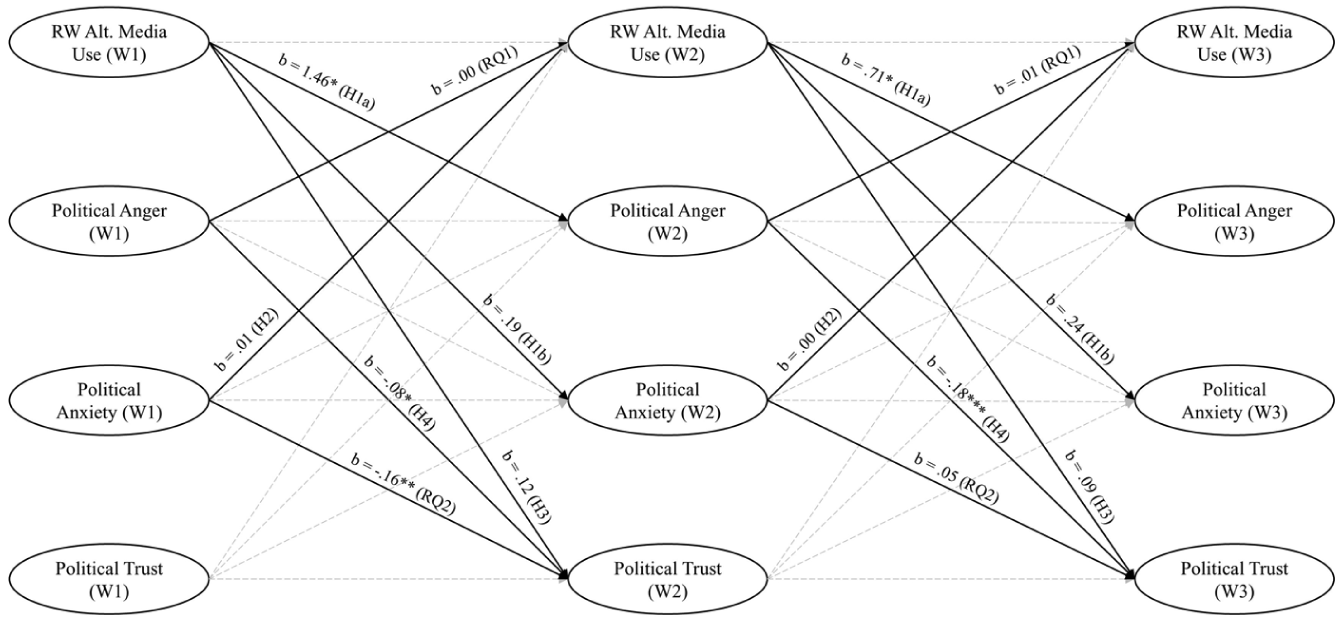
Simplified graphical representation of the RI-CLPM.
RI-CLPM: Within-person Relations between Right-wing Alternative Media Use, Political Trust, Political Anxiety, and Political Anger.
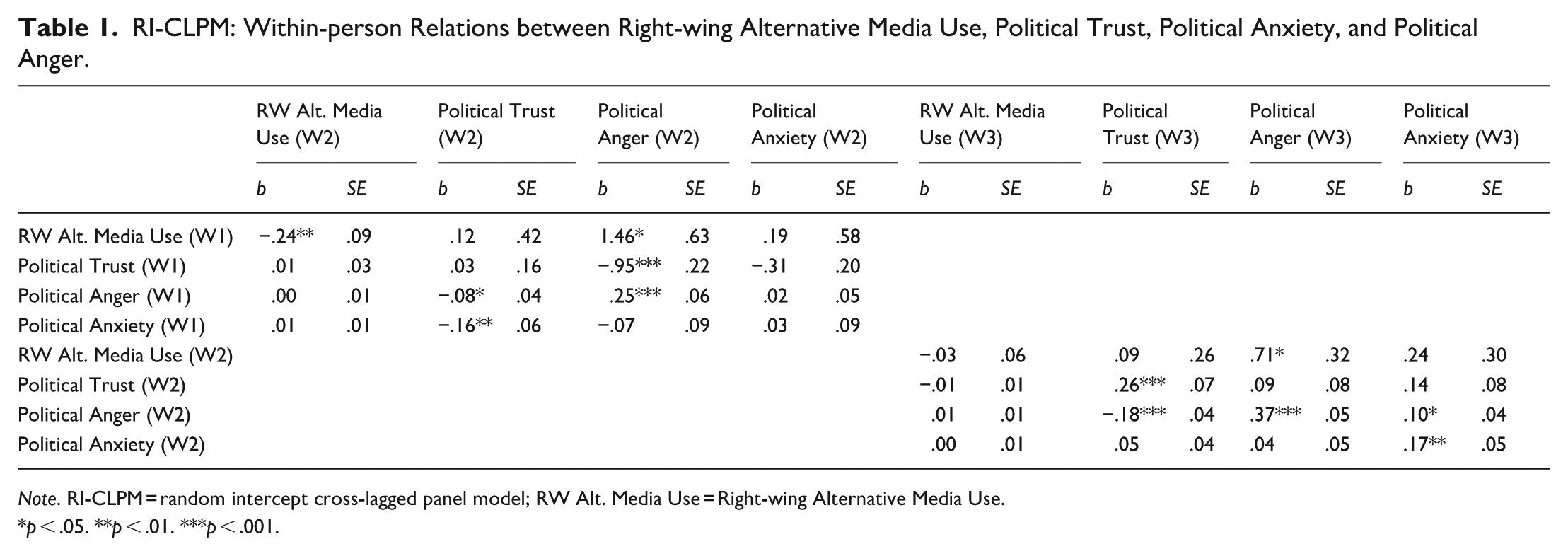
Note. RI-CLPM = random intercept cross-lagged panel model; RW Alt. Media Use = Right-wing Alternative Media Use.
p < .05. **p < .01. ***p < .001.
RI-CLPM: Between-person Relations between Right-wing Alternative Media Use, Political Trust, Political Anxiety, and Political Anger.
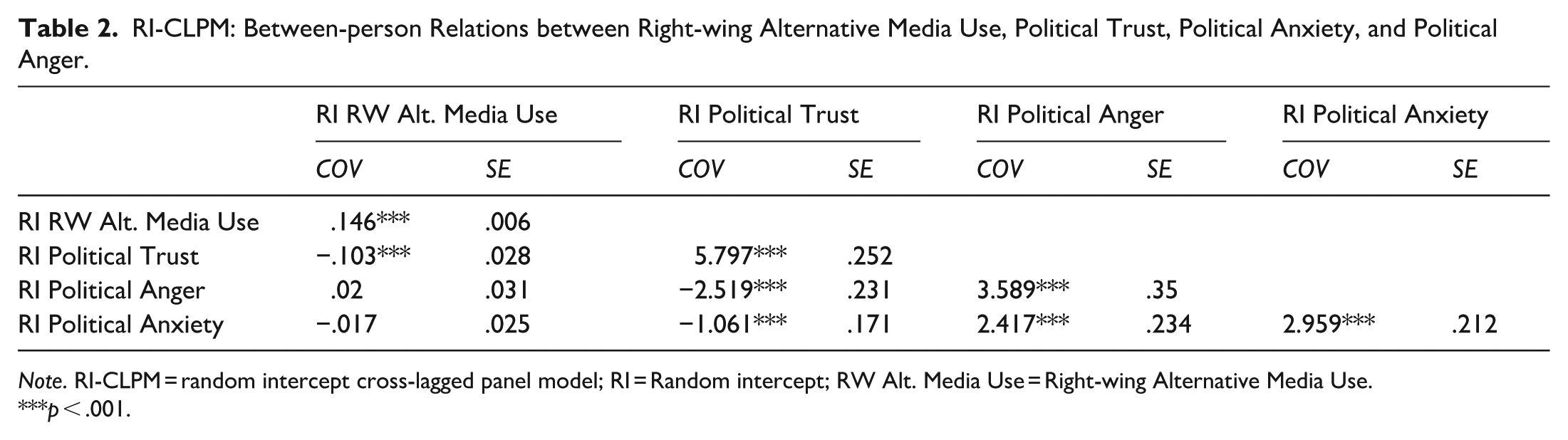
Note. RI-CLPM = random intercept cross-lagged panel model; RI = Random intercept; RW Alt. Media Use = Right-wing Alternative Media Use.
***p < .001.
Next, I am turning to the within-person associations. To reiterate, the within-person coefficients should give more robust insights into whether the four variables causally affect each other (but see limitations). H1 expected that right-wing alternative media use leads to more political anger and anxiety. I found a significant negative relationship for W1–W2 (b = 1.46, p = .021) and W2 to W3 (b = .71, p = .025), supporting H1a. Regarding political anxiety, there is no support for H1b from W1 to W2 (b = .19, p = .739) or W2 to W3 (b = .24, p = .428). Investigating reciprocity, H2 hypothesized political anxiety as a driver of right-wing alternative media use. Right-wing alternative media use was not affected by political anxiety (W1–W2: b = .01, p = .371, W2–W3: b = .00, p = .766), rejecting H2. Answering RQ1, political anger did not have an effect on right-wing alternative media use (W1–W2: b = .00, p = .958, W2–W3: b = .01, p = .399). Turning to H3, I did not find any support that right-wing alternative media use negatively affects political trust (W1–W2: b = .12, p = .781, W2–W3: b = .09, p = .739). As predicted in H4, there is a significant negative effect of political anger on political trust over both periods (W1–W2: b = −.08, p = .021, W2–W3: b = −.18, p < .001). RQ2 asked whether political anxiety affects political trust. Indeed, from W1 to W2, there is a negative effect of political anxiety on political trust (b = −0.16, p = .007). However, there was no relationship from W2 to W3 (b = 0.05, p = .224).
Robustness Checks
Further, I ran a set of robustness checks (details in Supplemental Material B). First, the measure for right-wing alternative media use is highly skewed. This is very common with list-frequency measures for alternative media outlets (Strömbäck et al. 2025). I reran the model with a log-transformed measure. Second, the list of relevant trustees was selected based on the assumption that these actors are the most likely to be held accountable for the current political situation (see also Webster 2018). However, some scholars opt for more extensive measures of political trust, including trust in courts, media, or police. I reran the analysis with a trust measure consisting of the four indicators above and trust in (1) “police,” (2) “media,” (3) “judicial branch,” and (4) “constitutional court.” In this model, the effect of anger in W1 on the extensive political trust measure in W2 (i.e., H4) stays negative but becomes insignificant (b = −.05, p = .109). All other tests for hypotheses and RQs remained the same.
Discussion
Right-wing alternative media and its impact on democratic processes have become a widely discussed topic in the public sphere and academic scholarship. Recent research voiced concerns regarding the media effects stemming from these sources and their potentially detrimental consequences for democracies (e.g., Andersen et al. 2023; Strömbäck 2023; Tsfati et al. 2025). The present study addresses two major blind spots in this line of literature: the role of emotions and the impact of right-wing alternative media on general political trust. This study extends previous research in multiple ways.
One of the key takeaways is that the consumption of right-wing alternative media fosters a climate of political anger. Anger can surely be an important and productive emotion in the sense that it can help to initiate political change by mobilizing (Valentino et al. 2011). However, given that there is some evidence that right-wing alternative media may tend to distort stories or misinform (Adam et al. 2026; de León et al. 2024; Staender et al. 2024), it raises the question of the extent to which this anger aligns with normative democratic principles. Future research, thus, may consider right-wing alternative media as mobilizing agents to assess their impact on democratic processes.
Notably, right-wing alternative media use increased anger but not anxiety (Andersen et al. 2024). It has been well-documented that news negativity can cause negative affect (Soroka and McAdams 2015). While there is a wider array of discrete emotions that may arise with negative affect (e.g., guilt), anger and anxiety are the most widely discussed ones in the field. What can explain the circumstance that right-wing alternative media use gives rise to anger but not to anxiety? Possibly, right-wing alternative media offers relatively little uncertainty regarding the control appraisal compared to mainstream news. In other words, these media outlets might often offer a target to blame for a negative situation. However, this remains an untested hypothesis based on what appraisal theory claims about these two emotions until content analytic research systematically quantifies the blame attribution in right-wing alternative media.
Furthermore, since this study cannot make any inferences about the specific content individuals saw, additional research is needed that taps into the content characteristics typical of right-wing alternative media and their effect on political anger. Previous research considers social media as a frequent entry point for alternative media users (de León et al. 2024). Due to algorithmic curation and the diffusion through social media networks, a substantial part of the public (and not only the minority that directly steers to the URLs of alternative media) might have the opportunity to encounter alternative media content. This requires the field to ask the following question: Who is susceptible to the anger appeals present in right-wing alternative media? Scholars have suggested that individuals who already feel fear and anger about politics may actively turn to alternative media to validate their feelings (Thorbjørnsrud and Figenschou 2022). But to what extent can right-wing alternative media prepare the breeding ground for hostile feelings in the political realm? In other words, future research may study to what extent emotions about politics are merely validated and reinforced versus to what extent they can originate from right-wing alternative media exposure.
This leads me to the next point. Previous interview studies have highlighted how emotions may be a crucial puzzle piece in understanding what drives individuals toward right-wing alternative media. Specifically, the fear of immigration and the perception that mainstream political and media outlets do not take this threat seriously have been mentioned by right-wing alternative media users as an entry point to using this type of media (Ihlebæk and Holter 2021; Thorbjørnsrud and Figenschou 2022). Thus, it has been argued that negative political emotions may drive media selection. However, in the timeframe of this study, neither anxiety nor anger was a driver of right-wing alternative media use—in fact, not even the RIs covaried. This null finding stands in contrast with expectations built on AIT. AIT expects that individuals who feel fearful engage in information-seeking behavior. One potential explanation for the null finding is that individuals might not turn to right-wing alternative media to decrease uncertainty related to their political fears. Potentially, other channels are deemed more important or reliable by those feeling fear.
To put these two findings into a broader context, the relationship between right-wing alternative media use and negative emotions seems to be asymmetric over the timeframe of this study. While previous research and theorizing point toward a reciprocal logic between media use and negative emotions, the empirical results suggest a one-sided dynamic in which alternative media use affects political emotions but not vice versa. Thus, a reinforcing spirals model (Slater 2007) has to be rejected in this context. When it comes to the role of emotions, in sum, this suggests that media-induced emotional responses may play a more central role than emotion-driven media selection.
Still, in general, the findings provide further support for the view that emotions are essential for our understanding of political trust. In line with previous research (Webster 2018), anger negatively affected political trust, reaffirming the argument that affective responses are critical in understanding citizens’ evaluations of political institutions and actors. While anger mainly emerged as a negative predictor of political trust, anxiety showed a negative effect on political trust only in the first study period, from W1 to W2. This underlines again that the relationship between anxiety and trust might be contingent on other factors, potentially of situational nature and related to other secondary appraisals (see Erhardt et al. 2021; Myers and Tingley 2017; Otto 2018). Unfortunately, this study was unable to provide insights into potential moderators that explain the variation. A fruitful approach to tackle this might be to investigate whether the (non-)attribution of competence to solve the anxiety-generating circumstance to a specific trustee can predict trust (Albertson and Gadarian 2015).
Returning to the context of right-wing alternative media, political anger might be the missing link between right-wing alternative media use and political trust. However, it should be noted that this study did not formally test anger as a mediator. Causal mediation analysis requires a myriad of assumptions (e.g., Bullock and Ha 2011) that I am not willing to make with the data at hand.
This study comes with multiple limitations. First and foremost, I must address a crucial assumption for identifying a causal effect with the RI-CLPM: the absence of unobserved time-varying confounders. I believe that this assumption is potentially violated, as it may be the case in many studies relying on RI-CLPMs. During the panel timeframe, two elections happened, which may have affected within-person changes. This limitation is not unique to this study, but rather a general limitation that applies to the extant field. For instance, a recent four-wave panel study conducted in Sweden on alternative media use and media trust covers a period that includes a general election and a global pandemic (Tsfati et al. 2025)—both events that can be hypothesized to interfere with the estimation of the causal effect. This limitation does not render this study uninformative but should be kept in mind when interpreting results from RI-CLPMs. Further, violations of measurement invariance could be problematic for the estimation of the causal effect. Second, relatedly, the trustees, “the national council,” and “European Union” have formally changed in composition due to the two elections. While I believe that only a negligible minority have updated their trust evaluation of these institutions post-election, this should be considered a limitation. Third, the study relies on self-report measures for emotions. While this is very much in line with the current dominant procedure in the field, it may be at stake with the conceptualization of emotions as neural processes (e.g., in AIT). Since individuals may not be consciously aware of their emotions, interpret items differently than intended by researchers, and censor their responses due to social desirability (Gadarian and Brader 2023), self-report assessment of emotions has substantial weaknesses. Fourth, and related, the study relies on self-reported media use, which is known to be an imperfect measure for actual exposure. Further, there is no information about the type and style of content participants consumed. Experimental research and tracking data (e.g., Adam et al. 2026) may complement this in future research. Fifth, the final sample does not exactly mirror the target population. Particularly, the slightly underrepresented strata of younger individuals and women may harm generalizability.
Conclusion
This study underlines the importance of taking emotions into account in the study of right-wing alternative media as well as political trust. The strong reliance on cognitive and evaluative outcomes in media effects research, as well as the focus on cognitive origins of political trust, might be limiting. The study suggests that right-wing alternative media can stir anger, which, in turn, is negatively related to political trust. These findings should encourage future work analyzing emotional appeals in and the effects of right-wing alternative media content. Given that political anger has been argued to be related to a myriad of political behaviors (e.g., participation), attention to right-wing alternative media’s role in facilitating mobilization is needed.
Supplemental Material
sj-docx-1-hij-10.1177_19401612261446713 – Supplemental material for Fear, Anger, and Mistrust: How Right-wing Alternative Media Influences Political Trust and Emotions about Politics
Supplemental material, sj-docx-1-hij-10.1177_19401612261446713 for Fear, Anger, and Mistrust: How Right-wing Alternative Media Influences Political Trust and Emotions about Politics by Andreas Nanz in The International Journal of Press/Politics
Footnotes

Funding
The author received no financial support for the research, authorship, and/or publication of this article.
Declaration of Conflicting Interests
The author declared no potential conflicts of interest with respect to the research, authorship, and/or publication of this article.
Data Availability Statement
Supplemental Material
Supplemental material for this article is available online.
Author Biography
References
Supplementary Material
Please find the following supplemental material available below.
For Open Access articles published under a Creative Commons License, all supplemental material carries the same license as the article it is associated with.
For non-Open Access articles published, all supplemental material carries a non-exclusive license, and permission requests for re-use of supplemental material or any part of supplemental material shall be sent directly to the copyright owner as specified in the copyright notice associated with the article.
