







Abstract
As generative artificial intelligence (AI) reshapes news production, understanding what drives global audiences to accept AI-generated news is critical. Existing research largely adopts a competence-based perspective, neglecting the complex role of trust dimensions and macro-political contexts. This study examines how AI self-efficacy interacts with two distinct dimensions of trust (competence trust and ethical trust) to shape acceptance of AI-generated news, and how these relationships vary across political environments. Analyzing survey data from 24,000 respondents across twenty-four countries, we find that ethical trust is a substantially stronger predictor of acceptance than competence trust, while AI self-efficacy promotes acceptance only when ethical trust is high. Multilevel analysis incorporating national-level indicators (press freedom, regime type, and AI readiness) reveals that the relationship between ethical trust and acceptance is stronger in open, liberal democratic, and technologically ready societies. These findings suggest that the legitimacy of AI-generated news is more strongly associated with audiences’ ethical evaluations of AI systems than with perceived technical capability, and that this association is shaped by the normative expectations that different political contexts cultivate.
Keywords
Introduction
The integration of generative artificial intelligence (AI) into newsrooms has accelerated rapidly. From automated content generation to algorithmic curation, AI promises unprecedented efficiency and scalability (Diakopoulos 2019; Lewis et al. 2019). The revitalization of automated journalism following the rise of ChatGPT further underscores the industry’s growing commitment to AI-assisted news production (Siitonen et al. 2024). Yet global audiences remain largely skeptical of AI-generated news, frequently perceiving it as less trustworthy than human journalism (Fletcher and Nielsen 2024; Nanz et al. 2025). The inconsistency raises a central question: what determines whether audiences accept AI-generated news as legitimate?
Existing scholarship has largely approached this question through the lens of technological adoption, emphasizing functional drivers such as perceived accuracy, expertise, and users’ own technological capabilities (Graefe et al. 2018; Jang et al. 2024; Schiavo et al. 2024; Zhang et al. 2025). The underlying assumption of this competence-based paradigm is that if audiences perceive AI as capable, and if they feel competent in using it, acceptance will follow. However, this perspective risks overlooking the normative foundations of journalism. News is not merely an information product; it is a social institution rooted in public trust, accountability, and ethical standards. Emerging studies have begun to document that user resistance to AI-generated news extends beyond perceived incapability. Qualitative evidence shows that audiences express concerns about opacity, lack of human effort, and potential biases in AI-produced content even when they acknowledge its potential objectivity (Yeste-Piquer et al. 2025). Survey data across six countries similarly reveal widespread discomfort with AI in news production, extending beyond quality evaluations to concerns about transparency and trustworthiness (Fletcher and Nielsen 2024). Moreover, labeling news as AI-generated has been shown to reduce perceived trustworthiness, an effect concentrated among those with higher journalism knowledge, suggesting that normative expectations of journalism mediate audience responses to AI disclosure (Toff and Simon 2025). Yet a theoretical understanding of how these ethical dimensions interact with functional drivers remains underdeveloped. Furthermore, while isolated findings indicate that acceptance varies with external factors, such as news topics (Nanz et al. 2025; Wölker and Powell 2021), author labeling (Leuppert et al. 2025), or regional background (Gondwe 2025), the existing literature has yet to theorize these findings.
Overall, previous literature faces at least three limitations. First, trust in AI is widely recognized as important for acceptance (Choung et al. 2023; Kim et al. 2021), yet studies often treat trust as a unidimensional construct rather than distinguishing between its underlying dimensions (e.g., Morosoli et al. 2024; Toff and Simon 2025). Building on Mayer et al.’s (1995) integrative model, which identifies ability, benevolence, and integrity as distinct components, this study distinguishes between competence trust (belief in AI’s reliability and effectiveness, aligning with ability dimension) and ethical trust (belief that AI systems and their developers act in accordance with moral and social values, synthesizing the dimensions of benevolence and integrity, see also Glikson and Woolley (2020). Disentangling these dimensions is essential to understanding whether acceptance stems from perceived utility or normative alignment.
Second, while individual factors like self-efficacy are often assumed to foster acceptance, the mechanism remains underexplored. Whether higher self-efficacy leads to acceptance (as assumed in technology adoption) or instead heightens critical scrutiny remains unclear. In the sensitive domain of news, where credibility is paramount, audiences may acknowledge AI’s technical capabilities while remaining skeptical about its ethical implications. This helps explain why individuals with greater knowledge of journalism tend to be more critical of AI-generated news (Toff and Simon 2025).
Third, most research treats AI acceptance as a universal psychological process, neglecting the influence of macro-political contexts. For instance, while surveys in six countries show general skepticism (Fletcher and Nielsen 2024), results from ten African countries are generally neutral (Gondwe 2025). Whether the logic of acceptance holds equally in a liberal democracy with a free press and in an authoritarian regime where information is tightly controlled remains an open question. Little attention has been paid to how national factors, such as press freedom, AI readiness, and political regime type, reshape the relationship between trust and acceptance.
To address these concerns, the study analyzes survey data from 24,000 respondents across twenty-four countries. We disentangle the distinct roles of competence and ethical trust in shaping acceptance of AI-generated news, and examine how these individual-level mechanisms are conditioned by macro-level factors. Specifically, we investigate whether the relationship between AI self-efficacy and acceptance is contingent upon underlying trust structures, and how national contexts moderate these dynamics. By integrating psychological predictors with macro-political structures, this study offers a multilevel framework for understanding the legitimacy of AI-generated news across diverse political contexts.
Literature Review
Self-efficacy and AI News Acceptance
Grounded in social cognitive theory, self-efficacy refers to an individual’s belief in their capacity to execute actions required to achieve specific outcomes (Bandura 1993, 1997). In technology adoption research, self-efficacy has been shown to shape engagement with technological systems by influencing perceived ease of use, behavioral intentions, and actual usage, primarily through reducing uncertainty and enhancing confidence in interaction (Compeau and Higgins 1995; Venkatesh et al. 2003). Extending this to artificial intelligence, AI self-efficacy captures an individual’s perceived capability to understand and effectively use AI technologies (Wang and Chuang 2024).
This study focuses on AI self-efficacy instead of the broader construct of AI literacy, which is typically operationalized as demonstrated competence (Long and Magerko 2020; Ng et al. 2021). Because perceived and actual capability can diverge considerably, and it is subjective confidence that most directly shapes attitudinal responses (Bandura 1997), AI self-efficacy is the more appropriate construct for capturing how individuals’ sense of competence interacts with trust to determine acceptance.
When applied to the news domain, the relationship between self-efficacy and technology acceptance becomes more complex. Evidence from journalism studies provides preliminary support for a positive link, though with important nuances. Audiences with greater knowledge of automated journalism evaluate algorithmically attributed news more favorably than those with less knowledge, who tend to prefer content attributed to human authors (Jang et al. 2024). Similarly, consumer trust and usage intentions toward AI-involved news production can remain stable or even increase as AI enters the production process, provided that human oversight is maintained (Heim and Chan-Olmsted 2023). Related evidence on knowledge and competence suggests that individuals with greater confidence in engaging with AI-generated news may be more open to accepting it, while also indicating that this openness is conditional rather than automatic.
At the same time, existing literature highlights important boundary conditions. Greater competence or knowledge may increase comfort with AI technologies, but can simultaneously intensify critical scrutiny of issues such as bias, opacity, and weakened accountability. Toff and Simon (2025) found that AI-generated news labels reduced perceived trustworthiness, particularly among those with higher journalism knowledge. Qualitative research similarly shows that AI-knowledgeable citizens are more inclined to question the neutrality of automated news content (Yeste-Piquer et al. 2025). This reflects the fact that audiences evaluate AI-generated news against normative expectations of journalistic professionalism, accountability, and public responsibility, rather than treating it as a purely technological artifact.
Taken together, prior research suggests that AI self-efficacy equips individuals with the cognitive resources to engage with AI-generated news but does not guarantee acceptance under all circumstances. This ambiguity motivates our first hypothesis, which posits a baseline positive relationship while recognizing that self-efficacy alone may be insufficient:
Ethical and Competence Trust in AI
Trust is a foundational mechanism that enables individuals to engage with complex systems under conditions of uncertainty and risk (Boon and Holmes 1991; Glikson and Woolley 2020). In this study, trust is directed at AI as a technology, and is theorized as a psychological antecedent of AI news acceptance, which refers to audiences’ willingness to recognize AI-generated news as a legitimate form of journalism. In the context of artificial intelligence, trust is especially consequential because users typically lack direct access to how systems function and must rely on evaluative beliefs about their performance and intentions. Drawing on organizational trust theory (Mayer et al. 1995), this study distinguishes between two dimensions of trust in AI: competence trust and ethical trust.
Competence trust refers to users’ confidence in AI’s instrumental effectiveness and outcome quality. It reflects the belief that AI systems are capable of producing reliable, useful results across practical applications. In the context of AI-generated news, competence trust captures whether audiences believe that AI can deliver accurate and functional outputs in information-related tasks.
Ethical trust, by contrast, concerns users’ evaluations of whether AI systems and the organizations deploying them operate in accordance with fundamental moral and social values. It is particularly salient in journalism, where legitimacy depends not only on performance but also on adherence to normative principles such as accountability and public interest.
Prior research suggests that these dimensions play distinct roles in shaping acceptance of AI systems. Competence trust typically develops through performance-related cues such as accuracy, reliability, and output quality, and supports instrumental reliance on AI (Afroogh et al. 2024; Glikson and Woolley 2020). Ethical trust is shaped by process-related cues, such as transparency, explainability, and fairness, and is more closely tied to perceptions of legitimacy and moral acceptability (Malle 2022; Shin 2021). Even when AI systems are viewed as capable, deficits in benevolence or empathy can limit willingness to trust and rely on them (Li and Bitterly 2024). Survey evidence indicates that when AI is introduced into news production, audiences simultaneously expect gains in speed and cost-efficiency while expressing concerns about transparency and trustworthiness (Newman et al. 2025), suggesting that perceptions of technical capability may coexist with normative reservations.
While both competence trust and ethical trust contribute to audience acceptance of AI-generated news, they likely do so through distinct mechanisms. We therefore propose:
Beyond their direct effects, trust may also condition how individual capabilities translate into acceptance. Prior research has established trust as a central mechanism in technology adoption, shaping how resources such as perceived usefulness and transparancy translate into behavioral intentions (Aysolmaz et al. 2023; Choung et al. 2023; Shin et al. 2022). These relationships, however, have been theorized primarily in instrumental settings; in value-laden domains, acceptance is lower (Castelo et al. 2019), and perceived AI risk substantially higher, particularly in media and judicial contexts relative to utilitarian applications (Araujo et al. 2020).
Journalism is a paradigmatic normative domain, where legitimacy rests on professional values rather than on functional performance alone. Research consistently shows that greater competence fosters critical evaluation rather than automatic reliance: domain experts are less likely than laypeople to rely on algorithmic recommendations even when algorithms outperform human judgment (Logg et al. 2019); higher AI literacy does not directly increase trust in AI-generated news (Goyanes et al. 2026); and those with higher literacy report less confidence in newsroom AI adoption while remaining the most frequent personal users of AI tools (Toff and Simon 2025; Yeste-Piquer et al. 2025).
These findings indicate that in normatively charged domains, self-efficacy does not translate into acceptance as straightforwardly as in instrumental settings. When ethical trust is low, users may channel their competence into scrutinizing normative shortcomings; when ethical trust is high, self-efficacy more fully supports acceptance. We therefore propose:
Competence trust may play an analogous role. When users believe AI systems produce reliable and useful outputs, self-efficacy may translate more readily into acceptance because perceived functional quality validates users’ confidence in engaging with the technology. We test this as a parallel hypothesis:
Macro-political Context Factors
Individual attitudes toward AI-generated news are embedded within broader national and institutional contexts that shape normative expectations about media, technology, and authority. Comparative media systems scholarship has long argued that the relationship between audiences and news institutions is structured by the political and media environments in which they operate (Hallin and Mancini 2004). More recent extensions of this framework have demonstrated its applicability beyond Western democracies, showing that media-politics relationships vary systematically across regime types, with consequences for how citizens evaluate news credibility and institutional legitimacy (Brüggemann et al. 2014; Hallin and Mancini 2011). Building on this tradition, we examine three macro-level moderators. Each captures a distinct dimension of the institutional environment in which audiences encounter AI-generated news: media norms, political legitimacy structures, and technological governance capacity.
Firstly, from the media perspective, press freedom plays a crucial role in shaping the normative expectations audiences hold for journalism. Countries with higher press freedom tend to foster journalistic cultures that emphasize independence, transparency, and ethical standards (Hanitzsch et al. 2018). In such environments, audiences are socialized to demand accountability from media institutions, and this normative orientation likely extends to new technologies entering the news production process, which may heighten the salience of ethical trust as a precondition for accepting AI in news production. We therefore hypothesize that:
Secondly, from the politics perspective, political regime type fundamentally structures the broader logic of institutional trust. Comparative political scholarship has long distinguished between input legitimacy, grounded in procedural accountability and citizen participation, and output legitimacy, grounded in effective governance performance (Norris 2011). Democratic governance tends to foster trust along the input dimension, where citizens evaluate institutions against procedural and normative standards. Authoritarian contexts, by contrast, tend to cultivate trust rooted in performance and output delivery, as citizens assess institutional legitimacy primarily through the lens of effective governance rather than independent normative scrutiny (Karpa and Rochlitz 2025), and press trust in these settings is often conflated with political trust (Hanitzsch et al. 2018). Under these conditions, ethical trust in AI may carry less weight as a predictor of acceptance, because the evaluative framework through which citizens assess news legitimacy is less oriented toward independent ethical standards. We therefore hypothesize:
Thirdly, from the technology perspective, AI readiness reflects the technological infrastructure and adoption environment of a country. High readiness may facilitate the diffusion of AI, but may also heighten public sensitivity to its risks. Cross-national surveys suggest that publics express a complex mixture of excitement and concern about AI, with concern particularly pronounced around issues of societal impact, job displacement, and institutional responsibility (Kelley et al. 2021). In the United States, for instance, the public expresses limited trust in technology companies and governmental actors to develop and manage AI responsibly (Zhang and Dafoe 2019). High AI readiness can also coexist with ethical governance gaps, creating a ‘ready but irresponsible’ condition (Nzobonimpa and Savard 2023). In digital advanced societies, citizens are more likely to have encountered AI applications and their limitations, increasing the weight they assign to ethical assurances before accepting AI in sensitive domains such as news. Therefore, we hypothesize:
Synthesizing the arguments above, this study proposes a multilevel conceptual framework. At the individual level, AI news acceptance is driven by the interplay between self-efficacy (H1) and trust (H2a-c), with both ethical and competence trust hypothesized as a direct predictor and as a moderator that conditions the impact of self-efficacy (H3a-b). At the macro level, the influence of ethical trust on acceptance is contingent upon national contexts (H4a-c). The complete model and hypotheses are presented in Figure 1.
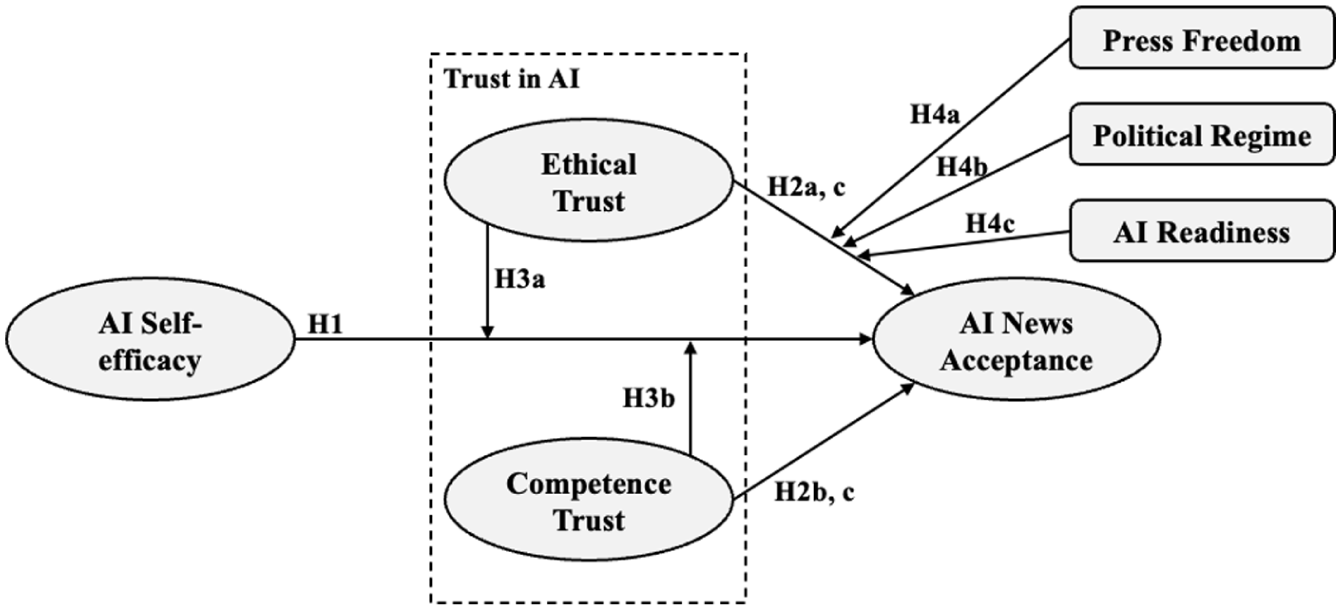
Hypothesized model.
Methodology
Sample and Data Collection
Data for this study were drawn from a large-scale global survey conducted from May to October 2025, designed to capture public perceptions of journalism and artificial intelligence across diverse cultural and political contexts. The survey was administered online by professional market research firms (Ipsos and Kantar) through their established global consumer panels, using stratified quota sampling to ensure representativeness of the general public in terms of demographics within each country. Quota targets for age, gender, education, income, and region were set by the survey firms based on national census parameters; no additional post-stratification weighting was applied.
A total of twenty-four countries were selected through purposive sampling to maximize variation among political systems (spanning full democracies, flawed democracies, hybrid regimes, and authoritarian states per the EIU Democracy Index), media environment (ranging from high to low press freedom), and technological development (covering the full spectrum of AI readiness scores). This selection strategy ensures that the sample captures meaningful variation in both the individual-level and macro-level factors central to our theoretical framework. The final qualified sample consisted of 24,000 respondents nested within twenty-four countries (1,000 per country). Table 1 lists the countries and corresponding demographics.
Countries and Demographic Profiles of the Respondents.
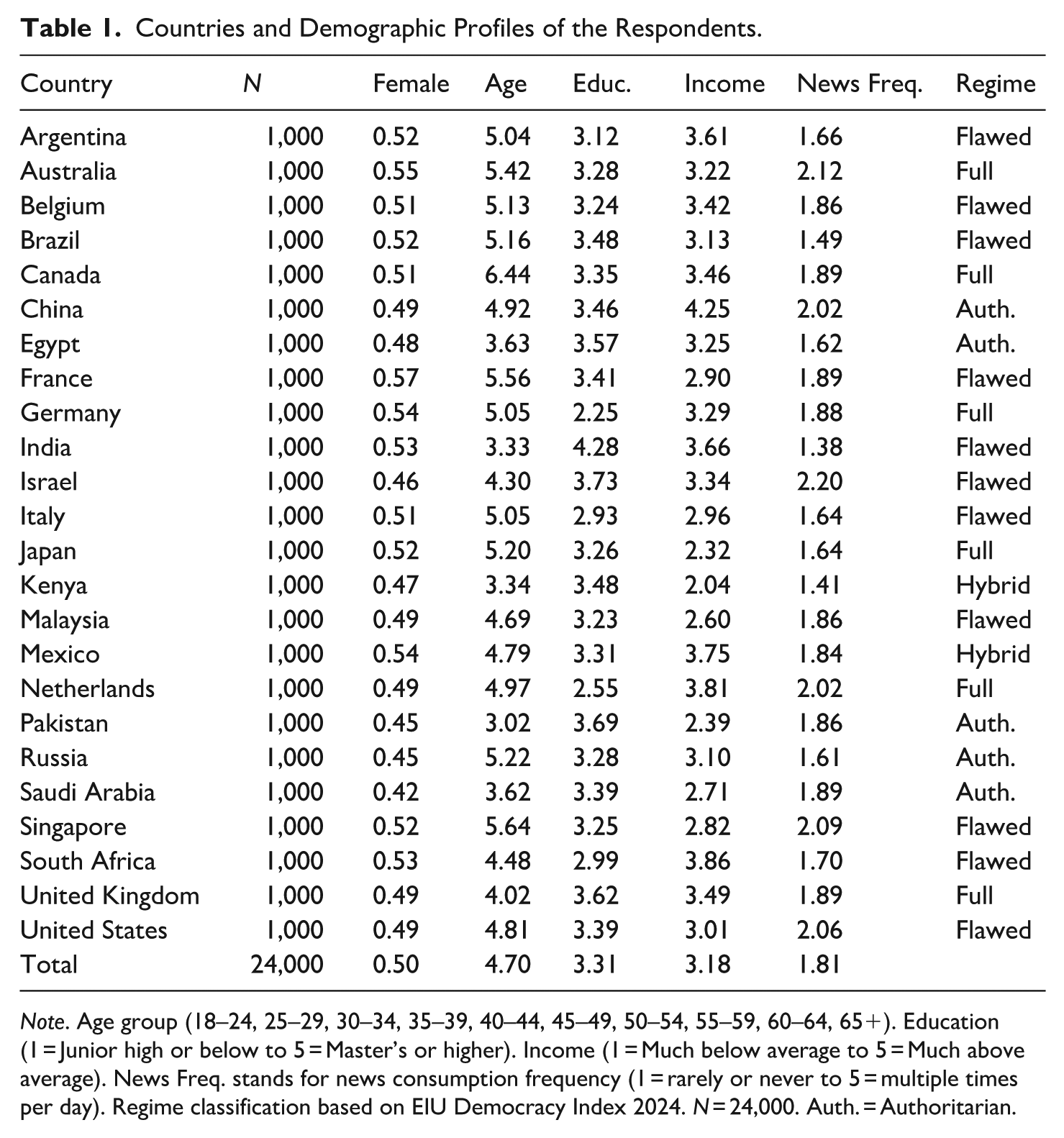
Note. Age group (18–24, 25–29, 30–34, 35–39, 40–44, 45–49, 50–54, 55–59, 60–64, 65+). Education (1 = Junior high or below to 5 = Master’s or higher). Income (1 = Much below average to 5 = Much above average). News Freq. stands for news consumption frequency (1 = rarely or never to 5 = multiple times per day). Regime classification based on EIU Democracy Index 2024. N = 24,000. Auth. = Authoritarian.
Measures
All items for individual-level scales are provided in Supplemental Material S1.
AI News Acceptance (Dependent variable)
We define it as audience’s willingness to recognize AI-generated news as a legitimate and socially acceptable form of journalism. The notion is evaluative instead of cognitive or procedural, and thus is not about whether they perceive specific articles as credible or whether AI adheres to particular editorial routines. It reflects a judgment about AI’s appropriate role in the journalistic field. This construct was measured using a five-item scale (α = .888) that captures multiple facets of acceptance, including legitimacy recognition, willingness to grant editorial autonomy, parity judgments with human journalism, and perceived relative advantage. Responses were recorded on a five-point Likert scale (1 = Strongly Disagree, 5 = Strongly Agree).
AI Self-efficacy (Independent variable)
AI self-efficacy was assessed using a six-item scale (α = .885) adapted from Wang et al. (2023) and Wang and Chuang (2024), focusing on users’ perceived capability to understand and interact with AI technologies.
Trust in AI (Moderators)
Trust in AI was disentangled into two dimensions, confirmed through both exploratory factor analysis (Supplemental Material S2) and confirmatory factor analysis (Supplemental Material S3): (1) Ethical Trust (four items, α = .859): Reflecting beliefs about whether AI systems and their developers adhere to moral and social values. (2) Competence Trust (four items, α = .825): Reflecting beliefs about AI’s instrumental reliability and effectiveness.
The confirmatory factor analysis supported the hypothesized four-factor structure with good fit (RMSEA = .027, CFI = .990, SRMR = .021; Supplemental Material S3). The analysis also examined discriminant validity across all individual-level variables (Supplemental Material S4). Most HTMT values fall below the conservative threshold of .85, while the value between ethical trust and competence trust (.894) falls below the liberal threshold of .90 (Henseler et al. 2015).
National-Level Moderators
(1) Press Freedom. Measured using the global score of the World Press Freedom Index 2025 (Reporters without Borders). Higher scores indicate greater press freedom. (2) Political Regime. Countries were categorized based on the 2024 Economist Intelligence Unit (EIU) Democracy Index: 1 = Full Democracies (six countries), 2 = Flawed Democracies (eleven countries), 3 = Hybrid Regimes (two countries), and 4 = Authoritarian Regimes (five countries). (3) AI Readiness. Measured using the Oxford Insights’ Government AI Readiness Index 2025, reflecting a country’s technological maturity, governance capacity, and digital infrastructure.
Control Variables
At the individual level, we controlled for gender, age group, education, household income, and news consumption frequency. At the country level, we incorporated World Bank national income classifications to control for economic development.
Analytical Strategy
Given the hierarchical structure of the data (individuals nested within countries), we employed hierarchical linear modeling (HLM) with random intercepts using Stata 18.0. All continuous individual-level predictors were group-mean centered to separate within-country from between-country effects. Country-level predictors were grand-mean centered. The three country-level moderators are substantially correlated at the macro level (r = −.872 between press freedom and regime type; Supplemental Material S5), as press freedom, regime type, and AI readiness jointly reflect overlapping dimensions of national institutional characteristics. We therefore retain the separate models as primary specifications to preserve interpretive clarity given the limited Level-2 sample size (k = 24), following recommendations for multilevel designs with limited group-level sample sizes (Maas and Hox 2005); still, a combined model entering all three macro-level variables simultaneously is reported as a sensitivity analysis in Supplemental Material.
We estimated six models in sequence. Models 1–3 examined individual-level relationships: Model 1 included only control variables, Model 2 added the main effects of AI self-efficacy, ethical trust, and competence trust, and Model 3 introduced two-way interactions between self-efficacy and each trust dimension. Models 4–6 each added one macro-level moderator and its cross-level interaction with ethical trust: press freedom (Model 4), regime type (Model 5), and AI readiness (Model 6).
Measurement invariance was assessed across regime type groupings using multigroup confirmatory factor analysis. We tested invariance across the theoretically motivated regime-type groupings that correspond to our cross-level hypotheses. Results supported scalar invariance (equal factor loadings and intercepts across groups), with BIC favoring the scalar model over less constrained alternatives (Supplemental Material S6). This provides confidence that the constructs function equivalently across the political contexts central to our analysis.
To evaluate the relative strength of ethical versus competence trust, we report both unstandardized coefficients (in the main tables, following convention in HLM) and fully standardized coefficients (in Supplemental Material S7). In addition, the hybrid regime category comprises only two countries, which limits the reliability of the corresponding estimates. Results of this group should be interpreted with caution; robustness check using a three-category classification is provided in Supplemental Material S8.
Results
Trust in AI as Moderators
The results of hierarchical linear regression in Table 2 reveal the impact of AI self-efficacy and different trust on AI news acceptance.
Hierarchical Linear Regression Predicting AI News Acceptance.
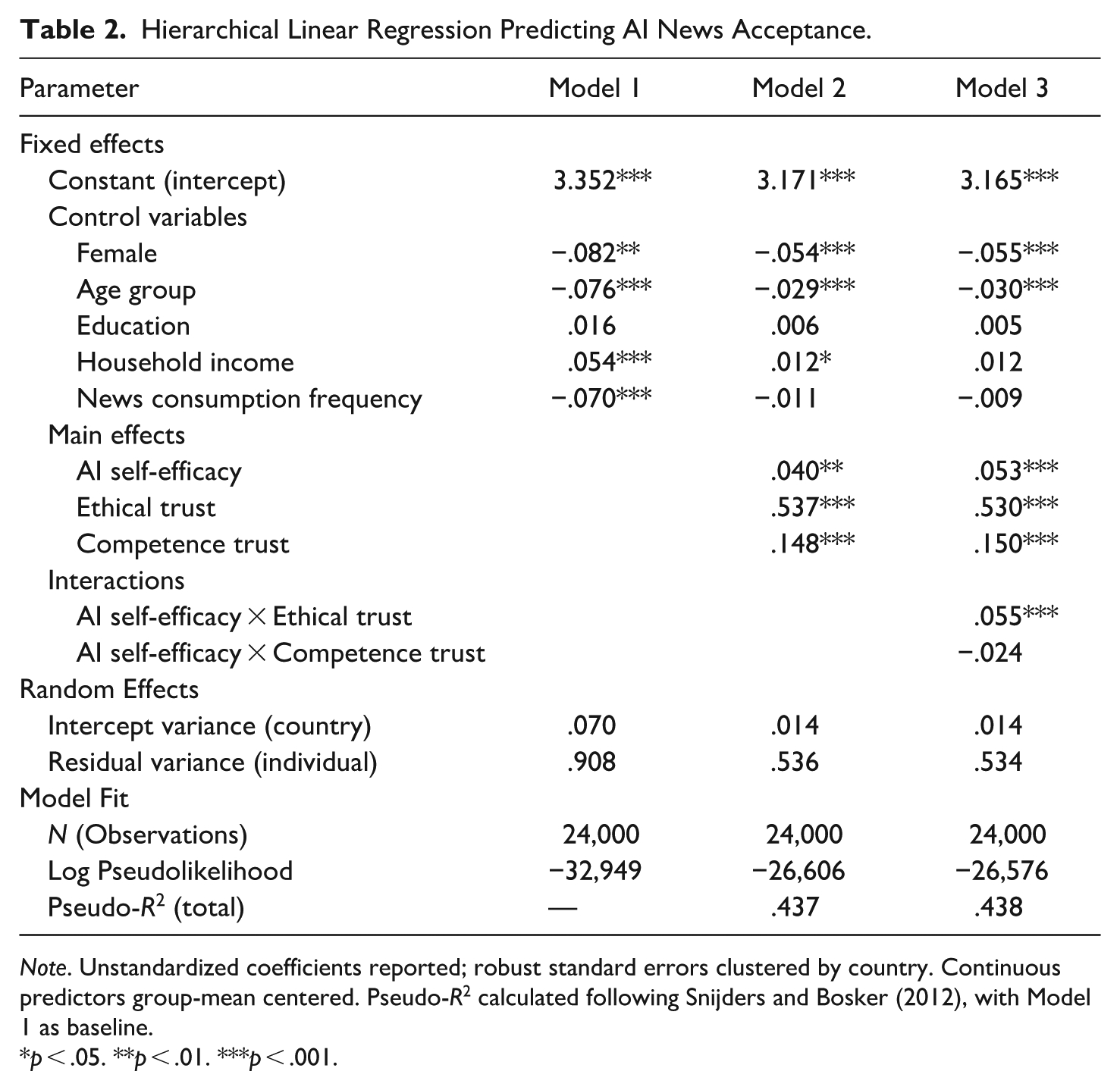
Note. Unstandardized coefficients reported; robust standard errors clustered by country. Continuous predictors group-mean centered. Pseudo-R2 calculated following Snijders and Bosker (2012), with Model 1 as baseline.
p < .05. **p < .01. ***p < .001.
Supporting
The reduction in country-level intercept variance from Model 1 (σ2 = .070) to Model 2 (σ2 = .014) is notable, indicating that individual-level trust and efficacy variables absorb a substantial portion of between-country variation in acceptance.
Model 3 tested interaction effects. The interaction between AI self-efficacy and ethical trust was positive and significant (b = .055, p < .001), supporting
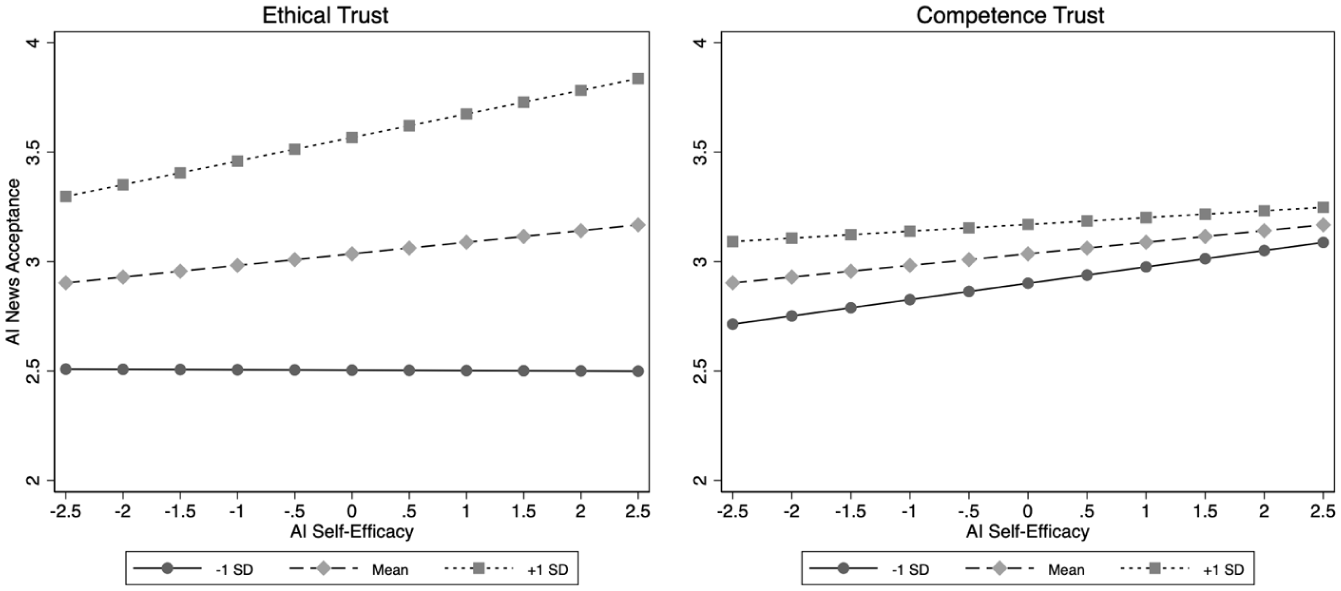
Moderating effects of trust on AI news acceptance.
Macro-level Comparative Analysis
Table 3 presents cross-level interaction models examining how macro-political contexts moderate the relationship between ethical trust and AI news acceptance. Across all models, individual-level predictors remained consistent with Model 2. Ethical trust was the strongest predictor (b = .536–.578, p < .001), followed by competence trust (b = .144, p < .001) and AI self-efficacy (b = .037–.039, p < .01).
Hierarchical Linear Regression Predicting AI News Acceptance.
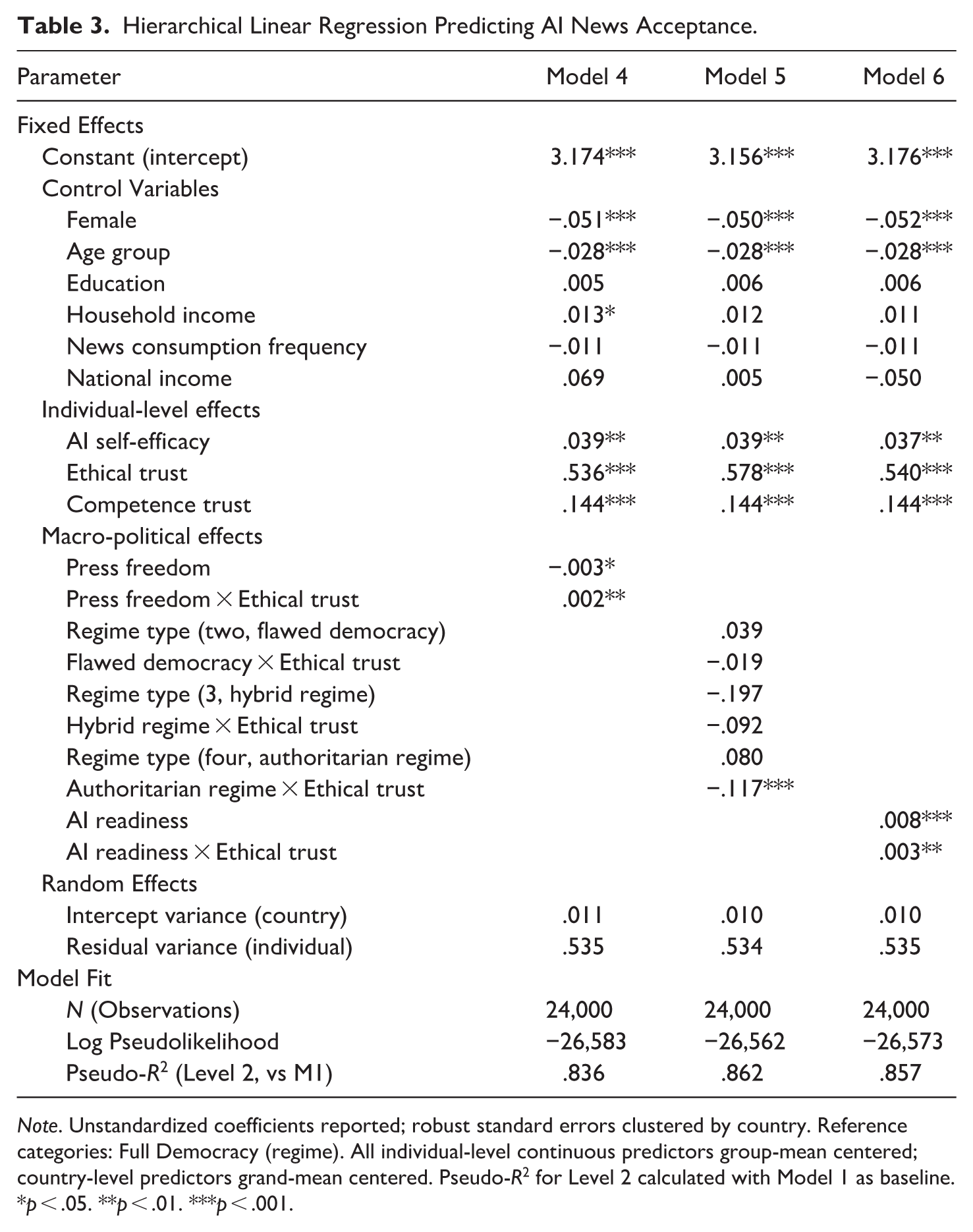
Note. Unstandardized coefficients reported; robust standard errors clustered by country. Reference categories: Full Democracy (regime). All individual-level continuous predictors group-mean centered; country-level predictors grand-mean centered. Pseudo-R2 for Level 2 calculated with Model 1 as baseline.
p < .05. **p < .01. ***p < .001.
Press Freedom (Model 4)
Press freedom significantly moderated the effect of ethical trust (b = .002, p < .01), supporting
Regime Type (Model 5)
With full democracies as the reference group, the cross-level interaction between ethical trust and authoritarian regime was significant and negative (b = −.117, p < .001), indicating that the ethical trust–acceptance link is substantially weaker in authoritarian contexts. Figure 3 visually presents this difference in political regime. The ethical trust slope was .578 in full democracies versus .461 in authoritarian regimes, a reduction of roughly 20 percent. Interactions for flawed democracies (b = −.019, p = .36) and hybrid regimes (b = −.092, p = .10) were non-significant.
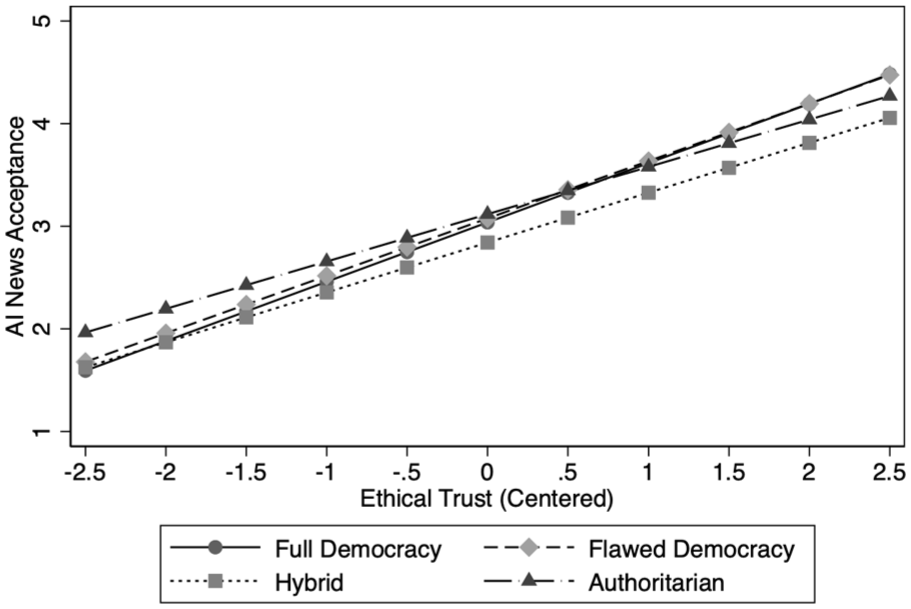
Ethical trust effect in different regime types.
AI Readiness (Model 6)
National AI readiness positively moderated the ethical trust–acceptance relationship (b = .003, p < .01), supporting
Across Models 4–6, the cross-level interaction effects are statistically significant but modest in practical magnitude. As is shown above, the ethical trust slope varies by roughly 8 percent per standard deviation of press freedom and by 20 percent between full democracies and authoritarian regimes. Full variance decomposition is reported in Supplemental Material S9. A sensitivity analysis entering all three macro-level moderators simultaneously is reported in Supplemental Material S10.
Discussion and Conclusion
This study investigated the factors shaping public acceptance of AI-generated news across twenty-four countries (N = 24,000). Through distinguishing between ethical and competence trust and embedding individual-level mechanisms within macro-political contexts, the analysis offers a multilevel account of how audiences evaluate the legitimacy of AI-generated news.
The core finding is that ethical trust in AI is a substantially stronger predictor of acceptance than competence trust, and that self-efficacy promotes acceptance only when ethical trust is high (H1, H2a-c, H3a supported, H3b not supported). At the macro level, the ethical trust–acceptance relationship is weaker in authoritarian regimes (H4b partially supported) and stronger in countries with higher AI readiness (H4c supported), while the press freedom effect is not independently separable from regime type (H4a supported conditionally; see Supplemental Material S10). We discuss these findings in turn.
The dominance of ethical trust over competence trust suggests that audiences evaluate AI-generated news primarily through a normative lens. This finding extends trust theory (Mayer et al. 1995) to a high-stakes information context. When the technology operates in a domain built on public trust and normative expectations, ethical considerations outweigh functional ones. This aligns with research showing that public skepticism toward AI in news is driven by normative concerns. Audiences across multiple countries express discomfort not only with AI-generated news quality but also with the transparency and trustworthiness of AI-mediated journalism (Fletcher and Nielsen 2024), and report specific risk perceptions including potential biases, threats to editorial independence, and reduced accountability (Morosoli et al. 2024). The gap between the two trust dimensions was substantial, challenging the notion that user acceptance will grow as AI systems become more powerful and productive.
One scope condition is worth noting. Where AI serves as a productivity tool, such as software development or data analysis, users can directly evaluate output quality, and adoption is driven largely by perceived usefulness (Venkatesh et al. 2003). News audiences, by contrast, typically cannot independently verify the accuracy, balance, or fairness of reporting. When output quality is unverifiable, trust in the production process becomes paramount, and that trust is fundamentally ethical rather than technical. Whether the dominance of ethical trust extends to other domains where users must rely on process integrity rather than outcome inspection is a question for future research.
The significant interaction between self-efficacy and ethical trust helps resolve a tension in the prior literature. Earlier studies have reported both positive (Heim and Chan-Olmsted 2023; Jang et al. 2024) and critical (Toff and Simon 2025) effects of AI literacy and knowledge on news attitudes. Our results suggest these findings are not contradictory but conditional. Self-efficacy promotes acceptance when ethical trust is present, yet its positive effect is attenuated when ethical trust is low. It also carries implications for media literacy initiatives. Programs that seek to increase public comfort with AI in news by building technical knowledge alone may prove insufficient if the underlying systems are not perceived as ethically governed. Self-efficacy, in short, functions as a resource whose effect depends on the trust environment in which it is deployed.
The pattern finds coherent interpretation through a comparative media systems lens (Hallin and Mancini 2004). In full democracies, press freedom traditions, professional codes, and public accountability mechanisms establish ethical criteria as a primary frame through which media credibility is assessed, and citizens extend these criteria to AI-produced news. That press freedom and regime type are not independently separable in the combined model (Supplemental Material S10) is consistent with the interpretation that press freedom reflects or is affected by some institutional dimension of regime type.
In authoritarian contexts, media is understood less as an independent institution and more as an extension of state authority, where trust derives from source legitimacy and perceived alignment with governance objectives (Karpa and Rochlitz 2025). The institutional environment does not sustain media ethics as a distinct, publicly salient evaluative domain (Stockmann 2012). Accountability flows upward to the state rather than outward to the public, so the ethical qualities of a news production technology carry less decisional weight. Social desirability pressures in less free environments may further attenuate the observed relationship, a possibility we address as a limitation below.
The non-significant differences for flawed democracies and hybrid regimes suggest a threshold dynamic: the ethical trust mechanism weakens only when independent media evaluation is systematically suppressed, not when democratic institutions function imperfectly. Flawed democracies typically retain formal press freedoms, active civil society organizations, and normative expectations of media accountability, even where these operate unevenly (Norris 2011). This null finding may also partly reflect the coarseness of the four-category regime typology, which collapses considerable variation within each category. Additionally, democratic media norms may also be more durable than the institutional arrangements that originally produced them, persisting in civic culture even as formal safeguards erode (Voltmer 2013).
Higher national AI readiness amplified the ethical trust–acceptance relationship, consistent with the argument that technologically advanced societies are also societies where publics have encountered AI’s limitations and governance gaps (Nzobonimpa and Savard 2023). Greater exposure to AI appears to raise the premium placed on ethical governance as a condition for acceptance, rather than normalizing AI in ways that render ethical concerns less salient.
A supplementary analysis of the predictors of ethical trust (Supplemental Material S11) shows that AI self-efficacy is positively associated with ethical trust, suggesting an indirect pathway to acceptance. This association suggests that self-efficacy may shape acceptance both directly and through its positive relationship with ethical trust. Education, by contrast, is negatively associated, consistent with the argument that formal education fosters normative scrutiny rather than deference toward AI systems.
This study has several limitations. First, its cross-sectional design precludes causal inference. It is plausible that acceptance shapes trust rather than the reverse, as individuals who already accept AI-generated news may come to evaluate AI systems more favorably. Experimental manipulation of ethical and competence cues would provide stronger evidence for the hypothesized direction. Second, social desirability bias may distort responses in authoritarian contexts, where political environment shapes reporting tendencies. Third, online sampling limits generalizability to broader national populations, particularly in countries with lower internet penetration where panel samples skew toward younger, more urban, and more educated respondents, though this bias is consistent in direction across countries and the sampled population arguably represents the segment most likely to encounter AI-generated news in practice. Finally, statistical power for cross-level interactions remains limited with twenty-four Level-2 units, and the macro-level findings should be treated as suggestive pending replication with larger country samples.
This study provides cross-national evidence that audience acceptance of AI-generated news is more strongly associated with ethical trust than with perceived technical capability, and that self-efficacy promotes acceptance only in conditions of sufficient ethical trust. These dynamics are modestly shaped by macro-political context, with the ethical trust–acceptance relationship strongest in full democracies and weakest in authoritarian regimes. For news organizations, this suggests that transparency, accountability, and demonstrable fairness matter more than improvements in output efficiency. For policymakers, fostering public trust in AI-involved journalism requires regulatory frameworks that enforce ethical principles rather than merely technical standards.
Supplemental Material
sj-docx-1-hij-10.1177_19401612261451950 – Supplemental material for Ethics First: How Trust and Political Contexts Shape Public Acceptance of AI-Generated News Across Twenty-four Countries
Supplemental material, sj-docx-1-hij-10.1177_19401612261451950 for Ethics First: How Trust and Political Contexts Shape Public Acceptance of AI-Generated News Across Twenty-four Countries by Jinpeng Wang and Xin Yu in The International Journal of Press/Politics
Footnotes

Funding
The authors disclosed receipt of the following financial support for the research, authorship, and/or publication of this article: The work was supported by National Social Science Fund of China (grant number 21CXW001), Shenzhen University Social Sciences 2035 Program (grant number ZYZD2406), Jinan University Institute of International Communication Program (grant number IIC-TS202508) and Tsinghua Initiative Scientific Research Program (grant number 20257020014).
Declaration of Conflicting Interests
The authors declared no potential conflicts of interest with respect to the research, authorship, and/or publication of this article.
Data Availability Statement
The data underlying this article will be shared on reasonable request to the corresponding author.
Supplemental Material
Supplemental material for this article is available online.
Author Biographies
References
Supplementary Material
Please find the following supplemental material available below.
For Open Access articles published under a Creative Commons License, all supplemental material carries the same license as the article it is associated with.
For non-Open Access articles published, all supplemental material carries a non-exclusive license, and permission requests for re-use of supplemental material or any part of supplemental material shall be sent directly to the copyright owner as specified in the copyright notice associated with the article.
