






Abstract
This study compares the guiding influence of political attitudes and emotions on citizens’ news selection within a fragmented, polarized, and emotionalized political information environment. While selective exposure has long been a central focus in research on political information behavior, the guiding role of emotions has received far less attention. This study brings both perspectives together by directly comparing how pre-existing attitudes and momentary emotional responses shape citizens’ news choices. Using migration as a salient and contested issue, an online experiment conducted in Germany in June 2025 (N = 1,002) tested how framing variations in political stance (supportive, balanced, opposing migration) and emotional valence (positive, unemotional, negative) shape citizens’ news choices, and how these effects depend on individuals’ pre-existing attitudes and induced emotional responses toward migration. Results reveal a clear negativity bias: negatively valenced and contra-migration news were chosen most frequently, whereas positive and pro-migration ones were least preferred. Negative affect increased the likelihood of selecting negatively framed news, while positive affect showed no effect. In contrast, pre-existing attitudes exerted stronger and more consistent guidance, as citizens predominantly selected attitude-congruent information. The findings highlight how affective and cognitive orientations jointly shape selective exposure and suggest possible implications for how such patterns may unfold in algorithmically curated political information environments.
Introduction
Informed citizens are necessary for a well-functioning democracy. Individuals’ state of knowledge about politics and the national and international political situation is the basis to form a well-founded opinion and political participation (Castro et al. 2022; van Aelst et al. 2017). However, the political information environment has changed profoundly in recent decades (van Aelst et al. 2017). Digital, social, and mobile media have simplified access to news and enabled its constant availability. At the same time, news is no longer disseminated only by professional journalists but also by political actors and laypersons, which has intensified competition among providers. Traditional news media have lost reach and influence, while media and genre boundaries are increasingly blurred, and citizens’ attachment to classical news sources has declined. These developments have resulted in a fragmented and polarized political information environment (Kubin and von Sikorski 2023; van Aelst et al. 2017). Living in such a high-choice information environment does not guarantee an increased acquisition of political information (Damstra et al. 2023) but demands that individuals decide which media and information diets are most conducive to their information and emotional needs (Steppat et al. 2022; van Aelst et al. 2017). Citizens’ decisions for certain news articles can have extensive consequences for knowledge gain (e.g., Castro et al. 2022; Guo et al. 2024), opinion formation (e.g., Gil de Zúñiga et al. 2012; Wojcieszak and Garrett 2018), and political participation (e.g., Feezell 2016).
Today’s digital political information environment offers citizens ample opportunities to consume attitude-consistent news. This development has been reinforced by the rise of alternative and partisan news media, which further expand the availability of like-minded content and enable individuals to curate highly personalized news repertoires that align with their predispositions (e.g., Edgerly 2015; Schulz 2019; Stier et al. 2020). Such attitude-consistent or partisan coverage can, in turn, reinforce citizens’ polarization (Kubin and von Sikorski 2021; Stroud 2010). Furthermore, news coverage has become increasingly politicized and polarized across many issues, reflecting clearer partisan stances and growing divergence in how political camps frame and interpret events (Chinn et al. 2020; Hart et al. 2020; Marozzo and Bessi 2018).
These developments go hand in hand with increasingly emotional news coverage. Although news has always been emotional (Peters 2011), the emotionality in the reporting has increased substantially over time (Rozado et al. 2022; Umbricht and Esser 2016), leading to stronger emotional responses from citizens (Kühne 2012; Valentino and Nardis 2013). This shift is reflected in the increasingly negative tone of news coverage, which has been shown to harm emotional well-being and often reinforces rather than alleviates uncertainty and anxiety (Boukes and Vliegenthart 2017; Toff and Nielsen 2022; Wagner and Boczkowski 2021). Consequently, political news content tends to elicit more negative than positive emotions (Chang 2001; Cho et al. 2003). These developments in today’s political information environment can foster affective polarization, that is, the perceived increasing divide between political positions and the growing sense of incompatibility and hostility toward opposing views (Kubin and von Sikorski 2023).
To navigate such a fragmented, polarized, and emotionalized political information environment, citizens rely on various cues that help them make rapid decisions about which news to consume. One well-researched source of guidance is individuals’ existing predispositions, known as selective exposure: individuals tend to select information that aligns with their stances, while avoiding information that contradicts their stance (Garrett 2009; Hart et al. 2009; Stroud 2008). However, not only can cognitions serve as signals, but emotions can too, helping citizens interpret political events and direct their attention and behavior amid the abundance of information (Bonansinga 2020; Marcus et al. 2000) in shaping how citizens select news (e.g., Gadarian and Albertson 2014; Hoewe and Parrott 2019). These selection decisions are not isolated incidents but rather part of a dynamic spiral in which news selection and news effects continuously interact (Otto et al. 2020; Schumann et al. 2022; Slater 2007, 2015).
These dynamics are particularly relevant in today’s fast-paced political information environment, as news selection and effects can occur within seconds while scrolling through social media feeds. In such settings, selective exposure and emotional responses are highly intertwined, as polarized and emotionally charged news content fosters rapid and intuitive engagement (Eberl et al. 2020; Marozzo and Bessi 2018; Steiner 2020), making it essential to examine the selection decisions of news content in greater detail.
Whereas attitudes are relatively stable and long-term, emotions are situational, episodic, and often more intense (Frijda 1986; Lazarus 1991; Marcus et al. 2000). Both can guide news choices (e.g., de los Santos and Nabi 2019; Stroud 2008), albeit in different ways: attitudes as relatively stable predispositions and emotions as situational responses. Yet, they have rarely been directly compared. Selective exposure has long been established as a central mechanism in political information behavior, whereas the guiding role of emotions has received considerably less empirical attention. Thus, the present study examines the roles of pre-existing attitudes and induced emotional responses on news selection. Using migration news as a case, we carried out an online-experiment to investigate how (1) pro or contra-political attitudes, as well as (2) positive and negative emotional responses toward migration, influenced the selection of different framed news articles. The framing of the news teasers varied along two dimensions: political stance, which expressed supportive, balanced, or opposing positions on migration, and emotional valence, which conveyed a positive, unemotional, or negative emotional tone. Finally, (3) we compare their relative influence to determine which more effectively directs citizens through the political information environment.
By contrasting both perspectives, we provide a more comprehensive understanding of how individuals navigate today’s polarized and emotionally charged political information environment, with migration serving as a particularly relevant case characterized by strong polarization and emotional reactions (e.g., Eberl et al. 2018; Parrott et al. 2019; Štětka et al. 2021).
Framing of News and Its Effects
The ways in which news conveys evaluations, political positions, and emotions are often subsumed under the broader concept of framing. Frames organize information and provide interpretive schemata that highlight certain aspects of an issue while downplaying others. Within this tradition, both political stance (supportive, balanced, or opposing positions) and emotional valence (positive, unemotional or negative) can be understood as specific manifestations of framing that shape how audiences interpret and emotionally respond to political information.
Frames can be understood as the ways in which information about an event is structured and presented to highlight certain aspects of an issue (e.g., Entman 1993; Scheufele 2000). In this sense, news frames refer to the stylistic and content features through which journalists select and emphasize particular elements of a complex reality, thereby directing citizens’ perceptions of political and social issues (de Vreese 2005; Entman 1993). Framing research has identified several news frames, which can be categorized into generic frames, which are adaptive to various issues such as framing politics as strategy or game (Aalberg et al. 2012), and issue-specific ones, which apply only for certain topics (de Vreese 2005), such as frames covering specific aspects of the migration debate (Eberl et al, 2018; Lecheler et al. 2015). By emphasizing certain arguments, frames can communicate implicit evaluations by the author. The positive or negative portrayal can provide clues to implicit good or bad evaluations reflecting specific political stances. Stances are individual opinions of communicators that shape the frame and are thus transmitted to citizens (Ragragio 2022; Wu 2018; Zhou et al. 2025). Stance as a component of news frames has so far received little attention (Zhou et al. 2025), yet such political positions are also reflected in different frames (Ragragio 2022).
Furthermore, frames can convey specific clues to implicit good or bad evaluations through linguistic elements such as evaluative adjectives, metaphors, or emotional formulations, providing cues about implicitly favorable or unfavorable judgments (de Vreese and Boomgaarden 2003; Kühne and Schemer 2015; Lecheler et al. 2013). This valence framing can range from strongly positive to strongly negative (de Vreese and Boomgaarden 2003; de Vreese et al. 2011) but can also be balanced, covering opposing views, as can be the case with conflict frames (e.g., Bartholomé et al. 2018). The valence of news frames influences citizens’ attitudes and opinions by eliciting corresponding emotions (Eberl et al. 2020; Kühne and Schemer 2015; Verkuyten 2004) and thereby promoting certain positions (de Vreese et al. 2011; Liu 2022; Vliegenthart et al. 2008). This also applies to attitudes toward migration (Lecheler et al. 2015). For example, emphasizing the positive aspects of migration, such as cultural diversity and social gain, tends to trigger positive emotions such as hope or enthusiasm, while portraying migration as a criminal or cultural threat tends to evoke negative emotions such as fear or rejection (Atwell Seate and Mastro, 2016; Guo et al. 2025; Igartua et al. 2011; Lecheler et al. 2015). Both types of framing, whether emotional or polarizing, influence not only citizens’ perceptions but also evoke emotions and reinforce existing opinions.
How Attitudes and Emotions Guide News Selection
In an information environment increasingly characterized by polarized stances and emotionally charged content, citizens must decide which news to attend to. This process of choosing among available news options represents one of several selection decisions within broader political information behavior. From an information-seeking perspective, such selection decisions are typically goal-directed and serve to reduce uncertainty or to achieve specific informational goals (Atkin 1973; Case and Given 2016). Accordingly, individuals may select news to form new orientations driven by exploratory motivations, or to reinforce existing ones through accuracy- and defense-oriented information seeking (Atkin 1973; Hart et al. 2009). Selection can also serve affective functions, helping individuals cope with or regulate emotional states (Schramm and Wirth 2008; Wolfers and Schneider 2021). Consequently, news selection does not capture a single behavioral tendency but rather a multifaceted process driven by cognitive and affective needs and motivations.
Citizens rely on various cues to help them make rapid decisions about which news to consume. One key mechanism that has been extensively studied in political communication research is selective exposure. Building on the theory of cognitive dissonance (Festinger 1957), this approach assumes that individuals preferentially select information that confirms their existing attitudes while avoiding information that might challenge or contradict them. The underlying assumption is that people seek to avoid cognitive dissonance, that is, the unpleasant feeling arising from contradictory cognitions, by choosing attitude-consistent information, thereby maintaining a coherent worldview and eliciting positive feelings. A substantial body of research demonstrates that ideological orientations guide news choices in ways that confirm pre-existing prejudices, opinions, or attitudes (Garrett 2009; Hart et al. 2009; Knobloch-Westerwick and Meng 2011; Stroud 2008). Fragmented and polarized information environments, such as social media, may further amplify this tendency toward selective news exposure (Rivera Otero et al. 2023; Steppat et al. 2022).
Based on these assumptions, we assume that citizens’ attitudes toward migration will guide their news selection in an attitude-congruent manner. Holding attitudes against migration (contra) will increase the likelihood of selecting stance articles opposing migration, whereas holding attitudes for migration will increase the likelihood of choosing supportive stance articles. Thus, we hypothesize the following:
In addition to attitudes, a central role in this process is played by emotions. Drawing on Appraisal Theories (e.g., Frijda 1986; Lazarus 1991), emotions function as signals based on the evaluation of stimuli in citizens’ environment. They provide situational cues regarding how a stimulus is appraised and result from a cognitive appraisal process, helping citizens navigate the political environment and make relevant decisions (Bonansinga 2020; Marcus et al. 2000), including how information is sought (Hoewe and Parrott 2019; Zhu et al. 2024). The first step in this process is the evaluation of whether goals are being achieved or threatened. Goal congruence characterizes positive emotions, whereas goal incongruence is connected to negative emotions. Thus, positive emotions reflect a desirable state and negative emotions reflect an undesirable one (Frijda 1986; Gross 1998; Lazarus 1991). Emotions are grounded in clear action tendencies toward stimuli in the environment, such as approach or avoidance, and thereby serve as important guides (Frijda 1986; Lazarus 1991). Individuals are motivated to maintain or enhance positive, pleasant states and to avoid or at least not worsen negative, unpleasant states (Frijda 1986; Gross 1998, 2015). Accordingly, from the perspective of emotion regulation, it can be argued that positive emotions lead to the selection of positive news in order to maintain, for instance, enthusiasm or hope. This has already been confirmed in studies on news selection: individuals with higher positive affect were more likely to choose positively valenced news (de los Santos and Nabi 2019; Shaikh et al. 2024; Soroka et al. 2021).
Negative emotions, in turn, should lead to the selection of positive news to counteract unpleasant feelings and restore positive affect. However, empirical findings do not support this assumption. While recent evidence shows that negative emotions are not associated with the selection of news of a specific valence (Shaikh et al. 2024), other studies indicate that negative emotions are rather linked to the selection of negatively framed news (Skurka et al. 2022; Soroka et al. 2021). It can be assumed that these studies do not support emotion regulation precisely because people are looking for explanations for the purpose of gathering additional information about negative, goal-incongruent events (Shaikh et al. 2024). For example, anxious people specifically seek out information in order to find explanations or prepare themselves for threats (Brader et al. 2008; Coan et al. 2021).
Ultimately, emotions guide news selection in an emotion-congruent manner, aligning with the goals of the respective emotion (Coan et al. 2021; de los Santos and Nabi 2019). Based on this reasoning, we assume that positive emotions triggered by news about migration will increase the likelihood of selecting positively valenced articles. Negative emotions, in contrast, will increase the likelihood of selecting negatively valenced articles. Therefore, we propose the following hypotheses:
Pre-existing attitudes and induced emotions are both important sources of guidance that help citizens navigate the political information environment. Yet the question arises as to which of the two citizens relies on more strongly, and which provides greater guidance—affect or cognition? While previous research has examined emotions and selective exposure separately, to the best of our knowledge, no study has directly compared their explanatory power in the same context. Understanding which of these determinants citizens draw on more strongly in their news selection is particularly relevant for designing news content or interventions that can effectively counteract their impact. After all, the consumption of negative or contra-attitudinal news has the potential to substantially worsen attitudes, as is the case in the domain of migration (e.g., Eberl et al. 2018). We therefore pose the following research question:
Case Context: Migration as a Polarized and Emotionally Charged Issue
We selected migration as a topic to test our assumptions for several reasons. Migration has been one of the most salient and contested topics in European public spheres over the past decade, repeatedly surfacing in politicized cycles of attention and conflict. Comparative reviews show consistent regularities in how immigration is portrayed: coverage is often conflict-centered, emphasizes threat (e.g., security or cultural disruption), and tends to be more negative than positive, even as national contexts differ in intensity and focus (Eberl et al. 2018; Kubin and von Sikorski 2023).
These patterns matter because they supply precisely the kind of polarized and emotionally charged information environment in which affective cues and prior attitudes are most likely to guide audience choices. It has been shown that citizens are more often exposed to attitude-congruent information online (Burghartswieser and Rothmund 2021). People’s previous attitudes toward migration affect how they engage with news about such issues. Those with strongly negative views on immigration are more likely to seek out and consume news that aligns with their stance (Gil de Zúñiga et al. 2012; Price and Kaufhold 2019; Wojcieszak and Garrett 2018). Selective exposure to such partisan media, in turn, can reinforce negative perceptions of migrants, increase support for restrictive policies, and ultimately contribute to polarization in immigration attitudes, particularly among conservative citizens (Gil de Zúñiga et al. 2012; Price and Kaufhold 2019; Štětka et al. 2021; Wojcieszak and Garrett 2018). Moreover, it has been shown that emotions can also guide the selection of migration news. For instance, Gadarian and Albertson (2014) demonstrated that citizens experiencing anxiety about migration were more likely to seek out threatening information.
At the same time, migration news exhibits clear—and experimentally tractable—variation along two framing dimensions central to this study: portraying migration as a societal threat (Lecheler et al. 2015) clearly implies a political stance against migration, as migrants are explicitly assigned blame (Simonsen 2024). Conversely, framing migration as cultural diversity and a social gain (Lecheler et al. 2015) signals a political stance in favor of migration and highlights its benefits. Political stance framing likewise affects citizens (Ragragio 2022; Rivera Otero et al. 2023; Wu 2018; Zhou et al. 2025). It can therefore be concluded that news frames convey evaluations of issues both on a content and a linguistic level. Each form of political stance can be combined with any form of emotional valence. An article can be against migration but still be phrased positively, for example, by praising strict border policies, or it can be in favor of migration but still be negative if it addresses the challenges of integration.
Thus, political stance (supportive, balanced, or opposing migration) is conveyed through the selection and weighting of arguments (e.g., benefits vs. threats), allowing researchers to pit attitude-congruent against attitude-incongruent options in realistic stimuli. Prior work on issue-specific framing of immigration confirms both the prevalence of these contrasts and their attitudinal effects, making migration a suitable domain for testing general guidance in news selection (Eberl et al. 2018; Lecheler et al. 2015; Vliegenthart et al. 2008). Second, emotional valence frames (positive, unemotional, or negative tone) can be operationalized via evaluative emotional language and emphasis, and have been shown to shape both opinions and emotional reactions in political communication (de Vreese and Boomgaarden 2003; Lecheler et al. 2015).
Finally, the broader information environment around migration—characterized by high choice, fragmented sourcing, and frequent politicization—amplifies both selective exposure dynamics and affective processing. In such an environment, polarized content is highly available and emotionally arousing, creating ideal conditions to compare whether pre-existing attitudes (stance-congruent selection) or induced emotional responses (valence-congruent seeking or avoidance) are the stronger drivers of news choice. This rationale underpins our use of migration as an ecologically valid test context for the general hypotheses derived above.
Methods
Study Design and Sample
To test our hypotheses, we conducted an online experiment in June 2025. Data was collected via the German panel provider Bilendi, which provided a random sample of people aged 18 and over with cross-quotas for age and gender based on the German population (N = 1,002). Manipulation and quality checks were included in the standardized online survey, and straightliners were excluded to ensure good data quality. These participants were already excluded during the survey. 54% of the sample were female. Individuals were between 18 and 74 years old (M = 49.56, SD = 15.70). Roughly one third (34%) held at least a university entrance qualification, which exactly matches the German population.
Written informed consent in accordance with the General Data Protection Regulation (GDPR) was obtained from all participants prior to their participation in the survey as well as at the end of the survey.
Procedure
At the beginning of the experiment, participants answered questions about their political predispositions, such as their attitudes toward migration. Afterward, they completed a short block of media use questions and were then presented with a brief news teaser about migration, which included a headline and a short description of the article’s content (i.e., up to 30 words). This initial stimulus was designed to induce positive or negative emotions, which were measured immediately afterward. Studies show that even news headlines in social media can elicit emotional reactions (Mousoulidou et al. 2024), which is why this approach was considered appropriate. Subsequently, participants were shown in the experimental news environment four news teasers on migration that they were asked to read carefully before choosing one article to read in full. As an alternative, participants could also choose to read an article on a different, non-migration topic. This selection served as the dependent variable. See Supplemental Figure A1 for an example of this study’s political information environment.
After choosing the news teaser, participants completed attention and recall checks as well as sociodemographic questions.
Stimuli
To ensure ecological validity, all teasers were designed to resemble authentic online news layouts, though no real news source or outlet name was displayed to avoid source effects. To enhance external validity and topical diversity of the experimental news environment, the news teaser included five distinct migration-related topics. Causes of fleeing (used as the initial emotion-inducing stimulus), social integration, border policy, economic implications, and security & crime. This variety helped to prevent redundancy and simulate a realistic news browsing experience.
All news teasers were experimentally manipulated in terms of political stance (supportive, balanced, opposing) and emotional valence (positive, unemotional, negative), resulting in nine article versions per topic that were randomly assigned to participants. Articles with a stance supporting migration primarily framed migration as a benefit or opportunity for the economy, society, or culture, highlighting positive effects such as labor market contributions, demographic relief, or cultural enrichment. In contrast, articles opposing migration emphasized risks or losses, such as economic burden, social tension, or cultural threat, and portrayed migrants as a strain or challenge to the host society. Balanced articles presented both advantages and disadvantages of migration in a balanced and fact-based manner, integrating supportive and opposing arguments and citing multiple perspectives or sources. Emotionalization was operationalized as the deliberate evocation of emotions through linguistic means, for example, by using emotionally charged wording, rhetorical devices, or affectively framed examples. For the initial teaser that dealt with causes of fleeing and for each of the four topics (social integration, border policy, economic implications, and security & crime), we created all combinations of political stance and emotional valence, which resulted in 45 stimuli (3 × 3 × 5). Participants were assigned four teasers with different topics, with random combinations of political stance and emotional valence. See Supplemental Material for flowchart of the study procedures (Figure A3) and for news teasers (Table A1–A5).
To test the manipulation of political stance and emotional valence, we conducted a pretest (N = 50) in which participants evaluated the news articles. The results indicated that both the political stances and emotional valences were clearly perceived as intended across all articles. Only minor linguistic adjustments were made afterward. Detailed information on the procedure and manipulation check results are reported in the Supplemental, Figure A2, Tables A6 and A7.
Measurements
Attitudes toward migration were measured using three items adapted from the European Social Survey (2022). Participants indicated their opinions on whether immigration is good or bad for the German economy, whether it undermines or enriches cultural life in Germany, and whether it makes Germany a worse or better place to live. Responses ranged from 1 = very negative to 11 = very positive. The three items were coded into a mean index showing high internal consistency (M = 5.75; SD = 2.82; α = .918). Higher values indicate more positive attitudes toward migration.
Emotional responses toward migration were measured using four discrete emotions reflecting positive and negative valence dimensions. Specifically, anxiety and anger were used to capture negative affective reactions, each assessed with three items derived from the German version of the Differential Affect Scale (Izard et al. 1974; Merten and Krause 1993). Hope and enthusiasm represented positive emotions with three-item measures consistent with the DES (Richins 1997). These four emotions reflect commonly observed political emotions in response to salient societal issues such as migration (Brader et al. 2008, 2011; Funck and Lau 2024; Marcus et al. 2000). After viewing the initial stimulus, participants indicated how strongly they experienced each emotion when thinking about migration in Germany. Responses were given on five-point scales (1 = very little, 5 = very strongly).
An ML CFA with oblimin rotation on 12 items supported a two-factor solution (variance = 35%/32%; cumulative = 68%), with a clear simple structure and a moderate negative factor correlation (r = −.43). Based on these results, two mean indices were computed for each valence dimension (positive emotions: M = 2.06, SD = 0.84, α = .918; negative emotions: M = 2.92, SD = 1.07, α = .923). Higher values indicate stronger experienced emotions in the respective direction (see Table A8 in Supplemental Material). We retained this valence-based operationalization in the main analyses because it fits the theoretical focus of the study and was supported by the factor structure of the data. Furthermore, the experimental manipulation targeted emotional valence rather than discrete emotional states, making a valence-based operationalization the most appropriate match between stimulus design and measurement. This decision is also consistent with methodological work suggesting that self-reports of current emotional experience tend to capture broader affective dimensions such as valence and arousal more reliably than clearly separable discrete emotional states (Mauss and Robinson 2009).
Data Analysis
We opted for conditional logistic regression models (McFadden’s conditional logit) using the R-package survival (Therneau 2024), which allows us to model discrete choices within fixed choice sets (McFadden 1974)—in our case, the selection of one news teaser among four options—by linking alternative-specific attributes to the probability of selecting an option. Probabilities are conditioned within each respondent’s set (removing person-constant propensities), and interactions with person-level covariates are straightforward. Standard errors are typically clustered at the respondent/choice-set level. In our analysis, each respondent formed one stratum with four competing news teasers, selecting one. We estimated a conditional-logit model (via stratified Cox partial likelihood) with ID-clustered robust SEs. Alternative-specific predictors were emotional valence (positive, unemotional, negative; ref. = unemotional) and issue stance (supportive, balanced, opposing; ref. = balanced). All continuous predictors (migration attitude, positive emotions, negative emotions) were standardized (z-scores) prior to analysis to enable direct comparison of effect magnitudes across predictors. We estimated three models: a base model (M0) including only the teaser attributes (stance and emotional valence), two intermediate models each adding either attitudinal (M1a) or emotional (M1b) interaction terms, and a full model including both attitudinal and emotional interaction terms (M2). For all models, see Table A9 in the Online Appendix.
Results
Of the 1,156 participants, 154 (13%) selected the non-migration opt-out article and were excluded from the main analysis. Among those selecting a migration teaser (N = 1,002), opposing migration teasers were chosen most frequently (41%), followed by balanced (32%) and supportive teasers (27%). Regarding emotional valence, unemotional (36%) and negatively valenced teasers (36%) were selected at similar rates, while positively valenced teasers were chosen least often (28%).
To investigate the influence of political attitudes and emotions on selecting migration news, a conditional logit including news teaser attributes—political stance (ref. = balanced) and emotional valence (ref. = unemotional)—was estimated on 4,008 choice sets (Table 1). The base model (M0) revealed that respondents selected supportive migration teasers less often than balanced ones (OR = 0.82, 95% CI [0.68, 0.98], p = .042) and were more likely to choose opposing migration teasers (OR = 1.59, 95% CI [1.30–1.95], p < .001). Regarding emotional valence, participants were less likely to select teasers with positive emotional valence (OR = 0.75, 95% CI [0.63, 0.90], p = .002), whereas selections for negative valence did not differ from unemotional (OR = 1.06, 95% CI [0.89, 1.26], p = .527).
Conditional logistic regression models.
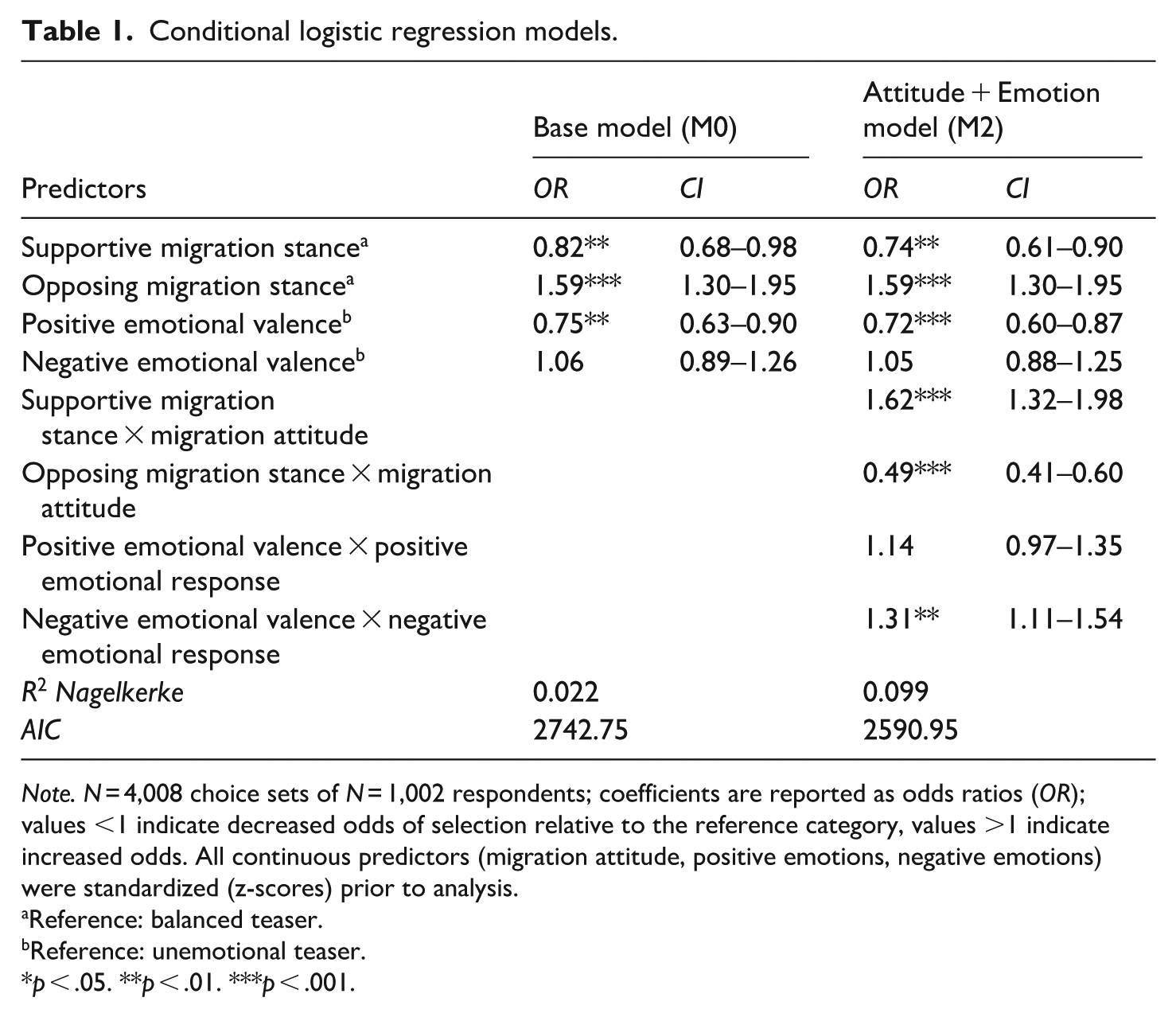
Note. N = 4,008 choice sets of N = 1,002 respondents; coefficients are reported as odds ratios (OR); values <1 indicate decreased odds of selection relative to the reference category, values >1 indicate increased odds. All continuous predictors (migration attitude, positive emotions, negative emotions) were standardized (z-scores) prior to analysis.
Reference: balanced teaser.
Reference: unemotional teaser.
p < .05. **p < .01. ***p < .001.
To examine the role of political attitudes in selecting migration-related news (H1), M2 includes two interaction terms testing attitudinal congruence between the political stance of the teaser and respondents’ pre-existing migration attitudes. Both interactions were statistically significant and substantively large. With increasing positive attitudes toward migration, participants were more likely to select a news teaser framed as supportive of migration and less likely to select a news teaser framed as opposing migration; the reverse pattern held for respondents with more negative migration attitudes (Figure 1).
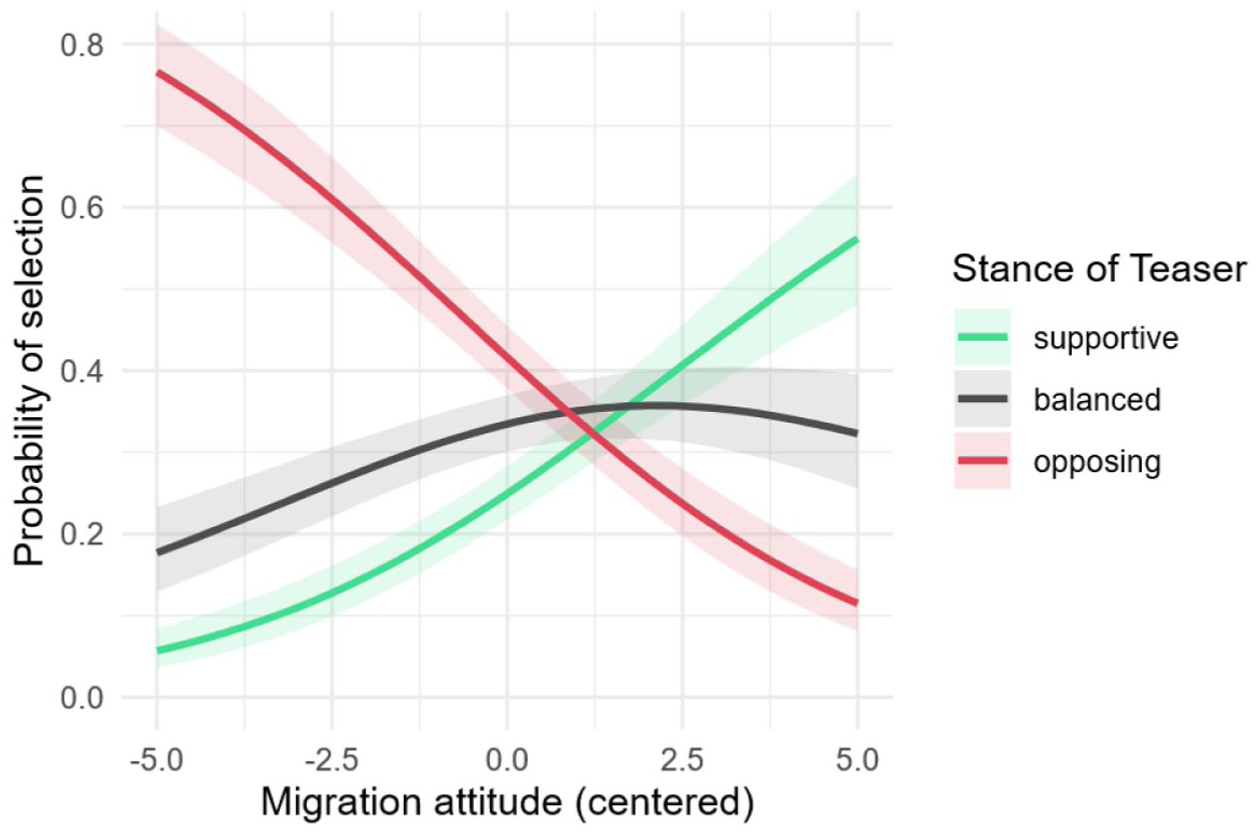
Predicting selection with teasers stance and attitudes toward migration.
To quantify these effects, we computed average marginal effects (AMEs) based on standardized predictors. A one SD increase in migration attitudes increased the probability of selecting a news teaser framed as supportive of migration by 8.8 percentage points (95% CI [7.1, 10.4]) and reduced the probability of selecting a news teaser framed as opposing migration by 10.1 percentage points (95% CI [−11.4, −8.5]; Figure 3). These effects are substantial given a baseline selection probability of approximately 25% per alternative. Both H1a and H1b are thus supported.
To test the influence of positive and negative emotions on news choices (H2), M2 adds two interaction terms capturing emotional congruence between the emotional valence of the news teaser and respondents’ momentary emotions. The positive-emotion congruence term was not statistically significant, thus not supporting H2a (Figure 2, left panel). In contrast, participants reporting more negative emotions were more likely to select a news teaser framed with a negative emotional valence, supporting H2b (Figure 2, right panel).
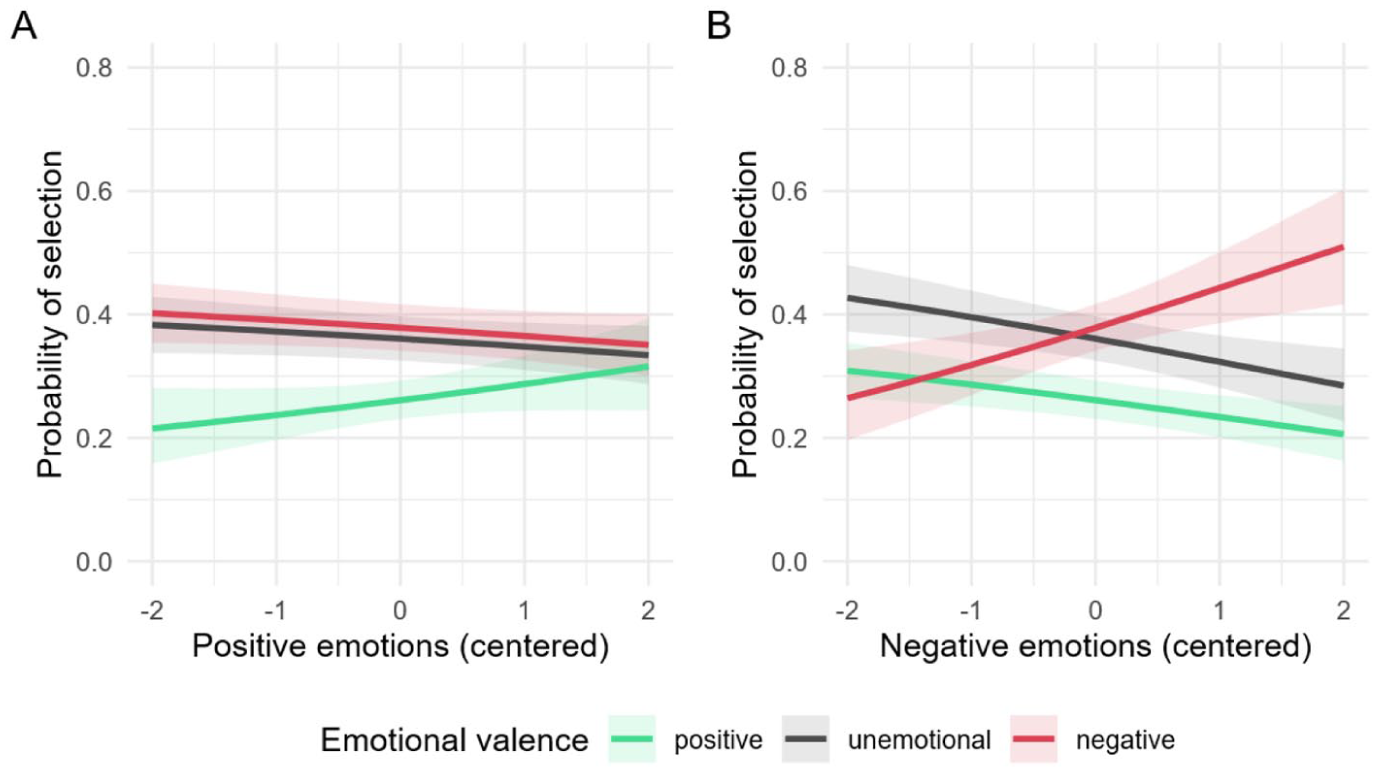
Predicting news teaser selection with emotional valence and emotional responses.
The AMEs confirm this asymmetry. A one SD increase in negative emotions increased the probability of selecting a news teaser framed with negative emotional valence by 3.2 percentage points (95% CI [1.2, 5.2]; Figure 3). The effect of positive emotions on selecting a news teaser framed with positive emotional valence was small and non-significant (AME = 1.4 pp, 95% CI [−0.3, 3.2]; Figure 3).
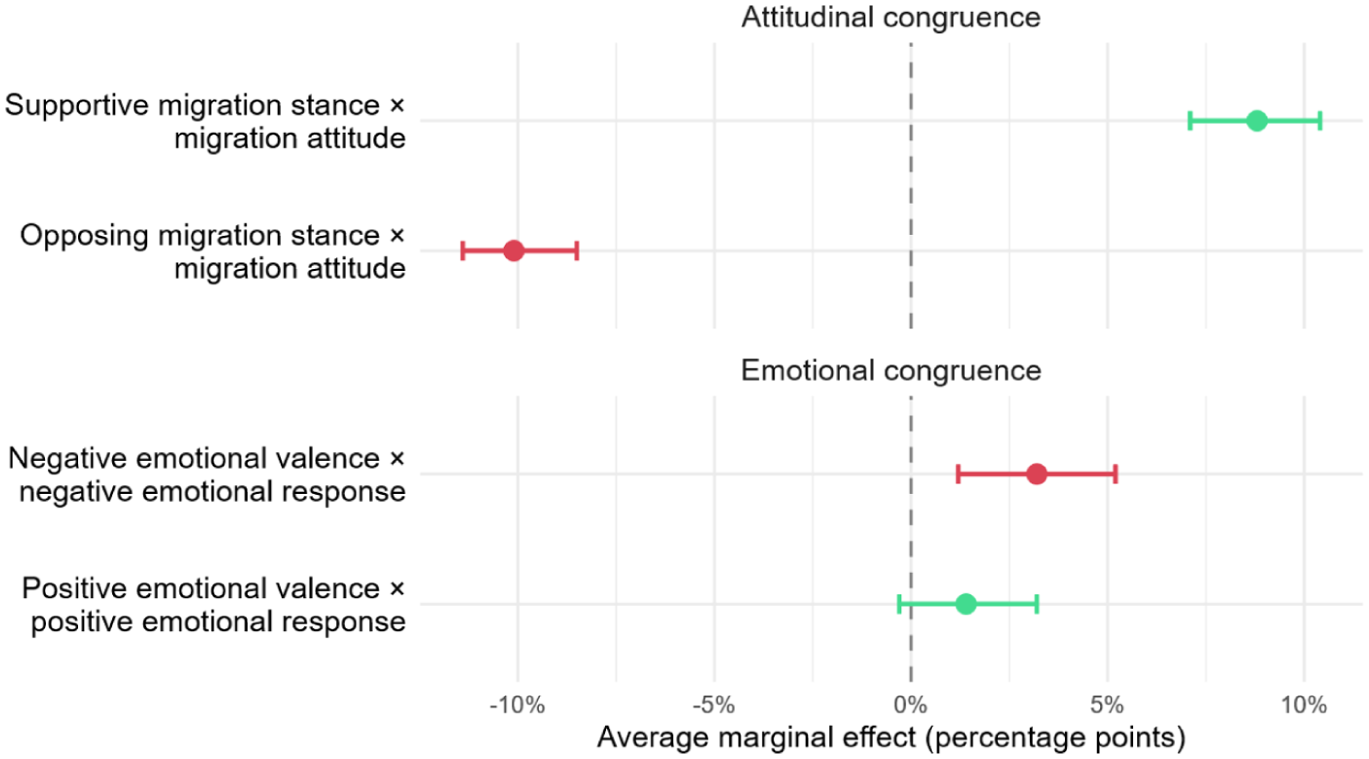
Average marginal effects of attitudinal and emotional congruence on news selection.
To assess whether pre-existing attitudes or situational emotional responses more strongly shape news selection (RQ1), we compared the explanatory power of attitudinal and emotional congruence using two complementary approaches.
First, we compared the incremental fit contribution of each interaction block against the base model (for all models see Table A9 in the Online Appendix). Adding attitudinal interactions resulted in a substantial improvement in model fit (ΔAIC = −140.11, χ²(2) = 144.11, p < .001), with Nagelkerke’s R² increasing from .022 to .091 (Δ = .069). Adding emotional interactions alone yielded a considerably smaller but still significant improvement (χ²(2) = 12.44, p = .002, ΔR² = .006). To enable a fully symmetric comparison, we additionally estimated each interaction block against the full model: when emotional interactions were already included, adding attitudinal interactions still produced a large improvement in fit (χ²(2) = 147.36, p < .001), whereas adding emotional interactions on top of attitudinal ones yielded a smaller but significant gain (χ²(2) = 15.69, p < .001).
Second, the AMEs provide a directly comparable metric of effect magnitude on the probability scale (Figure 3). Attitudinal congruence produced effects roughly three times larger than emotional congruence: migration attitudes shifted selection probabilities by 8.8 to 10.1 percentage points per SD, compared to 3.2 percentage points for negative emotions. The effect of positive emotions was non-significant.
Exploratory cross-domain analyses further corroborate this pattern (Table A10, Figure A4). Negative emotional responses increased the probability of selecting a news teaser framed as opposing migration by 6.1 percentage points (95% CI [4.2, 7.8. By contrast, migration attitudes showed a significant effect only on the selection of positively valenced teasers (AME = 3.6 pp, 95% CI [1.5, 5.6]).
Taken together, pre-existing attitudes constitute the primary compass guiding news selection, while emotional states contribute additional and independent but substantially smaller explanatory power. Exploratory cross-domain analyses further suggest that stance congruence produced stronger selection effects than valence congruence, regardless of whether the predictor was attitudes or emotions.
Discussion
By bringing together pre-existing attitudes and induced emotional responses within one experimental setting, this study contributes to a more comprehensive understanding of how citizens navigate today’s political information landscape.
Overall, the results reveal a clear pattern in citizens’ news selection. Positively valenced and supportive migration news teasers were chosen least often, whereas balanced and especially negatively valenced or opposing migration ones were selected more frequently. Such a preference for negative information is consistent with previous research showing that negative news attracts greater attention, is perceived as more relevant, and evokes stronger emotional arousal (Boukes and Vliegenthart 2017; Kühne 2012; Soroka et al. 2021).
The results confirm that citizens’ pre-existing attitudes are a powerful source of guidance in political news selection (H1). Respondents with a pro-migration attitude were more likely to select supportive migration news, whereas those holding a contra-migration attitude preferred opposing framed articles. This pattern confirms the well-established principle of selective exposure: citizens tend to select attitude-consistent information to avoid cognitive dissonance and to reinforce their pre-existing beliefs (Festinger 1957; Garrett 2009; Hart et al. 2009; Stroud 2008). The guidance of attitudes proved particularly strong among respondents being against migration, who showed the clearest preference for attitude-consistent and conflict-oriented content. Balanced articles, in contrast, were chosen less frequently overall and mainly by participants with more moderate attitudes. This suggests that attitudinal orientation operates along a continuum of conviction, with strongly predisposed citizens showing little interest in balanced perspectives.
From a broader perspective, these results are consistent with polarization mechanisms documented in prior research: repeated exposure to like-minded perspectives may reinforce ideological divides and affective polarization (Kubin and von Sikorski 2021; Rivera Otero et al. 2023). Selective choice of attitude-consistent migration news can thus be interpreted as a micro-level driver of broader polarization trends even though the present study does not directly test these longer-term dynamics.
Beyond attitudes, we assumed that induced emotions would be an important source of guidance when citizens navigate political information (H2). In fact, emotional responses shape news selection, but not in a symmetrical way. Negative emotions increased the likelihood of choosing a negatively valenced news teaser, whereas positive emotions did not significantly predict the selection of positive ones.
Rather than supporting assumptions of emotion regulation, which is often understood in a hedonistic sense (Gross 1998, 2015), the findings suggest that emotional guidance in political news selection follows a different logic. Negative emotions did not lead citizens to seek positive or pleasant information but were instead associated with the selection of negatively valenced news teasers. This pattern suggests that citizens experiencing unpleasant emotions turn toward problem-oriented or threatening content to find explanations, understand perceived threats, or reduce uncertainty (Brader et al. 2008; Coan et al. 2021; Gadarian and Albertson 2014). From an appraisal perspective (Frijda 1986; Lazarus 1991), such behavior can be understood as a response to goal-incongruent or threatening situations that elicit more attentive and explorative information behavior rather than avoidance or mood repair.
This pattern not only challenges the idea of hedonistic emotion regulation but also reinforces the overall negativity bias in political news selection, showing that both general and emotional levels of news choice follow similar dynamics (Soroka et al. 2019, 2021). While emotions can serve as a situational compass that directs citizens’ attention toward relevant information, their guidance appears to be more strongly driven by threat and problem orientation than by the pursuit of positive or mood-enhancing content. In this sense, negative affect may increase alertness and motivate citizens to pay closer attention to potential threats or uncertainties, as suggested by previous research on affect and attention in political contexts (Marcus et al. 2000).
Comparing the relative influence of pre-existing attitudes and induced emotions (RQ1) shows that political attitudes provide a considerably stronger compass for citizens’ news choices than momentary emotional states. While emotions serve as short-term signals that guide information selection in specific moments (e.g., Gadarian and Albertson, 2014; Marcus et al. 2000), attitudes shape more stable and enduring selection patterns that reflect lasting predispositions rather than situational appraisals (e.g., Garrett 2009; Stroud 2008). Emotional responses may fluctuate depending on situational cues or immediate appraisals of relevance (Frijda 1986; Lazarus 1991), but attitudes represent long-term orientations that consistently direct citizens’ attention toward attitude-consistent content (Rivera Otero et al. 2023). In this sense, attitudes exert a more powerful and systematic influence on political information behavior than momentary emotional reactions.
The exploratory cross-domain analyses further nuance this picture. Congruence with the political stance of a news teaser produced stronger selection effects than congruence with its emotional valence, regardless of whether guidance came from attitudinal or emotional orientations. This asymmetry suggests that political stance is the more powerful congruence-relevant attribute in news selection, consistent with research on political directionality as a particularly accessible and motivationally relevant cue in partisan information environments (e.g., Garrett 2009; Hart et al. 2009). As discussed in the limitations section, however, this pattern may be partly attributable to the stronger perceptual distinctiveness of the stance manipulation.
Such reciprocal processes of media use and selection tendencies have been theorized to reinforce both attitudes and emotions over time (Otto et al. 2020; Slater 2007, 2015). Although the present study does not examine these longer-term dynamics directly, repeated exposure to attitude-consistent and negatively framed content could plausibly intensify existing convictions and emotional responses and thereby contribute to cycles of confirmation and avoidance.
Overall, these findings have important implications for understanding news selection in high-choice political information environments. Selective attention implies that exposure does not necessarily translate into meaningful processing: counter-attitudinal or corrective information may be encountered but not processed deeply enough to influence existing beliefs, thereby contributing to attitude stabilization despite the availability of diverse viewpoints. This reframes selective exposure as operating not only through outright avoidance but also through differential depth of engagement. These dynamics are consistent with research on motivated reasoning and heuristic processing, suggesting that individuals protect prior attitudes by minimizing cognitive effort when processing incongruent information (Chaiken 1980; Kunda 1990; Petty and Cacioppo 1986; Taber and Lodge 2006). Our findings suggest that such biases may already emerge at the level of news selection and plausibly extend to subsequent processing. Future research should therefore examine not only what information individuals select, but also how intensively they engage with it.
Limitations and Outlook
This study has several limitations that should be considered when interpreting the findings. First, emotions were measured after exposure to an emotion-inducing teaser. It therefore remains unclear whether these emotional reactions referred to the broader topic of migration, to the specific news teaser, or to political actors mentioned within. Future studies could disentangle these aspects and examine how topic-related and article-specific emotions interact in guiding selection behavior.
Second, our results should be interpreted in light of the study’s focus on a single issue. By choosing migration as the topic, we selected a highly salient, polarized, and frequently discussed issue about which many participants were likely to hold strong prior attitudes. This ensured experimental control and ecological validity, but involves trade-offs. Because all stimuli revolved around migration, respondents may have inferred the broader topic of the study, even if the exact hypotheses remained unclear. While this risk was reduced by varying teaser topics and frames and by offering a non-migration alternative, issue-specific demand effects cannot be fully ruled out. The focus on a single issue also limits the generalizability of the findings. When pre-existing attitudes are strong and well established, there may be less room for emotions to guide news selection. This may help explain why attitudes emerged as the stronger compass in our study. On issues that are newer, less polarized, or less personally relevant, emotional responses may play a more substantial role in guiding content choice. Future research should therefore examine whether the relative influence of attitudes and emotions varies systematically across issues with different levels of salience, polarization, and personal relevance. Additionally, the emotion-inducing teaser always concerned causes of fleeing, which may have primed migration-related considerations beyond its emotional valence. Because the conditional logit model conditions on all person-constant characteristics, any such priming effects are absorbed by the fixed effects and do not confound the estimated selection effects. At the same time, this also means that potential differences in priming effects across induction conditions cannot be empirically disentangled from emotional effects within the present design.
The generalizability of our findings is also limited by the specific national context. Although migration is a salient and contested issue across many countries, the German media and political system may shape the relative strength of attitudinal and emotional guidance in distinctive ways. In more partisan media systems, attitude-congruent selection may be even more pronounced, whereas in systems with stronger public service broadcasting and more balanced news provision, citizens may be more likely to encounter cross-cutting perspectives (e.g., Steppat et al. 2022). Future comparative research should therefore examine more explicitly how attitudinal and emotional guidance in news selection vary across media systems and national contexts.
Third, the statistical power was limited for testing complex interaction effects. Future research should investigate more closely how emotional and attitudinal guidance interact and whether they mutually reinforce each other over time. Longitudinal designs could provide deeper insights into whether emotions following or preceding news selection differ and whether news choice can, in turn, serve emotion-regulatory functions.
Fourth, although we measured four discrete emotions, we incorporated emotions in the main analyses only at a broader valence-based level. While this approach fits the theoretical focus of the study, was supported by the factor structure of the data, and aligns with methodological research suggesting that self-reports capture valence and arousal more reliably than discrete emotional states (Mauss and Robinson 2009), it may obscure meaningful differences on information behavior between emotions that share valence but differ in their appraisals and action tendencies (Funck and Lau, 2024). Future research should therefore develop more targeted experimental manipulations that induce distinct emotions on the basis of appraisal patterns (e.g., Lazarus 1991) and examine how these shape political information behavior and news selection.
A related limitation concerns the empirical distinguishability of the two stimulus dimensions. Experimental stimulus design inevitably involves a trade-off between achieving clean variation across manipulated dimensions and maintaining the ecological validity of the materials. In the present study, pretest results indicate that the stance manipulation was perceived more distinctly than the emotional valence manipulation, and that both dimensions partially overlap in participants’ perceptions, which is not surprising given that political stance and emotional tone tend to co-occur in real-world news coverage. It is therefore possible that part of the observed dominance of attitudinal congruence reflects the stronger perceptual salience of political stance framing rather than a genuine difference in the guiding influence of attitudes versus emotions.
Finally, future work could link individual-level selection dynamics to structural processes in digital information environments. Algorithmic recommendation systems may amplify affective and attitudinal selectivity by reinforcing citizens’ preferences and reducing exposure diversity – a crucial next step for understanding how emotional and attitudinal guidance evolve within personalized information ecosystems.
Conclusion
This study provides one of the first direct comparisons of attitudinal and situational emotional guidance in political news selection. Using migration as a highly emotionalized and polarized issue, the results show that citizens’ news choices are guided more strongly by political attitudes than by emotional reactions. Particularly, contra-migration attitudes and negative affect steered news selection, whereas pro-migration attitudes and positive emotions played a minor role. Political information behavior thus remains primarily attitude-congruent, with emotions acting as secondary, situational cues rather than primary drivers.
While emotions play a smaller role overall, negative affect functions as an attentional amplifier that draws citizens toward problem-oriented and threatening content, whereas positive affect shows only limited influence on selective exposure. The combination of strong attitudes and negative emotions appears especially consequential, as it may heighten selectivity and polarization, whereas weaker attitudes paired with negative emotions could foster more explorative information seeking.
Taken together, our findings underscore that political information behavior emerges from the interplay of cognition and emotion: attitudes define stable orientations, while emotions provide situational impulses that guide attention and engagement. This balance, however, is not fixed.
In algorithmically curated information environments, these tendencies could potentially be reinforced: recommender systems adapting to engagement signals may strengthen affective and attitudinal congruence and create reinforcing spirals at both the individual and structural level. However, as the present study does not directly examine algorithmic curation, these implications remain speculative and warrant closer empirical attention.
Supplemental Material
sj-docx-1-hij-10.1177_19401612261456367 – Supplemental material for Attitudes or Emotions as News Compasses? Comparing Attitudinal and Emotional Guidance in Selecting News About Migration
Supplemental material, sj-docx-1-hij-10.1177_19401612261456367 for Attitudes or Emotions as News Compasses? Comparing Attitudinal and Emotional Guidance in Selecting News About Migration by Nico Spreen and Pablo Jost in The International Journal of Press/Politics
Footnotes
Acknowledgements
We would like to thank the Department of Journalism and Communication Research at the University of Music, Drama and Media Hannover and the KommunikationsKultur e.V. for funding the survey for the study.
Ethical Considerations
According to the ethical guidelines of the German Research Foundation (DFG), which govern research in Germany, and the Code of Ethics of the German Communication Association (DGPuK), no ethics approval was required for our study.
Consent to Participate
Written informed consent following the General Data Protection Regulation (GDPR) was obtained from the participants prior to the survey.
Data Availability Statement
The data generated and analyzed during the current study are available from the corresponding author* on request.
Funding
The authors received no financial support for the research, authorship, and/or publication of this article.
Declaration of Conflicting Interests
The authors declared no potential conflicts of interest with respect to the research, authorship, and/or publication of this article.

Supplemental Material
Supplemental material for this article is available online.
References
Supplementary Material
Please find the following supplemental material available below.
For Open Access articles published under a Creative Commons License, all supplemental material carries the same license as the article it is associated with.
For non-Open Access articles published, all supplemental material carries a non-exclusive license, and permission requests for re-use of supplemental material or any part of supplemental material shall be sent directly to the copyright owner as specified in the copyright notice associated with the article.
