







Abstract
If activism is an act of challenging marginalization and hierarchy, The Bodies Collective works to challenge the hierarchy between “mind” and “body” inherent in much academic discourse, and can be witnessed in the conference space. We do this, not through forming another hierarchical structure, but from within—through invitation and inviting those who may be labeled as “participant” to become a leader within each workshop presented. This is the act of activism that The 2019 European Congress of Qualitative Inquiry (ECQI19) invited. In this article, we discuss how The Bodies Collective’s contributions to ECQI can be seen as activism. We describe our contribution, a workshop, and provide examples of feedback from those involved. Finally, we show some of the challenges we have encountered and conclude with looking toward the future.
Introduction—Opening the Space
The 2019 European Congress of Qualitative Inquiry (ECQI19) happened under the banner of: Qualitative Inquiry as Activism. Delegates were invited to “explore what ‘activism’ means, what it looks like, what it can do.” 1 This call deeply resonated with The Bodies Collective, a collective conceived at the International Congress of Qualitative Inquiry in 2017 (ICQI17) and gestated through meetings and workshops that took place primarily at conferences (e.g., ECQI18). The collective aims to challenge hierarchies, particularly the hierarchy of “mind” over “body” and the hierarchy between those in research and academia. For us, the very notion of being a collective means subverting typical hierarchical structures that can be manifest within the conference space, while leaning into the complications that can arise from this.
In this article, we illustrate the activist movement of incorporating the body within the academic sphere of the conference, and how this collective of bodies—The Bodies Collective—works to challenge and overturn felt hierarchies within the conference space. We will explore what this “hierarchy” is to us and what it means to do something differently in the conference space, leaning on the insights and writings of fellow activists and academics who have inspired us.
We attempt for this piece to be active and alive, and we do this by incorporating voices of various Bodies Collective members and workshop participants throughout the article (block quotes in italics) to provide context to theory, artfully illuminating how theory and practice can be felt, heard, and grappled with from within the bodily experience. We provide the evolution of a methodology called “Bodyography” 2 that the collective has come up with based on working from within and about the body as a form of collaborative inquiry.
Bodies are amazing, aren’t they. So many questions about them; so many vague, frizzling out borders. They are not quite so clearly defined. Never not there yet and never quite there already. Never beginning or finished.
We feel our ancestors in our bodies, feel others’ emotions becoming ours in our bodies. Your heartbeat becomes mine. Your anxiety becomes mine. The size of my body is not fixed and relative to its space and time. Different vulnerabilities and affordances appear and disappear. I am big or small only in comparison, same as clever and stupid. Good or bad. I do not just think and therefore I am. I am embodied and I am and I think about it and speak about and intra-act about it. See hear feel myself in others. (Mark)
First, we highlight the role of activism within this and locate it with an overview of how “we” came to be. We then describe how we performed this “activist affect” (Harris & Jones, 2019) in our preconference workshop and the workshop at ECQI19, providing feedback from those who participated, and have subsequently joined the collective.
What is “Activism”?
Activism starts with an “Act”—an act that attempts to change regimes that have promoted powerlessness, marginalization, and dominance. Yet, in answering this question, it seems contrary to provide a top-down answer as to do so risks forming a totalizing vantage point (Deleuze & Guattari, 1987), a point of privilege that is illusory. Activism works from within, as a point of becoming (Murris, 2019), and it is within this becoming that an act can challenge and question established practices. It is this “on the ground” definition of Activism that was the mandate for the invitation to present at ECQI19.
Silence. Time. Space. Precision. It all diffracts and reverberates in this space and I feel like a shard in which my color is … orange. Davina is pink. Alys Green. Ines blue. Sarah purple. Mark is yellow. And Claudia red. We are colors.
Silence. For the first time I am thinking of silence and invisibility as the virtual. Do others feel the potentialities of the virtual? The virtuosity that comes with silence, potential, space. What wasn’t said because of what the space afforded? The opportunities of what ‘could have been’ that are still very real, even if they never ‘materialized’.
The virtual body. The Little Body that Could. The body that is denied. Silence. And becoming.
I think I will make a workshop on ‘becoming cat’. To not attend to this would be to let the virtual slip into what ‘could have been’ in a way that doesn’t feel good. How ironic. (Jess)
During the ECQI19 conference space, each of us sought to explore the body as a method of inquiry, showing that it is as valuable as other celebrated sources of “proof” and “inquiry.” We worked at disrupting academic hierarchy as a collective, eschewing set structures or established role-power relations. Madison (2010) discusses “acts of activism” and their potential to send out waves of change. In this case, the acts that we engaged sought to disrupt the norms of a conference space and set off waves of discursive and embodied change.
In What Ways Might This be Controversial?
The controversy of act as activism has the potential to come alive through the context of the conference, the context of qualitative inquiry, and the broader context of academia. Thinkers have long been grappling to understand the differences between activism and academia. For example, an epitaph on Karl Marx’s grave states:
The philosophers have only interpreted the world in various ways. The point, however, is to change it.
It is clear there are many interpretations of the world; it is also true that the world has changed since these words were first written. But has the change we have wrought been active and willful? If the point is to change the world, the immediate question is—how? Even in its efforts to change the world, academia has largely concerned itself with interpretations. We have a sense of what academia has to say about activism, but what can we do? It is here that a series of questions arise: from what moment do we call acts activism? What are we trying to achieve? And in what ways is the microcosm of the conference space benefiting society at large?
These questions allow for multiple entry-points into the term “activism” that is often used but seldom taken up and described; yet attending to this task further aids in connecting and seeking change through “activist affect”—a term coined by Harris and Jones (2019) to describe the shared affect during an act that opposes the status quo. Harris and Holman-Jones use the term “activist affect” to discuss marches for queer rights, women’s rights, and the rights of people of color, and we humbly seek to apply this understanding of activism as an affect to the micro-politics of the qualitative inquiry field.
Deep and profound, yet playful and fun. It seems such an easier, lighter way of being. Knowledge has been generated there and then, locally. Newness, diffractions, intersecting circles of echoes reverberating through the space, through each other. Through the other in me. I am with you, in you, through you. Your body the other to me or the me to me. Other/me/who are we? (Mark)
In our application of an activist affect, we acknowledge that the stakes are lower as we battle for a place for bodies in the field, rather than something as fundamental as a right to exist. However, we also see how the very bodies that are wrought in chains both physically and through the normalizing gaze (Foucault, 1977) elucidate that the place of the body has always been marginalized through its bearing as the “lower” of the binarized pair between mind-and-body (Grosz, 1994). It is with this understanding of body as lower-to-the-advanced-mind that we see a hierarchy at play.
Activism starts as a movement, usually from dissatisfaction with the way things are. It moves in all directions to become something different, hopefully for the better. Deleuze and Guattari knew this when they first mandated that we “make rhizomes, not roots, never plant!” (Deleuze & Guattari, 1987, p. 24). Deleuze and Guattari use the image of the rhizome to show the ways in which action can take a multiplicitous action—in various directions.
It was a small room, tucked away
Prepared, unprepared, unknown
Autonomous pedagogy
Yet needing to hold
Reminded by the pace of the body
My body
And other bodies not moving so fast
Nor understanding the fastly spoken English
What assumptions do we live with
Normativity of the body and communication … (Alys)
Deleuze and Guattari use the image of the rhizome to show the ways in which action can take a multiplicitous action—in various directions. Action/activism fights stagnancy and hegemonic practices, what Deleuze and Guattari call the “state machine,” through its various speeds, its inability to be cut down, and its ability to fight from within. As a rhizomatic action, we strive to carry the torch for act-ivism in the conference space to enable a wave of inclusivity through the body, the members, and all the affects in materiality (Barad, 2003) as seen in the conference space.
To me, I’m on a completely different level when I can connect with the people in an embodied way first–to get to know something about what they are going through. (Claudia)
We need to clarify here that we consider “from within” (Shotter, 2006, 2012) an important aspect of activism. Shotter (2006) critiques what he calls “aboutness thinking,” the engagement with something as if distant, not influenced and objective. He recommends what he calls “withness thinking,” an acknowledgment of being actively engaged with the object or topic. Similarly, Barad’s (2007) agential realism reminds us that knowledge is created within an apparatus where the boundaries between observer and observed are fluid, where engagement is essential and knowing only from within one’s perspective is unavoidable. We see both ideas as a direct challenge to the hierarchy in which the mind as separate entity observes the body, as well as a challenge to the conceptual separation between researcher/participant and the hierarchy that is implied by this.
How “Bodyography” Fits as Activism
It is with the mandate to act from within, that a group of like-minded academics/researchers met in 2017 at ICQI, questioning together what it meant to challenge the disconnect between mind and body. A question hung in the air: With so much knowledge about the importance of the body, what is it that short circuits its privileged place within a conference setting? The small group grappled with this question around the pub’s wooden, sticky table. Pints in hand, they sought to do something different within the conference space: “Let’s meet together this summer to do research on the body differently!” And with this rhizomatic gesture, The Bodies Collective was conceived.
During ECQI18, The Bodies Collective gestated as the founding members created a Game Changer that welcomed participants to move away from the perspective of spectator and become part of the wider process of embracing the body within a research conference through various workshops designed to allow the body movement, to encourage depth at witnessing the body, and engagement with others. The Game Changer was led by the original group on the first day, and the second day was entirely led by those who had attended the previous session. This was an activist stance that facilitated not only the topic of emancipating the body from the usual epistemological and hierarchical positioning of “I stand and talk while you sit and listen,” but also to allow those in the audience to show their talents and skills through leadership, laughter, and meaning-making (Lewin, 1946). Many of the members during ECQI18 became Bodies Collective members and some of these people then came together to form another emancipatory workshop at ECQI19.
Through the Game Changer and sharing during ECQI18, the term Bodyography started to emerge, defined as a practice that explores the body, its communication, and inter(or intra-)relations to other bodies (Barad, 2007). Moving bodies, voicing the body (Erb 2019); a pedagogy of lived moments within the body. We are aware that there are many bodily practices (e.g., yoga, dance, and somatic processes) that have been researched and documented not least through qualitative inquiry. Yet the body seemed to be given less importance with regard to it being a social entity and part of the apparatus (Barad, 2007) of research about the material body. In line with Shotter’s critique of “aboutness thinking” and adopting his suggested “withness thinking” (Shotter, 2006), Bodyography emerged as a term that signaled how the body was both the material and the method of inquiry. In this way, we suggested a significantly different boundary drawing practice regarding what is subject and what is object of research (Barad, 2007).
ECQI19 presented a homecoming for many of the members, especially as the Collective had grown to an international scale. However, regardless of its growth, its mandate stays rhizomatic: to provide another form of movement and care by witnessing and addressing the body within a conference space. The Collective, again, sought to encourage new members to find a space within the workshop to present their ideas and lead those to new depths within the body. Through each of these actions, we strove to achieve a reawakening of the importance of the corporeal body within academia. And, importantly, to allow all engaged in this process to move together enacting autonomous pedagogy—through a “flattened hierarchy” that enables all to be involved.
The Bodies Collective at ECQI19
What We Did at ECQI19
As part of the “homecoming” effort, The Bodies Collective met the day before the conference in order to be bodily together, collectively devising and writing, as well as playing-out ideas for the workshop. We envisioned a space that would be co-created and flexible, changing shape and design to suit not only the needs of the original facilitators, but all in attendance. We would build on the method we had explored at ECQI18, the method of autonomy as pedagogy. 3 This would be a space in which academia was felt and enacted differently, a space where power could be collaborative rather than hierarchical (Natiello, 2001). We sought out to create a space that disrupted the usual academic modes of being—rather than stroking chins and thoughtful looks, we invited folks to use their bodies in ways they otherwise didn’t—in ways that might be silly, vulnerable, or intense. We hoped that this reminded people that, despite being ignored much of the time, bodies have an important place in academia that needs to be explored and celebrated. A Bodies Collective member that joined us at that workshop for the first time shared this:
On coming in as an outsider and reading your intention … and arriving late at the conference, (after a missed bus, a turning back to make sure child had lunch money) I noticed there was an intensity; within the wider welcome there was a vibrant resonant cluster like a spinning galaxy spreading arms wide. It wasn’t the green buttons, it was this energy that made me think, “hey, whatever they are doing, I want to know more”. If we think in our head in standard academic mode with a concentrated frown, like part of the herd with hunched shoulders, the possibility of being part of a flock in mid-flight tingled in my shoulder blades at first glimpse of the bodies collective. (Beth)
The idea for badges/or “green buttons” mentioned above came from a couple of our members inspired by #FEAS (Feminist Educators Against Sexism) who wore political t-shirts with feminist messages at conferences, we also wanted to create interest in the “body as activism” within the conference environment and to highlight our bodies as Bodies Collective bodies. We collectively discussed the words, font, and color and had them made for the conference opening (Figure 1).
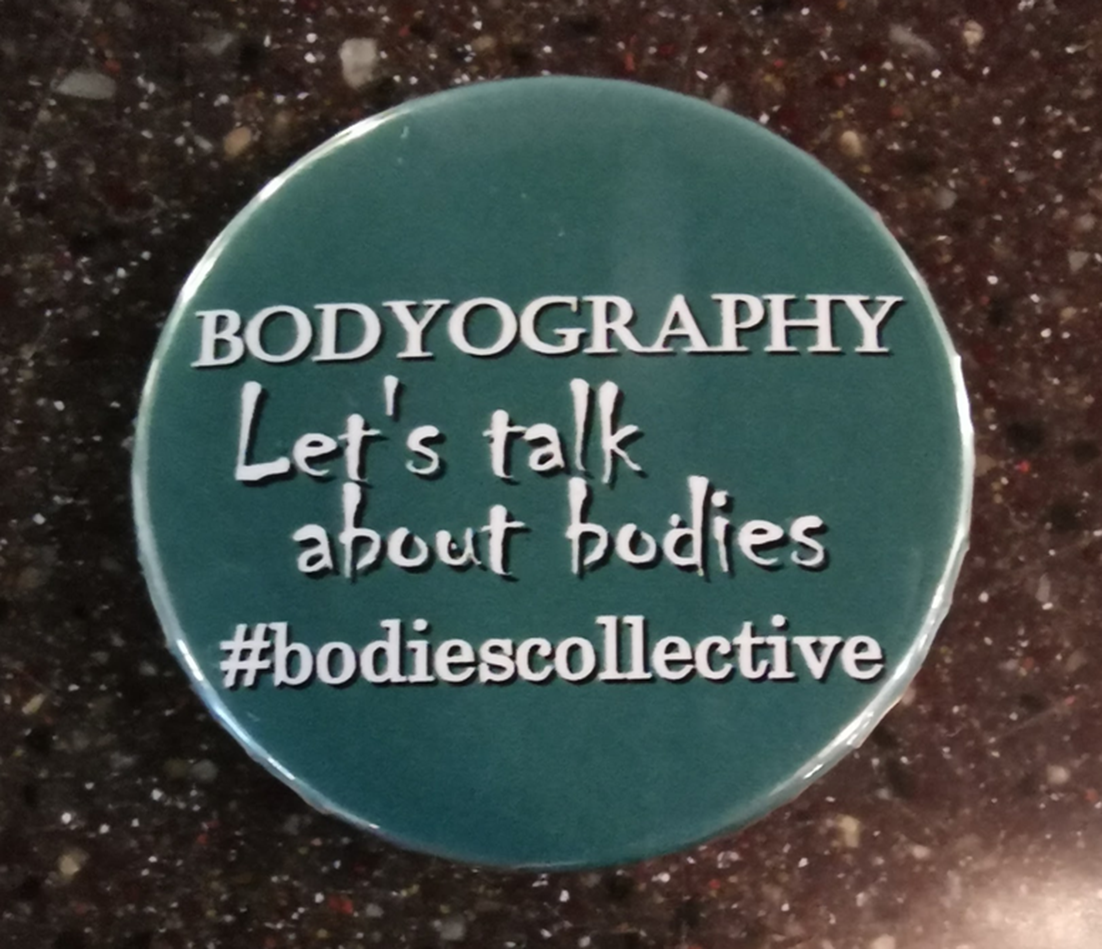
Bodies collective badge at ECQI19.
The Bodies Collective Workshop(s)
In setting up the workshop space, we removed all of the tables and chairs to create a symbolically and physically open space that could enable all to focus on the body.
The pain in her shoulder and neck shifts as she stretches out the muscles. Reminding her that she slept sporadically and awkwardly.
Listening for a clue, a double message.
She could be fascinated, alarmed, saddened by the disconnect between her body desires for meeting and matching intensity and her head full of anxiety.
Ambivalence to being, in present time. (Davina)
We started the workshop introducing The Bodies Collective, reading short text pieces that we had written during the preconference workshop, sharing our ideas for possible body-centered activities, and then opening the space and inviting the participants to suggest other activities—an invitation taken up by several participants so that we had more activities than the 90 min provided for. After a collective voting, we decided that we wanted to start with a gentle warm-up activity all together, led by two brand-new members to the group, and then split up in an outdoor and an indoor group and finish the workshop with a collective reflection all together again. The indoor group was meant to engage in more active practices, whereas the outdoor group would submerge in more contemplative activities. This split was to enable all the participants with different bodily requirements and abilities to participate in the activities.
In the following, you will read descriptions of the different activities and hear reflections from the facilitators and participants about their experiences.
The Warm-Up
Having spent so much time at the conference seated, milling about, moving to different seats, standing with coffee, sitting again, we realized that our bodies needed to come out of that habit—they needed waking up gently; our breath, having been ignored, would not mind having some loving attention paid to it. For us, this was the first part of allowing the conference space to be an active space. Inspired by walking workshops and other spaces that can lift the body out of stasis, we worked to provide another area in the conference where bodily awareness was to take precedence over exercising the mind—and recognizing that the two can work together if given space. How do we breathe if we stretch our spine high? Our arms wide? If we breathe out as arms come into fold around this rib cage, how is that?
trust your body
breath
breath
open
close
breath
don’t be scared of scary
don’t be scared of yourself
you belong here
your body belongs here
your body can change the world
breath
breath
open
close
spaces in
spaces out
Spaces in out
In outs
Outing ins
ins out
outs in
breath
breath
it’s not just air
it’s your spirit
breath
(Magda)
What aliveness is cherished, what do we hold, if we bend knees and let spine curl over thighs and just hang, a moment upside down with blood flowing a different way when we come upright in ourselves, are we a little more within ourselves? A little more attuned? Awake? Animal-appreciative with each other? [If you don’t know the answer to this, we invite you to step away from the screen and find out. Ask the questions posed above and allow your body to respond. How does that feel?] Choices to move are opened up, the metaphorical baton gets passed to the next person to step forward to lead.
Indoor Group: Becoming Animal and Gestures
Becoming animal …
The first mini-workshop indoors brought with it an invitation to slip into another body, inspired by one of us suggesting we try “becoming animal,” when we met during the preconference. This was meant to be a way of allowing the body to do the affective movement and rhizomatic action that has been called for by Deleuze and Guattari (1987) in their book, A Thousand Plateaus. There, Deleuze and Guattari called for one to “become animal” to recognize our animalistic parts. We felt that inviting the body to do this might allow for two things: first, it had the potential to bring theory to life; and second, it allowed for “serious academics” to play, laugh, and enjoy one another in a way that let go of any need to impress, but rather to be and relate to another’s—changing—body.
Inspired by theater studies, one of us remembered an exercise from Lecoq (1997): “Imagine your favorite animal (it did not have to be a cat)… Now become that animal as much as you can.” We then played around with different levels of animal-ness. What would it be like if you were 30% that animal and 70% still yourself?
As we approached 100% animal, different sorts of relationships and movements evolved in the room—barks, growls, woofs, and roars, hisses, shrieks, and yelps. There’s a dog chasing a dinosaur, no wait the dinosaur is chasing the dog! We have a cat that just wants to be left alone, an aggressive cat, a leisurely and calm sloth, some kind of bird, and much more. There is chaos but also order—animal relationships where affect is communicated with intensity. There is no subtlety here about who wants to be left alone, who wants to be dominant. Affects constrained in the seated and disciplined academic body all day are let loose! And what a remarkable shift in the room. Amidst all the chaos and tension there is laughter, joy, grinning ear to ear. We are becoming animal and letting out those affects.
What can we learn from being a dog for a few minutes? At the very least, we learned to connect with those affects that we have often held back, affects that might inform us on how we are impacted by the different topics we have heard presented during the conference and that we ourselves had presented. We were also allowed to be deeply in touch with our needs and desires within an academic space, and it seems that we really wanted to be playful and connect with our academic colleagues/animal pals. All hierarchy was disrupted as the doctoral dinosaur lunged at the cat lecturer, connected authentically at an animal level.
It went beautifully. All these bodies in a room. All moving as they wish. With emotion, laughter and growls. Movements met and not met. This is bodies-as-doing. We are living what bodies can and cannot do. I’m enlivened. I hope they feel a part of something. I certainly did. I feel as a body – a DINO! To feel alive. To feel myself be alive. I was “becoming animal.” I never left but I wasn’t there. Look at all these affects – we are making theory come alive and it is exhilarating and weird. BODIES BABY! (Jess)
From the expressions in the space, and reflections after, it was apparent just how impactful this exercise was, allowing affect and intensity to come forward, and a different sort of intimate connection to become present within and up against the hierarchy of the conference.
Express yourself in a single gesture
The main premise for those of us who entered this part of the workshop space run by another bodies collective member was to observe and communicate an experience, question, or insight without words but in one single gesture or movement. We gathered in groups of three and were told to silently contemplate one of our group members as they express this gesture through their body. The intimacy of the small group allowed bodies to express experience in slow motion. It was through their gestures that stories, emotions, and ideas were conveyed.
We were then asked to interpret their gestures, conveying what it meant for us. Despite our different nationalities, we were able to empathize, understand, and connect with the experience that had been offered to us. Bodies speak a shared knowledge that doesn’t need translation. This relational experience enabled us to feel more human, more present, more at ease with what we embody, and to connect through that. As someone in the group said, “bodies don’t lie.”
I was immediately drawn to the suggested activity that [one of the members] introduced. I experienced the activity as creating and sharing something very valuable that simply couldn’t have transpired if done in words. I realised my body had felt set aside, alluded to in other presentations but not called into the knowing. As I watched my four co-conspirators give embodiment to what it had felt like to do their presentation, just in their stance and sculpting movements my body responded, thank you, yes, I am no longer excluded from the knowledge to be exchanged amongst these extraordinary beings. I felt that I understood something much more satisfying and important for having witnessed these expressions than I had sitting through a conference paper-interesting and thought provoking though many were. (Beth)
Outdoor Group: Observing With All Senses and Drinking Water
As a group, we included a diverse range of bodies—younger, older, heavily pregnant, well and ill, queer and straight. In the slower and more contemplative group, we gently and quietly moved through two activities in the grounds of Salisbury Green, the green space outside the conference venue. Designed to make us mindful of the world around us, and our embodied locations within it, we sought to show how even in experiencing the “same” things we experienced them differently. We were invited to spend “slow time” outside, looking, hearing, smelling, and touching the environment around us. This focused switch of attention others’ experiences.
Alys:
Actually I didn’t know it was water
Sarah drank a liquid from a bottle that looked like awater bottle
It was pink
My bottom felt cold sitting on the pathway
I thought about the old ladies who told us schoolgirlsthat we would get piles sitting on the cold ground
Sarah glugged the water and put her hands together
Holding the pink bottle
I began to feel the chill extending to my hands
I was pleased to go inside and warm them on a radiator.
Davina:
She stands before us, looks at us, turns away and walks a fewpaces.
I notice the texture of close knitted wool.
She turns, she looks.
She unscrews the bottle and brings it to her lips.
I lick my own. I feel the sensation of cold water tricklinginto my mouth and swallow as she swallows down the real rather than theimagined water.
Mark:
There she is, planted her feet into the ground. Now shedrinks, as if watering the roots that she has just put in there. She looksstrong like a tree, but maybe a little vulnerable too, maybe like a youngtree, and as full of life.
I feel my own thirst, my life draining somewhat. I wantwater. I am a little jealous. Water, water, water. I want it.
I am glad that she has water. I like Sarah, I want herto have enough water. I just want it too.
Finishing in Collective Reflection
I brought my body to the room, but also felt I was still present in the last session. I participated and felt myself become present for a moment before the future pulled me forwards. (Davina)
When the two groups reunited, we wrote briefly about our experiences during the workshop and explored how would we like conferences to be spaces that acknowledge and embrace our bodied selves? Sitting on the floor in a circle, we finished the workshop by sharing our writings and thoughts.
The Workshop Space as Activism
We want to address the question of change that many scholars consider as crucial while engaging with activism (see for example, Freire, 2005; Madison, 2008, 2010; Harris & Jones, 2018; Lewin, 1946), and started to ask ourselves how our activities changed the participants who attended and maybe even the atmosphere of the conference space? As stated, our main goals as The Bodies Collective are to (re-)establish the body as a topic and method of qualitative inquiry, thus challenging academic hierarchies that often privilege word-over-body, by working in a collective fashion with a flattened hierarchical structure and following an autonomous pedagogy.
One way that we did this was by not fully preparing the workshop in advance to open space for the ideas and needs of the participants, allowing their voices to echo through. We prepared enough to provide a stable container, offering a variety of ideas and activities, but invited workshop participants to decide what to focus on and to suggest other activities. The process was indeed messy and lengthy, yet participants eagerly accepted the invitation to co-create the workshop, some of them even asking to run activities themselves. As with our ECQI18 Game Changer, we saw that given an opportunity within the conference space, many were keen and willing to add their ideas to the collective pot, and afterwards desired to join The Bodies Collective, saying that they already felt a part of it.
Another result of this open, live process was the joint decision to divide into an active and a more contemplative subgroup, responding to the need to be more inclusive to all kinds of mental and physical preconditions. Compared to a common body-ignoring-practice at a conference, participants and facilitators felt more aware of their own conditions and needs, something that is not always a pleasant experience—that is, dealing with a fatigued, ill body or navigating with a pregnant body.
My body is changing, my winter clothes packed away so carefully when I left the UK last August no longer fit as my belly expands
I take up space
So much more space as I walked here this morning
Stopping regularly to breathe heavily into the cold Winter’s air
Panting slightly, I waddled on up the hill conscious that I would need to wee again soon
Berating myself for wearing dungarees that take so long to unwrap the many layers covering my body so I can be free to relieve myself
As I trudged along, I kept an eye for a bench, the thought of taking the weight off my legs praying heavily on my mind
I realised this new, larger body of mine has different needs to before
I would never have looked out for somewhere to rest until now. (Alys)
Despite the discomforts that we became aware of once we listened to our bodies, it helped participants feel “met” and held in a relational way—this is the point where the seeds of change are planted as personal involvement becomes achievable and welcome.
We disrupted the conference setting by disclaiming any front stage presentation—an open space that not only symbolically underlined our goal to flatten hierarchies and co-create but also created a space for body activities. The disruption of conference norms could initially be observed on the hesitant and confused nonverbal body language of some of the entering participants, some of whom would have been quite uncomfortable coming into a workshop that did not allow for anonymity or silent observation. To account for this, participants were only ever invited into activities and we made clear to show a “safe place” where participants could observe and reflect—another bodily need. Based on feedback, many said that the greatest impact was related to the permission to focus primarily on the body, to express its needs, and to access knowledge stored in the body. This meant abandoning academic restraint to show oneself through movement, to communicate nonverbally, making emotions visible, connecting physically, and being or becoming vulnerable.
Our most activist act at ECQI19 was simply to focus on the body, privileging it over the mind, or as one of the facilitators wrote: “speak truth to power from bodies.”
We communicated so much that we didn’t even know we were, and perhaps that we didn’t know at all. Through our bodies we made new friends, fast – an authentic and less guarded self-expression. Maybe through our bodies we can speak truth to power? Move bodies truthfully, with an embodied ethic of responsibility to one another. Speak truth through bodies. (Ryan)
The Challenge of Collectivity
How to Write the Body?
There is an inherent contradiction at the heart of this project. We call for bringing the affective and relational body into academic and conference spaces that often require us to disregard the body’s effects and needs with regard to travel, busyness, intensity, excitement, and exhaustion. Yet, while activist affect could be seen within the ECQI19 workshop, we now return to the paper, and require the written word to disseminate our experiences.
Becoming more human, more present, more at ease with what I embody. Connected. Bodies don’t lie. I can’t wait to lay again in the sun. Bodies speak a shared knowledge that doesn’t need translation. (Ines)
We see the dichotomy and yet need to communicate the powerful connections the workshops have engendered. Inevitably, there is an aspect of “aboutness” when writing about the body, about our experiences … We include the quotes that were written fresh, in affect and from within the experiences.
How to Write Collectively?
There are logistical challenges to keeping connected as a collective; the most active members of the group hail from not just different countries but different time zones, so planning to meet over Skype to discuss ways forward with projects can involve early mornings or late nights for some members. We try to remain mindful of this and include in initial doodle polls a variety of meeting days and times. The diversity of perspectives and voices that our different cultures and first languages adds is one of our strengths but can create communication glitches, as we have to readjust our aural faculties to cope with multiple accents and voices. Skype calls involving up to eight participants can be tricky in terms of allowing all the voices and perspectives to be heard. As we feel these barriers push us apart and away from our bodies, we remember “I sing the body electric” by Whitman (1855). Imagine the rhizomatic fiber-optic-enabled conversation that pulses as we continue to think together, these digital gestures surfacing as we slow dance in and amidst all our other activities, and family demands on our time—including one of us, as this is written, being bodily in the streets of London as an act of system change not climate change.
Autonomous Pedagogy
Our definition of “autonomy as pedagogy” comes from the method in which we ran the Game Changer sessions at ECQI18 and then developed within the workshops at ECQI19. Autonomy as pedagogy sees the group as having collective knowledge rather than a small group of facilitators directing the next steps of the body as collaborative research. Therefore, within the collective, some of us may hold the space, at the same time trusting existing collective knowledge to find its way into the dialog.
The challenge with autonomous pedagogy is that we tend to hold back from leadership, not wanting to create a hierarchy within the group and wishing to keep the balance of voices and input. Pragmatically this can mean that tasks don’t get done, as people get caught up with their individual lives and concerns and there is not an overall controller to call out and gather people together. We need to get better at realizing that it is not hierarchical to allow the gifts of those better at facilitating to take charge to lead a project forward—which happened with this project when the due date for journal submissions was fast approaching and we realized we would need an extension. We needed a couple members to step up and keep the fire of creativity and inspiration stoked, so that we could all contribute our ideas and knowledge. We recognize now that having one or two people take the lead to administer each project enables others to stay on track. As mostly early career researchers, we are excited by the connections and opportunities that working as a collective affords us, but these still have to be balanced by appraising paid and unpaid employment and finding our individual voices within an academic frame. It’s also about trust.
Inclusivity
Another challenge is how to make a workshop inclusive, allowing space not just for the able body, but making space for the ill body, the exhausted body, the differently abled body.
I want … to make a space for this body, imperfectly embodied, in this room (or outside this room) in workshops, panels, performances and all the spaces between. To be welcome and find ease in this fatigued, inglorious, ill body. To realise the need to sit – sit down on the floor if need be and for that to be OK. To root myself with and among others. To be more cat, a resting, curled up knot of cat, or an ears pricked, sharply alert cat. To allow our energies, our faders to be at different levels, volumes and speeds. Not to have to keep up but to set a pace. To be aware, to accept, to explore this embodiment. To be. (Georgi)
We remain mindful of this in terms of pace and setting, offering a range of activities that allow the slower, more contemplative, being to be prized as doing just as much as the actively moving doing body.
Ending Words and New Beginnings
The Bodies Collective offers an opening up of possibilities, ways to connect differently with people and with the wider environment. As Madison (1998, p. 277) says “[i]n a performance of possibilities, I see the ‘possible’ as suggesting a movement culminating in creation and change”.
Moving forward, we are finding ways to connect, write, and be together both virtually and bodily. Like any rhizome (Deleuze & Guattari, 1987), the connections might be manyfold and there might be seemingly localized centers but there are always recombinations. While we might not always all be in the same space, at the same conference, at the same time, something lives on, gets transformed and transferred. Some of us will be at ECQI20 and others will attend ICQI20, creating together, bringing the embodied research back into the collective. The work is new, and it is far from finished.
Footnotes
Acknowledgments
We would like to thank all the participants of our workshop at ECQI19 for their active participation, creativity, feedback, and texts about their experiences. We thank Alys Mendus for her comments on the manuscript.
Declaration of Conflicting Interests
The author declared no potential conflicts of interest with respect to the research, authorship, and/or publication of this article.
Funding
The author received no financial support for the research, authorship, and/or publication of this article.
Notes
Author Biography