







Abstract
This article draws on data from a participatory visual ethnography exploring the identities of two second-generation Iraqi refugee boys living in a southern state of the United States. It describes multiple “figured worlds” (Holland, et al., 1998) as the context of identity negotiation in the lives of these children. Findings also reveal multi-layered fluidity among figured worlds, children’s authoring in negotiating figured worlds, and the possible influence of the family’s pre-migration trauma on identity. The article argues that to support the well-being of second-generation refugee children and their families, we need to understand the multiplicity of refugee children’s identity and how children construct their figured worlds using resources from their multiple communities.
A Found Poem: “I’m from Iraq” I’m from Iraq in the middle east of Asia. It has sunny days so we can go outside and play. My family has been to Iraq. I’ve never been. If you’re Iraqi you’re Muslim. We fast; we pray; because Allah asks us to. When I think about home I usually think about the Qur’an. Mom always says, “come read, come read.” In the morning then in the evening. Soccer is my favorite sport. A lot of people play it in Iraq our country. We watched soccer movies. They were mostly Iraqi guys. It was my first sport. When we came to our house the doors were all dark. There were gunshots. They shot our window. It’s really loud. You know George Floyd? A Black person that didn’t do anything. The police just decided to kill him because he’s Black. It’s called racism. Iraq is really hot. I want to live there for about three years. I’m gonna come back here for sure. Does it mean that we are American?
Introduction
Taken directly from the interview data in this study, words in this found poem highlight the lived experience of second-generation Iraqi refugee children living in the United States. Interest in examining the identity construction of second-generation immigrant children has grown, as an increasing number of new immigrants have settled in the United States and raised their children. Currently, U.S. schools are serving over 20 million students who are the children of foreign-born parents, representing 25% of the total student population enrolled in pre-kindergarten to postsecondary education (U.S. Department of Education, 2017). Although there are abundant studies related to immigrants in the United States, many are focused on immigrants from Africa, Latin America, and the Caribbean (Britto, 2008), with very few that target Arab immigrants and their children as participants. Most studies on second-generation Arab immigrants focus on adolescents and youth (e.g., Ajrouch, 2000; Britto & Amer, 2007), and few have studied younger children. Furthermore, several studies on second-generation refugees’ identity formation have addressed issues of language transmission and experiences of racism and stigma (Bloch & Hirsch, 2017; Hirsch, 2019; Ludwig, 2019). Yet, few studies have involved Arab refugees. As Britto (2008) has suggested, we need more research to understand the identity construction of Arab children in the United States.
To do so, this study explores the identity formation of two second-generation refugee children, who are brothers from the same Iraqi family. As the found poem demonstrates, young children’s identities are complex. Drawing upon Holland et al.’s (1998) “figured world theory,” identities exist in figured worlds that are socially and culturally constructed with particular actors and values. Therefore, identities are not static; individuals continuously construct their identities and are constructed by others in multiple figured worlds. To look into the identity formation of young children in context, I explore the following question: How do two second-generation Iraqi refugee children, Amir and Caden, 1 construct their figured identity in their diverse contexts?
History of Arab Immigrants’ Identity
Currently, there are estimated 3.7 million Arab Americans in the United States (Arab American Institute, 2018). There were four major waves of Arab immigration. The first wave of Arab immigrants came to the U.S. from the Syrian Ottoman region in the late 1800s as farmers and labors and were mostly Christians (Hitti, 1923; Naff, 1994). Though they spoke Arabic, they identified themselves with the Ottoman Empire and did not call themselves Arabs. After the collapse of Ottoman Empire, Arab immigrants began to identify themselves with the region from which they came, usually Syria or Lebanon (Arab-American Historical Foundation, 2003). By the 1920s, the first wave of immigrants had largely assimilated into the U.S. society. However, their “whiteness” was often challenged in court regarding citizenship and voting rights (Naff, 1985; Hitti, 1923). The second wave of Arab immigrants came post-World War II following the establishment of the state of Israel in 1948. Unlike the first wave, these Arab immigrants were mostly educated professionals, escaping from political persecution and war to seek a new life in the United States (Abdelhady, 2014; Britto, 2008). Around 70% of this group of Arab immigrants were Muslims from Egypt, Palestine, Yemen, Syria, Jordan, and Iraq (Arab-American Historical Foundation, 2003). The third wave took place in the 1960s, many of them came from Palestine following the 1967 Arab-Israeli War. Their arrival awakened ethnic and political consciousness and furthered the development of the Arab American identity (Arab-American Historical Foundation, 2003). Lastly, the fourth wave of Arab immigrants came more recently due to political conflicts in the Arab region with increasing U.S. involvement (Abdelhady, 2014; Basma & Gibbons, 2016). After conflicts including the Gulf War in 1991, the invasion of Iraq in 2000, and sectarian conflict between Sunni and Shiite Muslims under Saddam Hussein, 40,000 Iraqi immigrants came to the United States (Hakim-Larson et al., 2007). Among them, approximately 29,000 were refugees (U.S. Committee for Refugees and Immigrants, 2000). Large numbers of refugees also came from Syria and Lebanon (Basma & Gibbons, 2016). Many of the refugees have experienced multiple relocations (Jamil et al., 2002). Today, the Arab American population is diverse in religious, racial, tribal, and sectarian affiliations (Semaan, 2013).
Since the events of September 11, 2001, the experience of many Arab and Muslim immigrants in the United States has drastically changed (Britto, 2008). Many have suffered an increase in discrimination (Ibish, 2003) in a social and political context that also promoted “a violent and subversive Arab stereotype” (Khouri, 2016; Sarroub, 2010). This was further aggravated under Trump’s policies of “a Great Expulsion of immigrants and a Great Exclusion of refugees and asylees” (Feliciano and Rumbaut, 2020: 215). Even today, “there appears to be a deep reluctance to link current events—for example, the rise of ISIS, global terrorism, or the refugee crisis—to U.S. responsibility” and any injustices of the past was left unchecked, rather than healed (Inhorn, 2020: 166). Immigrant and refugee children are growing up in a social context with “processes of simultaneous inclusion and exclusion” that creates challenges in their identity formation (Abdelhady, 2014, p. 29). Identity formation is an important aspect of human development and has been “linked to psychological adjustment and the overall well-being of immigrant children” (Britto, 2008: 853). Therefore, understanding identity development is paramount to supporting the flourishing of second-generation refugee children.
Though there has been abundant research related to immigrants in the United States, with many studies focus on immigrants of color, very few of them target Arab immigrants and their children as participants. Within studies related to identity formation among second-generation refugee and immigrant children in the U.S. and European context, some are rooted in the ecological perspective. These studies reveal “the belief that the local context plays a powerful role in identity development” (Britto, 2008: 855; Bronfrenbrenner, 1979; Verkuyten, 2004). Major ecological influences in the process of identity formation can be categorized in three aspects: family (Haikkola, 2011; Britto & Amer, 2007; Ludwig, 2019), school (Sarroub, 2001) and community (Ajrouch, 2000; Ghiso, 2016; Ludwig, 2019). Some studies also demonstrate a close relationship between language and identity. Children’s use of their heritage language and the dominant language of their host country is explored in several studies to reflect their sense of cultural identity (Bloch & Hirsch, 2017). Furthermore, a number of studies explore the issue of race related to ethnic identity. Hirsh (2019) and Ludwig (2019) have explored experiences of racism among second-generation refugees of color in the United States. Arab immigrants are categorized as white on the Census, including the current Census 2020 (Britto, 2008; “Race/Ethnicity and the 2020 Census”, 2019), and many have successfully assimilated into the white middle class based on their professional status and linguistic abilities (Abdelhady, 2014). However, traits identified with the Arab ethnicity or the Islamic religion still cause types of discrimination for the Arab immigrant community and characterize them as the other (Naber, 2000). For example, in Hirch’s (2019) study, the Kurdish and Tamil participants shared that their more recent experience of racism were often related to “their identification by others as Muslim”(p. 101). Apart from race and religion, there are structural barriers “tied to domestic and global political interests” that continue to construct Arab Americans “as deviants, outsiders, and as inherently violent” (Cainkar, 2009: 279). Lastly, some studies highlight the fluidity of identity construction among second-generation immigrant and refugee children, rather than the passing down of identity as a fixed object (Bloch & Hirsch, 2017; Ghiso, 2016; Hirch, 2019). Others describe the interweaving of multiple individual and collective forces at play among gender, race, religion, and language in the forming of identity (Bloch & Hirsch, 2017; Chronaki et al., 2016; Kurien, 2005).
Many of the studies to date are centered around second-generation adolescents and youth. Second-generation children’s identity formation among the Arab refugee population has rarely been explored. A few studies incorporated Arab children’s voices through interviews and visuals (Barley & Russell, 2019; Chronaki et al., 2016; Welply, 2015), but none of the studies were conducted in the United States. As Britto (2008) has proposed, a cohesive conceptual framework needs to be developed to capture all the multi-layered influences at play in Arab refugee and immigrant children’s identity formation in contemporary U.S. society.
Clarkston, Georgia
In the 1990s, the Clarkston area, where the study participants’ family settled when they first moved to the United States, was identified to be a prime location for refugee settlement, given the availability of low-income housing and access to public transportation (City of Clarkston, 2018). Since then, it has welcomed thousands of refugees. Between 1996 and 2001, around 20,000 refugees were sent to Georgia, and most of them were settled in Clarkston and the surrounding areas (David J. Sencer CDC Museum, 2016). Since 2007, more than 1000 Arabic-speaking refugees have settled in Clarkston. The small town was ranked first in the nation with the highest number of refugees per capita between 2015 and 2019, with 171 refugees per 10,000 residents, and it was nicknamed as “Ellis Island of the South” (APM Research Lab, 2020). Most of these refugees came from the Democratic Republic of Congo, Myanmar (Burma), Iraq, Somalia, and Syria, with many languages, cultures, and religions represented (APM, 2020). The intersection of linguistic, cultural, and religious diversity in Clarkston makes up the context where the study participants grew up in the United States.
Figured World Theory
Britto (2008) argues that Arab Muslim identity has multiple dimensions including cultural, historical, social, religious, and gender components. Adding on the layer of refugee context, it is important to utilize a conceptual framework that can capture multi-layered influences at play in children’s identity formation for this specific population. The study reported here explores identity development among second-generation refugee children from Iraq by drawing on the “figured worlds” approach (Barron, 2014; Holland, et al., 1998). At the intersection of cultural, structural and constructivist theories (Bakhtin, 1981; Vygotsky, 1962), a figured worlds approach views identity as dialogic and multidirectional, which is appropriate in examining the complex identities of the participants (Barron, 2014). According to Holland et al. (1998), figured world is “a socially and culturally constructed realm of interpretation in which particular characters and actors are recognized, significance is assigned to certain acts, and particular outcomes are valued over others” (p. 52). In the figured world, one’s “figurative identity” is continually constructed by the actors, the environment and the interactions among the actors and the environment. Holland et al. describe “figurative identities” as having “to do with the stories, acts, and characters that make the world a cultural world” (p. 127).
Recently, a growing number of studies have examined the identity construction of immigrant children in the United States using the figured worlds framework. These studies have mostly focused on youth and young adults and address the deficit perspective from which schools construct the identities of immigrant students (Allexsaht-Snider et al., 2020; Chang et al., 2017; Wickens, 2020).
Methods
Data used in this study are collected from an Iraqi family living in suburban Georgia. The researcher first became acquainted with the family in 2012 when they moved to the United States. A mutual friend introduced me to the family to be an English language tutor. Since then, our relationship has grown into a close friendship. Seeing the youngest boys growing up, conversations with the family members about the boys’ identity development have also led me to the scarcity of research conducted among second-generation children of Iraqi refugee families. I chose to conduct the study with this Iraqi family to explore in-depth the identity construction of young children in context. The close relationship I had with the family and the relationship the boys had as brothers not only helped the participants to be open and at ease around me as the researcher, but also gave me greater access into their lived experiences. I was able to conduct field work in February 2020 at the family’s home. However, due to the COVID-19 global pandemic, the field work was later moved online.
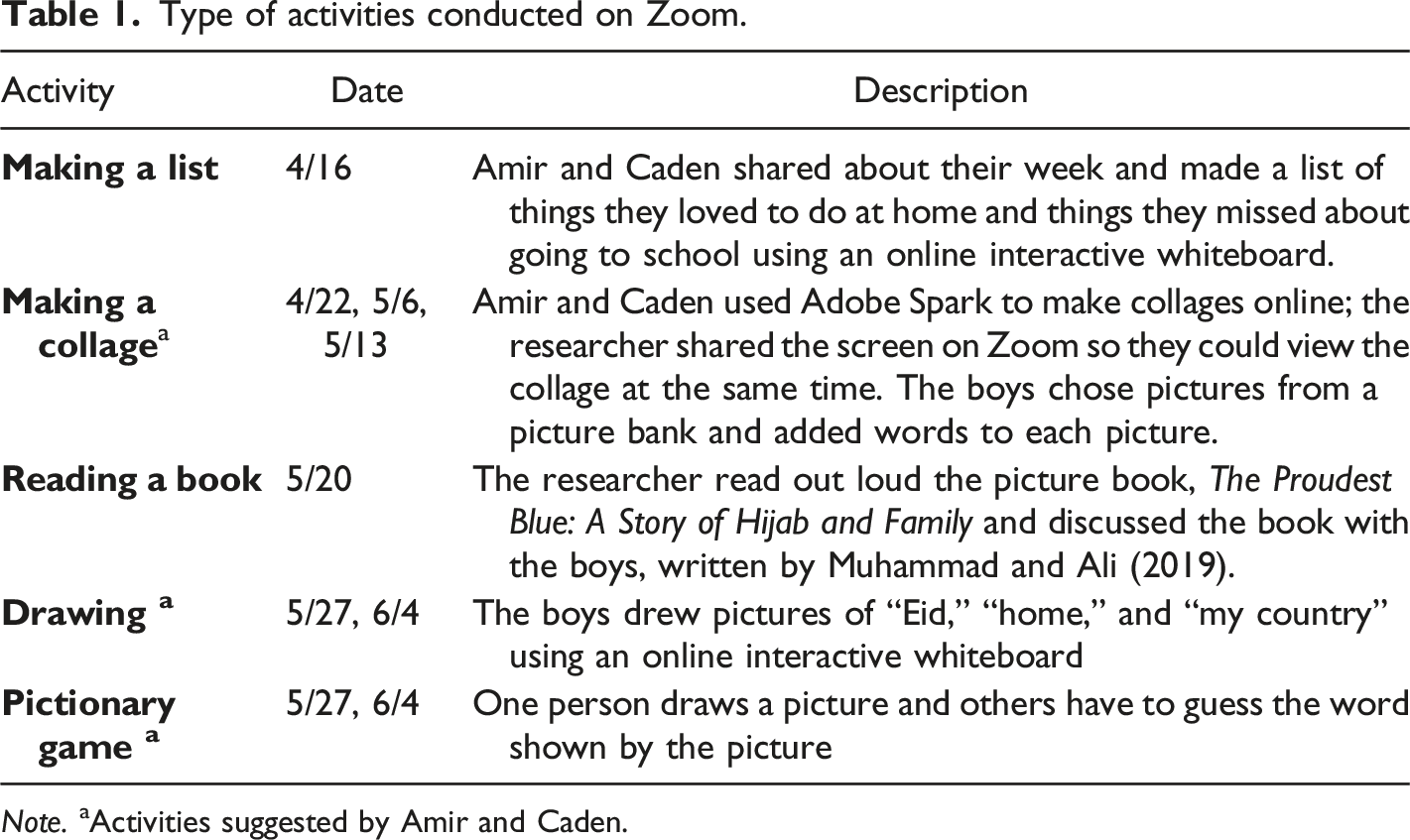
Type of activities conducted on Zoom.
Note. aActivities suggested by Amir and Caden.
Participatory visual methods are increasingly used among research with children in conjunction with ethnography (Barley & Russell, 2019; Clark & Moss, 2011; Coats, 2004; Oh, 2012). Instead of being passive participants, participatory visual methods enable children to be “active, knowledgeable social agents able to contribute to the production of knowledge that is not solely reliant on the verbal” (Barley & Russell, 2019: 223; James et al., 1998). As Oh (2012) finds in her visual ethnography study of refugee children living along the Thai-Burmese border, incorporating visual participatory methods in the research generates “meaningful child-centered narrative” that provides a rich understanding of refugee children’s lived experiences (p. 287), countering the discourse surrounding refugees as helpless and speechless victims (Rajaram, 2002).
During the Zoom meetings, I used the “share screen” function to share contents on my computer screen to go over any directions for the activities. I also used the “whiteboard” function in Zoom for the participants to draw. Amir and Caden accessed the Zoom meetings using a mobile device, and they were able to draw with their fingers on the screen. Throughout the meetings, I asked the boys about their lives. Following each activity, the boys shared their individual work with each other, and I interviewed them informally about their visual product, and their thoughts and actions as they conducted the activities. I also interviewed two family members about Amir and Caden’s upbringing. Both family members were Amir and Caden’s older sisters. The interview questions drew on the concept that social forces influence the way individuals act within figured worlds (Holland et al., 1998). Questions are framed to investigate the social and cultural context of Amir and Caden’s family’s immigration journey to the United States, and how family members perceive Amir and Caden’s cultural and religious identities. All meetings via Zoom were video recorded.
I analyzed the data collected through observations and interviews by conducting two rounds of coding. The first round of coding was conducted by using inductive reasoning, developing codes “directly from the data” (Linneberg and Korsgaard, 2019: 263). I conducted an inductive analysis first to stay close to the data and highlight children’s voices, before narrowing down my focus using deductive analysis in my second round of coding, utilizing categories generated from a theoretical framework (Galman, 2013; Linneberg and Korsgaard, 2019). From the inductive analysis, codes (e.g., eating practices, imagined homeland) were generated from the data, while codes from deductive analysis (e.g., authoring, Muslim community as a figured world) were generated based on the “figured world” framework. I also drew on Andrelchik’s (2016) approach to Critical Discourse Analysis inspired by Bakhtin (1981) and Tobin’s “generous reading” (2000) to analyze the boys’ collages (see Figure 1). According to Andrelchik, “The tools of generous reading come mainly from the critical examination of literature” by looking, for example, at repetitions (e.g. mentions of soccer, food and home) and binaries (e.g. Iraqi vs. American) in the discourse. Lastly, memos were kept throughout the data analysis process to capture my reflexivity about the research. As a 1.5 generation Chinese immigrant who moved to the United States when I was a teenager, I continued to reflect on the discourse about my own identity and how it differed or intersected with the boys’ discourse. Based on the data analysis, I identified multiple figured worlds and relevant themes. Amir (top) and Caden’s (bottom) “About Me” collages using Adobe Spark.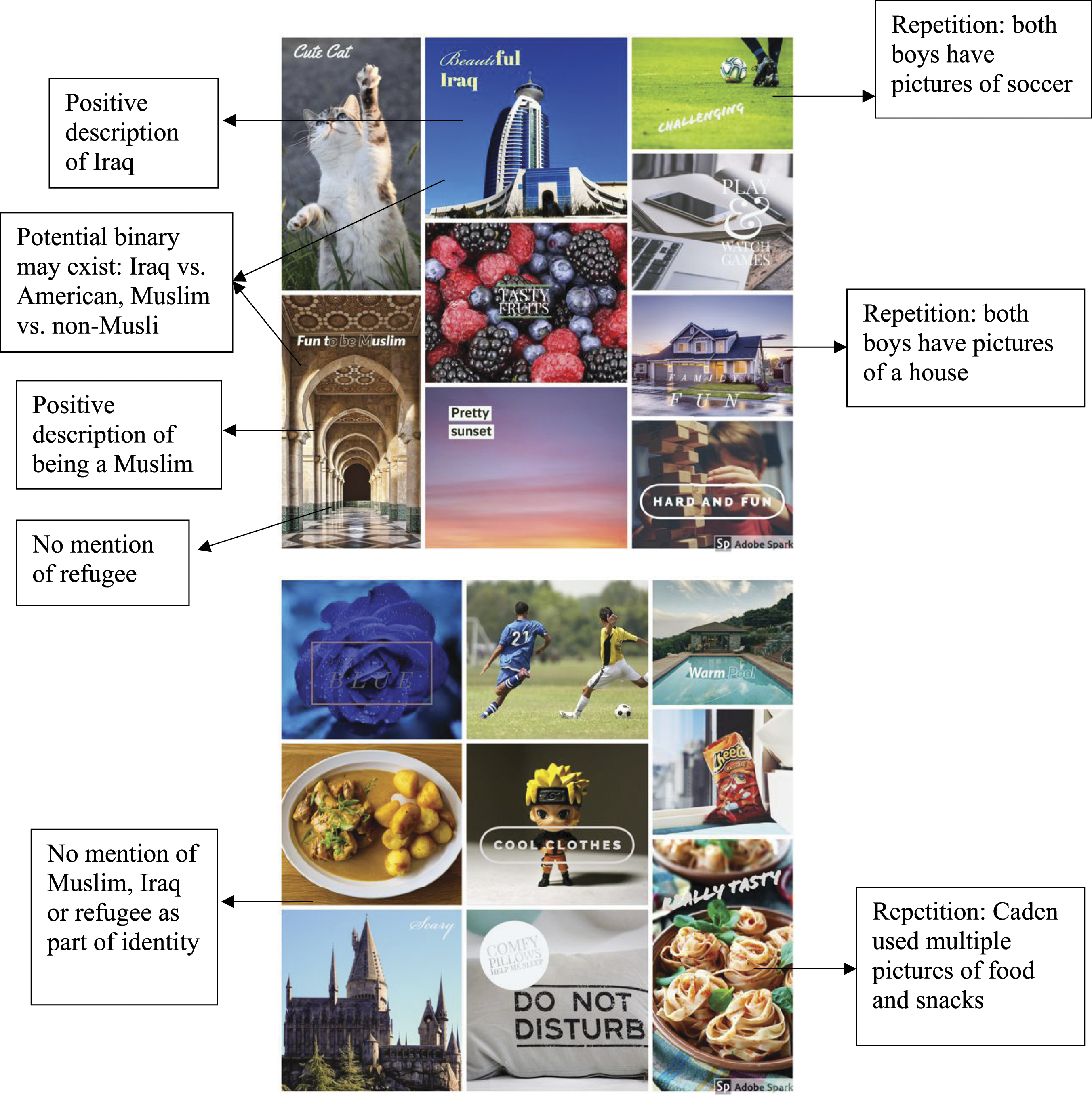
Multiple Figured Worlds
Multiple figured worlds emerged as important in the context of the participating children’s identity formation: Iraq as imagined homeland; refugee community enclave in suburban United States; the local Muslim community; and the online space through social media, digital media, and gaming. These figured worlds all have their own constructed actors and environments in the boys’ narratives. Significance is also assigned to acts within these figured worlds.
Iraq as Imagined Homeland
The boys viewed Iraq as their homeland though they have never visited. They shared about extended family members living in Iraq, the importance of staying connected to them and their wish to visit someday.
Refugee Community Enclave
The refugee community around Clarkston, Georgia was a social context the boys frequently mentioned but not identified as home. They discussed about people they encountered in the community including their classmates, landlord and neighbors. Staying safe seems to be of particular importance to the boys as they discussed violence they have seen in the community.
Local Muslim Community
The local Muslim community includes the boys’ immediate family members, family friends, Muslim classmates, and the Mosque. Religious celebrations (e.g., Eid) and practices (e.g., reading the Qur’an and praying) are valued in this figured world.
Online Space through Social Media, Digital Media and Gaming
The boys mentioned their frequent interaction in the online space through Tik Tok, YouTube, and online gaming such as Fortnite. The influencers and gamers are significant actors in this figured world. As the boys follow them in the online space, their words and actions also bear great importance.
Multi-layered Fluidity Among Figured Worlds
These multiple figured worlds of the participants are similar to the agents of socialization under the ecological model of Arab American youth identity development (Ajrouch et al., 2016). However, rather seeing them as separate aspects, these figured worlds interact with one another fluidly and reveal the multi-layered nature of the boys’ identities. Discussing their collages shown in Figure 1, Amir and Caden had the following conversation. Researcher: How can you tell someone is Muslim, someone is not? Amir: For girls, they have to wear a Hijab. And boys, sometimes they wear dishdasha (Iraqi menswear). It’s like a onesie- it’s like a dress, but it’s for men. Caden: Yeah. Researcher: Ok, do you guys wear them? Caden: Yeah. Amir: But now we don’t cuz… Caden: Most Somali people, they wear it a lot. Amir: That’s their clothes. Caden: Yeah, that’s their clothes, but we just wear it because we want to. Researcher: So how can you tell someone’s Iraqi- someone who’s from Iraq, can you tell from the outside? Amir: I don’t know, that’s too hard you know. Researcher: If someone’s Iraqi, can they also be Muslim? Amir and Caden: Yeah. Amir: If you’re Iraqi, you’re Muslim. Caden: If someone’s Indian, they can still actually be Muslims. Amir: No. Caden: Yes they can. Amir: No they are not. Caden: Yeah, I think someone that’s like Indian in our country- they’re Muslims. They know how to speak Arabic.
In this conversation, the children drew on their knowledge about the local Muslim community and about Iraq to make sense of their own identity as Muslims. In the context of the refugee community enclave in Clarkston, Georgia, many Muslim refugees came from diverse backgrounds. This context was reflected when Caden mentioned about Somalis and the way they dress, and when he talked about Indians who may be Muslims from the Indian subcontinent. Drawing on what they know about Iraq, both boys were sure that if someone’s Iraqi, the person must also be Muslim. However, they disagreed with how the Muslim identity interacts with one’s linguistic identity. Living in Clarkston, the boys were exposed to diverse languages spoken at school and in the community. Most likely, they have encountered Muslims who spoke languages other than Arabic. This could be confusing for Amir and Caden, but in this process they drew on the figured worlds of Iraq, the local Muslim community, and the refugee community enclave to make sense of their Muslim identity.
The brothers also spoke about celebrating Eid al-Fitr (a religious holiday that marks the end of Ramadan) at home with others from the Muslim community. They illustrated how their family celebrated Eid. Rather than sitting and eating on the floor as they usually do at home, the boys drew people sitting at a table- a practice familiar to them in the context of their schools and local restaurants. Apart from having Shawarma and other traditional Iraqi foods, the boys also enjoyed having waffles and pancakes- a common American staple for breakfast. The boys’ drawing of the Eid celebration reflected the convergence of the refugee community enclave and the local Muslim community in the U.S. context.
Children’s Authoring in Negotiating Figured Worlds
The boys’ figured worlds not only interact with one another, but also require negotiation when conflicting narratives are present. In the figured worlds approach, Holland et al. (1998) draw upon Bakhtin’s (1981) notion of the dialogic self and argue that “identity emerges from the space of authoring” as individuals interact with the discourses to which they are exposed (Barron, 2014: 254). This space of authoring is where children negotiate the various discourses and rewrite them into their own figurative identities that have “to do with the stories, acts, and characters that make the world a cultural world” (Holland et al., 1998: 127).
As revealed through the multiple figured worlds, Amir and Caden were exposed to discourses through their family, local communities, and media in the online space. Amir and Caden’s family members shared hopes for the boys to embrace their cultural and religious identity as Iraqi Muslims. They were also intentional in cultivating the boys’ identity by engaging them in cultural and religious practices such as watching Iraqi soccer games, celebrating Eid, reading the Quran, and offering Salat (prayers). In addition to the family influences, the brothers were introduced to the U.S. social and cultural context through attending public schools and accessing social and digital media. However, neither of the boys identified any American cultural symbols as important to them. For example, when asked to draw their country, neither of them identified the United States as their country where they found belonging. Nevertheless, the U.S. context was very much present in the boys’ narratives and practices. For instance, although Amir had very limited knowledge about Iraq, he was able to speak in detail about U.S. current events. In a game of Pictionary, Amir drew a picture of a person holding a sign that says “BLM.” When asked about the picture, Amir went on to explain: It’s all over the news, it’s all over TikTok, YouTube…. You know George Floyd, Caden? It’s a Black person that didn’t do anything, but the police just decided to kill him because he’s Black. It’s called racism and people are protesting. They’re really mad at the police now. You see all the people that are on the news? Because they’re mad at the police. Black Lives Matter! Black Lives Matter! George Floyd! George Floyd! … I say- the president should unhire all the police and get a whole new group. (Fieldnotes, 6/4)
Amir’s speech about U.S. current events reflects a process of authoring. Amir tried to make sense of what was happening in a U.S. social context outside of the refugee community enclave by imagining himself acting as the president. According to Vygotsky (1962), as time passes by, this “outer organizing, sense making speech” may be turned “inwards and become a means of understanding, organizing and imagining the self” (Barron, 2014: 255). This imagining of the self enabled Amir to become a “worldmaker” in “a time and space defined by others’ standpoints in activity” (Holland et al., 1998: 272).
The multiple figured worlds together inform a space of authoring where the boys negotiate their unique ways of being. In his study with a group of white British and British Pakistani children in a kindergarten classroom in England, Barron illustrates his participantsthe children’s negotiation of their figurative identities in the space of authoring, and how this space is not static, but “a space of struggle” (p. 255). Similarly, the collages (see Figure 1) reveal Amir and Caden’s authoring of their identities in this contested space. For example, soccer was a sport that the boys watched on TV when the Iraqi teams played. Games Amir and Caden identified, such as the board games and video games, were popular games they played with friends from school in the United States. Even though there may be binaries of “Iraqi” vs. “American,” or “Muslim” vs. “non-Muslim” discourses in the social context, and the boys may be led to choose certain identities based on family influences, the collages show the multiplicity of discourses in the space of authoring as the boys form their own unique identities.
Possible Influence of Trauma on Identity
Throughout the research process, the boys did not mention their “refugee” status in their narratives. When speaking and drawing about Iraq, Amir and Caden identified Iraq as their country and used positive but general descriptors such as “beautiful,” “hot,” and “sunny” mingled with their own imaginations. Neither of the boys have been to Iraq since the family moved to the United States and they learned about Iraq mostly from family members. In the interview with the boys’ older sister, Hana (age 28), she revealed that many first-generation Iraqi refugees in the United States did not want to form communities with other Iraqis because of their mental health issues. It was much harder for us to find Arab and especially Iraqi [for social network], and I think the main reason for that is the mental health of the Arab and especially Iraqi community…. Since day one, Iraqis…just don’t want to make friends because of all the things we have to go through.… It just goes back to all the wars and economic hardships that we have to go through since 1979 in Iraq, and the division we had to struggle with after 2003, especially religious divisions. (Interview, 6/16)
In Hana’s narrative, she hinted at the sectarian and ethnic conflicts in Iraq among Shia, Sunni, and Kurds, who were the three main religious and ethnic groups in Iraq. These conflicts were fueled by Western interference first by the United Kingdom from 1918 to 1958, and then by the United States since the invasion in 2003 (Dawisha, 2013). Amir and Caden’s family lived in Baghdad before they moved to Syria in 2007, when conditions deteriorated in Iraq. They were approved by the United Nations to come to the United States just 2 weeks before the Syrian civil war started. The family was financially stable through their time in Iraq and in Syria, and they were able to stay in their own housing arrangements rather than refugee camps. Even so, family members have experienced war in personal ways. In the study of Jamil et al. (2002) focusing on Iraqi refugees in the United States and their mental health, they found that Iraqi refugees were more likely to have high levels of anxiety and to have a diagnosis of PTSD compared to other Arab American clients (p. 358). This negative mental health impact can be caused by both pre-migration and post-migration stressors. The process of migration can also cause “feelings of alienation and isolation, situational crises, the loss of a sense of identity, and the loss of meaning” (Basma & Gibbons, 2016: 152). The absence of the refugee narrative and their lack of knowledge about Iraq in the second-generation suggest that those topics may trigger experience of trauma and are therefore avoided in family discussions. By not discussing events and experiences related to their pre-migration lives, the first-generation refugees are also influencing the way the second-generation constructs their figured world of Iraq as an imagined homeland.
Discussion
Considering the recent immigration policies and social narratives that incite xenophobia and anti-Muslim sentiments including the Muslim Ban under the Trump administration (Executive Order No. 13,769, 2017), Arab refugee children are facing continued challenges in their identity formation. As “identity integration may be especially complex for Arab American youth because they have various intertwined and competing identities within a single domain (e.g. national identity, ethnic identity, and religious identity) that they must synthesize,” this is true for Arab American children as well (Ajrouch et al., 2016: 92). Studying these children’s identity development not only helps us understand our own society, but also builds coalitions that enable solidarity across differences for social justice ends (Hames-García, 2011). As Hames-García notes in his book on social identity, one cannot declare solidarity with a group of people without really knowing them. In order to form “a rich and robust solidarity”, Hames-García suggests that one must “take into account deeply embodied connections and relations among people” through knowing their social identities (p. 16). This study provides a theoretical framework for researchers to explore the multiplicity of refugee children’s social and cultural identities and challenges the narratives that essentialize the refugee population as only victims (Chan & Kim, 2003) and Muslim refugees as terror suspects (Abbas, 2019).
As teachers engage in Culturally Sustaining Pedagogy, findings in this study support Paris’ (2012) argument to not only consider “heritage and traditional practices in teaching” but also consider “the shifting and changing practices of students and their communities” (p. 93). This study argues for a nuanced and fluid understanding of the second-generation Arab immigrant children’s identity development and suggests that engagement with family and community members is important for educators to gain insight into these children’s identity formation, and for them to create “a more inclusive and collaborative form of education where the line between the school and the community is blurred” (Hoque, 2018: 153). Echoing what Hoque recommends in his study of the identities of third-generation British–Bangladeshis from east London, educators should provide spaces for students to explore their complex identities in the curriculum, in order to engage their students in relevant and democratic education. This complements Esteban-Guitart and Moll’s (2014a) idea of funds of identity, which are “historically accumulated, culturally developed, and socially distributed resources that are essential for people’s self-definition, self- expression, and self-understanding” (p. 37). Funds of identity can be used as educational resources to bridge “the gap between in-school and out-of-school cultures, practices and learning experiences” (Esteban-Guitart and Moll, 2014b: 75). The theoretical framework and the visual methods used in this study can support teachers in detecting and understanding children’s funds of identity. For example, teachers can adapt the use of collages in the curriculum to foster conversations around identity and explore how children construct their figured worlds using resources from their communities.
In addition, this study points to the importance of community supports for refugee families as they adapt to the United States. For those who work with the refugee community, it is necessary to be aware of the histories of conflict and resulting trauma that might be influencing different generations. Resources that help refugee families develop social capital and support their mental health are crucial for their well-being and their children’s flourishing.
Lastly, due to the COVID-19 global pandemic, part of the data for this study was collected in the online space. The interactive element in video conferencing, online whiteboard, and other media creation applications, such as Adobe Spark, enhanced the ease of data collection and provided rich data comparable to traditional face to face methods. As we enter the new normal post–COVID-19, this study informs future studies with children on ways to conduct research remotely.
