







Abstract
In this article we explore how two artistic practices related to sound and sound making worked as a routine of re-encounter across a yearlong qualitative research project exploring how Black and Indigenous creative collective evolve to sustain themselves over time. We situate our artistic practices—writing ritual performance scripts and composing audio tune-ins—in the art of the social: the presence and relations among ourselves, research collaborators, and those we bring with us in body and spirit. We share the processes of this artful inquiry and how they inspire imaginative possibilities with sound, sound design, performance, and ritual.
Introduction
The art of the social, which Ruth Nicole learned from her mother, means the art we make is situated in relation, and we acknowledge the artfulness of creating relations—sometimes with people in the physical present and sometimes with people in memory and spirit. Held by the art of the social, we know our most meaningful work—whether art or articles—comes from the collective, in collectives, and from collective settings. For us, the art doesn’t work and the work isn’t artful outside an actuality of collective formation (Brown & Petchauer, 2023), outside the creative kinship of the swarm (Ruiz & Vourloumis, 2021), outside the undercommons of Black study (Harney & Moten, 2013). Artful inquiry as a mode of thinking can embrace collective knowledge production. Likewise, there is something about collective knowledge production that makes an embrace of artful inquiry possible. That something for us, in both instances, is a commitment and practice to reencountering what it is we think we know through the making and sharing of art in relation to people we care about deeply. It is a fact that we prefer making art as a part of our beloved collectives opposed to perpetuating the illusion and ontological falsity of the individual.
Because of our belief and experiences in collective formations, we designed and facilitated a yearlong project with collectives that we belong to and/or with whom we have ongoing, loving relationships. This project was called Forms of Freedom: The Art and Design of Black and Indigenous Creative Collectives (https://www.formsoffreedom.com), and the collectives participating in this project were Saving our Lives, Hear our Truths (SOLHOT; Chicago and Urbana, IL); The AADIZOOKAAN (Detroit, MI); and The Space Program/Fire in Little Africa (Oklahoma City and Tulsa, OK). 1 Throughout the project, we, as well as our collaborators, explored how Black and Indigenous creative collectives evolve to sustain themselves over time. Together, we learned they regenerate by the movement they create—with members moving on, moving through, and moving away from the collectives. We learned that wholeness—individually and collectively—is an aspect of reseeding because of the ways settler colonial, patriarchal, and capitalist systems work to pull apart the integrity of collectives. We remembered how care, practices of love, and loving accountability are necessary to nourish collective agreements and desires.
While facilitating this project, as a duo, we (Emery and Ruth Nicole) enacted practices aligned with artful inquiry: “A mode of thinking that inspires how we orient, how we encounter, and how we move, in our inquiry work” (Guyotte et al., this issue). These practices come from the aesthetics, tactics, and experiments we know as artists-scholars held by the art of the social: Ruth Nicole—a poet, playwright, SOLHOT visionary, and performer; Emery—a sound designer, beatmaker, turntablist, and community-based music educator. Our enactment of artful inquiry breaks from notions of representation instead to prioritize art, art making, and artistic form as a re-encountering rhythm of the collaborative inquiry process. Closest to our practice are instances when artmaking affectively spills outside the methodological and disciplinary borders (Brown et al., 2014; Coogler, 2022; Ellis, 2021; Flint, 2020; Gumbs, 2016; Guyotte et al., 2018; Loveless, 2019; McKittrick, 2021), particularly through sound practice (JAY ARE, 2019; Johnson, 2023; Lauren, 2024; Smith, 2024). This spillage makes all the more sense given our artful inquiry takes place through sound and sound making practices. As Henriques (2011) and many others have noted, “sound offers a dynamic mode of thinking” (p. xviii). This mode of thinking, knowing, and being is patterned, felt, and relational—distinguished from modes of knowing rooted in distance, observation, and reflection (see also Cox, 2018; Ellis, 2021; Gershon, 2018; Ruiz & Vourloumis, 2021).
To address our enactments of artful inquiry in this piece, we provide a brief background of how we root artful inquiry practices in the art of the social. This background provides context to our artful conceptualization of how we held and hosted Forms of Freedom. Then, we share two examples of our own making—ritual performance scripts and tune-ins—that showcase how we enacted artful inquiry in relation to our collective work. 2 These examples are the primary objects we relied on to express our creative intentions as Forms of Freedom project facilitators. We experience these creations not as texts for analysis or representations of social science findings but as artful, sound-based creations for thinking with (Jackson & Mazzei, 2012; Petchauer, 2024). We conclude the same way we began, with dialogue reflecting on our process of artful inquiry.
The Art of the Social in Forms of Freedom
The artful inquiry of Forms of Freedom grows from the presence and relations among us, our collaborators, and those we bring with us in body, spirit, and memory. This is what we mean by the art of the social. Like xtine burrough and Judy Walgren (2022), we recognize creative practices that are “participatory, collaborative, critically-engaged, and process-driven” (p. 4). From this standpoint, anticipation and excitement were high in our first Forms of Freedom exchange session. These emotions grew from an ensemble of existing solidarities, collaborations, heartbreaks, we-made-its, and we’re-still-doing-its among specific people across these collectives—with some relationships going back over a decade. How good it would feel to be together again, picking up where the last conversation, rhyme, or line left off. At the same time, these emotions were a product of newness: the opportunity to meet and build with people only known indirectly through their songs, videos, and art. Forms of Freedom began as a mix of newness, oldness, and what-might-be-nextness. Our scholarly purpose for assembling these collectives was to explore how collectives evolve to sustain themselves over time amidst changing conditions. Our human purpose was to connect with some, reconnect with others, and deepen the love. In a sense, we created a temporary super-collective out of collectives, an alignment among the questions of inquiry, method to study it, and deeper ethical commitments.
Monthly exchange sessions with our collaborators on Zoom—exchanging ideas, strategies, experiences, art, and solidarities in conversation—was our primary tool of connection and data generation. 3 The question propelling our inquiry was not new: not to us as organizers nor to our collaborators. Yet the question took on new, different, and deeper importance because our assembly began during the peak of the pandemic. Survival was not a distant, abstract idea but very real and present. As a result, the depth of our contemplation and desire for exploration together grew greater, lifted by the creative potential among kin poets, rappers, singers, homies, songwriters, performers, and hip-hop, electronic, and classical music artists.
Toward the end of our first session, we opened space for collaborators to express their hopes and desires for the experience. We asked everyone what they wanted to get out of the experience over the next year—intellectually, emotionally, spiritually, or creatively. We heard desires for connection, learning, solidarity, and strategy. And we heard something else too: a desire to create, not simply as individual artists but together as a super-collective.
Mark, Zooming in from Detroit, was the first to speak on it: I’m looking to kind of deepen my collaboration. It’s really easy to just go into the studio and bang out beats by yourself, but learning other people's visions and then trying to co-create something together would be something that I would be looking to personally expand on.
Jacobi, on the Zoom from Oklahoma City, extended this point further: “With the knowledge that everybody here is a professional artist, a creator who lives with what they create, and is masters of their craft…. I just want to soak everything up to make my craft better.” Moments later, Blair, Zooming in from central Illinois, put her spin on it: I’d be down to make something creative or to do something creative. Of course, writing and stuff, there’s always a way, but I’d definitely love to make something creative. I’m also interested in building sound libraries with you all or exchanging music or sounds because that would be dope too.
As the two of us debriefed after this first exchange session, we identified what we felt as a pull/request from our collaborators into the artful practices in us. This feeling/petition/ask convinced us to lean more heavily into our artistic lineages and practices as the inquiry progressed. Our collaborators voiced a desire to create something new together, and we were intrigued to oblige.
Artful Inquiry in Forms of Freedom: Ritual Performance Scripts, Tune-ins, and Deep Dives
Over the course of Forms of Freedom, a routine of artful inquiry practices between the two of us was exchanging art that we made in response to the monthly exchange sessions. Emery came to call what he made, a tune-in; Ruth Nicole called what she made, a ritual performance script. Giving names to our art pieces meant we took them seriously as generative ways to process and debrief the exchange sessions. To get specific, we created the following routine: facilitated a 75–90 minute exchange session with our collaborators that we recorded via Zoom, listened to the recorded sessions asynchronously as many times as we found sufficient, created something for each other that showed and revealed what and how we heard us all together; exchanged what we made between us and then met for what we came to call a “deep dive” conversation by phone that lasted approximately an hour, sometimes two.
The deep dives started with how we received and experienced the other’s creation. This is to say, talking about an experience with art that was created with an artifact/recording from research was the initial way into debriefing the emerging impressions, insights, and ideas about the research project as it unfolded. The deep dives also touched on technique and approach, asking one another about specific artistic choices and liberties taken in the creative process. The discussion about the art we made eventually wove through direct impressions of the exchange sessions. In our deep dive conversations, Emery repeatedly used the word reencounter when describing his listening praxis, and Ruth Nicole easily and promptly affirmed that she too experienced the process as one of re-encounter. This routine of creating, re-encountering, and then diving deep was not a process for artful or arts-based inquiry that we had decided prior to the project. Rather, the initial pull from our collaborators and our own sensibilities and practices as artists moved us into this rhythm of re-encounter.
In the next two subsections, we share two examples of our artful inquiry: our individual processes of creating tune-ins and ritual performance scripts during Forms of Freedom. The examples are what we came to call the “Integrity” tune-in and “Integrity” ritual performance script, from how the topic of integrity resonated across the collectives. By the term integrity, we suggest nothing about moral virtue but rather a collective, ontological state of being whole (Petchauer & Brown, 2023).
Composing Tune-ins and Staging Re-encounters
I (Emery) came to call these minor experiments tune-ins, named for the ways I felt myself tuning into the recording of our exchange conversations while creating. I understand tune-ins as a micro genre, typically between 2–3 minutes long, that activates characteristics of audio papers (see/hear Figure 1). Audio papers, as a scholarly genre and situated practice, were first conceptualized by Sanne Krogh Groth and Kristine Samson during the 2015 Fluid States–Fluid Sounds conference at Roskilde University in Denmark. Typically between 12 and 15 minutes in duration, audio papers address a research topic or question through performance, sonic aesthetics, technological mediation, and awareness of affect and materiality (Groth & Samson, 2016). An audio paper co-exists among DIY experiments, arts-based research, and ethnographic field work (Groth & Samson, 2019). Tune-ins, in my practice, are the smaller experiments and explorations en route to a full audio paper (e.g., Petchauer & Brown, 2023). QR Code for “Integrity” Tune-In. Note. Additional tune-ins can be heard in our project ensemble: https://formsoffreedom.com.
Composing tune-ins was a process to re-encounter what was in motion during our exchange sessions. I was trying to do something beyond representing, summarizing, or synthesizing the ideas or conversations in the manner that a qualitative coding process might. The composition process began with the step taken by every audio engineer when mixing a song to its final rendering: organization. After an exchange session with our collaborators, I loaded the audio recording into Ableton Live, a digital audio workstation (see Figure 2).
4
I listened back to our exchange conversation in Live in an attempt to re-encounter it. Early organization of “Integrity” in Ableton Live.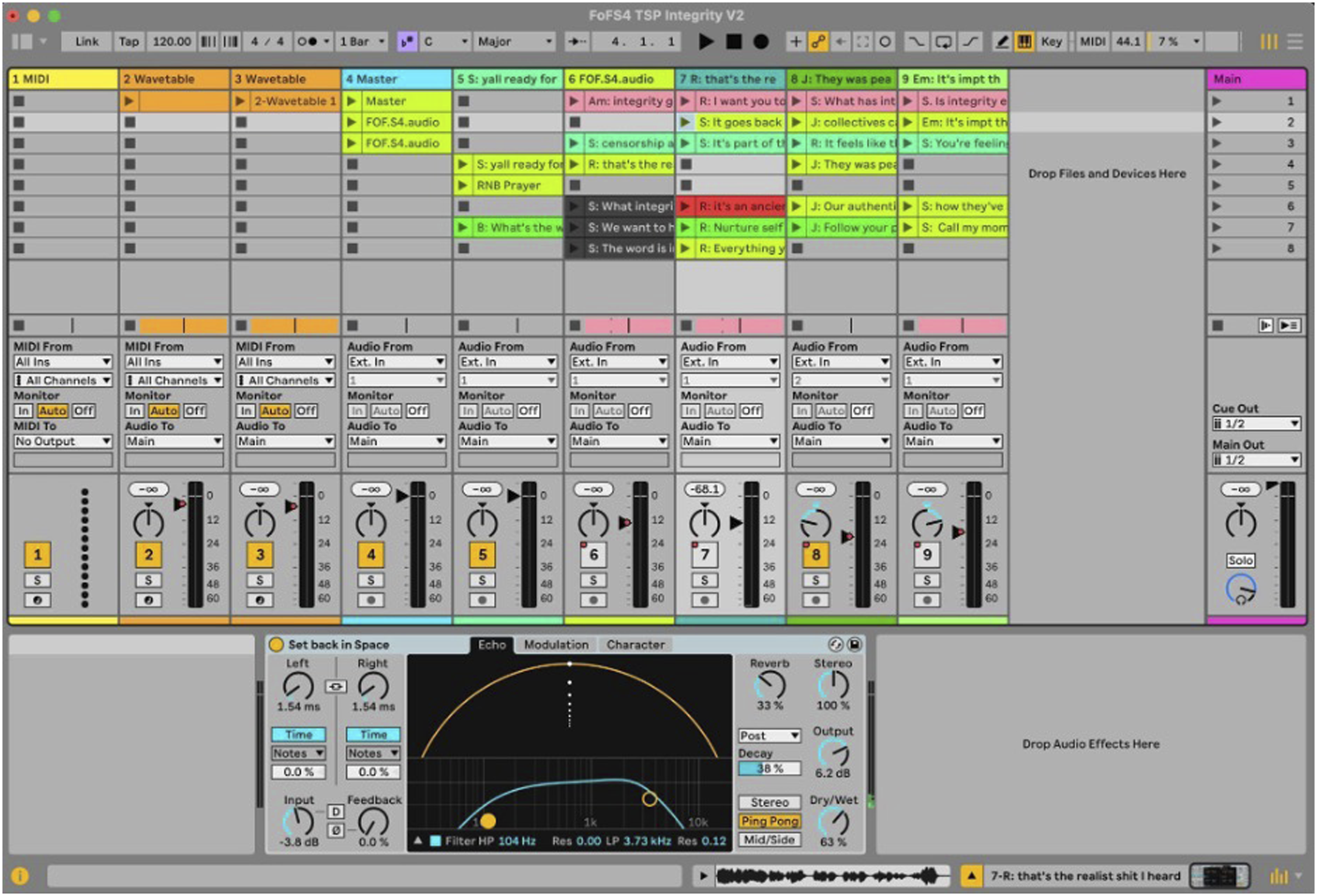
Listening to the exchange session in Live, rather than transcribing it to text and then reading it, afforded aspects of what Ceraso (2018) calls embodied listening. Like other scholars working from affective, sensory, or multimodal standpoints, Ceraso advances a conception of sound and listening that is beyond the semiotic and discursive listening modes (Chion, 2012). In the latter, sound is another kind of text for interpretation. Through embodied listening, Ceraso reasserts the affective, embodied, ecological, and situated aspects of sound and listening. From there, it is not only a matter of which words are spoken and what those words mean, semantically or discursively. It is also a matter of the physical register of those vibrations hitting the body, and what those vibrations also mean (Blacktronika, 2024; Henriques, 2011; Veal, 2007). This is to say that an embodied listen meant not only tuning into the words people said but also how the ways those words were said made me feel in this re-encounter. These ways might pertain to the grain of voice (Barthes, 1977), the certain swing of vocal articulation and its discernable geographical homeplace, or the emotional residue that hangs in silence. The audible mediation of technologies (mainly Zoom) and physical spaces were in play too. Here, I mean the ways the rooms people were in become audible through the reverberation of voices computer microphones recorded. The sounds of these containers were keynotes of the pandemic time we were all spending inside, physically separated from one another.
Listening and re-encountering the conversation in these ways, I separated phrases, exchanges, and fragments into clips/cells in Live. I used colors, text labels, and other visual markers for loose indicators of the clip’s content and speakers. With this organization, I moved toward a linear arrangement by staging interactions, moments, and minor exchanges. This process also included experimenting with signal processing effects like reverberation, delay, feedback, and distortion—and the subjective sense of proximity, scale, and clarity these effects render, and what additional affective layers might mean (Veal, 2007). Some aspects of the tune-ins are meticulously staged in the linear arrangement: these sounds happening at these specific times. Other aspects are the result of generative and aleatoric processes resembling experiments of loop-based minimal music (Baumgartel, 2023). 5 The question “how do we hear us together?” bounced back at me during the creation of these tune-ins and even now as I commit these ideas to text on screen.
The “Integrity” Tune-In serves as a specific example (see/hear QR code above). It is 2 minutes and 11 seconds in duration but composed from only 10 seconds of conversation pulled from a 90-min exchange session. The tune-in is designed around a rhetorical question asked by our collaborator Stevie “Dr View” Johnson: “What has integrity done for me?” In the tune-in, Stevie’s voice is separated into two tracks, one panned left and one panned right. These two versions of his voice are locked into a bi-vocal conversation loop, asking questions like, “What has integrity done for me? Has it really helped me? Has it really saved me? Is it enough to sustain you?” Sometimes the two voices collide and talk over one another, in and out of phase. In other moments, one voice is clear and singular in the mix. The audio signals are dry with no delay or reverberation on them, so they sound intimate and close to the listener. In performances, audiences have said the voices sound like a conversation that might be taking place in his mind, a mix of thoughts—though the strategic opacity of the composition does not make knowable to those outside the exchance session the exact experience behind the conversation (McKittrick, 2021).
Hovering over the bi-vocal conversation loop is a question Ruth Nicole interjected during this part of the exchange session: “I want you to answer your question. What has integrity done for you?” In the tune-in, the question cycles over top of Stevie’s bi-vocal conversation. The audio signal of her question is processed through a short delay, a filter that cuts out the high and low end frequencies (think the sound of AM radio), and reverb. This combination of effects makes the question sound wide, distant, and thin—hovering over the conversation loop of Stevie’s two voices.
Another phrase from Am’re Ford also cycles over the bi-vocal conversation loop. It’s Am’re telling Stevie, “Integrity did get you something, it got you freedom and peace of mind.” Through audio effects, the voice sounds thin, distant, and swirling. Audiences have told us it sounds like an elusive answer to the question, easily missed. These various loops of voices progress over a melodic line I improvised using a wavetable synthesizer.
Writing Ritual Performance Scripts
I (Ruth Nicole) created ritual performance scripts from/during/while listening to the recordings and reading the transcripts of 15 hours of exchange session conversations. The ritual performance scripts combine voices, narrations, and speaker positions into multivocal texts with performative poetic typeface that write a kind of sound: a splash of reverb across the page, text fading like an echo, layering and ruptures of words/sounds (see Figure 2).
6
The scripts attempt to make felt “mind-heart-body-spirit” entanglements (Nagar et al., 2023, p. 268), juxtapositions and contradictions in a grief-joy-funk register that exists within many collectives, while highlighting surprise and dissonance and playing with voice. This artful practice generates an ethic of deep listening (Oliveros, 2005), extends from a genealogy of Black feminist embodied performance (Brooks, 2021; Brown & Kwakye, 2012; Callier & Hill, 2019; Durham, 2014; Shange, 1997/1997), and engages performance activism (Edell, 2022) through wreckless theatrics (Brown, 2014). While I have written creatively before, I didn’t write with a pre-determined form or genre in mind. I wanted to listen for the form as much as I was listening to everyone individually and collectively. The form emerged as a performance script, which is how I heard us in conversation (Figure 3). Integrity Performance Script Sample Page. Note. The full performance script can be viewed here: https://formsoffreedom.com/Integrity-Ritual-Script-1.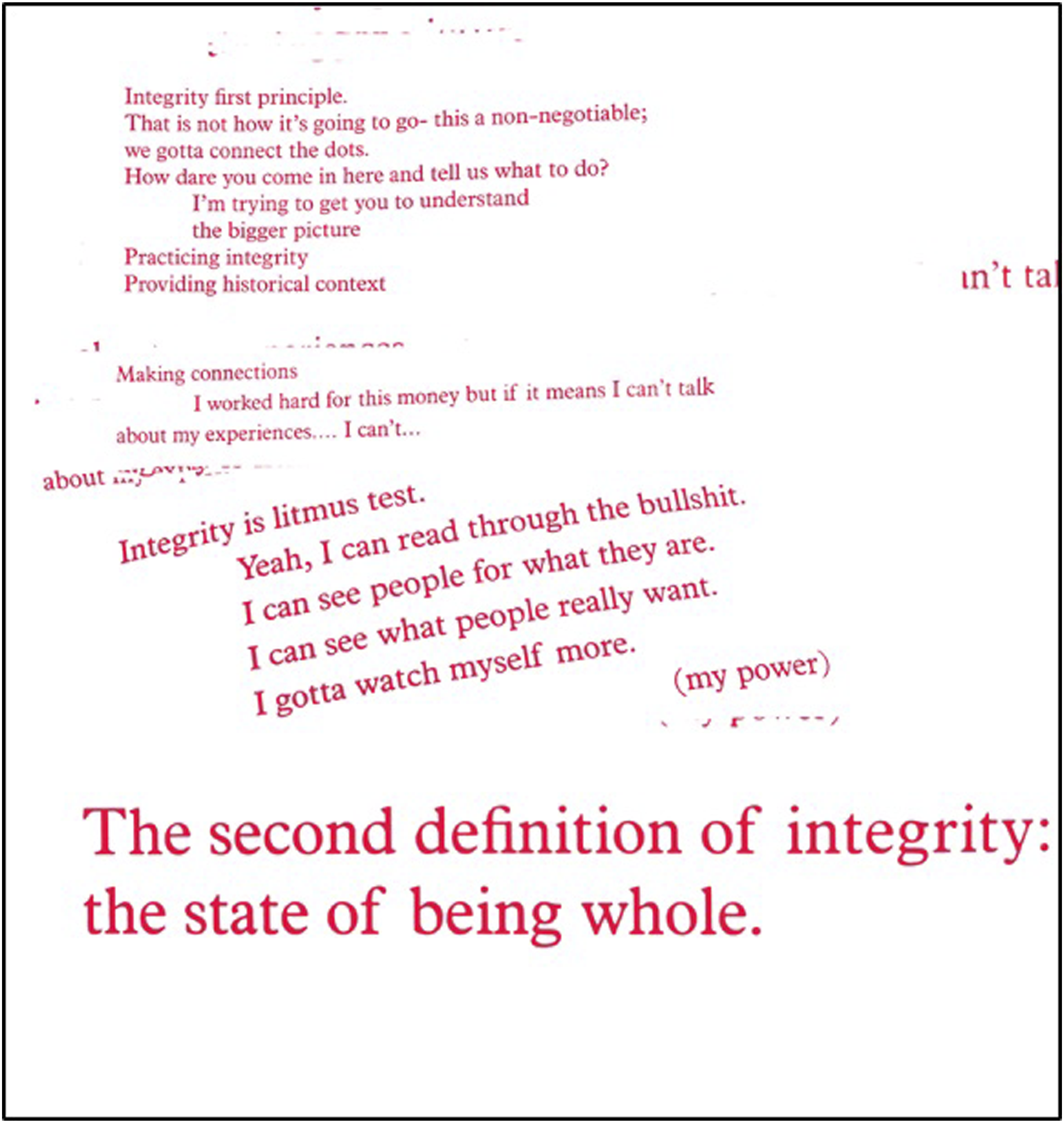
To create each of the ritual performance scripts, I was attentive to all matters of languages and limits demonstrated via Zoom: the intonations, gestures, and silences. I was kind of falling in love with Zoom through Forms of Freedom even though we were in deep pandemic time and I was certainly “over Zoom.” In any case, when we Zoomed together, the technology somehow worked in support of us, not against us. Aware that our conversations were nonetheless mediated by technology, I slowed down to ask questions about how Zoom itself is mediating what is said, what we hear, and how we are listening to each other. Doing digital wrongly yet again (Brown et al., 2018). I wanted to hold our conversations in my hands, literally, and thus took to the page. The process of making the scripts was spiritual, intuitive, experimental, iterative, and artful!
The scripts disidentify what is typically taken for granted as known or knowable about ourselves, our collaborators, and our collective work. For example, I did not include names or identify who said what. I took creative license and constructed a collective “I.” To write in a collective voice without references to individuals, especially when most of us knew each other well, was a choice I made to signal the unowning of shared knowledge production and the unbelonging to a particular collective. The script could be read by anyone and be about any collective. Additionally, during our Zoom sessions, I was often shocked to hear us making definitive, categorical statements about leadership and participation, which is counterintuitive to the misguided notion that because we work collectively, anything and everything goes. We were specific and decisive in our conversations. The scripts present a clarity of confidence that reminds me just how much collective knowledge is hard won in its locality; it also for this very reason resonates across, through, and beyond.
The ritual performance scripts can be called sound writing as they emphasize listening to our own listening with others (Kapchan, 2017). After I wrote the scripts, I read them out loud, recorded my readings, and shared them with Emery. We always heard new things as we listened. For example, as the person who proposed SOLHOT, I was listening to learn something new about my life’s work and wondered since we were deeply reflecting with others who know the nuance of collectivity, what was something said about SOLHOT that we don’t usually say? When Emery noted how Jessica said, “that Black girlhood class” I already knew the way Jessica said it meant it wasn’t just no class. I heard myself saying “after a decade of SOLHO” and we’re actually closer to two decades. In SOLHOT we have all this shorthand notation like, “that Black girlhood class” to indicate whole worlds in turns of phrases that signal to me when it’s time to ceremoniously strike a bowl.
The performance script is another notation of sound as ceremony, which for me is a synonym for collective formations that those who participate recognize as worthwhile. What is not written in the script but certainly present is the music that can only come from activating the script in performance. Do you sense the musicality in the script? Perhaps, the music can only be felt by those who already know the art of the social. For me, the instrumental hum is the bassline throughout. Perhaps, the music can only be felt when those who do collective work are also writing about the same work they’ve done and the striking of bowls, tuning of forks, ringing of bells, smelling of lit candles, and burning incense are needed as means to recall our wholeness. To remember ourselves through musicality for those who weren’t there or do not have a clue about how we made it ourselves and why our best ideas reverberate between each other; in the round to print out public following tears, shared care, a necessary nap, and some heartache is how the ritual performance script work. The music is unscripted in performance. The words recited any which way and how I will predictably go off script, ultimately—how we are together is knowledge people will feel even if only because it allows us to remember what we already know. Every time and in any place.
To be clear, the ritual performance scripts are foundational to a larger aspiration: activating a cure or two for collective ailments named and unnamed. Each script uses our own words to show us together on the page for the purpose of performing a ritual of redirection for the sake of wholeness, or as it was called by Sacramento Knoxx during Forms of Freedom, a re-spiriting. I heard each collective in need of re-spiriting due to the pandemic and other factors. In our questions were also the answers. In our stories there was already a way out, in, and through. In our silence, I heard music. The unknown is a favorite feature. I thought enough of what I experienced to write it down so I could do as Emery did, re-encounter us in another way. As I wrote the ritual performance scripts, I reached for and desecrated forms that just felt right to me while creatively embracing ars spirituality as a means of reflection and connection (Cutts, 2020). The script is one instrument among others I thought could be of use to remember our wholeness through a ritual that is sonic.
Performance in the Presence of Others
• One: Artful inquiry practices may proliferate from the reverence, commitment, and durable kinship of Black and Indigenous study. We are not talking about just getting friends together to make art. The stakes are higher, the political commitments are deeper, and our obligations to one another are thicker in this kind of collectivity. • Two: The utility of these artful inquiry practices may be singular, only useful to and in the collective contexts that birthed them. They might not be for adaptation and implementation beyond the collective context of Black and Indigenous study. • Three: Artful inquiry as a process often emerges from being so completely dedicated to a collective practice that you exhaust yourself to find new limits, expressions, and possibilities. The love and admiration holding the collective in dynamic togetherness is so deep, nuanced, and powerful that it inspires local change and certainly internal transformation that when made public, generates inspiration to create again. This is what artful inquiry can do: create conditions of generosity and critical connections. • Four: These artful inquiry practices, during formation and exploration, may feel incomplete and insignificant, even playful. They gain their significance in circulation back through the collective: sharing the creation, anticipating what inspiration will return, and wondering if and how it might make a kind of re-encounter.
Footnotes
Declaration of Conflicting Interests
The author(s) declared no potential conflicts of interest with respect to the research, authorship, and/or publication of this article.
Funding
The author(s) disclosed receipt of the following financial support for the research, authorship, and/or publication of this article: This work was supported by the Spencer Foundation (202100288).
