







Abstract
Background:
Single-sport specialization at the exclusion of other sports has become increasingly popular in youth sporting culture. The purpose of this study was to survey Major League Soccer (MLS) athletes to examine factors influencing the timing of single-sport specialization in soccer.
Hypothesis:
The majority of surveyed athletes will have participated in multiple sports prior to specialization and specialized primarily as a result of a coach’s recommendation, with no significant impact on specialization timing stemming from birth or high school location, obtaining a collegiate scholarship, MLS experience, or position.
Study Design:
Cross-sectional study.
Level of Evidence:
Level 4.
Methods:
Anonymous surveys were distributed to 3 MLS organizations and completed by MLS athletes during preseason physicals. Surveys evaluated the age and reason(s) behind an athlete’s decision to specialize in soccer, birth location, geographic high school location for US-born athletes, participation in a developmental league, college scholarship, years in the MLS, and position played.
Results:
Approximately 74% (64/86) of athletes returned completed surveys. Athletes reported beginning soccer at a mean age of 5.1 ± 2.1 years and specializing at age 12.6 ± 4.3 years. Athletes who participated in no other sports prior to specialization (P < 0.001), athletes reporting soccer to be their first sport played at an advanced level (P < 0.001), and athletes receiving a college scholarship (P = 0.02) specialized at a significantly younger age. Internationally born athletes specialized at significantly younger ages when compared with US-born athletes (P < 0.001).
Conclusion:
The majority of athletes participated in multiple sports prior to specialization and eventually specialized to focus exclusively on soccer. The timing of sport specialization in professional MLS athletes was not associated with multisport participation prior to specialization, playing soccer at an advanced level prior to other sports, receiving a college scholarship, or being born outside the United States.
Clinical Relevance:
Timing of sport specialization is associated with multiple factors prior to athlete promotion to the MLS that warrant further investigation to better understand the impact of specialization on injury incidence, performance, and career length.
The current culture in youth sports is trending toward early sport specialization, defined by intense year-round training in a single sport at the exclusion of other sports,24,25 as it is believed to be necessary to develop and attain sufficient skill to achieve elite status.6,8,24,25,28,35 This trend is reflected in growing participation in club and travel leagues for athletes as young as 7 years old across multiple sports, along with the increasing numbers of young Olympic athletes.22,24,30 A survey of 152 high school athletic directors found that 78% reported a perceived increase in sport specialization that was predicted to continue to rise, 22 while recent reports estimate that 17% to 41% of youth athletes are highly specialized in a single sport.12,25,37,38 The emphasis and pressure to select a single sport at the exclusion of others is believed to come from coaches, parents, and other youth athletes.8,17 However, early sport specialization has not been validated as being essential to attain collegiate scholarships or attain future professional status.3,6,9,27,29,34,36
Despite limited evidence, early sport specialization, defined as occurring before puberty,10,28,30 has been associated with negative consequences, including increased rates of overuse injuries, overtraining, burnout, and sports withdrawal.6,12,20,24,25,37 This has led to multiple medical organizations, including the American Orthopaedic Society for Sports Medicine, 27 American Academy of Pediatrics, 23 the American Medical Society for Sports Medicine, 12 and the American College of Sports Medicine, 33 to release position statements advocating against early specialization. In contrast, early diversification with participation in multiple sports may improve long-term performance, with increased lifetime enjoyment of sport participation. 2 This has led to recommendations encouraging youth athletes to acquire a wide range of skills through multisport participation while avoiding single-sport specialization until middle to late adolescence, after puberty.5,24
Soccer represents one of the most popular youth sports, with over 600,000 youth athletes participating in soccer annually. 14 To date, no investigation has examined the age and reason for specialization in current professional soccer athletes or differences between American-born versus internationally born athletes. The purpose of this investigation was to survey Major League Soccer (MLS) athletes to determine (1) their age of specialization in soccer, (2) other sports participated in prior to soccer specialization, (3) the reason(s) behind specialization, and (4) the impact of birth location (United States vs international), geographic location of high school (West, Midwest, South, Northeast), participation in a developmental league, receiving a collegiate athletic scholarship, years in the MLS, and primary position on specialization timing. The authors hypothesized, based on prior studies,4,18,22,24,28 that the majority of surveyed athletes participated in multiple sports prior to specialization, with athletes specializing primarily as a result of a coach’s recommendation, with no significant impact on specialization timing stemming from birth or high school location, obtaining of a collegiate scholarship, MLS experience, or position.
Methods
After discussion and approval from head MLS team physicians, athletes from 3 MLS teams were provided with an anonymous 12-question paper survey prior to the 2017 season (Appendix 1, available in the online version of this article). Surveys were distributed by athletic trainers to all athletes presenting for yearly preseason preparticipation physicals at training camp where athletes are asked to fill out necessary medical and legal paperwork to obtain league approval to participate in training camp and the upcoming season. Athletes were informed that surveys were voluntary, anonymous, and would not affect their sport participation.
The survey consisted of questions related to the age at which athletes started playing soccer and details pertaining to age and reason(s) behind specialization in soccer. Details on other sports played prior to specialization were included, along with information regarding the first sport played at an advanced level, defined as being a part of a travel team, Amateur Athletic Union team, select invitation team, or all-star team. Demographic information relating to birth location and high school location based on zip code were also collected. Athletes were also asked whether they participated in a developmental soccer league, if they received a college scholarship, and whether they played another sport besides soccer in college. Finally, the total number of years in the MLS and primary position played in the MLS were solicited. The completed surveys were collected by the athletic trainers and mailed back to the office of the primary investigator. As all data were collected in a deidentified manner, written consent was not required, and institutional review board exemption was granted by our hospital.
A study number was assigned to each survey for analysis purposes. Surveys were analyzed to calculate the mean response rate per question to evaluate the timing and reasons behind specialization. Analysis of sports played prior to specialization in soccer was categorized based on athletes participating in 0, 1, 2, 3, or 4 or more sports. For athletes born in the United States, zip codes were used to classify athletes as being from 1 of the 4 Census Bureau–designated regions of the United States: West, South, Midwest, or Northeast. Years in the MLS were separated into 5 groups (0 years, 1-2 years, 3-4 years, 5-7 years, and 8-10 years) to achieve near equal numbers of athletes in each group for analysis. Continuous data were analyzed using an unpaired Student t test, while 1-way analysis of variance was performed to compare 3 or more response variables with post hoc comparisons using the Tukey test. All statistical analyses were performed using SPSS statistical software (Version 25.0; IBM Corp).
Results
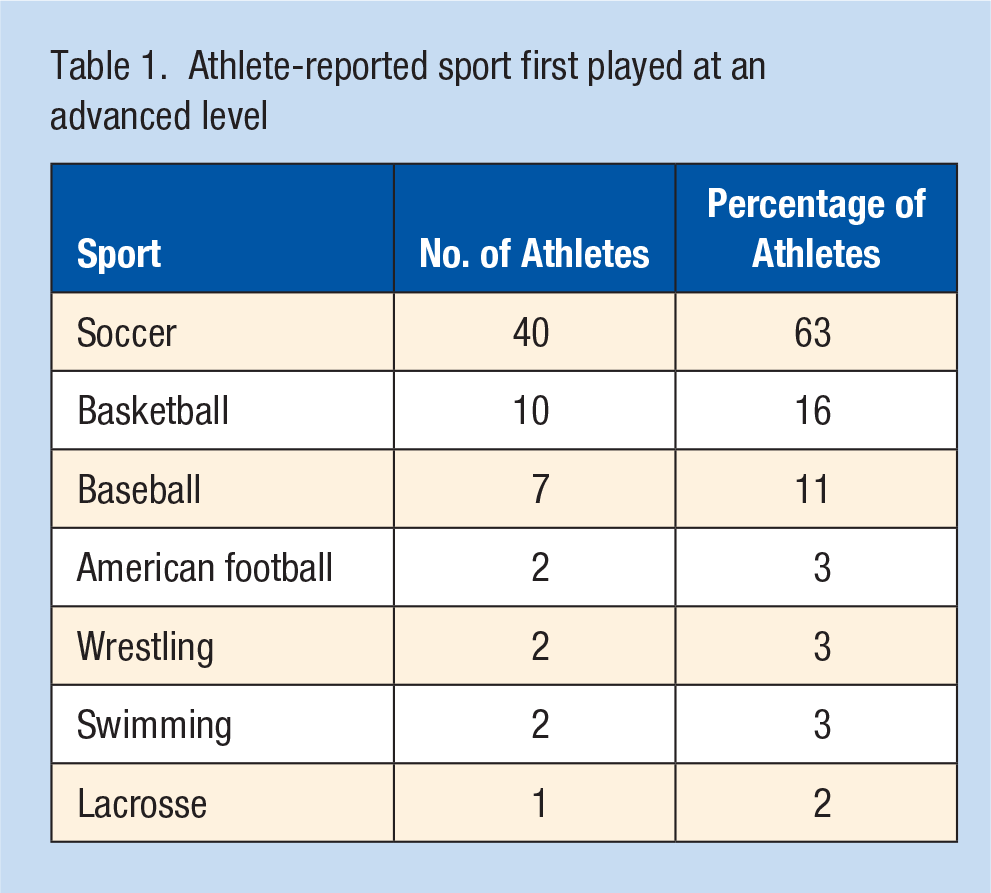
Completed surveys were collected from 74% of athletes (64/86)presenting for preseason physicals. The mean reported age at which athletes began playing soccer was 5.1 ± 2.1 years. Athletes reported specializing in soccer at a mean overall age of 12.6 ± 4.3 years. Prior to specialization, 81% (52/64) of athletes reported participating in 1 or more sports. A total of 63% (40/64) of athletes reported soccer being the first sport played at an advanced level (Table 1).
Athlete-reported sport first played at an advanced level
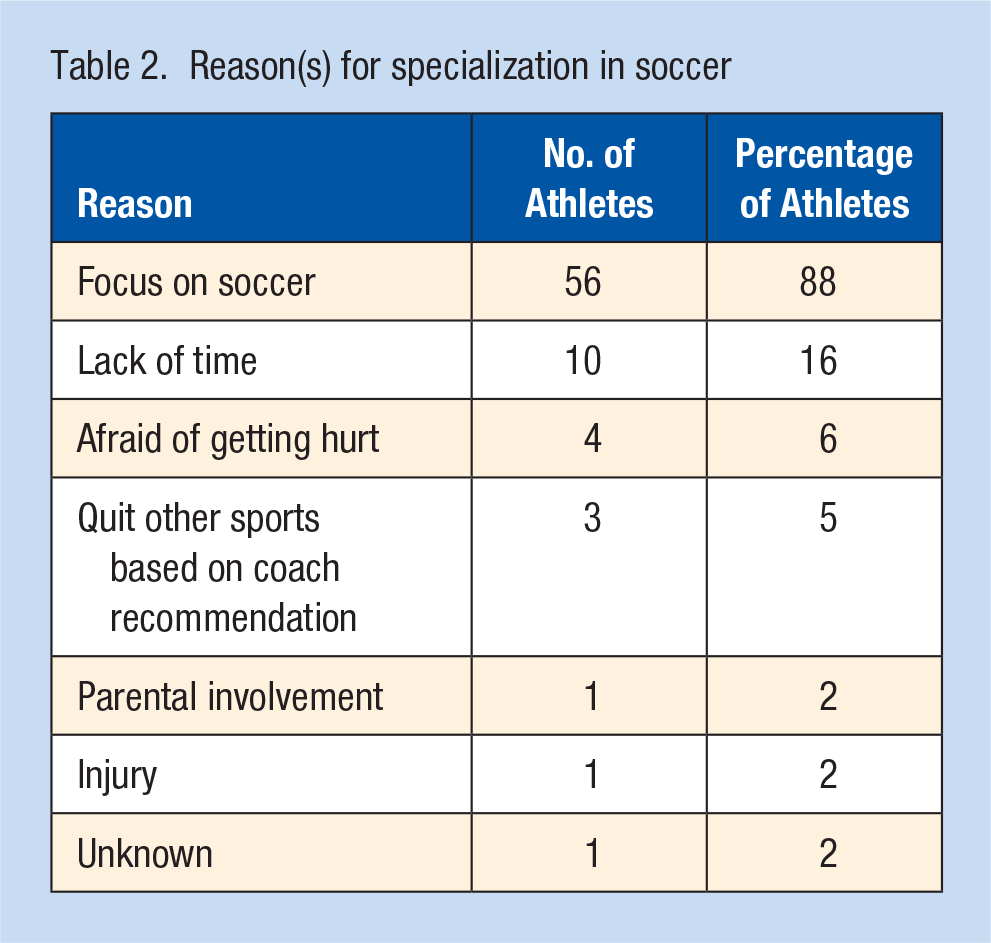
When asked the reason(s) athletes specialized in soccer, the majority (88%; n = 56) of athletes cited specialization to focus on soccer (Table 2). Approximately 61% (39/64) of athletes reported being born in the United States, compared with 39% (25/64) born outside the United States. Of the 39 athletes born in the United States, 38% (n = 14) attended high school in the Midwest, 22% (n = 8) in the West, 22% (n = 8) in the South, and 19% (n = 7) in the Northeast, while 2 athletes did not provide zip codes. A total of 72% (46/64) of athletes reported competing in a developmental league prior to playing in the MLS, while 67% (43/64) received an athletic scholarship to play soccer in college. One athlete received a scholarship to play American football in college, being drafted into the MLS after his collegiate football career.
Reason(s) for specialization in soccer
Prior to the start of the season, athletes had a mean 3.3 ± 2.9 years (range, 0-10 years) of experience in the MLS, with 22% (n = 14) of athletes being rookies. Based on position, athletes were primarily defenders (39%; 25/64) and midfielders (30%; 19/64), strikers/forwards (19%; 12/64), and goalkeepers (13%; 8/64).
Moreover, athletes who reported soccer as their first advanced sport specialized at a significantly younger mean age compared with athletes who reported playing another sport besides soccer at an advanced level (P < 0.001) (Table 3). When compared with athletes born in the United States, internationally born athletes specialized at a significantly younger mean age (P < 0.001). When US-born athletes were analyzed based on primary region growing up while in high school, no significant difference in age at specialization was appreciated overall (P = 0.89) or between any region on post hoc testing (P > 0.05 for all). Participation in a developmental league had no significant impact on mean age at specialization (P = 0.92), while athletes who received an athletic scholarship were found to specialize at a significantly younger mean age compared with athletes not receiving an athletic scholarship (P = 0.02). Mean age at specialization was not significantly different based on years of experience in the MLS overall (P = 0.31) or between any groups (P > 0.05 for all). No overall significant difference in specialization timing was appreciated based on position played (P = 0.13) or between each individual position (P > 0.05 for all).
Overview of sport specialization timing
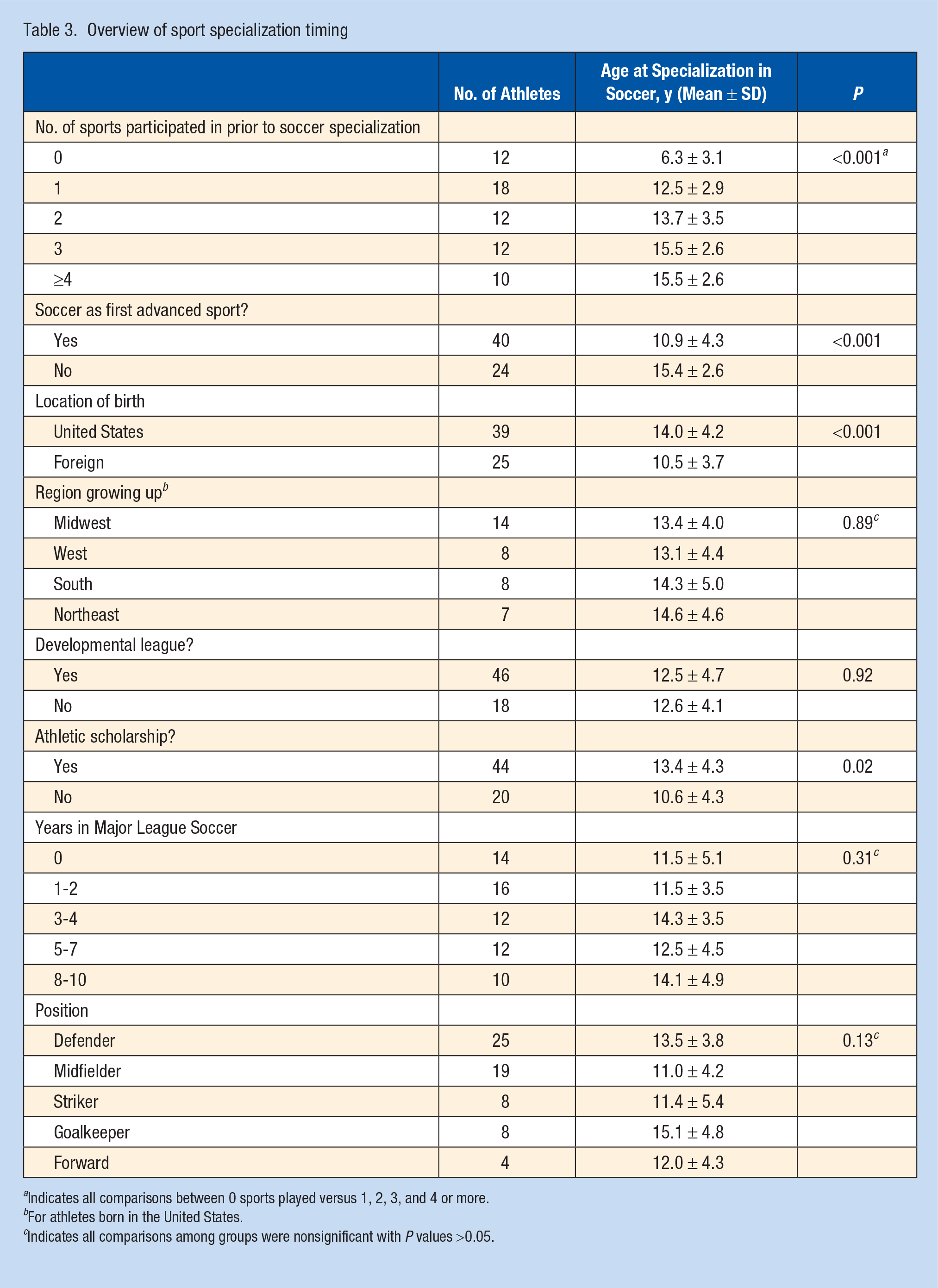
Indicates all comparisons between 0 sports played versus 1, 2, 3, and 4 or more.
For athletes born in the United States.
Indicates all comparisons among groups were nonsignificant with P values >0.05.
Discussion
Survey results from 64 MLS athletes found that athletes who participated in no other sports prior to specialization, those who played soccer as their first advanced sport, athletes born outside the United States, and those who received a collegiate athletic scholarship specialized in soccer at a significantly younger mean age. Specialization was pursued by the majority of athletes to focus on soccer exclusively. Meanwhile, the primary region in which US-born athletes attended high school, participation in a developmental league, years in the MLS, and playing position had no significant impact on the mean age of specialization. This work may represent the first study documenting data on specialization timing in professional soccer athletes.
Specialization occurred at a significantly younger mean age in athletes who reported not participating in any sports prior to specialization in soccer and those who reported soccer to be their first advanced sport. Multiple medical associations and societies have issued consensus statements urging parents, coaches, and clinicians to advocate for youth athletes to engage in multiple sporting activities, avoiding early specialization in a single sport.11,23,26 While not specifically analyzed in this investigation, prior studies have suggested that specialization prior to puberty is associated with increased rates of athlete burnout and withdrawal from sport over time.15,26 Moreover, when compared with youth athletes diversifying their athletic activity, the risk of injury is greater in highly specialized athletes.1,24 In their study investigating specialization status, sport participation volume, and injury history, Post et al 32 reported that in 2011 athletes aged 12 to 18 years, the odds of an athlete reporting a previous injury were 45% to 91% higher among highly specialized athletes compared with nonspecialized athletes. These findings are in agreement with the results from Jayanthi et al, 25 in which the authors compared 822 injured athletes aged 7 to 18 years from 2 hospital clinics with 368 uninjured controls, reporting that highly specialized athletes were more likely to report any injury (odds ratio, 1.58) or an overuse injury (odds ratio, 1.50). Meanwhile, Hall et al 20 found that in 546 middle school and high school female, single-sport athletes in basketball, soccer, and volleyball had increased rates of patellofemoral pain when compared with multisport athletes.
The mean age of specialization in all athletes in our investigation was 12.6 ± 4.3 years. The perception that early specialization is a requirement for future elite performance and a professional career is not valid. 26 Investigations comparing elite versus nonelite athletes among professional and collegiate athletes across a variety of sports has shown that elite athletes typically trained less during childhood and specialized later in adolescence, participating in more sports during high school than nonelite athletes.7,16,29,31 The majority of athletes participating in Division I National Collegiate Athletic Association athletics were more likely to have played multiple sports in high school, while only 17% had participated exclusively in their current sport. 28 A study on the progression and development of German professional soccer athletes found that 88% of athletes participated in more than 1 sport as children, comparable with the 81% of athletes found in our study. 18 Meanwhile, Helsen et al 21 found that differences in the training profile of expert and nonexpert soccer athletes did not occur until age 15 years. As such, despite the growing trend toward specialization, the notion that future success at elite levels in soccer requires athletes to specialize in a single sport at young ages has not been validated, with many elite athletes pursuing early diversification followed by specialization in late adolescence.10,24
Athletes most commonly reported specializing in soccer at the exclusion of other sports to focus on soccer. Prior studies examining athletes participating in multiple sports have shown that the strongest influence on children starting a sport were parents, while coaches influenced athlete’s decisions to train intensely and specialize in a single sport.4,22,24 Moreover, a survey of 153 high school athletic directors supported the finding that coaches were the most powerful influence on athletes specializing in a single sport. 22 In our survey, 88% of athletes reporting specializing to focus on soccer, while only 5% specialized based on a coach’s recommendation. As such, evaluation of the reason(s) behind the athlete’s decision to specialize warrants further investigation to better understand the motivation for specialization.
Internationally born athletes were found to specialize in soccer at a significantly younger age when compared with athletes born in the United States. This finding is likely related to the limited options available for international athletes to participate in multiple sports during their youth secondary to resources and stricter international talent development processes requiring athletes to focus exclusively on club teams or enroll in soccer academies at young ages. 19 To date, no investigation has similarly examined differences in specialization timing comparing athletes born in the United States versus those born internationally, meriting further research.
Despite a response rate of 74% to all distributed surveys, there were a number of limitations in this investigation. As previously stated, due to the anonymity utilized in surveys, no injury data were collected. This precluded an analysis of the impact of specialization on the prevalence of injuries in professional soccer athletes. In addition, the validity and reliability of the questionnaire utilized in this investigation has not been established in prior investigations. Details regarding an athlete’s decision to “focus on soccer” as the reason for specialization were not further characterized and likely limited clarification behind the true reason(s) associated with the athlete’s exclusion of other sports. Moreover, only male athletes from a single sport were surveyed, restricting the generalizability of the data to females and athletes participating in other professional team or individualized sports. All athletes completing the survey were also subject to recall bias, as athletes were asked to recall the age of specialization. Because of the cross-sectional design of the current study, it is not possible to infer causality between the age of specialization and the variables surveyed. Last, the current literature uses multiple definitions of sports specialization, including hours per week and total months per year of involvement in sport, which were not utilized to define specialization in this investigation.24,25 However, the use of survey methods instead of the measurement of actual exposure to define sport specialization has been previously published. 13
Conclusion
The timing of single-sport specialization in 64 MLS soccer athletes was significantly affected by athletes participating in no other sports prior to specialization, playing soccer as their first advanced sport, being born internationally, and receiving a collegiate athletic scholarship. Specialization was primarily undertaken by athletes to focus exclusively on soccer.
Supplemental Material
Appendix_I – Supplemental material for Timing and Reasons Behind Single-Sport Specialization in Soccer: A Survey of 64 Major League Soccer Athletes
Supplemental material, Appendix_I for Timing and Reasons Behind Single-Sport Specialization in Soccer: A Survey of 64 Major League Soccer Athletes by Derrick M. Knapik, Katherine H. Rizzone and James E. Voos in Sports Health: A Multidisciplinary Approach
Footnotes
Acknowledgements
The authors thank Stephanie Madercic for survey distribution and collection and Peter H. Edwards Jr, MD, Scott Luallin, MD, and Steve Hudyma, ATC, PTA, CSCS, for their assistance with survey distribution and collection within their respective Major League Soccer organizations.
The following author declared potential conflicts of interest: J.E.V. is a paid consultant for Arthrex, Linvatec, and Stryker.
References
Supplementary Material
Please find the following supplemental material available below.
For Open Access articles published under a Creative Commons License, all supplemental material carries the same license as the article it is associated with.
For non-Open Access articles published, all supplemental material carries a non-exclusive license, and permission requests for re-use of supplemental material or any part of supplemental material shall be sent directly to the copyright owner as specified in the copyright notice associated with the article.
