







Abstract
Context:
Among American sports, football has the highest incidence of exertional heat stroke (EHS), despite decades of prevention strategies. Based on recent reports, 100% of high school and college EHS football fatalities occur during conditioning sessions. Linemen are the at-risk population, constituting 97% of football EHS deaths. Linemen heat up faster and cool down slower than other players.
Evidence Acquisition:
Case series were identified from organized, supervised football at the youth, high school, and collegiate levels and compiled in the National Registry of Catastrophic Sports Injuries. Sources for event occurrence were media reports and newspaper clippings, autopsy reports, certificates of death, school-sponsored investigations, and published medical literature. Articles were identified through PubMed with search terms “football,” “exertional heat stroke,” and “prevention.”
Study Design:
Clinical review.
Level of Evidence:
Level 5.
Results:
Football EHS is tied to (1) high-intensity drills and conditioning that is not specific to individual player positions, (2) physical exertion as punishment; (3) failure to modify physical activity for high heat and humidity, (4) failure to recognize early signs and symptoms of EHS, and (5) death when cooling is delayed.
Conclusion:
To prevent football EHS, (1) all training and conditioning should be position specific; (2) physical activity should be modified per the heat load; (3) understand that some players have a “do-or-die” mentality that supersedes their personal safety; (4) never use physical exertion as punishment; (5) eliminate conditioning tests, serial sprints, and any reckless drills that are inappropriate for linemen; and (6) consider air-conditioned venues for linemen during hot practices. To prevent EHS, train linemen based on game demands.
Strength-of-Recommendation Taxonomy:
n/a.
The first recorded exertional heat stroke (EHS) death in the modern era of football was David Tilson, a high school player. 29 From 1955 through 2021, the National Registry of Catastrophic Sports Injuries (NRCSI) has documented 159 EHS fatalities in youth, high school, and collegiate football players; a mean of 2 deaths per season (Figure 1).
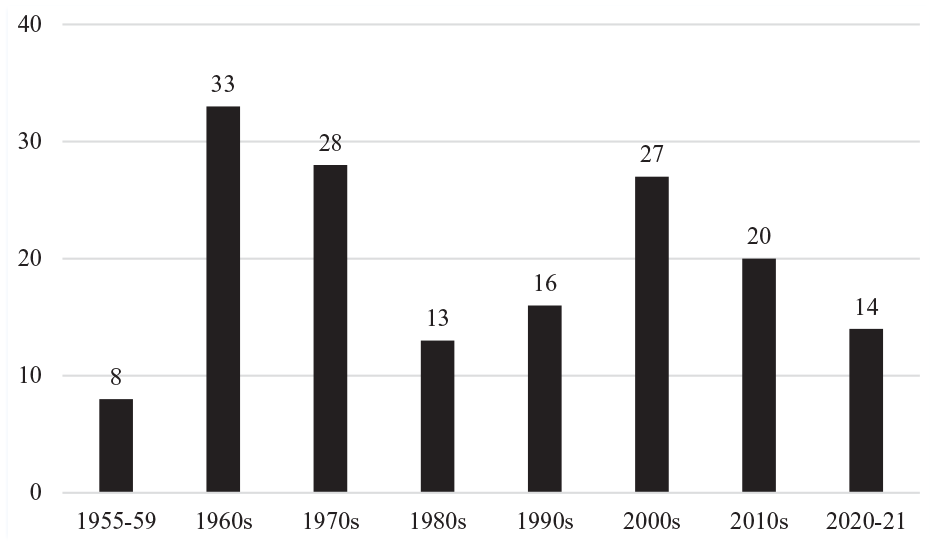
Youth, high school, and college football EHS fatalities. Source: National Registry of Catastrophic Sports Injuries (NRCSI).
Since the 1960s, EHS prevention strategies have included reducing the uniform from full pads to shorts and t-shirt and mitigating environmental stress by practicing in the cool of the day. The National Collegiate Athletic Association (NCAA) implemented a 3-day preseason acclimatization period in 1968. Hydration before, during, and after football practices was emphasized in the 1970s. Since 2000, the preseason acclimatization period increased to 5 days as 2-a-day practices were reduced and ultimately eliminated.
In 2001, the football EHS deaths of Korey Stringer in the National Football League, Eraste Autin in the NCAA, and Travis Stowers in high school spurred actions to prevent football EHS. Sports medicine organizations developed or updated position statements and expert opinion documents to prevent EHS in football and other sports.9,11,12,40 The NCAA and the American Football Coaches Association partnered to structure out-of-season football workouts to prevent EHS. 4 Strength and conditioning (S&C) specialists developed consensus football training guidelines. 13 Sport governing bodies advanced protocols, policies, and legislation to prevent EHS.33,34,36,42 Published medical literature based on field and laboratory research on EHS increased sharply in the past 2 decades on the premise that we can prevent EHS in football.6,7,16,17,19,28,30
Premise Unfulfilled
Unfortunately, the traditional strategies have not prevented football EHS fatalities.5,6,32,40 Mean per season deaths from 2000 to 2021 rose to nearly 3, and there were 9 football EHS deaths in the summer of 2021, equaling the combined number of deaths in the preceding 3 years (NRCSI data).
If EHS is considered an inherent risk in football, this is a dangerous misperception. To reduce EHS, contemporary football guidelines key on exercise and environmental acclimatization, hydration, and uniform modifications. Because these improvements have not ended EHS deaths, it is time to shift the prevention paradigm.
Understanding Who Is at Risk for EHS in Football
The traditional belief is that all football players are equally at risk of EHS based on heat, humidity, and uniform configuration during practice and competition.
Compelling data specific to football EHS deaths from 1998 to 2018 show that 97% are linemen.6,7 Line play self-selects large, muscular athletes as size and strength are essential for success. 41 Compared with nonlinemen, linemen differ in body size, shape, fitness, and composition.19,27,30,41,44 The large size and lesser aerobic fitness of linemen contribute to a higher percentage of heat load stored during physical activity compared with nonlinemen, particularly in hot and humid environments.30,44 A linemen has a “heat stroke habitus”: a large body with a high percentage of lean muscle mass generating high metabolic heat loads that can outstrip the surface area for cooling, along with high body fat stores that tend to retain heat.13,19,21,22,27,28 Even when fit and acclimatized, the combination of excessive metabolic heat production, high body fat heat stores, and diminished heat dissipation in humid conditions means the linemen will heat up faster and cool down slower than leaner players. 44 Knowing that linemen are at greatest risk for EHS is vital.7,22,23,41,44
Conditioning Workouts and Weather Conditions as Risk Factors
EHS risk factors are “individual” and “organizational.” 39 The primary individual risk factor for linemen is large size. Organizational factors like training load (duration, volume, intensity, work:rest ratios) pose greater risk than individual factors and drive the risk for linemen. Organizational factors are related mainly to the conduct of the workout and are within the control of the coach and S&C coach. Football EHS deaths are tied directly to elevated core body temperature caused by high-intensity aerobic physical activity like serial sprinting, sustained repetitions during conditioning drills, fitness testing, and punitive exercise.1,6,7,10,12,19,25,27,43,44 Workout intensity is set by the coach and S&C coach. In the football conditioning community, “[an] athlete’s development, health, and safety are sometimes overshadowed by a culture that values making athletes tough, instilling discipline, and focusing on success at all costs.” 10 In a retrospective study of high school and collegiate football EHS fatalities, 100% occurred during conditioning drills and none occurred during game play. 7 It is essential to understand that EHS deaths in football are caused by training and conditioning sessions that generate high heat loads and overwhelm an athlete’s cooling system as opposed to inherent, individual player traits or conditions. 7
The environmental conditions, especially severe heat and humidity, are undeniably related to EHS incidence.32,40 Although EHS is most apt to occur in hot and humid weather, it can occur in cooler and “normal” environments.7,11,25,32 The environmental conditions in recent football EHS deaths had a mean maximum temperature of 90.8°F (32.7°C) and a mean wet bulb globe temperature of 76.7°F (24.8°C). This supports limiting the intensity of exertion as key in preventing EHS in football. 7
Risk Associated With Transition Periods
Transition periods in training are associated with increased risk for EHS.7,9,10,13,16 Transition periods occur during the first 7 to 10 days of any new conditioning cycle (including the start of conditioning in January, summer sessions, or preseason practices, and after spring break or a return to activity after an injury). Transition periods call for acclimatization to exercise intensity with appropriate work:rest ratios to allow exertional body heat to dissipate.9,13,35,36,42
In 2003, the NCAA mandated a 5-day acclimatization period in transition to preseason football practices. 34 The National Federation of State High School Associations and USA Football heat policies have similar acclimatization strategies.36,42 These strategies do not address the intensity of exertion or focus on linemen as the at-risk players and have not reduced football EHS fatalities. 6
Is the Football Uniform Overrated as a Risk Factor?
The uniform configuration is prominent in EHS prevention guidelines as players are transitioned from shorts and helmet to full pads over the first 5 days of preseason practices.12,33,34,42 Fatal EHS in football usually occurs in the first 2 to 4 days of practice and, among football EHS deaths, 60% from 1990 to 2010 and 70% from 1998 to 2018 wore shorts and t-shirt at the time of collapse.5,7 Research strongly supports pads and helmet may increase rate of heat storage and reduce exercise-heat dissipation. 3 However, reduced uniform use as a prevention strategy in acclimatization periods has not reduced football EHS fatalities, in part because it does not address root causes, ie, exercise intensity and linemen at risk. 6
Time for a Paradigm Shift
Train Linemen for the Game They Actually Play
Position-specific training is vital to prevent EHS. Training and conditioning sessions should prepare athletes to play the game by enhancing position-specific “football fitness” and skills as demonstrated in Figure 2.14,31 The Collegiate Strength and Conditioning Coaches Association and National Strength and Conditioning Coaches Association support the 50/30/20/10 rule for conditioning and the FIT rule (frequency, intensity volume, and time of rest interval) for resistance training during transition periods. 13 Using the 50/30/20/10 protocol, the conditioning is phased in gradually to accommodate exercise acclimatization with progressive increases in volume, intensity and duration over a 4-week period. 10 The first week is reduced by at least 50% of the uppermost conditioning volume on file for the individual player, and progressively increased to 30% the second week, and so on. 13 The intent of transition strategies is to allow the player to adjust gradually to both environment and exercise load.
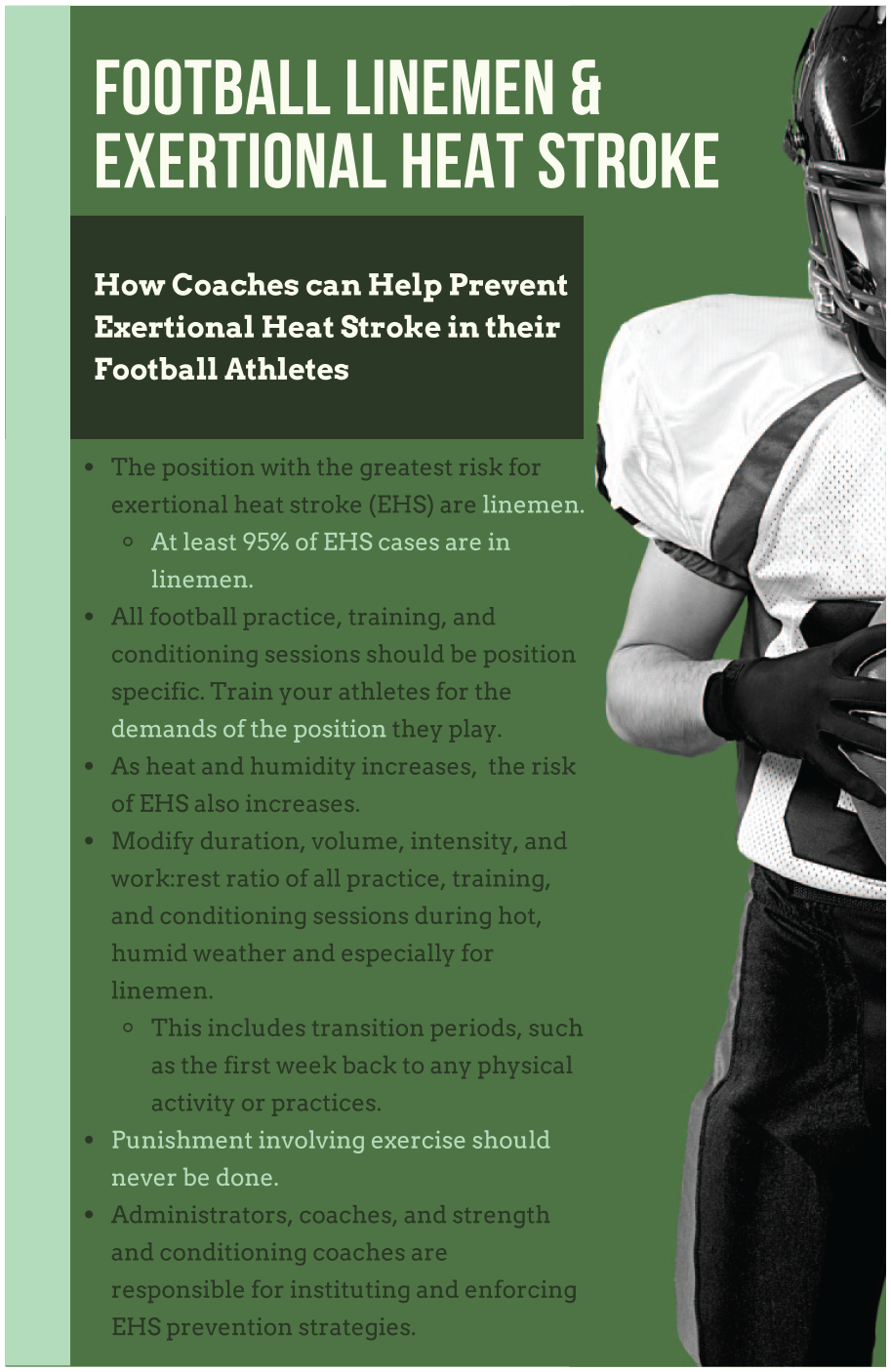
How coaches can help prevent EHS in their football athletes.
To improve safety for linemen, the 50/30/20/10 rule should not allow high intensity, large volume workouts, timed mile runs, or sustained sprinting for distance (“conditioning tests”) within the first 2 weeks as outlined in Table 1. 13 Sustained, aerobic, high-intensity 110-yard (100.6 m) sprints early in the transition period put linemen at great risk for EHS, even with modest reductions in repetitions completed at slower speeds and slightly longer rest times (Table 2). Serial sprinting with high work:rest ratios caused the EHS that resulted in the deaths of 2 college football linemen in recent high-profile cases. 7 The traditional sprinting at the end of practice is especially risky for linemen as sustained, intense exertion further increases an already elevated core temperature in an athlete with diminished capacity to shed metabolic heat.
Offense positional movement profiles a
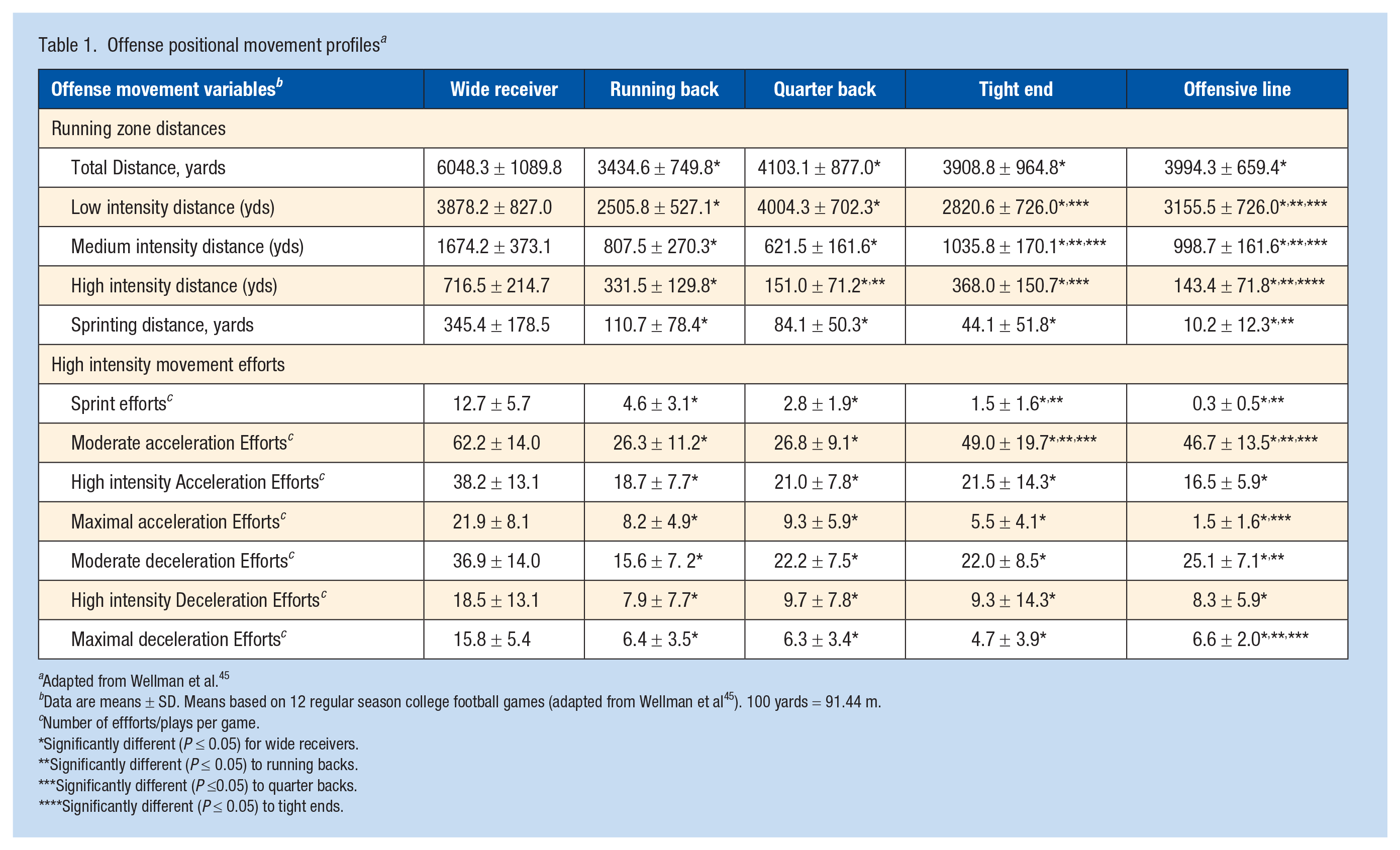
Adapted from Wellman et al. 45
Data are means ± SD. Means based on 12 regular season college football games (adapted from Wellman et al 45 ). 100 yards = 91.44 m.
Number of effforts/plays per game.
Significantly different (P ≤ 0.05) for wide receivers.
Significantly different (P ≤ 0.05) to running backs.
Significantly different (P ≤0.05) to quarter backs.
Significantly different (P ≤ 0.05) to tight ends.
Movement classification system a
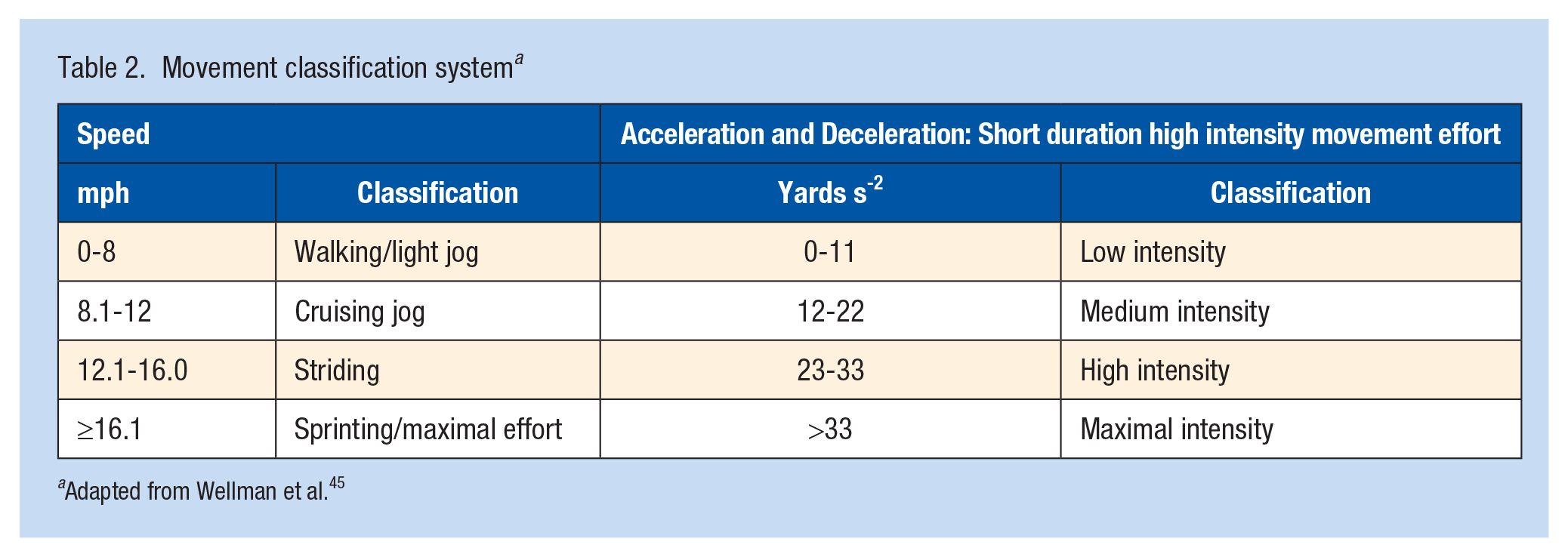
Adapted from Wellman et al. 45
Linemen do not sprint like wide receivers and running backs, either in practice or games. Both offensive and defensive linemen play mostly at or near the line of scrimmage. The game demands for linemen are to spring up from a stance, take a few fast steps forward or backward, and maneuver or grab a heavy object at a low work:rest ratio that differs in distance and intensity as compared with nonlinemen (Tables 1-2). 45 Training linemen in the same manner as nonlinemen ignores the game demands and characteristics of the lineman’s position, skills, habitus, and heat exchange response to exertion imposed by the excess physical stressors.18,44,45
Leadership by institution and sports administrators, coaches, S&C coaches, athletic trainers, and team physicians, all of whom are responsible for athlete health and welfare, is essential to EHS prevention.2,9,12,17,37,39 Training athletes for sport is a vital and moral responsibility that all leaders should take to heart.7,17,20,23,31,37,38,43 A retrospective review of nontraumatic, exertional football deaths revealed training that lacks a basis in exercise science, is not specific to the demands of competition, and is not position-specific. 7 Strength and conditioning standards based on exercise science should be applied to improve football heat safety.7,9,11,13,18,26,37,45 Education and better leadership is needed to reduce the risk of football EHS (Figure 2).14,37
Eliminate Punishment Drills
The common coaching practice of using physical exertion for punishment has been tied to 37% of recent football EHS deaths - a shocking and troubling statistic. 7 Exercise as punishment elevates EHS risk above any reasonable performance improvement and is not defensible.2,7,10,37,43 Even if the intent is not punitive, when an intense workout becomes physically punishing with sustained exertion pushing players to their limit, the EHS risk skyrockets.2,7,15
Keep Motivation in Perspective
Intrinsic motivation is a highly regarded and encouraged trait in athletes, and extrinsic motivators (eg, playing time, scholarship, money, peer pressure, public/parental acclaim) can push athletes beyond personal safety limits. Paradoxically, healthy athletes are at very high risk for EHS because they are motivated to succeed.11,23,39,40 Coach-induced external motivation is a dangerous double-edged sword when applied as training for mental/physical toughness with admonitions such as “Finish!” and “Don’t quit!” 43 Many players who died from EHS had finished the workout or collapsed just short of the finish line. EHS victims are posthumously described as “the hardest worker,” “a workout warrior,” “determined to prove himself,” and the one pleading to “let me finish!”20,22 Although motivation is rudimentary to individual success, understanding the risks with an athlete’s drive to succeed is essential for coaches and S&C coaches to prevent EHS.
“Dehydration” May Be More a Distraction Than a Risk Factor in Football
Proper fluid replacement is a best practice for athlete health and performance.11,40 Dehydration, however, contributes little to the high core temperature in college football players in action and is not the main factor for fatal EHS.19,27,30 Drinking water to stay hydrated does not make a player immune to EHS. Minimal dehydration is inevitable in football players training and conditioning in the heat. Dehydration may be a more notable EHS risk factor for high school football players and more research is needed here.
Conversely, overhydration is also dangerous as 3 high school football players have died of hyponatremia from 1998 to 2018.7,24 Again, proper fluid replacement is clearly best practice, but adequate fluid replacement does not eliminate the risk of EHS.
Lessons on Prevention
Can EHS deaths be prevented in football? A model for preventing football EHS is patterned after the football exertional sickling (ES) prevention strategy.6,8 From 2000 to 2010, the leading cause of fatalities in NCAA Division I football players was ES in a football player with sickle cell trait (SCT). 24 To prevent these ES deaths, in 2010, the NCAA mandated identification of SCT status in the preparticipation physical evaluation. 35 As a result, the mean annual rate of ES related fatalities was reduced 85% from 0.83 to 0.13 per year and the incidence declined from 3.34 to 0.40 per 100,000 athletes. 6 ES is related to the intensity of exertion in football training and conditioning. 24 Strategies proven effective in preventing ES are identifying player SCT targeted education; status (ie, knowing who is at risk), and tailored restrictions on sustained, intense exertion during conditioning and training for at-risk players.6,8,24,33
Conclusion
EHS is a vital issue for football at all levels. From 1998 to 2018, all football EHS deaths occurred during conditioning. Among those who died, 97% were linemen and 37% were being punished with exercise. No deaths occurred during game play. EHS in football is 100% preventable. But preventing EHS hinges on knowing who is at risk - and why. Linemen are those most at risk. Because of their unique body habitus (larger body size and muscle mass, greater fatness, lower baseline fitness), linemen build body heat faster and shed heat slower than leaner players. The current training of linemen errs by including sustained aerobic intensity (eg, serial sprinting) that is neither wise nor required for how linemen play the game. This is a recipe for disaster in the heat. All football training and conditioning should be position specific. Coaches and S&C coaches should change how they train linemen to ensure the duration, volume, intensity, work:rest ratio, and types of drills match how linemen play the game. To prevent EHS, the workout structure should be incorporated into the football culture along with the now widely accepted strategies involving the uniform, hydration, and acclimatization. Until we change the football culture to train players for position-specific demands, the tragic EHS deaths of linemen will continue.
Footnotes
Acknowledgements
The authors honor our colleague, Greg Elkins MD, who passed away before publication. Dr. Elkins was passionate about the athletes and their welfare. He was unwavering in his support of this paradigm change with the potential to prevent EHS in football.
The following authors declared potential conflicts of interest: J.K.D. is an employee of the Gatorade Sports Science Institute, a division of PepsiCo. The views expressed in this article are those of the authors and do not necessarily reflect the position or policy of PepsiCo, Inc. R.C. is on the medical advisory board for BOA. J.K.D. has stock options from PepsiCo.
