







Abstract

A 41-year-old African American male with sickle cell disease and a history of acute chest syndrome and avascular necrosis was admitted for 5 days of dizziness. Patient had no history of trauma, recent lumbar puncture, or surgery. Vital signs, physical and neurological exams unremarkable. CT angiography head and neck revealed normal intracranial and extracranial vasculature with several small foci of air in the cavernous sinus (Figure 1). Transesophageal echocardiography (TEE) failed to reveal an intracardiac shunt. CT of the sphenoid sinus the following day did not show any bony defect, and the pneumocephalus had spontaneously resolved. MRI brain did not demonstrate any etiology for dizziness or the transient pneumocephalus.
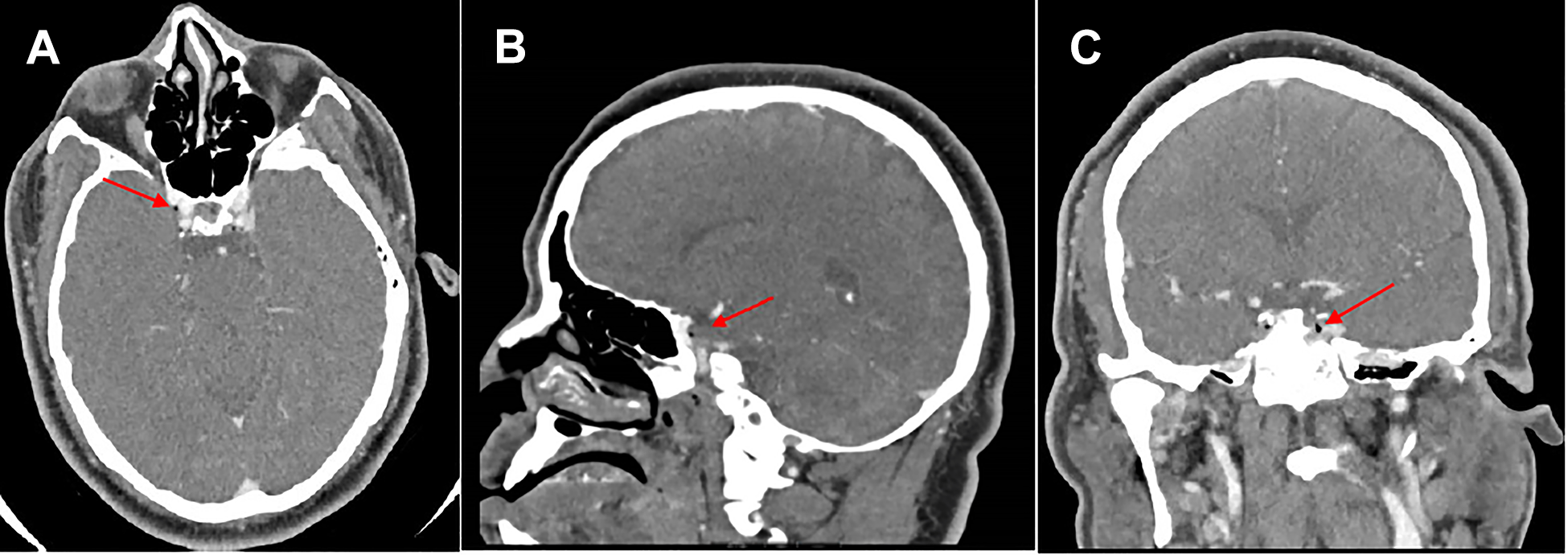
Axial (A), sagittal (B), and coronal (C) sections of contrast enhanced head and neck CT arteriogram. Red arrows indicates pneumocephalus in the cavernous sinus.
Pneumocephalus, or the presence of air or gas in the cranium, usually occurs in association with barotrauma, infection, nasal cannulation, neurosurgical interventions, or spinal anesthesia.1,2 Pneumocephalus in this patient was likely an incidental finding unrelated to his dizziness. Air embolism secondary to CT angiography is not uncommon and was the probable source.3 Because TEE did not reveal a cardiac shunt, air entry into the systemic circulation may have been due to an intrapulmonary shunt associated with sickle cell disease.4,5
Non-traumatic pneumocephalus may or may not be symptomatic. It may resolve spontaneously or require surgical treatment. Tension pneumocephalus can be a clinical emergency due to mass effect.6 Pneumocephalus raises the possibility of a CSF leak, which was not present in our patient. When intracranial pneumocephalus occurs after an intravenous injection, neurohospitalists should consider the presence of an intracardiac or intrapulmonary shunt.
Footnotes
Declaration of Conflicting Interests
The authors declared no potential conflicts of interest with respect to the research, authorship, and/or publication of this article.
Funding
The authors received no financial support for the research, authorship, and/or publication of this article.
