







Abstract
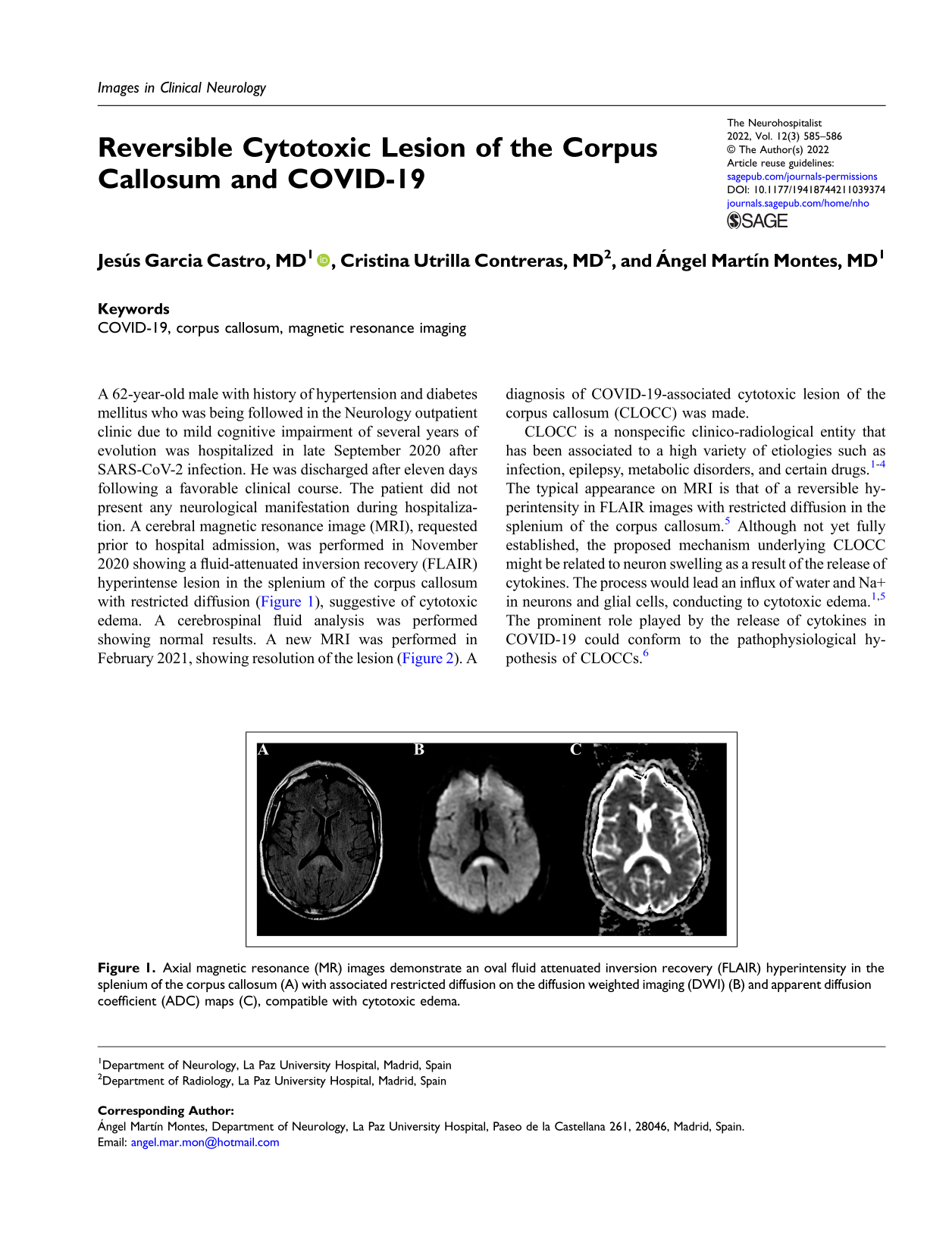
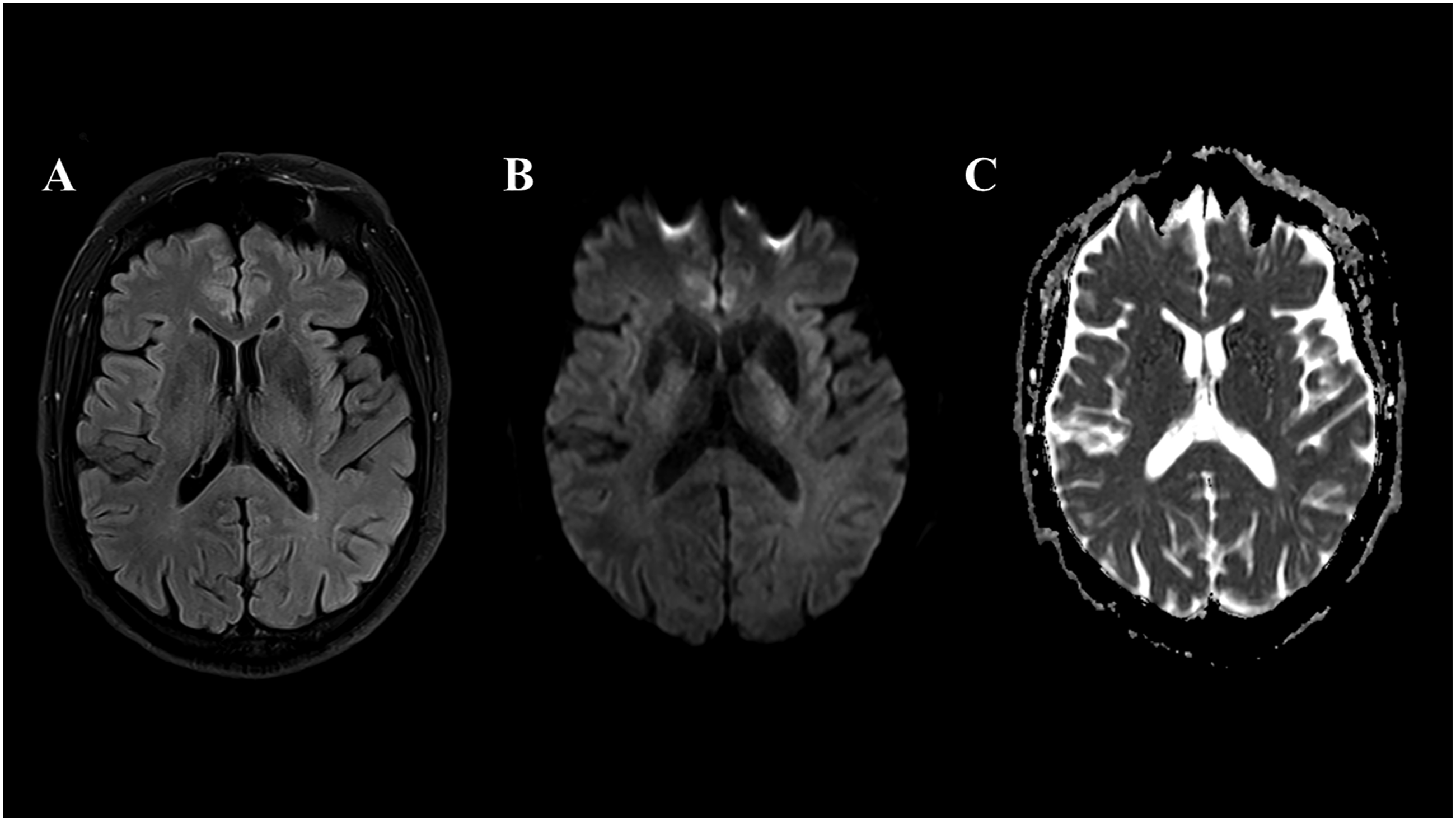
A 62-year-old male with history of hypertension and diabetes mellitus who was being followed in the Neurology outpatient clinic due to mild cognitive impairment of several years of evolution was hospitalized in late September 2020 after SARS-CoV-2 infection. He was discharged after eleven days following a favorable clinical course. The patient did not present any neurological manifestation during hospitalization. A cerebral magnetic resonance image (MRI), requested prior to hospital admission, was performed in November 2020 showing a fluid-attenuated inversion recovery (FLAIR) hyperintense lesion in the splenium of the corpus callosum with restricted diffusion (Figure 1), suggestive of cytotoxic edema. A cerebrospinal fluid analysis was performed showing normal results. A new MRI was performed in February 2021, showing resolution of the lesion (Figure 2). A diagnosis of COVID-19-associated cytotoxic lesion of the corpus callosum (CLOCC) was made. Axial magnetic resonance (MR) images demonstrate an oval fluid attenuated inversion recovery (FLAIR) hyperintensity in the splenium of the corpus callosum (A) with associated restricted diffusion on the diffusion weighted imaging (DWI) (B) and apparent diffusion coefficient (ADC) maps (C), compatible with cytotoxic edema. Follow-up MR imaging performed 3 months later showed almost complete resolution of the abnormal signal on axial FLAIR (A), DWI (B) and ADC map (C).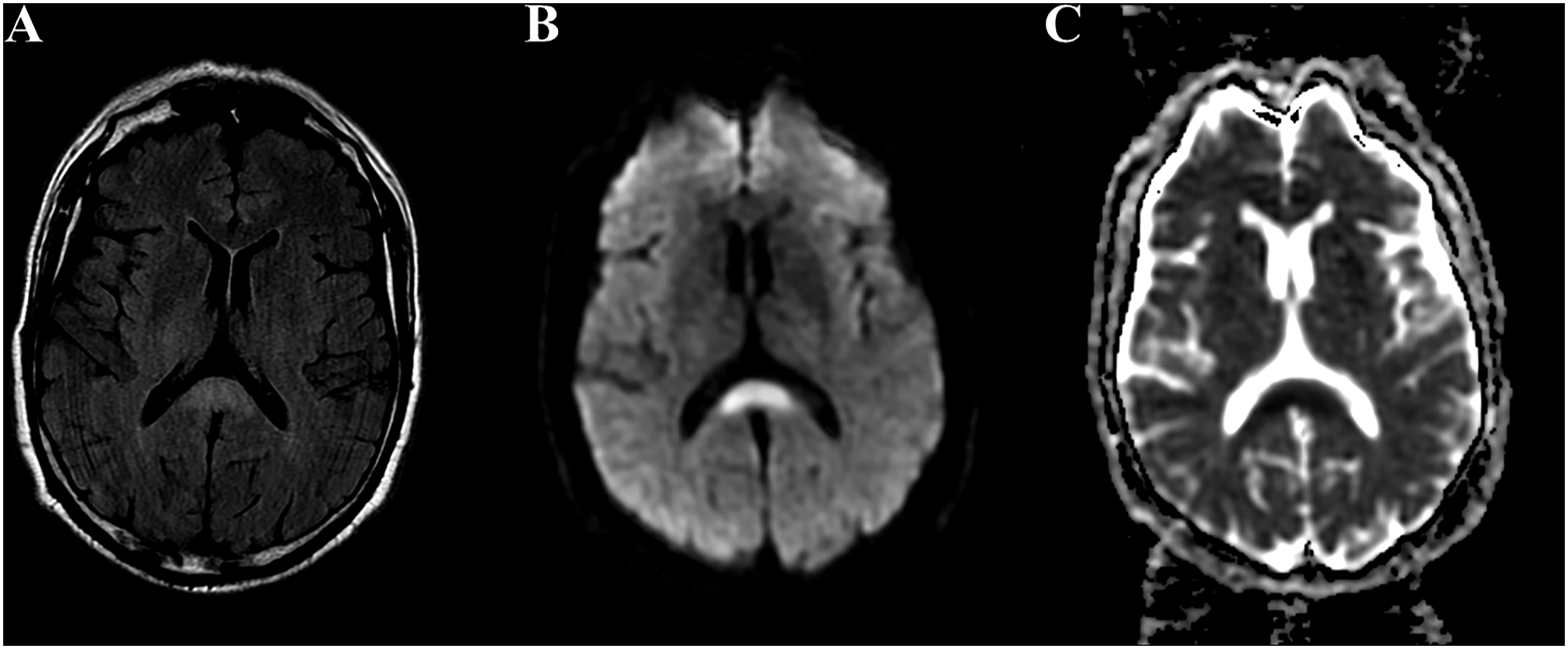
CLOCC is a nonspecific clinico-radiological entity that has been associated to a high variety of etiologies such as infection, epilepsy, metabolic disorders, and certain drugs.1-4 The typical appearance on MRI is that of a reversible hyperintensity in FLAIR images with restricted diffusion in the splenium of the corpus callosum. 5 Although not yet fully established, the proposed mechanism underlying CLOCC might be related to neuron swelling as a result of the release of cytokines. The process would lead an influx of water and Na+ in neurons and glial cells, conducting to cytotoxic edema.1,5 The prominent role played by the release of cytokines in COVID-19 could conform to the pathophysiological hypothesis of CLOCCs. 6
Footnotes
Declaration of Conflicting Interests
The author(s) declared no potential conflicts of interest with respect to the research, authorship, and/or publication of this article.
Funding
The author(s) received no financial support for the research, authorship, and/or publication of this article.
