







Abstract
Acute hemorrhagic leukoencephalitis (AHLE) is a rare but fulminant variant of acute disseminated encephalomyelitis, an uncommon immune-mediated demyelinating disorder. We report a case of AHLE in a 27-year-old pregnant woman who presented with acute onset of fever, aphasia, and a generalized seizure, followed by rapid neurological deterioration. The hallmark neuroimaging findings made the prompt diagnosis. The patient responded dramatically to high-dose corticosteroid therapy, with full neurological recovery. She subsequently delivered a healthy full-term infant and remained asymptomatic at one-year follow-up.
Keywords
A 27-year-old pregnant woman at 18 weeks of gestation presented with a one-week history of fever, slurred speech, and a generalized tonic-clonic seizure. There was no antecedent prodromal illness, sick contacts, or known precipitating event; fever and neurological symptoms developed simultaneously. Examination revealed global aphasia, spastic quadriparesis, and bilateral extensor plantar responses.
Magnetic resonance imaging of the brain showed multifocal, confluent hyperintensities on T2-weighted and fluid-attenuated inversion recovery sequences involving both cerebral hemispheres, thalamus, midbrain, and pons (Figure 1A and B). Susceptibility-weighted imaging revealed multiple punctate microhemorrhages (Figure 1C, arrows). Cerebrospinal fluid revealed 12 lymphocytes/μL, elevated protein (100 mg/dL), and normal glucose (60 mg/dL). Workup for autoimmune conditions, including oligoclonal bands and aquaporin-4 antibodies, as well as viral and other infectious etiologies, yielded negative results. Magnetic Resonance Imaging Showing Multifocal Confluent Hyperintensity Lesions on T2-Weighted and Fluid-Attenuated Inversion Recovery Sequences, Involving Both Cerebral Hemispheres, and the Left Thalamus, Midbrain, and Pons (A, B), With Microhemorrhages Noted on Susceptibility-Weighted Imaging (C, Arrows), Consistent With Acute Hemorrhagic Leukoencephalitis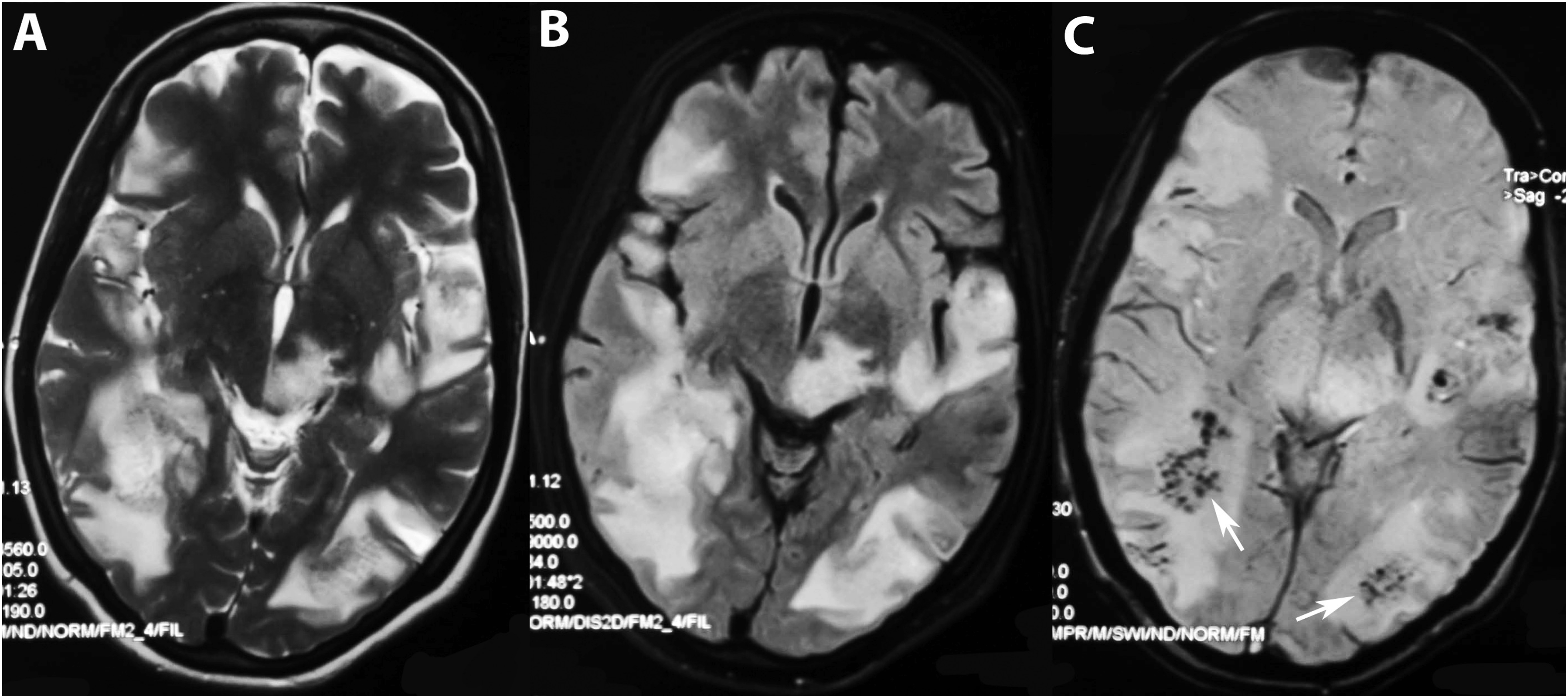
These findings were diagnostic of acute hemorrhagic leukoencephalitis (AHLE), a hyperacute, necrotizing form of acute disseminated encephalomyelitis, characterized by rapid neurologic deterioration, multifocal deficits, and extensive demyelination with hemorrhagic necrosis.1,2 AHLE is more frequently reported in males and is often associated with a preceding infection or immunologic trigger. 2 In this case, however, no specific precipitant was identified. The patient was treated with high-dose intravenous methylprednisolone (1 gram daily for five days), followed by a tapering course of oral corticosteroids over six weeks. She showed marked neurological recovery, remained asymptomatic at one-year follow-up, and delivered a healthy full-term infant.
This case illustrates the classic imaging features of AHLE—a rare but life-threatening demyelinating syndrome. Early recognition and immunosuppressive therapy are crucial for favorable outcomes. In pregnant patients with acute encephalopathy and hemorrhagic brain lesions, AHLE should be considered as a differential diagnosis, alongside more common conditions such as posterior reversible encephalopathy syndrome and cerebral venous sinus thrombosis, even in the absence of an identifiable trigger.
Footnotes
Author Note
The corresponding author is responsible for ensuring that the descriptions are accurate and agreed upon by all authors

Consent to Participate
Written informed consent is present. The patient’s brother was explained about the confidentiality, and the case information will be used for education purposes only.
Author Contributions
AT: Writing-original draft (supporting); Writing-review & editing (lead)
AS: Data curation (supporting); Writing-original draft (supporting)
VB, NB: Data curation (supporting)
AKP: Conceptualization (lead); Writing-original draft (lead), Writing-review & editing (supporting), Data curation (supporting)
Funding
The authors received no financial support for the research, authorship, and/or publication of this article.
Declaration of Conflicting Interests
The authors declared no potential conflicts of interest with respect to the research, authorship, and/or publication of this article.