






Abstract
Staff development is an important role of the school nurse, yet little is written to assist the nurse in this role. Though some obtain advanced degrees in education, most school nurses are not prepared for the staff development role without further education in pedagogy, teaching strategies, and evaluation methods. This article presents discussion as one of many active teaching strategies that can engage learners and promote critical thinking. More work is needed in the area of course design and implementation, as well as additional research to help identify the most effective teaching strategies for school employees.

Over the past decade, schools have been increasingly mandated to provide training for staff members on topics such as relief of foreign body airway obstruction, blood-borne pathogens, and child abuse recognition and reporting. Additionally, childcare staff in Ohio are required to receive training in communicable diseases, first aid, and cardiopulmonary resuscitation as part of a required (or “totaling”) 15 hours of staff development training each year (Ohio Department of Education, 2009). School nurses are increasingly called upon to present this content, and NASN standards of practice support this teaching role (American Nurses Association, 2011).
Though some school nurses obtain advanced degrees in education, they are not usually prepared for the staff development role without further education in pedagogy, teaching strategies, and evaluation methods. Many rely on PowerPoint presentations in lecture format instead of using more engaging teaching strategies. Learning principles of curriculum and course development are a starting point to developing the teacher role of the school nurse. Choosing an effective teaching strategy is a second important aspect of course development. The purpose of this article is to discuss considerations for teaching adults and explore discussion as an effective strategy that will stimulate active learning while engaging faculty and staff in the process of critical thinking.
Though health education is frequently cited within the scope of school nursing practice, it is most often in the context of the individual and classroom teaching of students or as a resource for classroom teachers, including providing input into curriculum development (Broussard, 2004). Proctor (2006) and McHenry, Silver, and Wolfe (2006) described faculty and in-service education as a part of the health teaching and health promotion standard of practice for school nurses.
Adult Learning
With in-service programs being focused on faculty and staff, it is important to realize the difference between learning styles of children and adults. School nurses proficient in classroom instruction with students will need to consider the unique needs of adult learners. There are several theories about how adults learn, as well as different domains of knowledge. Review of adult learning theory is beyond the scope of this article, though Mintor (2011) summarized some important assumptions regarding the teaching of adults. He pointed out that the adult learner brings a wealth of experience to the learning environment, along with a self-directed focus. Adults prefer to be actively engaged in learning and prefer a facilitator who is learner focused. They have a great foundation on which to build new information for their own use. Additionally, it is important to consider the many ways that adults learn. Various dynamics influence learning, including motivational factors, learning styles, amount and type of professional experience, educational preparation for their role, and the context of learning (e.g., required vs. elective) (Sherwin, 2010; Wellman, 2009). Using a variety of teaching strategies (in addition to presentation style) is most likely to support the various dynamics and multiple learning styles of adults (Bain, 2004; Gross Davis, 2009; McKeachie & Svinicki, 2011).
Bloom’s taxonomy is a way of identifying and classifying various domains of learning and cognitive levels. Benjamin Bloom is credited with this classification system, created in 1956 and revised in 2001 (Erickson, Peters, & Strommer, 2006). The taxonomy describes cognitive, behavioral, and affective domains. In the cognitive domain, the learner is concerned with concepts including understanding, reasoning, and application of information. The behavioral domain is related to learning specific physical tasks or motor skills. Finally, the affective domain is concerned with developing values (McDonald, 2007; Onega & Devers Barbero, 2010). For example, in a staff in-service about removal of a foreign object from an airway, an instructor would want to address the behavioral domain of teaching, which would encompass the motor skills necessary to perform abdominal thrusts on a choking victim. The cognitive domain might be addressed in a communicable disease presentation through helping learners develop a prevention strategy by assimilating what they have learned about the spread of disease using a chain of infection model. In a child abuse prevention course, learners may be impacted in the affective domain by learning to view perpetrators of violence as individuals with poor coping skills and a lack of support systems, two characteristics associated with those who abuse (Ohio Department of Jobs and Family Services, 2007). This could have far-reaching consequences by inspiring participants to create an environment of family support, which could result in the prevention of abuse.
Further, all three domains might be utilized for a single subject. Utilizing the removal of a foreign body from an airway example given above, the cognitive and affective domains can be secondary focuses. The instructor can use the cognitive domain to help the learner understand why abdominal thrusts are effective. The affective domain is utilized when the instructor reminds students that in a choking episode, the victim is typically embarrassed and often seeks to retreat to a restroom or other place out of site of the remaining individuals. Helping the adult learners relate to the past embarrassment they have felt while choking has the possibility of strengthening the effectiveness of the instruction, namely, to never let a choking victim go off by themselves.
In regard to effective teaching strategies, there are many that are appropriate for adult learners. Some examples include problem-based learning, where a group works toward the solution of a case study over a matter of time, utilizing role plays, electronic communication strategies, or multimedia, to name a few (Bradshaw & Lowenstein, 2011). Discussion is one teaching strategy that has been found to be particularly effective with adults. Therefore, this strategy will be explored for the remainder of the article.
Discussion Method
Discussion facilitates the adult learner’s ability to use past experiences to build new knowledge. Brookfield and Preskill (2005) identified many benefits of discussion, including helping learners develop a tolerance for ambiguity and diversity, as well as foster critical thinking skills. The authors pointed out the benefit of encouraging good listening skills and improving collaborative learning. They also asserted that discussion helps students scrutinize their assumptions by testing them out in small group settings. This process, according to the authors, “increases intellectual agility” (p. 22).
Further, discussion requires a certain amount of exposure to the topic at hand. Ezzedeen (2008) asserted that “prior preparation boosts students’ confidence and fosters a greater desire to participate” (p. 233). Because pre-reading isn’t always possible prior to in-service programs, it’s important to plan how to provide some background information before the opening of a discussion. This could be in the form of a short reading assignment on the day of the meeting or the presentation of a short video clip. It might also be effective to invite those in the group with experience to share their knowledge or expertise, enriching the knowledge base of the group.
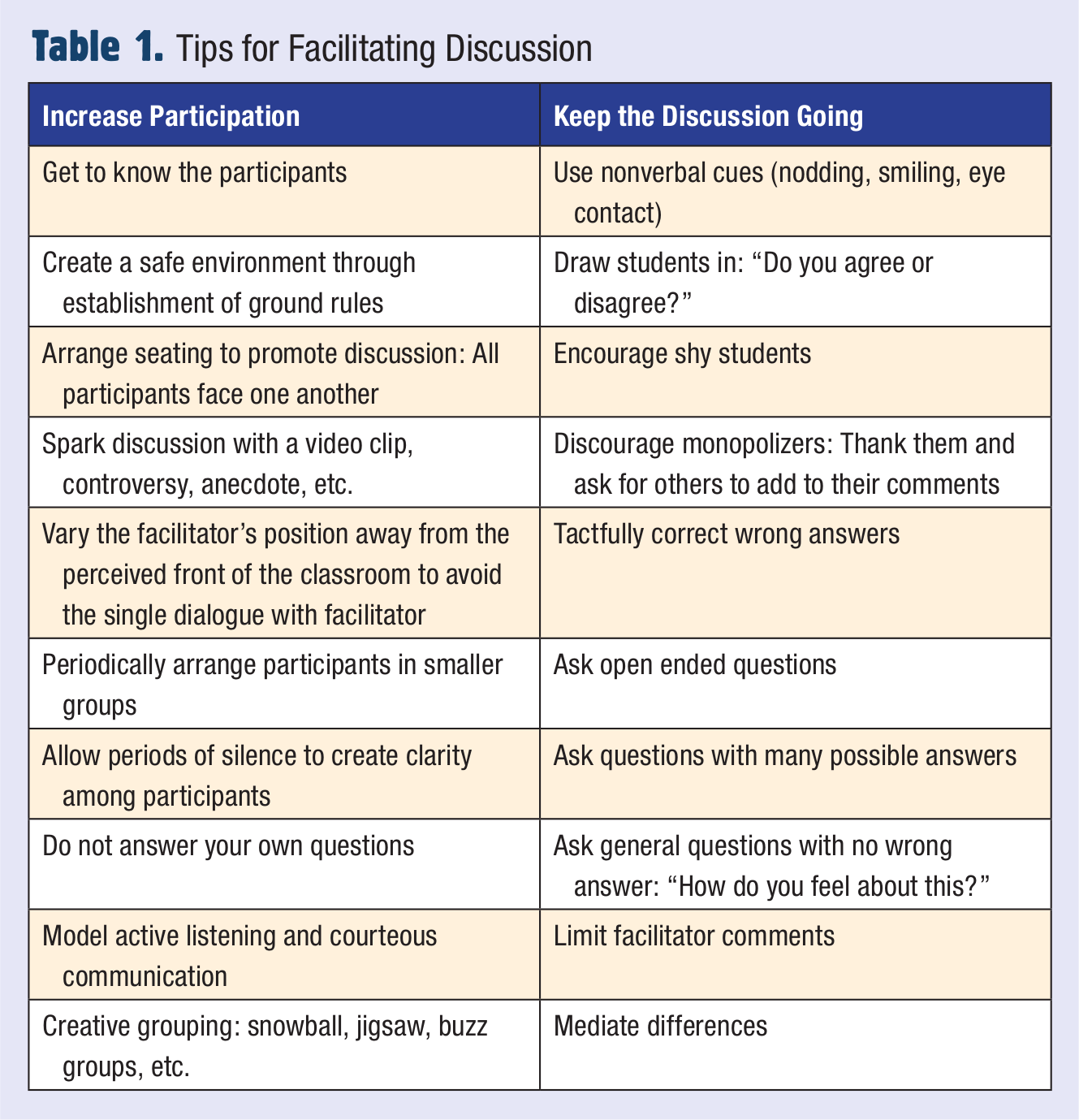
When choosing discussion as a teaching strategy, planning for seating is especially important. Arranging the room in a circle or, for larger groups, a horseshoe can eliminate obstacles such as desks and other participants by creating a seating arrangement where all participants can see one another (Edmunds & Brown, 2010; Ezzedeen, 2008). Arranging the space so that the facilitator is not at the perceived front of the classroom will encourage participants to talk with one another rather than dialoguing with the instructor (Gross Davis, 2009).
Discussion is more productive and effective if ground rules are established at the beginning. According to Landis (2011), “when people feel safe, listened to and understood, their performance is enhanced” (p. 88). Ground rules establish an atmosphere where participants are respected (Brookfield & Preskill, 2005; McCann, Johannessen, Kahn, & Flanagan, 2006). Bain (2004) added that an environment where learners can try, fail, and learn by their mistakes adds to a learner’s sense of safety. Participants can assist with the development of ground rules at the beginning of the in-service, and these can be written on a dry erase board or newsprint for ease of reference throughout the program.
Getting a discussion started can be challenging for several reasons. Sometimes participants have developed passive learning habits from past lecture-style presentations. Others may fear criticism, believing that the facilitator is looking for a specific answer (McKeachie & Svinicki, 2011). Still others may avoid participating in discussions for cultural reasons (Gross Davis, 2009). As shown in Table 1, these obstacles can be minimized by talking with staff about the method of instruction, detailing the value of discussion, creating ground rules, and giving tips for participating in discussion (Erickson et al., 2006; Gross Davis, 2009). Facilitators can model good listening techniques, keeping an open mind and giving encouragement to others. This creates a safe environment, conducive to effective and meaningful discussion.
Tips for Facilitating Discussion
There are various creative grouping ideas that can keep a discussion lively and learners engaged. Though this is not an exhaustive list, several will be discussed here. Brookfield and Preskill (2005) presented many of the techniques, including snowballing (also known as pyramid), jigsaws or crossover groups, buzz groups, and newsprint dialogue.
In
Structured buzz groups are given an agenda to follow and are expected to come up with answers to specific questions. Brookfield and Preskill (2005) suggested allowing some flexibility and choice in answering questions so that spontaneous exploration of the topic can still take place. This way, if the group wants to explore a compelling facet of the topic, freedom allows them to stray from the suggested direction proposed by the given agenda. The authors also suggested maintaining group sizes of four to five participants so that discussion is more manageable.
Brookfield and Preskill (2005) also described a technique for reporting discussions back to larger groups, where a group summarizes discussion results on
Conclusion
Though responsibilities for staff training are increasing, not much is written addressing the role of the school nurse in staff development. This article has highlighted important considerations when planning for adult learning, suggesting discussion as an effective teaching strategy to support active learning and engagement of faculty and staff. Several challenges of the discussion technique have been presented, including strategies to overcome or limit these obstacles.
The educator role of the school nurse is varied and expansive. Effective teaching strategies for staff are only one piece of the puzzle. More work is needed in the area of course design and implementation. Research would help identify the most effective teaching strategies to employ with staff members. By following a systematic plan of course development, school nurses can provide high quality faculty and staff education, making an important contribution to quality schools. ■
Footnotes
Acknowledgements
The author wishes to thank Heather Janiszewski Goodin, PhD, RN, for her support, encouragement, and contagious enthusiasm, as well as thoughtful review of earlier drafts of this work.
Amy is a school nurse, serving the pre-kindergarten children and families of the Columbus City School District in Columbus, Ohio. She also provides staff development opportunities in the district for the Department of Early Childhood Education.