






Abstract
Sports-related concussions (SRCs) are not uncommon among teen athletes. School nurses are in an ideal position to care for athletes affected with SRCs. However, evidence suggests there is a lack of knowledge regarding concussion management, use of baseline concussion testing, and active involvement on concussion management teams among school nurses. This article briefly examines the use of baseline concussion testing as a tool for assessing and managing the student athlete suffering from an SRC. The role of the school nurse on concussion management teams will also be explored. As active members of concussion management teams, working closely with athletic trainers, coaches, school administration, and local medical providers, school nurses have the opportunity to evaluate for return to learn and play, ultimately improving outcomes of student athletes suffering from SRCs.
Keywords
School-sponsored contact sports are common activities among children and adolescents across the globe. However, with participation in contact sports comes the danger of head injuries, specifically concussions (Podolak et al., 2021). In the United States, it is estimated that between 1.6 million and 3.8 million sports-related concussions (SRCs) occur from sports each year (Halstead et al., 2018). Of these SRCs, 1.1 million to 1.9 million occur in children 18 years of age or younger (Bryan et al., 2016; Podolak et al., 2021).
Historically, the Centers for Disease Control and Prevention (CDC) has provided tools such as the Acute Concussion Evaluation (ACE) form and the ACE care plans to aid providers in diagnosing concussions and guiding student’s recovery following a concussion (CDC, 2022). However, these tools do not provide a student athlete’s baseline information to the provider as a means to compare the extent of impairment postinjury. In an effort to provide direction regarding management of symptoms, return to play, and risks with recovery after an SRC, the CDC released evidence-based guidelines in 2018 (Sarmiento, Thomas, et al., 2019; Worley, 2019). An element of these guidelines is the use of baseline concussion testing (BCT). BCT is a neuropsychological tool that provides objective data regarding cognitive function, physical, somatic, and neurobehavioral symptoms that include memory, reaction time, and attention span (CDC, 2020; Weber et al., 2019).
An initial BCT should be performed prior to the start of the sport season (CDC, 2020; Weber et al., 2019). After an injury occurs, an additional BCT should be conducted, allowing for comparison of postinjury results to the initial BCT results, which can help determine the extent of the head injury as well as provide guidance for returning to learn and play (Dobney et al., 2018; Halstead et al., 2018; Weber et al., 2019). While BCT is not recommended to be the only determining factor in return to learn and play decisions, it can provide valuable data to guide these decisions (Halstead et al., 2018).
Moody et al. (2019) performed a systematic review of BCT tools and their use in evaluation of injured athletes. Results showed that the three most used assessment tools were the ImPACT, Sport Concussion Assessment Tool–5th Edition (SCAT5), and King-Devick (K-D) tools.
ImPACT
ImPACT testing is available in both baseline and postinjury format for ages 10 years and older. A pediatric ImPACT tool is available for ages 5 to 9 years. ImPACT assesses four areas: (a) verbal memory, (b) visual memory, (c) visual motor speed, and (d) reaction time. In addition, a 22-question symptom inventory is included to assist with assessment. Trained healthcare professionals must interpret postinjury scores (ImPACT Applications, Inc., 2021).
SCAT5
The SCAT5 tool is used for athletes aged 13 years and older, and a child SCAT5 is available for use in children aged 12 years or younger (Echemendia et al., 2017; Sport Concussion Assessment Tool–5th Edition, 2017). SCAT5 is used at the beginning of the season to collect baseline data and again after injury for comparison. Data collected includes (a) background information; (b) symptom evaluation, and (c) cognitive screening, which consists of immediate memory, concentration, balance, and delayed recall. An additional section is available for evaluation of on-field injuries and can quickly be administered to the injured athletes in just 10 minutes. On field screening of the injured athlete includes observation for signs of confusion, balance, and gait disturbances, use of the Maddock’s memory assessment, Glasgow Coma Scale, and cervical spine assessment (Echemendia et al., 2017). A trained staff should administer the SCAT5; however, if no trained staff is available a modified tool, the Concussion Recognition Tool 5 can be utilized.
King-Devick
K-D is an easily administered BCT that requires a participant to read while being timed. The tool measures attention, language function, and rapid number naming, which requires the integration of eye movements and number identification and may be used in addition to other sideline assessments of balance and cognition. K-D can be administered by parents, coaches, or any other members of the concussion management team, to anyone 5 years or older (King-Devick Technologies, Inc., 2022).
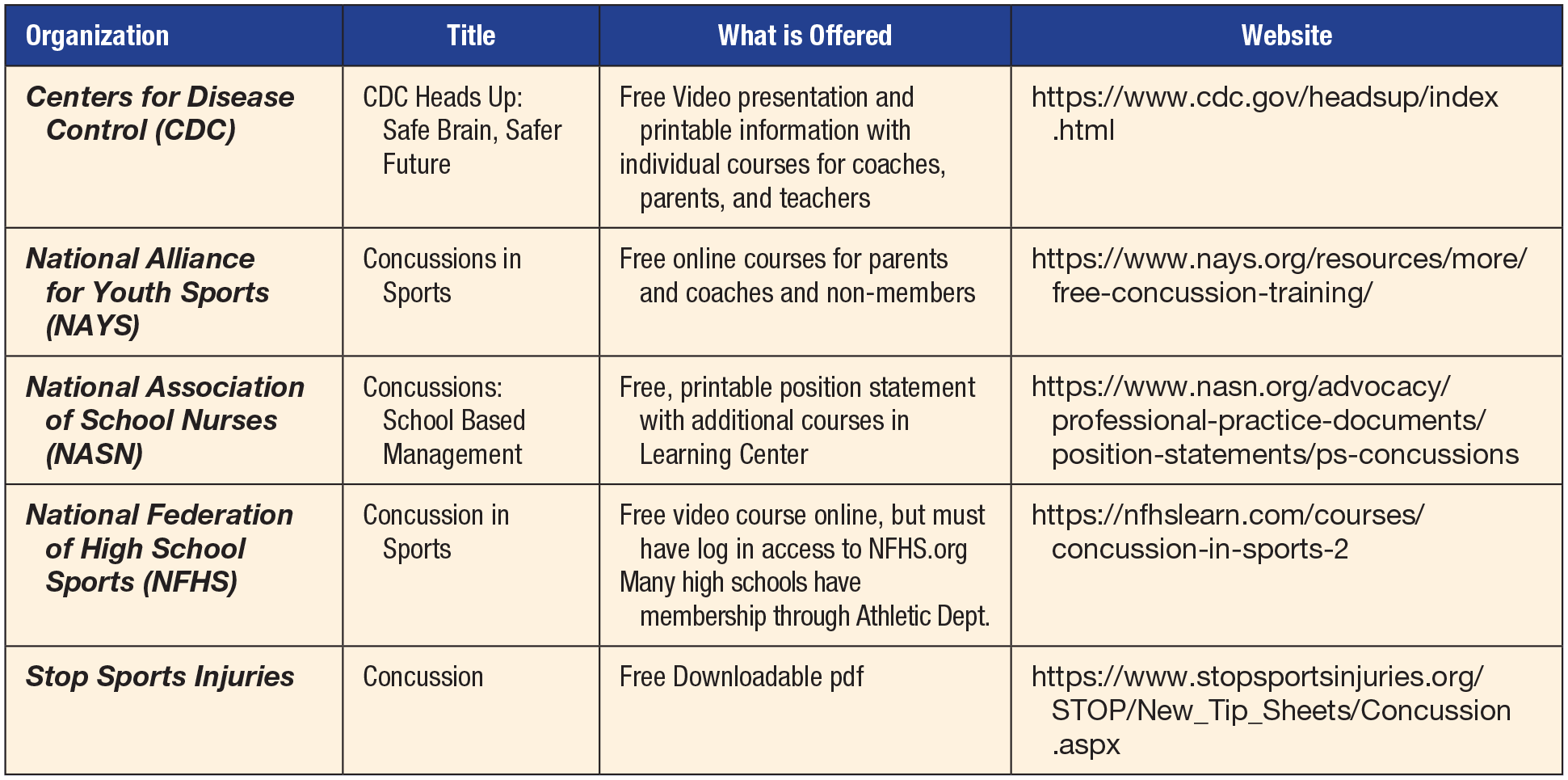
Variations among these three tools, affecting the decision for use among healthcare providers, are illustrated in Figure 1.
Comparison of Baseline Concussion Testing Tools
School Nurse Role in Concussion Management
School nursing is grounded in community/public health with a focus on community health promotion (National Association of School Nurses [NASN], 2018). In the United States, there are 95,776 full time equivalent school nurses who play an important role in the care of athletes with SRCs (Willgerodt et al., 2018). As healthcare providers for student athletes, school nurses should be an integral part of the concussion management team (Hall & Ketcham, 2017; Weber et al., 2019). NASN (2021) recommends that the concussion management team include the school nurse, athletic trainer, primary care provider, parents, school guidance counselor, and school psychologist, with the school nurse assigned to lead the team. Unfortunately, many schools either do not have a designated team, or the school nurse is not part of the decision-making process (Welch Bacon et al., 2018).
Although the goal is to have student-athletes return to learn and play as quickly as possible after an SRC, there is lack of a single objective standard or validated data to demonstrate the length of time a student–athlete should rest before returning to play (Davis et al., 2017). In most cases, students will be able to return to school before being released to return to their sport, typically within 2 to 3 days (CDC, 2019). Once a healthcare provider has given permission for the student to return to the classroom, the school nurse can help monitor the student closely (CDC, 2019). School nurses can utilize BCT information in developing return to learn protocols so that student athletes may safely return to the learning environment prior to their return to play (Weber Rawlins et al., 2020). School nurses also collaborate with teachers to ensure learning recommendations are in place postinjury because a return to learn should occur before return to play (Hall & Ketcham, 2017; Weber et al., 2019). Assessment of the student in the classroom includes monitoring the concussed student’s attention, behavior, mood, and memory. Data from these assessments provides the nurse the information needed to recommend appropriate rest breaks for the student, adjusted length of time at school, and accommodations for assignments as needed postconcussion (CDC, 2019).
School nurses may be the only healthcare provider that has access to the athletes during the school day, giving them the unique opportunity to act as a liaison between the concussion management team, teachers, parents, and coaches (Weber et al., 2019; Welch Bacon et al., 2018). Therefore, it is necessary for school nurses to be knowledgeable about postconcussion care and BCT administration. Since school nurses come from diverse professional backgrounds, BCT knowledge and training lack consistency (Pietz et al., 2021; Sarmiento, Donnell, et al., 2019; Worley, 2019).
Wing et al. (2016) surveyed 151 elementary, middle, and high school nurses. Findings from the survey demonstrated that while 58% of nurses indicated they had received education regarding concussion diagnosis and management, only 19% felt adequately prepared to be part of a rehabilitation team for a concussed student. Additionally, only 48% of the school nurses were able to correctly recognize all the strategies to help concussed students in the school setting. Similarly, Pietz et al. (2021) surveyed 315 public school nurses and found that while 70% of school nurses felt comfortable managing a student’s return to learn, only 48% of these nurses felt confident in managing an athlete’s return to play postconcussion. These findings demonstrate the need for ongoing concussion management education for school nurses.
Another key challenge for school nurses in concussion management is lack of support and collaboration among the concussion team members. Welch Bacon et al. (2018) performed a qualitative study exploring 315 school nurses’ perceived challenges with concussion management procedures. Data were collected by semistructured phone interviews with findings demonstrating that school nurses felt there was a lack of education and consistent training among school staff involved in concussion care, noting inconsistencies in the treatment plans of different members of concussion management teams. By providing continued education and promoting open communication, school nurses can play a vital role in improving the entire concussion management process (Welch Bacon et al., 2018).
Project Findings on School Nurse Knowledge
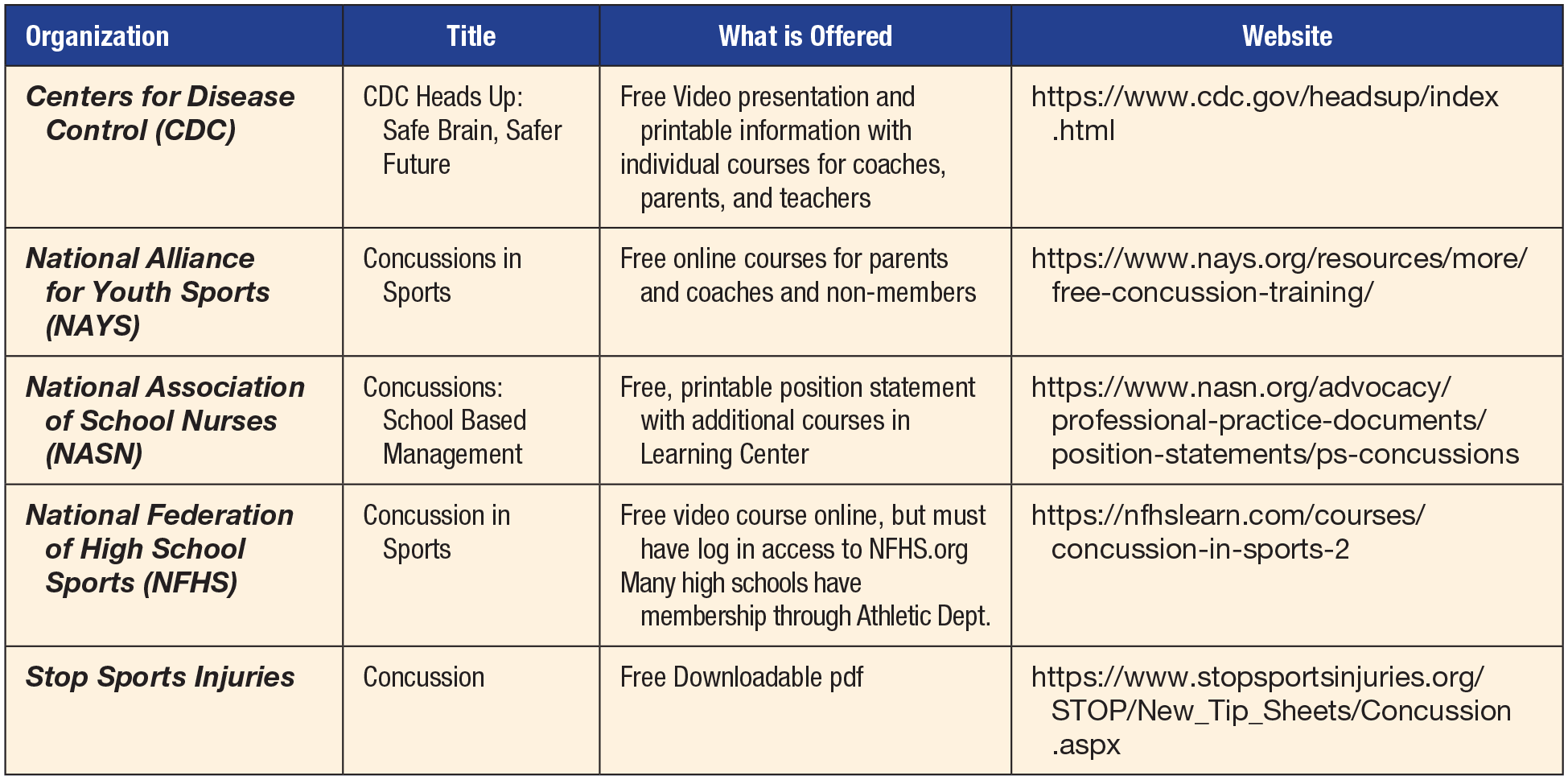
In an attempt to provide school nurses with BCT information and encourage the role of the school nurse as an active leader on the concussion management team, we implemented an evidence-based project. After receiving institutional review board approval, an online education session was developed and emailed to 89 school nurses from five counties in Northeast Ohio. The information was delivered via Google Slides and included the following information: (a) how to recognize concussion symptoms and outcomes associated with concussions among students, (b) the purpose of BCT, (c) the three most commonly used BCT screening tools, and (d) identifying and advocating for the role of the school nurse in BCT. This training is similar to resources that are provided in Figure 2, with the addition of information specific to BCT for school nurses which was not found in other resources. The school nurses were asked to view the education session and then complete a brief, anonymous survey via Google Forms. Thirty-two school nurses viewed the presentation and completed the survey.
Online Trainings and Printable Information on Concussions for School Nurses
Surveys were sent to school nurses serving middle and high school students, but as school nurses often care for students across multiple grades within a district, it should be noted that there was overlap in grade assignment. Of the 32 respondents, 28 worked in a kindergarten through Grade 5 building, 22 worked with Grades 5 to 8, and 21 worked with high school–level students. The respondent’s years of experience as a school nurse ranged from less than 1 year to greater than 20 years.
When the school nurses were asked if they were aware of BCT, 12 of the 32 nurses stated they were unaware of BCT prior to this education session. In addition, 23 of the school nurses stated they had never utilized BCT or BCT scores despite 27 claiming to have cared for students that had suffered a concussion. Similar to the findings from Weber et al. (2019), the school nurses surveyed reported barriers to implementing BCT as time, money, and limited resources and personnel. It is also possible that the lack of BCT use could be an indicator that the school nurses in this survey were not active members of concussion management teams. This demonstrates a need for BCT education and advocacy among school nurses to potentially improve outcomes of student athletes afflicted with SRCs (Halstead et al., 2018). A list of some available training sessions and resource information about concussion management can be found in Figure 2.
Conclusion
Given the prevalence of SRCs among student athletes, proper care and management is essential. School nurses should have an active role in caring for these injured students (Weber et al., 2019) and therefore, should be a leader on the concussion management team (NASN, 2021). School nurses are instrumental in guiding a student’s return to learn by working with parents and teachers to monitor a concussed student’s attention, behavior, mood, and memory (CDC, 2019). They can provide accommodations for the students’ learning environment and experience as they closely monitor their progress. BCT is one available tool that can be used to offer guidance for the student athlete’s safe return to learn and return to play after an SRC has occurred (CDC, 2020). Findings from the literature (Halstead et al., 2018; Pietz et al., 2021; Weber et al., 2019; Wing et al., 2016) as well as this project, demonstrate that consistent education regarding BCT and the role of the school nurse should be provided for all members of the concussion management team to ensure consistency in the care for the concussed student-athlete. Furthermore, information about concussion symptom identification, proper use of BCT and management of the student with an SRC would be beneficial to include in new school nurse orientation programs, as well as continuing education for school nurses in current practice.■
Footnotes
Acknowledgements
We would like to thank Sheri Hartman, PhD, APRN-CPNP, for her assistance and support on this article.

Dawn has been a registered nurse for 14 years in a variety of inpatient settings. She is pursuing an MSN degree at Malone University in Canton, OH in the FNP Program with expected graduation in August 2022.
Renae worked as a school nurse for over 20 years and currently attends Malone University pursuing a degree as a family nurse practitioner, with graduation expected in August 2022. Her work was instrumental in beginning baseline concussion testing in local football programs.
Alexa has a background in orthopedic medicine and is currently working as a pediatric registered nurse.