






Abstract
To promote health equity and address an increasing need for nurses, educational pathways and mentorship programs for students who want to pursue a nursing career should be considered during the earlier stages of secondary education. Several school nurses in the Brandywine School District in Delaware piloted a program to introduce middle school students to a career in nursing. Recognizing the racial, ethnic, and gender disparity in the nursing workforce, nurses sought out Black/African-American, Hispanic, and male students, populations who are underrepresented in nursing. Nurses informed students about a career in nursing and offered information on pathways to pursue an education in nursing. The program is intended to give a realistic perspective on the duties of nurses and to provide a level of educational and collaborative support from parents and faculty to assist students to transition into postsecondary nursing education programs. The current nursing shortage is a multifaceted issue creating an extreme need for nurses, particularly baccalaureate-prepared nurses who provide culturally competent and safe patient care. The BSD Lifesavers program aims to create programs and policies to promote a more diverse nursing workforce that will provide equitable health care for all communities.
Introduction
The number of registered nurses has increased since 2018, but nursing shortages are still expected across the country as more intense nursing care is needed to address increasingly complex health issues, including an aging population of baby boomers, mental health, and the impact of social determinants on health. To further compound the projected need for more nurses, one-fifth of the most experienced nurses expect to retire within the next five years (National Academies of Sciences, Engineering, and Medicine; National Academy of Medicine; Committee on the Future of Nursing 2020–2030, 2021).
In addition to the projected shortages, the current nursing workforce does not reflect the make-up of the population in the United States. Of all healthcare providers, it is nurses who spend the most time with patients and their families in their communities (Ackerman-Barger et al., 2022). Nurses who represent the clients they serve help to provide culturally competent care, establish trust, and build relationships within the community, addressing the issues that impact health equity (National Academies of Sciences, Engineering, and Medicine; National Academy of Medicine; Committee on the Future of Nursing 2020–2030, 2021). While an increasingly diverse population of younger nurses have entered the workforce, the most recent national workforce study indicates that 81% of registered nurses identify as white, 6.7% identify as Black/African American, and 5.6% identify as Latino/Hispanic. Only 9.7% of nurses are male (Smiley et al., 2021). Current U.S. demographics show that 75.8% of the population are White, 13.8% are Black/African American, and 18.9% are Latino/Hispanic (U.S. Census Bureau, 2022). African Americans, Latinos, and Native Americans comprise approximately 35% of the total population of the United States, and yet, the nursing workforce data demonstrate that less than 13% of the nursing workforce is representative of these groups (Smiley et al., 2021). Males are also underrepresented in the field of nursing.
Impact of COVID-19
The need to provide culturally diverse health care providers has become even more evident during the COVID-19 pandemic. The pandemic has drastically affected multifaceted variables such as race and socioeconomic status that contribute to persistent health disparities and perpetuate inequalities (National Academies of Sciences, Engineering, and Medicine; National Academy of Medicine; Committee on the Future of Nursing 2020–2030, 2021). Not only has the COVID-19 pandemic caused these health disparities to exacerbate but it also shows the importance of policy implementation. These inequities cannot be fully addressed by continuing to do what has always been done (Ackerman-Barger et al., 2022). Healthcare leaders have a moral duty to examine and address the upstream conditions to create equitable health care systems and develop strategies to better handle public health crisis in the future.
Healthcare leaders have a moral duty to examine and address the upstream conditions to create equitable healthcare systems and develop strategies to better handle public health crisis in the future.
-Alexandra Randolph
Background
Increasing the number of baccalaureate-prepared nurses, who provide culturally competent care to a growing minority population is crucial to address the increasingly complex needs in our communities. To tackle the factors contributing to this multifaceted need for nurses, we need to innovatively disrupt the status quo and begin recruitment into the nursing profession at an early age.
Middle school has proven to be a critical time for career development and can be utilized as an avenue to reach underrepresented populations within the field of nursing. Although rigorous studies are limited, numerous programs indicate that traditional approaches of waiting until high school to declare interest in nursing may be too late (Williams, 2018). School counselors noted that middle school students should accrue authentic developmentally appropriate experiences to develop foundations of a profession’s attitudes, beliefs, and competencies (Williams, 2018).
Between 2007 and 2010, the U.S. Department of Health Resources and Services Administration (HRSA) provided workforce development grants to reduce racial and ethnic health disparities in health care. During this time, several projects offered middle school programs to encourage students to consider a career in nursing/health care. This approach allows students time in high school to make appropriate choices to put them on this career path (Knight et al., 2011; Moutseous & Heckel, 2013; Williams, 2018). Unfortunately, longitudinal data to determine if students did in fact pursue a career in health care from these projects is lacking, although all of the programs were very positive with student, parent, and staff satisfaction.
Brandywine School District Lifesavers Program
The most recent Delaware Nursing Workforce Data indicate that 86% of registered nurses are white, while 7.5% are Black/African Americans. Ninety-two percent of nurses identify as female (Delaware Nurses Association, 2014). These statistics are mirrored in Delaware’s school nursing landscape, as an assessment portrayed the reality that it has been difficult to hire school nurses of color, nurses from underrepresented groups, and males because they are not applying for the positions. To address the underrepresentation of minority groups in nursing, Brandywine School District (BSD) school nurses designed this program to work with the resource most readily accessible, their students. One middle school nurse observed that many of her Black/African American students had not considered a nursing career to be an option. She found that many of her students would be first-generation college students and did not have the support systems in place to consider or support a nursing career choice.
Program Development
The goal of the BSD Lifesavers Program is to provide a pathway to nursing education and engage students from population groups that have shown to experience barriers to health and health care. The BSD partnered with the Delaware Nurses Action Coalition, Delaware’s arm of the Future of Nursing Campaign for Action (https://campaignforaction.org/about/) to address nurse’s role in improving health equity and was one of six states awarded the 2021 Innovation Fund Grant from the Center to Champion Nursing in America. In addition, the program received matching funds from the BSD and the University of Delaware School of Nursing.
The school nurse team’s knowledge of systems that prevent students, particularly students of color and boys, from considering a nursing career propelled their recruitment plan. The nurses sought administrator, teacher, and counselor input. Staff members in the Brandywine School District Program, Advancement via Individual Determination (AVID) Educational Courses, helped to identify students who have the potential to succeed but may lack the familial and/or structural support to identify and strive for attainable goals.
A major objective within the BSD Lifesavers program was to provide students a realistic view of the rigor required in nursing education, going beyond the perspective of nursing being solely considered a “caring” profession. Individuals with a distorted perspective may not succeed if the necessary educational groundwork is lacking (Glerean et al., 2017; Williams, 2018). Nursing was promoted as a S.T.E.M (Science, Technology, Engineering, and Math) career, dispelling myths or any preconceived views about nursing.
Nurses recognized the learning needs of middle school students in developing the curriculum. The curriculum targeted four areas of learning:
Nursing as a career,
Professionalism,
Skills, and
Population health as shown in Table 1.
BSD Lifesaver Curriculum Weekly Lesson Topics and Tools
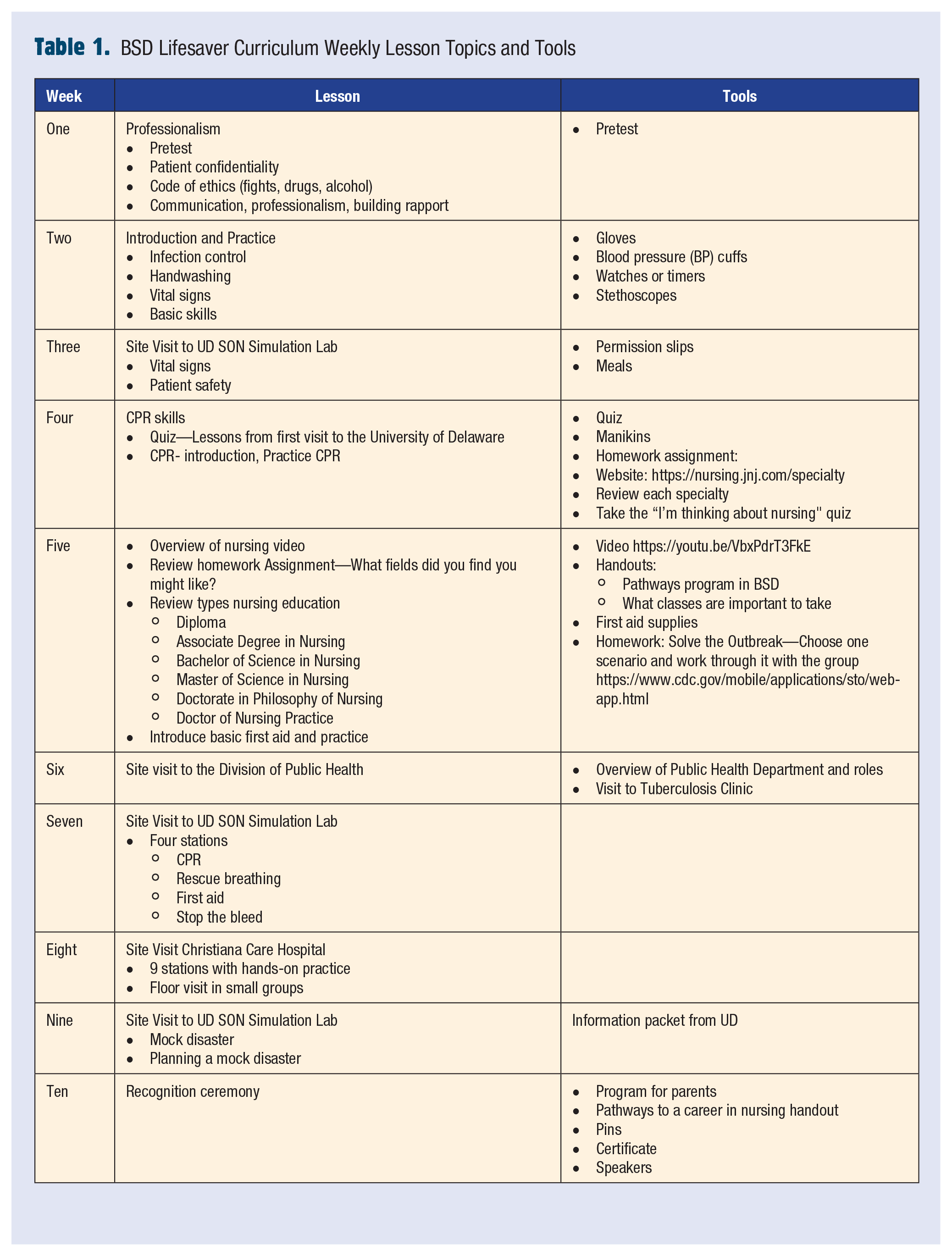
Previous middle school projects described hands-on activities with limited classroom and lectures as the most successful way to engage middle school students (Knight et al., 2011). Middle school educators confirmed this approach and reviewed the curriculum proposal.
BSD Lifesavers Program on the Ground
Parents and family members have a large influence on a child’s perceptions and parent’s perceptions may influence a child’s future choices (Glerean et al., 2017). With this in mind, BSD nurses made it a priority to engage parents from the beginning, providing families an overview of the program through a flyer with a description of the program. Each potential participant was required to submit a brief essay describing why they wanted to participate in the program. In addition, a recommendation letter from a parent or guardian and a teacher, counselor, or an administrator was required to participate. Each application was reviewed by the middle school nurses before acceptance into the program. Adequate supervision, clinical skills oversight, and transportation to off-site practicums made it necessary to limit the number of participants to ten students from each middle school.
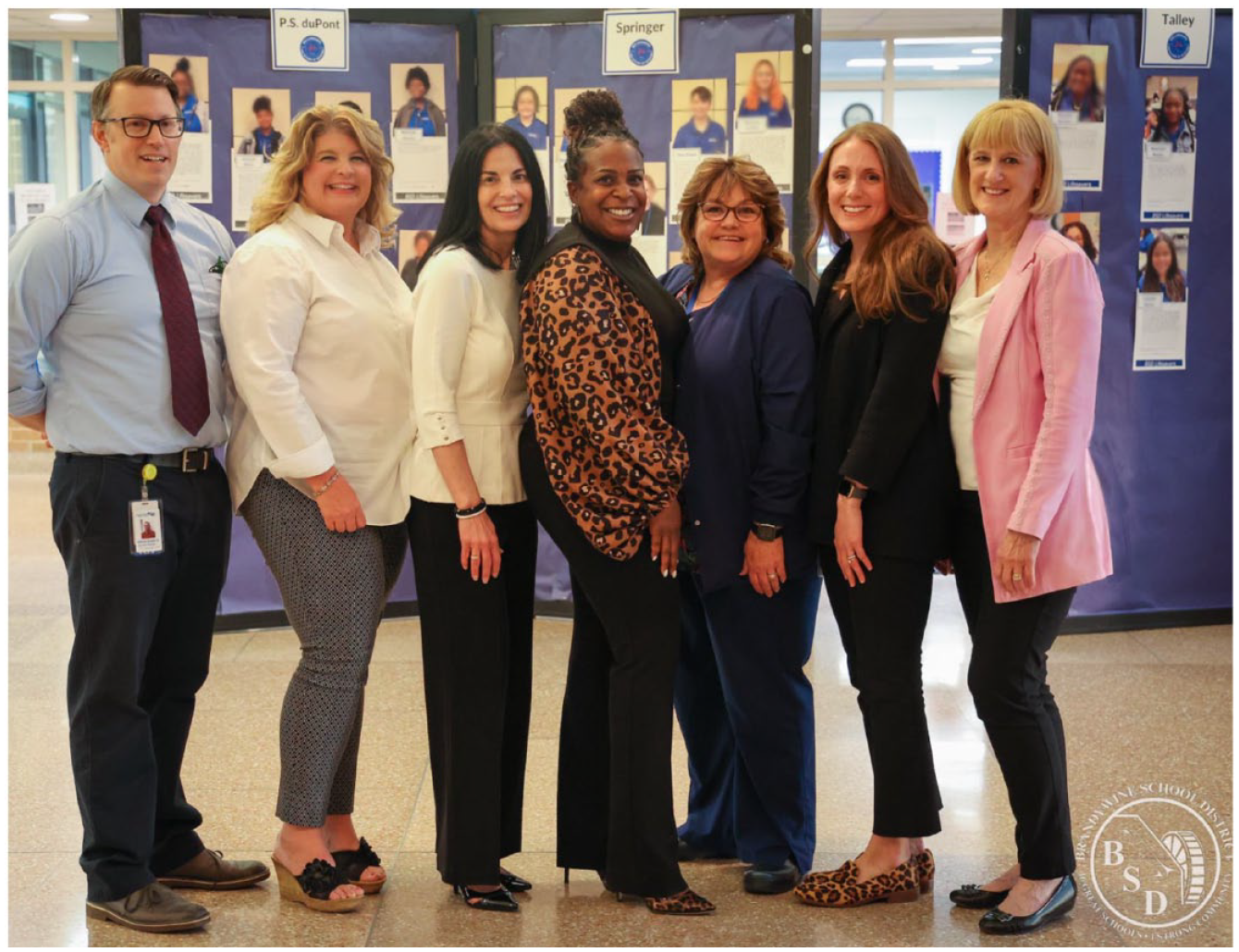
The Students’ Personal Short Essays Reflecting their Experiences in the Program were Showcased for Guests to read. The BSD School Nurse Lifesaver Team are shown here in front of the Student Showcase at the Celebration Ceremony. (Photo Credit: Mikaelyn Austin) L to R: James Grant, Sheila Pickering, Richele Lawson, Tracy Seth, Michelle Scott, Jacquelyn Kimball, and Beth Mattey
The nurses not only made parents an integral part of the recruitment process, but they also strongly encouraged their commitment in support of the student’s participation in the program. The BSD Lifesavers nurse team was prepared to reach out to families through phone calls or home visits, in case any external barriers might affect program participation. Parent involvement and engagement was an opportunity for parents to see student success and engage their child in discussions about what they learned. In return, parents were also being educated about the opportunities and pathways for a career in nursing for their child. Parents were required to sign permission forms for all off-campus activities. The BSD Lifesavers Nurse Team, instrumental in piloting this program, is shown in Photo 1.
Students and nurses met together once a week for 10 consecutive weeks after the regular school day ended. Classroom instruction was provided by a team of two school nurses at each middle school. In addition to the 4 days of structured after-school classroom curriculum, the students had a total of five off-site visits to our community health partners. Transportation to off-site events was provided by the district transportation services.
The University of Delaware School of Nursing (UD SON) Simulation Laboratory Team hosted students for three afternoons of instruction for small group skills learning and practice. University nursing students provided education, guidance, and support with hands-on learning. The BSD Student Lifesavers met with nurse administrators, as well as front-line nurses including advanced practice nurses who work both in acute care and practice in the community at Christiana Care, a metropolitan acute care hospital, with a Level 1 Trauma Center. Nine different stations allowed hospital nurses to demonstrate skills and students practiced simulated hands-on learning. An afternoon at the Delaware Hudson State Service Center, allowed students to meet with nurses and other public health workers, observing and discussing the different roles necessary for community health. The BSD lifesavers program concluded with a large mock disaster simulation designed by the University of Delaware School of Nursing Simulation Lab Team and University nursing students, which made the experience even more genuine, while allowing the students to use the knowledge they had gained throughout the program. The photographs introducing this article showcase our students in their clinical experience.
A major element embedded in the program was to provide students an opportunity to meet nurses of color and men with extensive careers in the field of nursing. It was important to ensure that student experiences include nurses who are reflective of the participants. Students observing others who look like them and experiencing success in the field, helps students to realize nursing is an attainable goal.
The trips off campus had students returning to school 4–5 hours after school ended, so lunch/dinner was provided by school nutrition services prior to beginning the off-campus activities. Innovation Grant Funds were used to support the BSD Lifesavers program which included supplies, transportation costs, and compensation for the seven members of the school nurse team. BSD covered pay for substitute nurses when transportation needs required nurses to leave prior to the end of the school day for the after-school learning activities. Our community partners, the University of Delaware School of Nursing, Christiana Care, and the Delaware Division of Public Health donated their time and services.
Student Impact and Program Success
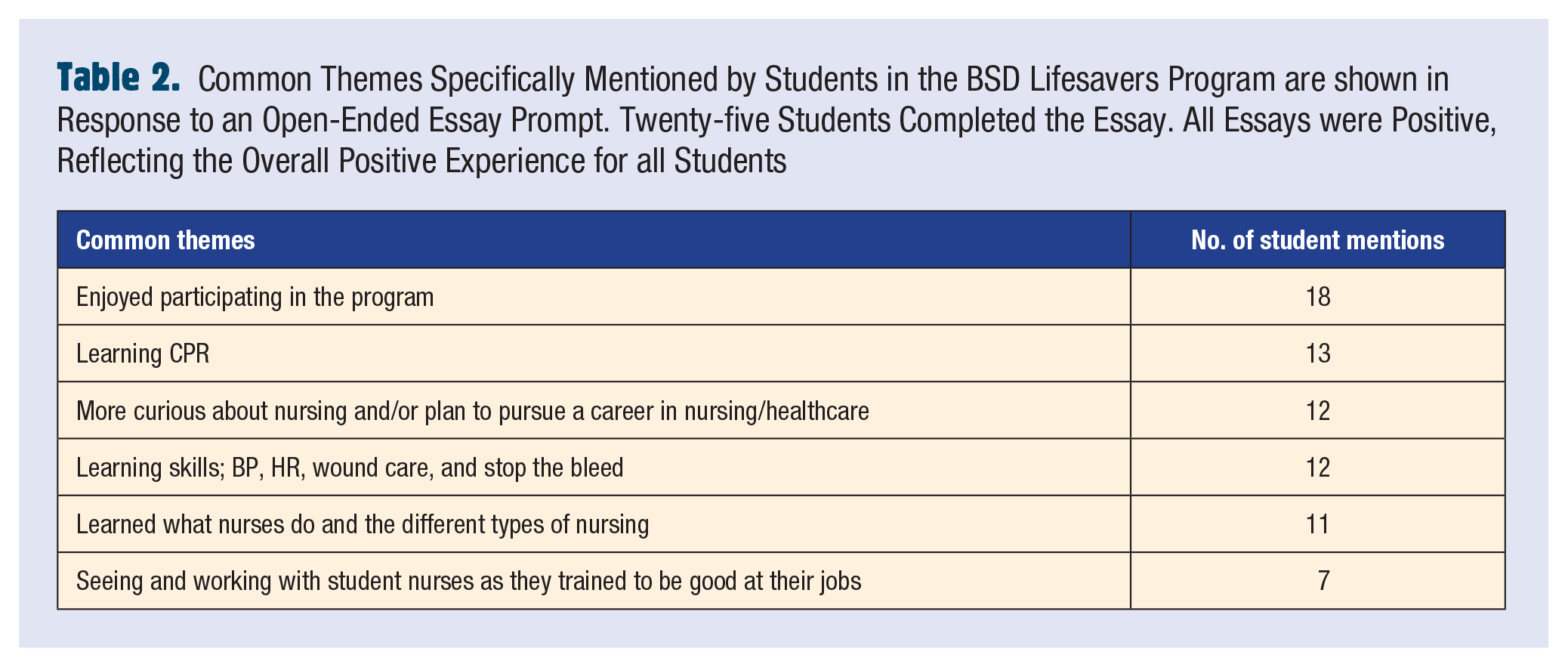
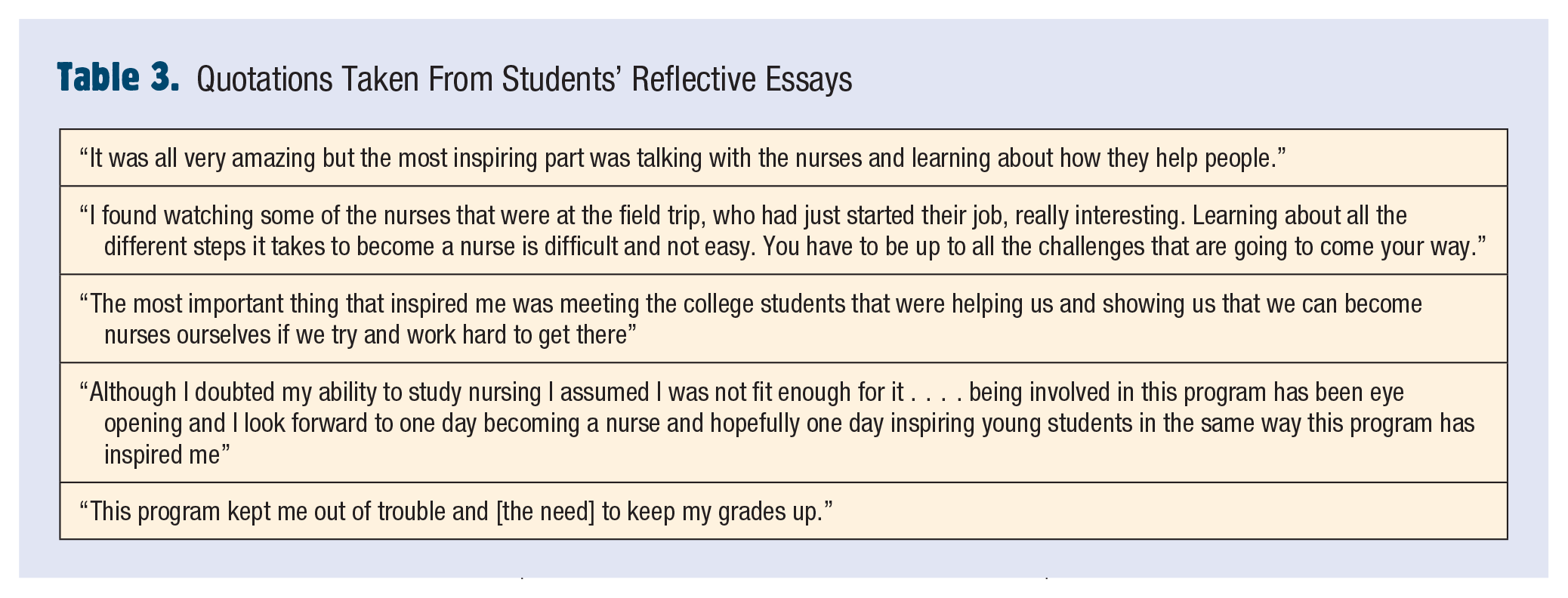
At the conclusion of the program, students reflected on their experiences, by completing essays that described what they learned and the impact it has on their current lives and their future desires of continuing the path toward a career in nursing. Common themes listed by students are shown in Table 2. Many of the students expressed how their interest in the field of nursing had grown since being part of the program enhancing their desire to help others with an actual visualization of what it would look like to become a nurse. Several students mentioned they wanted to be a nurse so they could take care of their family members. Most students expressed that they learned new information about what nurses do and enjoyed participating in simulations that gave them opportunities to perform some of those nursing skills. Students mentioned the hands-on CPR and first aid classes provided by the BSD nurses as important and useful knowledge they can use now. The real-life simulations provided by the UD SON Simulation Lab program, Christiana Care, and the Delaware Public Health Department were also mentioned frequently. Several excerpts from the student reflective essays are shown in Table 3.
Common Themes Specifically Mentioned by Students in the BSD Lifesavers Program are shown in Response to an Open-Ended Essay Prompt. Twenty-five Students Completed the Essay. All Essays were Positive, Reflecting the Overall Positive Experience for all Students
Quotations Taken From Students’ Reflective Essays
Students were also given a pretest to demonstrate basic knowledge of skills that would be taught in the class. In two of the middle schools, a posttest showed a 60% improvement from the pre-test scores at the beginning of the program to the posttest scores at the end of the program. The third school did not have the data available to record.
At the end of the sessions, the BSD Lifesavers celebrated with a well-attended evening “Recognition” ceremony, which was open to parents, families, teachers, counselors, and administrators. During the ceremony, the students were given mock nursing pins similar to that presented during an actual nursing completion program. The BSD Lifesavers’ program team also gave words of personal reflection and inspiration to encourage students to continue pursuing career interest in the field of nursing. Students expressed gratitude for being able to participate in a program that provided opportunities they would not have had otherwise.
The students were not the only group inspired by the experiences and outcomes of the program. Many of the nurses and stakeholders expressed that the program was an opportunity for them to collaborate and inspire the younger generation. Most were grateful to be able to use their platforms in the field of nursing to provide this opportunity to give back to students in their communities. A critical aspect of the program was providing authentic career-related nursing exposure to stimulate and hopefully sustain interest in the field of nursing.
Future Plans
The BSD Lifesavers Program will now be expanded into 9th and 10th grades at the three local high schools. This planned program will continue to engage BSD students, providing education, support, and mentorship by school nurses. Students may then choose to connect with the newly instituted career health careers program pathway in 11th and 12th grades, a partnership between the BSD and Delaware Technical and Community College.
The upstream approach of the BSD Lifesavers program creates a pipeline for students, as early as middle school, to develop the community support and educational foundation to pursue a career in nursing. This approach promotes equitable opportunities for students in underrepresented communities potentially creating a more diverse nursing workforce and addressing health equity for all communities.
Implications for School Nursing
Innovative programs to introduce nursing as a career is essential to impact the projected needs in our communities. Implementing educational pathways and mentorship programs during middle school years should be a priority. Interest and preparation in the field of nursing must be stimulated prior to entering high school where important courses are selected, and academic scores are required to advance in post-secondary placements. Working with the middle school population requires commitment over many years to increase entry by “seeding the pipeline” into nursing programs (Williams, 2018). School nurses are in an ideal situation to develop similar programs in their own schools. Continuation of a gateway program such as the BSD Lifesavers that integrate fun activities with accurate information can serve as a pathway for students at a young age to consider the nursing profession. Academic rigor associated with the nursing profession must be emphasized, and a structured mentorship program to provide ongoing student support for those who might be struggling in certain areas should be provided.
View this 6-minute video for an overview of the BSD Lifesavers Program: https://fb.watch/f7KV7W823W/
Policy Development and Implementation
Policy development and implementation will play a significant role in providing support for accessible and affordable nursing programs to ensure equitable resources are provided for students in all communities at all levels. For the BSD Lifesavers program to grow in the State of Delaware a restructuring of current postsecondary transitional programs can be enhanced by providing additional mentoring, academic, and career guidance during early stages of secondary education within the curriculum.
While the BSD Lifesavers is a beginning, we must continue to think differently to keep students engaged and successful. Students, particularly students who are first-generation students aspiring to continue their education, will need support with mentoring and career guidance throughout their journey. A robust and structured mentoring program for students is necessary to provide ongoing support throughout the program and into post-secondary education. Community partners, faith-based organizations, and other stakeholders will be targeted to support students throughout the educational cycle.
Overall, the BSD Lifesavers program demonstrated that middle school exposure to a career in nursing can be vital in addressing nurse shortages and providing a more diverse nursing workforce. The program demonstrates the need for policies that direct funding to programs for underserved students in populations reflecting people of color and young men demographics that are underrepresented in nursing.■
Footnotes
Acknowledgements
This work was made possible through support from the Center to Champion Nursing in America, a joint initiative of AARP Foundation, AARP, and the Robert Wood Johnson Foundation. Additional funding was provided by the Brandywine School District and the University of Delaware School of Nursing. Additional thanks to our partners, Christiana Care, Delaware Division of Public Health, BSD Assistant Superintendent Lisa Lawson, and to the school nurses who initiated and brought this project to fruition: Richele Lawson, MSN, RN, NCSN; Jacquelyn Kimball, MSN, RN: Michelle Scott, MSN, RN, NCSN; Tracy Seth, MSN, RN, NCSN, Sheila Pickering, MSN, RN, NCSN; and James Grant, BSN, RN. Thank you to our BSD photographer Mikaelyn Austin.
Alexandra Randolph has a BA in Sociology and a Master’s in Public Health at the University of Delaware’s Biden School of Public Policy. Currently, she works as a liaison with the CDC Foundation serving the Brandywine School District. She plans to continue her work in public health with a focus on health equity and health policy.
Beth Mattey recently retired after 35 years as a school nurse and school nurse administrator in the Brandywine School District. She is a Co-Lead for the Delaware Action Coalition, Campaign for Action for the Future of Nursing and serves on the executive committee of the National School-Based Health Alliance. She continues to work as a school nurse consultant to address issues important to nursing and school nurses. She believes nurses are leaders in achieving health equity and recognizes that school nurses work daily to address the barriers to health and health care which requires support through policy and funding. Beth served as President of NASN from 2015 to 2017.
References
Supplementary Material
Please find the following supplemental material available below.
For Open Access articles published under a Creative Commons License, all supplemental material carries the same license as the article it is associated with.
For non-Open Access articles published, all supplemental material carries a non-exclusive license, and permission requests for re-use of supplemental material or any part of supplemental material shall be sent directly to the copyright owner as specified in the copyright notice associated with the article.
