






Abstract
A system-level health equity lens is needed to meet the needs of today’s students. School nurses stand at the intersection of health and education, poised to improve the health and academic outcomes for all children in collaboration with school health and education colleagues with a focus to reframe “learning and health losses” to “learning and health recovery.” The Multi-Tiered System of Support is a familiar approach used in schools to address education equity for students. Working alongside educators, school nurses can demonstrate how including health in this framework augments reaching the goal of supporting student academic success.
Introduction
A system-level health equity lens is needed to meet the needs of today’s students (Johnson, 2017). School nurses stand at the intersection of health and education, poised to improve the health and academic outcomes for all children in collaboration with school health and education colleagues with a focus to reframe “learning and health losses” to “learning and health recovery.” The Multi-Tiered System of Support (MTSS) is a familiar approach used in schools to address education equity for students. Working alongside educators, school nurses can demonstrate how including health in this framework augments reaching the goal of supporting student academic success.
Although the MTSS terminology may be unfamiliar to some school nurses, a multi-tiered approach to student health and school health services is familiar. The three tiers of MTSS are aligned with the public health model of primary, secondary, and tertiary prevention (Figure 1).

MTSS/Levels of Prevention Comparison
MTSS Is Aligned With School Health Services and School Nursing Practice
In the literature, MTSS is applied to multiple topics (e.g., suicide prevention, mental health, school attendance, traffic control, child welfare), but there is little mention of this approach being applied to school health services. The authors felt compelled to change this, as can be seen below.
MTSS is often considered an umbrella framework combining Positive Behavioral Intervention and Supports (PBIS) and Response to Intervention (RTI) processes. All three frameworks were the result of federal education legislation (Table 1) (Ehlers, 2018). Built by educators, MTSS is designed to provide a continuum of academic support for all students using three tiers:
Tier 1—universal curriculum that targets all students bringing most of them to an acceptable level of proficiency.
Tier 2—targeted supplemental instruction to students with poor response to Tier 1.
Tier 3—intensive application of instructional interventions designed to increase student progress, which may or may not include special education.
Foundational to the MTSS approach is the use of data to identify the needs of students and to inform decision-making about how to establish benchmarks and monitor progress in each tier. Also foundational to the MTSS approach is using research-based interventions in each tier. The goal of using this approach is to form wrap-around structure, supports, and practices to support more equitable educational outcomes for all students.
PBIS, RTI, and MTSS
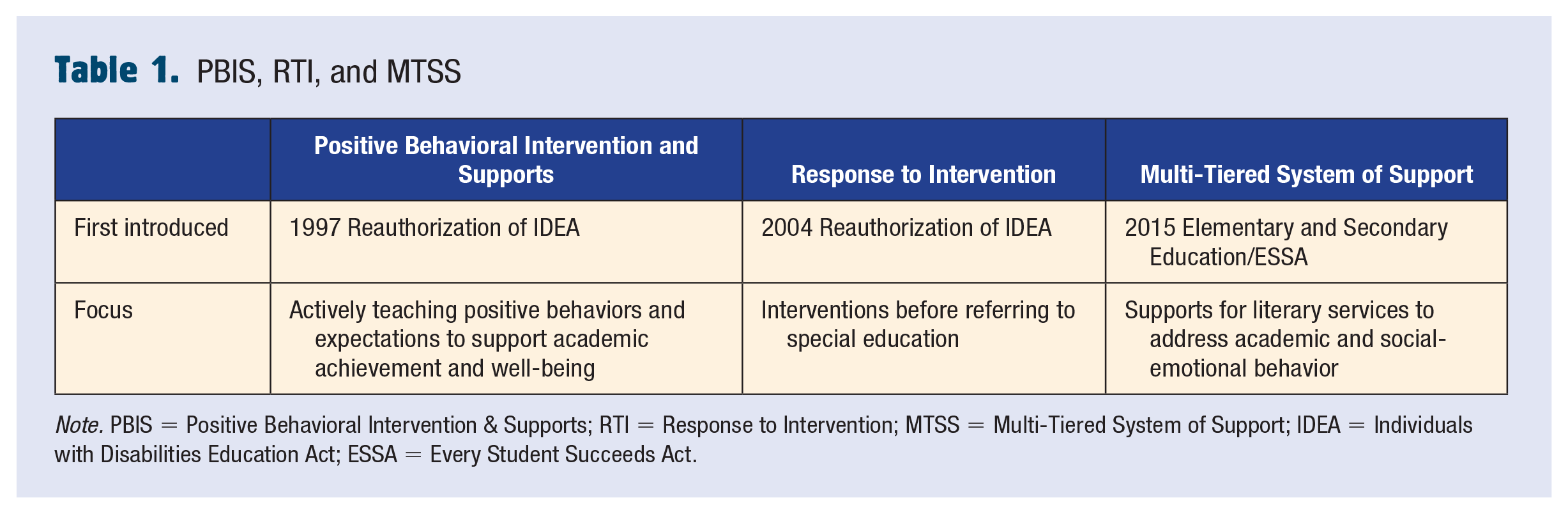
Note. PBIS = Positive Behavioral Intervention & Supports; RTI = Response to Intervention; MTSS = Multi-Tiered System of Support; IDEA = Individuals with Disabilities Education Act; ESSA = Every Student Succeeds Act.
Many parallels exist between the three tiers of the MTSS approach and tiered approach of the public health model embraced by school nursing practice. For example:
Tier 1 or Primary Prevention focuses on the population of healthy students. Primary prevention or tier 1 strategies address health promotion and include providing health education and addressing risk factors, including social risks.
Tier 2 or Secondary Prevention focuses on students at risk for a health condition or issue. Secondary prevention or tier 2 strategies include using evidence-based screening tools to identify youth at risk for health concerns, controlling risk factors for those concerns, and beginning interventions to mitigate risk-related emerging health issues.
Tier 3 or Tertiary Prevention focuses on individual students with a known health concern. Tertiary prevention or tier 3 strategies include prevention of complications from the health condition and increasing quality of life—strategies used by the school nurse that are aligned with the practice components of Care Coordination of the National Association of School Nurses (NASN, 2016) Framework for 21st Century School Nursing PracticeTM (FrameworkTM).
It is interesting to note some authors (Kisling & Das, 2022) include the Primordial Tier, a tier before Tier 1. In this tier, the focus is on social and environmental conditions and strategies promoted through laws and national policy. This is considered an upstream approach for protecting community health. A focus on social and environmental factors at the local level, such as the social determinants of health, can be included in Tier 1 of MTSS or the primary prevention level of the public health model.
Several foundational documents for school nursing practice support a tiered approach integrating health and education. The Whole School, Whole Community, Whole Child (WSCC) framework calls out the multiple components in a student’s environment that intersect impacting health and education (ASCD & Centers for Disease Control and Prevention [CDC], 2014). Each component of the WSCC framework is important for students to be healthy, safe, engaged, supported, and challenged—including the Health Services component (Figure 2).

Whole School, Whole Community, Whole Child Model
NASN’s (2016) FrameworkTM articulates the role of the school nurse working within the WSCC model, in particular, operationalizing the Health Services Component. The five principles and related practice components of the FrameworkTM support a tiered approach to school nursing practice at the individual student and student population level (Figure 3).

NASN’s Framework for 21st Century School Nursing PracticeTM
NASN’s (2022) School Nursing: Scope and Standards of Practice (4th ed.) also aligns school nursing practice with a tiered approach. The six Standards of Practice describe the steps of the nursing process—assessment through evaluation—used to guide the critical thinking when matching tiers or levels of prevention to best support health equity for all students. The Standards of Professional Performance describe the competent level of behavior in the professional role of a school nurse necessary when advocating to be part of the MTSS multidisciplinary team.
There are three aspects common to MTSS, WSCC, NASN’s FrameworkTM, and NASN’s Scope and Standards of Practice. The first element is being whole child or student-centric, an approach that addresses the needs of the individual student and entire student population. Second, they are all evidence-based and comprehensive, with an emphasis on reaching positive outcomes through collaboration across the home-school-community continuum. Finally, all provide wrap-around structure, supports, and practices to meet the health and related social needs of students and families.
How to Implement a MTSS Approach for School Health Services?
Keep in mind, a MTSS approach is familiar to educators, but these colleagues may not be familiar with how this approach is also familiar to the school nurse. Implant yourself in the steps needed to implement the new or expanded MTSS approach with school health services (Averill & Rinaldi, 2013).
Step 1: Build Consensus With an Inclusive Team
Identify if the school or district uses a MTSS approach to support academic achievement of students. If the MTSS approach is used, next identify who the members of the MTSS planning committee are (e.g., principal, superintendent, instructional support personnel) and invite yourself to also attend. When present with your educator colleagues, use MTSS “educator-speak” while demonstrating how aligning the education focus of MTSS with student health services provides synergy in achieving both academic and health outcomes. Use communication and interpersonal skills to build consensus on the importance of applying MTSS to school health services. Be intentional about focusing on equity and raise awareness for known inequities that exist. Educate the team on the role of the school nurse in the early identification of healthcare concerns and the ability to provide access to care for students.
Step 2: Build Infrastructure and Capacity
Whether you are new to the MTSS planning team in the school or district, or an established team member, team building activities can strengthen interdisciplinary collaboration. Consider shared professional development to highlight similarities between disciplines, solidifying the shared vision of using a tiered approach to support both student academics and health. Strengthen school and district policies that support a MTSS approach to education and health. Engage families and strategic community members to expand capacity for meeting the often-fluid needs of students moving across and between tiers and levels of prevention. Identify the data that will be used to drive decisions when identifying student needs and evaluating progress within each tier/level of prevention; and include patterns and trends of school health office student visit data (Rau & Little, 2020).
Step 3: Facilitate and Evaluate Implementation
Using the data identified in Step 2, implement and evaluate the MTSS approach across the three tiers/levels of prevention. An understanding of the school environment is key to this step. Each school is unique, and implementation of student interventions is individually determined. Clear communication of the implementation progress within the MTSS team to determine the next steps and modify interventions as needed benefits both students and staff. The school nurse can advocate for evaluation of the MTSS approach across the tiers to include health data, such as health office visits and progress toward meeting health goals outlined in a student’s individualized healthcare plans (IHPs). Connecting academic needs to healthcare needs demonstrates the relationship between health and academics.
Example of a Tiered Approach in School Nursing Practice—Addressing Student Mental Health in a Large Urban High School
The following example addressing student mental health in a large urban city school is provided to demonstrate a tiered approach in school nursing practice. Application of MTSS to adolescent mental health begins with understanding the scope of the problem. Poor mental health can result in serious negative outcomes for the health and development of adolescents. Young people who feel hopeless about their future are more likely to engage in behaviors that put them at risk for HIV, STDs, and unintended pregnancy (CDC, National Center for HIV/AIDS, Viral Hepatitis, STD, and TB Prevention, 2023b). National and state data, and local data, if available, can be used to identify the mental health needs of high school students, although it is often difficult to align data points (Table 2). Consider conducting a school or school district survey, aligning questions with an existing state and/or national survey (e.g., CDC’s Youth Risk Behavior Survey).
High School Student Mental Health Data Sample
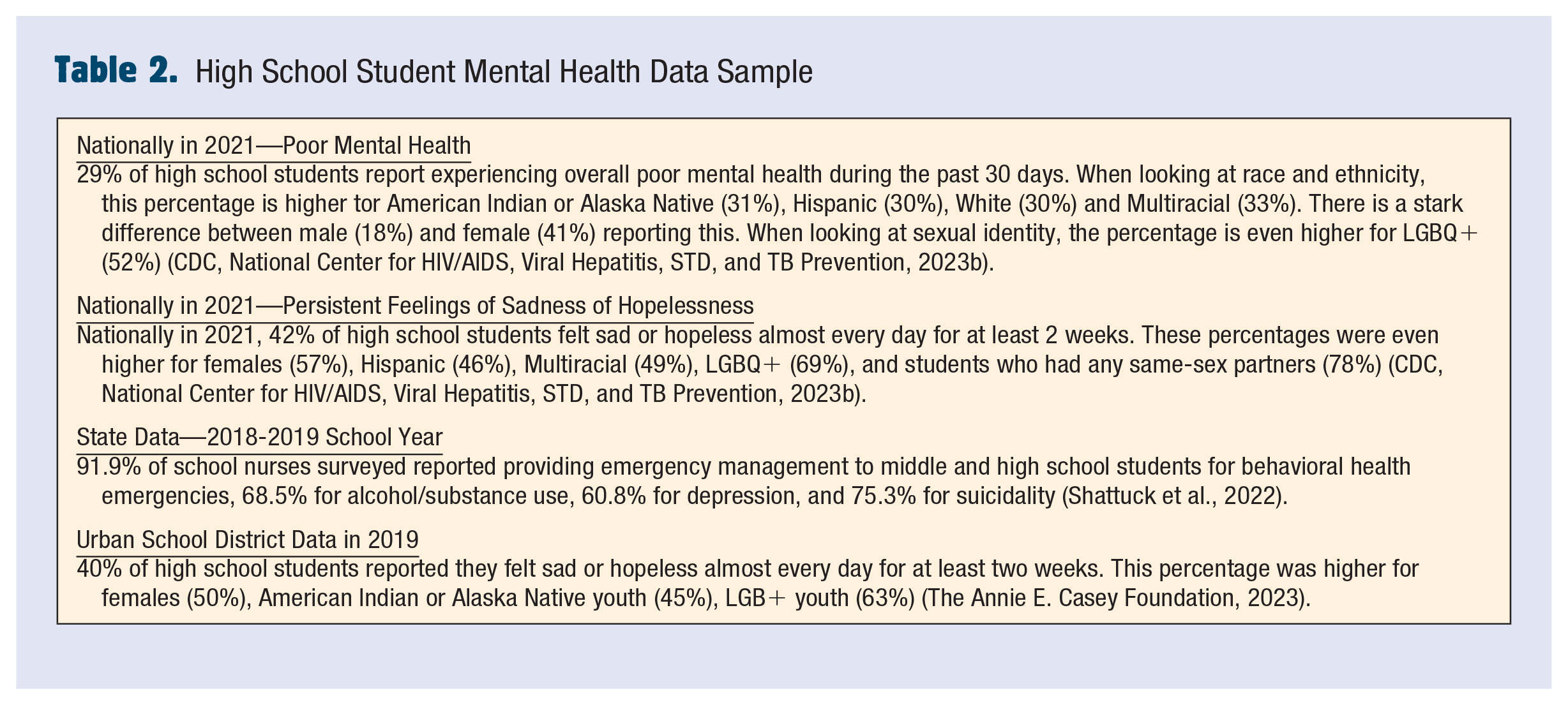
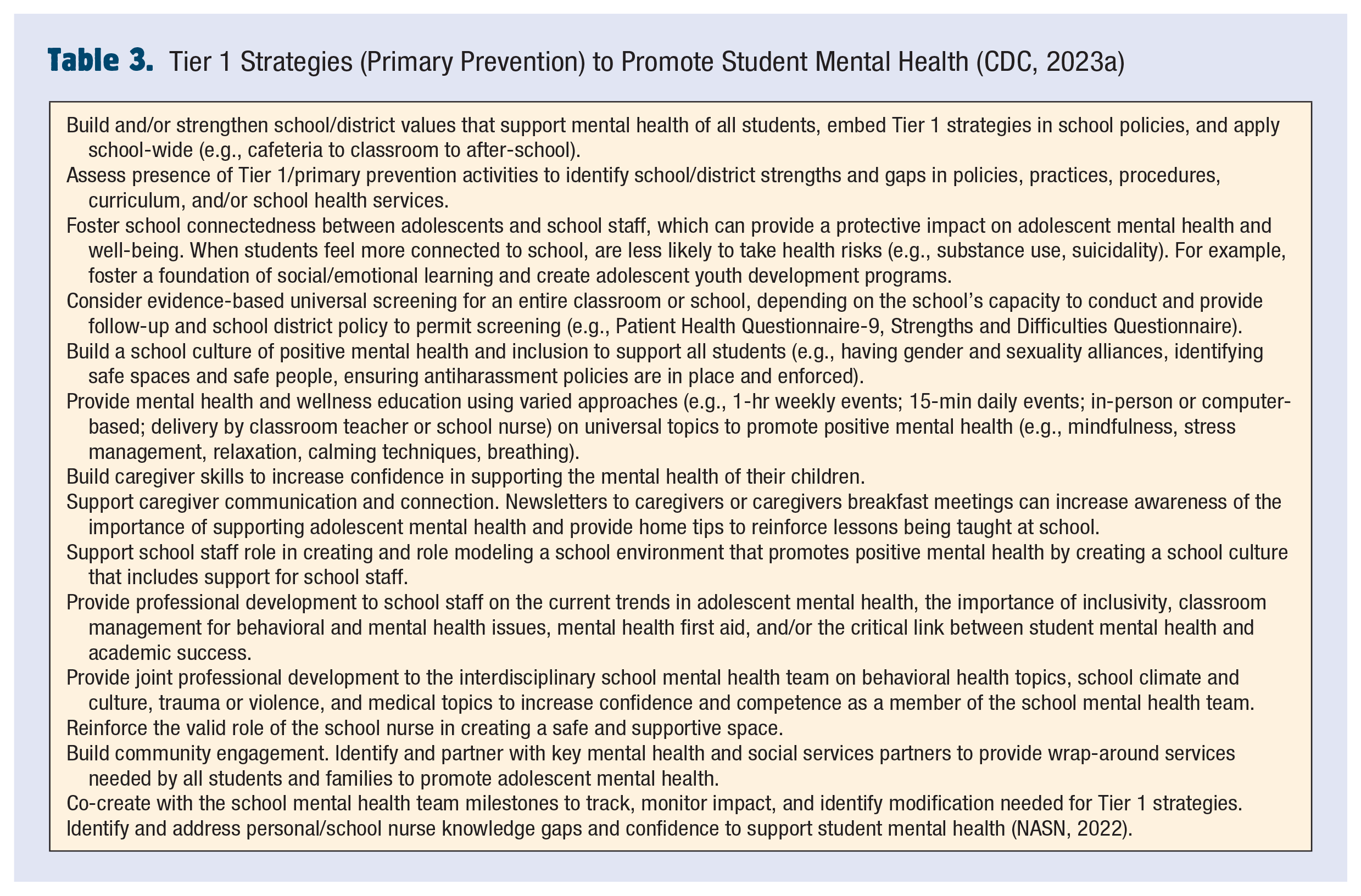
The data guides the choice of Tier 1 strategies (Primary Prevention) that support mental health for all students in an entire classroom or school (Table 3).
Tier 1 Strategies (Primary Prevention) to Promote Student Mental Health (CDC, 2023a)
The data also guide the choice of Tier 2 strategies (Secondary Prevention) that would identify and address risk factors. The sample state data points highlight the vast majority of school nurses report providing emergency management for behavioral health emergencies. The national and district data reveal some of the underlying mental health concerns may be related to the behavioral health concerns (Table 4).
Tier 2 Strategies (Secondary Prevention) to Identify, Halt, and Prevent Student Mental Health Concerns (CDC, 2023a; Messman et al., 2021)
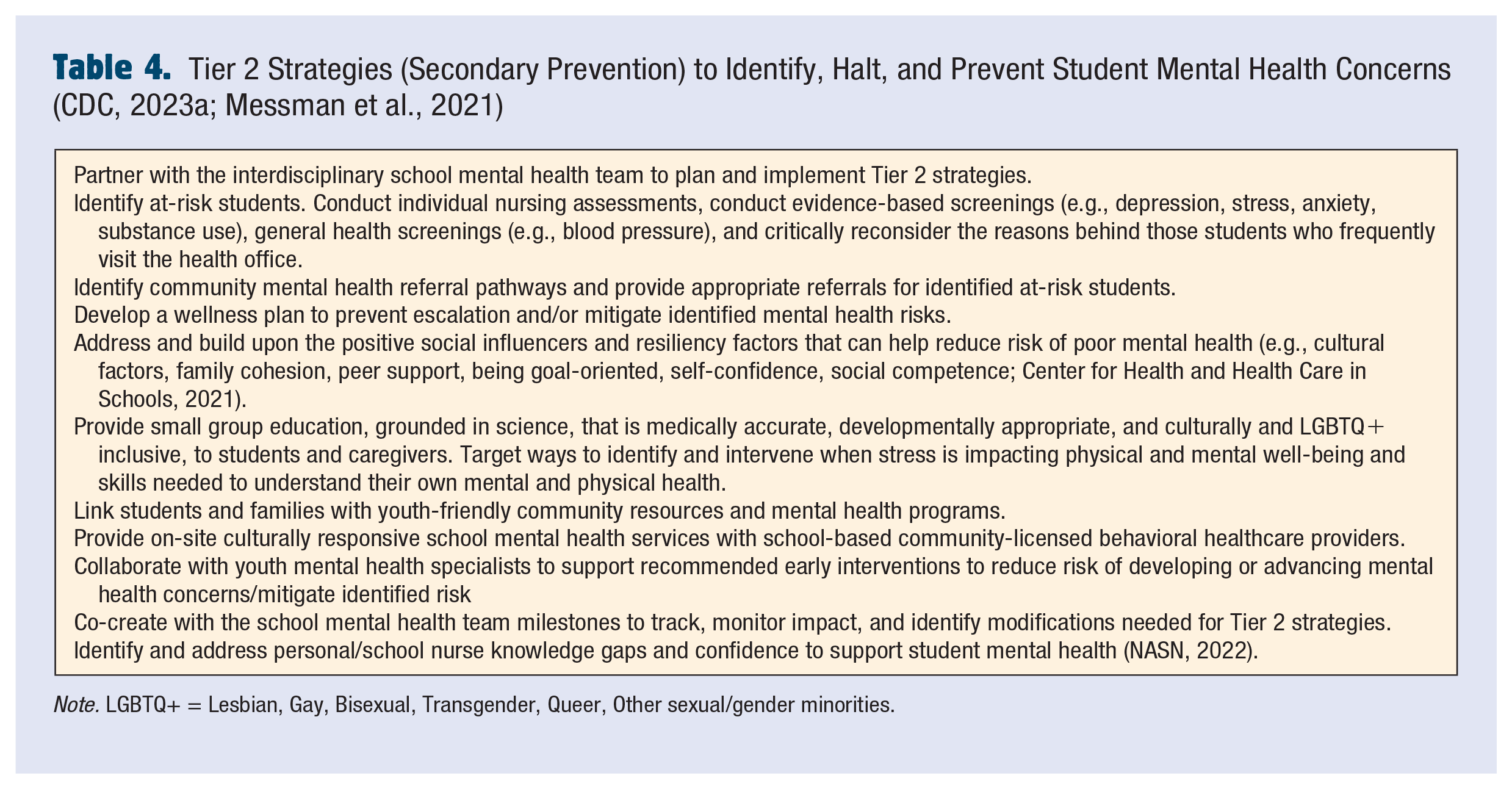
Note. LGBTQ+ = Lesbian, Gay, Bisexual, Transgender, Queer, Other sexual/gender minorities.
Tier 3 strategies (Tertiary Prevention) address the individual needs of a student with a known mental health concern. It requires the full implementation of the nursing process and the case management practice component of the Care Coordination principle of NASN’s (2016) FrameworkTM. This includes development, implementation, and evaluation of a student’s IHP and emergency care plan to support the adolescent mental health (Table 5).
Tier 3 Strategies (Tertiary Prevention) to Support the Individual Student
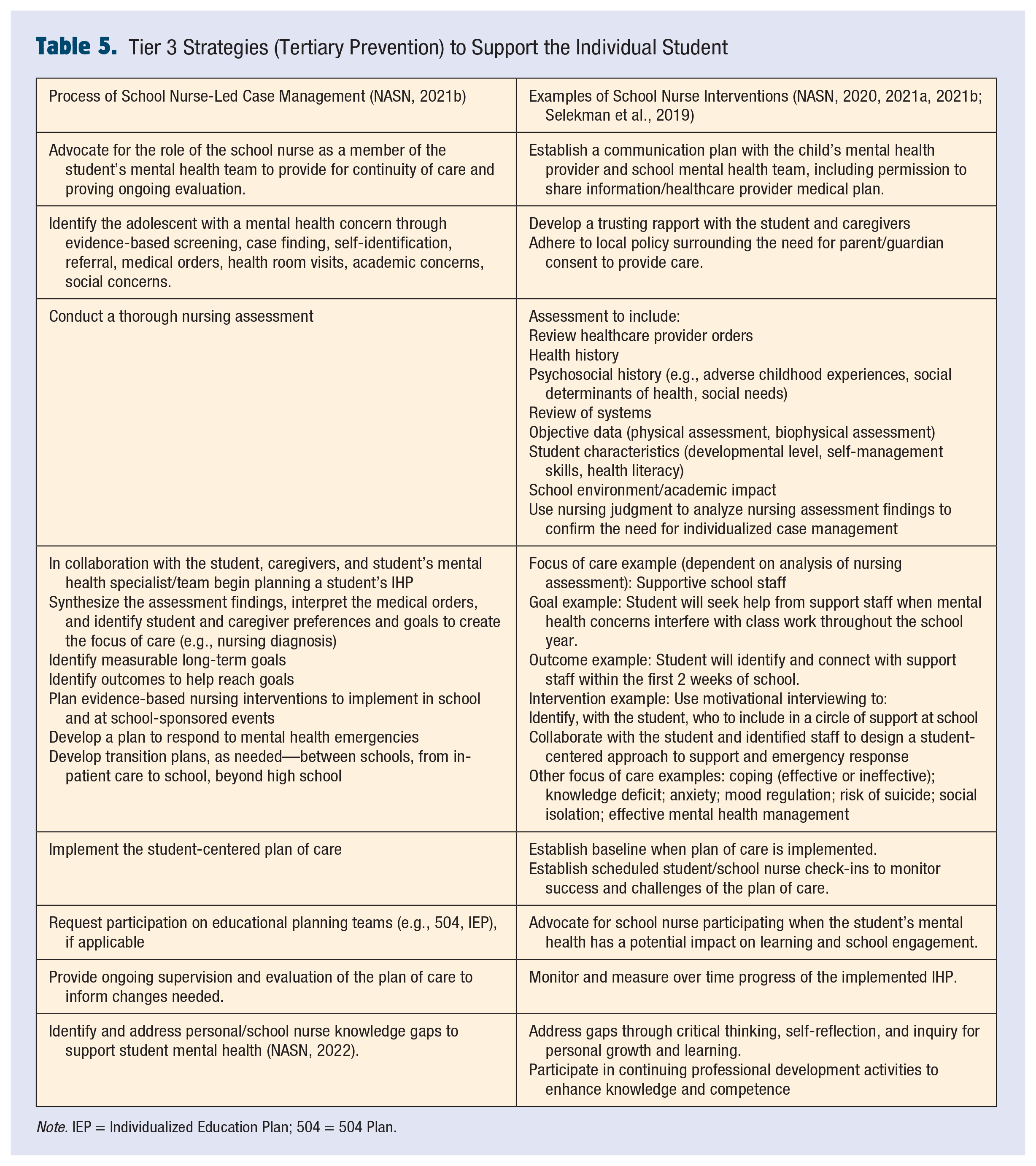
Note. IEP = Individualized Education Plan; 504 = 504 Plan.
Conclusion—Implications for School Nursing Practice
The MTSS approach is aligned with the public health model of primary, secondary, and tertiary prevention known by school nurses. It is a framework used by educators to address education equity. Application of MTSS to school health services can foster a shared language and strengthen the shared vision held by school nurses and educators: a system-level health equity lens to meet the needs of today’s students (McCart & Miller, 2019). It is critical for the school nurse to establish credibility and garner a “seat at the table” with the school MTSS team to create a shared vision to plan, implement, and evaluate the three tiers of MTSS. A tiered approach can identify and address the social determinants of health in a student’s surrounding, and related social needs, while addressing social influencers that can foster the mental and physical health and well-being critical to achieving health equity and academic success for all students (Center for Health and Health Care in Schools, School-Based Health Alliance, National Center for School Mental Health, 2021; NASN, 2021a).
Footnotes
Funding
The author(s) disclosed receipt of the following financial support for the research, authorship, and/or publication of this article: This resource was supported by Cooperative Agreement Number NU58DP007086, Advancing Equity in School Health Services by School Nurses, funded by the Healthy Schools Branch—Centers for Disease Control and Prevention (CDC); and is a subgrant from CDC with a third-party contractor, Contract Number 47QFSA21F0044-G2S008, School Health Services and Mental Health Support—An Integrated Approach. Its contents are solely the responsibility of the National Association of School Nurses and do not represent the official view of the CDC of the Department of Health and Human Services. ■

Nichole Bobo has had the privilege of reaching the lives of many children and adolescents by providing tools, resources, and educational offerings to practicing school nurses in the role of Director of Nursing Education at NASN since 2000. She is a contributing author to NASN’s Framework for 21st Century School Nursing PracticeTM (2016) and current Project Director for the CDC cooperative agreement Advancing Equity in School Health Services by School Nurses.
Elizabeth Clark has over 25 years of experience as a school nurse and school health service administration. She is currently the Project Director for two CDC-funded NASN projects: Coordinated Support System for Students with Epilepsy and School Health Services and Mental Health Support—An Integrated Approach.
Renee Griffin has a background in the Allied Health field. She provides administrative support and coordination and contributes editing and aesthetic design for multiple NASN programs and projects such as NASN’s Overview of the Framework for 21st Century School Nursing PracticeTM (2023) online course and resources provided under the CDC cooperative agreement Advancing Equity in School Health Services by School Nurses.