







Abstract
School nurses are vital in addressing food insecurity affecting 6.5 million U.S. households with children, leveraging leadership and care coordination skills to tackle this adverse social determinant of health. As frontline advocates, they can bridge gaps in food access through key strategies: promoting universal school meal programs to ensure stigma-free access to nutritious meals and supporting Summer Electronic Benefit Transfer (EBT) to sustain families during summer breaks. They can advance produce prescription (PRx) programs for fresh produce access and Supplemental Nutrition Assistance Program (SNAP)-Ed to boost nutrition literacy. Implementing the Hunger Vital Sign screening tool allows early identification of food insecurity, linking families to SNAP, food pantries, and community resources. By forging partnerships with schools, policymakers, and local organizations, school nurses can integrate care coordination principles to address systemic inequities, improve child nutrition, and foster academic success. Their role as trusted health leaders positions them to drive equitable solutions, ensuring students thrive through holistic, community-centered, school-based interventions.
Keywords
Introduction
In the United States, 6.5 million (17.9%) households with children are food insecure, which occurs when a household’s economic and social conditions result in limited or uncertain access to nutritious food (United States Department of Agriculture [USDA], 2023a). Notably, children who are Black or Hispanic, those living in single-parent households, and families with incomes near or below the poverty limit are disproportionately food insecure (Rabbitt et al., 2024). Food insecurity is associated with poorer dietary quality because the social and economic conditions contributing to food insecurity, like poverty and poor food environments, present significant barriers to a healthy diet (Agurs-Collins et al., 2024).
Most children, especially children who are food insecure, rely on school meals for most of their daily nutritional needs (Ralston et al., 2017). Hence, school nurses have the tremendous opportunity to advocate for policies and programs to strengthen school access to nutritious foods. Taking a policy, systems, and environmental approach has shown great promise for addressing adverse determinants influencing access to foods and diet quality (Bowen et al., 2015). Despite this, a recent systematic review found that out of 20 studies that included nurse-involved policy, system, and environmental-level approaches to address healthy nutrition and reduce obesity in the school setting, none included approaches to reduce or prevent food insecurity (Francis et al., 2024).
School nurses have high trust within the school community, a deep understanding of students’ health needs, and are well-positioned to advocate for policies and programs to support food security. The NASN School Nursing Practice Framework (Figure 1) can guide nurses’ advocacy and action efforts to help students and their families, in addition to the School Nursing: Scope and Standards of Practice, 4th edition (National Association of School Nurses [NASN], 2022, 2024). The former is a practice framework comprised of five principles, including Care Coordination, Quality Improvement, Leadership, Community/Public Health, and Standards of Practice, while the latter defines school nursing and professional performance expectations through competencies (NASN, 2022, 2024). As such, we provide recommendations for school nurse advocacy and action to promote childhood food security in the school setting guided by these two essential school nursing resources.
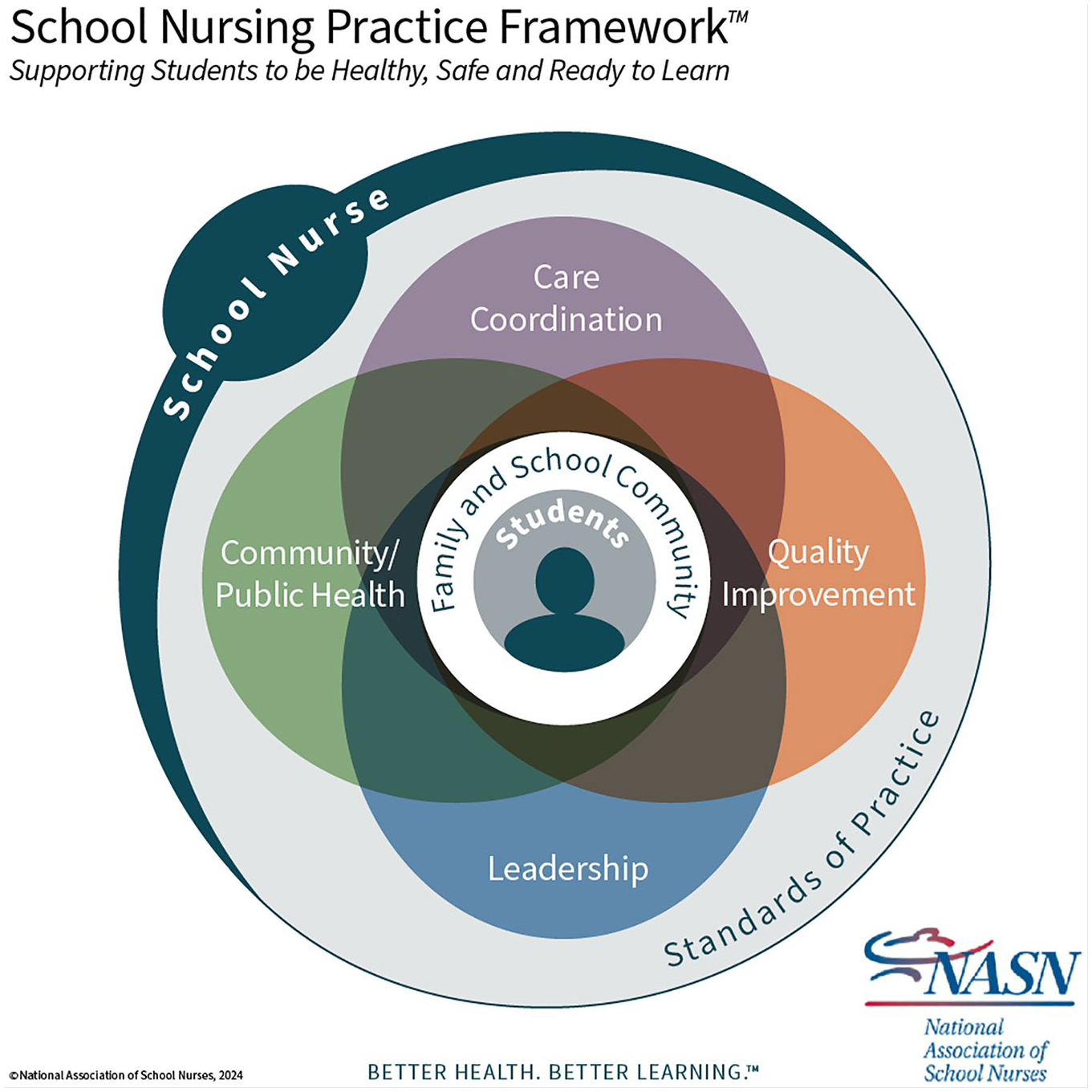
School Nursing Practice Framework
Advocacy on Increasing Access to Nutritious Food in Schools
The Community Eligibility Provision and Universal School Meals
The Community Eligibility Provision (CEP), launched by the United States Department of Agriculture (USDA) in 2014, enables schools and school districts in high-poverty areas to serve breakfast and lunch at no cost to all students (USDA, 2024a). For schools to be CEP-eligible, at least 25% of students should be certified as eligible for free meals because they participate in the Supplemental Nutrition Assistance Program (SNAP) or other food assistance and social safety net programs. The CEP has been found to promote food security and improve academic and student behavioral health outcomes (Hecht et al., 2020). The Food Research and Action Center (FRAC), an organization centered on nutrition policy and advocacy, developed a national database identifying CEP participating and eligible schools for the 2022 to 2023 school year. Despite 82% of eligible schools adopting CEP in the 2022 to 2023 school year (up 20% from the previous year), many schools that could benefit from the program are not enrolled due to potential barriers such as the loss of traditional school meal data, low rates of direct certification, and perceived financial viability of the CEP (FRAC, 2023).
The pandemic ushered in the universal school meals initiative, where COVID-19 federal policies allowed the USDA to provide schools with waivers that ensured free school meals for all students (Cohen et al., 2022). In 2022, however, the federal provisions for universal school meals ended, and states had to choose whether to continue with providing school meals for all students. Post-pandemic, Healthy School Meals for All is the current national campaign to offer free school breakfast and lunch for all students, regardless of household income. Several states, including Maine and California, have passed laws to continue with universal school meals. Universal school meals can potentially increase students’ participation in school meals, promote food security, and impact student’s health and academic performance (Cohen et al., 2021). Nonetheless, perceived challenges remain related to labor shortages, supply chain issues, cost implications, and food waste due to food preferences or quality school meals (Cohen et al., 2022; Orta-Aleman et al., 2024; Zuercher et al., 2022). Additionally, an equity audit would help to inform strategies to ensure equitable implementation of universal school meals (i.e., equitable funding across school districts, kitchen infrastructure, and the quality of meals).
In schools and states that have yet to adopt the CEP and universal school meals, school nurses can form a collaborative workgroup comprised of administrators, their school nutrition department/provider, and community partners to determine how to overcome barriers to adopting these important policies and programs. Recognizing childhood nutrition as a collaborative effort aligns with the Leadership and Community/Public Health principle of the School Nursing Practice Framework. Nurses have a unique perspective on food insecurity because they care for youth at school daily and see the struggles youth face when they come to school hungry. Nurses can amplify the voices of families in their communities to address structural barriers to food access. According to the Food & Research Action Center (2024), the following 12 states have active campaigns supporting healthy school meals for all: Connecticut, Maryland, New Jersey, New York, North Carolina, North Dakota, Ohio, Oregon, Pennsylvania, Rhode Island, Tennessee, and Wisconsin, along with Washington, D.C. School nurses in these states, backed by their collaborative workgroup, can navigate to the FRAC website (https://frac.org/healthy-school-meals-for-all) to learn how they can support their state initiative, which may include joining a coalition of advocates, signing pledges, and writing letters to their state legislature about the importance of this kind of program. Advocating for state policies that support health fall under the leadership principle of the School Nursing Practice Framework and the advocacy standard of professional performance in the School Nursing: Scope and Standards of Practice (NASN, 2022, 2024).
Summer Electronic Benefit Transfer Program
The Summer Electronic Benefit Transfer (EBT) program, a flexible and responsive solution for families who are low-income was launched in 2011, providing families and their children with essential summer nutrition benefits (USDA, 2024c). This program adapted during the COVID-19 pandemic into the Pandemic EBT Program, PEBT, which extended nutritional benefits to low-income families who lost access to free or reduced-priced meals due to school closures, covering both school and summer months (USDA, 2023c). In a significant development, a bipartisan Congress in December 2022 transformed the summer EBT into a national permanent program, ensuring families can receive up to $120 of nutritional benefits throughout the summer months (SUN Bucks) if their state participates in the program (USDA, 2024c). Before this landmark decision, only 11 out of every 100 children who received free or reduced lunch received summer benefits in the 2021 to 2022 school year. This occurred despite higher rates of food insecurity among low-income children during the summer months, highlighting the significant barriers to food access (Bleich et al., 2024). The summer EBT program, a testament to adaptability, has enhanced food security and accessibility for children and their families nationwide, offering flexible grocery utilization to overcome existing barriers (Bleich et al., 2024). Navigate to this interactive map: https://www.fns.usda.gov/summer/sunbucks, which is updated bi-weekly, to see whether your state is participating in this program for the summer of 2025 (USDA, 2025).
Building upon the School Nursing Practice Framework, school nurses can embody the Framework principles of Care Coordination and Leadership by connecting students and their families to available resources, such as the summer EBT program, and through advocacy, increase exposure and enrollment into the summer EBT program. School nurses in states without summer EBT can play a key role in advocating for their state to enroll in future summer EBT program issuances. Also, nurses residing in states that have summer EBT programs can continue to raise awareness for the summer EBT program by providing education to eligible families, especially for families who are not automatically enrolled in the program (Bleich et al., 2024). For example, the Summer EBT Outreach Toolkit (https://www.fns.usda.gov/sebt/outreach-toolkit) can be used as a guide to educate families about the program and EBT benefits (USDA, 2024b). In addition, recommendations to increase awareness and eligibility for the summer EBT program include utilizing schools as an ideal setting for EBT educational outreach. As school nurses build family rapport, they can increase family knowledge and utilization of these benefits. The School Nursing: Scope and Standards of Practice Standard 8: Advocacy emphasizes the nurse’s advocacy role and responsibility to have a voice at the table with policymakers in promoting equity for all. School nurses hold a unique perspective on school health among the student population. Because of their professional experiences and training, school nurses have an impactful voice that can shape policies that affect local communities.
School-Based Produce Prescription Programs
Produce prescriptions (PRx) are provided to patients at risk of diet-related conditions or food insecurity (National Produce Prescription Collaborative, 2024). These prescriptions, represented by vouchers or prepaid debit cards, are recognized at different food retailers and increase produce accessibility for patients and their families (Centers for Disease Control & Prevention [CDC], 2024; National Produce Prescription Collaborative, 2024). Although research documenting the impact of PRx has primarily focused on adults, there is emerging research showing positive effects of PRx on food security and diet quality among children and youth (Muleta, Fischer, Ali, et al., 2024; Muleta, Fischer, Chang, et al., 2024). Furthermore, PRx has demonstrated high feasibility and acceptability, illustrating the effectiveness of the implementation of PRx programs (Muleta, Fischer, Chang, et al., 2024). While there is a need for more research on these programs, the existing evidence is promising. A real-world example, the No Kid Hungry grant, received by Maryland Mid-Shore-Choptank Community Health System, utilized the $25,000 funds to operate a PRx program for students and their families to improve health outcomes through food accessibility and educational engagement on food and vegetable consumption (Choptank Community Health, 2022). School nurses can implement a PRx program through their school-based health centers by partnering with different communities or healthcare organizations with similar interests or experience in food policy or disseminating best practices (CDC, 2024). These interdisciplinary partnerships can be beneficial in increasing awareness of PRx programs and their benefits to families. By partnering with school-based health centers to implement PRx programs like the Choptank Community Health System, nurses can lead this transformational shift toward addressing food insecurity in school systems and advocating for health equity for all student populations (NASN, 2024). Because of the promise of PRx programs to advance food equity, school nurses have the opportunity to integrate the Care Coordination, Quality Improvement, Leadership, and Community/Public Health principles through partnering with health centers to implement these programs.
Supplemental Nutrition Assistance Program Education
The Supplemental Nutrition Assistance Program Education (SNAP-Ed) is a USDA grant program that supports healthy student lifestyles by providing nutrition education, disseminating multilevel interventions, and using community and public health approaches to improve family nutrition (USDA, 2023b). Implementing SNAP-Ed in schools is common and has been shown to improve child nutrition, including increasing fruit and vegetable intake (Ryan-Ibarra et al., 2020). Schools where 50% of students in a school are eligible for free or reduced lunch, with eligible students having household incomes between 130% and 185% of the federal poverty level, qualify for SNAP-Ed funding and often partner with a state agency to bring SNAP-Ed into schools often with nurse involvement (Francis et al., 2022; USDA SNAP-Ed Connection, 2024). SNAP-Ed produced a library outlining initiatives that promote food security in schools at a policy, system, and environmental (PSE) level; PSE initiatives are upstream approaches that improve people’s health by addressing social determinants of health, increasing access to healthy behaviors, or making healthy choices easier (see Table 1; USDA, 2023c). School nurses can visit the online SNAP-Ed Library (https://snaped.fns.usda.gov/library/materials) for ideas on PSE-level food insecurity interventions in schools, or they can contact their state SNAP-Ed agency for recommendations (USDA SNAP-Ed Connection, 2024). Taking action to support student nutrition aligns with school nursing standard #4: Planning and the Leadership principle within the School Nursing Practice Framework (NASN, 2022, 2024).
Summary of School Nurse Food Insecurity Advocacy and Action Efforts
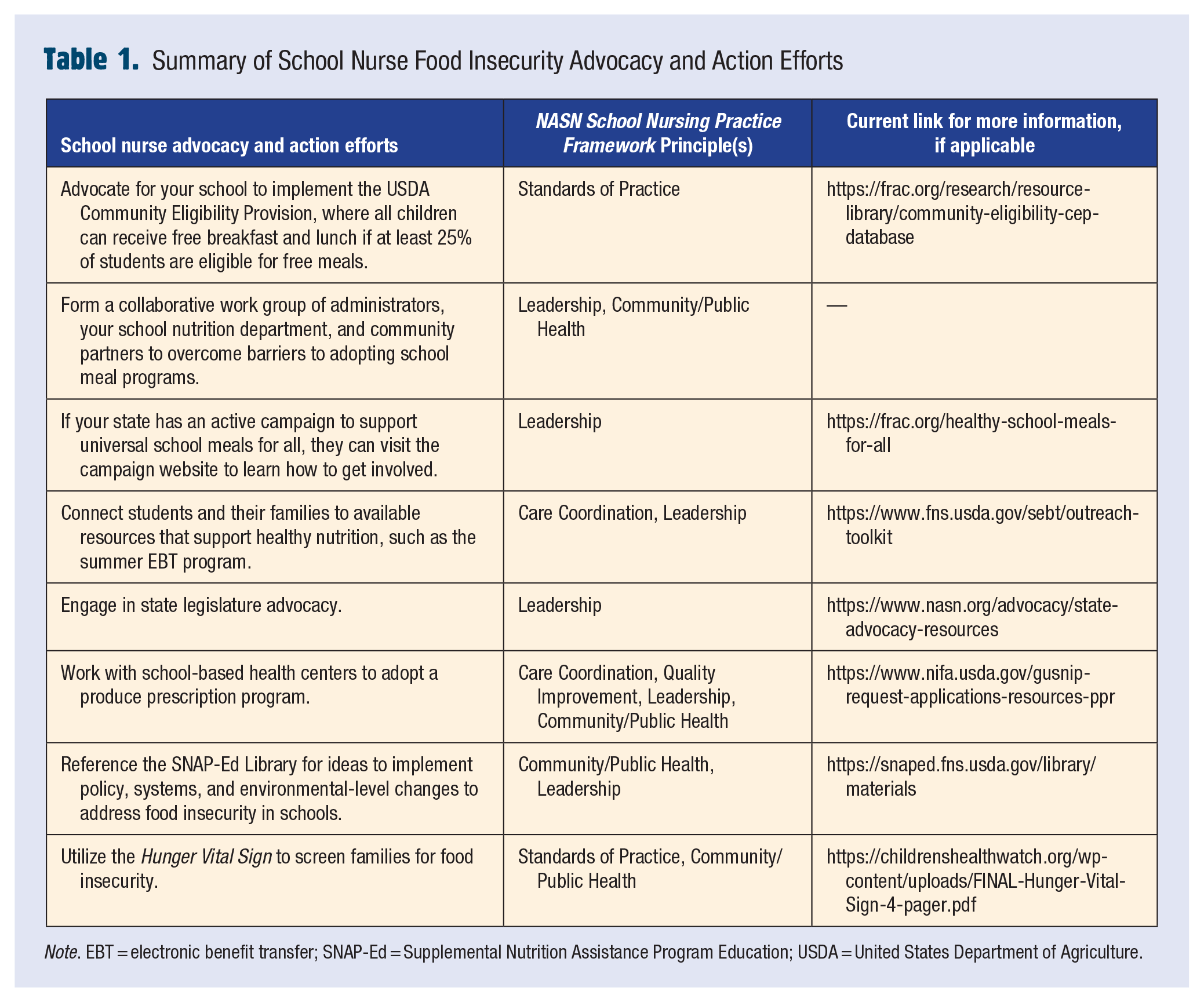
Note. EBT = electronic benefit transfer; SNAP-Ed = Supplemental Nutrition Assistance Program Education; USDA = United States Department of Agriculture.
Screening and Care Coordination to Address Food Insecurity and Unmet Social Needs
Food insecurity is closely linked to social determinants of health, which can be addressed, in part, through PSE interventions that promote quality nutrition and food security. School nurses are well-positioned to address their students’ health and screen for and coordinate care to address adverse social determinants of health and learning (Francis et al., 2021; Schroeder et al., 2018). School nurses can use a simple tool called the Hunger Vital Sign in school health offices or in meetings with parent/guardians to screen for food insecurity to inform the development of interventions or support food security efforts already taking place in schools (see Table 2; Children’s HealthWatch, 2014; Hager et al., 2010). If a child screens positive for food insecurity, school nurses can connect families to food assistance programs, such as SNAP and the Special Supplemental Nutrition Assistance Program for Women, Infants and Children, and SUN Bucks, as well as provide families with a list of local food pantries (Children’s HealthWatch, 2014). Utilizing the screening tool and engaging families in next steps encompasses the Assessment, Diagnosis, Outcome, Planning, and Implementation Standards of Practice and the principle of Care Coordination.
The Hunger Vital Sign Two-Question Food Insecurity Screening Tool
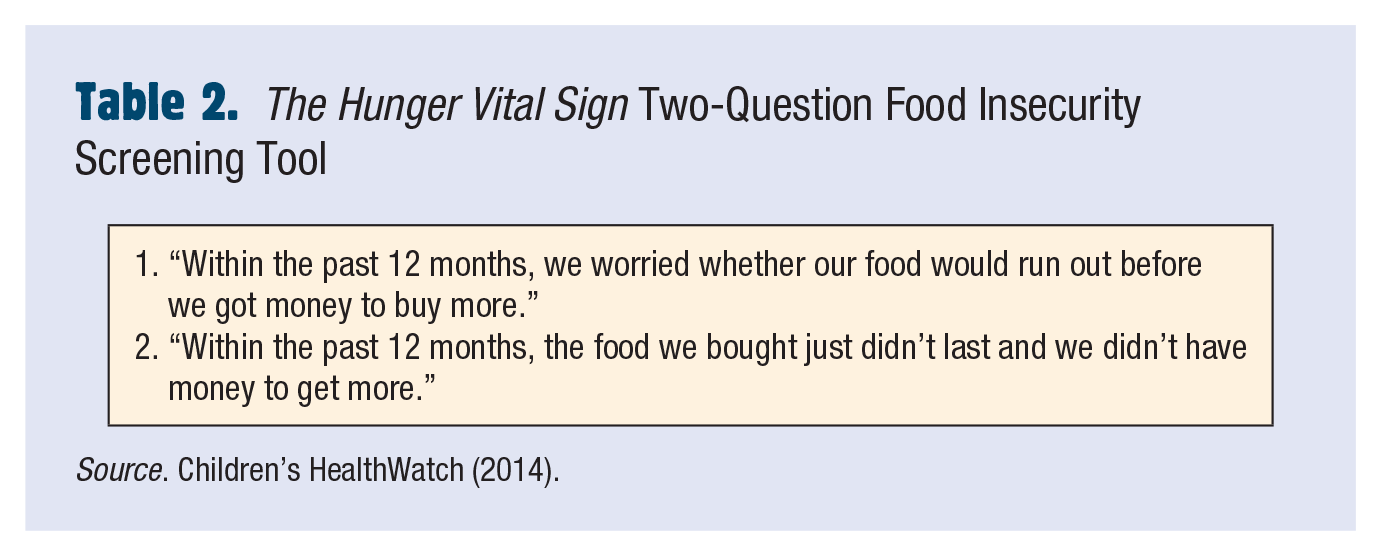
Source. Children’s HealthWatch (2014).
School staff in leadership positions, such as administrators and school nursing supervisors, can provide school nurses with protected time to work on health promotion tasks and to participate in additional training (such as those offered by NASN) to help them understand and feel comfortable with social determinants of health (Schroeder et al., 2018). Furthermore, a billable pathway must be explored for nurses to provide out-of-school time care to address health and unmet social needs (Francis et al., 2018). With strong support from school and nurse leaders, school nurses’ efforts in this realm can lead to advancing their overall goal—supporting the health of children and school communities. The Framework’s Care Coordination and Community/Public Health principles emphasize how nurses can provide holistic, preventative care to students by collaborating with community partners, teaching health promotion and disease prevention, and assessing school-level social determinants of health.
Conclusion
School nurses are one of the few, and often only, healthcare professionals in a school or school district, giving them a unique and holistic perspective on how coming to school hungry can impact children’s mental, physical, and emotional health. The School Nursing Practice Framework’s Leadership principle upholds school nurses as key leaders in advocating for and helping to develop equitable school health services. As advocates who can use their voices to amplify the voices of families in their communities to address barriers to food access, nurses are well-suited to lead health initiatives and policy change across all levels (Bergren, 2017). Given its harmful impacts on student learning, health, and overall well-being, food insecurity can be a priority health issue for school nurses to leverage their unique skills to make these transformative upstream changes.
Footnotes
Funding
The author(s) disclosed receipt of the following financial support for the research, authorship, and/or publication of this article: This publication was supported by the National Institute of Nursing Research of the National Institutes of Health under Award Number T32NR020315. The content is solely the responsibility of the authors and does not necessarily represent the official views of the National Institutes of Health.
Patient & Guardian Consent
Not applicable.

Data Availability
Not applicable.
Alexandra Peary has her Bachelor of Science in Nursing and is currently a PhD student at the Johns Hopkins University School of Nursing. Her research interests focus on school health, childhood obesity prevention, and food insecurity among youth and adolescents.
Erika Estrada-Ibarra is a BSN-prepared nurse and second-year DNP-FNP/PhD student at the Johns Hopkins School of Nursing. Her research interests focus on obesity prevention and food security among Hispanic/Latino families.
Dr Krista Schroeder is a nurse scientist, educator, and clinician. Her research focuses on measuring, documenting, and addressing the impact of social determinants of health on chronic disease risk.
Dr Laura Samuel’s research examines the roles of financial strain, food insecurity, and the Supplemental Nutrition Assistance Program in relation to health and health disparities.
Dr Jennifer Peterson is a pediatric Clinical Nurse Specialist and nurse faculty. Her scholarship and interests focus on improving neurodevelopmental, functional, and health and school readiness outcomes for infants, children, and adolescents with cardiovascular disease.
Dr Nancy G. Russell is a family nurse practitioner in college health and nurse educator. She has particular interest in the care of and issues affecting adolescents and young adults, including in the college health space.
Dr Lucine Francis’s research focuses on health promotion and innovation in child- and youth-serving organizations locally and globally. Her research program informs policy, systems, and environmental solutions to support food security, healthy nutrition, and mental health among children and youth using diverse research-informed strategies. She serves as a research mentor to Alexandra Peary. She is the corresponding author and can be reached at