






Abstract
Puberty, the physical and sexual maturation process of a young person, is associated with cognitive, emotional, and psychosocial changes. Puberty is a key time for health education and health promotion interventions, and school is an important setting for developmentally appropriate, evidence-based puberty education for all students. School nurses, with their clinical understanding of growth and development and patient and family education skills, are qualified and uniquely positioned to advocate for and assist in delivery of puberty education in the schools. However, school nurses may not have received any formal instruction in puberty education content or on classroom teaching as part of their training. This can put the school nurse at a disadvantage and is a gap this article intends to address. Therefore, a team of school health content and technology experts developed a free, online learning module-based puberty education training resource to answer some common puberty education questions.
Puberty, the physical and sexual maturation process of a young person, is also associated with cognitive, emotional, and psychosocial changes. In this normal, complex, transitional period, sexual development occurs at varying times and includes physical changes such as growth spurt, development of reproductive organs, hormonal changes, and brain development (Breeh & Caban, 2023). Rapid physical changes interact with social changes as youth may experience moodiness, lack of confidence, stress, more concern about body image, and peer pressure for risky behaviors as they adapt to their body changes (Viner et al., 2017).
Puberty is also a key time for health education and health promotion interventions to reduce risk for violence, mental health concerns, eating disorders and autoimmune diseases that present themselves during this period (Viner et al., 2017). While parents or guardians are the first and most important providers of puberty education, about 85% of parents in a national study supported a wide range of topics, including puberty education, being taught in schools (Kantor & Levitz, 2017). School is an important setting for developmentally appropriate, evidence-based sexual health education for all students. Effective, high-quality programs include supportive school polices and instructor competency and confidence (Walker et al., 2021).
School nurses are part of the school health promotion team who provide health services to students and coordinate care with families and providers (National Association of School Nurses [NASN], 2025). School nurses, with their clinical understanding of growth and development and patient and family education skills, are qualified and uniquely positioned to advocate for and assist in delivery of puberty education in the schools (NASN, 2024). However, school nurses may not have received any formal instruction in puberty education content or on classroom teaching as part of their training. This can put the school nurse at a disadvantage and is a gap this article intends to address.
Therefore, a team of school health content and technology experts developed a free, evidence-based, online learning module-based puberty education training resource. Modules included instructional content and background, best practices in teaching methods and strategies, and lesson plans and additional instructional materials and resources. The content and resources are easily accessed, and learning modules can be paused for return at any time. Continuing education credits were also available for free for those who were interested. See end of article for specific information on this course. The development of the course revealed several common puberty education questions.
Common Puberty Education Questions
The role of the school nurse can include teaching in the classroom (NASN, 2024). For some, taking on a formal teaching role, developing lesson plans, and managing a group of students so they can learn is a new experience. For others, it may be that teaching puberty education, a sensitive subject that may be dictated by state statutes and district policies, creates a level of concern. The following set of questions addresses the most common questions school nurses have. Direction as to where additional resources can be found in the online puberty education course referenced at the end of the article are also included.
How Do I . . . Feel More Confident in the Topic?
Knowledge of puberty basics and access to research-based resources and weblinks will help you become more confident in the subject matter. It is important that the school nurse review the physiology and the science of puberty development and puberty disorders, be familiar with the symptoms and causes of delayed and precocious puberty, and review information on state educational standards for school health education. Armed with this knowledge, school nurses can feel confident that they have the necessary content expertise. Reviewing and downloading handouts on puberty basics for parents and students is also helpful. The handouts can be shared in advance or as a follow-up to puberty education. After reviewing content and providing background information for parents and students, training and instruction in best practices for teaching puberty education can bolster school nurses’ confidence (Continuing Education for the Health Professions, 2024 [Module 1]; Sellers, 2026).
Best practices for puberty education include (Sellers, 2026):
Evidence-based curriculum, taught over time
Developmentally appropriate lessons
Relevant topics
Inclusive, mixed gender classroom
Family and school participation
How Do I . . . Teach Puberty Education?
Once you have increased your knowledge and confidence around puberty education content, it is important to use appropriate teaching techniques and methods to deliver instruction in the classroom (Continuing Education for the Health Professions, 2024 [Module 2]). Setting the stage for a safe and productive classroom climate involves a self-assessment of personal values and attitudes to make sure instruction is bias-free and addresses both social-emotional and physical changes. If coming into the classroom as a guest speaker, the nurse needs to ensure the classroom teacher stays in the room to support classroom management. It is also helpful if the nurse can consult with the classroom teacher in advance about their classroom management style and learn if they have specific approaches, for instance, how they call on students. The nurse can also ask if there are students who need any special accommodation. Before introducing the topic, the school nurse should establish rapport, assess prior knowledge, and create classroom rules for appropriate behavior. Setting expectations for classroom behavior at the start is important and should cover that the classroom is a safe space for asking personal questions, that confidentiality should be maintained, and that medical terms will be used rather than slang during the lesson (Sellers, 2026).
Classroom management also sets the stage for productive instruction. Commanding attention, using students’ names, encouraging immediate application of content, using a variety of teaching techniques, creating pair and small group discussion options, and active-learning strategies encourage engagement. Obtaining information from reliable sources and trusted adults is a necessary skill for students to master. Helping students identify a trusted adult is key during the introductory, stage-setting lessons (Continuing Education for the Health Professions, 2024 [Module 2]).
How Do I . . . Answer Student Questions?
Those who teach puberty lessons often wonder about the best way to respond to student questions. It is important to be prepared with strategies to help discern if you are being asked a fact or opinion question, establishing a goal for the answer, and using best practices. One approach that can be used is to affirm the questioner, then assess prior knowledge, clarify the question’s meaning, and allow the student to ask any follow-up questions. Also, use of a question box of anonymous questions or an anonymous polling app is a popular strategy to reduce student embarrassment and distraction as the nurse can answer the questions generically and has the ability to choose which questions to answer. School nurses need to be versed in strategies for dealing with embarrassing, gotcha, or personal questions with a focus on classroom management and knowledge of school guidelines as preventative techniques (Continuing Education for the Health Professions, 2024 [Module 3]). See Table 1.
Tips for Answering Difficult Questions
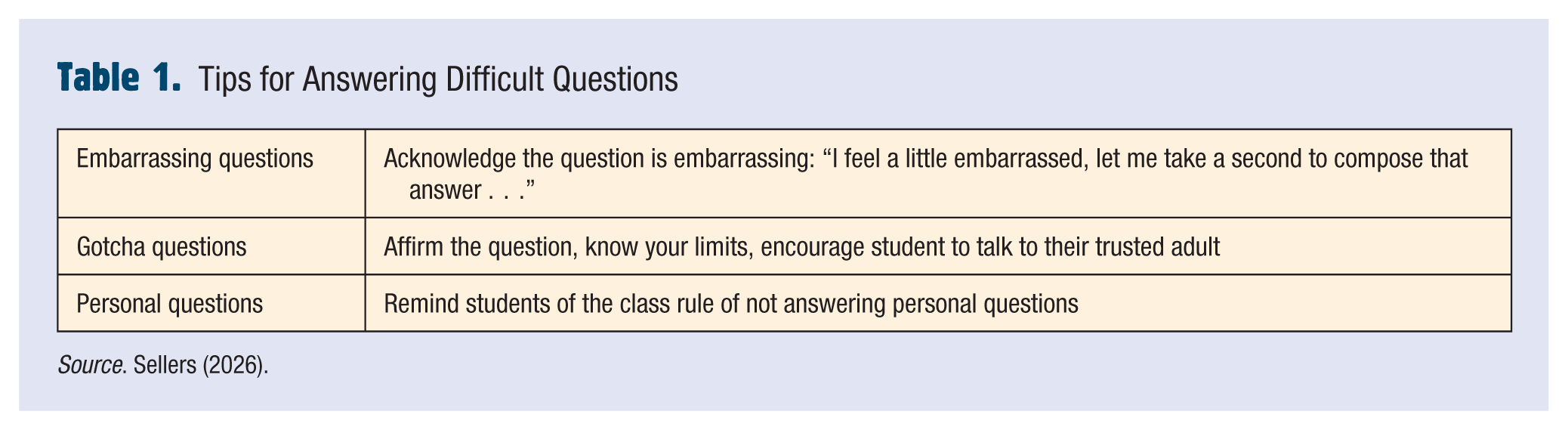
Source. Sellers (2026).
How Do I . . . Work/Partner With Parents?
Engaging families and schools is an important aspect of providing puberty education to minor students. School nurses must be aware of state and district rules around puberty education including opt-in/opt-out requirements as well as content that must be included and content that cannot be shared with students (National Conference of State Legislatures, 2020). Transparency about the curriculum and materials, listening to their questions, and respecting their values help to develop a school–parent partnership. Strategies to strengthen school–home partnership and communication can include providing take-home materials for parents or making presentations at the school board meetings to increase transparency and family engagement (Continuing Education for the Health Professions, 2024; [Module 4]).
How Do I . . . Find Lesson Plans?
Evidence-based lesson plans that follow national and state learning standards provide the school nurse with a great starting point. Lesson plans should be reviewed to ensure that they align with state statutes and standards. The lesson plans and teaching activities should cover four topics: Hormones, Body Changes/Hygiene, Physical/Emotional/Social/Intellectual Changes, and Reproductive Structure and Function. It is recommended that school nurses aways check and vet the lessons or activity options with the school/district leadership, such as the Curriculum Coordinator, Superintendent/Principal, or School Board (Continuing Education for the Health Professions, 2024 [Module 5]).
Summary
Effective puberty education for students relies on instructor competency and confidence (Walker et al., 2021). School nurses can benefit from additional education on the topic. The Puberty Education for School Nurses online, asynchronous program can provide school nurses with the needed training (Continuing Education for the Health Professions, 2024). While created in accordance with Missouri regulations and learning standards, the continuing education resource is recommended for all school nurses who wish to review pertinent content, learn and apply best practices in teaching techniques, and find additional active-learning activities to supplement their lessons. The role of the school nurse includes both episodic and formal teaching responsibilities; puberty education is among the most common. School nurses can and should use evidence-based resources to renew and expand their knowledge.
An Online Puberty Education Program for School Nurses
For school nurses interested in training in puberty education topics as well as skill-building for classroom teaching, enrolling in the free, online module-based, continuing education training resource at https://extension.missouri.edu/courses/puberty-education-for-school-nurses is the first step. After free registration, the home page and welcome screen provide a course overview as well as technology overview and course navigation tips (Continuing Education for the Health Professions, 2024).
Footnotes
Acknowledgements
Authors wish to acknowledge the support of the Continuing Education for the Health Professions Office the University of Missouri-Columbia.
Author Contributions
C.C.: Concept, Writing/original, Writing review/edits, Supervision, Funding; J.V.: Methods, Visualization/Analysis, Writing revision/edits; E.F.: Concept, Methods, Resources, Writing/Original; K.S.: Investigation, Resources, Writing/Original; B.W.: Investigation, Resources, Writing/Original.
Declaration of Conflicting Interests
The authors declared no potential conflicts of interest with respect to the research, authorship, and/or publication of this article.
Funding
The authors disclosed receipt of the following financial support for the research, authorship, and/or publication of this article: Creation of the project was funded in part by the Missouri Department of Health and Senior Services Title V Maternal Child Health Services Block Grant and was supported by the Health Resources Services Administration (HRSA) of the U.S. Department of Health and Human Services (HHS) under grant #B04MC45226
Ethics Approval Statement
This article adheres to NASN’s established ethical standards. Ethical approval was not required as the work did not involve human participants, animal subjects, or sensitive data.

Data Availability Statement
Data available upon request.
Dr. Cox is professor of health science at Truman State University in Kirksville, MO, USA. She assists school health teachers in curriculum development and evaluation.
Dr. Visker is a professor of health science at Minnesota State University-Mankato, MN, USA. He teaches Human Sexuality courses as a content expert.
Dr. Forsyth is an assistant professor of health science at Minnesota State University-Mankato, MN, USA. She is a nurse and teaches sexuality education courses.
Ms. Schilly is a student in health science at Truman State University in Kirksville, MO, USA. She teaches life skills education to elementary after-school students.
Ms. Wagner is a student in health science at Truman State University in Kirksville, MO, USA. She teaches life skills education to elementary students in after-school programs.