







Abstract
This case study presents a chronicle of events spanning a decade in Kentucky that led to state policy changes for principal preparation and details the response to those mandated changes by professors at the University of Kentucky. Professors’ collaborative efforts resulted in a new teacher leadership program and redesigned principal certification program that reflect characteristics of effective preparation programs described in literature. The article closes with lessons learned including a reflection by the author who was an active participant throughout the statewide and university redesign efforts.
Passage of the Kentucky Education Reform Act of 1990 (KERA) introduced ever-increasing state control over decisions affecting school districts and those who work in them (Browne-Ferrigno, 2009; Clements & Kannapel, 2010). Kentucky’s 1998 adoption of the Interstate School Leaders Licensure Consortium (ISLLC) Standards for School Leaders (Council for Chief State School Officers [CCSSO], 1996) initiated the first mandated redesign of principal preparation programs (Browne-Ferrigno & Fusarelli, 2005). A decade later, the cumulative actions by the Kentucky Education Professional Standards Board (KyEPSB), the agency created through KERA to oversee P-12 educator certification and program accreditation and initiatives supported by grants from The Wallace Foundation triggered a second mandated program redesign.
This article thus begins with a chronicle of key events between 1998 and 2008 that resulted in the closure of all principal preparation programs and a mandate for universities to submit redesigned program proposals to KyEPSB for review and approval. It then shifts to a presentation of redesign activities by faculty at the University of Kentucky between 2009 and 2011 to illustrate how one institution responded to the new requirements. The analysis of policy development and implementation in Kentucky is the state case, while the report of the response to mandated change by the University of Kentucky faculty is the institutional case. Findings and conclusions are presented as lessons learned framed by the three questions that guided the research.
Method
Like the other authors in this special issue, I am a member of the University Council for Educational Administration (UCEA)/Learning and Teaching in Educational Leadership Special Interest Group (LTEL SIG) Taskforce on Evaluating Leadership Preparation Programs, and I was an involved or peripheral participant in the redesign efforts reported here. The methodology used to report my lived and observed experiences is a combination of three approaches: (a) descriptive case study “within its real-life context” (Yin, 2009, p. 18), (b) contemporary phenomenology (Schwandt, 2000), and (c) interpretive ethnography “to better understand the conditions” (Denzin, 1999, p. 512). To report redesign activities in Kentucky spanning a decade, I used documents as the primary data source supplemented by findings from other research. The conclusions are based on evidence presented and my interpretations as the researcher-author who was an active participant in events reported.
State Case: Chronicle of Program Redesign Mandates
The chronicle of mandated program redesign in Kentucky begins with the introduction of master’s degrees in school administration in 1998 and ends with their elimination in 2008. The decade between those two policy changes illustrates a transition from grassroots efforts by professors to improve principal preparation through voluntary collaboration to statewide actions by diverse individuals often far removed from principal preparation.
Introduction of Master’s Degrees in School Administration
Prior to 1998, Kentucky had three unique principal certifications determined by school type: (a) Elementary School Principal, Grades K-4; (b) Middle Grades Principal, Grades 5 to 8; or (c) Secondary Principal, Grades 9 to 12. Educators seeking admission to preparation programs were required to provide evidence of completing 3 years of full-time teaching and holding a graduate degree in an education-related field. Those who had not completed graduate coursework in research methods, school-level curriculum aligned with certification sought, or educational and psychological testing were required to complete additional courses. Those completing these preparation programs typically earned a Specialist in Education (EdS) degree or a Rank 1, the Kentucky designation for completion of 30 credit hours beyond a master’s degree (Browne-Ferrigno & Fusarelli, 2005).
After the Kentucky General Assembly adopted the ISLLC Standards for School Leaders without modification in 1998, universities were required to redesign their principal preparation to reflect the new “blueprints of school leadership” (Murphy, 2003, p. 6) reflected in the Standards. The new state policy replaced the three school-level certifications with a single Professional Certificate for Instructional Leadership—School Principal, All Grades. Two former admissions requirements—an education-related graduate degree, three years of full-time teaching experience—were dropped. Programs thus redesigned after the Standards adoption began awarding master’s degrees in school administration, which was new for Kentucky. Novice teachers were allowed to enroll in principal preparation programs provided they had completed the mandated internship program for 1st-year teachers.
Beginning in 2001, KyEPSB thus began awarding provisional principal certification to individuals who (a) held a valid Kentucky teaching credential, (b) had completed 3 years of full-time teaching, (c) presented a letter of eligibility from an approved university stipulating applicant’s successful completion of principal preparation, and (d) achieved passing scores on the two required professional examinations administered by ETS (i.e., School Leaders Licensure Assessment, Kentucky Specialty Test of Instructional and Administrative Practices). During program graduates’ 1st year of service as school leaders, they were required to participate in the long-standing, mandated induction program called the Kentucky Principal Internship Program (KPIP) (Pickett & Richardson, 1992; White & Swezig, 1989). Upon successful completion of KPIP, practicing school administrators became eligible for the professional certificate, renewable every 5 years through completion of approved professional development hours or 6 credit hours of additional graduate coursework (Browne-Ferrigno & Fusarelli, 2005).
Although KPIP was suspended in 2007 because state funds were not appropriated by the Kentucky General Assembly to support it, state policy requiring the 1st-year induction program has not been modified. The most recent budget bill contains language that KyEPSB would allocate no funds for KPIP (R. Brown, personal communication, February 20, 2013). However, universities can develop an internship, mentoring, or practicum project for candidates (http://www.kyepsb.net/teacherprep/prinredesignguidelines.asp).
Administrator Certified, but Not Principal Candidates
Shortly after graduates of redesigned programs began to seek placements, Kentucky received a State Action Education Leadership Project (SAELP) grant from The Wallace Foundation. Kentucky Department of Education (KDE) officials hired professors from the University of Kentucky and University of Louisville to conduct survey research to gather perceptions about administrator practice across the commonwealth. Surveys were administered in 2001 to 11 discrete groups of educational practitioners and stakeholders. Data indicated that 1,285 teachers had been awarded provisional administrator certification (Björk, 2002). Superintendents, however, reported on their surveys that the statewide principal-applicant pool at that time included only 630 potential candidates (Björk, Keedy, Rinehart, & Winter, 2002), suggesting that in 2001, more than half of the graduates of the recently redesigned programs were not perceived by superintendents to be qualified to assume principalships.
Following the 2002 release of survey results, KyEPSB began tracking career paths of graduates against its active candidate pool. The number of teachers qualified to hold provisional certification but not seeking principal placement had mushroomed to more than 3,000 by 2004 and doubled to 6,000 by 2008. Kentucky has 1,233 public schools serving students in Grades K-12. Based on longitudinal data, the commonwealth annually needs about 300 new school administrators, evenly split between principals and assistant principals, to fill open positions (R. Brown, personal communication, November 1, 2011). The 2004 findings prompted KyEPSB to become an active agitator for program redesign to halt the overproduction of teachers completing principal preparation programs to meet the KERA-introduced requirement of a completed master’s degree within the first 10 years of full-time teaching.
From Grassroots to Comprehensive Redesign Efforts
In the early 1990s, professors of educational administration in Kentucky began gathering annually to strengthen ties among those preparing school and district leaders. In 1995, the professor-based group named itself the Commonwealth Collaborative for School Leadership Preparation (CCSLP) and thus became an identified entity among the many other education groups within Kentucky. The CCSLP thereafter held annual institutes where professors shared course syllabi, reported research findings, and discussed other issues relevant to their practice.
Professor discussions about program design elements
After hearing the results of survey research conducted by their peers, professors decided to draft white papers about program elements to share at the upcoming annual fall institute. When the coordinator of the Kentucky SAELP grant and the project director of Jefferson County Public School’s Leading Education Achievement in Districts (LEAD) initiative learned about the professors’ initiative, they offered to pool Wallace funds to pay all expenses for a 2-day meeting at a hotel in Louisville—provided that individuals other than university professors could also attend and that the institute be held the following spring. The two professors who served as CCSLP cochairs at that time accepted the offer.
Participants at the April 2005 Leading Change conference included 47 professors from the 11 institutions approved to deliver principal preparation as well as 21 individuals representing the Kentucky Education Cabinet, KyEPSB, KDE, and Kentucky Education Association. Nine other individuals representing the Education Development Center in Massachusetts, New York City Leadership Academy, and Southern Regional Education Board (SREB) in Georgia served as discussion facilitators and observers. The discussions during the conference focused on the nine elements researched by university faculty and presented in their white papers (e.g., codesign with district, codelivery of content, selection of participants, cohort delivery model, content and curriculum, practicum, program assessments).
The conference closed with a presentation by the SAELP and LEAD directors about the framework for principal preparation used in Jefferson County Public Schools. The framework was presented to conference attendees as the adopted document for program redesign. Professors at the eight universities that serve rural school districts expressed concern about the proposal for two reasons: (a) It focused specifically on preparing principals for an urban setting and (b) the model program was funded by grants. Although the professors’ concerns were noted, subsequent events evidenced a disregard for contextual and economic differences across the commonwealth (Browne-Ferrigno, 2011).
Outsider discussions about program design elements
Shortly after the Leading Change conference (CCSLP, 2005), the two Wallace-funded initiatives were merged into a single entity called the Kentucky Cohesive Leadership System (KyCLS). Its new director convened a meeting to which she invited representatives from the KyEPSB, KDE, and Council on Postsecondary Education and chairs of the 11 university or college departments with approved programs to determine “how best to improve principal preparation” (KyCLS, 2008, p. v). The group determined that the proposed model would serve as the framework for future discussions about program redesign.
This convening was a major turning point in redesign efforts: University professors directly involved in preparing principals or actively conducting research on principal preparation were no longer primary decision makers about program redesign. Their department chairs typically represented professors. Because department chairs were not involved in principal preparation, they were unable to contribute firsthand knowledge about programs or recommend relevant research-based literature to inform decisions. As the redesign initiative moved forward, the voices of those most closely involved with principal preparation were often not heard.
The KyCLS director then organized a Principal Redesign Summit held in January 2006 to gain feedback on Kentucky’s proposal for improving principal preparation and development. Attendees included “some 70 individuals representing 33 stakeholder groups” (KyCLS, 2008, p. v). Professors were among the attendees, but which ones or how many attended is not documented. The KyCLS director also invited representatives from the CCSSO, National Association of State Boards of Education, National Conference of State Legislatures, and National Governor’s Association to facilitate four breakout sessions intended to gather participant perspectives about Kentucky’s redesign proposal. The following are the five questions posed by facilitators during those breakout sessions:
Do you believe the recommended items for consideration will help Kentucky in its efforts to have a more coherent system for developing school leaders?
Does this proposal address the need to prepare leaders to carry out the roles and responsibilities critical to advancing student learning?
What role do you think your organization can play in making this redesign proposal a reality?
Are there obstacles to making this reality? What suggestions do you have for overcoming any obstacles?
Are there key areas or components that were missed or need to be addressed more fully?
Although the discussion notes are included in the appendix of the Continuum for Principal Preparation and Development (KyCLS, 2008), it is unclear who used the information. Analysis of the notes is difficult because they range from words attributed to specific speakers to lists of phrases or words under headings that are not aligned with the five questions. Nonetheless, a review of the breakout session notes revealed several common topics: criteria for selective admissions (e.g., years of teaching experiences, graduate record examination [GRE] scores, dispositions), retention or elimination of the master’s degree, resources (i.e., time, money, personnel) needed to implement internships, state policy specifying selection of principals by school councils rather than superintendents, missing groups in redesign discussions (e.g., program candidates and recent graduates, local school boards, school councils, personnel from rural isolated districts), and potential organizational hindrances within postsecondary institutions. Teacher leadership as an option for those not interested in the principalship or as prerequisite for admissions to principal preparation programs was discussed in two groups.
Redesign resolution and task force
Nine months after the Principal Design Summit, the Kentucky General Assembly adopted a resolution proposed by Representative Jon Draud who at that time also served as a member of the SREB Legislative Advisory Board. The resolution, which was based on a proposal drafted by professors following the Leading Change conference, directed the executive director of KyEPSB in collaboration with the president of the Council on Postsecondary Education and the Kentucky commissioner of education to “form a task force to present recommendations on the redesign of principal preparation and support” (Education Leadership Redesign [ELR] Task Force, 2007, p. 7). The 35-member ELR Task Force included 5 members of Kentucky education organizations, 12 representatives of state agencies, 6 practicing or retired administrators, a research consultant from the SREB, and the 11 department chairs. No documentation is available about who determined the Task Force composition or how members were selected. The executive committee included the Continuing Professional Education (CPE) interim president, KDE interim commissioner, KyEPSB executive director, Education Cabinet secretary, and Representative Draud. Expenses were covered by federal funds routed through SREB.
The Task Force divided into four work groups facilitated by KyEPSB staff members. They met for a year to “review salient literature [and engage in] in-depth discussions in which ideas were developed” (ELR Task Force, 2007, p. 7) about preparation programs, induction and working conditions, professional development, and doctoral programs. The principal program group submitted the following recommendations:
Incorporate all principal preparation programs and principal support services within dynamic and documented district-university partnerships.
Require that all principal preparation programs adopt highly selective admission standards.
Redesign the principal preparation curricula around the competencies shown by research to be necessary for raising student achievement.
Redesign all principal preparation courses around structured school-based learning experiences.
Detailed within these four recommendations are concepts that later appeared in the revised policy on principal preparation. The references listed in the Task Force’s report are predominately publications produced by SREB and The Wallace Foundation.
Statewide exemplar design efforts
Shortly after publication of the Task Force report, the KyCLS director convened a 47-member KyCLS Design Team composed of 23 professors (including the 11 department chairs) from universities with approved programs and two colleges without programs and 24 representatives of special interest groups and state agencies. About half the members of the design team were Task Force members (e.g., department chairs, members of state agencies, and practicing and retired administrators) and the other half were professors and others with unique expertise. Design team members as well as a paid consultant and occasional invited guests met monthly for 2 full days throughout a year to review documents prepared by previously convened groups and to design exemplars of performance assessments to support university personnel during their redesign activities. The exemplars were based on the six dimensions and corresponding functions created by Jefferson County Public School personnel for their Wallace-funded programs.
The design team developed a notebook that was approved in May 2008 by KyEPSB as a resource for program redesign. The October 2008 revised Kentucky Administrative Regulation about preparation and certification of principals stipulates that “Dispositions, Dimensions, and Functions for School Leaders,” (Professional Certificate for Instructional Leadership, 2008, Sec3(2)), which KyCLS-sponsored groups developed, are to be used to document candidate performance during preservice preparation.
Elimination of Master’s Degrees in School Administration
The 2008 revision of the Kentucky Administrative Regulation stated that all university-based preparation programs approved prior to May 31, 2009, would no longer be allowed to admit new students after December 31, 2011. Kentucky universities wishing to provide principal preparation were required to submit their program proposals to KyEPSB no later than December 31, 2012. The most significant change in policy was the elimination of master’s degrees in school administration. All candidates admitted to redesigned programs must
hold a graduate degree;
present evidence of 3 years of documented full-time teaching experience in a public school or a nonpublic school that meets state performance standards;
document their skills and understanding in three areas (i.e., ability to improve student achievement; leadership; advanced knowledge of curriculum, instruction, and assessment); and
present an agreement signed by a superintendent pledging support for the candidate to participate in a high-quality practicum experience.
All program proposals submitted to KyEPSB for review had to include signed collaborative agreements with districts that specify (a) joint screening of principal candidates and (b) codesign and codelivery of courses. The proposal also had to evidence (a) collaboration with academic disciplines and programs outside the field of education, (b) collaboration with districts in providing appropriate field experiences for candidates, and (c) requirement for candidates to conduct a capstone project that is defended before a panel of program faculty and school administrators upon program completion (Professional Certificate for Instructional Leadership, 2008).
Institution Case: University of Kentucky’s Response to Mandate
When faculty in the Department of Educational Leadership Studies (EDL) at the University of Kentucky began to discuss principal program redesign in 2009, only two professors remained who had participated in the events described above and had taught in the previously approved program for several years. Faculty composition had changed significantly due to recent retirements or resignations of four associate professors and the hiring of three novice assistant professors and a lecturer, a retired Kentucky superintendent who taught the finance course in the principal preparation program. While the change created an opportunity for innovation, the assistant professors that had relocated from other states needed time to gain experience teaching graduate courses, become acculturated into higher education, and learn about Kentucky’s education system.
The faculty decided to postpone principal program redesign to allow the assistant professors to engage in constructed conversations with educational practitioners. Thus, a principal program codesign team was created that included five professors (i.e., author, three assistant professors, lecturer) and nine educational practitioners (i.e., school and district administrators, state directors of AdvancEd, executive director of a state education cooperative). The team met 5 times during 2009 to review new state policy, professional standards and program redesign documents, test-preparation questions in the required certification examinations, and proposed curricular changes in the school law and finance courses. Meetings were held at district offices and local schools. Although the team disbanded after 6 months due to scheduling challenges, the discussions about principal preparation and school leadership provided foundational information that new faculty needed.
Shortly thereafter, the EDL department chair and the director of graduate studies (author) were asked to participate in the College of Education’s committee that was discussing mandated revisions to graduate programs for teachers. The policy required that those redesigned programs include a course on teacher leadership. To become better informed about teacher leadership, the EDL chair asked assistant professors to conduct literature reviews and search other institutions’ websites for teacher leadership courses. Our engagement in those activities and an analysis of program-graduate information led to the creation of an initially unplanned new program within the department.
Analysis of Program Graduate Placements
Acting within the responsibilities assigned to a director of graduate studies, I conducted a comprehensive review of former students’ files in June 2009 to ascertain their career paths after graduation. The process began by identifying those admitted between 2000 and 2008 and then determining their program entry and exit dates, admissions status, current position and work site, and email address. Data were gleaned from student files and from the online, open-access database maintained by KyEPSB that displays P-12 educators’ current employment status. With approval from the Institutional Review Board at the University of Kentucky, I created a database containing graduates’ working email addresses and then invited graduates to complete the School Leadership Preparation and Practice Survey administered by the National Center for Evaluation of Educational Leadership Preparation and Practice sponsored by the UCEA (http://edleaderprep.org/).
I then created a secondary database containing information for students who were admitted to the preparation program between 2002 and 2006 and who completed coursework requirements by May 2008, which gave them time to assume a principalship by June 2009. The following are results from analysis of those data. Among the 85 program completers within the bounded years, 54 (65%) hold either provisional or professional principal certification. Statistics based on racial and ethnic descriptors are consistent with statewide diversity statistics reported by the U.S. Census Bureau: Eight (9%) are members of minority groups (i.e., 6 Black or African American, 1 Asian American, 1 Hispanic), and the remaining 77 are White, non-Hispanic (91%). The group included 28 men (33%) and 57 (67%) women. The group’s average age when beginning the program was 33.5 years (range = 23-54, median 32, mode 28) and average years of teaching experience was 7.7 (range = 1-30, median 6, mode 7).
Table 1 indicates that 47 (55%) of the 85 program participants between 2002 and 2006 were using their leadership preparation as intended—as practicing principals or assistant principals. The professional development needs of the other 38 (45%) participants apparently were not addressed, evidenced by their continued service as teachers. Several discussions during statewide redesign activities centered on possible reasons for the overproduction of principal program graduates who never apply for principal certification or seek placement. While diverse factors influence a teacher’s decision to become a principal, one explanation could be that the only option for leadership preparation at that time was through participation in principal preparation. It is also important to note that these data suggest experience as a teacher leader prior to entry into a preparation program may be a predictor of future placement as a principal (Muth, Browne-Ferrigno, Bellamy, Fulmer, & Silver, in press).
Program Completers Statistics (2002-2006) and Current Work Assignments.
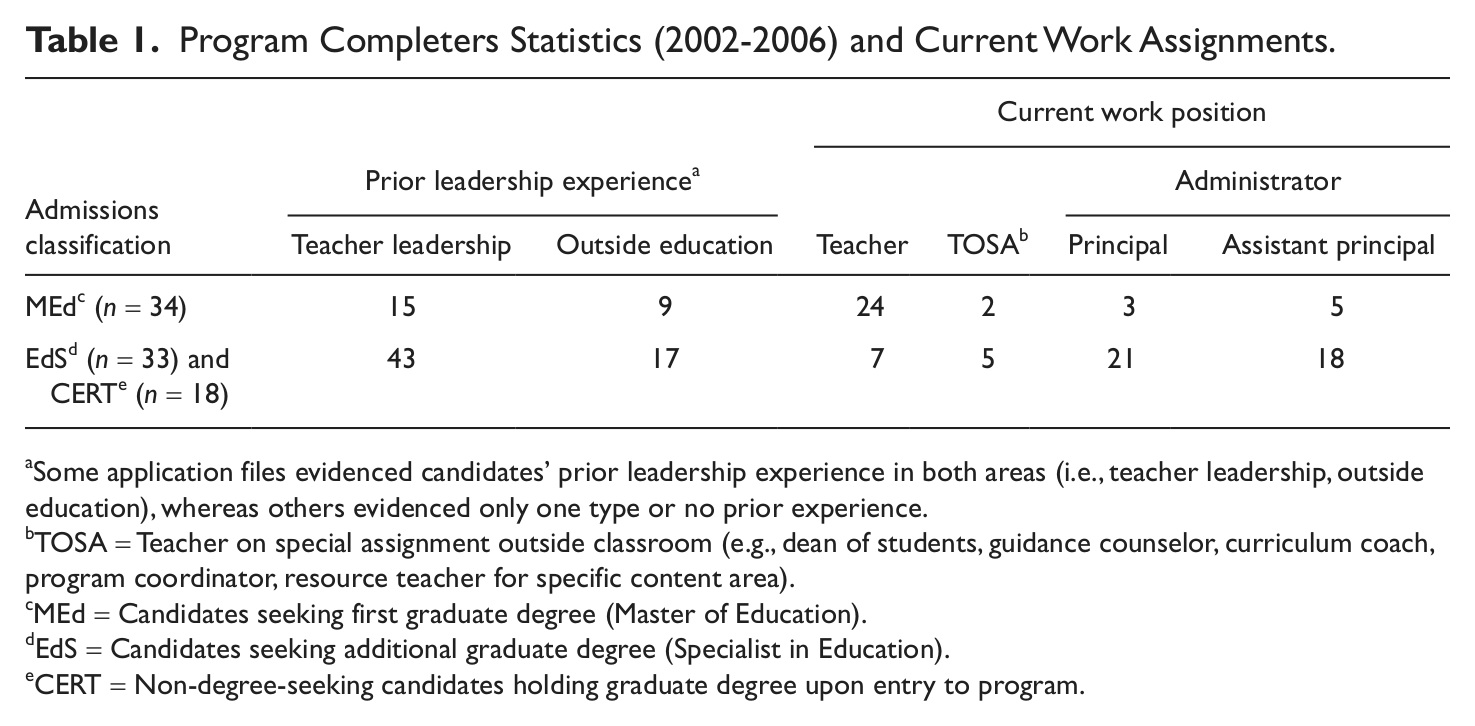
Some application files evidenced candidates’ prior leadership experience in both areas (i.e., teacher leadership, outside education), whereas others evidenced only one type or no prior experience.
TOSA = Teacher on special assignment outside classroom (e.g., dean of students, guidance counselor, curriculum coach, program coordinator, resource teacher for specific content area).
MEd = Candidates seeking first graduate degree (Master of Education).
EdS = Candidates seeking additional graduate degree (Specialist in Education).
CERT = Non-degree-seeking candidates holding graduate degree upon entry to program.
Program Development Activities
Data gathered from the survey and graduate files, review of the admission requirements for redesigned principal preparation programs, and engagement in activities about redesign of graduate programs for teachers indicated to EDL faculty that we needed to develop a teacher leadership program that prepared graduates to assume formal and informal leadership positions in P-12 schools with emphasis on working with principals and in learning communities. As the director of graduate studies at the time, I assumed responsibility for coordinating the program development activities, drafting the program application and proposal documents, editing new course syllabi to assure consistency in format and content placement to expedite review processes, and shepherding the proposal through the University of Kentucky and KyEPSB. Faculty assumed responsibility for course syllabi development and critical reviews of proposal drafts.
After months of brainstorming sessions, comprehensive reviews of literature, conversations with diverse P-12 leadership practitioners and university colleagues, and development of new course syllabi, EDL faculty produced its new Teacher Leadership Program. Following critical reviews of the course syllabi and application for new program by multiple faculty advisory and governance bodies at the University of Kentucky, the new courses and program application were approved in May 2010. The program proposal was then prepared and submitted to KyEPSB for review and approval. After four revisions to address review committee comments on the evaluation rubric, EDL received approval in May 2011 to deliver the Teacher Leadership Program and to recommend the addition of the Teacher Leader Endorsement to graduates’ teaching certificates. EDL faculty elected to postpone launch of the program to complete redesign of the principal preparation program.
Lessons learned during the development and approval processes required for the Teacher Leadership Program and the arrival of two new associate professors from other states expedited development of the Principal Certification Program. To avoid the comprehensive review of new degree programs required by the University, EDL faculty elected to embed principal certification within its Doctor of Education (EdD) program. Although some courses used in the previous principal preparation program required revisions, they were considered minor changes. However, the four new courses that were developed required the approval of the University of Kentucky. Although the new director of graduate studies assumed responsibilities for program development and proposal drafting, I assisted her by writing portions of the proposal, developing three new course syllabi, and editing all course syllabi to be submitted to KyEPSB to assure consistency in layout and content of requirement information. The Principal Certification Program proposal was submitted to KyEPSB in November 2011. After three revisions to address comments on the evaluation rubric prepared by the review committee, in May 2012, KyEPSB approved the Principal Certification Program to recommend principal certification.
The following sections present overviews of the two programs. In Kentucky, the word candidate is used to designate an adult engaged in professional preparation at a postsecondary institution, while student refers to children and youth enrolled in P-12 schools. The terms doctoral student and doctoral candidate are used where appropriate.
Teacher Leadership Program
The overarching program goal of the Teacher Leadership Program is to prepare teachers to assume leadership roles and responsibilities that “support school and student success” (Harrison & Killion, 2007, p. 74). The theory of action for the program is the “Framework for School Leadership Accomplishments” (Bellamy, Fulmer, Murphy, & Muth, 2007, p. 34) in which student learning is the central focus accomplished through conditions that create a learning-centered school environment (i.e., learning goals, instruction, student climate, related services, family, and community partnerships) and support the learning environment (i.e., family and community partnerships, resources, school operations, staff support, renewal).
Standards-based curriculum and continuous learning assessment
The program is framed by the advanced-level Kentucky Teacher Standards, Educational Leadership Policy Standards: ISLLC 2008 (CCSSO, 200), and National Educational Technology Standards for Administrators (International Society for Technology in Education, 2009). Candidates are required to complete self-assessments of their understanding and use of these standards at three points during the program (i.e., admission, retention, completion). They must upload artifacts to their electronic portfolios with a corresponding coversheet in which they reflect about how the work products link to specific standards that they identify. Candidates’ electronic portfolios also include their observations and reflections of diverse classrooms and their practicum log, which are reviewed by faculty. At program completion, candidates must defend their action research report (i.e., capstone project) before a committee composed of program faculty and P-12 educational practitioners.
Individualized professional development
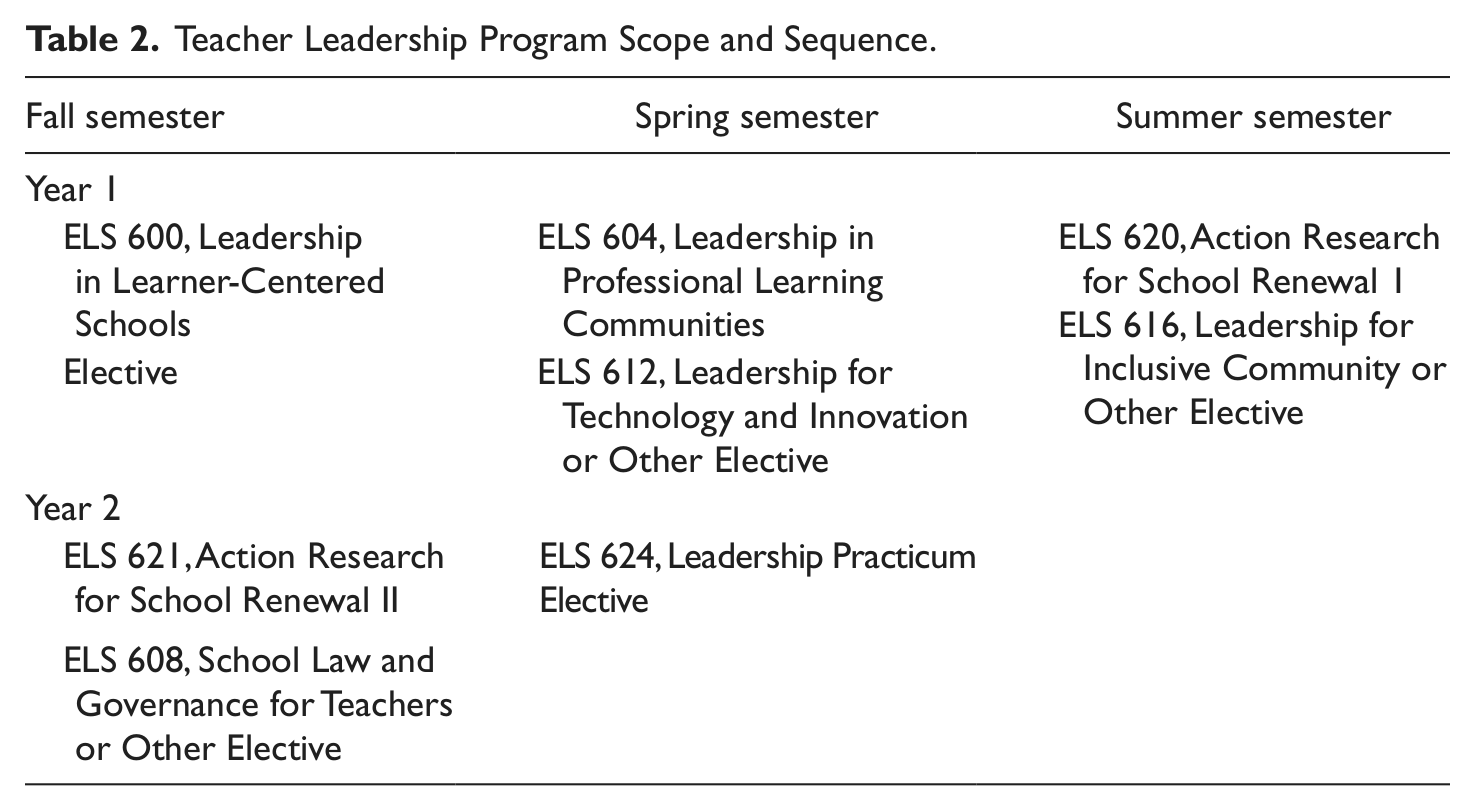
The program provides flexibility in course selection to address candidates’ individualized professional development needs. All students must successfully complete the 15 credit hours of core coursework (i.e., ELS 600, ELS 604, ELS 620, ELS 621, ELS 624). Teachers holding a graduate degree upon program admission can earn the Teacher Leader Endorsement by completing the 15 credit hours of core coursework and all elements in the continuous assessment plan. Candidates seeking the EdS or Master of Education (MEd) must successfully complete an additional 15 credit hours of elective courses selected from options inside or outside the program to meet their unique learning needs (i.e., ELS 608, ELS 612, ELS 616, other electives). They must also complete all requirements in the continuous assessment plan. Table 2 displays the scope of curriculum and sequence of courses in the program.
Teacher Leadership Program Scope and Sequence.
Outcomes
The program prepares teachers to assume schoolwide leadership roles, formal (e.g., school-governance committee member, department chair, grade-level team leader) and informal (e.g., instructional model, peer mentor, school-community collaborator, curriculum team member). Candidates work with principals and other educators to complete learning-focused activities that expand their knowledge about curriculum, instruction, and assessment and that develop their leadership skills. If graduates of the program determine in the future that becoming a principal is an appropriate career choice for them, they will have the required graduate degree, leadership experience, and advanced knowledge of schoolwide instructional program to apply for admission to one of Kentucky’s redesigned principal preparation programs.
Principal Certification Program
The Principal Certification Program is designed to prepare premier educators across the commonwealth to be transformational leaders who facilitate the use of evidence-based practices in P-12 settings. It was designed as a statewide program in keeping with the University of Kentucky’s land-grant mission. The conceptual framework for the program combines three critical components: (a) learning-centered leadership, (b) transformational leadership, and (c) implementation science. The program design enables candidates to become transformational leaders through carefully constructed opportunities to build their knowledge base, practice skills, implement skills in work-embedded experiences, and debrief using a transformational leadership/implementation science framework created specifically for the program. Candidates and graduates will have access to a Principal’s Toolbox, a set of online modules designed to provide just-in-time learning experiences to improve on-the-job performance (e.g., delivering effective presentations, writing effective memos, managing an online personal learning network).
Because the Principal Certification Program is an adaptation of the department’s EdD program, with the EdS degree option for those choosing not to complete the dissertation, applicants must meet requirements for admission to the regular EdD program (e.g., GRE scores, graduate GPAs, writing ability, graduate-level basic statistics course, recommendations) as well as those specified in state policy (e.g., 3 years of full-time teaching experience, leadership experience, knowledge of academic program). Admission decisions are based on holistic reviews of applicants’ application files, performance during interviews with faculty, and dispositions about the principalship.
Guaranteed support for high-quality field experiences
One recommendation for admission to the program must be from the applicant’s superintendent. If admitted, the candidate’s superintendent must sign a memorandum of agreement pledging support for a high-quality practicum experience. The agreement must
specify how the district will assure that candidate has opportunities to observe and participate in school and district leadership activities,
confirm that candidate will have access to school and district data to use when completing program assignments, and
articulate the number of days that candidate will be released from work responsibilities to engage in practicum.
Comprehensive curriculum and embedded field experiences
For a comparison between the previous and new principal preparation programs, see Table 3. The left column displays the scope of curriculum and sequence of courses in the previous MEd/EdS program. The right column displays the scope and sequence of the new EdS/EdD program. EdS candidates must complete 36 credit hours of coursework (Level I), oral defense of capstone project, and pass the two state-required examinations to be recommended to KyEPSB for provisional certification as school leader. They must assume a principalship or complete an additional 6 credit hours (Level II) to be recommended for professional certification.
Comparison of University of Kentucky Principal Preparation Programs.
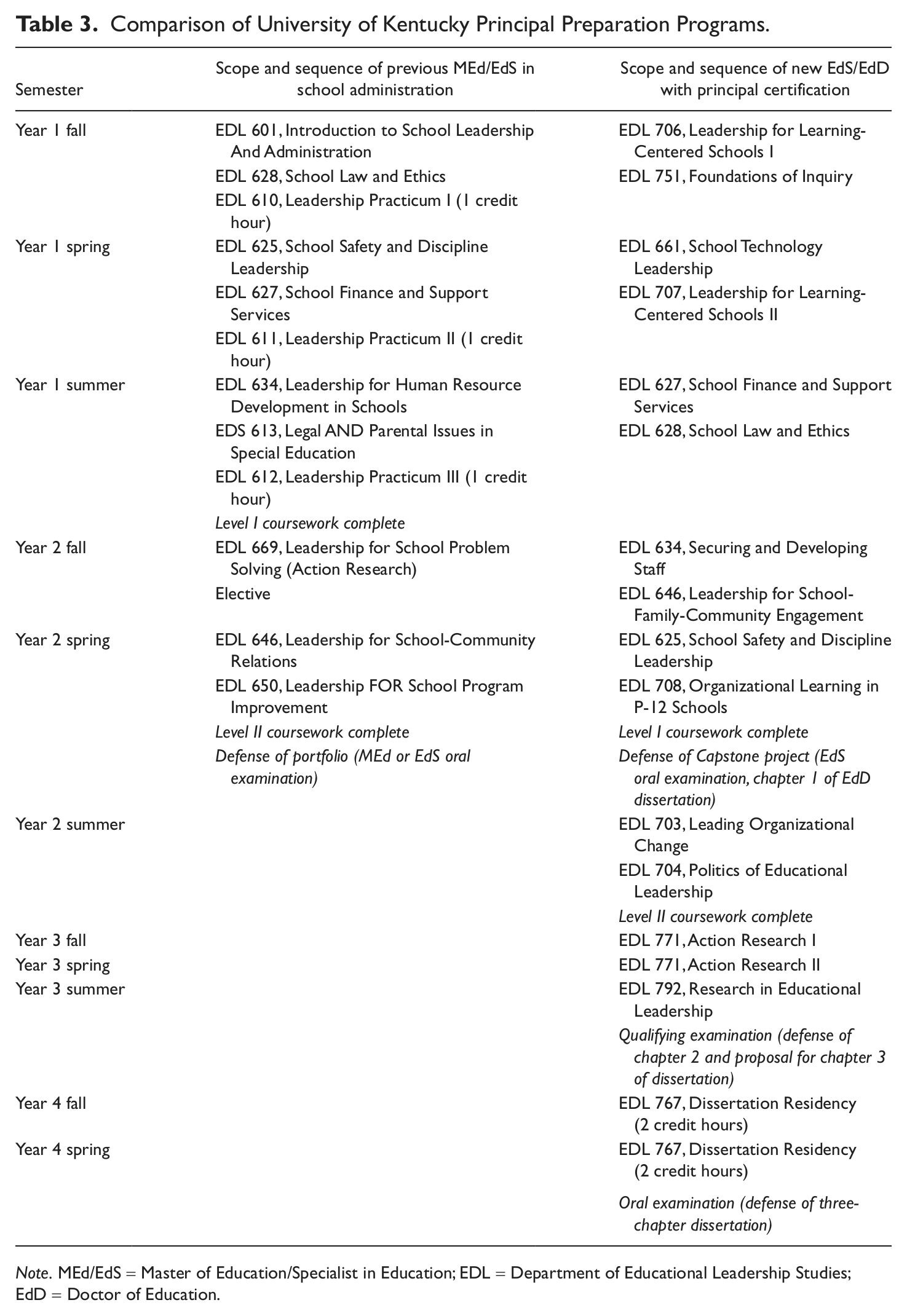
Note. MEd/EdS = Master of Education/Specialist in Education; EDL = Department of Educational Leadership Studies; EdD = Doctor of Education.
EdD candidates must complete 49 credit hours of coursework that includes the Level I and Level II courses described above plus an additional 9 credit hours of required research courses and at least 4 credit hours of dissertation residency courses after passing their qualifying examination. Although EdD candidates defend their capstone project (certification requirement) at the same time as the EdS candidates, they are advised to complete the doctoral program before assuming a principalship. The University of Kentucky recently shortened time to degree completion to assure doctoral candidates graduate.
With the exception of EDL 751 Foundations of Inquiry (required methodology course), each of the 10 courses in Level I of the program includes approximately 60 clock hours of required fieldwork during which candidates observe, participate in, or lead school leadership activities. Before exiting the program, candidates thus complete approximately 600 clock hours of field experiences related to school leadership. The field experiences in the 10 courses replace the 3-course practicum series (EDL 610, EDL 611, EDL 612) in the previous program.
Five courses from the previous preparation program were revised slightly to address redesign requirements, and the titles of two courses were changed to reflect content more accurately. These five courses constitute the specialization area (15 credit hours): EDL 625 School Safety and Discipline Leadership, EDL 627 School Finance and Support Services, EDL 628 School Law and Ethics, EDL 624 Securing and Developing Staff, and EDL 646 Leadership for School-Family-Community Engagement.
Four new courses were created to address new expectations for Kentucky principals and are among the six required leadership courses (18 credit hours). EDL 661 School Technology Leadership presents an overview of principal responsibilities concerning technology adoption and utilization, which is a statewide initiative. EDL 706 Leadership for Learning-Centered Schools I (curriculum and instruction) and EDL 707 Leadership for Learning-Centered Schools II (assessment and accountability) assure candidates have content knowledge and skills to be effective learning leaders. The previous program did not have courses about these two critically important responsibilities of principal leadership. EDL 708 Organizational Learning in P-12 Schools replaces and expands content of EDL 650 Leadership for School Program Improvement in the previous program. EDL 703 Leading Organizational Change and EDL 704 Politics of Educational Leadership are required courses in the leadership core of the regular EdD program and serve as Level II courses in the principal certification program.
Formal performance assessments
All program participants must defend their capstone project (i.e., analysis of an authentic school leadership issue) before a committee composed of university professors and leadership practitioners. All candidates who successfully defend their capstone project receive a letter of eligibility for provisional certification, provided they achieved passing scores on the two professional examinations administered by ETS. Defense of the capstone project serves as the EdS oral examination; those graduates must complete Level II courses within 5 years of program completion and assume an administrative position to qualify for professional certification.
For those seeking the EdD degree, the capstone project becomes Chapter 1 of their three-chapter dissertation, a format approved by the University of Kentucky for professional doctorate programs. Upon successful completion of the required 45 credit hours of coursework and with approval from dissertation chair, a doctoral student is eligible to sit for the qualifying examination, which is based on Chapter 2 of their dissertation (i.e., implementation plan to address the issue reported in Chapter 1). Doctoral students achieve candidacy status by passing their qualifying examination. While enrolled in the two academic semesters of required dissertation residency credit, doctoral candidates research the impact of their implementation plan and write Chapter 3, which is a report of findings and recommendations for further action. Once a complete dissertation is approved by the candidate’s dissertation chair, he or she is eligible to sit for an oral examination based on the complete dissertation. According to University of Kentucky regulations, the candidate’s advisory committee conducts the EdD examination.
Program Alignments With Recommended Program Design Features
Both of EDL’s new leadership preparation programs are framed by relevant leadership theory and professional standards. Each program has specific admissions criteria that are used during candidate recruitment and selection. Program content is delivered in a sequence that assures candidates’ development of requisite knowledge and skills, which is enhanced by utilization of active-learning strategies, collaborative group work, and projects as well as independent reading and writing.
Both programs integrate field-based assignments and research activities in core courses to provide opportunities for candidates to apply their learning in authentic settings. A practicum conducted in a school setting and supervised by an administrator near program end assures that aspiring teacher leaders understand the significance of collective leadership. In addition to the 600 clock hours of field-based experience, aspiring principals engage with practicing principals in a series of seminars focused on transformational leadership, implementation science, and other pertinent topics.
Both programs are delivered to cohorts composed of candidates admitted each fall semester; course enrollments may include other graduate students who take courses as electives. During the first semester of both programs, attention is devoted to transforming the cohorts into learning communities. Web-based learning sites (e.g., AdobeConnect, Blackboard, Canvas) are utilized in all courses to enhance learning and support collaboration. Diverse formative and summative assessments of candidate learning are used in all courses and at specific benchmarks within the programs (e.g., admission, retention, completion). Data derived from these assessments are used in program evaluation. Program faculty includes tenure-track, full-time university professors, and part-time adjunct instructors who are experienced educational leaders with expertise in the content area taught. Prospective adjuncts coteach with full-time professors prior to assuming responsibility for teaching a course.
Findings and Conclusions: Lessons Learned
The articles in this special issue of the Journal of Research on Leadership Education were written by members of the UCEA/LTEL SIG Taskforce on Evaluating Leadership Preparation Programs to “archive and disseminate our lived experiences as involved and peripheral participants in statewide redesign efforts and in our institutions’ responses to policy mandates” (Phillips, 2013, p. 141). To assure coherence in our work, we developed three questions to guide us. Following are responses to those questions with regard to this case.
Evidence of Substantive Programs Changes
The first question asked, To what degree did externally imposed redesign mandates influence substantive program changes? The redesign mandates in Kentucky required significant changes because programs approved prior to May 2009 were closed. But were redesign mandates needed? Recall that after the 2002 survey results were presented during an annual CCSLP institute, professors committed to improve principal preparation. They began by identifying nine elements related to program design and then conducted literature reviews and drafted white papers for distribution and discussion at their next institute. Considering the chronology of events presented at the beginning of this article, that action by professors was the catalyst for recent program redesign in Kentucky. It is thus interesting to consider several questions: What if the Leading Change conference had not happened? What if the SAELP and LEAD grants had not been merged? Would there have been a Principal Redesign Summit? Would there have been an ELS Task Force or a KyCLS notebook? I assert that program redesign would have happened more quickly without the lengthy, expensive statewide initiative—as professors redesigned the approved programs in use today.
Facilitated or Hindered Redesign
The second question guiding our research was, What are the primary factors that facilitated or hindered redesign program development and implementation? In Kentucky, program redesign was hindered by time and effort spent gathering input from individuals not directly involved in principal preparation. Data gathered through a survey of professors’ perspectives about program redesign (Browne-Ferrigno, 2011) evidenced frustrations about the statewide initiative, best exemplified in the following response to an open-ended question by a department chair who participated in all statewide redesign activities.
The timing of meetings, the chemistry of the invited participants, and the geographic location of the meetings has been ridiculous at times. Seems most attend for fear of something happening in their absence, and others are there who have no “horse in the race.” I believe in collaboration, but I like everyone to have a stake in the decision (hence stakeholder). Keeping retired university professors and educators around in meetings to enter into discussions and shape consensus around an agenda is classic, KY politics . . . but doesn’t make for the best decisions. Some universities have been given status and resources by KDE for “playing ball.” My university is up to speed on the models and knows the research and arguably has benefited from about 40% of what we have been part of, [but it] seems many times we are just justifying spending Wallace’s money. My time would benefit those I serve better if I were engaged in real program development “at home” or with others rather than arguing over some ideology or whether we should replace the [national assessment] with a state test or not. (Browne-Ferrigno, 2011, p. 705)
Program redesign at the University of Kentucky was facilitated by our collective efforts directed toward developing the Teacher Leadership Program. Creating a new program requires a different mind-set, and when creative work is completed in an environment where generative thinking, risk taking, and critical analysis are expected, innovation results. That experience stimulated strategic and imaginative thinking about other possibilities. The framework for our Principal Certification Program emerged during an impromptu Saturday faculty meeting in late September 2011. We met afterwards only as needed to complete our work and utilized technology for discussing ideas and drafting documents. Our formal proposal, which included letters of support from 8 superintendents and 10 new or revised course syllabi, was submitted to KyEPSB for review in November 2011.
Characteristics of Effective Preparation Programs
Our final research question was, To what degree did program redesign efforts reflect guidelines from emerging research on the characteristics of effective educational leadership programs identified by Orr and Pounder (2011)? The statewide redesign initiative was funded for the most part by The Wallace Foundation and influenced significantly by the leadership development continuum developed by Jefferson County Public Schools (Davis, Darling-Hammond, LaPoint, & Meyerson, 2005; Orr, King, & La Pointe, 2010). A comparison of the “features of effective programs” (Davis et al., p. 7) and the nine items on the Leading Change agenda (CCSLP, 2005) reveals similarities. Design features were discussed throughout the statewide effort, but never in the context of being essential to effective leadership programs. Embedded within the criteria on the rubric used by KyEPSB to review program proposals are many design features recommended by Orr and Pounder (2011). Because program proposals submitted to KyEPSB are not accessible through its website, it is impossible to report how many of the 11 recently approved programs in Kentucky exhibit those features. The University of Kentucky’s new principal preparation program exhibits all characteristics of effective education leadership programs except full-time internships, which cannot be implemented without financial assistance from the state. Instead, while enrolled in the program, candidates complete approximately 600 clock hours of field experiences related to school leadership—most completed under the guidance of or in collaboration with principals.
Author Reflection
My long-term research agenda centers on leadership preparation—specifically the experiences of participants actively engaged in leadership preparation, program features and their impact on participant learning, and program evaluation. As a doctoral candidate at the University of Colorado Denver, I conducted a case study of practitioner growth during a principal licensure cohort program. I collected copious data (via individual and group interviews, surveys, and questionnaires) at multiple times throughout the year and observed nearly every class session of the required courses in the program (Browne-Ferrigno, 2003). I taught in other cohorts of the same principal preparation program and collected additional data that the department chair and I analyzed (Browne-Ferrigno & Muth, 2004). Department faculty used our research findings during program evaluation to make informed decisions about program changes.
Shortly after arriving at the University of Kentucky as a new assistant professor, I was awarded a grant from the U.S. Department of Education to provide leadership development for practicing principals and teachers who had completed principal preparation but had not sought placement as a principal. For 3 years during the academic year, I made biweekly trips to Pike County Public Schools, a high-needs rural school district in the Central Appalachia region of eastern Kentucky, to facilitate cohort sessions. Because the project was funded by a 3-year grant, I again gathered copious data from program participants and district leaders across multiple years and on multiple topics to inform project progress and impact (Browne-Ferrigno & Allen, 2006; Browne-Ferrigno & Lindle, 2006). Concurrent with my grant activities and regular work, I collaborated with professors from institutions across the United States to design and develop surveys to assess candidate learning in principal preparation programs. We met twice annually at conferences and remained connected between meetings via email and telephone communication. The group eventually became known as the UCEA/LTEL SIG Taskforce on Evaluating Leadership Preparation Programs, from which the idea for this special issue emerged.
My involvement in the statewide redesign effort was based on my position as a professor at the University of Kentucky and my expertise in principal preparation. I attended my first statewide institute for professors who prepared principals in October 2001 and all subsequent ones through October 2005; no institutes have been held since due to redesign efforts. The KyCLS director invited me to participate in the Principal Redesign Summit held in January 2006 and to serve on the KyCLS design team that formed in April 2007. I became somewhat disillusioned by the compliance mind-set that emerged during the Summit. While participating in the monthly 2-day meetings of the KyCLS design team, my disillusionment transformed into frustration as critical decisions about program design were repeatedly made without analysis of data gathered from program graduates or suggested by professors—but instead were based on opinions by individuals far removed from principal preparation. During meetings, I watched other professors for visible evidence of their thinking about comments made by others and listened carefully to what my peers said. Based on email exchanges I received and brief conversations with them at other events, I surmised that they were as frustrated as I was—even after the statewide redesign efforts had closed.
I decided in October 2009 that it was time for me to collect data. I created an online survey that included single-response and multiple-choice items, Likert-type scales, and open-response prompts about program redesign. From the faculty listings on department websites of the seven universities (two classified as research extensive, five as comprehensive) that are the major contributors to the principal candidate pool, I identified 28 professors who met two criteria: (a) They worked full-time at the institution in a tenure-track or clinical position, and (b) they taught courses in the current principal preparation program. Through an email message with their addresses hidden, I invited the 28 professors to complete the online survey that did not ask any information that could identify them. Data were collected during a 1-week period. Seventeen of the 28 (61%) professors completed the survey, and analysis of data confirmed my perceptions about their thoughts concerning the statewide redesign effort (Browne-Ferrigno, 2011).
My attitude about program redesign changed dramatically when my department colleagues and I developed our Teacher Leadership Program and then the following year our Principal Certification Program. Our collective engagement stimulated thinking about other possibilities. Today our department offers a range of program offerings for individuals seeking leadership development (http://leadership.uky.edu). That work resulted from our imaginative thinking and collective commitment to renew and innovate—not from external mandates.
Conducting this case study required me to reexamine the statewide redesign documents and reflect critically about what unfolded over several years. Perhaps the most important lesson learned from this experience is that change can happen quickly when stakeholders are motivated, professionally engaged, and share a vision about desired outcomes.
Footnotes
Author’s Note
A previous draft of this article was presented at the April 2012 Annual Meeting of the American Educational Research Association in Vancouver, British Columbia, Canada.
Declaration of Conflicting Interests
The author declared no potential conflicts of interest with respect to the research, authorship, and/or publication of this article.
Funding
The author received no financial support for the research, authorship, and/or publication of this article.