







Abstract
Effective leadership is foundational to the success of all organizations. This qualitative case study aimed to explore exemplary principal leadership in the United States Virgin Islands (USVI). The study was based on Kouzes and Posner’s model of exemplary leadership. Interviews were held with school principals, teachers, and nonteaching staff members in three schools in USVI. The principal leaders in the USVI were found to exhibit the five practices of exemplary leadership as postulated by Kouzes and Posner. The study recommends that the Education department in USVI should develop guidelines and professional development opportunities to enhance exemplary leadership practices among principals.
Introduction
The roles played by school principals in the United States (US) are becoming more complex, with increasing population diversity and demands. Zheng et al. (2017) defined the characteristics of effective school principals as good communicators, functional managers, problem solvers, and risk-takers. Additionally, they were perceived to understand and be able to lead the instructional and administrative pillars that formed the core of the school and the education system (Sinnema et al., 2013; Zheng et al., 2017). The Virgin Islands Department of Education (VIDE) characterizes the role of school principals in the United States Virgin Islands (USVI) as significant in influencing students’ achievement and performance (VIDE, 2018). Therefore, as the determining force behind the degree to which schools may or may not be successful, principals are faced with dilemmas created by expanding roles, emerging demands, and the significant challenges regarding the future of educational leadership (Bottery, 2016; Early, 2013; Kellerman, 2015). Exemplary leadership in the education systems is paramount to its performance and management. Identifying functional school principal leadership approaches is vital for educational systems. This qualitative research study will explore exemplary principal leadership in the USVI using Kouzes and Posner’s (2017) five practices of exemplary leadership as the theoretical framework.
Background of the Study
The public school system in the USVI comprises two districts; St. Croix and St. Thomas-St John. St. Croix has 15 schools, 10 of which are elementary schools, while St. Thomas-St. John district has 17 schools, 13 of which are elementary schools. The challenges linked to raising achievement and sustaining school-wide improvement continue to intensify in the USVI. For example, the enactment of the Every Student Succeeds Act (ESSA) that replaced the No Child Left Behind (NCLB) Act has mandated changes in academic standards, accountability measures, and parents’ involvement.
The enactment of ESSA resulted in the implementation of strategies for improving the students’ performance in the USVI (Virgin Islands Virtual Information System [VIVIS], 2019). Since 2015, the USVI schools’ performance in the English language and Mathematics continued to decline progressively. Average performance scores for English language and Mathematics have gradually declined from 56%, 54.7%, to 43.1%, and 72.4%, 70.9%, to 68.8% respectively for the academic years 2015/2016, 2016/2017, and 2017/2018 (VIVIS, 2019). These issues present challenges in improving student performance for the educational leaders in the USVI.
The concept of raising student achievement requires the collective power of the school staff, especially the principal, who has the most significant impact on the school’s effectiveness. While school principals are often regarded as managers rather than leaders, their roles have evolved over the past ten years (Martineau, 2012; Nadarasa & Thuraisingam, 2014; Rousmaniere, 2013). The challenges faced by principals in influencing student achievement are connected to their responsibilities in creating a supportive environment at schools (Lee, 2015; Marks & Printy, 2003; Meier et al., 2015). As a result, Rousmaniere (2013) contended that the only way to cope with these challenges or, at least, mitigate the risk of negative developments is to develop an appropriate leadership model that would comply with the dynamic educational requirements as well as the specificities of the learning environments under consideration in the USVI. There is limited research into the concept of effective educational leadership in the USVI.
The Purpose of the Study
The primary purpose of this qualitative case study was to explore the exemplary practices of three school principals in the USVI using Kouzes and Posner’s (2017) five practices of exemplary leadership as the benchmark. The study strived to explore the applicability of the Kouzes and Posner model to the principal leaders in the US Virgin Islands. The qualitative case study focused on answering the following questions:
How do successful school principals in USVI model the way for school stakeholders?
How do successful school principals in USVI inspire a shared vision for school stakeholders?
How do successful school principals in USVI challenge the processes involving school stakeholders?
How do successful school principals in USVI enable stakeholders to act?
How do successful school principals in USVI encourage the hearts of stakeholders?
Conceptual Framework
The Kouzes and Posner (2017) model of effective leadership was used to examine the effective leadership strategies in USVI. Kouzes and Posner’s model posits that the five practices of effective leadership are as follows; modeling the way, inspiring a shared vision, challenging the processes, enabling others to act, and encouraging the heart (see Figure 1).
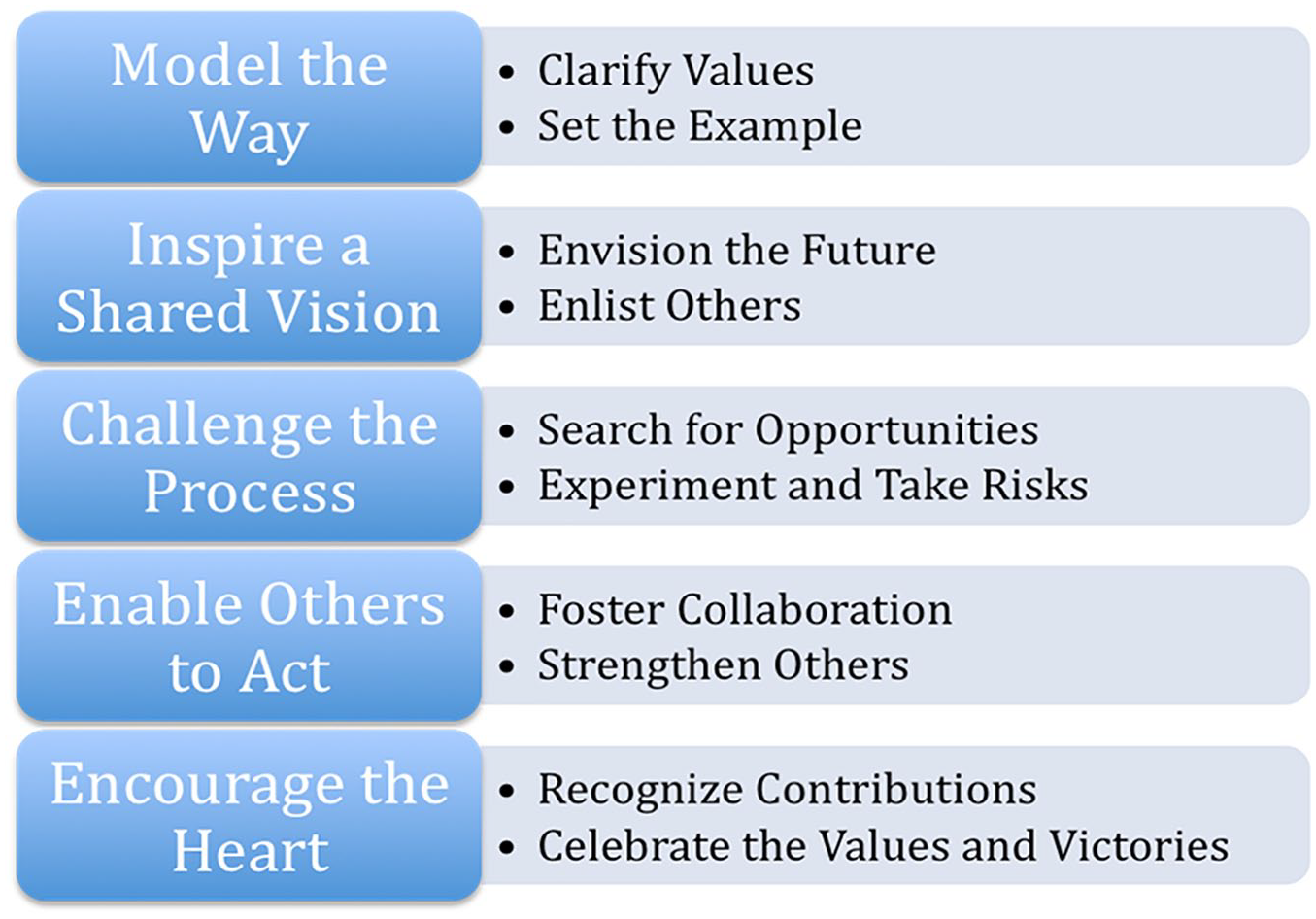
Summary of the five leadership practices.
Model the way
The actions of exemplary leaders must represent the behavior they wish to observe in their organizations. Leaders who want to gain commitment and achieve high standards of outcomes should model the same for their employees. To achieve this, exemplary leaders must clarify the values they want to be met and find their voice that gives power to the values. Effective leaders must have some beliefs that they stand up for in their workplaces (Kouzes & Posner, 2017).
Inspire a shared vision
Globally, leaders describe their most exceptional personal leadership experiences as situations when they imagined an exciting and transformative idea that had ensured an attractive future for their organizations. Therefore, leaders who are driven to realize their visions and have a workforce willing and capable of making it happen often succeed in actualizing their dreams (Kouzes & Posner, 2017).
Challenge the process
A challenge is considered the crucible for greatness, and successful leaders across cultures often involve a change from the status quo. Therefore, the model emphasizes that exemplary leaders must step out into the unknown and search for opportunities to innovate, grow, and improve. More importantly, they should not be hindered by mistakes, failures, or risks when it comes to boosting and sustaining quality performance in their environments (Kouzes & Posner, 2017).
Enable others to act
Kouzes and Posner (2017) asserted that grand dreams do not become a reality through the action of a single individual. Instead, achieving greatness requires a team effort, enduring relationships, and solid trust. Additionally, it requires individual accountability and group collaboration. From an organizational perspective, this can only be achieved by empowering the teams within the work environment. Therefore, to achieve quality standards, Kouzes and Posner (2017) argued that leaders should actively foster collaboration and build trust.
Encourage the heart
The goal achievement process requires resilience and commitment. The challenges and failures experienced can be frustrating and affect the ability of individuals’ motivation to achieve their goals. In most cases, they are often tempted to give up. However, genuine acts of care encourage weary people, propel them forward, and motivate them to keep going (Hilliard & Jackson, 2011). Kouzes and Posner (2017) emphasized that exemplary leaders should make their followers and partners feel valued. The most effective and sustainable manner of doing this is by acknowledging their accomplishments and recognizing their contributions to the organizational vision.
The Kouzes and Posner (2017) model has been used to evaluate leadership practices in previous studies (DeMatthews & Mawhinney, 2013; Frick et al., 2013; Lake & Stewart, 2012). They established that effective leadership is not all about personality but behavior - an observable set of abilities and skills. Similarly, DeMatthews and Mawhinney (2013) found the five leadership practices proposed in the model, common to leaders who are at their best.
Literature Review
A review of the literature was conducted to explore the challenges faced by principal leadership, the type of leadership specific to the USVI, and the applicability of the leadership model developed and studied by Kouzes and Posner. Existing literature on the three subtopics was researched to provide theoretical insights on exemplary leadership and identify gaps in the available information on principal leadership in the USVI.
Challenges Faced by Principal Leadership
An effective education system in the USVI demands proper management, leadership, accountability, professionalism, and the capacity to manage both the people and the resources available to create the best possible opportunities for students’ growth, development, and achievement (VIDE, 2018). Therefore, educational leadership is a scope of professional activities, including establishing a vision for school performance, promoting academic success for students, and ensuring the safety of students and staff, among other administrative duties (Marks & Printy, 2003). These responsibilities are associated with several complex challenges such as accountability of principals and creating school characteristics and culture that make for optimum teaching and learning (Marks & Printy, 2003; McKinney et al., 2015; Wallace Foundation, 2015). To develop an effective leadership model that can be applied toward achieving school objectives, it is important to understand these challenges.
Accountability of principals
From a human resource management perspective, principals, as leaders within a learning institution, are tasked with developing relationships with people toward the achievement of a common goal (Hilliard & Jackson, 2011). Principals are morally responsible for creating a relevant and inclusive environment so that all students have equal access to education regardless of their gender, background, or potential for academic success (Berkovich & Eyal, 2017; Jackson et al., 2016; McKinney et al., 2015; Meier et al., 2015).
However, the challenge is that the accountability of principals has shifted from the moral/ethical arena to the legal realm (Berkovich & Eyal, 2017; Jackson et al., 2016; McKinney et al., 2015; Meier et al., 2015). The inclusion of all students, excellence in school performance, developing more effective and comprehensive curricula focusing on the needs of all students, and expanding educational options have become the main priorities. Although these priorities seem easier to achieve by developing an effective leadership model, accountability of principals is a critical barrier to implementing any changes that would support the introduction of these improvements (Moolenaar & Sleegers, 2015; Santamaría & Jean-Marie, 2014).
There are a few issues with principal accountability, including risks of failing to properly report on the achieved progress due to complexities in reporting processes and limited allotted timeframes for achieving performance goals (Grissom & Loeb, 2011; Wallace Foundation, 2015). The educational system is nonlinear, so there may be significant lags between proposals for improvements and actual implementation of changes due to the specific features of school communities and students (Mascall & Leithwood, 2010; Moolenaar & Sleegers, 2015; Santamaría & Jean-Marie, 2014). Furthermore, the process of implementing improvements requires collaborative efforts to be effective. Such collaborative processes can be complicated to organize and manage. For instance, resistance to change at the individual level can complicate the collaborative process. Principals are tasked with implementing and overseeing such collaborative processes and are accountable for both the process and the outcomes (Grissom & Loeb, 2011; Wallace Foundation, 2015). Also, according to the legal accountability requirements, principals are obligated to have everyone involved in the educational process accountable for their actions and outcomes of these actions (Grissom & Loeb, 2011; Wallace Foundation, 2015).
Impact of principals on students
According to Bottery (2016), principals have an innate role of setting a clear vision for their learning institutions, communicating the vision to both the students and the staff, and providing instructional leadership focused on boosting students’ performance. The vital role principals play in creating a supportive environment at schools relates to the set vision (Bottery, 2016; Lee, 2015). Principals are expected to effectively and equitably allocate resources necessary for learning and teaching, determine the organizational structure of schools and workplace practices that correspond with the specifics of the learning environment, and identify school development goals along with the strategies for achieving them (Lee, 2015; Marks & Printy, 2003; Meier et al., 2015). At the same time, school principals are also regarded as instructional leaders responsible for facilitating student learning in the classroom, which has a direct impact on them (Le Fevre & Robinson, 2015).
Research is unclear on which factors have a significant effect on students, but several principal roles have an indirect impact on various student outcomes. The indirect impact of principals on students is also crucial. Educational leaders are responsible for developing a positive learning climate at their schools, which indirectly influences the students’ wellbeing and learning (Eaker & DuFour, 2015; Popp & Goldman, 2016; Riveros et al., 2012). Principal roles may include the day-to-day managing of the school operations, which determine how well students’ learning runs (Popp & Goldman, 2016; Riveros et al., 2012). Also, principals have a direct impact on teachers’ attitudes, motivation, and retention, which also has an indirect influence on the students (Nadarasa & Thuraisingam, 2014). Therefore, effective educational leaders strive to create an environment that is based on a well-developed school mission and vision that is shared with teachers and students. Most importantly, teachers should be actively supported by principals, and parents must be more involved in their children’s learning process (Eaker & DuFour, 2015; Popp & Goldman, 2016; Riveros et al., 2012).
Principal Leadership in the Virgin Islands
Demographic researchers report as many as 50 to 100 small islands in the United States Virgin Islands, but the four major inhabited islands are St. John, Water Island, St. Croix, and St. Thomas (Central Intelligence Agency [CIA], 2020). The VIDE (2018) Task Force stated that an effective school leader is one who promotes the social, emotional, and academic success of all students by developing and creating conditions for optimum teaching and learning, and this is to happen in a positive school environment and culture. Although many stakeholders, such as community members, teachers, and parents, contribute to the school leadership in the USVI, the principal creates a culture of leading and learning that effectively supports instruction that yields positive student growth and performance (VIDE, 2018). Zheng et al. (2017) noted that school leadership is very complex and therefore requires a multitude of skills, beliefs, and knowledge to build and sustain a positive learning environment. In so doing, success in education is ensured as learners are prepared both for success in higher education and the job market (Zheng et al., 2017).
According to VIDE (2018), the foundation of principal evaluation and leadership is founded on the five core essential practices of the school leadership framework. The framework is firmly aligned with the former national Interstate School Leaders’ Licensure Consortium Standards (ISLLC). The five core essential practices of the school leadership framework are:
Build a shared purpose. This leadership practice calls for the principal as the school leader to develop a compelling, shared organizational vision that ensures the vision of the learning institution is lived in the daily work of educators (VIDE, 2018).
Focus on learning. In this practice, the principal is expected to engage in instructional leadership approaches to develop and maintain student access to strong instructional, appropriate, and ambitious programs that are focused on social, emotional, and academic development and excellence. Therefore, the principal must assist the teachers in the development of a positive classroom climate (VIDE, 2018).
Management of organizational systems. The principals act systematically and strategically to develop teaching and learning conditions that are supportive, safe, and of high quality through proper alignment of human capital and financial resources (VIDE, 2018).
Collaboration with the community. As the school leader, the principal ensures that community organizations and parents’ associations are actively engaged with the school. The school must collaborate with stakeholders and families in responding to diverse community needs in the reg
Leading with integrity. The principal reflects professionalism by acting with integrity and making sure that their skills, knowledge, and abilities are visible and transparent. By adopting these practices, the principal is placed in a better position to create trust and working relationships with the teachers, thereby improving students’ performance and academic growth (VIDE, 2018).
The national ISLLC standards align in spirit with the five practices by Kouzes and Posner (2017). They both reveal that an exemplary leader is one who can model the way, inspire a shared vision, challenge the process, enable others to act, and encourage the heart. Therefore, regarding the USVI, the ISLLC standards focus on creating exemplary leaders in the learning institutions.
With the numerous challenges facing the education sector in the USVI, such as low student achievement, high dropout rates, and poor teacher retention, there’s a need for exemplary transformational principal leaders in the territory. An exemplary educational leader in the USVI is not only characterized by good management abilities but should also be capable of fostering teamwork among parents, students, and partnerships while enhancing the commitment to the learning community. As Kouzes and Posner (2017) established, transformational leaders can evoke change within an individual and a social system as well.
Applicability of Kouzes and Posner’s Model in Virgin Islands Education
As a transformational approach, Kouzes and Posner’s (2017) model is associated with principals’ effectiveness in crafting and executing reforms, policies, and practices in the education sector. It provides them with practical guidance on how to sustainably lead and efficiently act in reforming agendas in the education sector. Although the origins of the research are rooted in the business sector, over time, the authors broadened the scope. They involved the leaders of churches, communities, governments, and schools in the study to make it more relevant and applicable to multiple environments. The involvement of different leaders resulted in the development of five leadership practices, which are the pillars with the capability and capacity to transform the education sector in the USVI.
Educational leadership in the Virgin Islands is operated under annual targeted growth that strives to meet the yearly benchmarks on student learning and performance hence the focus on primary outcomes (VIDE, 2018). Effective leadership has become a top priority for schools, both locally and internationally (Hemsley-Brown & Oplatka, 2012). Effective school leadership remains essential in improving the equity and efficiency of schooling, and public schools within USVI are in pursuit of an education system that complies with the needs of the society, educational department, and other stakeholders. Institutions have enacted measures aimed at improving student performance, efforts that have enabled the institutions to serve the needs of diverse learner populations through evidence-based teaching methods (Hemsley-Brown & Oplatka, 2012).
Nevertheless, there are significant challenges to leadership success in the USVI. According to Kossler (2017), one of the most pressing challenges is the efficient management of federal funds allocated to learning institutions (Kossler, 2017). The USVI was compelled to enter into a compliance agreement in 2010 with the US Department of Education due to problems with fiscal management. The agreement addressed four areas: procurement, program planning, evaluation, and financial management (Necole, 2012; West, 2010). As a result, the VIDE initiated a large-scale campaign focused on improving the quality of education offered with a focus on school vision, mission, development strategies, and goals, areas in which educational leaders play the key roles (Bowles, 2014; Necole, 2012; West, 2010). A closer look at these issues proves that the challenges highlight the need for effective educational leadership in the Virgin Islands.
Kouzes and Posner (2017) stated that the established models of behavior acts as a source of empowerment for exemplary leaders. In modeling behavior, leaders are expected to establish guiding blueprints, as evident in the case where education institutions in the Virgin Islands deploy frameworks for guiding how they execute their functions (Bowles, 2014; West, 2010). Leaders in Virgin Island learning institutions envision their future by establishing ennobling possibilities that are achievable within a specified period. In other words, the leaders have well-enlisted visions, given the fact that they understand the needs of the students and the working fraternity (Kossler, 2017).
Methods
The research design chosen for the qualitative study was a case study approach. Case studies are particularly suitable for understanding relationships where the boundaries between the condition being examined and its context are not very clear (Creswell, 2013). The non-probability purposive sampling design was used where participants were selected based on their population characteristics - in this case, school leaders from the successful public and private schools. Three schools were chosen for the study; a public elementary school, a private junior high school, and a private high school. The schools were selected based on academic performance, and the three were the best performing in their categories. Nine participants were selected for the study, three from each school, a principal, a teacher, and non-teaching staff. The sample consisted of three principals, three teachers, and three non-teaching staff. The sample size was small due to the nature of the study population. However, having a small number of participants for this study served as an advantage as it facilitated detailed dialogue and in-depth investigation of issues.
A 30-item questionnaire adapted from the Kouzes and Posner (2017) study was used as the data collection instrument (see Appendices A-C). Three sets of interview guides were used targeted to the principals, teachers, and non-teaching staff. Each guide contained five categories based on the five practices of exemplary leaders proposed by Kouzes and Posner (2017); each category had six questions seeking an explanation of how the principal employs the given practice. The instrument was tested with a group that shared similar characteristics with the participants-a teacher, a non-teaching staff, and a principal- to check its effectiveness and further develop it to explore participant’s experiences better. Four teachers from one of the schools, the elementary school, participated in the pilot testing as an informal exercise with permission from the principal. Suggestions from the pilot testing were obtained, reviewed, and incorporated into the tool.
The actual data collection was conducted using a semi-structured interview format with open-ended questions. Each of the six questions under each concept of the Kouzes and Posner (2017) model of exemplary leadership were related and required brief answers. For example, a principal would be asked how they follow through with promises and commitments, while the teacher and non-teaching staff would be asked to describe how the principal does the same. The researcher met each of the participants at their workplace and sent the questions before the actual interviews. Each interview activity lasted for 30 to 45 minutes, and the audiotapes were transcribed after the data collection process. The respondents were offered a copy of their transcript interviews so they could check for accuracy. Participants were asked for any additional thoughts or information they feel they left out. Participants were also informed that they could send any additional information if they felt the need. The collected qualitative data from the transcripts were analyzed using the NVivo software. The analysis and development of themes for each of the five categories of the framework were conducted separately.
The process of analyzing the interviews involved six steps. First, the researcher comprehensively read the nine interview transcripts. Second, all the interview transcripts were imported into the NVivo version 10 software for analysis and stored in the Source file. Third, the emergent themes and subthemes based on Kouzes and Posner’s (2017) five practices of exemplary leadership were developed and classified in a folder named Nodes on the NVivo software. Fourth, the participants’ responses were coded into appropriate themes. Fifth, a model of the themes and subthemes were developed using the NVivo software.
To establish credibility for this study, the researcher applied reflexivity to reduce bias in the data collection and analysis process. Reflexivity involved identifying personal assumptions to ensure they do not affect the data collection and analysis through reflective journaling (Creswell, 2013; Merriam & Tisdell, 2016). Additionally, the researcher used the triangulation of data to build credibility. Triangulation for the study involved using secondary data from the review of the literature, pilot testing, written notes, member checking, interviewing subordinates and supervisors of the principals, and use of audiotaped data to identify themes and guide conclusions for the study. The study’s credibility and dependability were also established through accurate and detailed documentation of the processes and procedures used in the study so that other researchers can replicate the study.
Results
Ten themes emerged from the data analysis indicating how the principals in USVI model the five concepts of the Kouzes and Posner (2017) model and research question.
How Do Successful School Principals in USVI Model the Way for School Stakeholders?
Two themes emerged from the participant responses regarding the research question; role modeling and shared purpose.
Theme 1. Role model
The participants indicated that the principals use role modeling to influence the teachers, staff, and students. All the participants gave examples of how the principals set personal examples of what they expect from others by adhering to the desired standards or qualities. The participants also noted that the principals follow through on commitments by being transparent and accountable and creating clarity.
Principal A indicated, “a successful leader leads by example. You are in the spotlight daily. Others are looking to you as the leader to model the appropriate behavior.” In another statement, “a good leader always leads by example, and my principal is a perfect example of this statement. She (the principal) models the behaviors and standards that have been established by the school’s mission and guiding philosophy.”
The principals’ demonstration of accountability and transparency was also demonstrated in the participants’ responses. “If she [the principal] ever upsets someone or feels that she had not acted according to our school core values [integrity, respect, scholarship, citizenship], she is quick to recognize her mistake and apologize if needed.” Exemplary principals communicate regularly, check in with their staff, and providing opportunities for follow-up.
Theme 2. Shared purpose
A shared purpose was identified from the questions based on consensus and feedback. The participants indicated that the principals promoted consensus and ensured that the staff, teachers, and students adhered to the standards by creating a shared purpose based on values, opinions, and the schools’ missions. The values and opinions were communicated during group or one-on-one meetings.
Receiving feedback
Engaging in professional collaborative dialogue with the school teams ensures that the principals gather enough feedback and clarity of any teaching and non-teaching staff issues. The participant responses indicated that principals seek feedback regarding their actions or how school initiatives affect the other stakeholders or gain honest opinions and constructive criticism. A principal stated, “I receive feedback from people who will tell me the honest, constructive, and (possibly critical) truth.” In one of the schools, it was established that teachers and students evaluate the principals’ performance using anonymous surveys. A participant stated; During the year, the principal receives anonymous student feedback about the culture and classes of the upper school, including questions directed specifically about her impact on others. Also, during the year, the head of school collects and compiles anonymous feedback from faculty members about the principal.
Clarity on leadership philosophy
One of the principals mentioned creating clarity for their leadership philosophies by using metaphors, data, music, and poetry. Another mentioned that they do so by sharing the four guiding principles: curriculum, pedagogy, how we teach, and social and emotional support. For the non-teaching staff, including making presentations during parent orientation and board meetings. A teacher said the principal “is reflective in her practice, therefore, she can articulate her philosophy of leadership to others clearly, and demonstrates how her role relates to other stakeholders in the larger picture.”
How Do Successful School Principals in USVI Inspire a Shared Vision for School Stakeholders?
The research question’s answer was divided into three themes: evidence-based information, collaborative leadership, and a holistic environment.
Theme 3. Evidence-based information
Data and data-driven instructions were mentioned in all the schools where the principals read, analyze, and reflect on global, national, and local data to determine how the transforming landscape could impact the schools. A non-teaching staff stated, “We have been pushing a lot in terms of data. So, each school is required to have data charts, data walls, data folders, data books, and anything that is around data.” Involvement and engagement in the community, such as attending conferences related to education, reading professional journals and books about education, as well as discussions with various division heads, were mentioned as approaches used by the principals to inspire a shared vision.
Theme 4. Collaborative leadership
Principals create shared learning and leadership experiences with their staff, parents, students, and organizations contributing to the schools. A teacher mentioned that their principle encouraged teamwork with a focus on the long term success of projects. A principal said, “I firmly believe the future of the school lies with the commitment of the faculty and staff. Academic excellence and parental support are vital components that will continue to drive the success of the school.” Principals work with the teachers to create long and short-term goals to direct the staff’s actions and motivate long-term results. A non-teaching staff noted that the principal creates a compelling image through observations and student engagement, among other approaches for encouraging a teamwork approach to problem-solving.
Theme 5. Holistic environment
Principals create a holistic environment by considering the school as “an active part of a global community. The input of those with formal and informal connections to our school community help bring in a variety of perspectives and experiences that are impacting our community’s children.” The principals can speak of larger visions for the school by relating to the individual students and their families and the importance of the school to them.
Common vision
Principals foster an environment where everyone understands the vision and goals to be achieved. A principal said, “I think it is a shared vision that is part of the learning environment.” Another participant mentioned, “One way my principal shows teachers how their long-term interests can be realized by sharing a common vision is through the use of data to determine a common vision for the school.” The use and promotion of data use ensure that the personal goals of the staff are aligned with those of the school; thus, driving a common vision. The principal may ask questions while drawing and sharing examples from other schools to help the staff envision the shared goal.
Exciting dream
The principals inspired a shared vision by creating an exciting dream that involved focusing on individuals to foster professional growth, listen, and support. A principal said, “I have made myself focus on using the word learning rather than education. Our school is a system that brings humans of multiple ages, backgrounds, personalities, styles, cultures, and experiences together for the purpose of learning. . . .” The passion of the principals goes a long way to inspire a shared vision and is portrayed by the way they speak of the school and what it does for the community. A Teacher said She [the principal] speaks about the school as well as Montessori education as a whole with excitement, as she sees it as a catalyst for social change and for improving lives at the moment, a vehicle for a positive culture shift that values cooperation, diversity, and mutual respect, and by cultivating future generations of change-makers.
How Do Successful School Principals in USVI Challenge Processes Involving School Stakeholders?
The answer to the question was divided into two themes, professional development and being reflective.
Theme 6. Professional development
Exemplary leaders seek challenging opportunities through personal development. Active engagement in professional development, reading, mentorship, coaching, and experiences that challenge and support skill development such as Montessori philosophy, leadership courses, and other workshops were identified as some of the challenging opportunities principals engage in for their professional development. Current knowledge of all the newly available research, tools, and resources and reflection on personal strengths and weaknesses were also mentioned.
Research
Principals seek innovative ways through collaboration with colleagues, professional literature, webinars, and educational materials. A staff member mentioned; We recognized that she Googles best practices. She Googles to gather information or research scientifically based organizations or strategies or particular trends that are out there to see what she can do. That is, in alignment with the goals or expectations at her school.
Another principal stated, “I search for and share examples of innovation that reflect our values and ask others to do the same. . .Each year, we listen to TED talks, participate in reading a book or article together, and then, in a team meeting or parent education event, reflect on what stood out to us.”
Guidance
Principals encourage individuals to try innovative approaches by providing support, guidance, and encouragement to think outside the box. Principals may also seek assistance from the leadership teams’ expertise to assist teachers in trying new approaches. A principal said: I encourage teachers to try new things. In doing this, it is equally important to create a safe environment to fail. After trying something new, teachers are expected to evaluate what worked, what did not and modify to improve outcomes.
Theme 7. Being reflective
Principals step over their challenges to find new ways to make changes. Principals conduct meetings that involve brainstorming of ideas and lessons learned from previous mistakes. Others send out surveys to parents and students to solicit input regarding current projects. The use of data to facilitate reflective process was also mentioned by non-teaching staff, “She puts that data chart out there, and the data is what drives the conversation in terms of what we can learn and things we can do to move forward.”
Action plan
Having and sharing an action plan with the staff facilitates a common goal and vision for the school. A principal said that she “sets goals that are measurable and attainable.” The deputy superintendent supported the claims by mentioning that the principal ensures that the set goals are achievable “through the employee evaluation system.” Principals thus use visions, goals, and plans, all of which are measurable for projects in the schools.
Taking risk
The principals demonstrate overcoming challenges by encouraging risk-taking among themselves and their staff. A participant noted, “the principal recognizes, immediately, that there is a risk, that something might not work, and she articulates that this is ok. She knows that if she does not try something, and we are not comfortable with failure, we will never grow and learn.” Other principals also allow their teachers to experiment and take risks as long as it is within reason.
How Do Successful School Principals in USVI Enable Stakeholders to Act?
The question was answered by two themes; professional collaborative dialogue and autonomy.
Theme 8. Professional collaborative dialogue
Building and developing relationships that lead to professional dialogues with the staff is essential for a cohesive environment. There’s a need for principals to develop cooperative relationships with and among the staff. Activities like team building and social events should be aimed at facilitating these relations.
Affirmation
Principals affirm their staff activities and practices to reflect their appreciation of their efforts. One of the principals said, “I give positive affirmation through emails or via a ‘shout-out’ [where people publicly say thank you to someone for doing something] in full faculty or upper school team meeting.” Praising staff for good work and encouraging them to reflect on what to do differently in unsatisfactory results helps to encourage shared action by stakeholders.
Listening
Being nonjudgmental and appreciating others’ points of view is a helpful trait among principals when working together with people from different backgrounds and cultures. Listening to stakeholders in smaller groups or one-on-one helps to acknowledge their concerns hence helping them work toward the shared goal. A participant noted, “The principal gives her undivided attention to everyone she meets. She is careful not to judge people.”
Theme 9. Autonomy
Exemplary leaders provide freedom and choice while maintaining some form of accountability. A principal said, “Creativity and delivery are entirely up to the teacher. In a building, individuals have particular talents that enrich the learning environment.” Participants agreed that accountability is the key to autonomy in ensuring that all stakeholders work toward a shared goal. A teacher said: My principal is open to new ideas. She allows teachers to try instructional strategies in the classroom that are new and innovative. As long as teachers are meeting the learning targets and students are growing and learning, my principal gives teachers the freedom and choice to choose the path they want to take in the classroom.
Support
Being supportive when individuals can make decisions that positively impact the learning environment as long as it is within their boundaries was identified as a supportive trait among the principals. Expressing expectations and support verbally as well as asking how they can assist is a helpful trait.
Promote growth
Principals support personal growth in staff though pushing for professional learning opportunities, time and space for meetings and coaching sessions, and developing structured peer to peer mentorship programs with people in and outside the school. A participant stated; She challenges others to develop professionally as well as personally and provides resources and support for this work to take place. She places a high value on learning and growth and emphasizes the role they play in achieving our shared vision.
How Do Successful School Principals in USVI Encourage the Hearts of Stakeholders?
One theme with three categories emerged from the participant responses to the question.
Theme 10. Recognition
Participants mentioned that the principals thank and recognize the effort they put in their work in various ways, verbally thanking them, mentioned them for their achievements, and highlight the work done in conversations with other people. A participant stated, “. . . she has thanked us by use of a public address system and the newsletter through which parents can participate and be part of the school’s website.” In another response, “During a variety of meetings, my principal has verbally indicated faculty and staff that have done a job well.” Three categories emerged from the theme, which are indicators of the principals’ methods to recognize teachers and other stakeholders.
Reward
Principals often reward good performance among the stakeholders with gifts or ensure they get rewards from students. A participant stated, “After Hurricane Maria, there were several donations to the school via money. . . the principal made sure that each individual was thanked via a thank you letter and a beautiful hand-painted rock, each done by students. A principal explained how she gives rewards; When I see something I know will be a good idea, I hang onto it—for example, an inspirational magnet. I may hang onto it until I find the right opportunity, moment, or person. . . Sometimes, the reward is canceling a team meeting and saying, ‘You all worked incredibly hard today, and I appreciate you. Go enjoy yourselves!
Confidence in competency
Principals let staff know that they have confidence in their competence by entrusting them with important tasks, sharing the strengths observed, and appreciating how beneficial they are. Others voice their confidence and trust in stakeholders’ abilities verbally or via email. A principal stated; I am often sharing what I see as their strengths, how I have observed them using their abilities, what I appreciated and noticed about how others benefited, and that I am thankful for them being here. I tell them how much I trust them and that I support them regardless of whether they are successful or make mistakes.
Celebrating success
Principals celebrate success with teachers and other stakeholders through parties to show appreciation. A participant stated, “We had a big beach party with the faculty, and it was well-attended. Those loyal things that bring the climate and the culture together. Having fun. That is how you celebrate.” The participants also noted that the principals celebrate accomplishments by verbalizing and highlighting them during staff meetings. A response by a board member read; I have been invited to lunches where peers, as well as community leaders, were in attendance. Also, I witnessed students being issued with presents for good performances in the assemblies on the campus. We have a culture of appreciation. We take time to celebrate together and individually. We are proud of one another and take joy in each other’s happiness.
Discussion
Using questions based on Kouzes and Posner’s (2017) model, I found the participants’ responses were all positive and indicated that the success of the three selected schools was related to the fact that exemplary leaders led these schools. The study’s findings indicate that principals model the way by being transformative leaders and creating a shared purpose based on opinions, values, and the school’s mission. Exemplary principals verbally state the behaviors and attributes they desire at the institutions of learning, but they also set a personal example of what they expected to emulate. The principals are exemplary leaders because they requested feedback through professional collaborative dialogue and anonymous surveys. In addition, the principals model the way by providing clarity in their leadership philosophy using various techniques such as PowerPoint presentations, metaphors, images, poetry, and music. These findings were similar to those by Bowles (2014) and West (2010), who indicated that leaders are expected to develop guiding frameworks that illustrate how things should be done. In addition, Kouzes and Posner (2017) stated that exemplary leaders model behaviors that facilitate a commitment to the developed goals. In their findings, Bottery (2016), Lee (2015), Marks and Printy (2003), and Meier et al. (2015) posited that principals are required to develop and communicate clear goals and visions.
Principals inspire a shared vision for the school through the use of evidence-based information from books, conferences, journals, articles, and workshops to inspire a shared vision. The leaders created a compelling image that increased the faculty and staff’s commitment to achieve the explicitly stated short- and long-term goals. The findings support the argument that effective educational leaders in USVI possess management abilities; achieve the annual benchmarks; foster teamwork and partnership by involving parents, students, and teachers; and enhance the learning community’s commitment (Early, 2013). The principals inspired a shared vision by creating an exciting dream that involved focusing on individuals to foster professional growth, listen, and being supportive and encouraging. The findings were similar to those by Eaker and DuFour (2015), Popp and Goldman (2016), Riveros et al. (2012), who indicated that educational leaders are responsible for developing a positive learning environment. The quality of the learning environment and culture affects the students’ learning and wellbeing.
Exemplary leaders challenge the process involving stakeholders through professional development and being reflective. The principals facilitated professional development by researching innovative techniques, attending webinars, conferences, and workshops, reading professional literature, listening to TED talks, reviewing educational websites, coaching, and mentoring. The principals also provided guidance, encouraged teachers to develop innovative solutions, and created a safe environment to fail. Being reflective enabled the leaders to identify their strengths and weaknesses and find ways of making changes. The principals developed specific, measurable, attainable, realistic, and time-bound goals by creating action plans. The findings aligned with research conducted by Day et al. (2016) and Marks and Printy (2003), who found that leaders facilitate change by venturing out and searching for innovative solutions to enhance growth and improve the educational environment.
Principals encourage stakeholders to act through professional collaborative dialogue and promoting autonomy. The principals foster dignity and respect by listening to the teachers and providing them with positive affirmations. The findings were similar to the arguments by Eaker and DuFour (2015), Popp and Goldman (2016), and Riveros et al. (2012), who held that teachers should be supported by principals, and parents should be involved in their children’s learning process. The principals allowed freedom and choice while maintaining accountability in achieving the learning targets or improving the curriculum. The studies by Grissom and Loeb (2011) and Wallace Foundation (2015) indicated that principals are obliged to have everyone involved in the educational process accountable for their actions and outcomes of their decisions. The findings agree with those of the US VIDE (2018) Task Force, which noted that an effective school leader promotes social, emotional, and academic success by developing and creating conditions that promote optimum teaching and learning.
Principals in USVI encourage the hearts of stakeholders through recognition and being personable. The principals recognize students, teachers, and the staff for exemplary performance through shout-outs and thanking people publicly or privately. The principals also let the staff know that they have confidence in their competence through appreciation and involving them in decision-making. The findings were similar to those of Kouzes and Posner (2017), who posited that others’ recognition facilitates the achievement of the organizations’ strategic objectives.
The five practices model was applicable in establishing how principals in the USVI practice leadership. The study findings on how principals ensure efficiency by fostering shared purpose, encouraging adherence to programs, motivating staff, and creating necessary conditions for learning echo those by Parsons and Beauchamp (2012), who studied the model’s application in five elementary schools. The findings are also similar to those by Grauer (2017), who found that principals’ portrayal of focused motivation leaders works in military education
Limitations
The first limitation was in relation to the qualitative research design used in the study. The interview process required the interviewer to have some skills and competence in using questionnaires. The interviewer overcame the limitation by conducting a pilot test in preparation for the main study. The second limitation was related to the credibility and trustworthiness of the information provided by the participants. The information was self-reporting and may have been subject to bias as the participants may have answered the question according to what they thought the interviewer wanted to hear. The interviewer overcame the limitation by informing the participants that there were no wrong answers. In addition, the consistency of the information provided was assessed by comparing what a principal said against the respective supervisors’ and teachers’ responses. The third limitation was related to data analysis and interpretation. The findings retrieved from the data analysis and interpretation may be subject to the researcher’s bias. The limitation was mitigated by comparing the findings with those in peer-reviewed literature. A fourth limitation was the few schools studied. While purposive sampling was used, only three schools were studied, which is a very small number and may not represent all the schools in the USVI.
Implications for Professional Practice, Future Studies, and Conclusion
Exemplary leaders model the way, inspire a shared vision, challenge the process, enable others to act, and encourage the heart. The literature supports that exemplary leaders model the way by acting in accordance with the schools’ core values of integrity, respect, and scholarship; communicating; requesting feedback; promoting professional collaborative dialogues; and being accountable, reliable, and transparent (Berkovich & Eyal, 2017; Bottery, 2016; Lee, 2015; Marks & Printy, 2003).
Exemplary leaders inspire a shared vision through evidence-based information, collaborative leadership, creating a compelling image of the future, and fostering professional growth. Research by Eaker and DuFour (2015), Early (2013), Popp and Goldman (2016), and Riveros et al. (2012) supported these findings. Thus, the USVI education system should encourage principals to inspire a shared vision at their learning institutions. VIDE should encourage principals to challenge the process through professional development, providing guidance, encouraging teachers to develop innovative solutions, and being reflective.
School principals should encourage stakeholders to act through professional collaborative dialogue and promoting autonomy. At the same time, VIDE should develop guidelines that enable the principals to implement strategies that support the hearts of stakeholders through recognition and being personable. VIDE should also encourage and provide professional development opportunities for principals to use transformative, contingent, and instructional leadership styles to facilitate greater success in the annual indicators of students’ and school achievements (Moolenaar & Sleegers, 2015). Overall, the principals in the VIDE should consider adopting Kouzes and Posner’s (2017) five exemplary leadership practices.
In concluding this research study, recommendations for further research are presented. First, although Merriam and Tisdell (2016) posited that a sample size of one to three participants is adequate for a case study, the use of three principals, their teachers, and their supervisors was limiting, and future researchers could include a larger sample and triangulate the data further with the use of separate focus group interviews of students, parents, and teachers. Second, future studies could use a different research design, such as a mixed-methodology, to support the findings with numerical values. Third, future researchers can conduct studies in all schools in the USVI to identify the relationship between the leadership practices of the principals, the achievement of the students, and the overall performance of the schools.
Supplemental Material
sj-pdf-1-jrl-10.1177_1942775121990054 – Supplemental material for A Qualitative Case Study of Exemplary Principal Leadership in the United States Virgin Islands: An Application of Kouzes and Posner’s Five Practices of Exemplary Leadership
Supplemental material, sj-pdf-1-jrl-10.1177_1942775121990054 for A Qualitative Case Study of Exemplary Principal Leadership in the United States Virgin Islands: An Application of Kouzes and Posner’s Five Practices of Exemplary Leadership by Suetania Emmanuel and Clinton A. Valley in Journal of Research on Leadership Education
Footnotes
Declaration of Conflicting Interests
The author(s) declared no potential conflicts of interest with respect to the research, authorship, and/or publication of this article.
Funding
The author(s) received no financial support for the research, authorship, and/or publication of this article.

Supplemental Material
Supplemental material for this article is available online.
Author Biographies
References
Supplementary Material
Please find the following supplemental material available below.
For Open Access articles published under a Creative Commons License, all supplemental material carries the same license as the article it is associated with.
For non-Open Access articles published, all supplemental material carries a non-exclusive license, and permission requests for re-use of supplemental material or any part of supplemental material shall be sent directly to the copyright owner as specified in the copyright notice associated with the article.
