







Abstract
This study aims to explore how school leaders applied resilience in order to cope with the COVID-19 pandemic. This qualitative study used semistructured interviews with 26 school leaders. Results yielded three main manners of applying resilience: (a) be proactive, pragmatic, and creative; (b) find meaning and set goals; (c) lead the emotional climate. The study can contribute to the scholarly understanding of leaders’ resilience in crisis times as well as to professional development programs for nurturing resilience among school leaders.
The COVID-19 pandemic was experienced as a crisis and global anxiety (Ellis et al., 2020; Maor et al., 2020). It elicited extremely turbulent times that challenged even the most skillful leaders (Reed, 2018). The rapid changes during COVID-19 caused a lot of confusion and stress and raised the importance of finding tools to cope with the stress (Steward, 2014) that might be caused by unpredictable reasons (Burke, 2008), either internal or external: An internal crisis might be caused by personal issues, unanticipated changes, moral or ethical failure, etc. External crises, on the other hand, could be caused by external disasters such as pandemics, natural disasters, stock market crashes, etc. (Bowers et al., 2017).
Beyond that, we live in an uncertain era (Katsos & Miklian, 2021), and schools are always the first to deal with the stress that comes with it. Stress can be defined as an event where the individual feels threatened due to being asked to perform tasks beyond his/her capabilities (Sherman, 2020). Stress takes a toll. If not handled properly, the effect of stress in a turbulent time can be detrimental (Bhaduri, 2019). Many school principals are quitting their jobs, causing many countries to face a shortage of principals. Due to stress, 12% of school principals take time off work, ranging from 1 day to 18 weeks (French, 2009). However, some school leaders act differently during a crisis, exhibiting more resilient behavior (Bayer, 2016). Resilience can be described as a leadership behavioral tool for coping with stress (Coutu, 2017). The demonstration of resilience during the COVID-19 crisis should become an example and a solution for leading during other crises and infusing a competency-based approach to crisis management (Wooten & James, 2008).
Studies of management in crises and stressful times are still on the lesser side (McCarthy & Sheehan, 2014). Issues in crisis management remain unanswered and are worth exploring (Bhaduri, 2019). Hutchins and Wang (2008) called for research on crisis management that involves improving individuals, groups, and organizations’ strategic changes. A similar call was made by McCarthy and Sheehan (2014), recommending studying theoretical and practical standpoints during and after the crisis event. Another call for research was to explore conceptual frameworks that may influence effective crisis management from a leadership point of view and to create a proactive culture of preparing organizations for a crisis (Bhaduri, 2019). Nonetheless, voices called for the identification of opportunities that the COVID-19 crisis yielded, to reposition and redesign the field of education (Harris, 2020).
This study aims to explore how school leaders applied resilience during the COVID-19 crisis. We are interested in focusing on the core set of internal characteristics of leadership, resources of coping style, strategies, or behaviors that help navigate effectively despite the crisis. There is no consensus on the definition of resilience. Some refer to resilience as intrinsic characteristics, while others refer to a more holistic sense, competencies, or positive functioning in adversity situations (Southwick et al., 2014). The American Psychological Association (2014) defines resilience as a process of bouncing back from a difficult experience and adapting well to adversity, trauma, threats, or significant stress. Resilience is also considered to constitute mental health (Joyce et al., 2018), well-being, and effective leadership (National College for Leadership of Schools and Children’s Services [NCSL], 2010), and it contributes to performance at work (Robertson et al., 2015). In this study, we are framing resilience as leaders’ emotional and behavioral self-managed reactions that allow them to operate optimally and lead in the organization beneficially while experiencing crisis or stressful situations.
Moreover, recently, there has been a call to develop resilience among school leaders not only due to crisis times or possible crises but also because of the stressful characteristics of their work (Day et al., 2011). Developing resilience is an important tool for optimal coping with crises and overcoming stress and adversity (Bonanno, 2004). Yet, there is insufficient knowledge of how school leaders employ resilience (Steward, 2014) at work during the COVID-19 pandemic. In stressful times, school leaders must employ a set of skills unique to these times, such as providing certainty, engendering hope, and engaging in effective and efficient efforts to ensure credible communication with all staff members (Smith & Riley, 2012).
The following sub-sections of the literature review will deal with leadership in crisis; resilience leadership in crisis times; resilience and emotions; resilience, emotions, and leadership; research context and school leaders during the COVID-19 pandemic.
Leadership in Crisis
The COVID-19 pandemic was a crisis (Gurr, 2020). A crisis can be defined as: “A time when we are not ourselves, and the world around us is completely changed” (Smiar, 1992, p. 149). It is an urgent situation that requires immediate and decisive action (Smith & Riley, 2012). A crisis involves dealing with a threat, uncertainty, and emotions, requiring urgent action to bring things back to normal (Rosenthal et al., 2001). A crisis is characterized by a strategic gap due to the lack of adaptation to the changes that occur in the organization. The work environment has become increasingly complex due to rapid changes, making organizations vulnerable to a wide range of crises (Sawalha et al., 2013) and instability (Katsos & Miklian, 2021).
Since the crisis is an unprecedented event, it does not offer time to prepare, and the response time is short (Tarawneh, 2011). Crisis management includes assessing potential signs of crisis and taking action to eliminate the crisis with as little damage as possible (Al-Shibli, 2018). Crisis management should be a procedure for dealing with an emergency or unforeseen situation that may threaten the organization (Elliott et al., 2005). There is a need to prepare leaders to lead through crises (Gurr, 2020) and encourage organizations to improve their methods of recognizing warning signals to manage crises effectively to minimize the negative impact (Irtaimeh et al., 2016). A statistically significant effect of strategic leadership practices on all of crisis management’s dimensions was found by Al Thani and Obeidat (2020). They recommended that companies study their internal environment and identify possible indicators of the occurrence of crisis, helping to enhance their strengths and take appropriate solutions to remedy their weaknesses, thus preventing crises.
As mentioned above, the COVID-19 crisis elicited extremely turbulent times among educational leaders and challenged them tremendously. The pandemic led educational leaders to make changes in their role (Anderson & Weiner, 2023; Reyes-Guerra et al., 2021; Schechter et al., 2022). When facing a crisis, according to Weiner et al. (2021), school leaders need to demonstrate a clear vision of certainty, safety, a sense of hope, optimism, responsiveness, and creative thinking. They have to maintain trustworthy and empathetic communication with the school’s inner and outer stakeholders (see also Beauchamp et al., 2021). According to Netolicky (2020), the crisis made principals “step forward to the ‘front’ to act as a trustworthy, credible voice for their community” (p. 393). They maintained “forward momentum” (Harris, 2020, p. 322) by “using” the crisis to reach their goals and initiate independent, purposeful action, indicating will, autonomy, and freedom (Okilwa & Barnett, 2021; Oolbekkink-Marchand et al., 2017). School leaders leveraged new opportunities during the crisis and demonstrated professional growth by conducting essential pedagogical, professional, and organizational development (Yoskovitz & Schechter, 2023). They developed collaborations with external stakeholders to maximize learning resources, maintained working patterns according to their pedagogical perceptions, and applied positive organizational culture, to strengthen the core values of the school. Despite evidence that school leaders were able to reap positive benefits during the crisis, it contradicted the findings of Clifford and Coggshall (2021) who argue about a deterioration of school leadership during the pandemic.
Resilience Leadership in Crises Times
The role of school leaders is stressful (Steward, 2014); therefore, they are called to have high levels of emotional resilience (Steward, 2014). Emotional resilience is a healthy level of psychological and physical functioning and exhibits a stable trajectory of health over time (Bonanno, 2004). It is a person’s ability to reach a superior level of functioning after a stressful event, cope with crisis and stress, and maintain well-being, healthy behavior, and mental health (Carver, 2010). Resilience is also explained as a sense of hope or sense-making that can lead to a better future rather than leaning on the poor present (Panter-Brick & Eggerman, 2012). Others explain resilience as satisfaction, happiness, or psychological resources for better living as subjective well-being that connects to positive emotions (Heffner & Antaramian, 2016). Reed’s (2018) study indicates that resilience increases with age: Participants in the 60+ age group had significantly higher resilience scores compared to all other age groups. In the 20 to 29 age group, men had a significantly higher resilience score than women.
Despite the virtues in which the concept of resilience was described, others criticize it. Mackinnon and Driscoll-Derickson (2012) present in their study three kinds of critiques: First, the concept of resilience derived from the ecology and system theory is conservative when applied to the social sphere, and it shapes unequal powers and injustice. Second, resilience is defined in spheres such as security emergency planning and economic and urban design. The expectation that individuals, communities, and places invariably become more resilient and adaptable to a range of external stressors is unequal. Third, the concept of resilience of places is misconceived in terms of spatial scale. Applying resilience in terms of local-global scale is different from the scale that is needed for national, regional, and urban contexts.
Resilience and Emotions
Resilience strongly correlates with emotional intelligence, positive emotions (Maulding et al., 2012), and positive relationships (Bellibas & Liu, 2017). Positive emotions consist of mechanisms that could serve to protect individuals from adversity. They have a wide range of beneficial effects, such as sustaining an effort to restore vital resources to reduce stress, promoting flexible thinking and problem-solving, and facilitating adaptive coping (Folkman & Moskowitz, 2000). Positive emotions are the building blocks of resilience (Ong et al., 2010) and can lead to positive cognition (Huppert, 2009). People with positive emotions are more enthusiastic, energetic, curious, open to new life experiences, and tend to use humor and positive emotional attitudes in stressful times (Masten, 2001). They are more relaxed, and optimistic, and attribute positive meaning to events, thus motivating healthy behavior such as generating hope that infuses life with meaning and helps those around them to think of a better future (Panter-Brick & Eggerman, 2012).
Resilience can also be described as subjective psychological well-being that comprises a life of positive positions and fewer negative ones (Rodrigues-Fernandes et al., 2018). Happiness is affected by psychological factors, including resilience. Happy people tend to believe in their ability to overcome adversity (Sinclair & Wallston, 2004). They have greater inner strength, which reflects self-awareness, accurate self-assessment, and self-confidence, all of which help in using effective self-management mechanisms (Rodrigues-Fernandes et al., 2018).
Resilience, Emotions, and Leadership
Resilience and emotional intelligence are strong predictors of leadership success (Maulding et al., 2012). The National College for School Leadership identifies the term emotional maturity with resilience and considers it essential for effective leadership (NCSL, 2010). Effective school leaders who are coping with high levels of difficulties may prove to have a high level of emotional resilience. They tend to have positive emotions that motivate healthy behavior (Folkman & Moskowitz, 2000) and exhibit greater engagement with and responsiveness to their surroundings while possessing self-management (Ong et al., 2010).
Self-management, a component of emotional intelligence, resembles an ongoing inner conversation that allows mental clarity and concentrated energy to manage disruptive emotions. “It is the leader’s primal challenge” (Goleman et al., 2004, pp. 45–46). Leaders with self-mastery embody “optimistic enthusiasm and tune resonance to the positive range” (Goleman et al., 2004, p. 46). School leaders who possess self-mastery can regulate emotions, restore resources for reducing stress, promote flexible thinking and problem-solving, enable adaptive coping (Folkman & Moskowitz, 2000), generate positive thoughts (Yehuda et al., 2013) and positive cognition (Huppert, 2009). They can find the strength to recover from tense situations through optimism that constitutes hope in thinking about a better future rather than the stressful present. They attribute positive meaning to experiences, which helps them cope with adversity (Panter-Brick & Eggerman, 2012).
Studies about resilient school leaders have been focusing mainly on the personal characteristics of individuals and personal components such as interaction and flexibility (Moos, 2011). This kind of leader will support his or her stakeholders in advancing and developing a set of values as the cornerstones of building the personal resilience of the leader and the resilience of the organization (Vangen & Huxham, 2005). Values are synonymous with resilience, and a school leader who owns values, a solid identity, and a moral compass affects the resilience level of the organization by mitigating the emotional and physical needs for development and self-fulfillment (Harris, 2011). Meeting self-fulfillment needs allows one to focus better on the organizational requirements without concern (Walker & Qian, 2006).
Steward (2014) found that 98% of the school principals strongly agreed that the leadership role requires emotional resilience. Another study found that what mostly affects resilience is a healthy and balanced life, time for contemplating, discussions, empowering, a sense of role meaning, appreciation of other stakeholders, and celebrating success (Fletcher & Nicholas, 2016). They demonstrate five main characteristics describing resilient leaders: Being proactive, positive thinking, ability to focus, flexibility, and organization ability (Patterson, 2001). The National College for School Leadership (NCTL, 2012) demonstrates four main characteristics: Optimism, trust, hope, and valued purposes. A trustful organizational surrounding promotes personal and organizational resilience, helping individuals flourish (Seldon, 2009). A resilient leader is implementing hope in his or her team, which is an essential ingredient against a reality of despondency and anxiety. Isaacs (2012) points to six characteristics that demonstrate resilience: Initiative, optimism, an opportunity to grow, a visionary focus to achieve goals, cognitive flexibility, and patience in unclear situations. Cognitive flexibility helps people look at unclear situations from varied angles and find creative and efficient solutions.
Research Context
The first four cases of COVID-19 in Israel were found on February 16, 2020, and since then, the virus has spread. The government mandated nationwide regulations in an attempt to prevent the spread of the virus. The government applied a combination of stringent social distancing measures and a complete lockdown of the economy and education system on March 13, 2020. School leaders had to react immediately to the rapid changes: They converted schools to remote teaching and had to support unprepared teachers, students, and parents, respond to their new needs, and deal with the fear of an unknown virus. They also had to help teachers deal with the clash of home-work demands and contradictory information published by policymakers (Ellis et al., 2020). In April 2020, the infection rate reached its zenith. Large gatherings were banned, and people’s movement was restricted to 100 m from their dwellings. During the Passover holiday a national curfew was enforced (Maor et al., 2020). Despite this, on April 28, the government published its first announcement for returning to school, with rigid regulations. Classes were divided into two shifts, one in the morning and one in the afternoon, to prevent crowdedness (Blass, 2020).
Methodology
Research Design
This study aims to explore in depth how Israeli school leaders applied resilience during the stressful first three months of COVID-19 in Israel. This qualitative study uses an interpretative paradigm with semi-structured interviews of school principals. This approach demonstrates subjective perceptions, attitudes, and feelings (Crotty, 2003) and allows one to describe a “lived experience” of a phenomenon (Larsson & Holmstrm, 2007). It enables the focus on the meaning that principals attached to their experience, behavior, and narrative regarding their application of resilience and how they overcame the complexity of the COVID-19 crisis. They explore their perceptions of school principals’ actions, describing their personal “internal story” of resilience. By exploring how they apply resilience and by understanding their emotional and cognitive processes, we would be able to showcase the generalizability of effective leadership during stressful times and crises.
Participants
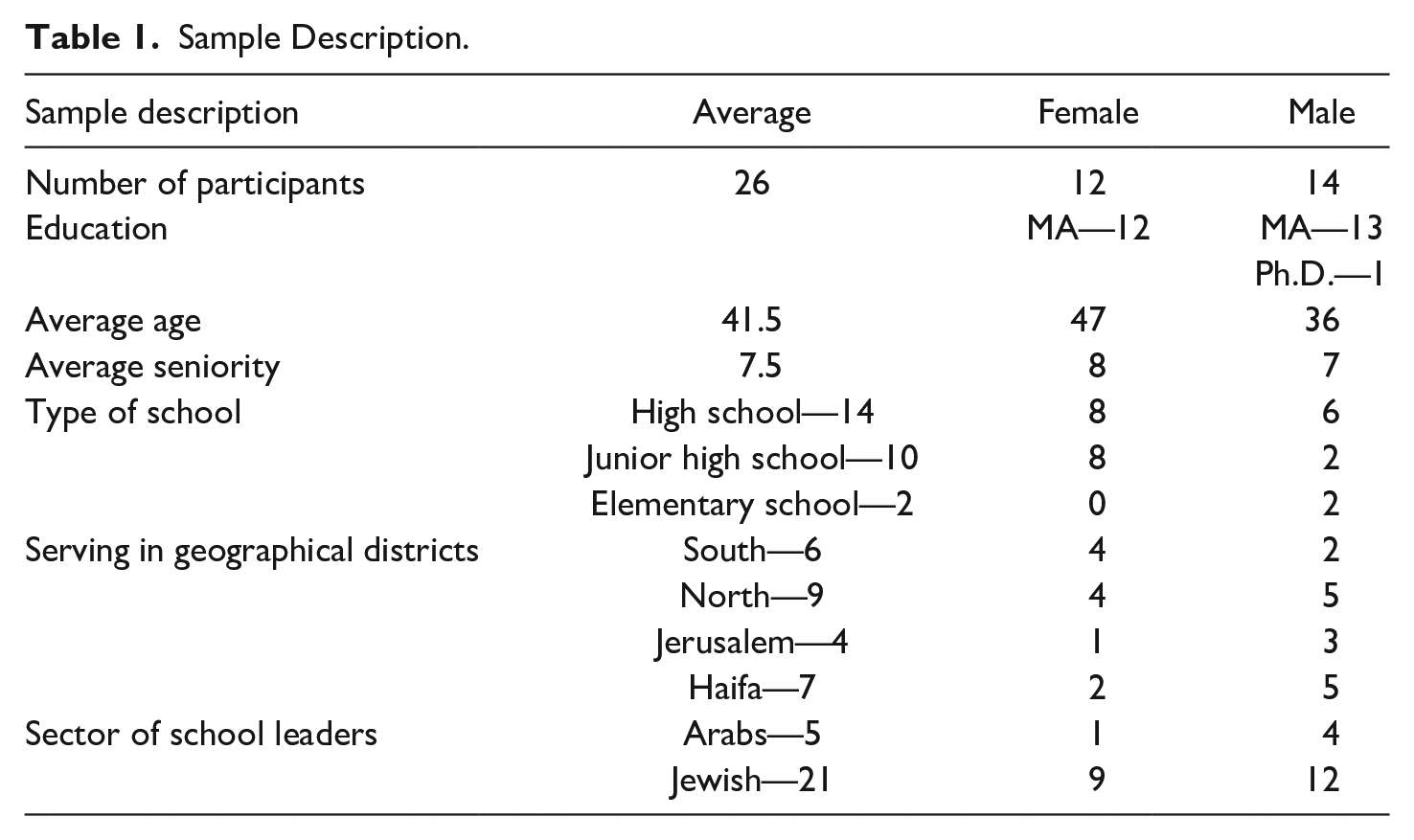
Seeking to maximize the depth and richness of data, we used maximal differentiation sampling (Creswell, 2014), a technique used to capture a wide range of perspectives and gain insights into a phenomenon, contemplating it from various angles (Merriam, 2009). The differentiation sampling applies to principals’ gender, years of experience as teachers and as a principal in general and in the specific school affiliation (Jewish and Arab sectors), religious background, and geographical districts. Twenty-six principals represented a diverse sampling (12 females, 14 males).
Their average age was 41.5 years old. The oldest is 63 years old, and the youngest is 35 years old. On average, participants had 7.5 years of experience as principals. The person with the least seniority had 1 year of experience, and the most seniority had 25 years of experience. Seven of them were from the Haifa region, nine from the northern region, six from the south, and four from the Jerusalem region. Twenty-five of them hold an MA in education, and one of them holds a PhD (Table 1).
Sample Description.
Data Gathering
Data was collected during the first months of the COVID-19 pandemic (April–July 2020). We received a list of middle school principals from the Israeli Ministry of Education and randomly asked them to be interviewed. A semi-structured in-depth interview was used, allowing us to gain in-depth knowledge of the participants’ viewpoints and expose their perceptions, beliefs, emotions, and thoughts. It allowed interviewees to express an authentic voice and expose their world and actions (Merriam, 2009). Sample interview questions were: How do you perceive the concept of crisis? Share the challenges that you experienced during COVID-19. What is the role of a school principal during a crisis? Describe how you managed your role organizationally and emotionally during the crisis. Describe your personal experience metaphorically (for the detailed interview protocol, please see Appendix A). All the participants agreed to be interviewed for this study. Their names were changed to pseudonyms to maintain confidentiality.
Data Analysis
Data was analyzed inductively, according to principles of qualitative research, based on the varied perspectives of the participants. The analysis was conducted in four stages: condensing, coding, categorizing, and theorizing. In the condensing stage, we looked for the data portions related to the research focus. In the coding stage, each segment was coded according to the aspect of the principal’s perception (Gibbs, 2007). This stage was data-driven rather than theory-driven. We did not use a priori codes but rather inductive ones developed by direct examination of the perspectives articulated by participants (Rossman & Rallis, 2012). After capturing the essence of the utterances in the second stage, we clustered similar utterances to generalize their meanings and derive categories in the third stage (categorizing). Then, we reworked categories to reconcile disconfirming data with the emerging analysis. Thus, we explored the dimensions of categories, allowing the identification of relationships between categories and the testing of categories against the full range of the data. We performed the analysis in two phases: We analyzed principals’ voices separately, and next, we analyzed them together to generate common themes and elucidate the differences between the voices (Cohen et al., 2011). Thus, generating themes was an inductive process grounded in the various perspectives articulated by participants (Rossman & Rallis, 2012).
Results
Our research question is how school leaders apply resilience during COVID-19. Concerning internal leadership characteristics and behaviors that help to lead effectively, the study yielded three major themes that demonstrate leadership resilience in crisis times: (a) be proactive and creative; (b) find meaning and set goals; (c) lead emotional climate (see Figure 1). The numbers attached to each theme describe the number of participants who argued its importance. The uniqueness of the results lies in the fact that each of the findings by itself is important and advancing resilience as described in the literature, and together, they complement each other, helping leaders reach a superior level of functioning not only in stressful times but also on regular times. They can maintain healthy and effective leadership.
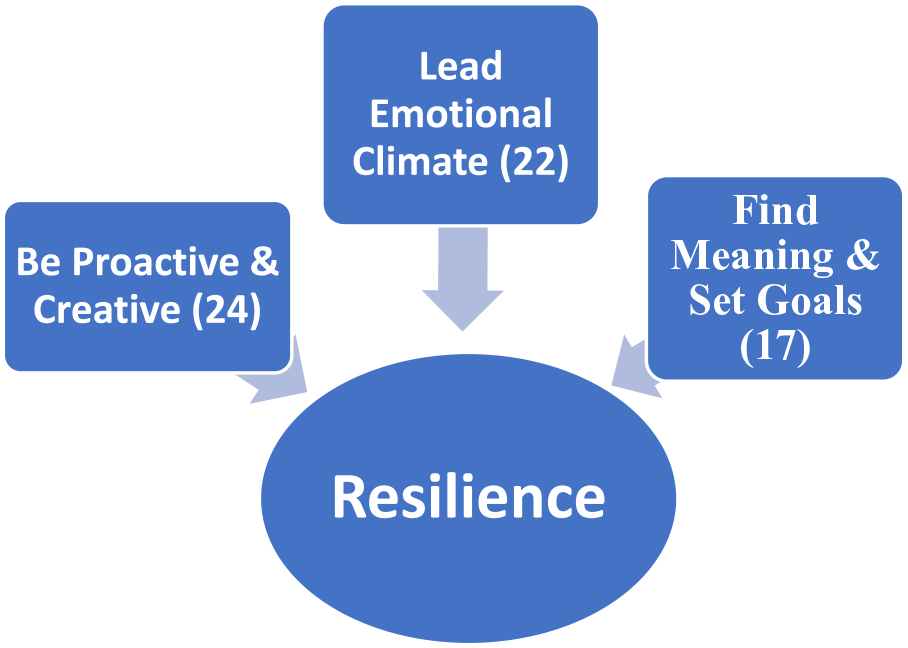
Characteristics of resilient leaders.
Be Proactive and Creative
The first resilience-applying theme emerging from the interviews involved principals’ dynamic stance toward managing the crisis. Twenty-four participants described multiple responsibilities and talked in length about long working hours working on how to run the school during the crisis. They illustrated very dynamic behavior that included being proactive and creative. As Eti said: “The complexity of running a school is immense … we are trying to be proactive, pragmatic, and creative … mainly because of the crises.” Uri talked about the dynamic reality that changes frequently and requires being proactive and adjusting according to the needs:
Things happen all the time … we know how we start the day, but we never know how we end it … we need to catch up about things that change all the time and find pragmatic solutions. Our challenge is to create a calm and controlled environment, so we need to take the initiative and be proactive … Be aware of things that might happen and adjust all the time. The trick is to know how to combine things properly and move forward.
According to Ofir, the dynamic and changing reality requires coordinating expectations: “There is a need to define what we will work on and what will be postponed … There is a need to coordinate expectations … and make sure people are on the move.” The loaded reality and the amount of work, Assi found meaning through encouraging, listening, and supporting teachers in doing their work: “Some teachers are very tired, and we constantly need to be aware of them, recharge them, to strengthen them … to listen, help and support them. That encourages them to do what’s expected of them.” Dani adds a positive, meaningful coping angle while describing his proactive, pragmatic, and creative management:
We need to act in a state of uncertainty … the significant difficulty is to be pragmatic and creative. I feel like a captain of a big ship that crashed on an iceberg, and water is getting into the ship. I have to plug the hole … . to be proactive, pragmatic, and creative and prevent problems in advance … It gives hope and helps to normalize the situation …[We] never experienced such great difficulties as the coronavirus crisis … but don’t worry; we will plug the hole and keep sailing to the shore.
Ruth described her role in coping with the crisis proactively in a metaphorical way:
I will describe myself as an octopus. As a school principal … I need to address different fronts … and integrate all the fronts proactively. Everyone needs me … and I need to coordinate myself proactively between fronts and find the optimal solution to everything. By the way, the main agenda of our school is being proactive. Pro-activism means the ability to lead myself and adapt to changing situations. It helps to control life and take responsibility for our lives.
Most of the participants described creativity as necessary for applying resilience, as Maor and Sami described. Maor: “In crisis times, we need to be more creative, and it feels like fighting for my people.” Sami adds: “To be proactive, creativity is the name of the game. You need to build your creativity all the time.” Assi explained how creativity serves him in being proactive and finding his way in uncertain situations:
We needed a lot of creativity … It was very hard to know where this boat was taking us and where the wind was blowing. So, we tried many ways, and each way helped us in another way or helped another group in school.
Nati also sees creativity as necessary for creating resilience: “For strengthening organizational resilience and resilient people, I need a lot of creativity in meeting the needs of everyone around me.”
Find Meaning and Set Goals
Finding meaning and setting goals in adverse times were described by 17 participants as giving a sense of significance and purpose and applying resilience. Meaning gives the drive and strength for acting, and setting goals is the next stage for ensuring the work is being done. Hana described how creating meaning and setting goals for remote teaching deaf students helped them find solutions:
No idea was wrong if it helped us reach the goals … We produced handouts for the students, and later, we added explanations on Zoom … We’ve perfected the work by allowing teachers to work together while learning from each other, and students are learning in pairs. Later, we developed a collaborative system for learning that every student or teacher could use.
Etti described how finding meaning was an opportunity to create new things: “Finding meaning in a crisis provided an opportunity to create new things, which brought us to new places … It is a springboard to other meaningful experiences.” Likewise, Chava talked about meaning-making by teaching students to create a hopeful picture of their future:
We taught the students to build an imaginary picture of their future and build a route to reach their goals … toward achieving this picture … This picture of the future makes it much more meaningful … It helps in making lemonade from the lemon.
According to Assi, finding meaning empowers teachers. He described how he encouraged them to find meaning in their work:
We knew that we must go on. The kids need to study, we need to work, and the work needs to be done. Some teachers got tired, and we had to recharge them with renewed powers by helping them find meaning in what they do … it helped them see the importance of their work … It improved their work and empowered them.
Ofra described how quickly she had understood the importance of teachers finding meaning in their work, arguing that meaning produced strength and resilience:
It was important for me that the teachers understand the importance of finding meaning in remote teaching. The meaning produces the strength of seeing the existing possibilities … leveraging the school to a higher place, and maintaining learning and routines. Meaning, order, and routines create resilience for the staff and the students.
Tubi and Rom see a crisis as an opportunity for growth and meaning-making. According to Tubi: “A crisis is always a breakthrough to a new path … This breakthrough is the meaning of our job … It opens a window to a new creation … [as] opportunity … it is an opening to success.”
Rom sees the meaning through the student’s improvement and growth:
Improvements are coming from the crisis … The crisis helps us bring results. I came here to do pedagogical work … Now I see that remote teaching is an exceptionally efficient way of teaching … The students learn the Zoom system … even if there are some difficulties, we are … moving forward.
Leading Emotional Climate
Leading emotional climate was mentioned by 22 participants, who found it very important. Emotional climate is a broad term that describes varied ways of being aware of the emotions of others and taking care of them. Yaffa described the first months of COVID-19 as terrifying: “You’re scared, and you’re afraid, and you have butterflies … like everyone here. It is obligatory to take care of the emotions of others. Otherwise, you can’t move forward.” Untreated emotions impact everyone badly, argues Hana:
The crisis … has an emotional impact on everyone … The emotional difficulties … stood out … We needed a program by a specialist … we had to create a good emotional climate … That’s how we discovered new powers that I didn’t see previously. Teachers became more flexible, adapted more to each other, and were more generous in helping and sharing knowledge.
Uri talked about creating emotional balance:
We needed to maintain emotional balance … My team … needed to see me calm and controlling the situation … I needed them to feel safe … on a stable island that gives them a sense of security as much as possible, and my goal was that they would pass the safe feeling and sense of security to their students.
According to Chava, emotions create her agenda: “We first need to work with emotions … always move from our own emotions to those of others. My emotions create my agenda, and it reflects on others who look at me.”
Fourteen participants argued that emotions demanded flexibility. According to Ofir, emotions are meaning-making and can’t be ignored. It helps to be calm, trustworthy, and supportive: “Emotions give meaning to our lives, and you are not allowed to ignore them. They demanded I remain flexible, calm, trustworthy, and supportive … It helps manage the crisis and not let the crisis manage me.” Ruth also described emotional coping as being flexible and supportive:
You need to have flexibility … be creative and smart like an octopus, which is an intelligent creature. In each arm, it has brain cells to handle each situation. It is a flexible, multi-disciplinary creature, like the principals who always need to think about how to maintain people in uncertain times and fear. Sometimes, it is existential fear … a completely destabilizing ground. I need to be the one people will lean on.
Adding to flexibility, Uri talked of the importance of thinking out of the box:
In a crisis, I needed to think out of the box, be flexible and elastic in my thinking, not to be fixed … things are very dynamic, and along the way, you need to make adjustments … depending on the emotional and other needs in the field.
Another thing that helps people emotionally in uncertain times is providing certainty, stability, and creating order, as argued by 21 participants. Uri: “You can’t set any goals without order and regularity … . School plays an important role in these times and needs to create consistency … Eventually, everyone looks for stability.” Or talked about complications and confusion: “The situation was complicated, confusing, and with many changes … We received contradicting messages, and there was an urgent need to create an order for everyone.” Dani explains that order clarifies things: “The most important thing in a crisis is order and regularities … it makes things much clearer.”
Advancing a positive emotional climate might be done by helping followers identify strengths and find supportive sources, as articulated by 25 participants. Hana explained why they needed to initiate support for their staff:
We were in a storm. It was a jolt for the staff, and I knew that I had to be an anchor for them … to bridge the flooding information and the stability. The situation was chaotic. The amount of information was enormous … I chose to be the bridge that would … support them.
Dana explained how they looked for support: “We always look for supportive sources. My supportive source is human assets … . We are a support source for each other. Without them, I would not have survived this period.” Sami said similar things: “My source of support comes mostly from the school staff. They learn from each other, support each other, and it is absolutely a source of support.” Dani sums up the idea by saying: “At the very moment that we can demonstrate our own support in front of our team, it makes them resilient. It will no longer be considered a crisis.”
According to 14 participants, a part of supporting people is supposed to be through trusting them and giving them autonomy. Ari said the Ministry of Education needed to show more trust in the people: “We need to have more autonomy, and they [the Ministry of Education] need to trust us more. We waste a lot of time on reporting instead of being with the teachers and students.” Eti talked about the value of giving autonomy to the school team: “There is a need to give us autonomy. We know what the needs are in this impossible situation better than anyone else.” Yaffa related how she thrived because she had been granted autonomy:
Professionally, I bloomed. I was given a chance to get autonomy, and it gives me the freedom … to be flexible … creative, and find better ways for my students … this freedom allows me to grow and helps me manage the crisis better.
Self-management, an articulation of emotional climate, was described as important by 20 participants. Rom argues that his role in crisis times is to build mechanisms in teachers for managing emotions:
The first thing to take care of is our emotions … only later do we think about learning and teaching. We need to prepare them … teach them to deal with fear, and regulate their emotions first … My job is to build mechanisms for managing and regulating emotions … I [am the one] … that has to strengthen them … they need my support to build their self-efficacy … if teachers feel good with me, they’ll do the same with their students.
Ofir, like Rom, described how he helped his teachers regulate emotions:
Emotionally, I met with the school counselor and the psychologist and … talked about how to help teachers regulate their emotions … Some are at risk … anxiety among the staff … parents and students who are afraid … emotional-social management helps them manage themselves. It is more important than learning.
Teamwork and collaboration were other themes that 24 participants mentioned as important for leading emotional climate, as argued by Maor: “I think that the most important thing is to work together with your team and collaborate at school. Without it, it is impossible to lead an emotional climate and succeed.” Assi is crediting his school team by saying: “I will say to my team’s credit, they stayed with me all the way, for many hours. Thanks to our togetherness, we brought this boat to a safe shore.” Eti also describes how their collaboration is strengthening them:
Teamwork and collaboration are strengthening us. The team strengthens each other … therefore, it is important to create an embracing, inclusive, and reinforcing atmosphere … my role is meaningful … but for sure, I do nothing alone. There is a whole crew behind me.
In summary, our study yielded three ways that demonstrate resilience among Israeli leaders: Being proactive and creative, finding meaning and setting goals, and leading the emotional climate.
Discussion
Varied Ways to Apply Resilience
Each of the results has its value, as will be described below. Applying them together is the uniqueness that demonstrates a superior level of functioning and maintains healthy leadership behavior (Carver, 2010). Results are supported by Bonanno (2004), who argued that there are diverse ways to apply resilience. Being proactive has mostly stood out by participants who used many verbs to describe their actions, and it is pointed out by Patterson (2001) as a way to develop resilience. Being proactive is an articulation of being motivated, ambitious, and creative to get the best at work despite the stress and find solutions to unexpected situations that emerge nonstop (Reyes-Guerra et al., 2021; Yoskovitz & Schechter, 2023). These characteristics are called by Ferrazzi and Gohar (2022) “agile management” or “agile teams,” which means self-management that encourages teams to achieve goals. Team resilience can be measured by the commitment of each member to shared responsibility (Ferrazzi & Gohar, 2022). Being proactive assists in taking responsibility for new needs and discovering hope to create a better future. It also exhibits creativity and greater engagement in an involuntary process that intervenes between the stressor and psychological, emotional, and physiological outcomes of the fight, flight, or freeze response to stress (Skinner et al., 2003). The principals’ behavior demonstrates responsiveness to their surroundings while possessing self-management (Anderson & Weiner, 2023; Ong et al., 2010) in doing their job and assuring that the school works properly despite the unknown reality. This demonstrates the value of finding meaning and setting goals that are described as part of paving the way to doing the job and demonstrating resilience (Isaacs, 2012). Being proactive does not leave the participants any other option than doing the work, as argued by school principals who cited a Hebrew idiom: “If there is no songbird, a crow can also sing.” That means the work needs to be done under any circumstances, regardless of the conditions. By applying this idiom to their work, they overcame the crisis and demonstrated their resilience.
Setting goals and finding meaning also recharges and renews powers and normalizes the reality of an abnormal situation. It creates optimism (Reed, 2018) and gives hope. It builds a bridge from the present day to a better future (Coutu, 2017). It reminds us of Viktor Frankl’s philosophy. A psychologist and a holocaust survivor, he believed it is better to focus on what is left rather than on what was lost. Frankl set goals by imagining himself giving lectures after the war, thus raising himself above the harsh moments (Southwick et al., 2014). Hope and optimism are articulations of self-management mechanisms. They increase self-control and self-regulation for dealing with crises (Masten, 2001) and are considered a foundation of emotional intelligence (Goleman et al., 2004).
Emotional Climate Leads to Resilience
Fear, anxiety, and emotional stress were everywhere as COVID-19 began (Reid, 2022). Schools had to deal with many changes, challenges, and chaotic situations that amplified the emotional needs: transition to remote teaching, contradicting information, unfamiliar tasks, and unknown future (Arastaman & Çetinkaya, 2022). Schools that master computer skills were more pedagogically ready to handle remote teaching, which helped a little in dealing with the stress. Preparing as much as possible for a crisis helps create a powerful awareness of how the crisis can potentially impact the school (Smith & Riley, 2012). Although those schools didn’t expect COVID-19, their awareness about crises, in general, was raised, impacting their ability to manage the crisis (Ganon-Shilon et al., 2023; Howat et al., 2012). Preparing for a Pandemic was described as a healthy functioning special edition by Harvard Business Review (Carver, 2010; Folkman & Moskowitz, 2000).
During a crisis, resilient leadership must deal with emotional issues that appear naturally (Beauchamp et al., 2021; Okilwa & Barnett, 2021). Participants described it by using varied terms of leading emotional climate and positive and healthy relationships as extensively used in educational organizations. It affects individual motivation, satisfaction, attitudes, expectations, self-efficacy, and behavior in a given context. Negative emotional climates may exacerbate depressive symptoms and discourage personal growth, while positive emotional climates stimulate creativity, growth, and professional development. Emotions can shape professional decision-making, work engagement, occupational well-being, and approaches to work (Lauemann & Butler, 2021). Emotional climate appears to be a significant contributor to staff morale, performance, and productivity (De Rivera & Paez, 2007). It illustrates the strength of the group. Emotional climate helps to deal with threats and uncertainty, keeping order and stability, and helps bring things back to normal (Smith & Riley, 2012). The first period of the pandemic resembled “almost existential anxiety” (Ellis et al., 2020, p. 560). The participants extensively described emotional issues that forced them to focus on emotional needs. Resilience has malleable characteristics (Isaacs, 2012; Joyce et al., 2018). It demands a lot of flexibility from leaders who need to understand how to benefit and balance followers’ needs (Gallo, 2022) and consists of positive relationships (Bellibas & Liu, 2017; Kaul et al., 2022).
There are diverse ways to apply resilience (Bonanno, 2004). Our study yielded three main ways to employ resilience: First, being proactive is part of self-management that demonstrates taking responsibility for life by doing things that exhibit greater engagement for the needs of the new situation and demonstrates the fight for a better future, rather than the flight or freeze responses (Skinner et al., 2003). It helps discover new powers that give hope in a chaotic situation and brings a sense of security as much as possible. The second way is finding meaning and setting goals that create a bridge between the tough present-day and a better future, thus creating hope (Coutu, 2017). Setting goals assists in making life more meaningful. The goal recharges and renews powers toward reaching a better situation or better future and serves to normalize the reality of an abnormal situation. The third way is leading an emotional climate, illustrating the self-management of emotions and behavior in turbulent times (Weiner et al., 2021). It is an extensively used concept in educational organizations that affects individual behavior, motivation, and attitudes. It is also a significant contributor to staff morale, performance, and productivity (De Rivera & Paez, 2007). Although each of the findings by itself is important for advancing resilience, together they complement each other. Together, they help reach a greater level of functioning and maintain healthy and efficient leadership in stressful times.
Practical Implications
Studies indicate the existence of a relationship between leadership characteristics, positive emotions, and resilience (Maulding et al., 2012). Our study points to the importance of understanding, self-managing, and emotional regulation as a salient capacity of leaders to enhance positive emotions, optimism, and healthy behavior. Through leading emotional regulation and self-management, leaders prime positive feelings and bring out the best in themselves and their followers, not only in times of crisis but also in ordinary times. Self-management, controlling and regulating emotions, and remaining calm under duress raise resilience (Lindebaum, 2017). By that, school leaders normalize the reality of the abnormal situation and provide hope. On the other hand, they set an example for their followers by leading an emotional climate that tackles followers’ needs, offers a sense of stability, and helps them recharge and renew their powers.
Since resilience is an outcome of psychological health and well-being and a behavioral and developmental outcome, it can be learned and developed (Ager et al., 2013). Institutes that prepare educational leaders should have programs for developing resilient leaders. Institutes for educational leaders’ professional development should include in their teaching plan strategies to develop resilience among school principals, teaching them how to lead through self-management, emotional regulation, and setting an emotional climate. Implementing the findings in educational development programs is vital to nurturing resilience among school leaders, teaching them that positive emotions motivate healthy behavior (Folkman & Moskowitz, 2000) and exhibit greater engagement with and responsiveness to their surroundings while possessing self-management (Ong et al., 2010).
Research Contribution
Increasing evidence and understanding resilience in our era is important. According to Rich Fernandez, CEO of SIY Leadership Institute, we have a fundamental neuroanatomy that orients us toward stress in highly charged times (Gallo, 2022). Our modern life and work demands are stressful (Blaug et al., 2007), and unpredicted changes might happen (Ferrazzi & Gohar, 2022). According to Katsos and Miklian (2021), we stand at the precipice of an uncertain era due to global warming and other magnifying challenges such as COVID-19. They argue that school leaders are reacting to crises rather than preparing for them, and they must have the tools to lead through them successfully because they will be affected by every crisis. Being a resilient leader is not an option. It is obligatory. These results might be applied in any other profession within public or private services. Covid-19 affected almost every business: physically or emotionally, economically or socially, monetary or family. Applying resilience is important for organizations and individuals alike. Everyone will experience a crisis at some time in their life, and it is only a matter of time before they need to cope.
Limitations and Further Research
The small size of our sample, 26 participants, might be a limitation of this study. A small sample can affect the feasibility of generalizing the findings (Merriam, 2009). There is an inherent challenge in researching a broad topic, such as developing resilience during a crisis. Another limitation pertains to the fact that the research has been done in Israel, and its results may have been affected by the Israeli culture, including its organizational and managerial characteristics. Similar cross-cultural studies from other countries should address this theme to provide a cross-cultural perspective. Other similar studies in different cultures would contribute to our understanding of how to develop school leaders’ resilience to cope with stressful educational eras. These can help develop resilience theory, which in turn can help reach a new understanding of applying resilience.
Footnotes
Appendix A
Declaration of Conflicting Interests
The author(s) declared no potential conflicts of interest with respect to the research, authorship, and/or publication of this article.
Funding
The author(s) received no financial support for the research, authorship, and/or publication of this article.
