







Abstract
This conceptual paper introduces FRAME (Facilitating Reflective Awareness through Mental-Model Engagement), a constructivist framework for surfacing students’ subconscious decision-making processes to support transformational learning and scholar-practitioner identity formation. Drawing on theories of mental models, constructivist pedagogy, and conscientization, FRAME articulates how Ed.D. faculty can foster reflective inquiry and theory-to-practice integration using dialogic instructional scaffolds. Situated within online and hybrid Ed.D. programs, this framework offers prescriptive guidance for cultivating cognitive disequilibrium that empowers students to apply theoretical lenses to complex leadership problems in their professional contexts, revise intuitive reasoning, and overcome barriers faced by diverse student populations.
Keywords
Introduction
This conceptual paper explores the role of Ed.D. instructors in facilitating a collaborative learning process that enables students to apply new theoretical lenses to real-world problems of practice within their professional contexts. Specifically, we examine how students bring intuitive, subconscious decision-making processes into conscious awareness and reframe them using the language and frameworks of scholar-practitioners. In doing so, we aim to shed light on specific approaches faculty can take to support this transition, not only by creating conditions that invite reflection and dialogue, but also by guiding students through a process of scholarly identity formation. We present Facilitating Reflective Awareness through Mental-Model Engagement (FRAME), an instructional framework offering prescriptive insights for faculty and program designers seeking to cultivate transformative learning environments that empower students to navigate barriers and enact meaningful change.
The Rationale for Transformational Learning in Ed.D. Programs
The rising popularity of Ed.D. programs utilizing hybrid and remote learning which may be directly integrated into students’ practical work, has expanded access to doctoral-level education. In particular, learners whose social and economic identities have historically faced marginalization – and students for whom professional demands may inhibit on-campus graduate education – can benefit from opportunities to leverage existing professional contexts as a point of entry into scholarly spaces (Offerman, 2011). In a recent special issue, Capello et al. (2023) called for the Academy to engage in a process of “reimagining research methods” in Ed.D. education, highlighting methodology courses that leverage the student’s organizational setting to provide immediate opportunities to practice applying new learning in a meaningful context. In addition to program designs that intentionally embed structures supporting dissertation success, faculty have a critical role – and, as Tolman et al. (2023) emphasized, a moral and professional responsibility – in actively cultivating students’ emerging identities as scholar-practitioners who are empowered to combine practical and theoretical knowledge to address problems of practice (Carnegie Project on the Education Doctorate, 2021).
However, there is still a great deal of room for improvement, particularly in the extent to which instructors recognize and build upon the rich experiential and professional knowledge of today’s Ed.D. students (DeMartino & Renn, 2023). It is incumbent upon Ed.D. program leadership and faculty to develop asset-based curricula and approaches that reflect the needs, interests, and values of this highly professionalized student core. While we agree with the perspective that Ed.D. programs and faculty bear an obligation to sustain programmatic supports and nurture students’ developing identities as scholars and leaders, we contend that students are best served by transitioning their decision-making processes from the subconscious realm into the domain of conscious thought as they progress toward Tolman et al.’s (2023) abovementioned vision. Bhardwaj et al. (2018) addressed this by claiming people in the workforce often plunge into the decision-making and problem solving process without first clearly thinking through the best way to address the issue at hand. While their research team proposed mechanisms for improving that dilemma in business education, we lean into Kovoor-Misra’s (2020) concept of the transformative faculty member as a constructive disruptor, centered on unhinging subconscious perspective-taking of Ed.D. students. As two recent graduates and two faculty members of the same Ed.D. program, we seek to build upon existing conceptions of the faculty role by exploring the process by which doctoral students in an online Ed.D. program bring these subconscious processes to the surface in order to analytically apply new frameworks within their own diverse professional/personal contexts.
The processes of analysis and inquiry, informed by practitioner and instructional perspectives (see Author positionality and framework development), were grounded in three key questions:
How do Ed.D. students conscientize and articulate the once-subconscious mental models that inform the decisions made while practicing their profession?
What antecedent conditions and experiences support Ed.D. students’ entry into the Theory-to-Practice Space?
What is the role of faculty in facilitating this process, particularly with respect to overcoming barriers that interfere with students’ entry into the Theory-to-Practice Space?
Theoretical and Conceptual Foundations
To aid our discussion of facilitating Ed.D. students’ transformations into scholar-practitioners, we draw upon concepts of mental models and intuition from management literature and Freire’s (1970/2005) concept of conscientization.
Mental Models and Constructivist Learning
Generally speaking, learning is defined as the process by which a learner adjusts, augments, or alters their mental model to accommodate a new stimulus, experience, or information. Piaget (1954) conceptualized the learning process as adaptation, which occurs either as assimilation in which new knowledge is added to existing mental models, or as accommodation in which the learner rearranges, reconstructs, redefines, or develops mental models so the new or contradictory information can be incorporated and interpreted (Vandenbosch & Higgins, 1996). Assimilation, or additive education, occurs when the learner is supplied with facts and understandings that fit into existing schemata without significant disruption. Accommodation, on the other hand, represents transformative learning in which the learner has the potential to emerge with changed perspectives. The process of accommodation hinges on inciting productive cognitive disequilibrium so students can refine or augment their mental models to address this challenge to pre-existing notions and engage in transformative learning.
Senge (1990) described mental models as the place where theory and practice come together, as they form the basis for not only how we make sense of the world but also how we respond through action (VanderVen, 2009). When an individual operates using a mental model too deeply entrenched for them to interrogate its underlying beliefs, this “closed” system of thought keeps them in a “comfort zone” that limits their capacity to think and act in new ways (Pearce et al., 2022; VanderVen, 2009). As much as embedded forestructures may constrain our behavior, though, they can just as readily liberate it: a learner who is able to examine their beliefs and understand how their experiential world is assembled possesses an operational awareness that opens the door for the cycles of dissonance and restructuring characterizing transformative learning (Von Glasersfeld, 2008). Scholar-practitioners reflect upon their practices as they act, enabling/stimulating awareness of unconscious knowledge and finding new ways to apply – or challenge – this knowledge.
Mental models may refer to an individual’s concentrated, personally constructed, internal conception of external phenomena or experience, which affects how that individual may act (Rook, 2013). Piaget’s (1954) schemata theory analogously defined knowledge construction as a dynamic process in which learners continually build and revise conceptual structures in order to maintain cognitive equilibrium. Expanding on this view, Von Glasersfeld (2008) emphasized that knowledge emerges from how individuals organize their experiences, further proposing a reimagined role for the teacher: rather than dispensing objective truth, instruction might instead consist of guiding learners in making sense of certain areas of experience. However, Druskat and Pescosolido (2002) also recognized the existence of shared mental models, which are socially constructed cognitive structures representing shared knowledge or beliefs about an environment and its expected behavior. Zhu & Kumar (2023) consider mental models as a means for people to “interact with” (in addition to “understand”) the external world. This interpretation of mental models is relevant to the performance of practical tasks (e.g., troubleshooting) and teamwork communication, alongside the “impressions” toward issues (e.g., choice of study areas, curricular change).
Mental Models as Interpretive Structures and Intuitive Filters
In our experience, students often rely on intuition when making decisions. This act appears instinctive, yet is typically guided by subconsciously activated mental models (Behling & Eckel, 1991). What may seem like a “gut instinct” is often the result of internalized frameworks quietly shaping how a problem is understood and addressed. Because practitioners are often unaware of the mental models underpinning their intuition, they frequently make decisions without consciously recognizing what was done and why. Many students in the Ed.D. program to which we are connected hold demanding professional roles that require rapid decision-making, leaving little time for deliberate analysis. When prompted to analyze a problem or case study, they often jump directly to solutions shaped by prior experiences through an intuitive process of pattern recognition (Druskat & Pescosolido, 2002). This strategy reflects what Vandenbosch and Higgins (1996) referred to as reproductive thought, in which individuals apply familiar solutions to problems that resemble past situations.
However, transformative learning begins when students begin using theoretical frameworks to view problems of practice through new lenses. In doing so, they may revise or restructure their existing mental models, making a critical shift from reproductive to productive thought. We have observed that students who make this cognitive leap earlier in their studies tend to experience greater success in their doctoral journeys. As such, one of our goals is to identify practical strategies faculty can use to help students navigate this transition and engage more intentionally with the transformative learning process.
Transformative Learning Theories
Mental models form the basis of ontological security, which is a stable mental state, resulting from a sense of continuity and order in one’s life and environment (Giddens, 1991). An ontological disruption, then, results in a state of cognitive disequilibrium. Conscientization, which often begins with an ontological disruption (Altranice & Mitchell, 2023; Day, 2012), consists of the process by which students develop an understanding of where they fit into the social world they exist in, particularly with respect to critical awareness. As they undergo conscientization, students engage in a cycle of praxis to reflect and take action, identifying and resolving contradictions in experience to change the world in which they exist.
Mezirow (1991) suggested that transformative learning, in which one’s worldview is fundamentally altered, begins with a disorienting dilemma that triggers critical reflection, dialogue, and action. As he described it, this process involves developing greater awareness of the societal and emotional context surrounding one’s beliefs, critically examining underlying assumptions, considering alternative viewpoints, and ultimately choosing whether to adopt a new perspective or synthesize it with the old. This internal shift is followed by action based on the revised understanding and a desire to integrate the new perspective into one’s broader life narrative (Mezirow, 1991). Dirkx (1998) extended Mezirow’s work by illuminating the emotive, imaginative, spiritual and creative facets of learning, placing these “extra-rational processes” at the heart of transformation: while critical reflection is the mechanism by which learners revise their mental models, it cannot be meaningfully separated from the affective experiences that ignite and fuel the process. Thayer‑Bacon (1998, 2000) likewise argued that critical thinking, which she reconceptualized as constructive thinking, must be understood as a transactive sociopolitical process integrating reasoning with imagination, intuition, emotion, and collaborative dialogue.
While transformative learning theory has primarily centered on sociocultural awakenings around power, identity, and justice, we propose that a parallel process of disruption, reflection, and reconstruction also characterizes other forms of learning that can be considered transformational, especially when learners are prompted to interrogate the internal frameworks that shape their professional decision-making. Indeed, for students who have only participated in traditional face-to-face learning before beginning their doctoral journey, the challenges of adjusting to online instruction may in and of themselves incite “thrownness” that stimulates transformation (Contreras & Bedford, 2023; Cranton, 2016; Lee, 2023). In such cases, transformation involves the conscious articulation and restructuring of existing mental models. This step is essential for theory-to-practice integration, wherein learners must examine the assumptions that drive their intuition using the structures and conceptual tools surfaced through this reflective process. Unlike Mezirow’s original formulation, which does not always require this kind of epistemic translation, our framework emphasizes the deliberate surfacing of intuitive knowledge in ways that empower learners to reframe their thinking and act with greater intentionality and theoretical coherence in complex personal and professional contexts.
Related to Freire’s idea of being unfinished is a concept called “subtractive awareness,” which focuses “on subtracting, letting go, self-identities that are no longer fit for collaborative purpose. . .[i.e.,] becoming aware of obstacles that inhibit creative action with others” (Bradbury, 2023, p. 18). This process begins when the learner realizes the limitations of their own forestructure, which represents the lens of “pre-understanding” that an individual applies to new situations. Education, then, should begin with students acknowledging and articulating their own individual forestructures, followed by developing an awareness of how these forestructures impact the way they learn, interact with the world, and practice their profession (Nakkula & Ravitch, 1998; Packer & Addison, 1989). Moreover, Freire’s (1998) assertion that “our awareness of being unfinished [is what] makes us educable” situates critical consciousness as an ongoing discipline of reflection-in-action, which in Ed.D. programs can manifest when students extend academic reflection into the moral and relational dimensions of their professional leadership.
Language, Cognition, and Framing
If mental models are the internal frameworks that guide how individuals perceive and act in the world, then language is the primary tool through which they are expressed and refined. Language can be understood to be a central cognitive mechanism that enables learners to examine and manipulate the intuitive constructs that shape practice. From a constructivist perspective, it is not language itself that carries meaning from one person to another. Instead, it acts as a set of instructions prompting individuals to draw meaning and engage connections within their own internal conceptual systems (von Glasersfeld, 2008). Understanding, then, is not a matter of decoding a static message, but rather negotiating an appropriate fit between a linguistic cue and one’s existing mental model. This subjectivity is essential to any learning process that aspires to effect transformation.
In the context of leadership education, this means that the language of theory is introduced as a dynamic, generative medium for articulating and reshaping practitioner knowledge. As students begin to surface and name their cognitive forestructures, they often become aware of entrenched assumptions that have implicitly shaped their practice beneath their conscious awareness. Articulating these unspoken frameworks helps surface what Schön (1983) termed “theories-in-use,” enabling students to reflect upon them and make revisions.
Language also plays a catalytic role when students experience the dissonance that results from those unexpected moments when a student’s mental model is challenged. When trying to make sense of these moments, reflective dialogue (either internally or with others) is the primary tool at learners’ disposal to navigate a resolution and invite accommodation. As this is the process that elevates disequilibrium into an opportunity for growth, theoretical vocabulary becomes a scaffold for reframing one’s worldview.
Furthermore, scholarly practice relies on its own set of discursive norms: making claims, using discipline-specific terms and syntax when presenting evidence, reframing, questioning, and theorizing can resemble a foreign language to students whose identities have been shaped in other professional spaces. Instructors play a vital role in demystifying this language and modeling its use in interpreting lived experience through new lenses. This linguistic apprenticeship is essential to empowering students to think with theory rather than simply about it.
We propose that the development of a scholarly identity is, in part, a linguistic act. Internal dialogue becomes transformative when students begin to “talk themselves through” complex problems using this new language of theory instead of relying solely on intuitive reasoning. In this way, language both reflects and reshapes cognition as learners participate in the recursive process of naming, analyzing, reframing, and eventually transforming their mental models.
It is equally important to emphasize that this process of language-mediated reflection does not occur in isolation. Shared dialogue brings about co-construction of meaning, and as students encounter others’ perspectives they begin to notice the boundaries of their own experiential frameworks. This collaborative framing of problems and solutions leads to the emergence of shared mental models that support both collective and individual growth (Druskat & Pescosolido, 2002).
In sum, language functions within our framework as more than a vehicle for expression by actually driving the transformation process. Expanding on Von Glasersfeld’s (1989) views on the subjectivity of linguistic meaning and its role in individual knowledge construction, we contend that when a learner organizes and reorders their knowledge, determinant lexical patterns and syntactic structures become an active force evoking dissonance. This interplay between language and cognition underscores the complexity of learning that is truly transformational: adult learners striving to reconcile intuitive knowledge with academic theory need more than simply to be exposed to new ideas. Practitioner-doctoral programs must take an intentional approach to planning structured opportunities for students to develop and practice the cycle of surfacing and revising. Despite the prominence of concepts like mental models, schemata, and forestructures across management and learning theory, however, few existing constructivist frameworks offer a cohesive, pedagogically grounded approach for facilitating this surfacing process within practitioner-doctoral education.
The Call for a New Framework
Mezirow conceived of transformative learning as a largely cognitive and rational process in which individuals engage in logical thought and reflection to transform problematic mental models that limit the individual’s frame of reference and constrain the way they perceive the world around them (Acton, 2023; Enkhtur & Yamamoto, 2017). Other scholars have expanded upon Mezirow’s work by introducing “extra-rational processes” offering intuitive, imaginative, emotional, spiritual and creative facets to transformative learning (Boyd, 1991; Dirkx, 2012; Taylor, 1998), while Freirean influences offer the lens of “social critique processes” (Freire, 1970/2005; Stuckey et al., 2022).
Our framework, however, aims to further expand the scope of existing transformative learning paradigms in several ways. First, while it includes processes that can indeed effect change within a social justice context, we see broader potential for applications that may include identity formation or change in epistemological perspectives, with particular interest in how scholar-practitioners apply new learning within their professional contexts. Second, Mezirow characterized transformative learning as a primarily organic process (Enkhtur & Yamamoto, 2017; Stuckey et al., 2022); although we are not the first to suggest that instruction can instead be intentionally designed to cultivate feelings of “thrownness” or nurture conditions that catalyze transformation (Moström Åberg, 2022; Pearce et al., 2022; VanderVen, 2009), we intend to augment this idea with an actionable approach to learning design with specific implications for the instructor’s role. Finally, transformative learning is depicted as a process of self-organization that takes place within the mind of an individual learner, which is reflective of constructivist perspectives in general (Von Glasersfeld, 1989). We propose a viewpoint shift that explicitly emphasizes interpersonal factors such as a safe learning space, instructor facilitation, social interaction, and collective sense-making as students transform individual stories into shared sociocultural understandings (Munn et al., 2023). The rising demand for flexible learning lends urgency to this shift, particularly given the impact of these interpersonal factors on student persistence and success within online learning environments (Capello, 2023; Lambrev & Cruz, 2021; Owens et al., 2020).
Recognizing the need for a model grounded in faculty facilitation of scholarly emergence, our model seeks to articulate the antecedents, sequential steps, and catalysts that enable Ed.D. students to unearth transformative learning and step into new roles as scholar-practitioners, shedding light on some specific practices faculty members may implement to overcome barriers and, ultimately, support students as they assume this new identity. With a more complete understanding of the antecedents, practices, and processes that facilitate a shift into the “third space” (Pearce et al., 2022) between theory and practice, Ed.D. faculty can help students negotiate a response to cognitive disequilibrium and become aware of the mental models that underlie their intuition. Bringing subconscious frameworks into the conscious realm can enable the development of deliberate frameworks for decision-making. This process of elevating the subconscious to the conscious is a critical turning point as Ed.D. students evolve into scholar-practitioners.
Author Positionality and Framework Development
As recent Ed.D. graduates working in collaboration with program faculty, our collective positionality informs not only the development of the FRAME model but also our understanding of how adult learners navigate the terrain between theory and practice. Our unique blend of experiences – spanning K-12 education, higher education, military leadership, nonprofit and public service, and educational management – offered varied vantage points that informed our individual understandings about the often-blurry boundary between theory and practice. One author experienced firsthand how practice frequently outpaces theory in the course of her professional work in K-12 schools, while another approached doctoral study after a career as a senior officer in the U.S. Navy, where leadership training emphasized intuitive action, often without space for academic inquiry. The remaining two authors are faculty members in the same Ed.D. program: one with a background in higher education policy and leadership, often through an organizational theory perspective, and comparative and international education educational policy and program development; and another whose consulting expertise and scholarship are centered on management and leadership education. Together, these perspectives informed a deep interest in the ways faculty support students in reframing their lived professional knowledge through a theoretical lens, particularly with respect to how we conceptualized the instructor’s role in transformational learning within Ed.D. programs.
Both collectively and as individuals, we have inhabited multiple disciplinary worlds where we have regularly encountered the tensions that exist between experiential intuition and conceptual abstraction. It is from these liminal experiences (Pearce et al., 2022) that we learned that the most meaningful transformations often happen not in adopting theory wholesale, but instead by engaging it as a dialogue partner with one’s existing mental models. In order to question and revise the assumptions embedded within a student’s practitioner knowledge, however, they must first acquire or develop the metacognitive and discursive tools needed to surface them.
As individuals, we have each experienced our own journey of “surfacing” subconscious mental models and integrating theory into our own professional and personal contexts. In some cases, this might have meant learning how to name the decision-making processes we once regarded as “common sense,” while at other times it meant recognizing the role that specific cultural, institutional, or experiential influences play in our intuitive decisions and, ultimately, opening them to critique and refinement. In any event, though, this awareness did not emerge all at once: it required repeated cycles of reflection, feedback, writing, and dialogue, all facilitated over time by intentionally designed coursework and mentorship. As varied as these journeys were, all of them reinforced our conviction that faculty play an instrumental role in creating conditions that encourage students to embrace the discomfort of dissonance that is necessary for real transformation – and scholar-practitioner identity emergence – to occur.
The hybrid Ed.D. program in which we taught and learned served as a source of insight for the FRAME model. Our cohort-based, online program was designed to support working professionals across diverse geographies and professions through intentional curricular design decisions that emphasized collaboration and reflection, both inside and beyond courses. It was in this environment that we began to identify patterns in how students surfaced their subconscious decision-making processes and, with instructor scaffolding, reframed them using the language of theory. Over time, these observations coalesced into a shared understanding of which conditions, activities, and instructional practices support this shift (and which do not).
In addition, our own collaborative process informed the development of FRAME, with which we sought to capture the dyadic relationships that drive the transformation process. As students and faculty, we engaged in a mutual exchange of ideas that blurred traditional hierarchies. We shared drafts, exchanged feedback, questioned our assumptions, and revised our thinking through the same type of reflective inquiry we now propose as core to Ed.D. instruction. Our dynamic was not one of static roles, but rather of reciprocal co-construction that required equal parts of vulnerability and rigor. In other words, we modeled our framework in action through our own collective praxis and iterative meaning-making processes.
In this paper, we lovingly offer FRAME not only as a conceptual tool but as a reflection of our own learning journeys. We believe that the challenges of conscientizing tacit knowledge, finding a scholarly voice, negotiating power dynamics, and integrating theory with practice are common across many practitioner-doctorate programs. Faculty in these spaces are uniquely positioned to support this transformation, but they require a map and a language to do so. FRAME provides such a map, one that illuminates students’ lived knowledge, invites them to re-examine it, recontextualize it through theory, and empowers them to recast it as a tool for informed action.
FRAME Model Overview
Students enrolling in Ed.D. programs embody a diverse range of professional, experiential, and cultural backgrounds which represent assets that are, ideally, leveraged immediately through thoughtful course design. In addition to these funds of knowledge (Gonzalez et al., 2005), students often bring an equally varied range of expectations about the work they will engage in as doctoral students. This initial orientation toward doctoral work may fall on a continuum with one extreme representing an expectation for an additive educational experience in which they absorb the “correct” answers to theoretical and practical questions as transmitted by expert faculty, while students on the opposite extreme of the spectrum perceive their mental models as complete and seek to confirm their status as expert practitioners with the doctoral credential.
We propose that transformative education must take place somewhere in the middle of this continuum: Ed.D. students need to embrace the confidence to generate novel solutions to complex and ambiguous problems, while simultaneously maintaining an openness to cognitive disequilibrium and a willingness to deconstruct and redefine their existing mental models. In order for this transformative process to take place, Ed.D. students must become consciously aware of their mental models and begin to articulate the various points of agreement and contradiction between these extant models and the theoretical frameworks they encounter during the course of their studies. We refer to this collaborative, iterative process as Facilitating Reflective Awareness through Mental-model Engagement (FRAME).
Model Components
Ed.D. faculty members play a role as facilitators, guiding students through critical inquiry to articulate and challenge their forestructures and mental models as needed. One key way they accomplish this is by providing a common vocabulary and a set of discursive norms setting the stage for students to collaboratively find entry points where they can build bridges between theory and practice. The traditional view of the university faculty role would cast the instructor as the “superior” and “authoritative” knowledge source, yet the Ed.D. program offers an opportunity to challenge/resist this dynamic. While some students may initially enroll in the program expecting didactic knowledge transmission, instructors can instead orient these students toward articulating their own mental models, generating novel discoveries, and acting on the resulting adjusted mental models as they overcome barriers to applying theory to practice in their own organizational contexts. In elaborating upon the processes that underlie FRAME, we aim to provide a new perspective orienting Ed.D. faculty toward pedagogical and programmatic decision-making to maximize the impact of productive ontological disruption (Figure 1).
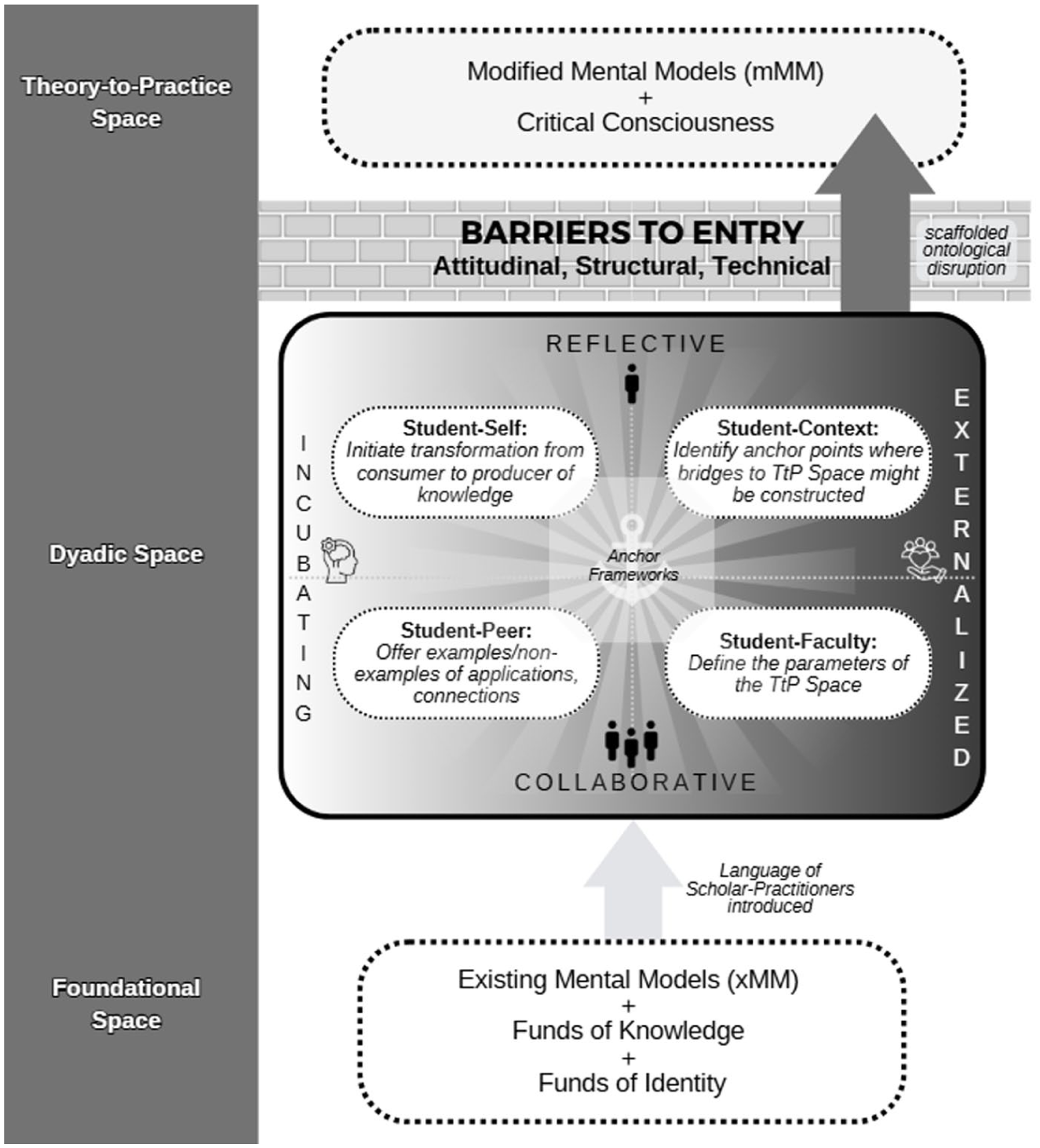
Overview of FRAME model.
Within the FRAME approach to leadership development, faculty instructors function as facilitators by (1) transmitting the common language of the Theory-to-Practice Space, and (2) supporting students as they work to overcome barriers to achieve organizational and professional goals. Through this facilitation instructors invite students to venture away from the default comfort of the Foundational Space and begin to step into the Dyadic Space.
Dyadic Space
The Dyadic Space serves as a crucial zone within the FRAME model, where scholar-practitioner transformation is actively nurtured. It is here that students begin to reflect upon not only their professional roles within their unique organizational contexts, but also as thinkers and learners whose assumptions and habits of mind offer rich soil for the seeds of inquiry. This process is an inherently relational one: rather than undertaking this reflection in isolation, students find support through sustained collaboration with faculty and peers who act as both mirrors and dialogue partners. Refusing to be constrained by any temporal boundaries that a learner might otherwise impose to delineate periods of time designated for formal study, the Dyadic Space seeps into lived experience to catalyze new interpretive connections. Persistent in its demands, it presents learners with moments of insight that emerge – often unexpectedly – during encounters with people, problems and situations in daily life to reshape and reinterpret their experiences across contexts.
One of the most critical roles for faculty in the Dyadic Space is to introduce and model the language of the Theory-to-Practice (TtP) Space. Many students enter doctoral study equipped with rich experiential knowledge but lack access to the discursive norms, conceptual vocabulary, and analytical structures that allow that knowledge to be examined through a scholarly lens. The instructor therefore must facilitate linguistic and epistemological access by helping students name what they know, question its origins and implications, and prepare to integrate it with relevant theoretical frameworks as they are introduced. Faculty may accomplish this through dialogic teaching, reflective writing and discussion, metacognitive modeling, and facilitating deep discussion of case studies and scenarios where theory and practice collide.
Additionally, students will begin engaging with three other dyads within the FRAME model: (1) the Student-Self Dyad, where students initiate the transformation from knowledge consumer to knowledge producer by reflecting on their goals and identities as scholar-practitioners; (2) the Student-Context Dyad, in which learners identify anchor points for bridging theory to practice; and (3) the Student-Peer Dyad, where students observe, question, and learn from one another’s evolving mental models. Together with the Student-Faculty Dyad, these relational dynamics cultivate the conditions for students to experiment, revise, and grow. The instructor’s ongoing presence and guidance ensure the discomfort of disequilibrium is met with care by providing learning scaffolds and upholding psychological safety in the Dyadic Space that allows students to practice new modes of thinking before they are expected to perform them independently.
With continued facilitation, students begin to revise and reframe their mental models within this space. They discover how to name their intuitive processes and articulate conscious, intentional frameworks for decision-making and action. As they continue to develop fluency in the language of scholar-practitioners, they become increasingly confident in their ability to interrogate practice and navigate the more autonomous Theory-to-Practice Space. In this way, the Dyadic Space functions not merely as a stage of the learning process, but as a dynamic incubator of identity development where students rehearse the habits of critically conscious leadership and prepare to apply them within their own organizational contexts.
Anchor Frameworks
Anchor frameworks offer a means for emergent scholar-practitioners to begin to practice working and thinking in the language of scholar-practitioners in a meaningful context. These may be drawn from seminal writings and influential scholarship selected by program faculty, though novel anchor frameworks might be also developed by faculty to advance specific program goals. In any event, an anchor framework should ideally include three essential characteristics:
(1) The framework should have a high level of affective resonance;
(2) The framework might be studied and understood as content, process, or both; and
(3) The framework should engage with what Meyer and Land (2005) call threshold concepts, which are: (a) transformative to how students perceive what they do within their discipline, (b) integrative and multidisciplinary, (c) troublesome enough to provoke cognitive disequilibrium, and (d) resistant to reverting to previous ways of thinking once learned.
What these works have in common is that they present theories and concepts in which readers are able to recognize themselves and their lived experiences. This affective resonance activates the prior knowledge needed to create an avenue for emergent scholar-practitioners to experience these frameworks as comprehensible input (Krashen, 1981). Essential to the secondary language acquisition process, comprehensible input represents a mode of transmitting information in a target language so that the learner has the opportunity to grasp essential meaning by working within a linguistic zone of proximal development: the learner may not yet fully comprehend all of the vocabulary and structures with precision, but sufficient context, affective, and other nonlinguistic cues help bridge gaps in the learner’s current language proficiency for the language learner to absorb meaning.
In identifying or developing anchor frameworks, faculty should consider both the epistemological fit of the framework within the discipline as well as the affective and developmental needs of students. The reflective questions and criteria listed in Table 1 may support this process.
Reflective Questions for Selecting Anchor Frameworks.
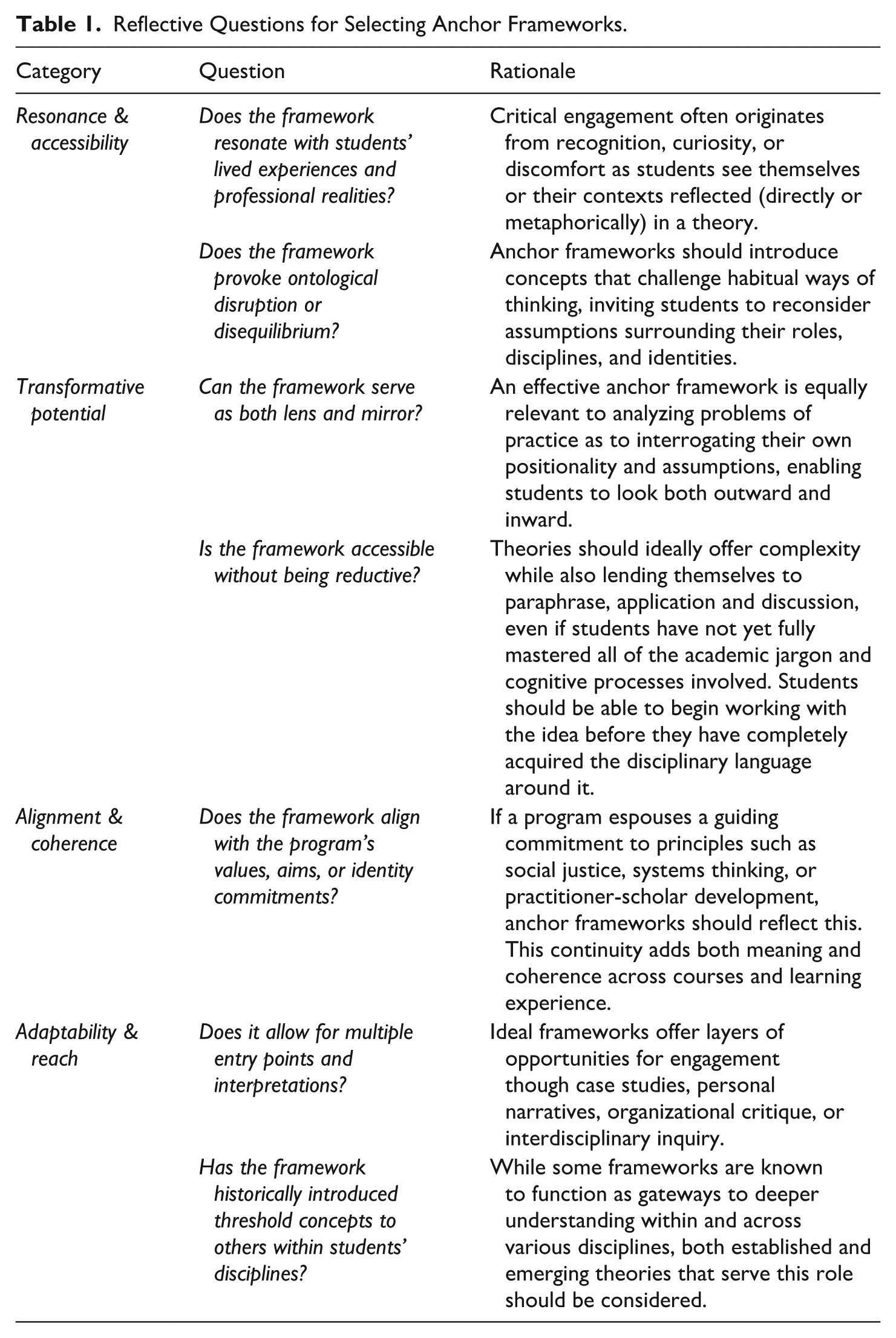
In our own program, several frameworks have consistently functioned in this role due to their affective resonance and generative power. For example, Funds of Knowledge (Gonzalez et al., 2005) positions students’ lived experiences and cultural assets as legitimate sources of expertise, resonating with not only the professional experiences of veteran educators who work with traditionally marginalized student populations, but also helping students working in any discipline to reframe their own prior knowledge as scholarly insight. Lipsky’s (2010) conception of Street-Level Bureaucrats also often simultaneously provokes both recognition and discomfort among students who realize that they have exercised significant discretionary power within their systems without having ever critically examined the implications of the power they wield. Finally, as a private Catholic university, our institution’s mission is informed by themes of community, adaptation, service, and faith that offer a grounding point for students who wish to situate their leadership within a values-based context. Across all three examples, students begin not by mastering the framework abstractly, but by seeing themselves in it. This experience, which in itself may represent a paradigm shift for students whose previous education reflected the “banking model” of knowledge transmission – and who may have viewed academic theory as disconnected from their own professional realities – catalyzes deeper inquiry and collaborative sense-making fueling transformation.
Theory-to-Practice Space
As students approach the final stages of their Ed.D. program and prepare to defend their dissertations-in-practice, the internal work of surfacing mental models and building discursive fluency has begun to yield visible changes in how they approach and engage with problems of practice. Within the FRAME model, this marks the transition into the Theory-to-Practice (TtP) Space, a zone of applied autonomy where students begin to confidently act upon the insights gained as a result of their time in the Dyadic Space. Students have now moved from constructing understanding to enacting it, and furthermore, are asked to make the additional stretch of articulating why these frameworks matter. They may complicate the underlying dynamics of a given problem just as easily as they can illuminate or clarify them, but a neat resolution is not the objective. Instead, students are now empowered to fill the new conceptual and strategic gaps that are exposed when inquiry and action converge.
Although instructor feedback remains critical in this space, the nature of the faculty role now begins to shift. Rather than facilitating new conceptual breakthroughs, instructors now support students as developmental editors and sounding boards, providing thought partnership as they support students in refining their arguments and testing the practical implications of their work. While this shift is significant, faculty scaffolding continues to matter as students translate their complex and often-abstract ideas into coherent narratives and actionable recommendations.
At the same time, students assume increased responsibility for knowledge production and peer feedback. Giving and receiving scholarly critique is integrated into their leadership practice as students learn to pose meaningful questions and offer constructive suggestions, developing the habits of collegial engagement that will continue to serve them in professional communities beyond graduation. This evolution reflects FRAME’s core assertion that this praxis bridge is a product of reciprocal, community-based intellectual labor rather than solely one of individual mastery.
Graduation does not signify an exit from the TtP Space, but instead signals a durable orientation toward leadership as reflective action informed by systems-level thinking and self-awareness. Having recognized how their own mental models mediate power, knowledge, and action within their leadership contexts, Ed.D. students now attain a form of critical consciousness that encompasses not only social awareness, but also a metacognitive awakening informing their habits of reflection-in-action, Graduates who continue to engage in cycles of surfacing and reframing in response to changing contexts remain in the TtP space long after coursework ends and dissertations are complete, carrying this disposition into their organizations to practice leadership that is simultaneously analytical, reflexive, and justice-oriented.
Faculty as Transformative Facilitators
Instructors can serve as architects of the conditions that support the elevation of students’ subconscious reasoning into consciously articulated frameworks. This process begins in the Dyadic Space when instructors model and scaffold reflective practice and use guided inquiry to introduce new vocabulary and discourse. Using dialogic tools such as metacognitive prompts and structured discussion protocols, faculty help students name and interrogate the assumptions and values embedded within mental models. Students’ progression through the Dyadic Space reflects a gradual release of responsibility (Buehl, 2017; Pearson & Gallagher, 1983) in which strong modeling and feedback from the instructor during early stages of learning gradually gives way to involvement more reflective of a facilitative role. As students refine their leadership and analysis skills through peer-to-peer critique, they grow increasingly prepared for autonomy within the TtP Space. Along with anchor frameworks, specific pedagogical tools and practices that can enable faculty to operationalize FRAME might include embedding dialogic structures such as peer feedback protocols; deliberate demonstrations of epistemic humility in which instructors “think aloud” difficult concepts and encourage students to practice the same with peers in small groups; or examples of completed work demonstrating the processes and discursive moves that explicitly show how other students have approached, organized, and communicated complex scholarly tasks.
Mitigating Barriers to Entry
In line with the model of dialogic pedagogy offered by Langan et al. (2009), FRAME challenges traditional hierarchies between faculty and students. In contrast to traditional perspectives of teaching and learning that position the instructor as a unilateral knowledge authority, FRAME situates faculty as co-inquirers acting with awareness of students’ specific goals and evolving identities. This relational stance is particularly valuable to students who are especially vulnerable to disenfranchisement due to their experiences with marginalization or nontraditional academic backgrounds. Historically underserved student populations face a range of obstacles that inhibit their access to educational, professional, and leadership opportunities. While many of these challenges stem from systemic inequities, they are often compounded by faculty assumptions that presuppose access to key knowledge, time, and resources is evenly distributed. The FRAME model encourages faculty to recognize that such assumptions can unintentionally reinforce barriers, especially for students whose social identities diverge from the dominant norms of scholarly participation. Broadly, the obstacles faced by marginalized students generally fall into three interrelated categories: structural, social, and technical or experiential.
Structural barriers include opportunity gaps rooted in inequities across K-12 and undergraduate education, as well as university-level policies and expectations that are misaligned with the realities of working adults and nontraditional students. Grading practices that prioritize individual performance over growth or collaboration, rigid timelines, and the undervaluing of experiential knowledge can all inhibit entry into scholarly spaces. One especially insidious aspect of this issue is the tendency to misattribute these structural issues to students’ personal shortcomings. Deficit-based assumptions about “learner responsibility” remain deeply ingrained in academic culture, especially at the post-graduate level. FRAME calls for a reframing that shifts from a focus on individual competition and performance toward an emphasis on collective inquiry and reflective, collaborative learning.
Social capital barriers affect students who lack familiarity with the informal systems through which opportunity and insider knowledge often circulate. Many first-generation and underrepresented students are unfamiliar with the “hidden curriculum” of doctoral study: unspoken expectations, mentoring relationships, and academic literacies are required to navigate the system successfully. For example, access to the undergraduate research opportunities that are often expected of applicants to competitive doctoral programs is frequently limited to roles with little to no pay, effectively turning financial privilege into a proxy for scholarly potential. Similarly, students from marginalized groups may not have had prior exposure to faculty who model emotionally authentic or relationally vulnerable scholarship, and thus may perceive self-disclosure or scholarly risk-taking as unsafe.
Technical or experiential barriers arise when students lack direct experience with the processes and tools of academic research, or when disciplinary norms and expectations are communicated using unfamiliar or exclusive language. Because academic cultures tend to ascribe value to a detached, logic-driven form of inquiry, students with different epistemologies may feel alienated from the discourse. As Thayer‑Bacon (1995) and Belenky et al. (1997) have argued, conventional critical thinking is often aligned with the “doubting game,” which prioritizes skepticism and deconstruction, while constructive or relational thinking aligns more with the “believing game” that values curiosity and connection. For students whose prior educational experiences have emphasized survival over exploration, the vulnerability that is necessary for transformative learning can feel risky. Scholar-practitioners who have experienced repeated marginalization may hesitate to reveal the “authentic self” that such deep engagement requires (Kahn, 1990; Teerikangas & Valikangas, 2012).
These barriers overlap and interact in ways that reflect systemic and intersectional inequalities. Norms of individualism and competition that are rooted in Western cultural values shape evaluative practices and classroom expectations across higher education (Langan et al., 2009). These norms are so deeply embedded that even students who have excelled within them may struggle to shift toward the collaborative, reflective engagement that the FRAME model promotes. Without explicit faculty modeling and scaffolding, students may miss opportunities to engage, perhaps even actively resisting this kind of participation as it deviates from their assumptions about what academic success requires.
Faculty Strategies to Dismantle or Mitigate Barriers
To reduce these barriers and expand access to the Theory-to-Practice Space, we recommend several approaches for faculty who seek to nurture learning environments that surface and challenge traditional norms while making space for diverse ways of knowing and doing:
Normalize vulnerability and uncertainty: Model reflective practices by narrating moments of their own epistemic shifts, then inviting students to do the same. Likewise, express curiosity when encountering divergent perspectives and explicitly affirm the value of exploring these tensions without zero-sum thinking.
Demystify academic discourse: Plan and deliver explicit instruction in the vocabulary and structures that make up the language of scholarly communication. Offer prompts for thinking, writing, and discussion that model discursive moves and rhetorical strategies (e.g., hedging, questioning, articulating connections, or theory-building) that support deeper inquiry and reflection over solution-seeking.
Create intentional structures for collaboration: Provide clear expectations about the purpose and goals of collaborative activities in a manner that invites diverse perspectives, emphasizing that the goal is generative dialogue rather than consensus. These might consist of creating participation protocols, assigning rotating roles, or encouraging synthesis of divergent perspectives from peers, for example.
Interrupt deficit framing: Recognize and name the systemic forces that contribute to opportunity gaps, and expand definitions of expertise to include lived experience and community-informed knowledge as valid sources of insight.
Additional Implications for Ed.D. Programs and Leadership Development
Faculty Professional Development
Instructors can play a critical role in cultivating transformative learning by purposefully inciting cognitive disequilibrium, and this begins with faculty engaging in their own metacognitive work. Faculty should be encouraged to name and interrogate their own mental models, including those that shape their perceptions of self-identity, students, disciplinary boundaries, and what counts as scholarly rigor. As instructors grow comfortable with modeling this vulnerability, open self-reflection becomes a habit that invites students to do the same. By demonstrating comfort with epistemic humility, faculty can nurture a climate of psychological safety that supports deeper inquiry. When instructors show that reflection and identity formation are lifelong practices by acknowledging uncertainty and revising their own thinking, they clearly signal to students that transformation is both possible and desirable.
Building on the linguistic dimensions of FRAME, faculty development should also include practical strategies for teaching the discursive norms, syntactic structures, and semantic domains of scholarly communication. Naming and scaffolding these often-unspoken conventions can help students internalize the tools of academic identity formation while simultaneously facilitating conscientization. Finally, metacognitive awareness should be emphasized as a key leadership skill for both faculty and students, reinforcing the notion that reflection and learning are central to effective, equity-minded leadership.
Course and Program Design
Curricula that support the development of scholar-practitioners must move beyond content delivery and mastery to take an intentional approach to fostering productive disequilibrium. Haggis (2006) affirmed the need for educators to shift from individualistic models that rely on post-hoc feedback to more dialogic, in-the-moment learning experiences. Instructors have an obligation to create learning conditions in which students’ lived experiences and evolving interpretations become the raw material for capacity building and disciplinary exploration.
This approach must include a reframing of traditional notions surrounding learner responsibility in which students are assumed to independently “come prepared” to navigate complex theory-practice dynamics. Instead, faculty are called to design environments where students are primed to engage through stimulating tasks that offer many possible points of entry: for example, provocative case studies, writing prompts anchored in experiential knowledge or identity reflection, and cross-disciplinary questions that shed light on unseen dimensions of familiar problems all invite students to leverage their lived experiences as a springboard for intellectual risk-taking. Program designers should also critically examine how participation expectations and assessment sequences reflect embedded normative assumptions about time, autonomy, and academic readiness. It is by intentionally disrupting these assumptions that they can open space for more equitable access to leadership growth and development opportunities.
Cohort-Based Experiences
Attributes of the online cohort model that might typically be characterized as limitations may be reframed as features that support conditions for transformation: the geographic dispersion, experiential diversity, and professional demands that are often viewed as challenges in online and hybrid programs can, when leveraged strategically, offer design opportunities that foster authentic learning. In fact, the diverse perspectives within a cohort serve as a powerful counterbalance to potential curricular gaps or disconnected course elements. When students discuss how they apply anchor frameworks and engage in new ways of looking and doing across different contexts with peers, their immediate insights add depth to their colleagues’ respective conceptions of the multidimensional nature of theory-in-practice. This peer-to-peer exchange supports students’ individual growth as learners while simultaneously contributing to a sense of coherence and continuity within the program. The importance of collegiality among cohort members cannot be understated, as intentional relationship-building cultivates emotional safety that provides the foundation for later peer review and co-construction activities.
Additional Applications and Directions for Future Inquiry
While FRAME was developed within the context of a hybrid Ed.D. program, we believe its core principles hold promise across a broad range of graduate and professional education contexts. Programs in fields such as social work, business, nonprofit management, healthcare, and military science, similarly grapple with the challenge of preparing practitioners to integrate theoretical knowledge into real-world decision-making under complex and often unpredictable conditions. In each of these settings, students must learn to navigate professional identities, interrogate assumptions, and communicate their reasoning within discipline-specific discourses. Though the specific frameworks and disciplinary vocabularies may differ, the process of surfacing intuitive mental models and engaging in dialogic sense-making is universally relevant. Adaptation will likely be necessary, particularly within highly technical or protocol-driven fields. However, the core commitment to making tacit, lived knowledge visible and actionable through theoretical grounding can guide curriculum design and faculty development in a variety of settings. Programs that seek to develop reflective and ethically grounded leaders can benefit from the essential components of FRAME to effect professional transformation.
The conceptual nature of FRAME naturally invites further inquiry, particularly through empirical research that examines how students and faculty enact these processes in practice. Longitudinal studies could offer insights into how scholar-practitioner identities evolve over time, including how FRAME-related experiences during graduate study shape post-graduation professional practice and leadership.
Further research might also explore the development and validation of tools to assess metacognitive growth or mental-model shift among adult learners. Comparative studies between Ed.D. programs and other doctoral or professional programs (e.g., Ph.D., J.D., M.B.A, D.S.W) could further refine the scope of FRAME while identifying discipline-specific adaptations. In addition, researchers might consider extending the framework into baccalaureate or even K-12 education, where early development of metacognitive awareness and dialogic reflection could foster more equitable and empowering academic experiences that nurture lifelong learning.
Conclusion
FRAME answers a critical need in doctoral and professional education for an instructional framework that honors the lived experiences of adult students while providing a structured path for integrating new learning into daily practice. By centering mental model awareness and collaborative reflection, FRAME offers a pathway for faculty to support students in moving from intuitive decision-making to theoretically grounded, consciously articulated practical action. In doing so, it expands the possibilities of what transformation can look like, in terms of identity as well as knowledge. As discussions surrounding equity and accessibility in leadership development – and, indeed, the relevance of higher education altogether – grow increasingly salient in the public sphere, we offer FRAME as a model to help reimagine the role of the instructor while illuminating the value of learner experience.
Footnotes
Acknowledgements
We sincerely thank Dr. Drew Moss, Dr. Sarah Colvin, and Mr. Kenny Kuniyuki for their contributions to early conceptualizations of this project. Sincere gratitude is expressed to the University of Dayton Libraries for providing access to the research databases that facilitated our work.

Funding
The authors received no financial support for the research, authorship, and/or publication of this article.
Declaration of Conflicting Interests
The authors declared no potential conflicts of interest with respect to the research, authorship, and/or publication of this article.
Artificial Intelligence Disclosure
NotebookLM (Google) was used to facilitate the literature review by extracting key themes connections among diverse sources, allowing us to efficiently identify patterns and possible gaps within the referenced works. However, all identified themes were subsequently verified within original sources, and the synthesis and interpretation of these themes were undertaken by the authors. ChatGPT (OpenAI, GPT-4o model, 2025) was also used to assist in refining the abstract’s wording for conciseness and to explore potential keywords with consideration for search engine optimization. The final text reflects the ideas, critical review and edits of the authors, who assume full responsibility for the content of this article and its abstract.