







Abstract
Superintendents have been leading school districts through a turbulent and politically divisive environment since the COVID-19 pandemic. This unprecedented context begs the question of whether superintendents were adequately trained to lead in such times. We interviewed 20 superintendents to explore what superintendency preparation programs could emphasize to prepare superintendents to lead in divisive environments. They recommended that preparation programs teach how to manage four politically challenging contexts and develop a foundational mindset and skills. We argue that the NELP standards and the curriculum in preparation programs need to be revised to reflect the contemporary political demands of the superintendent’s role.
Introduction
Superintendents have been leading their school districts through a turbulent, politically divisive, social media-fueled environment since the COVID-19 pandemic. This turbulent environment included hate incidents against racial and ethnic groups—from anti-Asian rhetoric such as 'Chinese virus' that exacerbated harassment of Asian Americans and ultimately made them feel scared to attend school (Balingit et al., 2021), to increased police violence against Black Americans, and amplified systemic discrimination against Indigenous and Latino communities (Fan et al., 2022). Communities and families held distinctively opposite opinions over various school issues, such as masks vs. no-masks, bans of controversial library books, and virtual vs. in-person schooling (Rogers et al., 2022). School board meetings became platforms for aggressive discourse with families or members of activist groups verbally attacking educational leaders (Groves, 2021; Rogers et al., 2022).
This unprecedented and more politicized environment (Cheatham & Lo, 2023) begs the question of whether superintendents were adequately prepared to lead in these turbulent times. While the National Educational Leadership Preparation (NELP) standards were developed between 2015–2018 to address societal changes, the post-2020 pandemic era is a different political and social context in terms of the intensity and chaos of political influences on education (Cheatham & Lo, 2023). Moreover, existing research highlights substantial criticism of educational leadership preparation programs, particularly regarding their inadequate training of aspiring leaders to navigate complex, real-world challenges (Murphy & Vriesenga, 2006; Nicks et al., 2020), especially in crisis environments (Grissom & Condon, 2021). Given these considerations, we asked the following research questions:
According to superintendents, what challenges do they navigate in their current environments?
What recommendations do superintendents have for preparation programs to help prepare aspiring superintendents to lead in turbulent environments?
What do the NELP standards help us understand about superintendents’ recommendations?
We found superintendents felt that they were not prepared for the extent to which their roles required strong political acumen. They recommended that preparation programs help aspiring superintendents develop a particular mindset for the contemporary superintendency and develop stronger communication skills for the politicized job. They also recommended that preparation programs spend more time teaching how to (1) manage relationships with school boards, (2) engage with their communities, (3) engage with traditional and social media, and (4) engage with legislators. We hope faculty in preparation programs will read these findings and reflect on whether their programs explicitly and adequately develop aspiring superintendents’ political astuteness. Additionally, we suggest it is time for the NELP standards to be updated to foreground the contemporary political demands of the superintendent’s role.
Literature Review
Research demonstrates a persistent pattern: as the superintendency transformed to meet changing societal demands, formal administrative preparation often struggled to provide relevant preparation to aspiring superintendents (Glass, 2006; Kowalski, 2005). Historically, as the superintendent’s role expanded from that of a teacher of teachers, to a manager, to a statesman, to an applied social scientist, and finally to a communicator (Callahan, 1966; Kowalski, 2005), the roles were not always reflected in university-based programs. For example, the role of a statesman, which became prominent in the 1930s, and the newer role of a communicator, which was conceptualized in the early 2000s, were not reflected in formal administration courses, while the roles of a manager and applied social scientist were (Kowalski, 2005).
To ensure relevant preparation, researchers identified a few areas university-based programs could improve on. One is the theory-practice disconnect. For example, Topolka-Jorissen and Wang (2015) found that some Ed.D. programs, which are supposed to prepare practitioners for district leadership, offer content similar to Ph.D. programs, which are supposed to prepare scholars and researchers. Further, faculty have often been encouraged to provide more real-world training to meet “the challenges of the present-day superintendency” (Orr, 2006, p. 1400). Suggestions have been made for them to partner with districts and professional organizations to include practitioners in the development and teaching of the curriculum (Darling-Hammond et al., 2007), to “thread practical experiences throughout program components” (Grogan & Andrews, 2002, p. 251), and to create interactive experiences with real-world tasks (Dexter et al., 2020). Nonetheless, superintendents develop some knowledge and skills only through experience (Hyle et al., 2010), relying on their dispositions, such as resiliency (Kingsberry & Jean-Marie, 2022) and tenacity (Klocko et al., 2019).
Another area for improvement concerns the curricular content needed to prepare aspiring superintendents for the demands of the role and its evolving context. Specifically, superintendents should receive better preparation in executive management issues such as personnel and facilities (Glass, 2006), better training in financial leadership (Glass, 2006; Klocko et al., 2022), better preparation to manage crises (Lochmiller, 2021), and deeper and more individualized experiences during internships (Nicks et al., 2020). Gawlik and Allen (2020) concluded that superintendents need to be equipped with solid policy knowledge so they can have the confidence to advocate for their districts. When Orr (2006) explored the opinions of about 140 superintendents on what coursework would be important, they identified the following: “organizational behavior, culture and change, leadership, negotiation and conflict resolution, law, board relations, curriculum and instruction, data analysis and problem solving, power and finance, and resource allocations” (p. 1392).
One of the most significant gaps in university preparation programs is the lack of training in political skills, which are crucial for navigating turbulent environments (Cheatham & Lo, 2023; Melton et al., 2019; Wong et al., 2025). These skills–centered on persuasion and influence–include coalition building within and outside the district, understanding power structures, identifying key players, networking, negotiating, managing conflict, leading change, strategic action, and effective communication (Flora, 2020; Hill & Jochim, 2018; Melton et al., 2019). Although not formally included in job descriptions or preparation curricula (Melton et al., 2019), many superintendents recognize the need for political astuteness to enact change (Gawlik & Allen, 2020), address systemic inequities (Wong et al., 2025), and navigate relations with school boards, local social and political issues, and communities (Orr, 2006). As Hill and Jochim (2018) concluded, “Any superintendent who says, ‘This political stuff is not for me,’ accepts unnecessary limits to their ability to improve education and serve children” (p. 19). Thus, scholars recommend preparation programs provide “sufficient training in educational politics” (Szolowicz & Wisman, 2021, p. 742) to better prepare superintendents for their political roles and the stress they entail (Schwartz & Diliberti’s, 2023).
To address gaps in preparation, faculty have been encouraged to redesign their programs (Grogan & Andrews, 2002; Thiede, 2020). Program redesign is challenging, time-consuming work that requires faculty collaboration, financial resources, collaboration with districts, and institutional support on all administrative levels, including university, college, and program governance (Clement et al., 2022; Darling-Hammond et al., 2007). Programs frequently need to seek approval through cumbersome steps involving linear and non-linear channels of approval from departmental chairs, deans, provosts, and college-level and state-level certification offices. There is evidence of successful redesign work in some superintendent preparation programs (Lewis et al., 2022; Robicheau & Haar, 2008; Thiede, 2020) and some principal preparation programs (Leggett et al., 2023; Darling-Hammond et al., 2007). Additionally, the call to distinguish Ed.D. from Ph.D. programs (Shulman et al., 2006) resulted in the establishment of the Carnegie Project on the Education Doctorate (CPED) and subsequent redesign work in CPED member-institutions to provide preparation oriented for practitioners rather than scholars (Perry et al., 2020). While faculty in some programs choose to actively wrestle with the challenges of redesigning their curricula (Neumerski, 2023), other faculty still need to overcome deep-seated program-level traditions, the lack of understanding of what practitioner-oriented education should look like, and faculty resistance to redesign efforts (Murphy et al., 2008; Perry et al., 2020).
This literature review highlights concerns about the misalignment between the demands of the superintendency and university-level preparation. The gap between preparation and practice is particularly concerning in today’s publicly polarizing educational landscape. While various suggestions have been made on how preparation programs could improve, what remains unclear is how they should pivot in their current turbulent environments to better equip aspiring superintendents for the challenges. Specifically, what content and skills do preparation programs need to teach so that aspiring superintendents are prepared to lead in these environments?
Conceptual Framework
We used the National Educational Leadership Preparation (NELP) standards as our conceptual framework, as national standards guide educational leadership preparation programs. The first national standards, known as the Interstate School Leadership Licensure Consortium, were first developed in 1996 and were mostly aimed at practicing leaders. In 2002, Educational Leadership Constituent Council standards shifted focus to program graduates’ competencies. The most current iteration - the NELP standards - was adopted in 2018 to respond to heightened demands on educational leaders to promote academic success while navigating political complexities (NPBEA, 2018). NELP includes standards for both building- and district-level leadership. We focus on the standards for the district level, which are meant for the preparation of superintendents, assistant superintendents, and other district-level leaders.
The NELP standards include eight district-level standards (see Table 1). The eight standards provide a comprehensive framework for district leadership development, covering both internal organizational management and external relationship building. They encompass leadership skills, operational competencies, community engagement, and advocacy. The standards culminate in a practical internship in real district environments.
The NELP Standards.
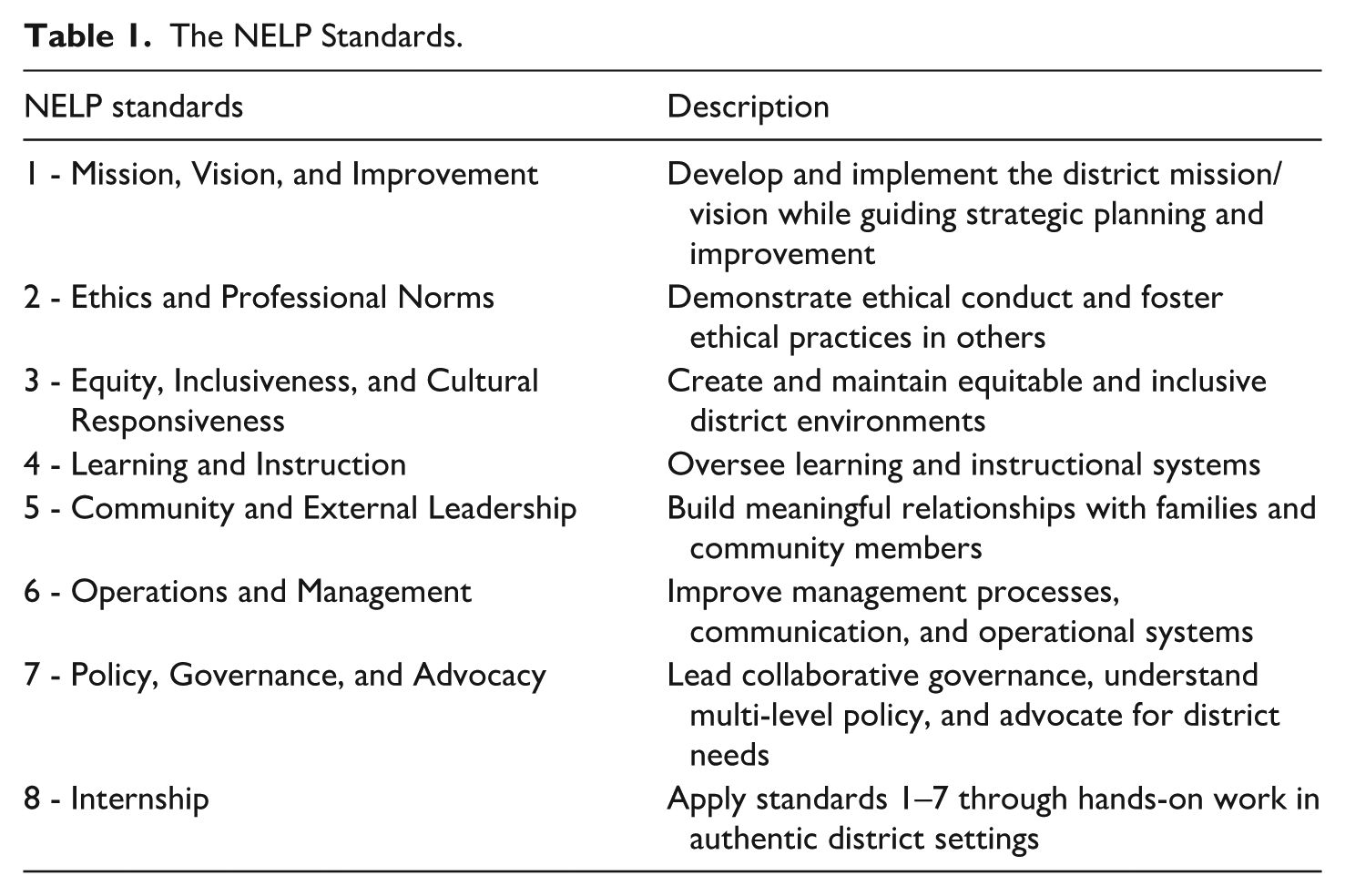
For leadership preparation to change, faculty need to integrate the standards into their teaching (Smylie & Murphy, 2018; Tripses et al., 2013). That teaching needs to be responsive to new social and political environments, such as the post-COVID-19 environment. Therefore, the purpose of this study is to explore what changes current superintendents, who led their districts through tumultuous times, recommend to preparation programs. To guide our study, we posed the following research questions:
According to superintendents, what challenges do they navigate in their current environments?
What recommendations do superintendents have for preparation programs to help prepare aspiring superintendents to lead in turbulent environments?
What do the NELP standards help us understand about superintendents’ recommendations?
Methods
This qualitative study explored the current state of the superintendency, including superintendents' recommendations for preparing aspiring superintendents to lead in turbulent, divisive environments. We conducted semi-structured interviews with 20 current and recently retired superintendents from a state where the educational and political context closely mirrors national trends. The state has long been governed by conservative governors and legislatures, with increasing state control over schools. Intense backlash emerged around the use of masks, LGBTQ+ issues, critical race theory, and library collections. Conservative political action committees funded challengers to previously nonpartisan board seats. Board meetings became chaotic sessions not seen before, and a number of boards changed overnight reflecting a strong, right-wing agenda.
Participants
We invited all current superintendents in one large metropolitan area to participate in our study. If there was a turnover in leadership within the past year, we also invited the recently retired superintendent to participate. We conducted one-on-one semistructured interviews with 20 superintendents, which allowed us to discuss sensitive leadership issues in-depth with each of them. Our participants served urban, suburban, and rural districts. Their years of experience ranged from under one to over 20 years, giving us insights from novice and experienced superintendents. Most of our participants are White (85%), with two who are Latine, and one who is Black (see Table 2). Most of the participants were from mid-urban districts (45%), which we define as older suburban communities now with urban characteristics. The rest served in suburban, rural, and urban districts (see Table 3).
Superintendents’ Demographics.
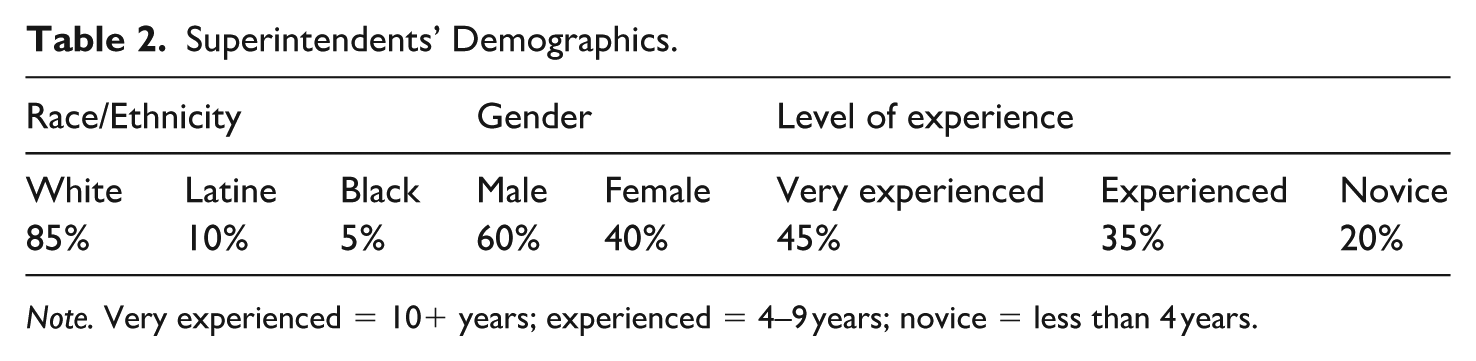
Note. Very experienced = 10+ years; experienced = 4–9 years; novice = less than 4 years.
Urbanicity of the Districts.
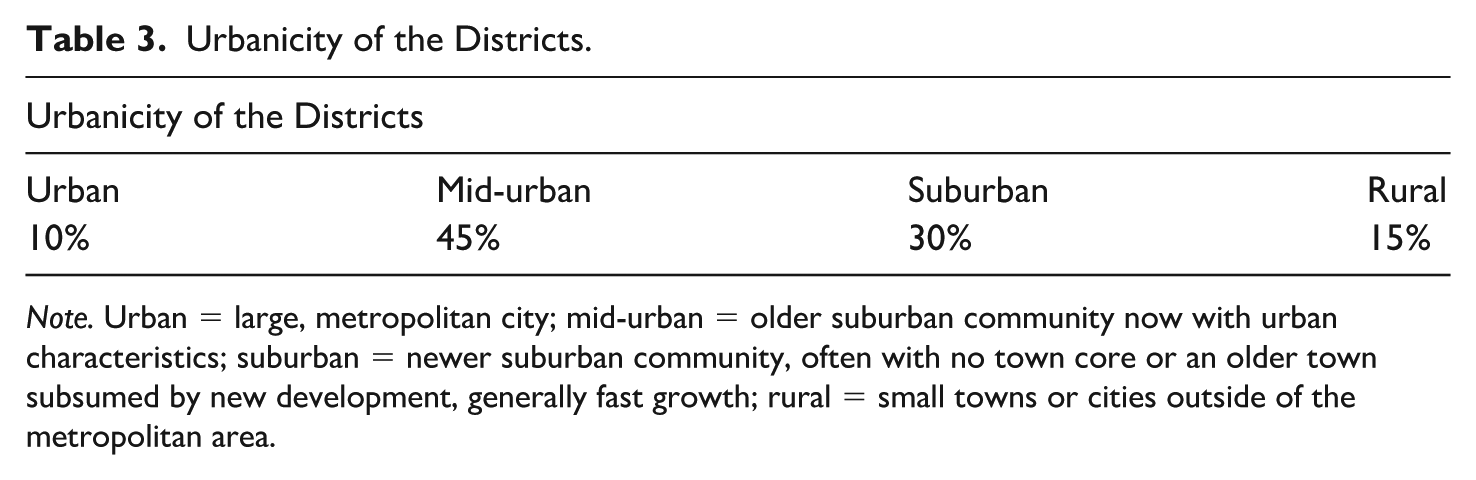
Note. Urban = large, metropolitan city; mid-urban = older suburban community now with urban characteristics; suburban = newer suburban community, often with no town core or an older town subsumed by new development, generally fast growth; rural = small towns or cities outside of the metropolitan area.
In today’s climate, researchers may face reluctance from superintendents who fear that participating in interviews or studies may lead to dangerous repercussions. They are often guarded to protect themselves and their districts. They also have full calendars, which presents a challenge for researchers trying to connect with them. Other studies were only able to include 3 and 15 superintendents in focus groups or individual interviews (Alsbury & Whitaker, 2007; Coviello & DeMatthews, 2021; Kruse et al., 2018). One study (Orr, 2006) was able to include over 100 superintendents, but through focus groups. Our study adds to the existing literature by providing insights from a relatively large number of individual interviews.
Data Collection
We conducted approximately one-hour-long interviews via Zoom in the summer and fall of 2022, which was an intentional decision to study the superintendency during a politically-charged period marked by ongoing recovery from pandemic-related disruptions and strong debates about public education. Given their current politically turbulent environments, we asked each participant about what their current roles looked like, what challenges they faced, and how educational leadership preparation programs needed to change to address the challenges. The primary goal of this study was to learn from superintendents about the current state of their role and to share their experiences with others. Our interview questions about preparation asked more generally about how to help prepare the next generation of superintendents. We did not ask our participants which programs they attended. Thus, we did not conduct an analysis of syllabi and other course materials to triangulate what our participants shared and what their programs offered. However, we hope that faculty will hear these superintendents’ experiences and reflect on whether their programs explicitly and sufficiently align with what these superintendents recommended.
Data Analysis
All interviews were transcribed, checked for accuracy, and de-identified to maintain superintendents' confidentiality. We first read through all 20 transcripts for emerging codes related to our first two research questions. After we determined a set of emerging codes common across interviews, we deductively coded the interviews with these codes to better understand the prevalence of the patterns. We remained open to new emerging codes and added them to our codebook if our research team agreed on this decision. We then created analytic memos (Creswell, 2018) where we gathered and analyzed the excerpts for each code to determine themes across what our participants shared. This memoing process included refining and collapsing some codes and themes until we arrived at six preliminary themes that captured what our participants said about challenges they navigated in their current environments and how preparation programs could prepare aspiring superintendents for these challenges. We disaggregated the data by superintendents’ race, gender, years of experience, and their district’s urbanicity to test for patterns in the six themes. We found no pervasive patterns to report.
We then engaged in another round of analysis to address research question #3, where we conducted a crosswalk between the themes and the NELP standards. Specifically, we carefully read through the standards and added annotations whenever one of our themes was mentioned. We then added to our analytic memos for each theme, noting how each theme was reflected in the standards. As we memoed on this crosswalk, our analysis of the NELP standards revealed that, while they do discuss, for instance, managing board members and community engagement, the discussion of these areas within the standards does not reflect the contemporary politicized role of the superintendent that our participants described, nor the degree of preparation they said they needed to do their jobs well. Further, based on our participants’ descriptions of the preparation they did receive, the NELP standards were not fully taught in their preparation programs. This led us to memo on an overarching theme that our participants repeatedly discussed, specifically that the political nature of the job has become more extreme. Within this theme, we identified a few specific themes, which we describe in detail below.
Findings
The growing political demands of the superintendency emerged as one of the most significant gaps between participants' preparation experiences and the realities they encountered in their roles. While many participants appreciated their preparation, they felt it lacked emphasis on the political realities of the superintendency–a realization that came as a shock to both novice and experienced superintendents. Helen predicted the job will grow even more political in the next few years and that superintendents need to have “some political acumen, and some thick skin, and some abilities to advocate.” Similarly, Kyle noted that without political skill, superintendents will struggle, regardless of their expertise in other areas. He tried to reframe the political responsibilities by saying that “politics doesn't have to be a bad word. Politics [is] just interacting with other people, groups and organizations so that you . . . control your narrative and make sure your narrative is being understood correctly.” Irene noted that preparation programs could provide more training on “how to do the dance on the political front,” how to avoid missteps, and deal with challenges that can be career-ending. She had to learn how to manage the politics when she assumed the job even though, as she said, “I've never seen myself as a politician, but my goodness, I am, and I have to be.” Nathan noted that the political responsibilities of the job need to be taught as a central thread woven through the entire program, not as a stand-alone subject.
Our participants described a foundational mindset and communication skills that are crucial for navigating their current politically precarious environments, which they said were insufficiently addressed in their preparation programs. They also described four contexts that have become highly politicized and difficult to navigate, which they again think they were inadequately prepared to manage. As we noted in the Methods section, we disaggregated the data by superintendents’ race, gender, years of experience, and their district’s urbanicity to test for patterns. We found no pervasive patterns to report. We discuss our findings in greater detail below.
Foundational Mindset and Communication Skills
Superintendents did not feel sufficiently prepared with a certain foundational mindset or with communication skills. They described a profile of the contemporary superintendent who can face current political challenges in today’s hotly charged environment. Many superintendents also stated that preparation programs need to emphasize communication skills for navigating the politically charged environment of their job.
The Contemporary Superintendent’s Mindset
Fourteen out of twenty superintendents described a portrait of who the contemporary superintendent needs to be to face the challenges in their current politicized, divisive environments. They shared that it is important for superintendents to have a difference-maker mindset for the job. Nathan said that superintendents need to be people “with a special mettle,” and Karl observed that they need to be “cut out of a certain cloth.” The difference-maker superintendent embodies several key characteristics that enable them to meet the political demands of the current job.
Difference-maker superintendents possess a serving attitude because their focus should be, in Barry’s words, to “change people’s lives and kids’ lives.” They should not be in the job for themselves. Like Barry, Karl thought that successful superintendents are people who “really want to do the job and not keep the job.” In fact, Nathan suggested that programs need to filter out people who are in the job for themselves before they get to classes.
Difference-maker superintendents are also bold risk-takers who are willing to take on challenges and think outside the box. When superintendents have that ‘special mettle,’ they will be able to stand on difficult issues, have the courage to make unpopular decisions, and take hits from community members, like Ellen did. When she allowed a gay-straight alliance club, the pastor of a local church preached a negative sermon about her. Ellen had the confidence to not take the criticism to heart because she believed she was doing the right thing for children. She said, “You've got to be willing to take a stand.” Karl demonstrated boldness and thinking outside the box when it came to compliance regulations. He said he always follows the rules, but he and his team “are going to push the envelope to meet kids’ needs” because the “notion that somebody somewhere [in the state capital] knows the best way for 33,000 kids to learn doesn’t exist.”
Further, difference-maker superintendents are future-focused and flexible. Kyle noted that superintendents need to have the ability to look into the future and “keep [their] eyes wide open, full peripheral” so that they can anticipate how things might change in the future and adapt accordingly. Otherwise, superintendents will struggle. Kyle thought that his district was able to adapt to the environment caused by COVID and is now flourishing, unlike other districts that were not able to adapt. Chad also emphasized how critical it is for the superintendent to be able to be flexible because the environment and the political climate keep changing. He said the superintendent needs to provide a vision for the future and think and plan strategically.
Difference-maker superintendents are also authentic about who they are to build trust in the community. For example, Lawrence emphasized the importance of being authentic because “people can really tell whether or not you’re genuine.” A child can pick that up about a teacher; teachers - about the principal; and central office employees and community - about the superintendent. Mandy exhibited authenticity in part through being vulnerable. She intentionally shared with her staff and community her personal story of why she became an educator.
Finally, difference-maker superintendents also know themselves and their values so that they can analyze their match with the values of their community. As Eric shared, a superintendent’s knowledge of their communities’ values can help them “bring people together around whatever is still common, whatever [they] believe is important to [their] individual communities.” Barry shared how he leveraged his knowledge of his community’s values to develop a vision for the district, “You may have a vision, but you have to crystallize your vision through the values that the community holds true to them.” Ultimately, superintendents concluded that if the values of the superintendent and the community are mismatched, then the superintendent needs to go. For example, Terry said she told superintendent candidates that “if it [the job] doesn't match your values, then you got to know you got to be out.”
Our participants suggested that preparation programs emphasize the development of a leadership mindset that would enable superintendents to address the challenges and changes associated with their role. For example, Nathan said, “[The community] want[s] a problem solver. And it's all about dispositions and attitudes. That's what you can teach your students, how to get there.” Similarly, Karl thought that preparation programs should emphasize a proactive leadership style, one that takes people through changes. Chad suggested that, like superintendents, programs need to be adaptive so that they respond well to the changing environment and prepare people for a role that is different from what it was five years ago.
While the NELP standards (see Table 1) address superintendent mindset, they do not reflect the realities of leading during politically turbulent times. Standard 2 emphasizes dispositions such as “equity, fairness, integrity, transparency, trust, collaboration, perseverance, reflection, lifelong learning” (NPBEA, 2018, p. 12). Standard 3 states that aspiring superintendents should have “the capacity to evaluate, cultivate, and advocate” for equitable, inclusive, and culturally responsive schools (p. 14). While these qualities and dispositions are crucial for superintendents to have, they do not reflect the controversial environments that superintendents now work within and the strong political skills required to navigate them. Ellen described defending a gay-straight alliance club in the face of criticism. Chad emphasized being flexible in a continually shifting political climate. Karl spoke of “push[ing] the envelope to meet kids’ needs.” Our participants described the need to be tenacious and values-driven to make decisions amid opposition, qualities that a superintendent needs in a conflict-ridden environment.
Communication Skills for the Politicized Job
In addition to developing a foundational mindset, 14 out of 20 superintendents said they need to possess strong communication skills as expectations for the level of communication in a turbulent, politicized environment are different. Lawrence pointed out that communication now is very different from what it was 20 years ago, and it is crucial that superintendents know how to communicate with their board, staff, and community. Spencer thought that because the challenges are getting greater, it calls for better leadership and superintendents who can get their point across. Chad thought that having some good crisis communication training is very important, which would also be helpful when issues go viral on social media. Ursula connected communication skills to political skills, saying, “I think, being a good politician to some extent falls in the category of being a good communicator.” Eric concluded that if a superintendent “can't communicate the message in a way that calms the waters and inspires the troops and results in a high level of achievement,” that superintendent will not succeed.
Superintendents discussed how they need to be prepared to address communication challenges in both a big-picture way and a detail-oriented way. Addressing communication in a big-picture way entails being able to develop and implement strategic communications plans. To illustrate how complex communications plans can be, Mandy’s plan includes the following multiple parts: what was communicated in the past, what will be communicated in the future, what channels to use, and who the audiences are. On top of that, she thought of how to help principals communicate. Additionally, superintendents recognized that they need to constantly communicate to make sure that the message is received and to not allow misinformation to spread. For example, Barry shared that “repetition is the key” when it comes to talking to constituents about the vision for the district because they probably hear only half of what the superintendent says. A constant flow of good communication is important to counterbalance the spread of misinformation on social media. Mandy explained that if superintendents allow some vacuum in their communication, “that vacuum is going to get filled with things.” Finally, superintendents needed to plan how to spread messages through both formal and informal channels for communicating with different constituents. For instance, Barry recognized the power of using one’s sphere of influence because people are more likely to hear a message if it comes from a peer. Barry explained: “One of the things that I noticed early enough that if I say, when I was a teacher, this is what I did, people tune me out because I am no longer one of them.”
Addressing communication challenges in a detail-oriented way entails a careful consideration of how messages are articulated, or paying attention to the language and the words superintendents use in their messages. For example, Irene said that before she had a communications officer, she spent a lot of time on written communications, trying to figure out how to respond to things, what to say, and what not to say. She said, “How do you write the communication so they can't hang you in the town square with it.” Spencer also acknowledged the importance of choosing words carefully and gave an example of how his district spent hours on selecting words because they realized that even an innocent word can be misinterpreted.
Superintendents overwhelmingly indicated that their preparation programs did not prepare them for effective communication, especially to deal with the political challenges of their job. Superintendents also acknowledged that even if they could afford a communications specialist or team, it could not replace the superintendent’s own ability to communicate well because they are the face of the district. Terry said that even though she has a communications specialist, she still spends a lot of her time on district communications. Mandy also recognized that she is “the face of the district,” but she did not feel prepared for it through her preparation program. During her doctoral program in educational leadership, she only had “one little class on communication.” Now she wished she had a degree in communications and marketing.
While none of the superintendents felt they received sufficient communication preparation in their programs, a few superintendents shared how they either received some training through their jobs or made their self-improvement a priority. Nathan, for instance, received training from communications specialists. One of them videotaped Nathan for two days and gave feedback on how he came across through his body language and his speech. She pointed out the importance of using positive instead of negative words to convey accountability rather than corruption. Another specialist taught Nathan that “people want to hear stories, but not your story, their story.” Barry improved his own communication independently by watching YouTube seminars and TED talks. He also practiced all of his speeches because he wanted to make sure that he said “the right things to inspire, motivate” people in his community.
Interestingly enough, the NELP standards do point out the importance of effective communication for various contexts, via various means, and for different purposes. Specifically, superintendents need to communicate a district mission (Standard 1) and professional dispositions and norms (Standard 2), communicate with different constituencies through various means (Standard 5), communicate about operations and management, (Standard 6), and advocate for district needs at the local, state and national level (Standard 7). While it is important that the standards discuss the need for communication skills, the undertone is that communication happens respectfully on all sides. However, our participants highlighted how contentious communication was with various constituencies and how little training they had on how to be the face for the district. Chad thought that having some good crisis communication training is very important. Ursula discussed communication as a political act. Eric cited the need for communication that calmed the waters and inspired people.
Politicized Contexts
Superintendents named four contexts they found highly political and hard to navigate, for which they felt underprepared by their superintendency preparation programs. Specifically, those contexts are (1) managing relationships with school board members, (2) engaging with their communities, (3) engaging with traditional and social media, and (4) engaging with legislators.
Managing Relationships with School Board Members
One of the most politicized contexts that superintendents (13 out of the 20 participants) felt underprepared to manage was their relationships with their school board members. School boards have become increasingly politicized, creating new leadership challenges for superintendents. Irene observed that school boards have become more radical, Terry noted that some board members have a more pronounced political bent, and Kyle shared that some board members receive outside funding during board elections. The radical, politicized nature of school boards makes superintendents more careful about what they communicate to their boards for fear of information becoming public. Further, the support of the board determines whether the superintendent will successfully remain in the job or not. Helen shared, “Nobody tells you [that] you can be doing the best job ever, and then, if your board changes over, you could be gone next year.” Ellen and Terry had the support of their boards, and that made them feel secure in their jobs.
To manage board relationships, our participants said superintendents should carefully consider whether and how their goals and values align with those of their boards. For example, Kelly said that a superintendent can only act on certain issues when the board supports it and there is an alignment of beliefs. The superintendent “has to know where the board stands on these very, you know, firestorm issues.”
Board alignment becomes especially important when new members are elected because turnover poses a threat to superintendent job security and initiative continuity. Kelly shared that her equity work lost support after a board shift, noting the new board members “hadn’t gone through that journey” with her. She reflected that pausing to “take them along on a journey for continuing” the work might have helped. Karl took a proactive approach when a new board member was elected on a platform of banning certain books and opposing critical race theory. He saw an opportunity to educate constituents who supported the board member and “to bring [their] community together,” recognizing that they were “a voice that . . . whether we've been listening to that voice or not, they don't feel listened to.” Spencer also navigated turnover effectively by including new members into the district’s work through sharing what work had been done in the district, showing data to support it, and asking those new members what goals they see for the district so that those goals could be incorporated into the plan.
Superintendents consistently reported feeling their programs did not adequately prepare them to navigate the politics of managing school board relationships. Karl noted that board relations are difficult to teach and something that aspiring superintendents will likely not have experience in before assuming the superintendency. Therefore, leadership programs need to help aspiring superintendents understand the politics of working with a board. Our participants thought programs do not allocate enough time to this topic. Ulani, for example, estimated that “there is a 10th of the time spent on what does it mean to develop board relationships, how to navigate boards.” She thought that programs need to discuss best communication practices with the board and include simulations of board meetings where aspiring superintendents would practice facilitating the meetings and asking the right questions to bring consensus among board members. Ulani herself “was blessed that [she] got to watch [a former superintendent] do it for a long time brilliantly.” Helen suggested discussing strategies for when a board has just one dissent on a particular vote versus a nearly even split vote. Barry shared how his mentor created opportunities for him to practice board relations by delegating to him many communication responsibilities, including one-on-ones with board members and participating in board trainings.
The main NELP standard that addresses the capacity to work with board members is Standard 7. It speaks to superintendents’ abilities to represent and advocate for the district’s needs to the board as well as cultivate effective board relationships. While these are important skills, they are not sufficient for navigating the radicalized boards our superintendents described. Their newly elected board members were supported by stakeholder groups who wanted to create conflict. Our participants needed skills not just to cultivate, but to persuade or counterbalance board members’ intent on disruption so that the district could realize its mission. Not once did the standards use the word ‘persuade’ or discuss conflict management. The word ‘negotiation’ only appeared once in this standard (and just this once in the whole document). Thus, while Standard 7 sets an expectation for training in navigating board dynamics, it does not situate this work within a highly divisive and turbulent political environment.
Engaging with Their Communities
Another context that superintendents (13 out of the 20 participants) said has become more politicized and that they felt underprepared for is engaging with their communities. Rapid growth of communities, changing demographics, and diverse constituents’ interests have created a politically challenging environment for superintendents. Irene and Terry described exponential district growth, with Irene’s district enrolling 5,000 new students in one year. Many of these families did not yet know about the district’s community engagement efforts. Irene also noted that although her district was known for family engagement, the pandemic had interrupted their efforts. Helen highlighted rising numbers of financially struggling families and families who primarily speak a language other than English, noting that “demographics in [her state] are changing faster than . . . the nonprofits and the schools and the churches and the hospitals are able to keep up with.” Mandy added that large communities contain diverse constituents, including people without children in schools, thus complicating outreach and consensus-building.
Superintendents noted that while community engagement has always been important, it is even more important now because of the growing divisiveness within communities, which can eventually create divisiveness in school boards. The political complexity requires superintendents to strategically build community alliances to maintain support and counterbalance opposition. Kelly explained that if the superintendent does not have the support of either the community, the board, or the staff, the superintendent will eventually “topple over.”
To get the support of their communities, our participants cultivated relationships with internal and external community constituents. To increase community engagement internally, Irene created a passion project initiative through which her cabinet members organized interest-based projects to engage the community for a year and to build relationships with them. Irene herself formed a superintendent parent advisory group, which helped her accomplish two goals: 1) to hear from all parents (including politically extreme ones); and 2) to ask parents to provide their top three priorities, helping her and the board prepare for board meetings. To ensure the community’s buy-in, Terry involved her community as the deciders and discussers of decisions by listening and getting feedback from them. Terry understood that, if decisions do not reflect the needs of the community, then the superintendent will find themselves at odds with their community. Chad also emphasized the importance of superintendents getting feedback from students, parents, and teachers, which he did through focus groups or committees.
In addition to building relations internally, superintendents need to build relationships externally to help them navigate their politically tumultuous environments. For example, Helen said that it is crucial for any superintendent to work with local organizations (e.g., community service clubs and Rotaries) and learn how to be a member of the non-profit world in the community in order to manage the politics. It is also important to connect with power actors such as mayors and city managers. Helen said, “Nobody told me that coming in. Nobody said, Hey, first thing you need to do is set up a one-on-one meeting with every mayor and every city manager.” Building relations with key community players helps superintendents with counterbalancing naysayers. Samuel said that superintendents need to keep those who are already on their side so that they can be strong advocates for the district. This can be accomplished by talking to realtor groups, churches, and pastors’ groups because these groups know what's going on in the district and they can help counterbalance some of the naysayers.
Superintendents in our study identified community engagement as a gap in their preparation programs, a skillset that they had to learn on the job. For example, when asked about what preparation programs could emphasize, Kelly said: “that's a big one in my books, . . . definitely community relationships, community relations, how to rally, get the community behind you.” Helen responded that “you really need to know how to manage politics. You need to know how to manage parent groups. You need to know how to be a member of the non-profit world in your community.” Karl suggested programs “spend a lot more time on policy, politics, understanding communities” and where a superintendent might fit as a leader to make an impact.
NELP Standards 5 and 7 address the context of community engagement inside and outside of school districts. Standard 5 focuses on understanding and engaging internal and external constituents, including diverse families and members of the business, civic, and policy community. Standard 7.2 calls for skills “to design governance systems that engage multiple and diverse stakeholder groups” (p. 26). This portrayal of community engagement fails to explicitly acknowledge the potential for significant dissent among diverse stakeholders. However, our participants shared how community engagement is increasingly political work. They said they needed more in-depth knowledge on how to identify influential groups, be strategic in forging alliances to counter hostile groups, and rally members of the community.
Engaging with Traditional and Social Media
Another context that superintendents described as more politicized and that they felt underprepared for is engaging with traditional and social media. While the majority of our participants did not speak about this context, the eight participants who did described how dramatically political this context had become, and how their programs did not prepare them for this. Communicating with the media is now a regular part of navigating the political front and controlling the narrative the public hears. Irene said that social media exacerbates the political climate by spinning narratives and misinterpreting information. Irene and Barry noted that even if superintendents have communications teams, they still need to be able to speak to the media themselves. Barry explained that the current reality is that “now everybody's going to put a mic in your face and expect you to say something.” If superintendents do not prepare what to say, they may say something wrong. It will be recorded and come back with repercussions. Further, if they avoid saying much, that also makes a statement. Nathan also emphasized the importance of consuming media wisely. He thought that while it is important for superintendents to read what social media says about them, they cannot allow it to “deteriorate [their] mind” or “steal [their] mojo.”
Superintendents identified multiple areas that preparation programs could address to help navigate the political dimension of the job. Chad and Barry noted that programs could emphasize the power of social media and how to harness it. Barry reflected, “How to act with the media - that's a huge part of this job. Last week, I think I did four interviews, . . . And so . . . nobody taught me that but my mentor. There was nothing in the university coursework that taught me that.” Nathan also shared that he received valuable media training outside his preparation program, which helped him to face political aspects of his role. For example, his supplemental training taught him how to address tough questions, "how to acknowledge, block, and bridge and stay on the message that [he] want[s] them to hear.” The superintendents’ consensus was that preparation programs must recognize media engagement as a political necessity for presenting educational narratives effectively and ultimately surviving in the position.
The NELP standards do not explicitly address the politically charged nature of media engagement or offer guidance on navigating divisive issues. In fact, media is only mentioned in Standard 5 as “digital means” in contrast to oral and written means of communication with community members. Yet, our participants stressed the need for preparation in media engagement, given its power to shape public opinions and erode trust in public education. Our superintendents described a contentious, unregulated environment they needed to steer through. They stressed they cannot rely exclusively on communication departments, but must themselves address the media. They called for targeted training in media communication that not only fosters effective messaging but also equips them to navigate high-pressure scenarios, including instances where “anyone can put a mike in your face.” They also said they need training on managing social media, since it is often used to spin narratives and perpetuate misinformation.
Engaging with Legislators
The final context where superintendents felt unprepared was legislative advocacy for public education. Again, while most of our participants did not discuss this context, the five participants who did described how increasingly political it had become, and how their preparation programs did not prepare them for this. Superintendents shared that legislative advocacy extends beyond local issues to regional and statewide concerns that impact public education. They also shared that legislative advocacy entails both mobilizing their own communities and building relationships with people who have the power to influence legislative decisions. Irene highlighted the intensifying need for superintendents to "become stronger advocates" who can mobilize their communities and "ignite [their] staffs and [their communities] to really have a voice down in the state's capital." Helen advised new superintendents should connect with legislators immediately after assuming the position. Barry shared that strategic relationships with both legislators and their staffers are essential. He initially believed "elected officials voted on issues because they understood everything," but later discovered that staffers often "whisper in an ear [of elected officials] how to vote on a specific issue." Barry now has senators’ phone numbers and communicates with them regularly.
Superintendents identified significant gaps in their own preparation related to legislative knowledge and advocacy skills. Irene stated, “There needs to be training on advocating for your school district at the legislative level because no one talked to me about that. I don't remember having a lot of fire behind being an advocate for public schools.” Helen noted that preparation programs should teach aspiring superintendents “how to navigate [our state capital]” and provide instruction about “the legislators, legislation, and . . . how to be advocates for public education.” She observed that some superintendents did not know “even the basics of the inner workings of the state capital.” Barry indicated that he only gained crucial advocacy skills and skills on how to deal with political pressure through mentorship rather than formal preparation.
The NELP standards do address legislative and advocacy work for district-level leaders, but, again, not to the degree that our participants shared is currently needed for their jobs. Standard 7.3 speaks to acquisition of knowledge about policy and the law and strategies for influencing local, state and national leaders, but the skills focus on evaluating and implementing policy and communicating about it. Standard 7.4 discusses the capacity to “understand the implications of larger cultural, social, . . . and political interests” and the capacity to “represent district needs . . . within larger policy conversations and advocate for district needs . . . at the local, state, and national levels” (p. 26). Standard 5.3 only devotes part of this last component to superintendents' abilities to cultivate relationships with members of policy communities “in support of their advocacy for district . . . needs” (p. 20). While the standards mention advocacy and the importance of legislative knowledge, our participants indicated that their preparation lacked focus on it. Indeed, they called for more training on how to build relationships and work with legislators and their staffers to influence legislation. For instance, Helen said there needs to be preparation on how a legislature works and on how to advocate. Irene said attention needs to be given to mobilizing the community to be a force at the capital. Irene said she had not been taught how to advocate at the legislative level.
Discussion
The COVID-19 pandemic led to an unprecedented level of political divisiveness in education that fundamentally transformed the superintendent's role beyond what traditional preparation programs had addressed. While the role of the superintendent has been described as political for a long time (Callahan, 1966), the environment superintendents lead in has become much more contentious. Our participants shared that their job became exponentially more complex and political, and the majority indicated that they had to navigate unprecedented times in education without proper prior preparation.
While superintendents have historically faced complex challenges and pressures (Callahan, 1966), the current political landscape represents a qualitative shift rather than merely a continuation of historical trends. The polarization and divisiveness in society (Abramowitz & McCoy, 2019), amplified by the pandemic, significantly politicized the superintendent's role (Cheatham & Lo, 2023; Marsh et al., 2022). Superintendents had to make decisions knowing that some constituents would be unhappy with any outcome; social media added to the divisiveness in communities and school boards by distorting narratives about public education.
Superintendents said that preparation programs should emphasize developing a difference-maker leadership mindset and communication skills for navigating politically divisive environments. This mindset includes having a serving attitude, taking risks, being future-focused, being authentic, and knowing one’s own values. Superintendents also emphasized the importance of having strong communication skills, which would enable them to be the district’s public face and build strategic communication plans.
Our participants also described a gap between their preparation and the political realities they faced, particularly in navigating four key political contexts: managing relationships with school boards, engaging with their communities, engaging with the media, and engaging with legislators. While some received guidance from mentors, all reported having to learn extensively on the job, much like other superintendents leading through COVID (Marsh et al., 2022) or through other crises such as hurricanes (Hemmer & Elliff, 2020). Our participants wished their university preparation had trained them in political skills for navigating these contexts.
While no program can prepare leaders completely for an unknown future (Hemmer & Elliff, 2020), there is still something that programs can do, such as develop a certain mindset, skills, and strategies (Robicheau & Haar, 2008). First, faculty could take a critical look at what they offer, just as faculty in Cutt et al. (2021) analyzed lessons from COVID to see whether their program prepared aspiring leaders for unprecedented situations. They humbly acknowledged that they did not feel they prepared future leaders enough for long-term crisis situations and started to make changes. Thus, we suggest that faculty analyze if their curricula help aspiring leaders develop a difference-maker mindset and communication skills for politicized contexts. After analysis, the curriculum could be revised to include coursework and activities to prepare superintendents to deal with divided boards, build coalitions, conduct crisis communication, and strategically lead polarized communities. Programs could include opportunities for aspiring superintendents to become adept at legislative advocacy and media management.
In terms of how programs could approach revising their curricula, we advise taking what faculty already offer and building on it. We encourage programs to include simulation activities and political scenarios for aspiring leaders to analyze and practice navigating stressful situations in a safe environment. Simulations could place aspiring superintendents in scenarios such as meeting with an angry political coalition, fielding reporters' questions about a divisive policy decision, or testifying before a state legislative committee, which are all contexts our participants identified as politically fraught. Revising the coursework does not necessarily require stand-alone subjects on political skills; development of the mindset and political skills can be holistically woven throughout the curriculum (Orr, 2006). At the same time, we do recommend that consideration be given to the development of specific leadership courses that teach political skills (e.g. negotiation, persuasion, exercising influence, dealing with conflict, etc).
We found that while the NELP standards offer helpful guidance to preparation programs, they do not adequately frame the superintendency as a political role. Although they emphasize leadership dispositions, communication skills, and the capacity to navigate the four contexts our participants described, they do not address the politically turbulent environment our superintendents described. This environment is full of opposition and power play, requiring leaders to persuade and influence rather than understand, evaluate, and implement. Our conclusion that the district-level standards do not foreground the current political, crisis-filled nature of the superintendency parallels Farley et al.’s (2019) conclusion that building-level NELP standards are unlikely to develop change agents and De Voto et al. (2023) who noted the absence of crisis leadership in the standards. We recommend updating the standards to emphasize the development of political astuteness in educational leaders for navigating politically-uncertain, turbulent situations. We acknowledge that some points from the standards can ‘get lost in translation’ when they are translated into curricula. For example, the standards clearly set an expectation for aspiring superintendents to know how to engage with their community. However, our superintendents shared that their preparation lacked in that area. We further acknowledge that many programs are facing shortages of faculty and time and work in a competitive environment for recruiting students. However, superintendency preparation programs that do innovate by better preparing their graduates for the political environments they will find themselves in may have recruiting advantages over the programs that don’t; thus, the incentive to innovate.
Future research could explore how successful superintendents have developed political astuteness and how preparation programs can systematically cultivate these capabilities. Our study has limitations in scope and timing as it explored experiences of superintendents in a unique tumultuous period. However, our participants indicated that they see how the superintendency will continue to be political. Therefore, future researchers may identify and explore programs that successfully develop political astuteness in aspiring superintendents and could conduct longitudinal studies to follow new superintendents as they develop their political acumen.
Footnotes
Acknowledgements
We wish to thank the superintendents who contributed their time to this study in the hopes that other educators could learn from their experiences. We also wish to thank the anonymous reviewers and editors for their feedback. We are solely responsible for any errors.

Ethical Approval
This study received ethical approval from the University of North Texas IRB (approval #IRB-22-297) on 09-20-2024.
Informed Consent Statements
Respondents gave written consent and signatures before starting interviews. Informed consent for publication was provided by the participants.
Funding
The authors received no financial support for the research, authorship, and/or publication of this article.
Declaration of Conflicting Interests
The authors declared no potential conflicts of interest with respect to the research, authorship, and/or publication of this article.
Data Availability Statement
The datasets generated during and/or analyzed during the current study are not publicly available due to confidentiality.