







Abstract
Educational leaders are increasingly encouraged to engage in practitioner inquiry to drive school improvement and advance equity. However, when such inquiry is conducted as part of a doctoral dissertation, particularly within Carnegie Project on the Education Doctorate (CPED) programs, it often collides with district research and conflict of interest policies not designed for embedded, improvement-focused studies. This paper analyzes policies from 13 large urban school districts, collectively serving over 3 million students, to examine how these systems enable or constrain employees’ ability to conduct dissertation in practice (DIP) research in their own settings. The findings reveal substantial variation in district guidance, reflecting underlying tensions between ethical oversight, institutional risk, and support for practitioner-led inquiry. These competing values and underlying institutional logics shape whether and how districts recognize the potential of embedded research to contribute to continuous improvement and equity. The study highlights how coherent, transparent policies can uphold ethical standards while fostering conditions for meaningful practitioner dissertation scholarship.
Keywords
Introduction
In this era of continuous improvement, school leaders and staff are encouraged to leverage diverse data to assess challenges, examine equity disparities, test solutions, and evaluate outcomes (Mehta et al., 2022; Park et al., 2022; Yurkofsky, 2022). Data collection in educational leadership has expanded to engage teachers and foster collaboration with schools, districts, and other entities (Ainscow et al., 2016; Lytle et al., 2018; Nichols & Cormack, 2016). Leaders are urged to embrace data-driven decision-making to promote teacher development (Lynch et al., 2016), foster collective inquiry (Huguet et al., 2017), and nurture cultures of evidence-based practice (Gannon-Slater et al., 2017; Uiterwijk-Luijk et al., 2017).
Many leadership preparation programs, particularly at the doctoral level, have been redesigned to equip education leaders with these data use skills to address context-specific challenges through applied research (Hochbein & Perry, 2013; Perry et al., 2020). The Carnegie Project on the Education Doctorate (CPED, 2022) specifically recommends that the education doctorate (EdD) culminate in a dissertation in practice (DiP) (Hochbein & Perry, 2013; Storey & Maughan, 2016).
CPED’s dissertation model benefits advanced leadership students by enabling them to apply their graduate studies to pursue real-time improvements in their schools or districts while gaining skills and an advanced degree. The intent is to have students engage in faculty-guided investigations of local problems as their dissertations, using practice-driven inquiry approaches to test solutions, promote equity, and disrupt ineffective practices (Perry et al., 2020). This type of dissertation involves educators using applied research approaches such as school-based action research to improve outcomes (Anderson et al., 2007), improvement science to enhance educational practices (Bryk et al., 2015), and practitioner inquiry to refine educational methods (Nichols & Cormack, 2016) all at their own school or district site. Such dissertation research typically combines quantitative and qualitative methods, often through a mixed methods design (author; Pape et al., 2022; Perry et al., 2020). The student’s school or district becomes the context for examining a local problem of practice and iteratively testing solutions.
Unlike conventional dissertation research, a DiP requires the participation and engagement of a leader’s school or district staff in testing solutions, blurring the lines between leadership and research practice. In theory, the benefit of this type of dissertation accrues to a leader’s home district, generating new, tested solutions to persistent problems of practice, and strengthening staffs’ continuous improvement practices. Yet these benefits must be weighed against potential ethical concerns, including the researcher’s dual role as supervisor, and the use of site-specific evidence and experiences as data.
To complete a DiP, an educational leader must obtain Institutional Review Board (IRB) approval from their graduate institution and local district, both of which have established guidelines and policies that are not always aligned. While not all districts maintain formal IRBs, several—including large systems like New York City—have dedicated IRB structures or research review boards that perform parallel oversight functions, particularly when research involves staff, students, or internal operations. These entities draw on federal and professional ethical guidelines to protect participants from harm, especially from violations of confidentiality and coercion, and to prevent conflicts of interest. However, these frameworks were designed for traditional research models and do not easily apply to embedded, improvement-oriented studies like the DiP. This creates ambiguity around acceptable research purposes, how to weigh risks and benefits, and how to manage relationships between researchers and participants. The challenge for districts is how to assess potential risks—not only for individual leaders conducting DiPs, but also for the staff and settings involved in their inquiry.
The Problem
The need to address this policy dilemma is underscored by the scale of the field. In 2014, 301 doctoral programs across the U.S. awarded 4,385 doctoral degrees in educational leadership or administration, primarily EdDs (Perrone & Tucker, 2019). The Carnegie Project on the Education Doctorate (CPED), a key influence on EdD programs, emphasizes preparing scholarly practitioners to address equity and social justice through practical research and applied theory. As of 2024, CPED encompassed over 135 member institutions, representing nearly half of all educational leadership doctoral programs nationwide.
To undertake a dissertation in practice (DiP), educational leaders must carefully navigate ethical and legal considerations, including confidentiality, anonymity, and the potential for coercion due to their positions of power and influence. Their dual role as supervisor and researcher complicates this process. Gaining staff consent to provide input on a problem, test a solution, and offer feedback can never be fully separated from the leader’s authority—even when the research is framed as collaborative. Staff participation in such research presents work-related risks, which may range from minimal to significant depending on the context and consequences for opting out. In some cases, participation cannot be declined because the DiP is embedded in ongoing improvement efforts, independent of the leader’s graduate work. These risks must be weighed against the benefits of addressing a pressing problem of practice and the professional development that the inquiry may offer both the leader and their staff. Similarly, investigating a local problem of practice and evaluating a solution often involves collecting student or staff data that is not initially anonymous. While such data can be de-identified, the risk of re-identification, particularly in small schools or teams, remains a concern.
Various scholars have flagged these problems. Hinnant-Crawford et al. (2024) underscore a “tension between continuous improvement research methodologies and the regulatory oversight of the IRB, particularly as it relates to educational leadership preparation and educational doctorate programs” (p.1). They distinguish between generalizable research, which requires IRB approval, and job embedded quality improvement research, like continuous improvement research, which might be exempt, but emphasize the ambiguity in drawing that line.
Given the growing number of CPED programs and the volume of educational leaders conducting DiPs, there is an important need to understand how local districts interpret and apply IRB and conflict of interest guidelines, and how they support or constrain this type of research. Building on Hinnant-Crawford et al.’s (2024) work, this study examines how 13 major U.S. urban school districts regulate DiP research by educational leaders. Whereas Hinnant-Crawford and colleagues foreground the conceptual tensions between continuous improvement methodologies and IRB frameworks, we extend this work by analyzing how district-level policy implementation operationalizes these tensions, shaping whether and how practitioner inquiry is institutionally supported. The intent is to identify policy patterns and clarify how current practices either promote or inhibit embedded, improvement-oriented dissertation research.
Conceptual Background
The Dissertation in Practice (DiP)
The DiP is the cornerstone of the CPED recommended EdD program design for educational leaders and other educators (Perry et al., 2020). Perry and others (2020) define the DiP as “a scholarly endeavor that impacts a complex problem of practice,” (p. 12). According to their definition, the DiP begins with a problem of practice and a review of research literature to better define the problem and develop an approach to improve it, followed by implementation of the solution through an inquiry process. Doctoral students are encouraged to conduct this continuous improvement-driven research within their own professional settings.
Perry et al. (2020) advocate for the use of improvement science as a rigorous methodology appropriate for DiPs. Although relatively new in educational leadership, improvement science is positioned as a scientific approach because it involves testing hypotheses, collecting data, and analyzing results to assess whether proposed solutions yield desired outcomes. As they note, “PDSA cycles [part of the improvement science process] align with the scientific method and their iterative cycles help educators build new knowledge, products and processes” (p. 32).
Perry and others (2020) stress the educational benefits of this dissertation approach, for educational leaders and their schools or districts, explaining that “[c]ontinuous improvement work in a dissertation process can create translational researchers who have skills, knowledge, and habits” (p. 27) to improve conditions in their local schools or districts. Moreover, EdD students are working professionals who want the degree for personal and professional goals, within their field, and their results can be shared broadly with their stakeholders and published in professional and scholarly publications (Perry et al, 2020).
Yet, in outlining the steps to developing an improvement science DiP, Perry and others (2020), provide little guidance on the Institutional Review Board (IRB) process or the potential underlying ethical considerations. Instead, they direct faculty and mentors “to ensure scholarly practitioners act ethically” (p. 116), by guiding their reflective practice about integrity, trust and confidentiality. More recently, Thompson and Nkansah (2023) expand these considerations in exploring the responsible conduct of DiP research, but also fall short in their guidance concerning district approval.
While these ethical tensions are not unique to DiPs, the structure of the DiP brings them into sharp focus. Because DiPs typically rely on practitioner-led, embedded, and iterative research methods such as improvement science or action research, they raise complex questions about researcher positionality, voluntary consent of staff as participants, and the blurred boundaries between professional and scholarly roles. These challenges also appear in other forms of practitioner inquiry, but the institutionalization of DiPs within EdD programs, their demand for scholarly rigor, and their embedded, site-based nature amplify these tensions and place them in direct conversation with IRB, conflict of interest and district-level research policies. In this way, DiPs function as a kind of stress test for how universities and school districts interpret and apply research ethics frameworks.
Standards for the Ethical Conduct of Research
The field of education has well-established ethical standards that apply broadly to practitioner inquiry generally, although they do not explicitly address the distinctive challenges posed by this approach. Ethical frameworks from organizations such as the American Educational Research Association (AERA, 2014), the American Psychological Association (APA), and the National Council on Measurement in Education (NCME) align with federal regulation—most notably the Common Rule (45 CFR 46), which governs IRBs, informed consent, and protections for human subjects. These standards emphasize professional competence, scientific integrity, respect for participants’ rights and dignity, and social responsibility (NIH, n.d.).
While these guidelines do not specifically reference action research or practitioner inquiry, they remain highly relevant to DiPs. In particular, they reinforce the importance of informed consent, confidentiality, the minimization of harm, and disclosure of conflicts of interest. However, when educational leaders conduct research within their own schools or districts, these principles become more complicated to enact. Power differentials and potential coercion, whether explicit or perceived, can challenge the voluntariness of participation (Coghlan & Brannick, 2010), requiring attention to minimize potential risks and weighing the benefits. To preserve research integrity, practitioner-scholars must embed ethical considerations into their design from the outset (AERA, 2014).
According to federal regulations, research is defined as “a systematic investigation … designed to develop or contribute to generalizable knowledge” (45 CFR 46.102). Although this definition is intentionally broad, encompassing qualitative, quantitative, and mixed-methods designs, its emphasis on generalizability often leads IRBs to interpret practitioner research, including DiPs, as falling either outside its scope or requiring additional scrutiny. At the same time, activities central to DiPs, such as program evaluation or continuous improvement, may qualify for exemption depending on their primary purpose. The Office for Human Research Protections (OHRP, 2022) clarifies that many quality improvement efforts are not considered human subjects research when they aim solely to improve internal operations rather than generate broadly applicable findings. This ambiguity places practitioner-scholars in a regulatory gray area, particularly when their work straddles institutional goals and scholarly dissemination.
A central question remains: who has oversight over continuous improvement research, and how should potential benefits and risks be weighed? Hinnant-Crawford and colleagues (2024) argue that the protection of participants should become part of the inquiry process itself, one that includes participant voice in how data are shared and interpreted. Similarly, Thompson and Nkansah (2023) propose that DiP researchers align their work with the federal values for the Responsible Conduct of Research (RCR): honesty, accuracy, efficiency, and objectivity (Steneck, 2007). These authors suggest that the CPED-design for DiPs, like RCR programs, are designed to prevent misconduct while promoting ethical research behaviors.
Yet, the current regulatory infrastructure remains tilted toward conventional research designs, offering few alternatives for embedded practitioner inquiry beyond exempt classifications. In practice, districts are left to decide how broadly or narrowly they wish to regulate continuous improvement research. These decisions include assessing the relative risk to participants, the alignment with institutional priorities, and the role of the leader as both researcher and administrator. District offices that review research proposals must similarly weigh the value of improvement efforts against possible risks such as participant discomfort or loss of confidentiality (Zeni, 2014).
Practitioner-scholars, particularly school and district leaders, must negotiate the dual demands of ethical research and institutional accountability. Hinnant-Crawford and colleagues (2024) highlight this tension, noting that leaders are simultaneously bound by university IRB policies and their district’s expectations for performance-based outcomes.
IRBs often raise concerns about voluntariness and coercion, particularly when leaders supervise potential participants. These concerns include “an overt threat of harm or improper reward for electing nonparticipation” (Hinnant-Crawford et al., 2024, p. 5). While these risks are real, the potential benefits of DiPs, including solving persistent equity-related challenges, must also be considered. Because DiPs are typically conducted as part of a leader’s job, with colleagues, subordinates, or supervisors, districts must decide how to manage this tension in ways that support, rather than suppress, improvement work.
Other scholars have similarly grappled with how to apply IRB frameworks to continuous improvement research. For example, Whicher et al. (2015) highlight confusion among IRBs and quality improvement professionals about whether certain activities constitute human subjects research, whereas Largent et al. (2013) critique the inconsistent application of ethical standards to practitioner-led and embedded inquiry, calling for clearer distinctions and oversight.
Competing Values and Logics
Given the ambiguity surrounding how to evaluate a DiP using IRB standards, districts must weigh a series of perceived benefits and risks. One clear benefit is to the individual leader, who gains a doctorate and advanced preparation through their own investment of time and resources. There are also potential organizational benefits, such as the development of solutions to persistent problems of practice and the strengthening of staff and organizational continuous improvement capacity. However, these potential benefits are counterbalanced by ethical concerns, particularly the risk of staff feeling coerced to participate, the lack of meaningful staff consent in testing new practices, and conflicts of interest stemming from the leader’s dual role as both supervisor and researcher.
Navigating these tensions requires districts to determine whether the perceived benefits outweigh the risks and prescribe steps to minimize the risks. Districts may be guided by different value orientations—some may prioritize leadership development and human capital investment, whereas others may prioritize minimizing legal or ethical liability, focusing more on risks from potential coercion or conflicts of interest.
Organizational theory offers useful lenses for understanding how districts might approach this risk-benefit analysis. One lens is the competing values framework (Cameron & Quinn, 2011), which emphasizes the internal tensions that shape organizational behavior. For example, some organizations are internally focused and emphasize staff development, while others are externally oriented and prioritize institutional reputation or compliance. Similarly, organizations differ in their preference for innovation and flexibility versus stability and control. These value preferences may influence how districts interpret and respond to practitioner-led research proposals and evaluate possible risks and benefits.
A second lens recognizes that organizations are shaped by institutional logics—the socially constructed belief systems and norms that guide organizational behavior. Scott (2001) identifies three general logics—regulative, normative, and cultural-cognitive. The regulatory logic gives prominence to “explicit regulatory processes: rule-setting, monitoring and sanctioning activities” (Scott, 2001, pp. 32–33). The normative logic is based on norms that “specify how things should be done” (Scott, 2001, p. 55). Finally, the cultural-cognitive logic reflects the subjective beliefs and taken for granted routines that construct meaning in an organization. Some researchers have explored the types of institutional logics that frame principals’ problem-solving work, finding that they center on bureaucratic, professional, marking, and democratic and family logics (Bridwell-Mitchell & Yurkofsky, 2023). Viewing district policies through the lens of logics could help explain why some districts might view practitioner inquiry as aligned with their mission, whereas others treat it as a threat to institutional control or a legal risk to be managed.
Methods
To explore how such organizational values and logics are reflected in district research and conflict of interest policies, we analyzed publicly available research review and COI policies from 13 large urban school districts purposefully selected to reflect geographic and contextual variation. We describe below the district selection process and the methods used to collect and analyze the data. The following research questions guided our analysis:
What is the nature of districts’ research review and conflict of interest (COI) policies?
To what extent do districts allow employees to conduct research within the district, particularly in their own settings?
How do districts evaluate the benefits of practitioner research in relation to district priorities and manage potential risks of harm?
Taken together, how do local district IRB and COI frameworks shape educational leaders’ capacity to undertake a dissertation in practice (DiP)?
Selection of Sample
Our sampling criteria were designed to identify a cross-section of large school districts that have two or more CPED member institutions nearby and are likely to enroll a significant number of degree-seeking school or district leaders. We purposefully focused on large districts because their policies impact large numbers of students and school and district leaders. The sample is not intended to be nationally representative, from a statistical perspective. Instead, districts were selected to reflect geographic and contextual variation among large urban systems where formal research review and conflict of interest policies are publicly articulated and centrally administered, making them appropriate for a document-based policy analysis.
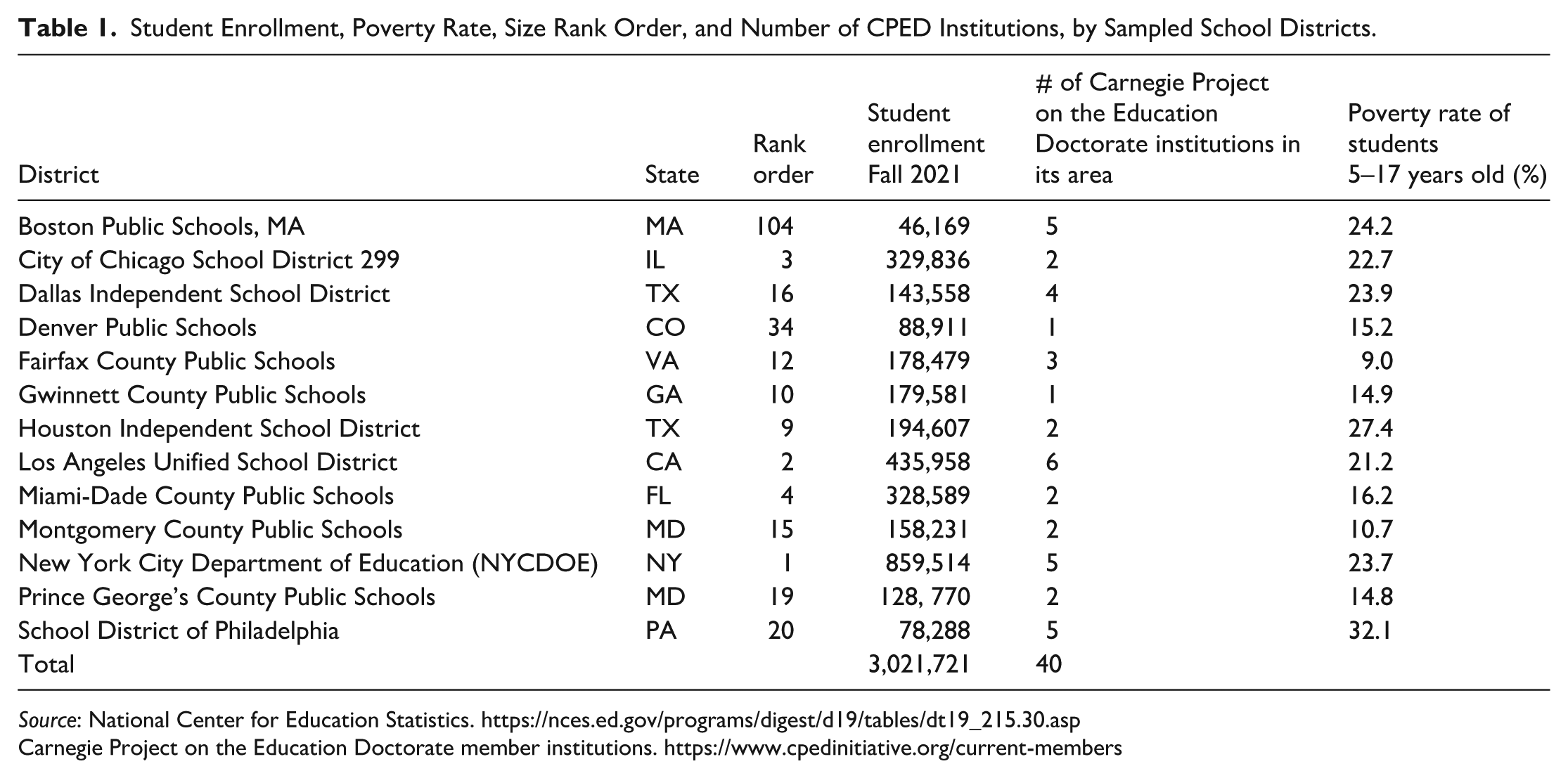
Districts were selected by cross-referencing the list of CPED member institutions with the largest school districts in the U.S. for broad geographic and institutional representation. We also considered district-level poverty rates, in line with CPED’s equity-oriented mission. According to the CPED website, 11 states host CPED member institutions, with California (15), Texas (14), and Florida (8) having the highest numbers. At least one of the largest-enrollment districts was selected from each of these states (see Table 1).
Student Enrollment, Poverty Rate, Size Rank Order, and Number of CPED Institutions, by Sampled School Districts.
Source: National Center for Education Statistics. https://nces.ed.gov/programs/digest/d19/tables/dt19_215.30.asp
Carnegie Project on the Education Doctorate member institutions. https://www.cpedinitiative.org/current-members
The final sample included 13 districts representing all four major U.S. regions, covering nearly all of the top ten largest school districts. To facilitate more regional differences, we selected two large districts that had only one CPED member institution each. The other 11 districts had 2–5 CPED member institutions. Notably, half of the selected districts had poverty rates exceeding 20%, compared to the national average of 11.5%. Only one district, Fairfax, fell below this threshold. Combined, the districts served 3,021,721 students and encompassed 40 CPED institutions.
Data Collection
We collected IRB, research-related, and COI policies from the websites of all 13 districts, focusing on policies relevant to educational leaders using continuous improvement (CI) methodologies for dissertation research, as of the 2023–24 academic year. When district-specific COI policies were unavailable, such as in Boston Public Schools, we supplemented the analysis with state-level policies, including provisions from the Massachusetts charter. We prioritized policies specifically applicable to employees with supervisory responsibilities conducting CI-based DiPs in their own settings.
Drawing on our review of the literature on IRB and COI considerations for practitioner-led research (e.g., Hinnant-Crawford et al., 2024; Perry et al., 2020), we developed an initial set of deductive codes derived from a priori criteria. These included whether districts: (a) had formal research review processes; (b) permitted employees to conduct research in their own settings; and (c) required oversight structures such as alignment with district goals or sponsorship from a local site administrator. These categories were refined iteratively through document review to account for unanticipated variations in policy language. We also examined whether the policies showed explicit support for employee-led DiP research, such as streamlined procedures or accommodations. COI policies were reviewed to identify potential restrictions on research or professional activities and to determine whether educator-specific exceptions were included.
Data Analysis and Trustworthiness
Two researchers—a faculty member and a graduate student—independently reviewed and coded the policy documents. Discrepancies were resolved collaboratively, and the coding rubric was refined iteratively as patterns emerged. The results were summarized in a spreadsheet to identify trends and highlight policy elements that either enabled or constrained educational leaders’ DiP research. We also used heatmapping to visually identify areas of commonality.
To ensure trustworthiness, the study relied on publicly accessible policy documents, promoting transparency while acknowledging the limitation of potentially excluding unpublished or internal policies. Data were independently reviewed and coded by both researchers, with discrepancies resolved through discussion; however, formal inter-rater reliability was not calculated. The analytical criteria were grounded in practical and ethical considerations relevant to practitioner inquiry. Although the geographically and demographically diverse sample of 13 urban districts enhances transferability, findings may not fully generalize to smaller districts or those without CPED affiliations. Additionally, the analysis offers a snapshot of policies in effect during the 2023–24 academic year, which may not capture informal practices or recent changes. Accordingly, this analysis speaks to formal, publicly articulated district policies rather than to how research requests are interpreted, approved, or enacted in practice, which may vary substantially based on leadership discretion, institutional relationships, or contextual pressures. Despite these limitations, the findings provide important insights into the complex terrain of district research and COI policies and lay a foundation for future inquiry.
Findings
An analysis of IRB and research-related policies across 13 large urban districts revealed significant variability in how districts screen and support employees conducting dissertation research. While all districts maintain formal research review processes, their levels of support for practitioner-led or site-based inquiry range from restrictive to highly enabling. These differences reflect variation in policy flexibility, procedural accommodations, and the presence (or absence) of explicit supports for employees engaged in continuous improvement work.
District IRB Review Processes
All 13 districts screened dissertation research requests using a formal district research review process and all required that applicants have their university’s IRB approval, or, for one district, their faculty advisor’s approval (as shown in Table 2). One district requires applicants to provide evidence of an approved dissertation proposal as well.
District Policy on Staff-Conducted Research, by District.
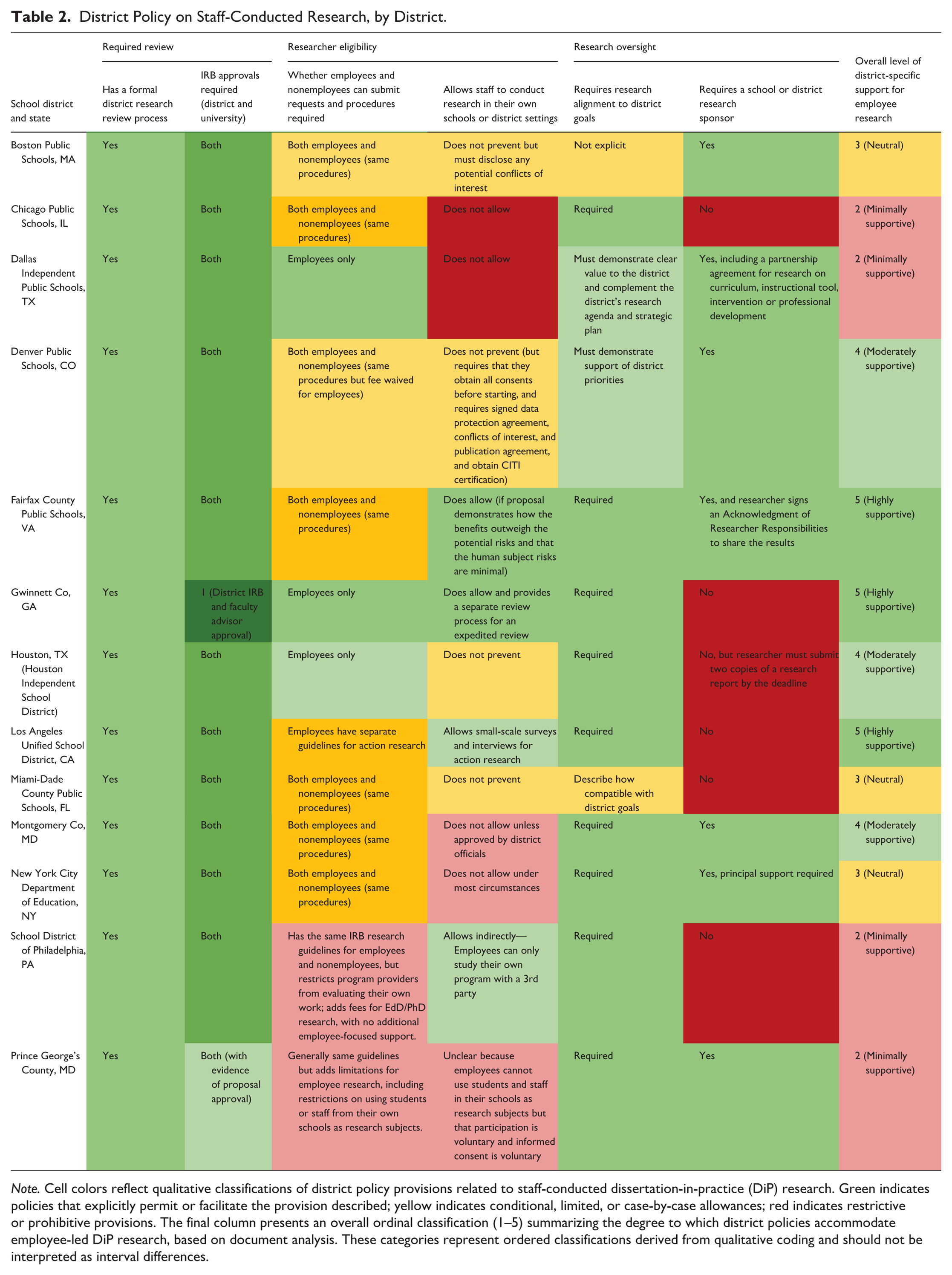
Note. Cell colors reflect qualitative classifications of district policy provisions related to staff-conducted dissertation-in-practice (DiP) research. Green indicates policies that explicitly permit or facilitate the provision described; yellow indicates conditional, limited, or case-by-case allowances; red indicates restrictive or prohibitive provisions. The final column presents an overall ordinal classification (1–5) summarizing the degree to which district policies accommodate employee-led DiP research, based on document analysis. These categories represent ordered classifications derived from qualitative coding and should not be interpreted as interval differences.
Research Eligibility
As shown in Table 2, all 13 districts allow employees to apply for approval to conduct dissertation research; however, three districts restrict approval to employees only, while the remaining ten also accept proposals from nonemployees. But, districts vary in whether they allow employees to conduct research in their own school or district setting. Two districts explicitly prohibit research in the employee’s own setting, while another two generally disallow it with exceptions. Four districts do not clearly address this. For example, Denver permits such research but requires prior participant consent and signed agreements covering data protection, conflicts of interest, and publication. The remaining five districts allow employees to conduct research in their own settings under specific conditions. Fairfax County requires applicants to demonstrate that the research benefits outweigh potential risks and that risks to human subjects are minimal. Gwinnett County facilitates this work by offering an expedited review process. Los Angeles Unified permits small-scale action research projects focused on interviews. Philadelphia allows employees to evaluate their own programs, but the research must be conducted through a third party.
District Alignment
To ensure that proposed research provides value to the district, 11 of the 13 districts explicitly require alignment with district goals (see Table 2). For example, Dallas mandates that research demonstrate clear value, complement the district’s strategic plan, and align with its research agenda. Similarly, Denver requires proposals to support district priorities. In addition, seven districts require applicants to identify a school- or district-level research sponsor or partner. In Dallas, a formal partnership agreement is required for any research involving curriculum, instructional tools, interventions, or professional development. Fairfax County requires researchers to sign an acknowledgment of their responsibilities, emphasizing the ethical obligations associated with conducting research in their professional context.
Variability in Employee Research Guidelines
The 13 districts varied widely in how they support—or restrict—employee-led dissertation research. We categorized them as: a) restrictive districts that impose significant barriers or additional requirements likely to deter employee research; b) moderately supportive districts that include some accommodations but lack tailored processes, and; 3) supportive districts with clear, structured policies designed to facilitate employee-initiated DIPs.
Among the most restrictive districts are Chicago, Dallas, Philadelphia, and Prince George’s County, which have policies that limit research opportunities. These districts only allow employees to conduct dissertation research but provide no additional flexibility or accommodations. Philadelphia imposes further restrictions by prohibiting program providers from evaluating their own work and charging fees for EdD and PhD research reviews, which may disincentivize employee-initiated research. Similarly, Prince George’s County places stringent limits on employees conducting research within their own schools, barring them from using students or staff as subjects without voluntary consent.
Somewhat less restrictive are districts such as Boston, Miami-Dade, and New York City, which treat employees and nonemployees research requests equally, applying the same IRB guidelines. While this eligibility neutrality avoids explicit barriers, it fails to recognize the unique needs of employee researchers. For example, these districts do not explicitly prohibit employees from conducting research in their own settings but do not provide specific accommodations or streamlined processes to support them either.
Moderately supportive districts, including Denver, Houston, and Montgomery County, incorporate some accommodations to ease the research process for employees. Denver stands out for waiving research review board fees for employees, reducing a potential financial barrier. Houston allows only employees to submit research requests, signaling a preference for supporting internal staff research. Montgomery County permits employee research with district-level approval, providing a degree of flexibility but additional administrative oversight.
Finally, the most supportive districts are Fairfax County, Los Angeles Unified, and Gwinnett County, which provide robust support for employee research. These districts demonstrate how tailored guidelines and streamlined processes can enable employees to engage in meaningful practitioner inquiry, particularly DiPs. Specifically, Fairfax County allows employees to conduct research within their own settings, provided that risks are minimal and benefits are clearly articulated. The district also requires employees to sign an acknowledgment of responsibilities, fostering a sense of accountability while ensuring transparency. Los Angeles Unified District, in turn, offers separate guidelines for action research dissertations, coupled with additional review flexibility, making it particularly supportive of employee-led inquiry. Finally, Gwinnett County provides a distinct, expedited review process exclusively for employees, reflecting a strong commitment to facilitating practitioner research.
Conflicts of Interest Policies
Conflict of interest (COI) policies across the 13 districts show broad consistency in emphasizing transparency, ethical oversight, and alignment with institutional priorities (see Table 3). While none of the districts explicitly prohibit employees from engaging in research or professional activities, many include educator-specific exceptions that acknowledge the dual roles of practitioners as both district employees and doctoral researchers. These exceptions often hinge on alignment with district goals and efforts to minimize interference with official duties.
Conflict of Interest Policies by District or Locale.
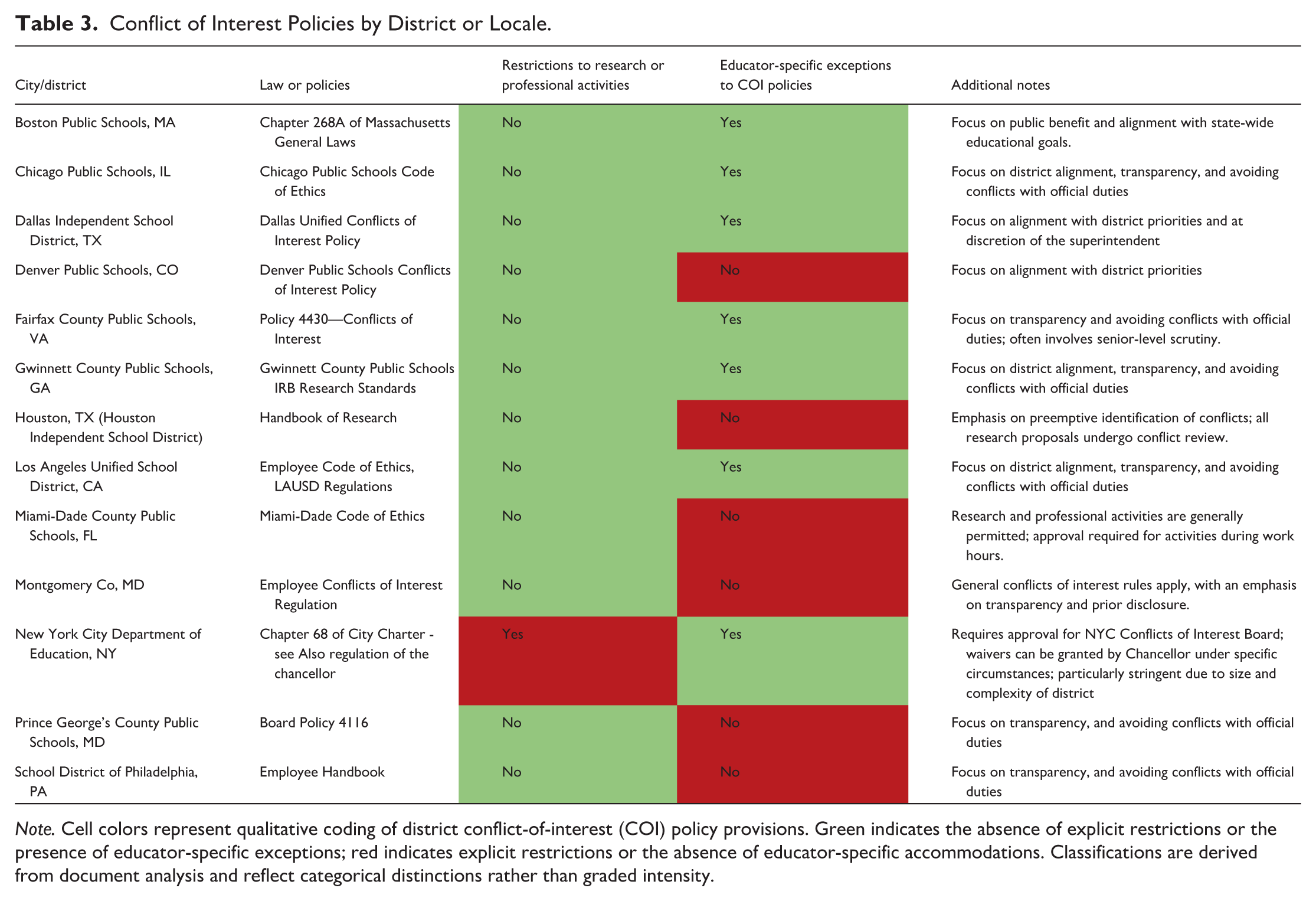
Note. Cell colors represent qualitative coding of district conflict-of-interest (COI) policy provisions. Green indicates the absence of explicit restrictions or the presence of educator-specific exceptions; red indicates explicit restrictions or the absence of educator-specific accommodations. Classifications are derived from document analysis and reflect categorical distinctions rather than graded intensity.
For instance, in districts requiring high-level approvals for COI waivers (e.g., New York City) where the Conflicts of Interest Board must review and approve all such requests, educational leaders pursuing DiPs may encounter delays or uncertainty about whether their project constitutes a conflict. These procedural hurdles can disincentivize practitioner inquiry or discourage leaders from pursuing research questions rooted in their own work contexts. In contrast, some districts have developed clearer pathways for navigating these tensions. Boston and Fairfax County, for example, include explicit carveouts or waivers for educational research that serves the public good or aligns with professional responsibilities. These provisions reflect a recognition that embedded research, when appropriately designed, can both honor COI principles and contribute to district improvement goals.
Other districts, such as Denver, Houston, and Miami-Dade, apply general COI policies without specific accommodations for educator-researchers. While not overtly prohibitive, this lack of clarity may limit the feasibility of practitioner-led research, particularly when role conflicts or approval processes are left ambiguous. Overall, while transparency and institutional alignment remain central across districts, the presence or absence of educator-specific provisions significantly shapes the extent of support for DiP research.
Discussion and Implications
This study highlights significant challenges and inconsistencies in how urban districts review research requests, particularly for educational leaders pursuing CPED-aligned DiPs. While most districts recognize the value of continuous improvement, the lack of uniform policies, especially regarding employee-led DiPs, undermines its potential contribution to addressing critical problems. The ability of employees to conduct research in their own schools or districts for a DiP emerges as a critical determinant of institutional support. It is important to acknowledge that this research is based solely on a web-based policy analysis and does not capture how these policies are interpreted, negotiated, or enacted in practice, which may be more or less restrictive depending on leadership discretion and local context. Notably, the findings do not suggest that districts should uniformly adopt more permissive research policies or that employee-led research necessarily yields greater benefits than risks in all contexts or situations. Rather, the analysis highlights the need for districts to engage in deliberate and transparent decision-making about how they balance ethical oversight, institutional risk, and support for practitioner inquiry. Districts may reasonably prioritize risk mitigation, centralized control, or legal compliance; however, when these priorities are not explicitly articulated, policies may default toward restrictive or ambiguous approaches that unintentionally limit improvement-oriented research.
Focusing on large urban districts also shapes how these findings should be interpreted. In highly centralized systems, research review and conflict of interest policies tend to operate as standardized, formalized mechanisms governing access across many schools and applicants. In smaller or mid-sized districts, by contrast, similar tensions may be negotiated through administrator discretion, informal norms, or relational trust rather than codified policy. As a result, the competing values identified here are best understood as illustrating how institutional logics are formalized and stabilized through policy in large systems, rather than as a comprehensive account of how all districts manage practitioner-led research. Examining how these dynamics unfold in less centralized contexts remains an important direction for future research. Notably, districts such as Fairfax County, Los Angeles Unified, and Gwinnett County provide exemplary models by creating tailored guidelines and expedited review processes for employee researchers. These districts reduce procedural barriers while maintaining ethical safeguards, enabling research in practitioners’ own settings under conditions that address concerns around informed consent and conflicts of interest.
Districts that proactively differentiate policies for employee research strike a better balance between ethical oversight and practical support. These models offer a roadmap for other districts aiming to support continuous improvement without compromising institutional integrity. They also signal a value orientation toward cultivating internal capacity and viewing employee research as an asset, worthy of potential risks.
By contrast, districts with neutral or undifferentiated policies (e.g., Boston, Miami-Dade, New York City) may be limiting the transformative potential of their leaders’ DIP research. These employees must navigate dual accountabilities—to their university and to their employer. They may struggle to meet both sets of expectations and forfeit continuous improvement dissertation research to do so. Such districts reflect a value preference for risk avoidance and institutional protection and appear to rely heavily on a regulatory logic for their policies.
Few districts go beyond procedural ethics to incorporate researcher responsibility frameworks that mitigate harm related to confidentiality or coercion. Denver and Fairfax County stand out for requiring researchers to formally attest to ethical practices. For example, Denver mandates signed agreements covering data protection, COI, and publication, while Fairfax requires applicants to demonstrate that research benefits outweigh potential risks and that human subject risks are minimal.
Conflict of interest policies also shape the landscape of DiPs, albeit more subtly. Districts that provide educator-specific exceptions (e.g., Boston and Fairfax) signal institutional trust in employees’ ability to manage dual roles. These policies clarify expectations, reduce ambiguity, and create enabling conditions for practitioner inquiry. In contrast, rigid COI frameworks—such as those in New York City, where waivers are rare and centralized control is strict—can deter practitioner research and imply mistrust of internal actors. These policy differences reveal deeper institutional assumptions about who is trusted to produce knowledge. Beyond procedural concerns related to approval and consent, district research and conflict of interest policies also shape the conditions under which dissertation in practice findings are produced and interpreted. Educational leaders conducting work-embedded research occupy dual roles as both investigators and organizational actors, which may introduce implicit pressures to frame problems, interpret findings, or represent outcomes in ways that align with institutional expectations, professional evaluations, or dissertation requirements. These dynamics affect not only what research is permitted, but how evidence is generated, interpreted, and communicated. While such risks are not unique to practitioner inquiry, they are intensified in DiPs due to their embedded, improvement-oriented nature and the close coupling of leadership practice and scholarly evaluation. Policies that explicitly acknowledge these tensions and promote transparency, reflexivity, or shared responsibility for interpretation may help mitigate epistemic bias while preserving the benefits of practitioner-led research.
In analyzing these policies using an institutional logics lens, we posit that some districts may have conflicting logics—a developmental one that encourages continuous improvement and staff and organizational development, and a regulatory one focuses on avoiding potential legal consequences—often applied by different units within the same district. When these two logics come into conflict, one may dominate (such as through strict rules against allowing leaders to study their own school practices), unless they are brought into harmony by structuring the policies in ways for employee-led DIP research to benefit the district and manage the risks, even when a conflict of interest exists.
Conclusions
This study highlights substantial variation in how large urban school districts regulate employee-led dissertation in practice (DiP) research, revealing that only a limited number of districts have developed policies that actively support practitioner inquiry. The most facilitative models—exemplified by Fairfax County, Los Angeles Unified, and Gwinnett County—demonstrate how alignment with district priorities, ethical safeguards, and tailored procedures can enable practitioner-scholars to engage in meaningful inquiry. These districts provide clear pathways for employees to conduct research in their own settings, offering expedited reviews, action research guidelines, and accountability structures that protect participants while preserving institutional integrity. In contrast, districts without such accommodations often restrict the scope or feasibility of applied doctoral research, reflecting either explicit or implicit prioritization of institutional risk management over practitioner-led inquiry.
Beyond procedural design, district research policies function as mechanisms of institutional power. While universities retain authority over IRB approval, districts control access to research sites, data, and participants. As a result, district research and conflict of interest policies shape which questions can be pursued, who is authorized to pursue them, and under what conditions. In highly centralized systems, such as New York City, stringent IRB and COI processes may operate as gatekeeping mechanisms that shape both access to research and the perceived credibility of practitioner-generated knowledge, potentially privileging external researchers over internal leaders seeking to study and improve their own communities. These dynamics risk reproducing epistemic hierarchies that undervalue practitioner expertise and constrain the democratization of knowledge.
The equity implications of these patterns warrant careful consideration. Restrictive or ambiguous policies may disproportionately limit the research opportunities of leaders of color, who remain underrepresented in traditional research spaces yet are often deeply embedded in the communities they serve. When practitioner inquiry is constrained, districts may lose opportunities to surface locally grounded insights, challenge deficit narratives, and address inequities through improvement-oriented research.
At the same time, this study does not suggest that all districts should adopt more permissive research policies or that practitioner-led research universally outweighs institutional risks. Rather, the findings underscore the importance of districts making deliberate, transparent choices about how they balance ethical oversight, legal responsibility, and support for internal inquiry. Districts with robust internal research infrastructures may reasonably choose centralized oversight, while districts with fewer internal resources may rely more heavily on university partnerships or external frameworks to support ethical, rigorous practitioner research. Extending this analysis to districts with more limited internal research capacity remains an important direction for future research.
Districts seeking to cultivate practitioner scholarship may benefit from policy approaches that explicitly acknowledge the dual roles of educational leaders as both researchers and organizational actors. Streamlined waiver processes, public benefit exceptions, or “conflict-of-duty” language can help mitigate concerns about coercion or conflicts of interest while preserving the improvement-oriented aims of DiPs. Such policies do more than reduce administrative burden; they signal whether districts view practitioner inquiry as a legitimate source of knowledge and a strategic investment in leadership development.
At the national level, these findings point to the limitations of existing IRB and conflict of interest frameworks for addressing embedded, improvement-focused research. Federal definitions and regulatory guidance often fail to account for the iterative, practice-based nature of practitioner inquiry, increasing the likelihood that DiPs are misclassified, misunderstood, or unnecessarily constrained. Clearer guidance that distinguishes practitioner-led improvement research from traditional generalizable research could reduce institutional friction while strengthening ethical oversight.
Ultimately, enabling educational leaders to study and improve their own contexts is not solely a matter of compliance but one of institutional values. When districts and universities create conditions that recognize practitioner inquiry as rigorous, ethical, and epistemically valuable, they challenge entrenched hierarchies that privilege external expertise over lived experience. Such alignment is essential for advancing the equity-centered aims of leadership preparation and for building research ecosystems responsive to the complex realities of educational practice.
Footnotes

Funding
The authors received no financial support for the research, authorship, and/or publication of this article.
Declaration of Conflicting Interests
The authors declared no potential conflicts of interest with respect to the research, authorship, and/or publication of this article.