







Abstract
In pursuing progress and economic growth, the Bolivian state led by President Evo Morales replicated the colonial division of labor through a development model known as neo-extractivism. Rooted tensions between indigenous communities and the state emerged due to the latter’s zealous economic bond with the extractivist sector. While the political economy of neo-extractivism has been considerably studied, how such tensions affect socio-political relations at the intersections of class, race, and gender remains underexplored and undertheorized. To address this research gap, this qualitative study posed the following research questions: How does neo-extractivism create gendered forms of accumulation by dispossession? And what forms of resistance emerge to challenge the impact of neo-extractivism among indigenous communities? By analyzing processes of social reproduction in Oruro, Bolivia, this study shows that neo-extractivism leads to the dispossession of indigenous lands and indigenous ways of life mainly through the contamination of water. Because indigenous peasant women are subsistence producers and social reproducers whose activities are water centric, the dispossession of water has a direr and gendered effect on them. Indigenous women and their communities, however, are not idle. Resistances against neo-extractivism have emerged. In parallel, the daily responsibilities of social reproduction within the context of subsistence agriculture, which are embedded in Andean epistemes of reciprocity, have allowed indigenous peasant women to build solidarity networks that keep the social fabric within and between communities alive. These solidarity networks provide important socio-political resources that are sites of everyday resistances that represent an ongoing threat and an alternative to capitalist, colonial, and patriarchal mandates.
Introduction
The radical social movements that consolidated Bolivia into an anti-neoliberal vortex at the beginning of the 21st century were galvanized around the notion of water as a common good and not as a commodity, therefore challenging the neoliberal premises of privatization and commodification (Spronk, 2006). These movements also paved the road for the election of Bolivia’s first indigenous president, Evo Morales in 2005. As part of the “pink tide,” a regional shift in Latin America toward progressive socioeconomic policies, Morales came to power with an anticolonial and anticapitalist rhetoric and revolutionary project to transform Bolivia into a just and fair society. In practice however, Morales reinstated an extractivist model of development known as neo-extractivism (Gudynas, 2011). “Neo” because unlike previous extractivist models, the state plays a more prominent role via nationalization, and/or increases in rents and taxes, which allow the state to implement social and redistributive policies (Fabricant, 2015; Gudynas, 2011).
Morales supporters refer to this development model as social extractivism. According to former Vice President Garcia Linera, the contradictions produced by the Bolivian state and its cozy relationship with the extractivist sector must be understood as creative tensions that produce short- and long-term benefits: immediate rents for the state to implement redistributive policies and a revolutionary path to eventually overcome capitalism (Garcia Linera, 2013; Webber, 2017). Critics, however, have demonstrated that although neo-extractivism generates rents that the state might use for progressive programs, it still benefits the private sector, and it continues the colonial division of labor, maintaining Bolivia’s role as a peripheral country that exports its natural resource wealth to core countries (Cusicanqui, 2014; Gudynas, 2011). What’s more, the core of neo-extractivism—the commodification of nature and its detrimental socio-environmental effects—remains unchanged (Fabricant, 2015; Gudynas, 2011; Svampa, 2012).
While the contradictions between neo-extractivism and progressive regimes such as the Morales government have been extensively explored, there is scant research on how such global, structural, and economic changes have affected the lives of women in rural Latin America in the last 15 years (Radcliffe, 2014). In other words, an intersectional and contextualized lens that includes race, class, and gender dynamics as well as its interaction with macro processes is absent. Yet, such a lens has the potential to show the ways in which capitalism intrinsically expands beyond economic relations to heavily produce, and simultaneously be coproduced by, racist, class-based, and patriarchal hierarchies (Cusicanqui, 2010, 2014; Mohanty, 2003).
Addressing these lacunas, existing works such as Van Hoecke (2006) and Deonandan and Dougherty (2016) analyze the gendered division of labor within mining industries and the increased feminization of the mining labor force within the region. The work of Jenkins (2014, 2015) addresses the increased violence against women due to male immigrants’ arrival to work in mines and an increase in domestic violence and alcohol consumption. In parallel, research on indigenous women and neo-extractivism in Latin America tends to focus exclusively on oppression, while giving little to no attention to how women exercise their own agency (Deonandan and Dougherty, 2016, Lahiri-Dutt, 2012; O’Faircheallaigh, 2013a, 2013b). This omission is explained in part by Chandra Mohanty’s criticism of feminist writings and the characterization of Third World women as singular, monolithic subjects and passive victims of global processes (2003).
Tackling this issue, Jenkins (2015) shows how politically active Ecuadorian women use a narrative of a broad connection with Pachamama (Mother Earth) to justify their anti-mining activism. Although this narrative represents an essentialist conception of femininity (caring, nurturing, and life-giving), women use it to perform a strategic role in anti-mining struggles that helps them legitimize their involvement (Jenkins, 2015). In Guatemala, women have a central presence in anti-mining struggles either in numbers (high presence of women) or in their roles, by being at the frontline of protests and by leading road blockades (Deonandan and Dougherty, 2016).
These important works, however, have a blind spot in that they do not explore the particular experiences of indigenous women and how the micro politics of everyday life might also challenge macro processes. To develop an analysis on these underexplored and undertheorized issues, I performed a qualitative study where I posed the following research questions: How does neo-extractivism create gendered forms of dispossessions that lead to accumulation? And what forms of resistance emerge to challenge the impact of neo-extractivism among indigenous communities? To answer these questions, I carried out an ethnographic work in four indigenous peasant communities in Oruro, Bolivia, an area heavily influenced by and affected by mining contamination. Unlike other studies that explore these dynamics within or near production sites (such as within mines or around mining towns), this study focuses on communities that are located far away from mines, but are still affected by their activities. Moreover, unlike Peru and Ecuador where anti-mining movements have intensified, in Bolivia these have not (Perreault, 2014). Nevertheless, anti-mining struggles are expressed through everyday resistances.
Through an analysis of social reproduction theory (SRT) and its connections to water, this study shows how extractive capitalism represents a gendered form of accumulation by dispossession (Harvey, 2003, 2005). In this case study, accumulation by dispossession is covert and indirect, yet it leads to the same outcome: the dispossession of indigenous lands and ways of life via the contamination of waters, which has a direr and gendered effect on indigenous women. This study also examines the everyday sociocultural practices of cooperation and reciprocity of indigenous peasant women within their communities to show that resistance is reproduced every day in these subjugated spaces, representing both a threat and an alternative to the hegemonic necessities of capitalism. By connecting SRT and accumulation by dispossession, I imbricate between production and reproduction processes through an empirical case study to argue that oppression and exploitation are intertwined in covert ways. I also offer an empirical case study from the Global South, specifically Bolivia, of everyday resistances that show how the micro politics of everyday life challenge extractive capitalism and the state.
Conceptualizing extraction and dispossession in Bolivia
This study draws on and integrates three theoretical and conceptual frameworks: the structural mechanisms of the state (Block, 1987), accumulation by dispossession (Harvey, 2003), and SRT (Bhattacharya, 2017). Using the latter as a bridge connecting macro and micro dynamics, this study shows the gendered effects of accumulation by dispossession and offers an explanation on how and why indigenous women resist against state power and extractive industries.
The structural mechanisms of the capitalist state (Block, 1987), such as business confidence, force the state to lean toward capitalists’ interests. At the same time, the state is also conditioned by the appearance of neutrality that it must show to the working class (Block, 1987). Exemplary works by Gudynas (2011), Veltmeyer (2012, 2013), Burchardt and Dietz (2014), Svampa (2015), Acosta (2013, 2015), and Sankey and Munck (2016), among many others, offer a comprehensive and critical analysis of the political economy of neo-extractivism and its relationship to the state. This new wave of extractivist activities were expressed as national development strategies based on economic, social, and political policies adopted by left and left-centered governments in Latin America (Argentina, Brazil, Bolivia, Ecuador, and Venezuela) known as the pink tide over the last decade and a half (Sankey and Munck, 2016). Neo-extractivism relies principally on foreign direct investment and it changes contractual arrangements with transnational investors, raising the royalties and/or taxes payable to the state (Burchardt and Dietz, 2014; Veltmeyer, 2012, 2013).
Nonetheless, independent of political orientation, all Latin American governments have relied on the expansion of the extractivist frontier as a mechanism for development and economic growth, which marks “the commodities consensus,” the beginning of a new economic and political era supported by the international demand for raw materials (Lopez and Vertiz, 2015; Svampa, 2012). In the Bolivian case, neo-extractivism does not support orthodox neoliberal policies. Natural gas and to a lesser extent mining are public-led economic activities. Neo-extractivism also portrays the Bolivian state as a neutral actor that best represents the interests of indigenous communities. In reality, Bolivia represents a case of coincidental economic interests where capital receives profits and the state receives rents (Veltmeyer, 2012, 2013). While Bolivia “has reduced its dependence on foreign direct investment … it is still at a high level” (Higginbottom, 2013: 194). Moreover, in Bolivia (as well as Venezuela and Ecuador), primary products for export during 2010 represented 90% or more of each country’s total exports (Gudynas, 2011).
Progressive and liberal regimes such as the Morales government have allowed extractive capitalism to transform indigenous territories formerly considered unproductive into new terrains for capital accumulation (Lopez Florez, 2013). Harvey (2003) calls these transformations accumulation by dispossession, where primitive accumulation and the violent alienation between labor and land are not the original sins of capitalism, but rather ongoing processes within capitalism at any stage (Harvey, 2003, 2005; Perreault, 2013).
Accumulation by dispossession has been applied in myriad ways in Latin America and elsewhere to show how privatization, financialization, and state redistribution aim to create capital surplus. A considerable number of laws and decrees regarding the distribution of rights over natural resources created in the last decade show that Latin American states, independently of regime type (left, right, center), perpetuate an asymmetrical power relation between the capitalist sector and local communities (Burchardt and Dietz, 2014). In Argentina, the nationalization of YPF (“Fiscal Oilfields” in English) in 2012 was accompanied by a policy to increase the extraction of non-conventional gas and oil reserves (oil shales; Seoane, 2012). In 2009, Ecuadorian progressive President Rafael Correa approved a new mining law that gives international companies more and better access to conduct extraction activities. This same law violates the constitutional right of indigenous people to prior and free consultation that is stipulated by the International Labor Organization Convention (Safransky et al., 2011). In 2015, the Bolivian government issued a series of decrees that opened national parks and other protected areas where many indigenous communities reside and made these lands available for oil and gas exploration (Stirling, 2015). These policies have led to accumulation by dispossession and an increase of foreign direct investment in the region, where “U.S. and European capital today own three times more of Latin America than they did just 15 years ago” (Higginbottom, 2013: 200).
SRT connects these macro and national-level processes of the structural limitations of the state and accumulation by dispossession with the micro politics of everyday life. Social reproduction as a concept refers to the beliefs, attitudes, activities, behaviors, emotions, and relationships that are “directly involved in the maintenance of life on a daily basis, and intergenerationally” (Bhattacharya, 2017: 6). This broad conceptualization captures the various kinds of social, mental, physical, and emotional work necessary to provide the historical, social, and biological means for maintaining and reproducing populations. Social reproduction therefore is a multiplicity of generational activities to provide food, clothes, and shelter for the worker, as well as socialization for children and care for elders (Bhattacharya, 2017).
As a theory, social reproduction examines and criticizes the dichotomous analyses that often study sex and economic class separately, either as social relations of production or social relations of reproduction, but rarely both, therefore obscuring the dialectical relationship between these two oppressive structures (Bhattacharya, 2017; Eisenstein, 1999). Moreover, political economy studies often present labor as if it “has no actual body — no home that actually creates it” (Einsestein, 2014: n.p).
SRT states that the capitalist system is not just relationships between workers and owners, but involves wider social processes that support the drive of accumulation. In other words, capitalism depends on activities external to it, which are nevertheless deeply connected to production processes. SRT therefore stresses the relational link between market and nonmarket relations rather than just pointing to their differences (Bhattacharya, 2017). Second, SRT argues that along with the capacity for labor, workers also have the capacity and need to reproduce life as a whole because, “we are not just reproducers of labor power, we are also reproducers of life” (Bhattacharya, 2017: 130).
SRT has re-emerged as a theoretical and empirical framework to explain various global political economic processes. Bakker and Gill (2003) offer a comprehensive framework of SRT applications as well as methodological implications and gendered migratory processes with case studies from Japan, Argentina, and Brazil. McMichael and Schneider (2011) use SRT to explain power relations behind food security ideals and practices and the role of corporate globalization in undermining national provisions. Analogously, Bhattacharya’s book on SRT is not a critique of, but a critical and indispensable extension of, Marxist theory on social reproduction, offering important analytical tools and case studies that reveal the extent to which capitalism relies on extra-economic relations (2017).
These essential works, however, exclusively examine social reproduction processes within urban settings and/or advanced capitalist societies while ignoring social reproduction processes outside the core of the global North. The lack of attention to capitalistic processes in rural areas in the global South implies the assumed perception of the eventual decline of the peasantry and the takeover of capitalism (Bhattacharya, 2017). In this study, I offer a case study on how social reproduction processes are interlocked to extractive capitalism and how indigenous women challenge them by reproducing alternative systems to capitalism.
An ethnography of neo-extractivism
As part of this study I carried out a multi-sited ethnography between October 2017 and June 2018 in four communities in the department of Oruro, Bolivia, located on the Bolivian Altiplano, an elevated, semi-arid plain between the towering mountains of the Eastern and Western Cordilleras of the Central Andes (Gareca, 2009).
The circular plaza that serves as a welcoming entrance to the department’s capital city of Oruro has an emblematic, 20-ft-diameter miner’s helmet made of tin and burnished metal. In a city full of legends, traditions, and myths, this monument attests to the deep and intricate economic and sociocultural relationship between mining and Orureños (people from Oruro) that has persisted for millennia, before and after the arrival of European colonizers nearly 500 years ago. Oruro’s economy became aggressively mining centric with the discovery of tin in the early 20th century, allowing Bolivian Simon Patiño, the varon del estaño (the baron of tin), to become one of the wealthiest persons in the world (Gareca, 2009). Oruro’s economic dependency on mining, however, has not translated into economic benefits for the majority who live there. While the departments of Oruro and Potosí are Bolivia’s major producers and exporters of minerals, they are also the poorest and have the lowest life expectancies within Bolivia (Gruberg and Andreucci, 2015; Instituto Nacional de Estadistica, 2013).
The Huanuni mine located in Oruro department is the principal tin mine in Bolivia, and it is among the top five tin producers worldwide (Cantoral, 2017). Increased production since the 1980s and a general lack of concern for environment regulations, particularly the lack of tailings dams to process mining acidic waters, have transformed the Huanuni mine into a major contamination source of waters and soils, including heavy metals (lead, arsenic, cadmium, iron, and zinc), chemical waste, and other acid runoff known as copajira (highly acidic, contaminated water; Perreault, 2014). These harsh realities have resulted in the creation of the Desaguadero River, Uru and Poopó Lakes Defense Coordinator (CORIDUP), a grassroots organization that represents more than 80 communities from the Poopó basin. CORIDUP was created in August 2006, and it made national and international news in October 2009 when it mobilized a rally to Bolivia’s capital city of La Paz to demand the approval of Supreme Decree 0335 (SD 0335), which declares the Huanuni sub-basin to be in a state of environmental emergency and mandates environmental remediation projects (Horowitz and Watts, 2016). In spite of all the promises behind its enactment, the impact of SD 0335 has been minimal at best (as of October 2019, the construction of Huanuni’s tailings dam, the main demand of SD 0335, is still incomplete).
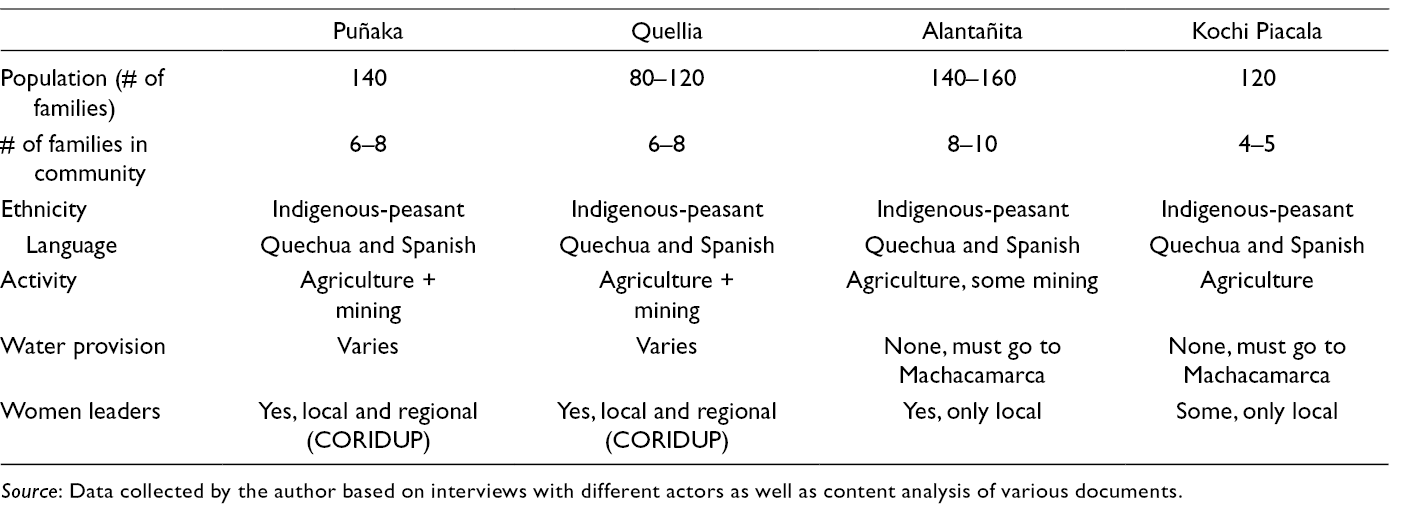
The four communities for this ethnographic study are all involved with CORIDUP as they are each heavily affected by mining contamination. It is important to highlight that none of these communities are in close proximity to the Huanuni mine, which is located over 40 km away, at least an hour and a half by private transportation. The characteristics of these communities are shown in Table 1. The “population” category includes all the families from each community, including those who live there permanently and those families who migrated to nearby cities but keep some connection to their communities: such as owing a parcel of land or holding leadership positions. The “number (#) of families” category lists the number of families who live permanently in each community. None of the participants have access to clean water in their communities or access to public transportation. One must walk to these communities (1–2 hours) from the nearby towns or have some private transportation arrangement.
Characteristics of the communities in this study.
Source: Data collected by the author based on interviews with different actors as well as content analysis of various documents.
Data collection for this qualitative study came from three main resources: (1) 27 semi-structured interviews with community women leaders, key CORIDUP and community actors, representatives of CEPA (a local environmental NGO) and government officials; (2) participant observation; and (3) focus groups with Wasi Pacha and Las Ramonas, two environmental and feminist urban collectives. Table 2 shows the demographic characteristics of the participants: the majority are women (63%) between 25 and 65 years of age. All of the participants from the communities self-identified as indigenous, peasants, and/or indigenous peasants. The concept of “indigenous peasants” used in this study refers to participants’ ethnicity and class: indigenous because all participants were predominantly Quechua and peasants in reference to their social economic class (Perreault, 2014).
Demographic characteristics of participants.
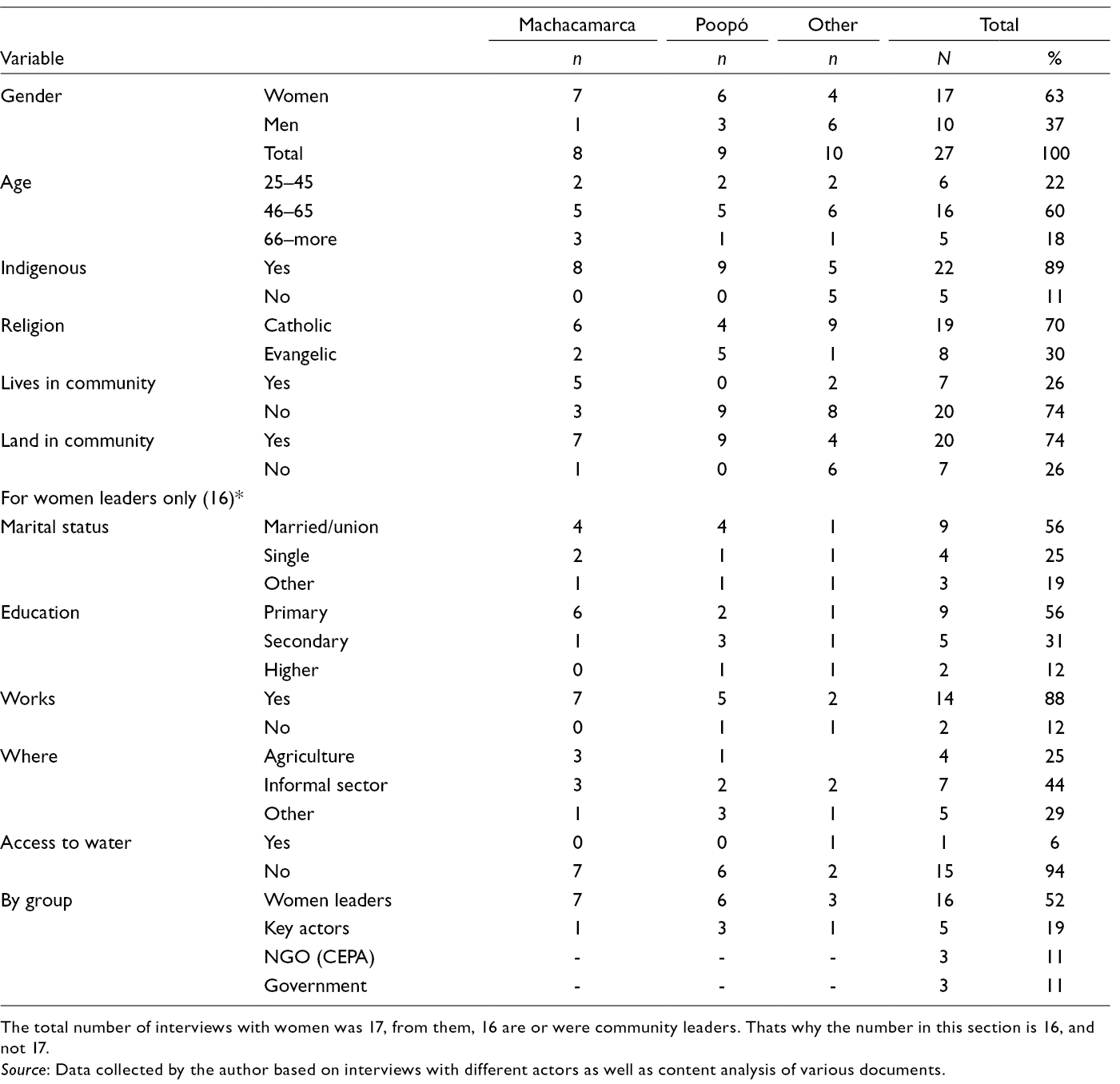
The total number of interviews with women was 17, from them, 16 are or were community leaders. Thats why the number in this section is 16, and not 17.
Source: Data collected by the author based on interviews with different actors as well as content analysis of various documents.
Continuities, disruptions, and connections
“Before I used to support Evo, I thought ‘wow, un campesino como nosotros va a hacer cambios’ [a peasant like us is going to make changes] but nothing, nothing [changed] for me or my community” expressed doña Victoria, 1 49, from Quellia, Poopó. Similarly, doña Elena, 68, CORIDUP leader from the Sorachico Ayllu (indigenous political, territorial, and organizational structure), expressed:
Since the very first moment he [Evo] allowed the miners to work, and now there is no tailings dam ... he says nothing about it, but he also says we have to take care of Pachamama, but I question that. How can we take care of her [Pachamama] with all those mining contaminants? It is impossible … all is the same thing.
The narratives of doña Victoria and doña Elena point to the continuities of neoliberal policies by the Morales government in relation to extractive capitalism. Their perspectives also interconnect with participants’ views that groups that produce for the state, such as miners, received preferential treatment, while they (peasants) are excluded: “One time we directly asked the president [Morales] to support us, and he told us, ‘mining contributes to the state, it pay rents, you don’t’ … Can you believe he told us that? That means whoever contributes [economically] has rights, and we don’t,” denounced don Miguel, 67, former CORIDUP vice president.
Although progressive governments such as Morales’ claim that neo-extractivism has improved the material conditions of indigenous communities, in reality it produces the same, or worse, socio-environmental effects as classical extractivism (Gudynas, 2011; Webber, 2017). These effects, however covert and indirect, lead to the same outcome: a) the dispossession of indigenous lands and ways of life, which is expressed through urban migration and the inability to revitalize rural livelihoods; b) the contamination of waters, which is at the epicenter of these dispossessions and it has worse and gendered effects on indigenous peasant women, as it affects their social reproductive activities. Consequentially, although the Bolivian highlands have not experienced major anti-mining social movements like in Peru and Ecuador, indigenous peasant women constantly engage in everyday resistances, both personal and collective. The following section describes these findings in detail.
Dispossession of lands and indigenous ways of life
Doña Carmen, 73, from the Kochi Piacala community located downstream and far away from the Huanuni mine, stated that mining contamination, “has taken everything away from us, it has affected our lands … before, we used to have seven types of grasses, now nothing.” Comparably, doña Jacinta, 57, from the Alantañita community explained:
Before contamination how did we survive? Only from our crops, sheep and cows, with their milk and cheese, their meat and also their wool, we would have 500 sheep and more than 50 cows, now we only have 50–60 sheep …we can no longer survive. Before everything would be produced here, even the clothes would be from the sheep, now not anymore.
Mining-induced displacement and resettlement (the processes where entire communities are removed to free their lands for mining activities) is often mentioned as the principal way that large-scale mining dispossesses indigenous communities of their territories (Jenkins, 2014). Nevertheless, such direct and overt dispossessions by or near production sites (mines) ignore the spatial scope of extractivism and its footprint (Perreault, 2013). The above testimonies from doña Carmen and doña Jacinta, however, allude to indirect, often invisible, yet parallel forms of dispossessions of indigenous lands and indigenous ways of life.
Moreover, most indigenous peasants in this region have migrated to urban cities in Bolivia and Argentina and participants such as doña Elena, 68, from the Sorachico Ayllu, argued that, “la contamination es siempre el mayor motivo para irnos [contamination is always the main reason for us to leave].” Urban migration, however, is a pattern common in many, if not most, communities in the Bolivian Andes, not just contaminated ones. The decomposition of subsistence agrarian economies in the Altiplano started in the 1970s, reaching its greatest disintegration between 1982 and 1984, and irregular climate processes such as El Niño affected migratory patterns in the Bolivian Andes (Gruberg and Andreucci, 2015; Webber, 2017). Socio-political decisions from the state since the 1950s that have favored agribusiness capitalists via subsidies, while creating biases against peasant economies, have also intensified urban migration (Colque et al., 2015).
While recognizing these macro effects on subsistence agrarian economies across the Altiplano, participants offered the quinoa boom as an exemplar to support their argument of contamination as the main cause for their migration. Doña Mariana, 58, from Alantañita, Machacamarca, shared:
I used to grow quinoa and potatoes … recently I have tried to even grow crops using a tractor, but nothing came out … it is the contamination. They [crops] do not grow completely; the potatoes have growth like little cachinitas [tiny rocks] and all contaminated.
The Altiplano is the traditional and leading quinoa producer of the world: between 2005 and 2013 quinoa production experienced a boom in demand from global North nations, with an increase of 600% in its price (McDonell, 2018). An ignored effect of the quinoa boom is that it created the circumstances for many indigenous peasants to return to their communities, leading to a repopulation and revitalization of indigenous peasant life (Tschopp, 2018). The participants in this study were also traditionally quinoa producers, “here [in Puñaka] we used to grow quinoa … because it is close to the river, we would bring quinoa in trucks” (doña Patricia, 43, Puñaka, Poopó). However, they did not benefit from the quinoa boom and community revitalization because their lands are contaminated and sterile.
In the context of the Bolivian Altiplano, lands are not expropriated for investment capital to take advantage of it as accumulation by dispossession presumes (Perreault, 2013). Instead, they are indirectly expropriated to be wasting sites of the mines. “Somos el dique de cola de Huanuni [we are Huanuni’s mine tailings dam]” was a very common phrase that participants expressed during interviews and meetings. Nevertheless, these passive and covert expropriations still lead to dispossession of lands and indigenous ways of life which are necessary for extractive capitalism to function because its spatial reach (particularly through water flows) demands such dispossessions (Perreault, 2013). This process is not an externality; it is part of a central (although not directly profitable) invisible mechanism for neo-extractivism to function. In other words, not all dispossessions are directly connected to the need for accumulation, although they are part of it.
Water is social life
“Sin agua no hay vida [without water there is no life] … it is really hard to take care of my children, to cook, to wash dishes and my cows suffer a lot too,” stated doña Teresa, 38, from Alantañita, Machacamarca. The Huanuni mine does not have a tailings dam, therefore acidic runoff goes straight to the San Juan de Sora Sora, Santa Fe, and Huanuni rivers, producing constant contamination of surface and underground water (Perreault, 2013). The four communities in this study are located near these rivers and their agricultural lands are, therefore, locations of ongoing accumulation of mining waste, heavy metals, and mining sediments, generating environmental liabilities through increase in toxicity and acidity of the waters (CEPA, 2009; Perreault, 2013). While these effects are widespread, access to clean water, or the lack of it, has a direct, direr and gendered effect on the lives of indigenous peasant women:
It is obvious that we women have the worst part in this contamination because we are the ones who have to find new ways to obtain water to give to our children … we [women] have to be aware of this, that this [contamination] disfavors women; it put us in trouble because we have to face the reality we are living in … We carry water in buckets, and we tell our kids not to wash their faces, we are always on alert (doña Victoria, 49, Quellia, Poopó).
Lack of access to clean water has a twofold effect on indigenous peasant women because they are also subsistence producers. For instance, doña Paula, 69, from the Kochi Piacala community usually wakes up around 5:00 am and her first activity is to bring (contaminated) water from a nearby waterhole (20 min walking distance) that she uses to wash dishes. The clean water she buys from the town of Machacamarca (2-hour walking distance from her house) is for cooking, drinking, and some minor hygiene activities (washing hands and face). She claims, “10 years ago I could still get my animals to drink water from a river there [near her house, about 15 minutes walking].” Now she has to walk approximately 2 or 3 hours in search of less-contaminated water for her animals.
These circumstances represent gendered forms of accumulation by dispossession that a fixation on production often makes invisible. Studies about gender and mining industries, or gender and development, often focus their research on women working within these industries, or on the gendered effects of mines in communities that are in close proximity to them (Lahiri-Dutt, 2012; Owen and Kemp, 2015). Yet, the experiences of indigenous peasant women in this study, seemingly disconnected to mining activities, show an interlocked but inverted link between production and social reproduction. Social reproductive activities such as cooking, grazing animals, and washing clothes among indigenous peasant communities do not create relevant labor power because extractive capitalism is not labor intensive; it is resource intensive. Surplus value does not come from the exploitation of labor (although it still needs workers—miners—to operate) but principally from the exploitation of resources. In the context of these communities, extractive capitalism creates and depends on the absence of their social reproduction: “the well [in my community] is completely salty and bitter, undrinkable, it smells like rotten minerals, so our only option is to migrate to the city, or to another country. If this region was productive, I think people would stay, but it is not” (doña Laura, 52, Caravi community). In other words, through water contamination, extractive capitalism halts all the productive and social reproductive activities of indigenous peasant communities, which further serves to expropriate their territories.
An analysis of water as the epicenter of these issues also elucidates how oppression and accumulation by dispossession are deeply interwoven. Examining hydrosocial relations in the Andes, Perreault (2013) argues that accumulation by dispossession and the collective rights and access to water are too narrowly framed within processes of the market and privatization. Hydrosocial relations in the Bolivian Altiplano are deeply conditioned by mining activities, not by privatization, which produce a codependent and antagonistic relationship between indigenous peasant communities and mining companies. Codependent because both economic activities are water centered and antagonistic because mining must extract the rights of access to water from communities in order to maintain its operations. The Huanuni mine consumes around 28 million liters of water per day (Perreault, 2013). On the other hand, as shown in Table 2, none of the participants in this study has access to clean water in their communities.
In 2014, the Morales government approved the Mining and Metallurgic Law 535 (MML 535), which grants rights and access to water to the mining sector while simultaneously stripping these rights from indigenous peasant communities (Perreault, 2013). This therefore creates an uneven socioecological relation, where water is deeply politicized and transformed:
With the mining law [535], politics have worsened. They [the miners] control all access to the water, they monopolize the rivers, and do not even look at the communities. What has Evo done? Nothing, he has done nothing to protect the peasants. At the same time he flirts with the miners (doña Tamara, 38, Alantañita, Machacamarca).
In this manner, hydrosocial relationships within processes of accumulation by dispossession and in a context of extractive capitalism are racialized, making the indigenous peasants’ ways of life unproductive and irrelevant.
Water and hydrosocial relations also reveal the gendered and patriarchal features of extractive capitalism. It might seem obvious that water is central to all the domestic activities that reproduce life, such as washing clothes, cooking, raising children, and taking care of the elderly. Yet, this taken-for-granted approach obscures the sexual division of labor, which is based on the biological distinction between male and female to create a sexed and gendered hierarchy where roles, activities, and labor are “determined sexually … [it is the] basic mechanism of control for patriarchal culture” (Eisenstein, 1999: 202). Within this hierarchy the determining relations are those of reproduction, not production.
Indigenous peasant communities in the Bolivian Andes are not exempted from the sexual division of labor. Although their cultural philosophies support gender-balanced and egalitarian notions (exemplified in chacha-warmi [male–female], a concept described in detail below) the socio-political organization within rural communities still relies on patriarchal hierarchies. “Men are always machistas, they want women to just take care of children, of the livestock, to be at home while they go to the meetings,” stated done Laura, 52, from the Caravi community. It should not be surprising then that indigenous peasant women are the main caretakers within social reproductive activities. As doña Victoria, 49, from Quellia, Poopó, explained:
We have to be aware of this, that this [contamination] disfavors women. I was talking with my husband and we concluded that women always take the worst part. We carry water in buckets, and we tell our kids not to wash their faces, we are always on alert, because contamination is visible.
Therefore, while neo-extractivism might seem racial and gender neutral, indigenous peasant women are the hardest hit by the erosion of the socio-environmental conditions in their communities.
Everyday resistance
The Bolivian Altiplano has historically harnessed indigenous rebellions and struggles such as those of CORIDUP. These struggles, however, are often expressed not through massive social movements, but rather, through everyday resistances, which Scott (1986) defines as those unexciting but ongoing struggles of the peasantry against those seeking to oppress and exploit them Scott, 1986.
Expanding on Scott’s definition, Vinthagen and Johansson (2013) define everyday resistance as an intersectional and contextual praxis that is historically intertwined to the heterogeneous powers it confronts. Everyday resistance is available to all subalterns, but it is not tied to them as subjects. It is constant and ongoing negotiations that are not whole, some power relations are challenged while others are not, and therefore it is not trapped in a single power relation (Vinthagen and Johansson, 2013). Everyday resistance often emerges within the realms of established power hierarchies, therefore it is both “subordinate and rebellious at the same time” (2013: 37).
In this study, indigenous peasant women engage in everyday resistances through community leadership. From the 16 women I interviewed, 15 held at least one community leadership role in the last 5 years. Doña Ximena, 29, CORIDUP secretary from the Sorachico community, explained:
While we were preparing the food [for the CORIDUP meetings], doña Francisca [a former CORIDUP leader] would also talk to us, she would tell us that we don’t have to be shy and that we have to speak in the meetings about our experiences … she would say “hermanas [sisters], these are our lands, we have to do this thinking about our children, our communities, not just about us” … she would also tell us that we needed to participate in the rallies, that our hermanos [brothers] needed our support.
One of the reasons for a high participation of indigenous women as leaders is the Andean concept and practice of chacha-warmi (male–female), which is based on the notions of duality and complementarity. For leadership positions, chacha-warmi means that communities must have both female and male indigenous leaders. While the extent to which chacha-warmi facilitates gender inclusion is open to question, it has created important, although unequal, spaces for indigenous peasant women to challenge authority and patriarchal power. Doña Patricia, 43, the water monitor from Puñaka, Poopó, shared:
It did not take long before I started arguing with them … with [the] authorities, even the licenciados [the ones with college degrees] … I would argue with them because they think we know nothing, but we do. We have to deal with this [contamination] every day. We also received workshops so we understand better. Before I was not paying attention, I did not think it was that serious, but as a leader I realized it was … I started demanding things, and they were mad that we were not quiet.
Indigenous peasant women were also aware of how intersectionalities of gender, class, and ethnicity placed them at a disadvantage in these struggles. Yet, they asserted their own agency and power:
The first time I went to the Ministry of the Interior, I was scared, I thought “a humble woman like myself here? soy campesina” [I am a peasant], I could not even speak! ... [but] then I started learning. … I learned that a good leader has to push, has to demand things. A good leader has to go to the government and has to speak about the harsh life in our communities. I learn to be a good leader and make demands every day (doña Jacinta, 57, finance secretary of the Alantañita community).
The vivid experience of contamination, combined with knowledge acquired from leadership positions, has allowed indigenous peasant women to exercise everyday resistances through unsubordinated actions, both personal and collective. Whereas experts describe issues in reference to technical understandings, indigenous peasant women such as doña Patricia and doña Jacinta speak from their own experiences, asserting their voices as equally valid. They confront the presumption that only technical knowledge is legitimate, and they defy colonial practices that grant unequal powers to some subjects, particularly males representing the state, to dominate others. By doing this, indigenous peasant women challenge patriarchal and colonial norms that portray their social reproductive and productive spheres as socially and politically irrelevant. As doña Ximena, 29, CORIDUP secretary from the Sorachico community, claimed in a CORIDUP meeting with government officials:
Hermanos y hermanas [brothers and sisters] … I want to share what is happening in our communities, because although I do not have any education, I can declare that contamination is affecting our lives, we can no longer survive, we produce nothing and we are still very poor. How is it possible that you, with all your studies, do not realize this?
Although often perceived as unimportant and oppressive, the gendered spaces of the house, the kitchen, and the markets where women are in charge are also spaces of cooking together, eating together, spaces of sharing stories, and spaces where indigenous peasant women have built solidarity networks that are central in strengthening relationships and the social fabric within and between communities:
Women in general arrange such support networks … it is not a big deal because we are just helping each other … when my mom was alive, her neighbors would come to help her grow potatoes, and then she would help them as well … comunarios [peasants] are like that, we know it is in our own benefit to help others (doña Silvia, 51, Major of Puñaka, Poopó).
Andean socio-cultural practices like Ayni, a socioeconomic system based on the notions of reciprocity, complementarity, and kinship (Ayni Bolivia, 2018; Ravindran, 2015), foster the construction of these solidarity networks. As doña Asunta, the spokesperson for Puñaka, Poopó, states, “we try to live like that, that’s the way we do things … that is Ayni, you know, today for you, tomorrow for me.”
These solidarity networks also provide important socio-political resources and sites for community-based resistance. Meetings are held in the nearby towns of Machacamarca and Poopó, many times occurring late at night to find a location and a time accessible to the majority, including those living in and outside their communities. This means that people must find a place to stay and food to eat, and women from these communities are the ones in charge of helping people with these needs. As doña Silvia, 51, from Puñaka, Poopó, explains, “we [women] always try to help others because we know how hard it is to travel, and especially to make time for the meetings and sometimes to find the money [to travel]”.
These practices of solidarity within the realms of social reproduction and indigenous cosmovisions such as Ayni have a fundamental role in the labor of community reproduction and resistance that is often disregarded and taken for granted. Yet, these practices represent everyday resistances. Although they emerge within the realms of established patriarchal and colonial hierarchies, they are also insubordinate. These solidarity networks and Ayni practices exemplify epistemes antagonistic to these established orders and therefore represent a direct threat to, and an alternative to, the hegemonic necessities of capitalism.
Conclusions
This study refocuses attention onto assumed mundane activities such as washing clothes, cooking, and grazing animals—activities where indigenous peasant women play a central role—to show how social reproduction is intrinsically intertwined with production processes. In this case study, a twisted version emerges where production leads to the un-reproduction of indigenous ways of life. Extractive capitalism depends on the commodification of territories and resources, not the commodification of labor. Indigenous communities therefore are expelled and dispossessed from their lands and ways of life by extractivist forces and the unabashed support of the Bolivian state for the mining sector. This, therefore, is an empirical case study that shows how neo-extractivism, even under a progressive government like Morales, still leads to accumulation by dispossession, specifically, the dispossession of indigenous lands and indigenous ways of life.
At the epicenter of these issues is control over access to water, which connects all of these conflicts. Water is social life—it is central in the reproduction of communities and societies. Water therefore is social and political, and as such, the character of hydrosocial relations and its effects both depend on, and reflect, the power relations behind it. MML 535, where the state grants rights and access to water to the mining sector while simultaneously stripping these rights from indigenous peasant communities, exemplifies the unequal powers in this conflict.
Water also reveals the gendered and patriarchal features of extractive capitalism. Indigenous peasant women are both producers and social reproducers within their communities, and they rely primordially on water-centric activities. Unlike some well-intentioned yet essentialist connections between indigenous women and nature, this study focuses on the socio-material conditions of indigenous peasant women to show that this case study represents a gendered form of accumulation by dispossession. By connecting SRT and accumulation by dispossession, I make an imbrication between production and reproduction processes to show that extractive capitalism is not just about production, exploitation, and the commodification of nature; it is also about reproduction, oppression, and the continuity and exacerbation of colonial and patriarchal mandates that have historically placed indigenous peasant women at the bottom of the hierarchies these mandates create.
Amidst all of the power imbalances that this study addresses, indigenous peasant women and their communities are not idle. They continue organizing against the political and economic forces that oppress them. The individual and collective efforts of indigenous peasant women and CORIDUP are not extraordinary events; they are part of ongoing and historical resistances that have been taking place in the Andes and are part of an emerging wave of eco-social movements referred to as the “eco-territorial turn of social struggles” (Svampa, 2015, quoted from Cusiqanqui, 2016: 65). The direction and potential of these movements are yet to be defined, but resistance is present and ongoing.
Furthermore, the daily duties of indigenous peasant women in production and social reproduction are embedded in the Andean episteme of Ayni, which includes reciprocity, duality, and complementarity, and have allowed indigenous peasant women to build solidarity networks that keep the social fabric within and between communities alive, providing important socio-political resources and sites for everyday resistance. For indigenous peasant women, the personal is political and their unsubordinated actions within their personal and leadership experiences are political efforts to challenge capitalist, colonial, and patriarchal orders. Their unsubordinated actions, however small or mundane, are existing alternatives to these hierarchical, oppressive, and exploitative mandates.
Footnotes
Declaration of Conflicting Interests
The author(s) declared no potential conflicts of interest with respect to the research, authorship, and/or publication of this article.
Funding
The author(s) received no financial support for the research, authorship, and/or publication of this article.
Notes
Author Biography
Gisela V. Rodriguez Fernandez is an Instructor at Portland State University, in Portland, Oregon. She earned a PhD in Sociology and Social Inequality from Portland State University. At the University of Southern Mississippi, she earned a Masters in Public Health and two Bachelor degrees in Anthropology and Music. She is from Bolivia and has previously worked as a research consultant and research fellow for various organizations, including Global Health Corps, and the Inter-American Development Bank. Her research focuses on race and ethnicity, social inequality, intersectionality, political economy, and social change. Her recent and ongoing scholarship aims to change the academic conversations surrounding marginalized communities that reproduce ideologies of victimhood and idleness while ignoring the ongoing struggles for self-determination, agency, and social change among these communities, both in Bolivia and the US Pacific Northwest.