







Abstract

It may not have been a week after the murder of George Floyd at the hands of Minneapolis Police (25 May 2020) and the ensuing international protests before Tucker Carlson and others appeared on their noise machines to sound their alarms about the “criminal mob” destroying businesses and neighborhoods (Grynbaum et al., 2020). By 2 June, Newt Gingrich published an opinion piece on Fox News about “how to stop the mob in 9 steps” (Gingrich, 2020). Evoking faded 1970s headlines of Weathermen bombings, Gingrich trades in nostalgia and panic simultaneously. The next day, Carlson declared, “The ‘revolution’ being waged in the George Floyd mob violence is against the working class” (Carlson, 2020). Right-wing media blustered on about “mob rule” and the slippery slope from “autonomous zones and police-free areas” to “militia and warlord rule in places where governance has broken down” (Anderson, 2020) Agitating, extending separations, steepening slippery slopes, the right-wing propaganda machine leaned on a century of Red and Black conspiracies, and mythic leftist threats to national security.
“Mob rule” was like an ancient warning, of the need for “bloody legislation” to discipline the “lazy rascals” who would ruin civilization. Regarding the Minneapolis marches for Black Lives, on May 29, the US president at the time tweeted, “When the looting starts, the shooting starts … I can’t stand back & watch this happen to a great American City … Either the very weak Radical Left Mayor, Jacob Frey, get his act together and bring the City under control, or I will send in the National Guard and get the job done right.” As if on cue, the president’s call for “control” redramatized brightly lit scenes from our national memory, of DW Griffith’s shoeless Freedmen invoking the necessity of the KKK, of Mayday 8-hour workday strikers beckoning 8 weeks of Chicago police terror, of Galleanist bombers invoking a 50-year repression campaign by JE Hoover, of Sandinistas requiring “the Enterprise” to fund the Contras’ brute squads with Iranian arms sales. The long history of the call to order against mob rule hums with repression, enhanced police violence, and paramilitary red squads and legionnaires. Executive calls for “law and order” to be won by police and military were as dissimulating and insulting to calls from the streets for justice in 2020 as they were in 1968. And, bolstered by the threat, the national security apparatus would peer into letters, listen on lines, disrupt, flip, drug, cut with canines and hoses, and murder to preserve the rule of the status quo (Senate Select Committee to Study Governmental Operations with Respect to Intelligence Activities & Church, 1976). Invoking mob rule most conspicuously underlines its ideological role in the class struggle, the defense of inequality, and the preservation of an unjust social fabric.
In the meantime, last summer, right-wing insurgents were at work kindling confusion and terror in the shadows of this spotlight across the country, making the spotlight seem brighter and more disorienting. “We are now confronting white supremacists, members of organized crime, out-of-state instigators, and possibly even foreign actors to destroy and destabilize our city and our region,” Minneapolis Mayor Frey posted on Twitter on 30 May 2020. Calls for liberation resounded from the president’s personal social media when armed crowds gathered in state capitals to protest the authoritarianism of pandemic mask mandates. And by 6 January, the repressive forces, paramilitaries, white supremacist members of police forces, and military branches assembled as a counter-mob, a vigilante posse to save the country from an imaginary theft. Murdering police, threatening to lynch elected officials, and screeching irrational creeds and conspiracy theories, this mob seized the capital with little resistance and official hesitation.
1.“Mob Rule in Orange”
Light: Pedestrian Zone by Maxpixel.
Shadow: Police beat protesters at 1968 DNC, Chicago. Dennis Brack/UT Austin’s Briscoe Center.
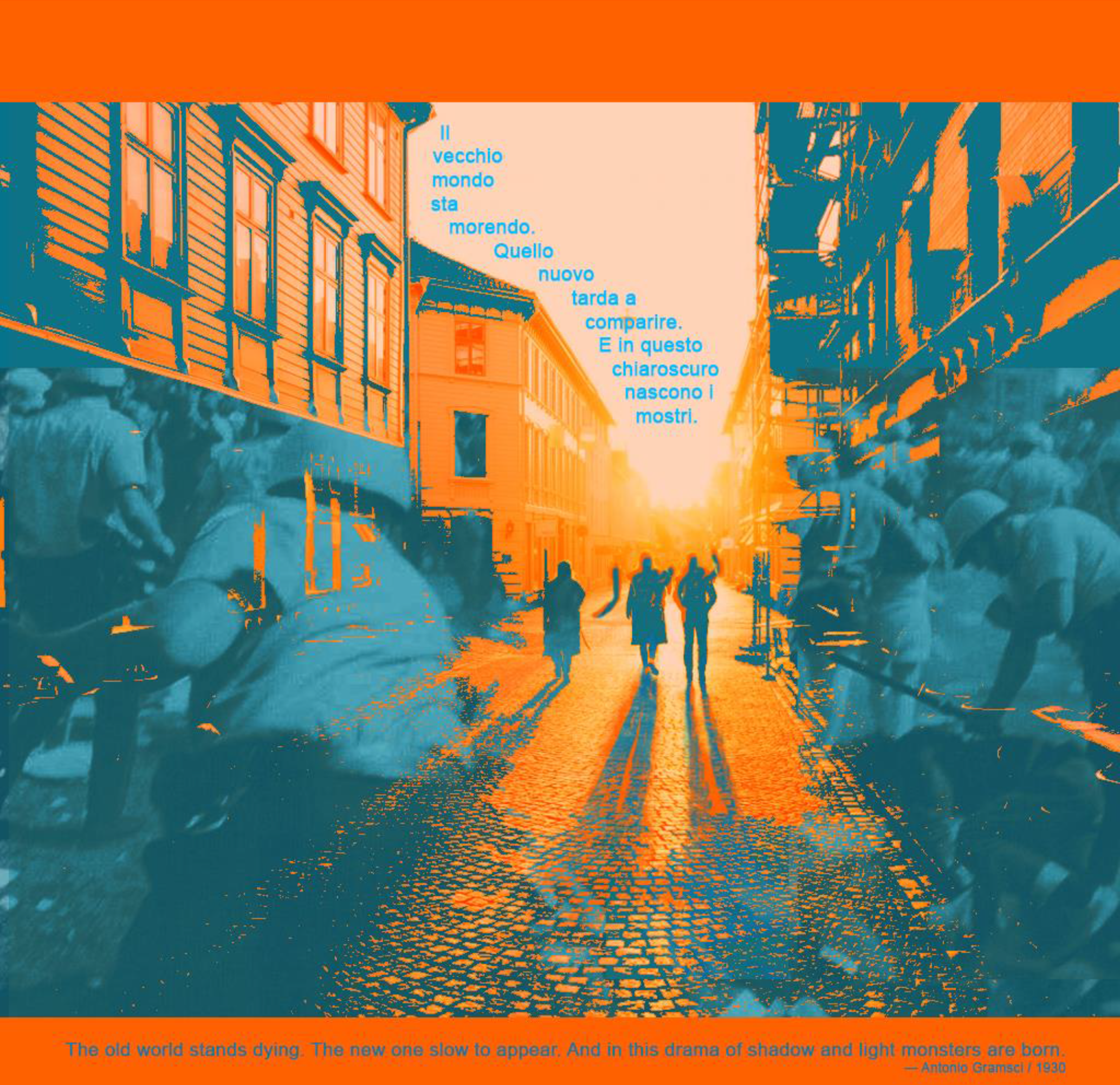
This time the liberals invoked the mob, the terrorism, and the “mob” violence that must be brought under control. Mob rule in this case was represented by the “mob mentality” or the mob mind that, as if through telepathy seized the mass by its primitive capacities for sympathy and imitation, as if each member in the crowd was but “a grain of sand amid other grains of sand, which the wind stirs up at will” (Le Bon, 1897). And what was this wind, which threatened to undo American civilization? It was speech, electronic signals, messages, and verbal incitements that had brought the riotous masses to the capitol, reverberations of Gabriel Tarde’s “contagion without contact” abound or Robert Park’s communicable social pathology (Park, 1972). The media and the president’s words, the headlines seemed to insinuate, had corrupted us and infected our minds. The New York Times sought to make rational sense of the “mob mentality” (Carey, 2021). The USA Today reported that the insurgents were “listening to Trump” (Yancey-Bragg, 2021). And psychology scholars and professionals opined that “When someone as powerful as the president tells a large group of his supporters to ‘fight like hell’, they will listen to him and feed off each other” (Sanderson, 2021). The pathological crowd, the incited rioters, and the charismatic leader; if these are familiar exclamations it is because they have been used to suppress the free speech of the Black freedom movement, antiwar movement, and most noteworthy with its Hollywood dramatization, the Chicago 8.
The inclusion of an “anti-riot act” within the Civil Rights Act of 1968 contained specific language about inciting riots was used to charge leadership of large New Left organizations with federal crimes and was a tactic to suppress civil rights and antiwar movements (Stalmack, 1973). After the violent 2017 Charlottesville “Unite the Right Rally,” in which white supremacist groups featured prominently, the 1968 “riot act” was challenged in court by one of those right-wing defendants, Michael Miselis (United States v. Miselis, 2020). The courts determined—as they could have decades before—that key portions of the law were dangerously broad and infringed on the First Amendment.
2.“Mob Rule, Selfie”
Light: “petit selfie devant un coucher de soleil” by didier.camus.
Shadow: Capitol, 6 January 2021. By Blink O'fanaye.
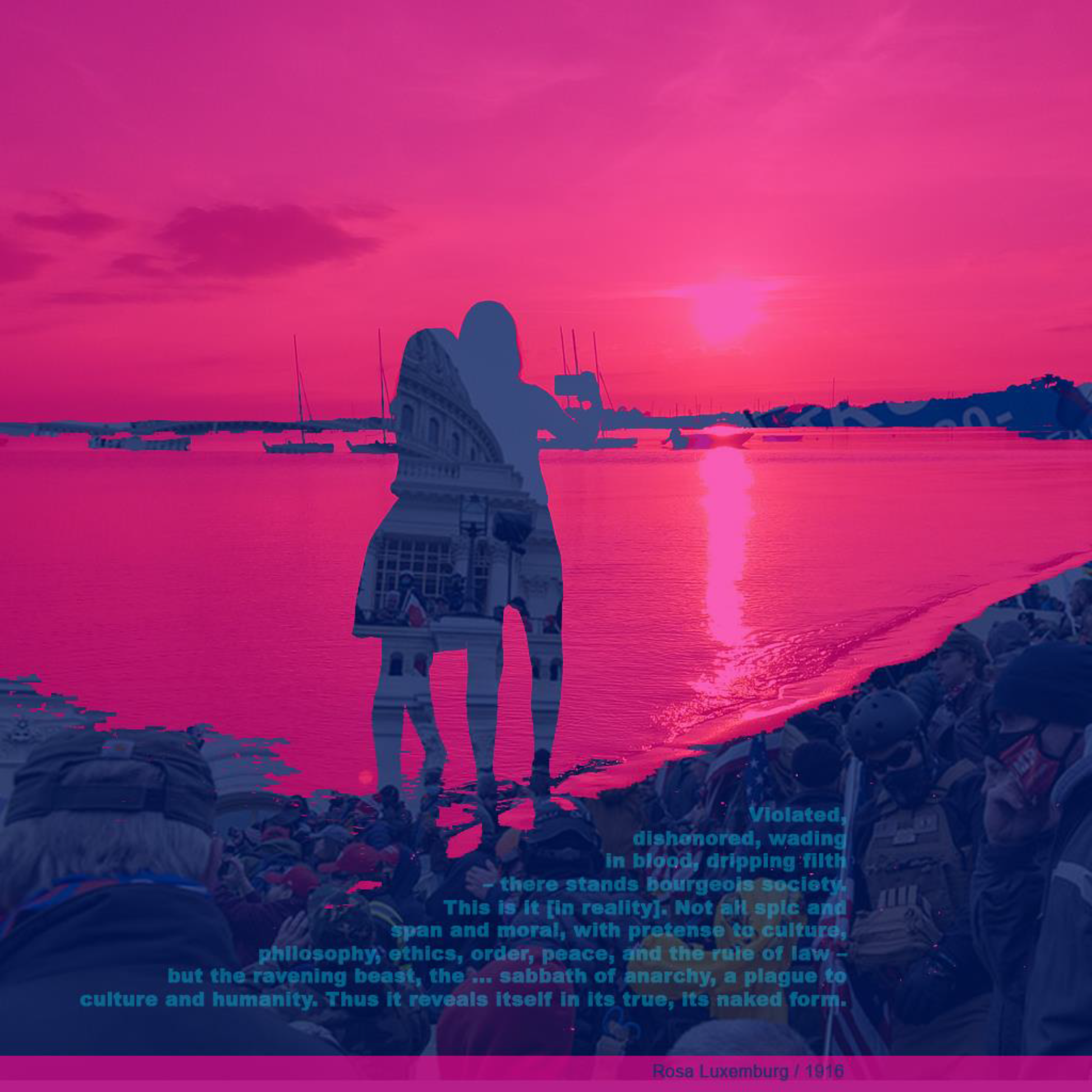
Mob rule is not an infection, communicated by speech. It is an organization, a regime, a corollary to class power and civilization. Members of mobs are not blown by the wind but labored on, reasoned with, threatened, and nurtured (Baecker, 2013; Han, 2017). To remark on or recoil from the violence of “the mob,” as the liberals do, is to convey an almost willful neglect of the breeze that blows ubiquitously around us and worse to assume that all breezes blow in the same direction. If the mob is an aggregate of self-motivations and acts of self-interest, rather than mesmerism and magic bullets, then what the mob stands for is the terrain of struggle and the object of judgement. And the decisive battleground is the geographical definition of self-interests. The white supremacist, anti-“globalist”, neo-Nazi, and anti-“Commie” insurgency—keenly aware of the dying old world—seeks to sow fear of the mob as its strategy to keep the old world in place. The liberals, wishing for order to return without acknowledging the ubiquitous war for inequality at its core, will accomplish those goals for them—as they seem prone to do—by creating new antiterror laws, new executive power against political dissent, and limiting political speech.
3.“Mob Rule, Carousel”
Light: Couple Downtown, By Milivojevic.
Shadow: George Floyd protests in Washington DC. H St. Lafayette Square. 30 May 2020, 21:32:36. Rosa Pineda.
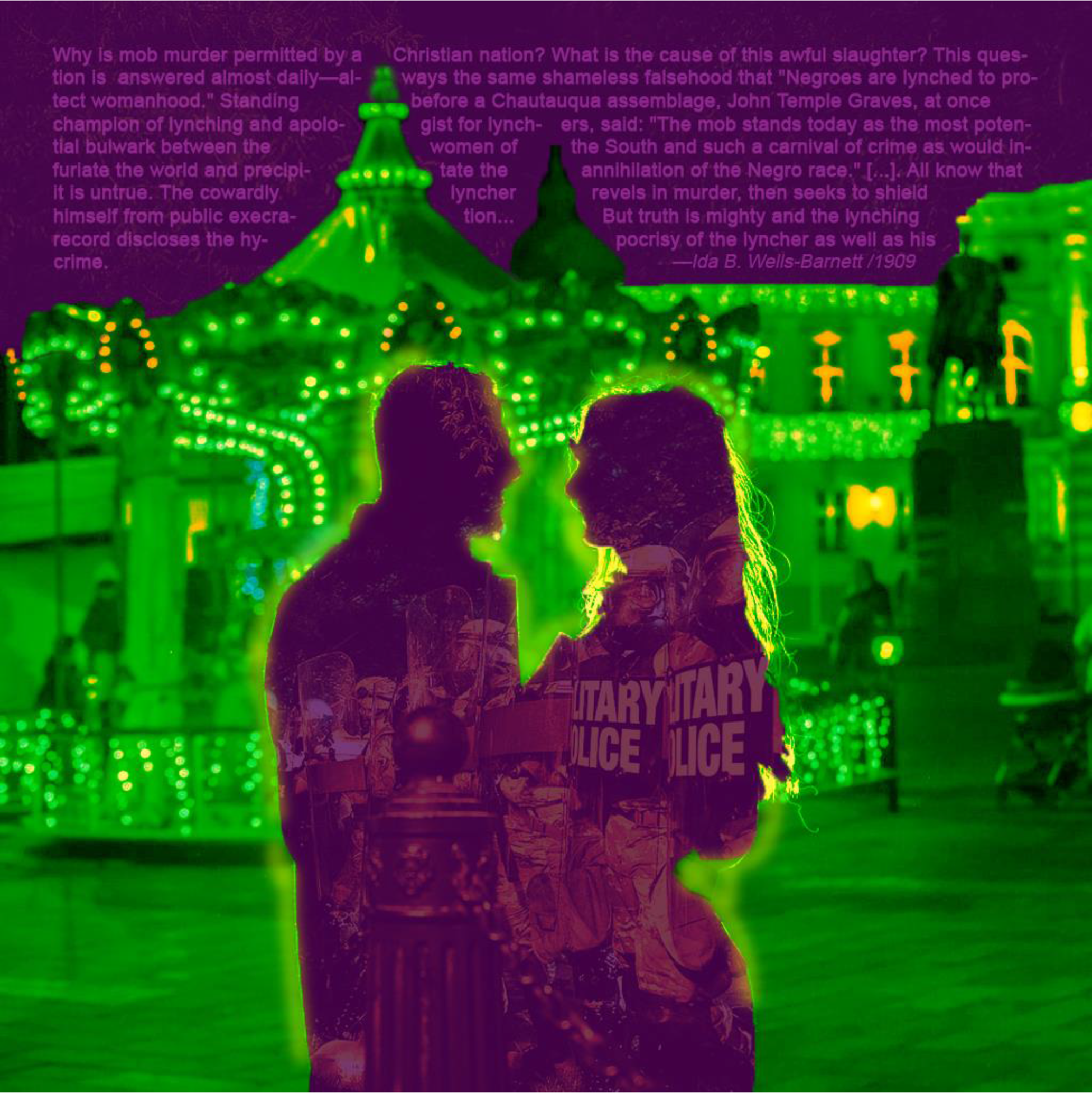
The three pieces that follow contemplate the brutal hypocrisy of bourgeois order, peace, rights, and so on. They shine a light on moments of tranquility, order, and romance. And, they attempt to make the omnipresent violence of police seething in the background of poor, Black, and dissident lives blend into the shadows as pleasing to the eye as possible. The inscribed quotes make what is already heavy handed, publicity-like.