







Abstract
This is the story of how I encountered Marxism and how I have used it to make sense of the world, and hence to inform my political activism. I describe how humanist materialism has helped me interrogate social structures so as to discover underlying interacting forces and the role played by human praxis and understandings. On the way, I examine debates about the researcher as outsider; criticisms of political multiculturalism; difficulties of being a Marxist after the cultural turn when many academics will no longer even engage with Marxist arguments; problems in writing about and working with Islamists; struggles to excavate housing studies from being buried in policy detail; uncomfortable truths about immigration and the reserve army of labour; and warnings from the failure of revolutionary stages theory. I end with lessons from the Kurdish freedom movement on human relationships and bottom-up democracy, and with its inspirational example of a society attempting to live as if in the early days of a better world.
Some are born Marxists, some achieve Marxism, and some have Marxism thrust upon them. Perhaps we all start off as Marxists of a kind, until we have our sense of logic and fairness systematically ‘civilised’ out of us, and we are moulded to live in a world where questions about the absence of logic and fairness can be met with ‘just because…’ I achieved my own rebirth as a Marxist relatively late, though not quite as late as my reinvention as a geographer. As a student, my passion for historic architecture and my love of 19th-century novels led me to dream of the world of Jane Austen, rather than visions of Karl Marx. But the same old fashioned small ‘c’ conservative upbringing that had taught me to dismiss all revolutionary ideas as dangerously naïve, also gave me a traditional sense of service to society. This sense of service provided the ground for my later activism to take root.
By the time I encountered Marx as a thinker whose ideas had relevance to us today, I had moved some way leftwards – I joined the Labour Party on the day I was made redundant in 1990 – but I was still comfortably within the political mainstream. I lived in Cambridge, and, for my own interest, I used to attend Indian history seminars. There I met Tony Cox, who was doing a PhD on the Calcutta jute industry. Tony introduced me to the meaning of Marxism both in academic understanding and in political practice. It was as though I had been given an opportunity to engage with ideas that had once been out of bounds and, after an initial hesitation, I dived into this new world.
It all made so much sense. I was discovering a tool that enabled me to understand what I was observing. It allowed me to look below surface narratives to see the structures that were constraining our possibilities and the processes that created those structures. I began to question the assumptions that came with my class position. I learnt not only that most people found it distinctly feudal that only college fellows could walk on Cambridge grass, but that I needed to look again at all the understandings that underpinned my world, including such comfortable notions as meritocracy, liberal democracy, and the goodness of charity.
I was helped in this by another part of my upbringing. I not only specialised in science at school but was also encouraged by my scientific father to understand the proofs and evidence for what we were taught, and not to take anything on trust. Now, I was transferring that habit of enquiry into the social world. I was beginning to become a critical social scientist.
My tangential engagement with the academic world around me had made me crave the opportunity to do research of my own. Much to my and everyone else’s amazement, at about the same time as I began to get to know Marx, I secured a grant to do a PhD in the Department of Geography at University College London. The subject of my thesis was the political mobilisation of immigrants in the East End of London, looking at the Jewish immigrants of the late 19th and early 20th centuries and the Bengali immigrants more recently.
My research took place in parallel with my own political mobilisation, and although the circumstances and location were different, the insight that my own experiences gave me into the dynamics of political movements was invaluable. These included experiences of intergroup rivalries and their toxic mix of political and personal differences, which I was seeing first-hand at the same time as writing about the tensions between Jewish anarchists and socialists at the end of the 19th century. But there were all sorts of more positive and practical things that I was able to understand too.
As new research students, our training sessions included a crash course in geographical theory. The only thing I remember from the classes on Marxism was a fellow student, from the United States, telling us that when she heard that word she felt a shiver going down her spine. I am often reminded of this image when I see American responses to world events. I also remember us all being asked why we were doing a PhD and – when I responded that I wanted to use my knowledge to inform my social action – being told that this was a Marxist approach. To me it was simply common sense.
When I had my first tentative encounter with social science through an Open University course, I had felt as though cogs were turning in my head that had never moved before. Now those cogs were lining up. As a Marxist in the age of post-modernism, I soon found that I had to be especially rigorous in my arguments and that Marxism gave me the tools to do that. I quickly learnt how to argue that no observer is neutral and that Marxist enquiry enables reflexive questioning as we move towards greater understanding. I fed off Marxist arguments that were able to cut through the undergrowth and throw light on the structures and processes below. While I found I was increasingly critical of mainstream ideas, I also discovered how to articulate those criticisms, and that this could lead me to new understandings.
I learned how the Marxist emphasis on process and change encourages an empirical approach based on experience of the real world, and how this could help me begin to untangle the complexities of existing societies without falling into the trap of reductionist empiricism. I found myself using and combining a mix of different research methods, but the underlying pattern was always that of Marxist scientific rationalism, whose materialist basis was explained by Engels (1962) in Anti-Dühring:
…the principles are not the starting-point of the investigation, but its final result; they are not applied to nature and human history, but abstracted from them; it is not nature and the realm of humanity which conform to these principles, but the principles are only valid in so far as they are in conformity with nature and history.
In looking at the forces acting on and in evolving societies, I learned to take a humanist approach. I attempted to look holistically at society as it is lived and as it develops through history, and not to recognise those forces as a science apart from human influence, but to examine the real effects of human praxis and of the theoretical understandings developed by human society.
While I revelled in the intellectual stimulation that came with a growing understanding of social processes, I tried to feed these understandings back into action, both directly and through dissemination of my ideas. And, of course, my practical experience as an activist informed my theoretical understanding. I was learning how to make connections between all the many different things I read and experienced, in order to build and rebuild my understanding of the world, and to re-evaluate my political practice.
I started my PhD in the late 1990s, so there was much debate over whether it was legitimate for someone to write about an ethnic community of which they were not a member. As my research compared two different communities, I had an additional argument against this siloisation of scholarship, but I also argued, as a Marxist, against both the simplistic prioritisation of ethnic identity (and the suggestion that a middle-class person could understand a working class person’s experience just because they shared the same ethnicity), and the hugely restricting idea that only those with lived experience of an ethnic group – or anything else – should be entitled to comment on it. I fully understood the impossibility of attaining true objectivity, and the need to acknowledge my own position, but I didn’t see that as absolving me from the duty to do the best I could to work towards an understanding of what was happening in other parts of society, not just my own little corner. As an outsider, you always have to ask questions and, while there are many things you may miss, there are others you will notice that a member of the group you are studying might just take for granted. We can all draw lessons from personal experience – in my case from my experience as a political activist – but these are just one of the many different forms of evidence that we bring together in our attempt to construct an understanding and interpretation of the society that we are looking at.
This argument about personal identity was to provide my first lesson in the practical difficulties of keeping to a Marxist line after academia’s ‘cultural turn’. I had suggested to a friend that we organise a conference for PhD researchers who were studying the Bengalis, and he invited some other researchers to join us. One of them claimed that the conference opening should be done by a Bengali, which in the circumstances could only mean her. When I argued that what mattered was what was said rather than who said it, I was accused of racism. Communication via a poor email connection compounded misunderstandings. I ended up being excluded from my own conference.
Just this spring, I received confirmation that, within parts of the East End Bengali community at least, my outsider status is not perceived as a problem. I was pleased to be asked to give a public talk as part of the fiftieth-year commemorations of Bangladeshi Independence organised by Tower Hamlets Local History Library. And I was also pleased to be contacted afterwards by one of the people who attended, who especially welcomed the fact that I hadn’t felt the need to promote any of the Bangladeshi political parties – as so many Bengalis are wont to do – and also that I had discussed the role of Bengali left groups, which have tended to be written out of the history, just as they were excluded from the development of the independent nation.
The main position of my PhD was a Marxist critique of political multiculturalism (Glynn, 2010). I was not, of course, arguing against the practice and enjoyment of cultural difference. My concerns were over political organisation based on ethnic group, which can lead to competition for resources within the existing system rather than a united struggle to change the structures of society. I included criticism of the impacts of the Communist Party promotion of stages theory – the idea that socialist revolution should be seen as separate from, and following after, a previous bourgeois revolution – as well as of the post-modern emphasis on personal identity, which, even decades on, still presents itself as the avant-garde.
I was not expecting this view to be popular. What I hadn’t anticipated was the extent to which it would simply be ignored. I had thought I would have to argue my case, but there was no one to have that argument with. I published articles, and eventually a book (Glynn, 2014), although, as others whose views don’t conform to mainstream trends will testify, this was not always easy. As each piece was launched, I hoped for more of a response, but apart from the support of a few fellow travellers, my writing seemed to disappear as if into the open sea.
It wasn’t as if the subjects on which I wrote were unimportant. 9/11 took place in the middle of my research, and a large part of my writing looks at and analyses the growth of Islamism. (When I first wrote about Islamism, I had to explain the term, which is now part of the vocabulary of every tabloid journalist.) I argued that this growth had been made possible by the decline – indeed the deliberate decimation – of the left, which had taken away hopes of attaining a better life on this earth, so creating a vacuum in which political religion could take root. And I showed how the Islamist organisations that were attracting young Bengalis in the East End of London adopted similar forms of organisation – and even similar rhetoric – to the left-wing organisations that had operated there before the Second World War. I also showed how liberal multiculturalism was working to boost these well-organised Islamist groups by giving them official recognition as community representatives. I never expected that the government organisations that were professing so much concern about the growth of Islamic radicalism would embrace my ideas and encourage the growth of left-wing radicalism instead. I was, though, disappointed to find that practically the only public acknowledgement of my discussion about competition for support between the left and Islamists came from the Islamist side.
How to write about and work with Islamists has become a problematic issue for many on the left. There is an unthinking tendency to resist criticising regimes that are opposed to western imperialism, however problematic they may be in themselves – and a related tendency to be uncritically welcoming of everything to do with Islam, in reaction to right-wing Islamophobia. (As for every religion, believers can find in Islam support for positive actions or for negative ones.) There rarely seems space or time to articulate the case for resisting the oppression of Muslims and for protecting religious freedom, while still arguing against dependence on religious belief and against reactionary religious practices. Here, I have found Bolshevik debates from a century ago to be much more considered than most of the arguments taking place today. We shouldn’t allow fear of offending believers to make us censor or self-censor every criticism of religion, nor should we support restrictions on religious practice, except for instances when these can hurt others, such as some of the traditional controls on women.
This is an area that has produced calls for restrictive laws from all sides: Laws aimed at protecting minorities from prejudice, and laws aimed at preventing Islamic ‘radicalisation’. Most of these laws are problematic, attempting to control behaviour without addressing fundamental structures. Such laws can be counterproductive and are also used to restrict the speech and actions of everyone who opposes authority, including the left. As Marxists, we have the tools to understand the growth of prejudice and the reasons why people seek resolution though violent ‘jihad’; and we need to resist the illusion of solutions through legal bans, even when this puts us on the same side, in this particular argument, as the far-right libertarians.
After I had finished my PhD, I moved to Dundee, in Scotland. There, in response to the urgent needs of the time, I soon became involved in housing campaigns, working first with tenants who were fighting the semi-privatisation of their homes, which the government wanted to transfer from local authority ownership to housing associations, and then with tenants fighting mass demolitions.
Again, I was very much an outsider – neither local nor a tenant – and this time I was playing a leading practical role, not simply writing about the actions of others. However, I was enabling local tenants to be heard, and my outside position was never a problem. Whenever I have had doubts about an ‘outsider’ position, I have found it reassuring to remember – without attempting to suggest that my efforts could otherwise be compared to theirs in any way – that Marx and Engels were hardly members of the English working class. When I got my first academic post, partly on the back of the work I had done with the tenants, I was afraid that they would feel exploited; but I think that they recognised that ours was a symbiotic relationship, and that, now that my activism had become ‘participant action research’, I had more opportunity to investigate their situation to the full and address the forces behind it.
What my political engagement and academic research enabled me to understand, was how what was happening to the folk in the Dundee ‘multis’ and Glasgow ‘high flats’ was part of a wholesale privatisation and regressive clawing back of wealth that was taking place throughout the neoliberalised world (Glynn, 2009). The analysis of writers such as David Harvey, Jamie Peck, and Neil Smith helped me to see how the actions of the local bureaucrats and councillors – most of whom probably genuinely believed that they were serving the community – were contributing to this massive economic realignment.
In the area of housing studies, the biggest impact of the ‘cultural turn’ has probably been neglect of a subject that is deemed old fashioned and merely technical. Here, the main arguments Marxists find themselves up against are from people who have been swayed by the political excuses used for dismantling social housing, and who often believe, like the bureaucrats, that there is no alternative. Numerous articles chart what is happening as though the forces behind it were outwith human control, like the weather, or examine only limited options while accepting the broad neoliberal drift. Some of the latter kind are actually commissioned by the authorities involved – and this is encouraged both by demands to bring in external funding and by pressure to prove research ‘relevant’. For the tenants, of course, my research was highly relevant – and a Marxist interpretation made obvious sense.
In this more overtly economics-related area, it was easier to be part of the debate, and I felt that some of those putting forward more compliant views quite welcomed the fact that others were pushing out the boundaries to their left. We didn’t manage to save the homes of the tenants who we were campaigning with, but we did help people more generally question what was happening. There have been relatively few large-scale demolitions in recent years, though I suspect that we also have to credit the economic crash for that.
The economic crash also destroyed my plans to return to my earlier work as an architect, and in a period of unemployment I began an involvement with campaigns for better treatment of the unemployed that was to take up a large part of my time for the next eight years. Like the Communist Party-run National Unemployed Workers’ Movement (NUWM) that I had looked at when researching the 1930s, we aimed at combining grassroots work outside the jobcentres with campaigns both for immediate reforms and for fundamental structural change – though we could never pretend that we were a mass movement, as the NUWM had been. Central to this campaigning was analysis of what was happening, both on our blog and through a book of our experiences.
An honest Marxist analysis of employment and unemployment cannot avoid acknowledging the impact of immigration on the reserve army of labour, and therefore on workers’ ability to demand better wages and conditions. To pretend otherwise is an insult to the workers affected and serves only to discredit the person who is making that pretence. Claiming that problems do not exist does not make them go away, and without a proper understanding of what is happening it is difficult to improve conditions for anybody. My blog on the lack of local recruitment for strawberry picking was careful to focus on the structural problems of the system and the role of the big food retailers, but that did not prevent some leftists we had been working with from declaring me xenophobic for raising this issue. It is not easy being a Marxist.
Like most, though not all, Scottish leftists, I also played an active part in campaigning for Scottish independence. It wasn’t difficult to make the progressive case for more local control, for breaking up the last bastions of British imperial power, and for escaping from endless Tory governments to set up an alternative, which would also act as a driver for change south of the border. Almost everyone in the YES camp believed that an independent Scotland would not be Tory, but, for Marxists, and indeed anyone on the left, the task was to try and make sure that we aimed higher than that. I tried to use historical example – and specifically the history I had studied of the impact of revolutionary stages theory in Bangladesh – to warn people of the need to make our more radical demands an integral part of our campaign, and not allow them to be side-lined to after independence and then dismissed.
Today, I work with the Kurdish freedom movement, which follows the ideas of Abdullah Öcalan. But that doesn’t mean that I have abandoned my Marxism, or my Marxist criticisms of Öcalan’s downplaying of economic structures and too-ready linking of Marxism with the Soviet Union. That there is room for even awkward Marxists within the movement was made abundantly clear by the most recent English translation of Öcalan’s prison writings (Öcalan, 2020). This was published with an introduction by John Holloway, who expresses his criticisms at the same time as giving his appreciation of the importance of Öcalan’s work.
I am also aware that working with an ethnic movement might seem to contradict the arguments against political multiculturalism that I made in my PhD and book, and also in an article in this journal (Glynn, 2010). I have been open about my worries that some of the pragmatic methods being used to ensure involvement of all the different ethnic groups in the development and governance of the Autonomous Administration of North and East Syria are similar to the theories I have criticised that were put forward by the Austrian Marxists at the beginning of last century under the heading of National-Cultural Autonomy. But I also admit that being with people who have faced such a brutal and persistent attempt to annihilate their culture has given me a greater understanding of culture’s vital importance. I have witnessed the dignity and strength the movement has brought to people’s lives by enabling them to value and defend their heritage. This political struggle is expressly directed at freedom for all different cultures, not just for Kurds and Kurdishness. In a way, it has made the acceptance of cultural heterodoxy a part of Kurdishness. And, yes, I have been made very welcome as an outsider (Figure 1).
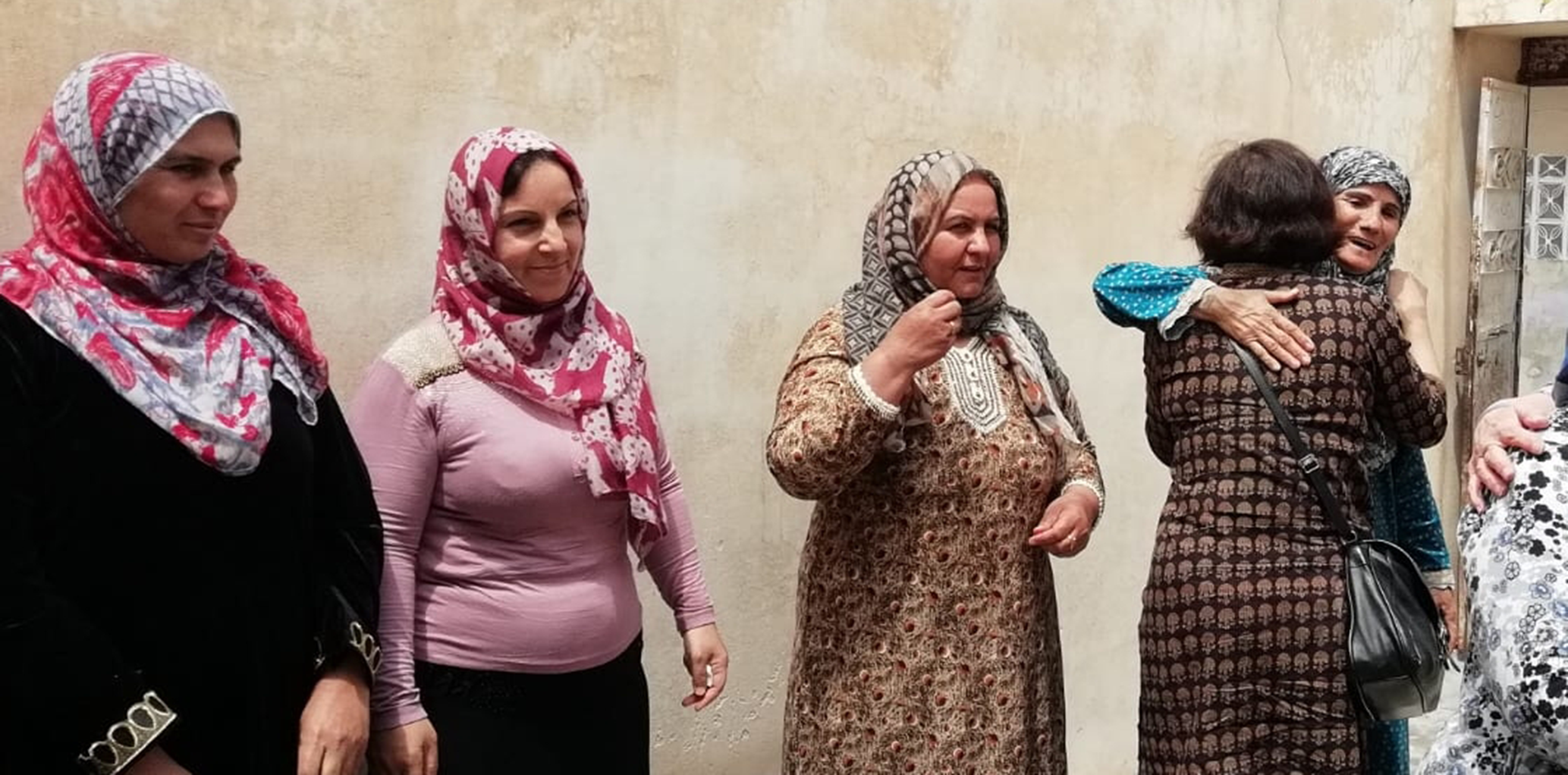
Revolutionaries also wear floral dresses; I am being greeted by members of a neighbourhood women’s commune in Kobanê in 2018.
For me, the great achievement of the Kurdish movement is providing a model in those areas that Marxism seems least equipped to address – specifically, relationships between people, including democratic structures. The movement is not only the most important force active today in the fight against capitalist hegemony and growing fascism, and the fight for a better world. It is also a living, if flawed, example of a different way of being.
I haven’t hidden my concerns about new dualisms and inconsistencies in Öcalan’s arguments over the role of women, or about his substitution of women in place of the proletariat as the driving force of revolution. But what I see in practice is a movement that encourages both men and women to develop a way of being that values nurturing and mutual aid above force and competition, and dialogue above argument, and where constructive criticism can provide genuine comradely support. I see an evolving system of grassroots democracy that is allowing people to work together to take control of their lives and neighbourhoods, and I see people becoming involved in a politics that is not distinct from the rest of their life, but integral to it, giving everyday actions meaning and purpose.
Combine this with a humanist Marxist analysis and anything is possible…
Footnotes
Declaration of Conflicting Interests
The author(s) declared no potential conflicts of interest with respect to the research, authorship, and/or publication of this article.
Funding
The author(s) received no financial support for the research, authorship, and/or publication of this article.