







Abstract
India is a large nation state facing the twin challenges of economic development and the need to transition away from its path dependence on coal towards a low-carbon infrastructure. By applying corpus linguistics to a sampled literature on decarbonising India's transport sector, we explore three motifs of difference, viz. ‘change’, ‘decarbonisation’ and ‘transition’, and how these motifs are applied within the context of this academic literature to refer to potential opportunities to transform India's developmental trajectory. We find that rather than exploring such opportunities, the sampled papers tend to recirculate discourses influenced by eco-modernisation which, although proposing change to India's carbon footprint, leave the fundamental structure of India's neo-liberal economic model unchallenged, even though, from a developmental discourse perspective, this lies at the root of climate change, and for meaningful change to occur it must be addressed.
Highlights
Indian transition policies for transport rely on technological changes Surveyed literature suggests continuation of eco-modernisation discourses Policies need to consider diverse needs of population for just transitions
Introduction
With the release of the sixth and latest assessment report by the Intergovernmental Panel on Climate Change (IPCC) (IPCC, 2022), and the publication of the findings of the Working Group 3 on transitions in transportation already being planned, the transport sector has been identified as one of several key risk and impact assessment areas. Efforts to decarbonise 1 this sector have often focused on fuel replacement options, such as the use of recycled biomass oils as well as the use of electricity, which is low to zero impact at the point of use.
With respect to the specific context of India, a rapidly developing country with a large population, the role of the transport sector is envisaged to play a critical role in facilitating and enabling India's economic progress. Indeed, the dominant mode of transport in India is via roadways, which carry about 80% of passenger and more than 50% of freight traffic (ITF, 2021). This network of roads is so significant that as a sector, transportation represents 3.06% of the national GDP. With some 3.5 million of both passenger and commercial vehicles sold in 2020, India constitutes the fifth largest automobile market in the world (IBEF, 2021), and the urban mobility sector continues to rise dramatically, with the growth in vehicle numbers exceeding the comparable rise in human population over the same period. Passenger activity has trebled between 2000 and 2020 peaking at some 6 trillion passenger kilometres (ITF, 2021).
However, it is critical to note that these figures represent increase in private vehicles only, because, with an already low baseline, the public transport sector is projected to further decline by 2030 (Jain, 2021). With a decline in the use of public transportation, coupled with continued urban expansion, private vehicle use continues to increase along with corresponding rises in both vehicular population and energy consumption. It is of no surprise that research into strategies to decarbonise the Indian transport sector is a burgeoning priority for transition scholars, and a number of studies on this theme have been published over the last decade.
Broadly, three classes of social factors that affect transport decarbonisation and transport transitions are noted in the literature. These are user behaviour and modal choice, employment opportunities and livelihoods, and information and its dissemination. Research favouring modal shifts tend to endorse increased use of more sustainable fuel types as part of the existing mix of transport modes, or to shift demand towards electrified public transportation systems. Modal shifts invoke cross-cutting technical and environmental factors, and this requires the development, propagation and user support for these to be adopted. Gupta and Garg (2020) include behavioural change by transport end-users as part of their carbon-neutral transport scenario assumptions, specifically to reduce demand through a corresponding increase in teleworking and the use of non-motorised transport. Tsoi et al. (2021) recommend a strong national and regional framework for encouraging modal shift, and this shift towards public transport is favoured by a number of scenarios (e.g. Gupta and Garg, 2020; Dhar and Shukla, 2015; Bhargava et al. 2018). Increased intermodal connectivity is also highlighted by Dhar and Shukla (2015) as a transport decarbonisation measure. Socio-economic factors affect transitions in transport in a number of ways. The purely economic factors are well- represented in the literature: studies such as Lam and Mercure (2021) offer insights into how economic incentives for developing low-carbon transport markets affect the markets, and which incentives are likely to produce the best results in the future. Vishwanathan and Garg (2020) also examine the investment rates that are required for the transport infrastructure to meet decarbonisation goals, and identify differing investment rates depending on phase of transition considered.
A consistent theme in the literature, however, is the current lack of a developed private electric vehicle market, and the need for the Indian government to develop a policy framework and potentially market support packages to establish a sustainable market for electric vehicles (EVs). Singh et al. (2021) recommend the government supporting market competition among original equipment manufacturers (OEMs) for EVs through policy, and Dhar et al. (2017) found that EVs can become competitive with internal combustion engine (ICE) vehicles with additional policy support through to 2050. What tends to be overlooked in many of these discussions on decarbonisation, however, are references to how the majority of the largely impoverished citizens of India are expected to acquire EVs, which are considerably more expensive than ICE vehicles. With India ranked as 107th out of 121 countries, with a score of 29.1 (meaning on the high side of the ‘serious’ margin) for the 2022 Global Hunger Index, any transition to EVs must take this limitation into account. This is especially relevant given that in 2020, India was found to have the highest global poverty increase (Mahapatra, 2021).
While it is clearly urgent to reduce greenhouse gas (GHG) emissions originating from the transport sector, few studies to date have considered the socio-economic impact of such transitions on the welfare and economic viability of ordinary working people who rely on cheap and affordable vehicles to earn a living. Given the costs associated with the rise of EVs, it is difficult to reconcile a transition to alternate but more costly transportation without also examining such impacts, particularly in a country such as India which struggles with such levels of poverty. Consequently, a significant percentage of an already economically marginalised population are at risk of being further disenfranchised unless due emphasis is also given to considerations of the socio-economic justice associated with such transitions. Unfortunately, these observations are not novel, and lend support to what others have noted in both the dairy (e.g. Singh, 2022) and agrarian (e.g. Mishra, 2020) sectors as a result of the continued efforts to globalise India.
In summary, this paper attempts to surface some of the ways in which India's transportation sector and the opportunities for transitioning towards a low-carbon future are framed and represented in the academic literature. We do this by means of employing corpus linguistic methods to interrogate the combined corpus of 48 academic papers retrieved as a result of a search strategy to identify peer-reviewed papers on the theme of decarbonising India's transport sector. In the next section we elaborate on this process, and the analytic methods employed, and introduce and briefly discuss the use of collocation and concordance analyses with reference to the location and function of key terms across the corpus.
In the third section we discuss the collocation of key terms within the corpus to generate an enriched understanding of the meaning of the terms through mapping words which tend to associate most strongly with the search keys. Thereafter, we explore three nodal terms that concern ‘difference’, these being ‘change’, ‘decarbonisation’ and ‘transition’, and examine these within the context of use by means of concordance analysis. In the fourth section, we review the findings and reflect on these with respect to discourses of difference and transformation particular to the transport sector, and the maintenance of eco-modernisation paradigms (Hajer, 1995). We conclude by problematising the technological eco-modernisation discourse which pervades much of the literature reviewed, and entertain potential alternatives to this framing of problems and solutions.
Methods and materials
The corpus used in this study was compiled from the results of a literature search and retrieval process undertaken as part of a British Academy-funded research project to examine the decarbonisation of India's transport sector. Two journal aggregator databases (i.e. Web of Science and ScienceDirect) were used to search for and retrieve published, peer-reviewed academic articles that satisfied the key terms ‘India’, ‘decarbonisation’, ‘transition’ and ‘transportation’. As anticipated, this initially generated a long list of 1054 potential papers (432 from ScienceDirect and 622 from the Web of Science). In preparation for second-stage filtering, author, title, year, abstract and keyword fields from each paper were entered into a spreadsheet, and screened further using four keywords, viz., ‘transport, ‘transition’, ‘decarbonisation’ and ‘India’ which demarcated the domain of interest. Abstracts and keywords were searched to exclude papers that did not address the main themes. A third and final filter was applied by various combinations of these keywords, for example ‘transport’ AND ‘transition’, and this final pass resulted in a selection of 48 of the most relevant papers.
Relevant papers were then downloaded and converted into plain text documents, which were manually reviewed and common sections, such as ‘Acknowledgements’, ‘References’, ‘Abstracts’, ‘Keywords’, along with equations, etc. were removed. Once these artefacts had been removed, the remaining text from each document was copied into one contiguous text file, and this is the focal corpus in our analysis. Taken as a single corpus, the collection contains 349,815 tokens, comprising 16,570 types and 14,111 lemmas. Given the specialist nature of the corpus, traditional reference corpora were not used in this study.
For our analysis, we were particularly interested in how the following 12 concepts were used in this research field, as represented by our sample corpus: ‘*india*’, ‘*mobil*’, ‘*transport*’, ‘*chang*’, ‘*travel*’, ‘EVs’, ‘*decarboni*’, ‘*sector*’, ‘*emission*’, ‘low-carbon*’, ‘PM 2.5 or PM2.5’ and ‘*transit*’. These terms were selected for the analysis due to their domain-relevance. However, for the purposes of this paper, we only report on three of these due to space constraints. A brief explanation of symbols and formatting is in order. Asterisks are ‘wildcards’ and expand the search to include variations on the nodal term, so ‘transport*’ returns ‘transport’, ‘transportation’ and ‘transport-related’ for example. Quotations fix the specifics of the search string. For example, to search for uses of PM 2.5, an airborne particulate common to ICE tail pipe emissions, both *PM* and PM* returns a high number of undesired results, prompting the use of ‘PM 2.5’. The term EVs has no wildcards, as we were searching for any reference to the widely used acronym for electric vehicles.
The purpose built free and open source software corpus linguistic suite, LancsBox (Brezina et al. 2020), is used because it brings together several tools within a common multi-platform interface. Again, due to space constraints, we only use two of these tools, namely the Key Word in Context (KWIC) function to find all instances of a search term presented in a concordance format and GraphColl, which computes and visualises collocations.
Using the GraphColl tool we interrogated the corpus for terms that are statistically associated with the key terms of interest (the node) and which therefore collocate with these, and did this for each of the 12 terms presented earlier using two measures of association, the MI3 (mutual information, cubed) and the z-score. The first 20 results, minus function words (such as, ‘the’, ‘a’, ‘an’, ‘for’, ‘as’, etc.) are retrieved, and these significant collocates are highlighted for an extended analysis and review.
In addition to the collocation analysis, we also used the KWIC tool which provides a display of key words in context for concordance analysis. Concordancing is a frequently used technique in corpus linguistics because it enables analysts to ‘investigate the occurrences and behavior of different word forms’ and is therefore helpful in selecting ‘the most frequent, suitable and representative examples’ of a word and ‘to help disambiguate between its different senses’ (Weisser, 2016: 67). Concordance requires the analytic window to be set to a preferred number of words on either side of the nodal term, and we set this at 15, so results were presented displaying 15 words to the left and to the right of the nodal term. This enables analysts to access a wider context from which to generate codes about the role and meaning of the key term in that specific example of its use.
Concordance line outputs from LancsBox were copied into keyword-specific spreadsheet tabs, thereby preserving the corpus reference for verification. Thereafter, each concordance line output was examined to generate a short set of codes addressing what the concordance line was likely referring to in the context of the paper. For example, a concordance line with ‘India*’ as the nodal term (represented in bold) might return the following concordance line: ‘[…] main focus on research and development pertaining to the reduction of greenhouse gas emission from
Results
Because we are particularly interested in the changes in the Indian transport sector leading to decarbonisation, we selected three terms denoting ‘difference’ to examine how these are used within the sampled corpus. Doing so helps to illuminate and surface prevailing discourses within this domain of emerging research. In the paragraphs below, we begin with the collocation analyses, and then proceed to review the results from the concordance and coding analysis. Each analysis is presented in order, below.
Collocation analysis
Corpus linguistic methods are an approach that others have adopted and developed for critical discourse analysis (CDA) (e.g. Baker et al., 2014; Baker, Gabrielatos et al., 2008). One of the methods common in corpus linguistic analyses is collocation which describes the statistical ‘tendency of words to be biased in the way they co-occur […] or as the tendency of one word to attract another’ (Hunston, 2002: 68). The point of this mode of analysis is quite simply that one shall know the meaning of words by means of those with which they associate (Firth, 1962). Here we are looking at a small sub-sample of the 12 nodal terms listed earlier, viz.: ‘*change*’, ‘*decarboni*’, and ‘*transit*’ because these three nodal terms are most specific to understanding discourses of difference.
There are a number of statistical measures for the strength of co-association between words. Of these, we opted for two, the mutual information score cubed (MI3) and the z-score. The MI-score ‘compares the actual co-occurrence of […] two items with their expected co-occurrence if the words in the corpus were to occur in a totally random order’ (Hunston, 2002: 71). To put this differently, the MI-score is a measure of the ‘non-randomness present when two words co-occur’ (Hunston, 2002: 71). On the other hand, the z-score tends to associate lexical values, specific words rather than grammatical constructs of interest, while the MI3 score tends to associate those terms that co-locate uniquely (Brezina, 2018a, 2018b; Gablasova et al., 2017). Using both methods therefore helps to balance out and triangulate the results.
To report collocation results, we adopt the Collocation Parameters Notation (CPN) format proposed by Brezina (2018b). The long form of this is illustrated in Table 1 by means of an example term ‘*mobil*’ to explain its format, and thereafter only the short form of the CPN will be used.
*Mobil* collocation using MI3 (CPN long form).

CPN: Collocation Parameters Notation.
Statistic ID refers to the number assigned to the statistic in the LancsBox suite, Statistic Name is the measure used (here, MI3), the L and R span is the size of the window on either side of the nodal term which defaults to five words on either side and is adequate for current purposes, Minimum Collocate Frequency (annotated ‘C’) is the minimum number of times a collocate must appear in the corpus to be included, and Minimum Collocation Frequency (annotated ‘NC’) is the minimum number of times a term must collocate with the nodal term to be significant, and Filter is used to record whether any amendments were made to what is reported. Table 1 can now be represented in the following CPN format string: ‘*mobil*’ – 05-MI3(9), L5-R5, C5-NC1, function words removed
Although we do not actually explore the collocates to the nodal term ‘*mobil*’ here, it serves to illustrate how the above CPN is to be interpreted. We list the top twenty words collocating with ‘*mobil*’, which are: low, high, mobility, electric, shape, scenario, demand, passenger, hypothesis, sustainable, india, future, transport, mission, carbon, shared, shapes, hyper, indian and momo. This is an efficient way of representing the collocates according to decreasing statistical value, so that the MI3 statistic for the first collocate ‘low’ is 19.82, while the statistic for the twentieth, ‘momo’, is 14.11. For our purposes here, we will ignore the statistical value.
Collocations for nodal term ‘*chang*’
In Table 2, we can see the following collocates. Climate is an obvious and clearly strongly associated collocate with the nodal term ‘*change*’, and similarly, one can anticipate the collocation of intergovernmental as per the IPCC. What is of more interest however are the collocates such as lifestyle, behavioural, regimes, cognitive, technological, rules and meta-rules, and mapping.
Collocations for ‘*chang*’.

Lifestyle, for example, only occurs 14 times throughout the whole corpus, but is very strongly associated with change, as in lifestyle change(s). Examining the context of this association further, for all but three of the text lines containing the collocate, the coupling is the bi-gram ‘lifestyle changes’. These each point to the nature of such changes in lifestyle as characterised by a shift towards electricity use, with an increased emphasis on CCS (carbon capture and storage). So less an actual change in lifestyle per se, but rather a change in the source of one's energy requirements.
Behavio(u)r is almost exclusively associated with changes in travel behaviour, which accounts for the strong associations between the nodal term and one of the collocates, that is, travel. Regimes seems to collocate strongly in relation to various policy frameworks which require changing, although some references to ‘regime’ change also draw on the socio-technological work of Geels and colleagues from the strategic niche management and multi-level perspective (MLP) research groups (e.g. Geels, 2002; Schot & Geels, 2008). Of interest is the association of cognitive which is also associated with ‘rules’, such that the context appears to be the need for ‘cognitive rules’ to change. Within the context of the corpus, rules and meta-rules both appear to apply to cognitive rules and regime rules, suggesting again insights informed by the work of Geels, et al. Finally, mapping also refers to this body of work on socio-technical regimes and regime changes from a MLP.
Although this notion of change will be picked up again for further examination in Collocations for nodal term ‘*decarboni*’ section, below, at this point of our analysis, references to change appear to strongly attract collocates associated with two specific perspectives. On the one hand, the first concerns a lifestyle change in energy demand, the use of CCS technology (despite this still being predominantly theoretical rather than practically viable), and on the other hand, an emphasis on socio-technological regime changes, involving cognitive rule mappings to alternate policy options.
Collocations for nodal term ‘*decarboni*’:
The nodal term ‘*decarboni*’in Table 3 attracts a range of collocates appropriate to the concept of energy decarbonisation, such as scenarios, energy, transportation, energy, shipping, policy and strategies. From the above, deep consistently collocates the strongest with the nodal term. Indeed, the term ‘deep’ itself occurs 85 times throughout the corpus, and is collocated with the nodal term ‘decarbonisation’ for 46 of those occurrences, suggesting a strong association of these terms, as in the bi-gram ‘deep decarbonisation’. Transport also features predominantly across both measures, which is not surprising given that this corpus was compiled on the basis of a specific research question into decarbonising the transport sector. Similarly, we find the terms ‘sector’, which is readily associated with ‘transport’ and ‘decarbonisation’, but here two specific transport sectors are associated with decarbonisation, that is, shipping and freight. Indeed, these collocates help to flesh out what a policy of decarbonisation might look like, the sectors it would affect, and the policy areas that would be implicated in such a transition towards an energy source that had been decoupled from a carbon-intensive base. Arguably, these decarbonisation policies appear to involve particular pathways, perhaps the result of multiple planning scenarios, with impact on emerging economies and which will have to be considered as long-term strategies.
Collocations for ‘*decarboni*’.

Collocations for nodal term ‘*transition*’
Collocates in Table 4 (CPN 6) appear to be more technical in nature, and a few of them represent an uneven distribution across the corpus. For example, the references to ndc-to-1.5, ndc-to-2 are both in the same paper and describe a specific scenario for transitioning from the BAU (business as usual) to a low-carbon economic infrastructure, while references to billion tons of CO2 (bt-CO2) again come from a single paper, as do references to dfc (dedicated freight corridors) and a three-level transition to sustainability. These actually gives us confidence in the measures used, because these are highly specific collocates with a very strong association with the nodal term.
Collocations for ‘*transition*’.

Other than this highly specific cluster of common collocates, both measures also select collocates which appear to lend themselves more readily to policy and planning frameworks, such as: energy, management, enablers, regime, optimisation, impede and validate. Transitioning will necessarily draw on policy and regulatory frameworks – governance – to be realised, so reference to these instruments is reasonable. Further, specific sectors are mentioned as transportation vectors for low carbon transitions, such as dfc, freight, road and rail.
A further observation is that sustainability collocates with both the nodal terms ‘*decarboni*’ and ‘*transition*’, suggesting a convergence around a type of sustainability discourse as constructed in the peer-reviewed articles selected for this review. Of interest is that reference to a ‘just’ transition, one that takes into account impacts on already socio-economically marginalised populations is not a collocate of ‘*transition*’. This lends itself to the interpretation that the impacts on people's well-being may be subjugated to impacts on the economy.
Concordance and thematic coding analysis
As Brezina (2016: 106) observes, while collocation is a tool with ‘great potential to reveal connections in discourse’ it needs be to used ‘appropriately and in combination with other methods, such as concordancing’. This section does just this, moving away from the quantitative analysis of unstructured data and introducing a more qualitative methodology to the examination of how the words and phrases of interest are used together in the corpus on decarbonising India's transport sector. As Baker (2006: 77) notes, ‘the object of creating concordances is to look for patterns of language use, based on repetitions’.
Using LancsBox's KWIC tool, we searched the three key words of interest (i.e. change*, decarboni* and transition*) and set the context or span window to 15 (so, 15 words on each side of the key word). This provides sufficient context of the sentence to be examined to deduce the semantic frame of the word's use. However, concordance lines can generate significant volumes of data. For example, the results from searching for change* generates 751 rows of text containing the term, decarboni* generates 338, and transition* 502. These are unlikely to be 1590 unique sentences, so duplicates must be addressed and the output managed in ways that facilitate the analysis.
Concordance analysis of ‘Change*’
Once duplicate lines were removed, the number of lines for the theme ‘change*’ is reduced slightly from 751 rows to 723, so there was evidently not too much duplication. To explore the concept of change as it is used in this corpus, we elected to examine what it is that the word is applied to. That is, what changes?
The coupled ‘climate’ and ‘change’ are found reasonably evenly distributed across the corpus, and this is consistent with one's expectations for a corpus of this nature. Decarbonising the transport sector has an obvious relation to efforts to mitigate climate change, and the occurrence of ‘climat*’ to the left of ‘change*’ comprises almost 30% of all references to ‘change*’. Many of these references to climate change include references to the IPCC, the Paris Agreements, and other regulatory frameworks.
What is more interesting is how change is contextualised without specific reference to the phrase ‘climate change’. Although the corpus is ostensibly about decarbonisation, the provision of EVs as an alternative transport system is rarely associated with change. When these terms do co-occur, the emphasis is on changing the public perception of EVs, or that EVs are themselves ‘harbingers of change’, and that diffusion of EVs will trigger broader changes in infrastructure, and other references to market economics (see Table 5).
Concordance of change in the context of EVs.
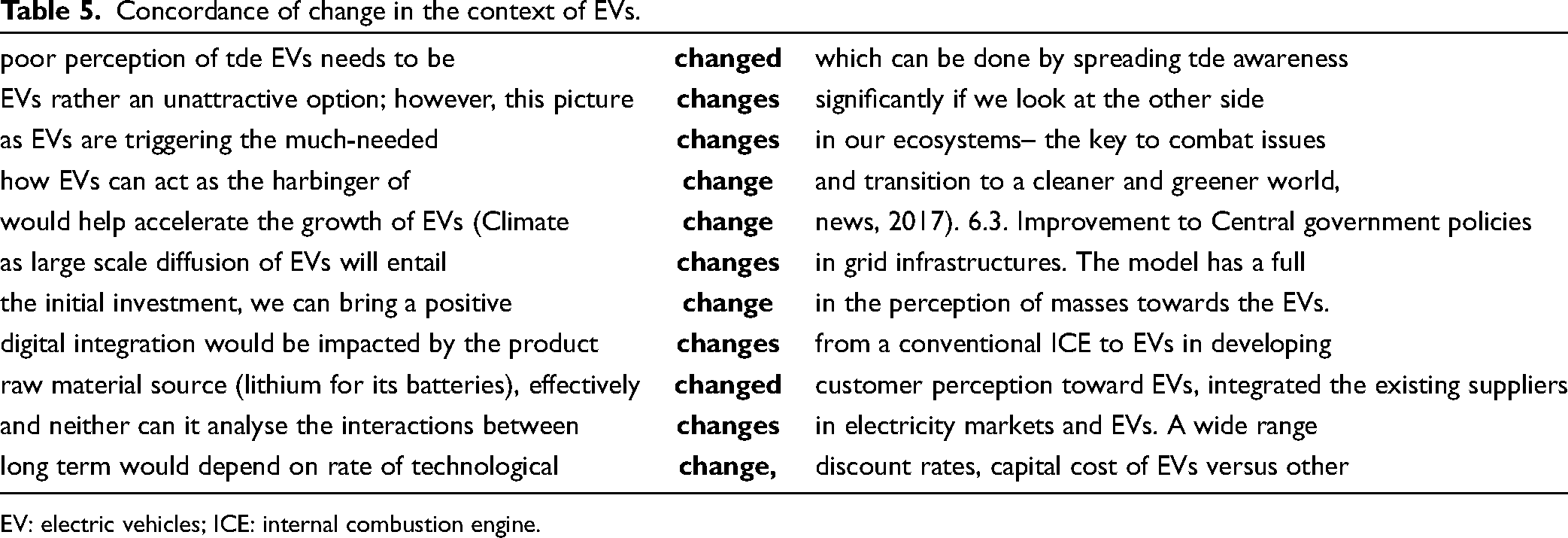
EV: electric vehicles; ICE: internal combustion engine.
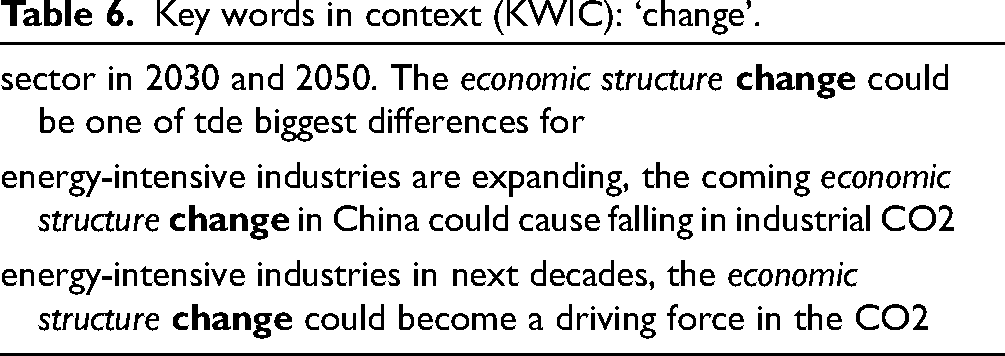
Change is also associated with structural changes and regulatory changes, but most uses of ‘structure’ refer to ‘economic structure’, as per the extracts in Table 6.
Key words in context (KWIC): ‘change’.
Other references to change in structure actually refer to changes in the structure of energy systems, planning systems and the electrification of the transportation systems. Behavioural changes are also referenced, particularly as the means by which transport and energy demand modifications might be achieved, and there are suggestions that this needs to be worked into policy-level amendments. Interestingly, when the presence of rule(s) are considered, most references actually pertain to changes in ‘cognitive rules’, particularly that changes in cognitive rules precedes changes in regulatory frameworks, and this again relates to Geels et al.’s work. It is evident that, for some researchers at least, if consumers and policy-makers shift cognitive framing with respect to transport demand, policy changes are a likely consequence, or at least, more readily facilitated.
We conclude this sub-section by exploring the domain that change effectuates by reference to the three typical words with which the nodal term collocates: in, of, and to. When the nodal term is coupled with the adverb ‘in’ to its immediate right (i.e. change* in), which occurs in about 26% of all uses of the nodal term, the terms ‘emissions’, ‘energy’, ‘fuel prices’, ‘travel’ and ‘policy’ (and the variants on these terms) are the most frequent domains within which change is related. The phrasing of this couplet concerning a change in something suggests that the thing itself is not being changed per se, but rather some internal configuration of the relations which compose the thing under consideration change. That is, to draw on the distinction between structure and organisation made by Maturana and Varela (1992), it is the organisation (the system of relations) which changes rather than the components that are related (which suggests a structural change). To elaborate, in their words, organisation ‘denotes those relations that must exist among the components of a system for it to be a member of a specific class’, while structure ‘denotes the components and relations that actually constitute a particular unity and make its organization real’ (1992: 47). In other words, what changes is the organisation of extant systems, but not the systems themselves. This is a key point to which we will return in due course in the fourth section.
The term ‘change’ is also used in conjunction with two prepositions, that is, ‘to’ and ‘of’. In this corpus, the coupling of ‘change’ and ‘to’ as an object affected by change accounts for only 2% of all uses of change, while ‘of’ accounts for about 4% of all couplings between change and of to the immediate right of the nodal term, viz. change(s) to and change(s) of. The first couplet, change(s) to, is most frequently used to refer to change(s) to the energy or fuel supply, while change(s) of pertains most commonly to change of ‘rules’ and ‘travel behaviour’.
Concordance analysis of ‘Decarboni*’
We now move onto the second of the three terms associated with difference, viz. decarbonisation, which is directly related to the core theme of the corpus. As above, we examine the way that the term ‘decarboni*’ is used in the corpus by exploring its conjunctions with the adverbs and prepositions ‘in’, ‘to’, and ‘of’.
As expected, the adverb ‘in’, most references to decarbonisation locate such changes as occurring within India, over a period of time (i.e. ‘in the long term’) and within emerging economies. Searching specifically for ‘economi*’ to the right of the nodal term returns only six references, while searching for this term to the left of the nodal term returns ten references. Of these, only one refers to the ‘sizeable economic losses’ associated with a deep decarbonisation of the Indian economy, another suggests limiting economic losses associated with decarbonisation, while other references suggest economic stability or even growth associated with decarbonisation.
Examining the preposition ‘to’, decarbonisation is typically associated with phrases such as ‘to achieve’ and ‘to (an | the) extent’, while the preposition ‘of’, as pertaining to that which is affected by decarbonisation, returns references to ‘electricity’ and the ‘transport sector’, both of which are consistent with the theme of the corpus.
The concordance analysis of the nodal term ‘decarboni*’ therefore doesn’t introduce any remarkable findings, as one would anticipate that the associations with this would indeed be relating to the transport sector and the wider economic infrastructure. Of the references linking decarbonisation with the economy, there are few suggesting that such a shift towards a decarbonised transport sector and economy would have a negative impact, while the majority either gloss over impacts or advocate that pursuing a decarbonisation pathway will have some economic benefit over time.
Concordance analysis of ‘Transition*’
In examining the concordance lines for the final nodal term pertaining to difference, ‘transition*’, we first searched for occurrences of the word ‘economic’ to the left of the nodal term, to explore what the corpus authors have written about economic transition, and there are very few such references, constituting almost 1.4% of all references to the nodal term. One of these explores the economic benefits of a low carbon transition while the other six references are more generic in nature, listing economic and technological transitions.
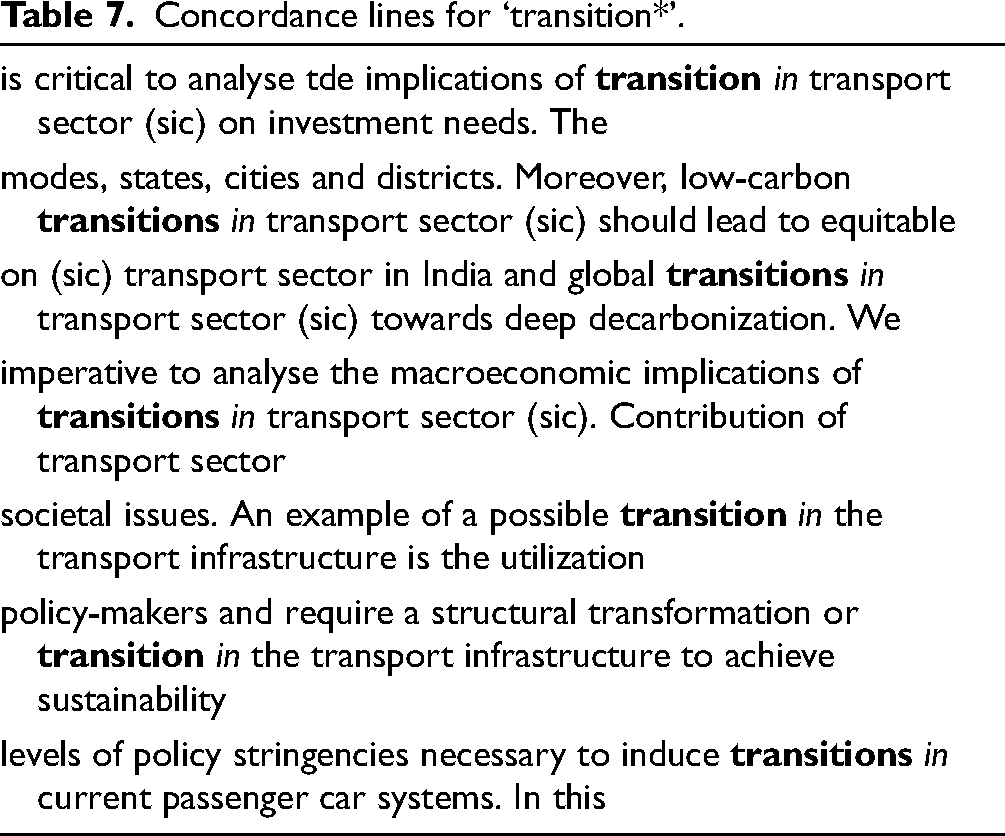
Exploring the use of the three common terms ‘of’, ‘in’, and ‘to’ in the context of this nodal term, there are few references suggesting a transition of, and these refer to transitions of energy and emissions of passenger transport systems, of the industry sector, and of vehicle types (including locomotives). When we look at the use of the second of these three terms, ‘in’, the references tend to collocate transition* and in the transport sector as an obvious and frequent coupling, as the seven concordance lines in Table 7 exemplify. Other references were specifically to the energy sector (particularly coal) and the industrial sector.
Concordance lines for ‘transition*’.
Of more interest here are references to what is transitioned, as in the couplet transition to, and this generally reflects the focus of the corpus with several references being made to a low carbon economy, low-emission pathways, to H2 (hydrogen) based economies and vehicles (fuel cells), to the electrification of mobility and renewable energy systems. What is absent from these concordances however, is any mention of transitioning the model of the economy itself away from a growth-orientation towards a more steady-state model. Rather, the emphasis appears to continue to endorse the current model of economic discourse, but one that is simply decarbonised via technological methods, the very crux of what was referred to earlier as the eco-modernisation discourse.
Discussion
In this penultimate section, we consider the findings analysed above in further detail and try to surface some of the prevailing discourses which permeate and motivate the research papers comprising the focal corpus. One way of approaching this is to clarify what problems and solutions are being articulated, and we can help clarify this by drawing on the social movements terminology of ‘diagnostic’ and ‘prognostic’ frames (Benford & Snow, 2000; Snow, Benford, McCammon, Hewitt, & Fitzgerald, 2014), as these frames refer to how problems and their matching solutions, respectively, are fit and aligned. Using this notion of framing and alignment between frames, we can begin to retrace the original diagnostic frame by working backwards from the prognostic frame. We have seen that the prognostic (solution-oriented) frame is to decouple the Indian transport sector from its carbon-intensive dead weight, and so can deduce that the diagnostic (problem-oriented) frame is quite narrow in its scope.
This paper analysed the concordances for three key terms associated with doing something differently with respect to the economics of transportation and energy demand, viz ‘change*’, ‘decarboni*’ and ‘transition*’. Most references were to changes in the transport and energy sectors, so what we were most concerned with was the nature of how these notions of difference were articulated – with what were these three concepts associated? In particular, we were interested in examining any references to the economic model itself which has given rise to the precipitous problems of global warming. Is there evidence from the corpus on decarbonising the Indian transport sector that challenged the dominant discourses on neo-liberal and pro-growth capitalist economic paradigms, for example? Our study does not seem to suggest that this level of analysis contributed to the diagnostic framing of the issue. There is no apparent evidence in this corpus that the underlying organising paradigm that has contributed, if not led directly, to the current state of existential threat is being challenged, let alone questioned.
Put differently, in a corpus that examines the decarbonisation of India's transport sector, a sector that has given rise to unprecedented levels of pollution and atmospheric chemical changes, a system that is driven by coal-fired power stations, supported and endorsed by a powerful political lobby and significant employer, the corpus is seemingly silent on challenging the basic tenets of this paradigm that espouses the apparent need for India to grow economically, at almost any cost. As noted above in our discussion on collocates, while mention has been made of ‘sustainable transitions’ within the corpus, it is significant to note that no mention is made of ‘just transitions’. This absence suggests that the concept of justice is either not considered, or potentially assumed a default in some way, as if by having it listed specifically in the SDG's (Sustainable Development Goal 16) is enough. Either way, the implication appears to be that somehow it will just occur over time because people are aware of it and that it would accompany greater economic growth. As noted earlier, given India's significant poverty and serious position in terms of the Global Hunger Index, such assumptions warrant further investigation.
Yet this may be considered outmoded thinking as this is very much a nod to the now debunked trickle-down economics theory that established itself as a considered norm in the 1950s and 1960s (Arndt 1983). Instead, the emphasis throughout this corpus has been on how such growth can be sustained, through using less polluting means. Concerns about the justice of how that growth is achieved, and indeed the issue of perpetual growth itself has, however, seemingly remained ignored. In itself, this is unlikely to come as a surprise. The corpus was, after all, compiled using academic literature predicated on decarbonising a particular sector, rather than drawing on critical ecological discourses, for example. However, to some extent this underscores the very point we are making here. In the absence of any challenge to or questioning of the dominant economic paradigm, a process of normalisation is allowed to continue, a phenomenon that excludes the active and explicit consideration of alternative paradigms to that of the neo-liberal perpetual growth model, the same model that has been the cause of most of the increases in greenhouse gases since the 1950s. In recent work however, some cracks in the ‘sustainable growth’ narratives predicated on eco-modernisation have become apparent. In a paper on developments in Sweden, Hagbert, Nyblom, and Isaksson (2021) for example, note that ‘crisis’-oriented discourses are beginning to form cracks in dominant narratives, and may even lead to the emergence of alternative discourses about change as transformation. Even more recently, Mathez and Loftus (2022) critically challenge the power-knowledge dynamics of the (eco) modernisation discourse in the Moroccan green strategy and how these lead to a perpetuation of reductionist emphasis on growth and development. Such studies offer hope that these dominant discourses may be losing their grip.
Decarbonising India's transport sector assumes the paradigm of economic progress as a linear trajectory, but in doing so, it also relies on a vision of the world as a near limitless source of goods and ecosystem services, a vision which we as denizens of the Anthropocene (Zalasiewicz et al., 2010) have come to see as deeply flawed. In effect, this necessitates a shift away from a relationship between ourselves and the ecosystems predicated on us living on a planet, and towards the deceptively simple sounding, yet fiendishly challenging priority to live with the planetary systems of which we are a part (Röckstrom et al., 2009).
Another area for consideration that we have to hand involves the strategic approaches to long-term policy analysis. It would be of interest for future discourse analysis to see if researchers are shifting the question from one of ‘what will the long-term future bring?’ to ‘How can we choose actions today that will be consistent with our long-term interests?’ and this involves four key elements, viz. to ‘[c]onsider large ensembles (hundreds to millions) of scenarios. Seek robust, not optimal, strategies. Achieve robustness with adaptivity. Design analysis for interactive exploration of the multiplicity of plausible futures’ (Lempert, Popper, & Bankes, 2003: xiii). While Lempert et al., explicitly advocate the use of computational scenario modelling, the key elements of their approach is akin to that favoured by adaptive management, with its recognition of the adaptive cycle on one hand and the embeddedness of our current system within a cross-scalar, cross-velocity panarchy of nested social-ecological systems (Gunderson & Holling, 2002; Mitchell et al., 2020; Waters, 1986). What draws these together then is a shift in values, away from the command and control (Holling & Meffe, 1996) paradigm that has dominated policy and economic models for growth and progress, towards a ‘letting go’ and a recognition that climate change is a cognitive problem, that it is the result of how we have framed the world and our place in it, and that change will need to happen within the ‘wet-ware’ of our thinking before anything will change at the scale of the planetary system. As such, discourse and how we conceptualise, think and frame our arguments becomes an ever higher priority.
And here we come full circle, and return to the emphasis this paper has placed on language, particularly on the central role language ‘plays in the formation of public meanings and hence how [it] shapes the possibilities for political action’, indeed, how language ‘constructs the spaces within which different forms of political action take place’, wherein ‘beyond its inescapable material reality, climate change is an idea to which there is no end of meaning and therefore no final resolution to the challenges it presents to people’ (Hulme, in Fløttum, 2017: x, xi, xii). In this contribution to the study of human adaptations to climate change, we have analysed how the discourses informing and shaping the decarbonisation of India's transport sector contribute to particular worldviews, to the maintenance of the technological eco-modernisation paradigm, and to the possibilities of shifting away towards as yet ill-defined and always uncertain futures.
We conclude with a few preliminary ideas on how our own discourses of change might be expressed through reimagining how we as humans think, the languages we use, and by re-evaluating our own role in ways of living with climate change impacts and within the multiplicity of nested complex adaptive systems. We hope to have highlighted and re-emphasised just how problematic our attempts at solution are if we refuse to countenance the broader frames of reference within which such problem-solution sets make sense. To revisit Maturana and Varela's (1992) distinction between organisation and structure, to the extent that the discourses pertaining to low-carbon transitions continue to work within the organisational frame of eco-modernisation, with technology as its means, then little will effectively change at the scale it needs to. If climate change is the diagnostic frame, then prognostic frames of reducing carbon are front and centre of such couplings. If, however, our way of thinking, and our values are the diagnostic frame, then the prognostic coupling becomes much more radical, and is likely to involve our entire modus vivendi as part of its resolution.
Conclusions
In the preceding paragraphs, we have highlighted some of the dominant discourses which permeate the selected academic literature on transition pathways to decarbonising India's transport sector. This topic is, in many respects, indicative of that class of problem Rittel and Weber (1973) classed as ‘wicked’. Each attempt at defining it dislocates it to another domain of study. For instance, if it is personalised private transport creating air pollution, then by decarbonising the vehicle fuel shifts the problem to coal-fired power stations and energy infrastructure, but to decarbonise the grid shifts the emphasis onto massive unemployment and anticipated socio-economic hardships for significant numbers of already economically vulnerable Indians. However, introducing solutions follows a similar pattern if those solutions involve relying on new technologies which now include the added challenges of mining and recovering the components necessary for EVs, a burden typically borne by radically impoverished sectors of the population living in already ecologically fragile parts of the world and who enjoy few protections of their human rights (Cugurullo & Ponzini, 2018; Lam et al., 2005). As Commoner (1971) observed, there is no free lunch in an interconnected complex system: someone somewhere has to pay, a perspective that technological eco-modernisation discourses typically externalise.
And this leaves us in a precarious position. It is all well and good critically analysing the discourses of others, highlighting gaps, obfuscations, contradictions and so on. But as researchers ourselves, it is not good enough to peer down from our ivory towers in academic detachment, and denounce these matters as not of our concern. In these closing paragraphs, we hope to be able to propose some potential options. Is it realistic to expect academics studying the decarbonisation of India's transport sector to widen their critical analysis to challenge the basic assumptions on which the polluting sector itself depends for its own coherence? We have adopted the position that if we are to find ways of decarbonising a given socio-economic and industrial sector due to its contribution to regional levels of pollution and global emissions of greenhouse gases, then do we not also have an obligation to consider the set of assumptions supporting the system? As researchers exploring the global and regional impacts of a socio-economic sector and ways of reducing these (via, here, decarbonisation) by overlooking the root conditions that render these polluting and greenhouse gas emitting conditions feasible in the first place, are we not neglecting the critical perspective that academic research is valorised for? Moreover, in glossing the notions of equity and justice in the proposed transitions in the transport sector, a significant number of Indian citizens will be left behind and may even fall deeper into poverty and economic marginalisation, in which case how do advocates of such transitions ensure that socio-economic justice is integral to such changes? Perhaps this is a debate best left for another place. In the interim, however, it is apparent that the 48 individual papers which were compiled into the current focal corpus have, almost to a paper, glossed over the cognitive paradigm that endorses the founding premise of a highly polluting sector without calling this very paradigm into question; that is, a pro-growth neo-liberal economy which relies on the economic marginalisation of people to work. This then is the contribution of the emerging discipline of eco-critical discourse analysis, and – we hope – what we are able to offer in the current paper.
As always, novel solutions introduce novel problems, albeit at one or more remove, and the challenge in adopting a discourse analytic approach is that doing so introduces what Derrida (1978) referred to as différance, the perpetual deferral of closure on meanings as an on-going dynamic between reader/author and text. By analysing the discourses inherent to a given text, especially academic work investigating real-world problems and the need for solutions, the work is unfinalisable in the Bakhtinian sense, as being fundamentally and irreconcilably open, with the last word yet to have been spoken (Bakhtin, 1981). Consequently, the emergence of future problems that follow on from the introduction of new solutions cannot necessarily be anticipated, and if they are, then certainly not in full detail. At the least, however, we might expect the application of the precautionary principle in the development of solutions, coupled with a reluctance to externalise those potential problems to some indefinite point in the future, or to some other geographic space, leaving it for others to deal with.
In this paper we have argued that the prevailing academic literature on decarbonising India's transportation sector has predominantly ignored the human impacts of such a transition. While the more obvious impacts will be experienced by those already economically marginalised, what strikes us as troubling is that academic research in this area is technocratic, almost entirely oriented towards technological fixes that not only ignore the social and economic justice involved in such transitions, but also overlooks the perpetuation of dominant economic models of production which continues to subjugate vast swathes of the global poor to eking out subsistence incomes. In other words, the decarbonisation of India's transport sector is laudable from the perspective of environmental health and a contribution to mitigating global warming, but does nothing to help lift the radically impoverished people out of such crippling poverty, and, if anything, may simply perpetuate the neo-liberal model of externalising whatever cannot be brought into profit generation. Indeed, as Oetsch (2013) has convincingly argued, failure to modernise and to become competitive in the global economy is a failure that can be attributed to the state, while solutions are inevitably attributed to the free market to resolve, and a similar dynamic appears to be informing the transition towards a decarbonised transport sector in India. This may be, as Ahmed (2009) has argued, the perpetuation of neo-liberal's global hegemony which, in India at least, has been embraced by the elites as a reproduction of the upper-caste's power-base.
To the extent that researchers and policy-makers attempt to foreclose on these deferred meanings, and on the openness of the world in the pursuit of reasonable certitude, discourse analysis offers a powerful tool with which to create and confirm the language and meanings to be used in future discussion that surface these tensions, the foreclosures, and the deferred consequences of novel solutions. These may be the bedrock that a new hierarchical policy making and engagement framework could be built upon – shared understandings of language and discourse being the foundation stone. This framework may use such techniques as Persona Modelling in geographically bound locations to allow academics and policy-makers to conceptualise the stakeholders appropriately and engage with the tensions identified in ways that do not polarise views nor raise conflict. This would allow for a personal investment in third party avatars used for solution modelling and discussion, thereby bringing them both to light and life for critical evaluation of future policies.
Footnotes
Acknowledgements
The author(s) acknowledge the contributions of the three anonymous reviewers and the editor in helping to make this a stronger article.
Declaration of conflicting interests
The author(s) declared no potential conflicts of interest with respect to the research, authorship, and/or publication of this article.
Funding
The author(s) received no financial support for the research, authorship, and/or publication of this article.
