







Abstract
Over the past decade, new municipalism has emerged as an alternative form of politics emphasising radical democracy and community-based urban agendas. However, recent election results and challenges in navigating existing institutional frameworks worldwide have prompted a further examination of the potential and limitations of new municipalism in different contexts. This article evaluates the implementation of new municipal governance in Valparaíso, Chile, where a neighbourhood organisation backed by the local government clashed with a developer seeking to privatise and redevelop a critical ecological area called Pümpin Park. The city's significant public park shortage led to widespread social unrest, protests, and legal inquiries. Using firsthand accounts and official records, this study analyses how Valparaíso practices new municipalism by collaborating with grassroots movements to achieve the project's cancellation. However, it is still unclear whether the municipality's long-term urban development plans will continue to reflect a new municipalist agenda beyond this particular conflict.
Introduction
The global financial crisis expressed through austerity measures in the global north or long-term inequalities and institutional violence in the south has produced different forms of social unrest, triggering massive revolts that demand changes and attempts to reconfigure local and national politics worldwide. The debates around new municipalism have gained interest in both practical and academic spheres. The 2014 Spanish new municipalist boom, with a particular emphasis on the Barcelona en Comú platform, has echoed in expressions of self-organised governance found elsewhere in the world such as Cooperation Jackson in Mississippi, Ciudad Futura in Rosario, Independents for Frome in the UK and Democrazia e Autonomia in Napoli, among many others (see Russell, 2019 and fearlesscities.com), through a network of sharing practices aimed at building radical alternatives for democracy integrated with their communities.
The ideas of new municipalism and other forms of municipal statecraft have been developed extensively in the global north (Angel, 2021; Blanco and Gomà, 2019; Janoschka and Mota, 2021; Purcell, 2020; Thompson, 2021a), with increasing contributions from the south (Aguiló and Sarabiego, 2019; Arpini et al., 2022; Toro and Orozco, 2023). These ideas explore the potential and limitations of new municipalism in bringing about systematic change and challenging neoliberal urban governance (Roth et al., 2023). However, recently, there has been a decline in new municipalist agendas due to electoral pitfalls or the difficulty of implementing radical political ideas within existing institutional structures (Janoschka and Mota, 2021). Furthermore, despite massive revolts in different parts of the world, political-economic structures and traditional political forces remain aligned with neoliberal principles (Roth et al., 2023). This poses a dilemma for new municipalism, which must build self-governed alternatives for social spatial justice while dealing with entrepreneurial forms of urban development.
This paper examines a dilemma in Valparaíso, Chile, where a grassroots movement contested a private large-scale project in a historic green area of the city, and the local government, under the flag of new municipalism, engaged with the conflict. The study provides an approach to new municipalism as seen in practice, highlighting its strengths and limitations in dealing with long-term conflicts around urban change and social contestation. Valparaíso's historical centre was declared a World Heritage Site in 2003 by UNESCO. However, the city's dire condition has deepened, with several competing explanations for this decline, for instance, the centralisation of the Chilean political and administrative system that weakens local governments both in power and budgetary terms (Hidalgo and Zunino, 2011), the privatisation of the city's port area producing high revenues but few benefits for the city (Cuevas and Budrovich, 2020), and failed national policies aimed at regenerating the city through heritage and tourism, producing small, gentrified pockets without positive spill-overs to the rest of the city (Caimanque, 2019; Opillard, 2017). Since the mid-1990s, several grassroots organisations and social networks have emerged to confront attempts to demolish heritage-listed buildings, upzoning plans, and the construction of high-rise towers and large-scale redevelopments (Opillard, 2018; Rojas and Bustos, 2015).
Under this scenario, by 2016, former student leader Jorge Sharp was elected Mayor of Valparaíso, establishing a landmark beyond the traditional competing duopoly of left-leaning centrist and right-wing political parties 1 . His support base was the Movimiento Valparaíso Ciudadano (Valparaíso Citizen Movement), composed of various civic organisations and political movements formed in Valparaíso. Sharp's appointment preceded the current President Boric's countrywide presidential victory, as they come from the same ‘autonomist’ party, now split, conforming to what has been called the Chilean New Left (Titelman, 2019).
Sharp's new local government, self-defined as Alcaldía Ciudadana, has developed discourses and practices aligned with new municipalism (Blanco and Gomà, 2019; Russell, 2019; Thompson, 2021a; Welp, 2017). In Valparaíso, new municipalism means defending a discourse of citizens’ active participation as the centre of the city's governance, besides strategies of ‘remunicipalization’ of public services (Toro and Orozco, 2023). The Alcaldía Ciudadana has been an active player in the worldwide ‘Fearless City Network’ that brings together new municipalist activists, mayors, and councillors to share experiences and propose radical democratic alternatives to neoliberalism. Chilean and European versions of new municipalism share visions and discourses for socio-spatial justice and radical transformations (Thompson, 2021a) through interventions that attempt “to embody present practices and condition the possibilities for a democratically envisioned future society” (Roth et al., 2023: 5).
In Valparaíso, the O’Higgins Hill neighbourhood, a residential area in a relatively central location, faced a 10-year conflict with a private group of developers owned by a Chilean tycoon, who was also a prominent political figure of the right. This economic group aimed to construct a privately led megaproject within Pümpin Park, one of the city's few open green spaces. This move sparked a reaction from a group of residents gathered under the name ‘Movement for the Defence of the O’Higgins Neighbourhood Parks’ (DONP hereafter), who aimed to overturn the project that included 23 buildings including high-rise towers at the centre of O’Higgins Hill. For many decades, Pümpin Park has remained open to the O’Higgins Hill residents and the rest of the city for various public recreational uses and plant vending activities, making it one of the few existing green areas in the city. The DONP, a network of grassroots organisations, has struggled against the real estate project since 2013. As we will see next, in the DONP, inter-class shared interests, socio-environmental concerns, and NIMBYism become intertwined.
This article's first goal is to analyse how the municipality and grassroots intersected, leading to a contested scenario against the developer's plan. Second, we examine Valparaíso's success in strategically and symbolically achieving the preservation of Pümpin Park for public use. We explore how the new municipalist agenda played a limited but crucial role in making the developer to withdraw. Additionally, we highlight how this achievement implies a significant shift away from entrepreneurial forms of urban development that prioritise the privatisation of common land, reflecting a broader struggle against Chile's influential private developers’ sector (Kornbluth, 2021; López-Morales, 2016). The municipality's actions to invalidate the project led to a legal conflict that turned against the mayor. The developers fought back with legal responses that could be viewed as resistance to the new municipalism's departure from the post-democratic consensus (Swyngedouw, 2018; Tarazona, 2017) that had dominated Chilean municipal politics for years. However, the local government has yet to present a clear urban development alternative beyond this conflict.
This study utilises qualitative methods and discourse analysis based on data collected from interviews with key municipality members, the ‘DONP’, private actors, and specialists involved in project development. The interviews were conducted after obtaining ethical certification for research on human subjects, granted by the Scientific Ethical Evaluation Committee of the Faculty of Architecture and Urbanism, University of Chile (Reference number: 3210089). The data were cross-checked with secondary data from the public sector and media reports. Field observations were conducted from 2021 to 2022, when the conflict's outcomes became apparent. The following sections provide a theoretical account of new municipalism and its particular approach in Chile and Valparaíso, an analysis of the Pümpin Park conflict, including the project, grassroots position, and the political effects of the judicialised scenario. Finally, conclusions are drawn.
Crisis, social outbreaks, locally based self-organisation: the path towards new municipalism
In recent years, Europe has faced a series of economic crises and austerity measures driven by neoliberal policies. As a result, local governments have taken direct action to address these challenges, gaining momentum in the past decade (Lauermann, 2018). Despite limited resources at the national level, municipal governments have become more active and interventionist in decision-making, shifting away from reactive and speculative approaches under neoliberalism (McGuirk et al., 2021). This has led to a greater focus on defining governance strategies that are endogenous to the local community while responding to external pressures (Lauermann, 2018: 2013). Some cities have even moved beyond state-led entrepreneurialism (Macleod, 2002) to embrace more radical forms of local governance that engages with social movements (Thompson et al., 2019).
The interest in various forms of municipalism, particularly from the left, has a lengthy history and different expressions before the 2008 global (mortgage) crisis (Purcell, 2020; Thompson, 2021a) which currently frame ongoing debates. Municipal socialism has been a long-standing tradition for over a century in Europe, reconfigured in the 70s and 80s, with specific distinctions in Latin America, serving as a precursor to national initiatives (Goldfrank and Schrank, 2009). Redistributive policies and the remunicipalisation of goods and services (Cumbers and Becker, 2018; in Thorpe and Morgan, 2022), appear as critical components, focusing on popular participation, especially in Latin America (Goldfrank and Schrank, 2009). Examples such as Porto Alegre and its Participatory Budget have gone in that direction. Under neoliberalism, various political projects have emerged, ranging from those drawing more liberal lessons from the 70 s and 80 s ‘Progressive City’ (Joy and Voegel, 2021) to more radical approaches such as new municipalism, “aimed at democratising local government, contesting inequalities, and promoting citizenship” (Beveridge and Naumann, 2022: 44).
In their work, Beveridge and Naumann (2022) employ the concept of ‘progressive urbanism’ to encompass a variety of political movements within cities, which range from liberal to radical interpretations and aim to increase “social justice, citizenship, and democracy in relation to municipal or local government and the lived spaces, places, and processes of urban life” (p. 46). While progressive urbanism seeks to encompass political projects from different perspectives, it also acknowledges that there are contingencies based on three key dimensions: localism (which can be a key space for proximities but carries the risk of falling into a scalar trap), social movements (which are important for setting alternative political knowledge but may be unstable in the long term to influence political agendas), and municipal government (aimed at exerting direct democracy, but recognising the tension between movements and formal institutional politics). These dimensions provide a useful framework for the analysis of cities, while also considering their unique characteristics and the forces that shape them. However, within the array of progressive approaches, it is important to avoid conflating them with radical (new) municipalism that goes beyond liberal progressive politics and aims to build collective counter-hegemonic struggles (Roth et al., 2023).
Therefore, new municipalism has emerged as a radical form of local government in response to the failure of the neoliberal State apparatus to fulfil people's basic needs (Bookchin, 2019; Thompson, 2021a). Citizen movements and digitally supported social platforms have become increasingly important and are now seen as alternative means of economic development through non-state institutions or urban networks (Thompson, 2021a). This approach, which is both anti- and post-neoliberal, seeks to re-imagine local power and challenge capitalism at a local level (Thompson, 2021a), without returning to state centrism (Magnusson, 2014), seeking to re-imagine local power and challenge capitalism at that scale. Under new municipalism, the locale becomes a strategic, transformative political space (Russell, 2019).
The local is understood as the scale of collaborations, the space of proximities and mutual learning, but this does not mean a more democratic scale per se. There is always a risk of falling into a ‘scalar trap’ (Brenner, 2019; Russell, 2019) by avoiding the influential role of the national State and transnational interests in the city (Pierre, 2014). Although the city and the neighbourhood are at the centre of new municipalism, upscaling towards regional or global scales through networks of collaboration (Angel, 2021) becomes fundamental for relationally sharing experiences and practices, as well as for building territorial expressions of local urban politics (McCann and Ward, 2010). This task is particularly relevant, as dominant forces and entrepreneurial forms of governance and urban development remain strong at national and supranational scales, led by transnational economic powers as well as normative and state power frameworks.
The concept of new municipalism involves citizen-centered, participatory, and urban attributes (Welp, 2017). This type of local government has strong connections with social movements that support its actions (Angel, 2021). Its main objectives include reclaiming public spaces and resources, such as water and housing, as well as regulating tourism (Welp, 2017: 167). Meanwhile, new authorities came from these self-organisation processes (Aguiló and Sarabiego, 2019; Russell, 2019). Spain's 15 M social outbreak led to movements and leadership in important cities nationwide. Barcelona en Comú emerged from social struggles against Spanish laws of evictions executed after the economic crisis ignited in 2008 (Russo and Scarnato, 2018), building a platform to win the 2015 municipal election and becoming a leading example of new municipalism.
Precisely, the organisation of the Fearless Cities Network in 2017 in Barcelona implied a real momentum for the internationalisation of new municipalism, sharing ‘north–south’ experiences and building collective alternatives of local governments that appeared “to be running ahead of theory, and these diverse initiatives were—whilst in-movement and in-practice—looking to develop their own theoretical understanding of what they have in common” (Russell, 2019: 991). New municipalism institutionally reflects and interprets social practices and actions to create new urban imaginaries beyond capitalism. These new imaginaries confront injustices such as inequalities and institutional violence in the Global South or austerity in the Global North (Eidelman and Safransky, 2021). They also involve forms of governance based on practising community activity (Pusey and Chatterton, 2017).
Likewise, Ahora Madrid municipal government also sought to change policies towards inclusive housing, democratising public spaces, and citizen participation, but without the same electoral outcomes as Barcelona after the election of 2019 (Janoschka and Mota, 2021), a phenomenon also repeated in other Spanish cities. The results in Spain highlight that participation and governance co-construction from the bottom might not be enough to build a new emancipatory political scenario (Ibid), as neoliberal forces embedded in decision-making remain strong at several scales, including the local level. The same case of Barcelona shows how after the 2019 election, Mayor Ada Colau had to depart from the original radical positions to create agreements with traditional political forces (Bernat and Whyte, 2019 in Thompson, 2021a). This draws attention to the unavoidable governance arrangements necessary once reaching formal positions of power, at the cost of limiting some of the original radical impetus, to give continuity to the core political aims.
Approaching new municipalism from the south
European new municipalism is not the only source to understand the emerging Latin American approaches to municipal statecraft. Previous experiences such as the Workers’ Party in Brazil, the Frente Amplio in Uruguay, and the United Left in Peru, marked a period where political forces, with different success levels, emerged from municipal socialisms as progressive alternatives ‘from below’ (Goldfrank and Schrank, 2009). Their formation as political parties searching for national state power (Welp, 2017) highlights the relevance of this scale in the region and the diversification of ongoing municipalist projects (with or without political parties). Recent case studies in Rosario in Argentina (Arpini et al., 2022), and Recoleta and Valparaíso in Chile (Toro and Orozco, 2023), call for expanding the temporality of the municipalist turn beyond social outbursts, paying attention to their preceding history to provide appropriate scrutiny in southern cases (Arpini et al., 2022). In other words, the shocks of austerity triggering social mobilisation, as seen in the aftermath of the 2008 crisis in Europe (Davies and Blanco, 2017), make no sense in a region that moves at a different pace regarding its post-dictatorial institutional reforms and towards the emergence of anti-neoliberal movements (Arpini et al., 2022).
Particularly Chile became a country accustomed to a historically weak, barely non-existing welfare state. As early as the 1970s, Chile's limited state apparatus was dismantled and reshaped following a neoliberal recipe during General Pinochet's military rule to fully embrace monetarist macroeconomic and social subsidiary policies (Ffrench-Davis, 2014; Garretón, 2016). Instead, private companies manage almost all social and economic sectors to deliver expensive services. At the same time, wealth concentration, inequalities, lack of opportunities or participation, and corporate abuses (Somma et al., 2020) have made Chilean society to react and demand a new social contract. State-led urban entrepreneurialism (López-Morales et al., 2021) makes the state to absorb political and economic costs to secure corporate benefits in extractive economies, including mining, fisheries, and even rent-seeking real estate development (see López-Morales, 2016), education, healthcare, etc. Economists Lefort and Vargas (2011) estimate tacit collusion in housing price fixation among developer companies. Corporate abuses and systemic inequalities have been relevant to Valparaíso's recent urban movements and protests.
Chile has experienced numerous social uprisings over the past two decades. In 2006 and 2011, students at the school and college levels demanded better education, while in 2015, groups protested against the fully privatised pension scheme. Environmentalist and feminist movements have also arisen. All these groups have claimed that Chile's neoliberalism has been exhausted (Garretón et al., 2017; Harvey, 2005; Klein, 2007). The country's entrepreneurial governance (Bustos et al., 2019) has been depoliticised and technocratic for decades, focused on elite-level stability and consensus rather than social organisation (Özler, 2012). As per Lauermann and Mallak's research (2023), elites possess the ability to navigate through institutional uncertainties, exploit legal loopholes, and leverage their political connections to influence urban development that results in creating exclusive spaces, promoting gentrification, manipulating planning regulations, and ultimately benefiting themselves. However, in recent years, there has been growing awareness of deep inequalities, inefficacy in delivering goods like social housing, deprivation, and the abuse of privileges by elites (Morales, 2020), able to move through institutional ambiguities and maintain proximity to political power to change urban trajectories, capturing benefits for themselves (Lauermann and Mallak, 2023). These issues came to a head in 2019 with unprecedented protests, known as Chile's Estallido Social.
In this context, the rise of different forms of municipalism, either citizen-based or led by leftist political parties, has resulted from long-term deprivations and a lack of responses from the state. Municipal powers in Chile are reduced both legally and financially, with a lack of effective decentralisation (Orellana et al., 2020), subordinated and dependent on the national state (Fernández, 2013) and exhibit an assistencialist orientation (Correa and Dini, 2019). However, after the 2019 Estallido Social and the Covid-19 pandemic, the ongoing crisis has been used politically by mayors from the right to the left to face and question national politics and propose alternatives 2 .
New approaches to municipal governance in Chile, particularly in Valparaíso, have gained popularity due to their promise of close connections with residents. Local governments have become an increasingly important political space with political changes occurring nationally. However, despite these promising developments, structural obstacles and institutionalisation processes have resulted in clashes between Valparaíso's municipalist discourses and the realities of realpolitik constraints (Beveridge and Naumann, 2022). Market-disciplined institutions (Brenner, 2020), technocratic decision-making (Jirón et al., 2021), and multiscalar networks of governance led by economic elites (Jaffee, 2019) have all contributed to this tension. Although new municipalism is a collective force that aligns with community demands, the relationship between the two should not be taken for granted. Institutional paths can easily deviate from unresolved place-based demands, even among those who are radical in their approach. This article highlights these issues and emphasises the need for governance arrangements within new municipalism to engage with social claims and dominant forces embedded in urban development to achieve their political goals.
Valparaíso’s Alcaldía ciudadana in a contested urban scenario
In 1990, following a 17-year dictatorship, various local social groups emerged in Valparaíso (Briata et al., 2020) to protect its architectural heritage from gentrification threats brought by real estate and boutique commercialisation (Cáceres, 2019; Opillard, 2017; Vergara-Constela and Casellas, 2016). These groups worked to rescue the city's fading buildings and landmarks. In addition, there were efforts to safeguard the coastline from a commercial project called Puerto Baron, which posed a significant threat to the UNESCO Site (Caimanque, 2023). Other real estate projects, including high-rise buildings and commercial projects, have sparked additional conflicts within the community.
In 2013, a movement to safeguard an important part of the city's waterfront was formed under the name Pacto urbano la Matriz (Venegas, 2018). This group comprised self-organised professionals and individuals from the arts and cultural sector who spearheaded the movement. Soon, political parties and groups joined under the broader umbrella of Movimiento Valparaíso Ciudadano (Contreras et al., 2018), running for the municipal government. Jorge Sharp, who had previously participated in the 2011 student protests as a Movimiento Autonomista member, emerged as the internal self-organised primary election winner. Against all odds, he secured the mayoral position in 2016 with 53.77% of the votes. This alliance also managed to secure two municipal council seats.
Possible reasons for the 2016 political shift in Valparaíso are as follows:
The city was in a dangerous position and felt abandoned by the national government. At the same time, large real estate and coastal development projects were being promoted, leading to protests from local civic groups. Student groups from across the country, which had mobilised in 2011, became more organised and involved in politics through Parliament and municipal elections. The previous municipal government was accused of corruption and had accumulated a debt of around US$ 20.5 million which, in 2016, represented around 30% of the municipal annual budget. Of course, it's not [against the private] real estate development, but rather the
The municipal government adopted a citizen-focused strategy called Alcaldía Ciudadana, which encouraged residents to participate in the fight against neoliberal urban development. According to Titelman (2019), this approach helped raise Mayor Sharp's profile and contributed to Gabriel Boric's Frente Amplio winning the national election in 2022. As soon as Sharp took cabinet, the municipality strongly opposed the Puerto Baron shopping mall (Caimanque, 2023). It also quickly modified Valparaíso's urban masterplan and downzoned large city areas threatened by high-rise building projects. The Pümpin Park mega-development project was one of the most emblematic cases this new municipality opposed. Yet the official argument given to us by a municipal official at the Local Economic Development Department is not against private investments, but instead
The local government's stance has garnered support, as evidenced in the 2021 re-election, explained by the municipality's emphasis on effective social participation with an increasing, though still insufficient, institutional presence in the neighbourhoods, the ongoing reductions of municipal deficits, and a successful health system called Red de Salud Popular.
However, the Valparaíso municipality has also gained detractors, especially former allies who denounced the displacement of existing local social organisations by the increasingly professional and exclusionary political machinery backing Mayor Sharp (Venegas, 2018). Furthermore, strong opposition comes from the side of investors and developers, such as the influential and powerful nationwide Developers’ Union named Cámara Chilena de la Construcción (Kornbluth, 2021), from whom Valparaíso's new municipalist governance has earned accusations of promoting urban disinvestment and perpetuating the city's stagnation. The Secretariat of the Municipal Planning Office explains [For a Valparaíso citizen, it is essential to] understand that the municipality is an ally, that stays on my side, that defends me, that faces a conflict with a prominent businessman, or in a real estate conflict, the municipality is going to be in my favour, not a municipality that makes arrangements with them. Of course, eventually, it has been a process where expectations were very high, our expectations of governing were also very high, and you find yourself with institutional bureaucratic limitations. (Interview, 2021)
The Pümpin Park conflict
The Pümpin Park project is located on a 10-hectare green space at O'Higgins hill. It is situated in a residential neighbourhood that has convenient access to the city centre and the high-speed road connecting Valparaíso and Santiago, the capital city of the country. This large-scale development with high-rise towers is built in an area with permissive planning regulations. As per Vergara-Constella and Carroza's research (2021), Pümpin Park corresponds to one of the three redevelopment types that exist in Valparaíso. The remaining two redevelopment types include small-scale developments in heritage-protected areas with strict zoning regulations and housing projects located outside the historic city as gated communities.
In 2003, Pümpin Park was acquired by Inmobiliaria del Puerto, a local real estate firm (owned by a prominent tycoon and figure of the political right) and part of the international holding Drake (https://drakespm.com/) 4 4. The park is made up of two areas that were once owned by the Pümpin family, and the State-owned Chilean Tobacco Company. The Pümpin family were Swiss immigrants who started a gardening business on the park's sloping terrain in 1891. They designed richly ornamented gardens that worked until 2004 when they relocated to another part of the region. Additionally, on this site, the Chilean Tobacco Company constructed a village for its workers in the 1950s, along with a football pitch that served as a sports and recreational area for over a hundred years (The Clinic, 2017).
The Inmobiliaria del Puerto company presented a project proposal for housing to the Municipal Construction Permit Department (DOM) in 2013. The proposal initially included 26 buildings with heights ranging from 3 to 11 storeys. However, the final approved plan comprised 22 buildings ranging from 2 to 12 storeys, including a commercial building and 713 apartments. The project's land occupancy rate is only 16%, much lower than the maximum allowed 60% for the area. However, some people have expressed concerns about the project's private enclosure, despite the lower density of approximately 400 inhabitants per hectare (based on Chile's density rule of four inhabitants per dwelling). The draft project's submission was approved in the same year under resolution N°47.
The design of this area aimed to establish a setting of medium-sized buildings encompassed by lush green spaces of the park, as depicted in Figures 1 and 2. This created an impression of an expensive suburban estate, which is rare in the city. The Building Permit N° 301/15 approved this plan in March 2015 by the DOM, just a year before Mayor Sharp's election.
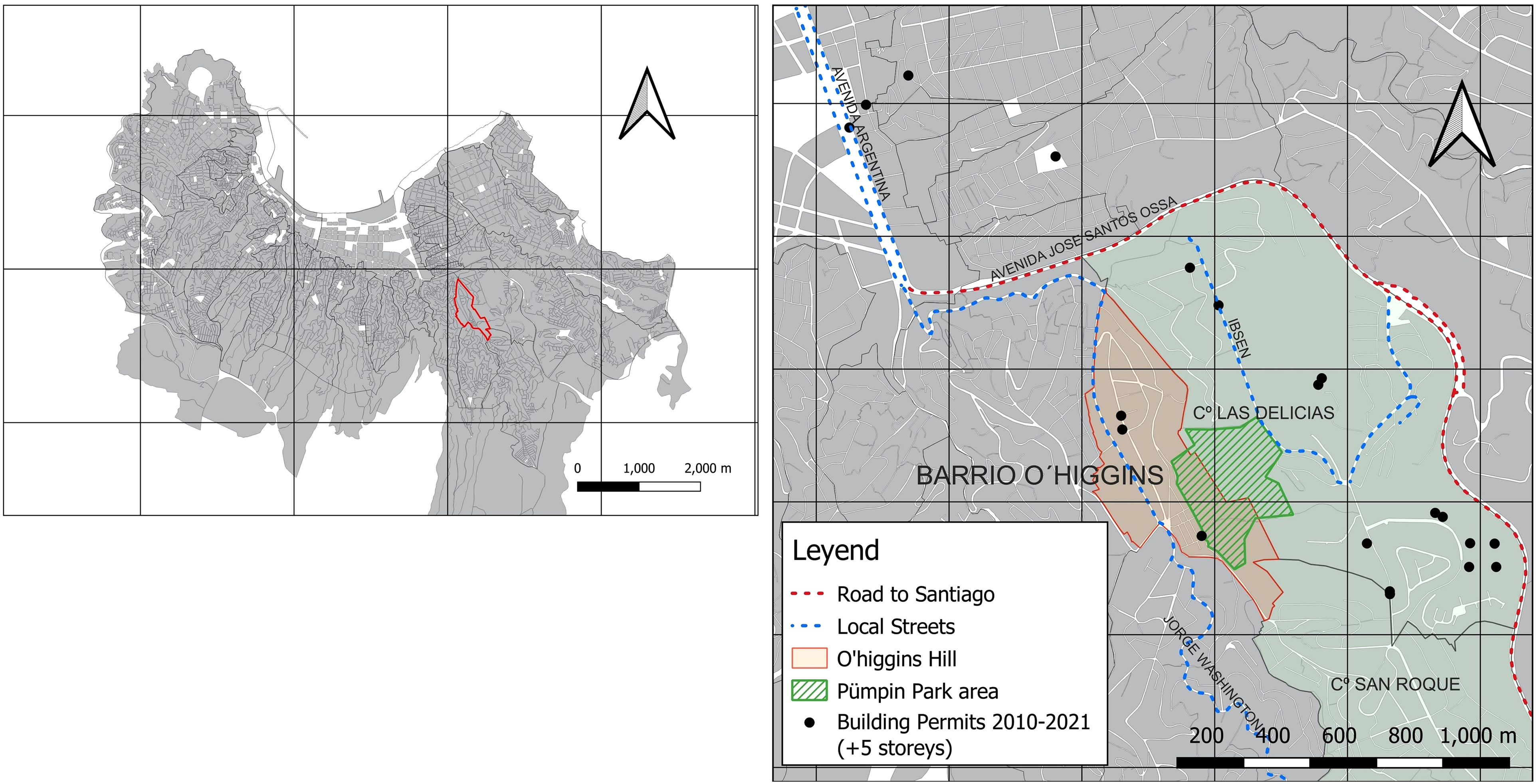
Pümpin Park in context. Source: Own elaboration.

Pümpin Park project's draft image. Source: www.parquepumpin.cl.
The area surrounding the project, which includes O’Higgins hill and Delicias hill (as shown in Figure 1) has experienced significant development with the construction of numerous high-rise buildings. Since 2011, approximately 3850 new apartments have been built, with Figures 3 and 4 depicting two adjacent high-rise developments near Pümpin Park. With an average household size of 3.1 people in Chile (according to INE, 2017), the development of Pümpin Park's may bring around 2200 new residents to the area. The National Census reports that the current population in the area is 11,700, meaning that this project would lead to a 19% increase in population due to a single real estate operation. In the context of Valparaíso's complex geography, where houses are built on steep hills, facing winding and narrow streets, problems such as limited water supply, sewage saturation, and traffic congestion are common. The community expressed concerns about the significant increase in housing and the loss of green spaces. A Municipal Councillor commented on the matter: It is not in question the housing projects per se, what is in question is that they are projects that do not have any dialogue with the community … there were 26 towers, 15 floors, that not only affect the standard of living in the neighbourhood, but also how the neighbourhoods are inhabited, it affects electrical and sanitary services, it affects car congestion in a sector that already has problems…. The issue is that they must change the way they do their business…. (Interview, 2021)
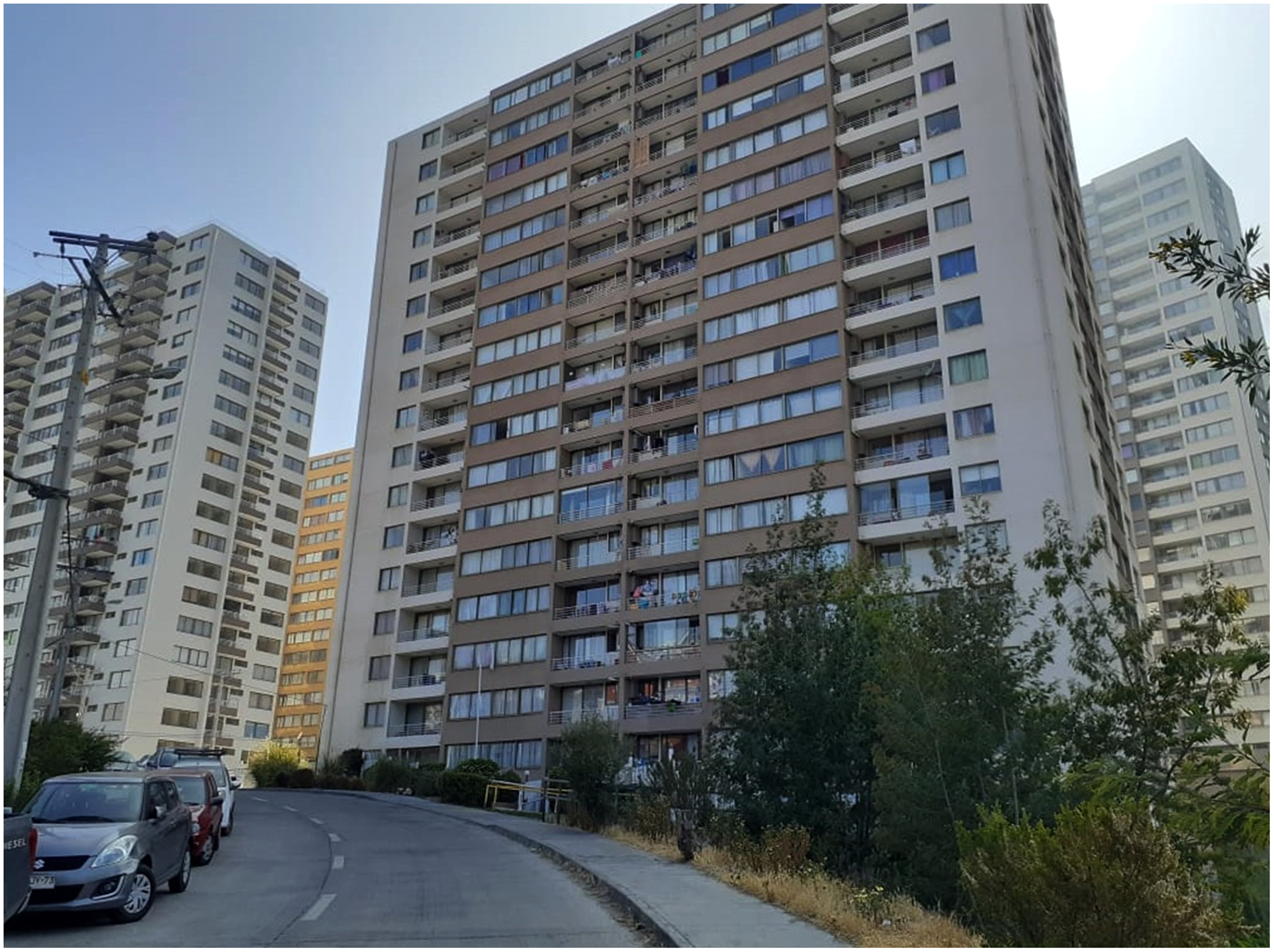
High-rise building next to Pümpin Park.
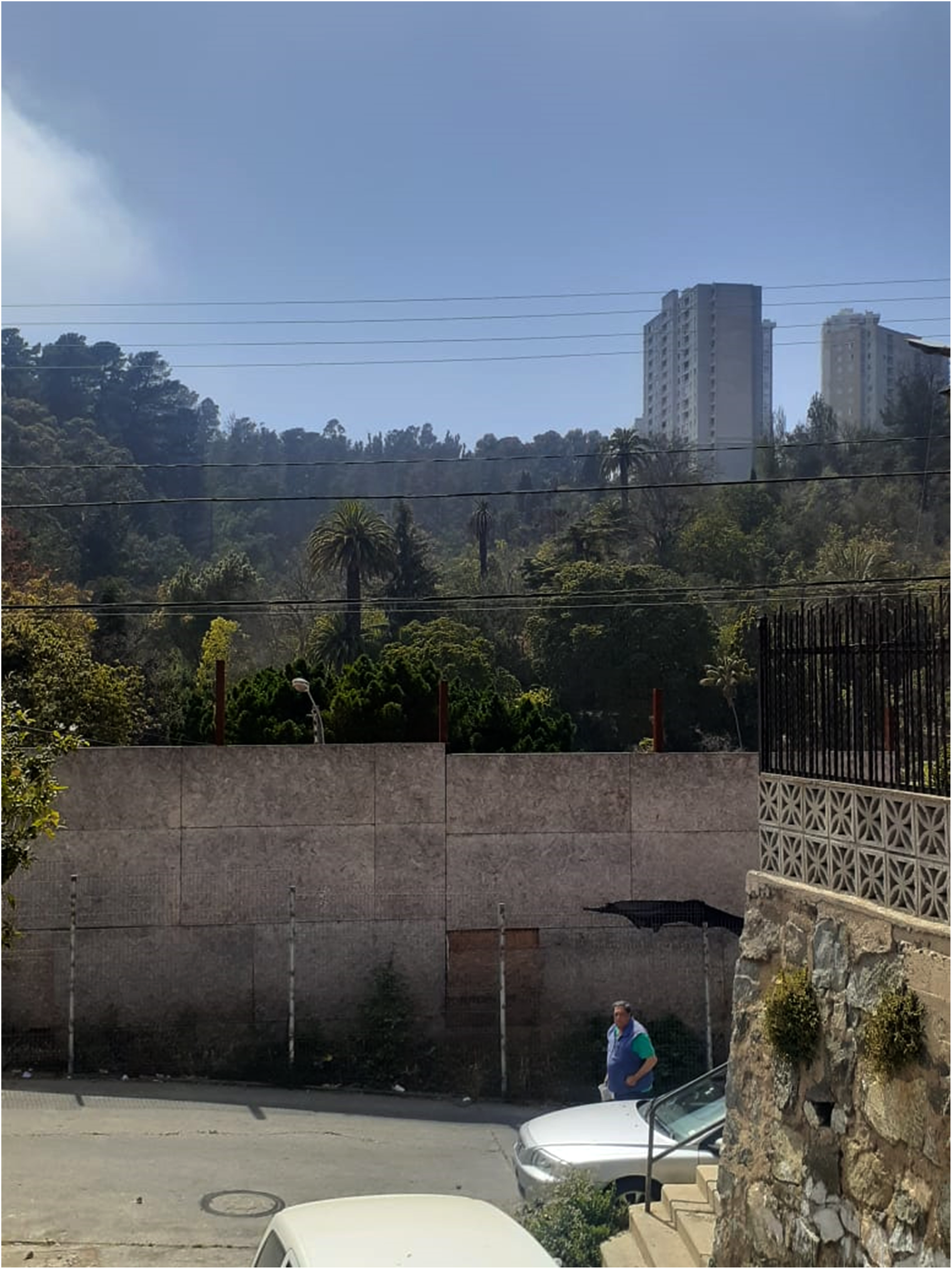
Current condition of Pümpin Park.
During our interview with the project's lead architect, he emphasised that the development of the Pümpin Park project was designed with great consideration for its surrounding environment. While openly expressing his criticism of the existing high-rise towers surrounding the park, he explained how the Pümpin Park project sets itself apart with its unique approach: [W]e did a simulation, and our project did not cover even 8% of the total FAR
5
we could have planned for this project if it were [high-rise] towers. We did an exercise to say, “look, if we wanted to make towers, how much could we do”. In short, I say this to endorse that, somehow, our objective here was to make a project very respectful of the context. We imposed ourselves extreme restrictions because the existing planning codes at the time were very flexible and allowed us to build nearly anything we wanted. (Interview 2021)
The Pümpin Park project's design did not take advantage of the maximum density allowed in the area. While there is a common perception that higher buildings and denser housing are preferred by the lower-middle class, this project's lower density suggests it aimed at higher-income inhabitants. Due to the limited number of high-quality housing units in the park surroundings, this project's economies of scale are not as high, resulting in housing prices that may exceed the neighbourhood's average. The architect interviewed suggested that the range of prices for the dwellings should be from 1800 to 4000 UF, which is above the average prices in Valparaíso. Additionally, Valparaíso's average household income is lower than the national figures, making these units unaffordable for many locals.
To summarise, even though the Pümpin Park site has been historically private, it holds great importance for the city and its surrounding areas because of its accessibility to the community, botanical value, and commitment to sustainability. It has been maintained by underground watercourses and been a social hub for generations. The Swiss Garden owned by the Pümpin family, and the Chilean Tobacco Company have made it an important ecological, recreational and emotional common ground. The proposed housing project in 2013 sparked controversy as it would displace this important green space. The park has been closed to the public since the beginning of the project, leading to further protests.
The DONP
In 2013, the DONP was created following a warning from a Municipal Counsellor from the Pacto La Matriz political organisation about the imminent approval of a housing project. The potential loss of this green space brought together residents and local leaders from various neighbourhoods around Pümpin Park, including those in lower-income areas, highlighting the DONP's socioeconomic diversity. Since then, the movement has regularly protested and built a strong community support network to question the project's legality. They have also gained political support from political figures, including members of the national Parliament, Mayor Sharp, and Municipal Council members. However, the DONP´s success is due to its evolution from an organised group of residents to a broader collective, learning to work cohesively and placing Pümpin Park at the centre of the conflict. Additionally, DONP leaders have collaborated with other networks to defend other green areas in the city, given Valparaíso's limited park space. The DONP's strategic relationship with the municipality reflects a new form of post-neoliberal, communal governance logic, as defined by Lauermann (2018).
The majority of the core participants in the DONP are middle-class individuals, although there are also working-class members who have played an important role in community engagement tasks. O'Higgins Hill is situated amidst vulnerable hills like Ramaditas and certain parts of San Roque (PLADECO, 2020), which has led to support from a broader range of social classes. Among the members are professionals such as lawyers and architects, who have been able to navigate the complex and bureaucratic hurdles associated with the real estate project. However, the movement required extended support as the scale of the urban struggle is significant. Territorial organisations in less affluent areas have pledged their support as they too are under real estate pressure. The composition of DONP, which includes individuals from mixed social classes, is relatively new compared to past middle-class movements, such as those opposing coastal projects in the latter half of the 2000s (Caimanque, 2023). [W]e began to understand that we are a tiny movement, like ten people. We look bigger for everything we have achieved [before], but we are few. Helped by many, yes, but we are few. We began to understand that we also must unite with other struggles to have more strength and a louder voice. The best thing about this movement is that each one plays a role. The lads (architects, lawyers) are the technical side of the campaign, and I am the community organiser with the Juntas de Vecinos
6
, aligning leaders and training the neighbours; that is my role. And “person A” with “person B” see the administrative part. (O’Higgins Movement activist #1, Interview 2021)
It is valuable to understand the composition of the DONP movement, which operates through a network of collaboration and solidarity. Although led by a small group, the movement has expanded its reach within and beyond the Pümpin Park area, gaining social and political support. Despite private property rights, the movement remains steadfast in its goal to preserve Pümpin Park as a green area as it benefits both local residents and the city as a whole. Valparaíso has only 1.25 m2 of green areas per inhabitant, the worst among the 117 municipalities measured by the State (SIEDU, 2022). So, [the park] contributes to the immediate environs (given its amenities) and the entire city due to this lack of green areas…. (O’Higgins Movement activist #2)
…then the fact that there are these green areas constitutes for us a [space of] relaxation (…), in a compressed way of living due to the density that exists in Valparaíso, so its preservation becomes vital. (O’Higgins Movement activist #3)
The class component of the DONP movement, led by middle-class activists, including some from the original Valparaíso Ciudadano movement that won the 2016 elections, cannot be denied. The connections with the local government and the professional background of its key members may explain some of the outcomes presented in this work. Some of the DONP's discourses also express NIMBYism, as the housing project will deprive nearby residents of the existing green area and devalue their properties. However, their struggles are not completely disconnected from structural issues in the city and lower-class problems, which are sustained by precarious forms of accumulation by dispossession. The DONP members maintain that the project harms an integral part of the city, and their struggles contest local politics that allow this kind of project elsewhere in Valparaíso. Therefore, the environmental argument is undoubtedly a key factor in this movement's struggle: I believe that environmental preservation cannot have people against it. Two municipal administrations ago, they unanimously supported us – including right-wing councillors – (…) Today, you cannot make public rejections (…). If there is something valuable, it is what we did from the beginning, which is to lead to an accessible language for authorities and residents regarding the value of the landscape and the [use] value of the land. (O’Higgins Movement activist #4)
The conflict at the centre of this issue stems from a partnership between developers and previous municipal governments, which overlooked the potential impact of the intervention. The developer's plan prioritised urban entrepreneurship, with the municipal side neglecting to address the issue. As a result, efforts to challenge the Pümpin Park project began soon after the Director of the Municipal DOM granted the Draft Project Permit during the previous right-wing mayoral administration under Jorge Castro in 2013. The Pümpin Park project's blueprint was submitted amidst an updated planning regulation to designate the area as a Green Area in the city's master plan. Chilean law allows freezing (postponing) of all building permits in urban areas subject to planning modifications, so the draft blueprint was submitted just before the municipal decree was enacted, between 26 August and 3 September 2023. The DONP deemed this “precise timing” as evidence of the previous municipal-private actor alliance.
In 2014, the DONP presented evidence to the National Comptroller regarding irregularities and the environmental impact of this project. The National Comptroller is an autonomous governing body that oversees the legality of administrative acts in the state. The DONP argued that the draft project was incomplete and had undergone multiple modifications that were against national planning and construction laws. The Comptroller invalidated the permit, but Mayor Castro's team used administrative tools to keep it in force. Informants have claimed that the municipality provided the developer with privileged information to modify the project's draft in an irregular manner.
Finally, in 2015, the project received Building Permit Code N°301/15, which differed from the original draft. Once again, the DONP movement reached the Comptroller at the Regional Level, obtaining favourable resolutions regarding their claims of illegality. Interestingly, the campaign did not take legal action against the project despite arguing that the building permit was illegal. Instead, the movement’s actions were oriented towards stopping the project through institutional inquiries to unveil a series of structural practices configuring Valparaíso's entrepreneurialism.
Alcaldía Ciudadana and the neoliberal backlash
The arrival of Sharp's Alcaldía Ciudadana political movement implied clear support for the DONP's struggles against the Pümpin Park project. This period also brought about a more aggressive role by the project developers to ensure its materialisation. Once the Regional Comptroller's resolution favouring DONP claims was published, Inmobiliaria del Puerto reached out to the National Comptroller to reconsider it. In March 2017, one year after Sharp took cabinet, the National Comptroller declared that the building permit resolution was legal and called on the Director of the Municipal DOM to rightfully use its authority to ‘not invalidate’ its resolution (Poder Judicial, 2021).
During this time, there were conflicts between the current Mayor Sharp and the DOM, an independent body within the municipality's structure. Although DOM Directors are municipal officials, they are appointed by the Regional Ministerial Secretariat for Housing and Urban Planning, which has the power to approve building permits. This political independence of DOMs in Chile aims to prevent collusion with mayors and the misuse of power to benefit or harm private individuals. Its purpose is to avoid any conflicts of interest or undue influence (Figures 5 and 6).
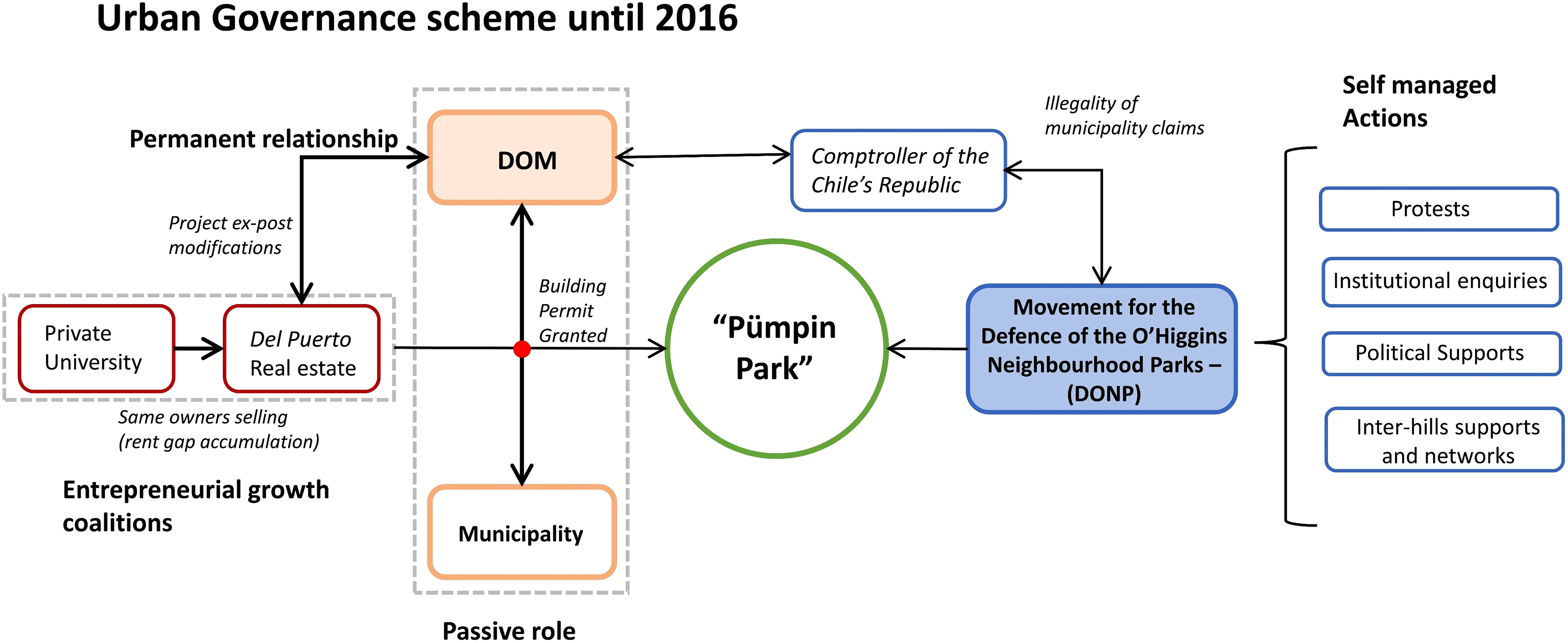
Pümpin governance shifts (before Alcaldía Ciudadana).
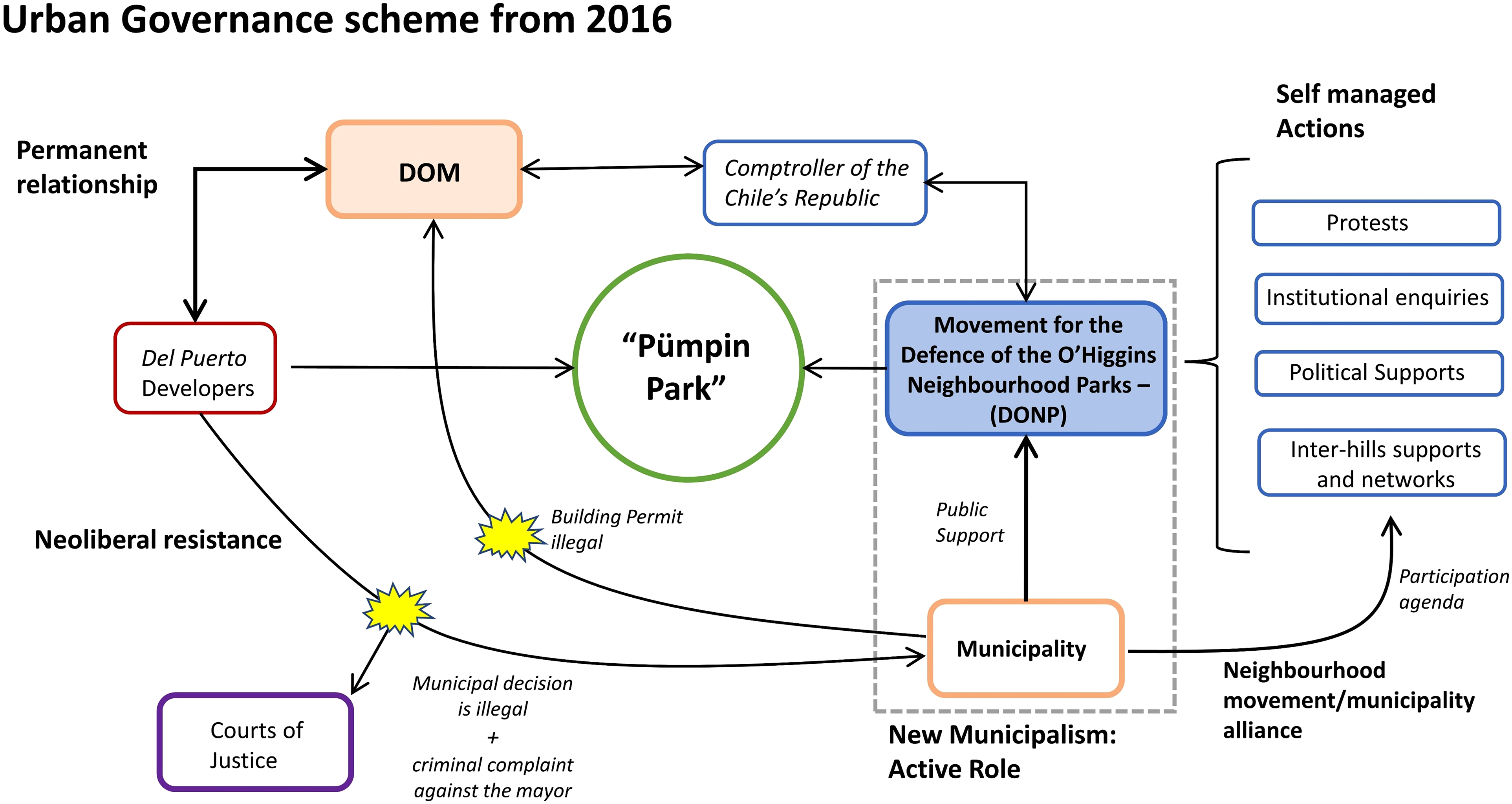
Pümpin governance shifts (after Alcaldía Ciudadana).
In August 2017, under Sharp's rule, the DONP movement presented a claim of illegality of the Building Permit before the municipality, which responded with two mayoral decrees that left the Building Permit N°301/15 ineffective. This meant that the imminent construction of Pümpin Park was once again indefinitely delayed.
By this time, the municipality had began an internal investigation against the DOM Director, who had been temporarily removed from his duties. Only at this point did the Pümpin Park project come before the courts of justice when Inmobiliaria Del Puerto filed a lawsuit against Mayor Sharp, accusing him of “administrative dishonesty, in a reiterated, consummated character, as an author” 7 . This accusation drew upon Mayor Sharp's overt position against the project during and since his municipal campaign and his alleged closeness with the DONP movement.
The politicisation of the Pümpin Park project resulted in two outcomes. Firstly, it aimed to protect and legitimise the project by obtaining the building permit to ensure its construction, thereby reinforcing the connections between the developer and the previous forms of governance. On the other hand, the accusation against Mayor Sharp was a natural reaction to the municipal action, which could lead to his removal as Mayor and a clear statement regarding the approaches to the city's development that the municipality and DONP support. Additionally, this measure directly impacted members of the DONP movement as they were interrogated by the Police, as per Chilean law, to gather information and build the legal case: The real estate company put it up, and Sharp's lawyers even tried to close the case, but the real estate company insisted that all the neighbours involved hadn’t gone to testify yet. Many of us had to … for example, I had never been in a police precinct here in the city, but I had to visit one to declare. Yes, it is quite a form of intimidation by the real estate company since we are defenceless, poor, and do not have money for lawyers. (O’Higgins Movement activist #1, Interview 2021)
Although the Supreme Court's resolution was a backlash to the DONP movement's aspirations, the project development entered a period of uncertainty. The expectations were that Inmobiliaria del Puerto would resume construction, but that did not happen. After studying alternatives, such as selling the land site to another developer, or even consolidating a green area for the city, the fact so far has been the project’s withdrawal in 2021. At this point, Valparaíso's municipalist discourses turned into limited but influential actions in supporting the DONP struggles, proving to be effective in overthrowing a controversial project in the city. However, any idea of a collective action framework became reduced to a strategic relationship between the movement and the municipality. As the municipality is institutionally weak within the centralised Chilean administrative system, with a particularly entangled relationship with the DOM, the political measures used in Valparaíso ended up, in practice, with the prevailing political figure of the mayor over any collective imaginary, blurring, regarding the urban conflict, the core concepts of the new municipalism.
To secure the future of Pümpin Park, the DONP contacted the Regional Ministerial Secretariat for Housing and Urban Planning, requesting the expiration of the Building Permit. This was based on a report from the Regional and National Comptroller in 2018, which showed that no construction work had been conducted on the site for three years, rendering the permit legally invalid. As a result, Sharp's administration directed the DOM to issue a decree for the permit's expiration in July 2022. There is ongoing debate surrounding the so far happy ending for the DONP people's demands against the project. The city's private green area needs to be transformed into a suitable public space. To achieve this goal, the city's mayor and Members of Parliament have requested the national state to either purchase or expropriate Pümpin Park, consolidating it as a public space. However, the future of the site remains uncertain.
Conclusions
We will now assess whether Valparaíso's governance aligns with new municipalism principles, based on the events surrounding the failed housing development in Pümpin Park and the partnership between the municipality and the local community. Even if we assume that Valparaíso's government follows new municipalism practices, it is still in its early stages of development, both in theory and in practice. The dispute over Pümpin Park serves as evidence of the potential and limitations of new municipalism in dealing with large-scale urban projects under centralised political and economic systems (Toro and Orozco, 2023; Navarrete and Toro, 2019) that are still dominated by entrepreneurial models of urban development, as found in Chile.
Although utilising established normative frameworks can serve as both a constraint and an empowering tool to develop a municipalist agenda (as noted by Thorpe and Morgan, 2022), Valparaíso's efforts face significant challenges due to weak institutional frameworks and limited legal authority. Moving beyond resistance and towards building urban alternatives, such as linking ecological protection with critical social demands to address the city's housing shortage, remains a significant obstacle. Valparaíso's new municipalism has yet to overcome its scalar traps (as described by Russell, 2019), and building strategic relationships with the national government is still crucial. Chilean citizens have been advocating for structural changes at both the local and national levels for almost twenty years, but the new municipalist agenda appears to be limited regarding urban development, a challenge that Valparaíso could not resolve by applying its own local resources in this case.
Despite the challenges faced at the national level, such as a lack of resources and weak institutional frameworks, Valparaíso's new municipalism has found success locally. For instance, the Pümpin Park developer attempted to gain more profit by closing a shared green space for a select few property owners. However, the local municipality of Valparaíso took administrative action against the project, reinforcing its commitment to preventing this type of lucrative enclosure. This action strengthened the political bond between the grassroots and the municipality, but it also put the mayor's political capital at risk. However, while this move may have boosted the mayor's position in local and national politics, it weakened the core ideals of new municipalism as a collective force where the leader is not the main component. Therefore, we observe a disconnect between new municipalism as a theory and the actions taken by Mayor Sharp in this particular case. The Pümpin Park case was ultimately resolved by placing the mayor's figure at the centre of the conflict, but this does not diminish the effectiveness of new municipalism elsewhere. We acknowledge Valparaíso's successful application of new municipalist principles fully in other areas of the city, but this is not the case in Pümpin Park.
In the struggle around Pümpin Park, the grassroots organisation composed of property-owning middle-class and working-class individuals did not demand socio-political coalitions for welfare provisions, but rather sought to prevent the dispossession of an ecological site that everyone uses. The DONP contested core features of an elite capture (Lauermann and Mallak, 2023), as they fought against institutional privileges and the hoarding of a historic and scarce common green space to build an exclusionary entrepreneurial project. It is well known that the group responsible for the redevelopment project had ties to the right-wing political spectrum and was associated with significant wealth in the country. As a result, the community's fight was not only against the exclusive, privatising nature of the redevelopment, but also a symbolic battle against private political and economic power. Even by ultimately not producing an outcome beyond the status quo, the DONP and the Municipality achieved to form a proximal, effectively politicised organisation. Borrowing Thompson's (2021b) words, this case serve as an example of ‘early new municipalism’, because Municipalism is not just about mimicking and improving a (social-democratic or even democratic-socialist) national statecraft at the local level, as many of the advocates of community wealth building seem to suggest. It's about starting with a ‘politics of proximity’ that only the urban scale can provide as the basis for organising spaces of solidarity and developing new popular institutions for political and economic democracy.
This case raises two important questions. Firstly, how can Valparaíso's new municipalism avoid the scalar trap and create urban development alternatives that cater to the needs of all residents in the future? Secondly, what will be the future negotiations for the maintenance and financing of Pümpin Park, and who will participate in them?
To make Valparaíso's approach to new municipalism truly effective in empowering communities, it is crucial to develop a shared vision and plan for the city. This means creating alternatives to the false choice of urbanism that limits options to either gentrification or urban stagnation. The case of Pümpin Park demonstrates the unavoidable and contested connection between legal ownership and the social and political nature of space (Blomley, 1994). Despite the dominance of property rights and state-led entrepreneurialism, it is possible to propose and implement alternatives for development in desirable areas. The next steps should focus on establishing Pümpin Park as a well-maintained and financially sustainable green space for the city, with the involvement of different actors committed to fulfilling the promise of new municipalism.
Footnotes
Acknowledgements
We are grateful to the people of Valparaíso for their generous help in the elaboration of this article and for setting an example in the defence of green historic areas in the city. We also extend our thanks to the people of Viña del Mar for their contribution.
Declaration of conflicting interests
The authors declared no potential conflicts of interest with respect to the research, authorship, and/or publication of this article.
Funding
The authors disclosed receipt of the following financial support for the research, authorship, and/or publication of this article: The research and findings for this paper was supported by the Chilean National Agency for Research and Development, project Fondecyt N° 3210089 and Fondecyt N° 1210972.
Notes
Correction (November 2023):
Article updated to correct Rodrigo Caimanque's affiliation as ‘1', since he is affiliated with only first affiliation, and details of the following references ‘Vergara-Constela C and Casellas A (2016)' and ‘Vergara-Constela C and Carroza N (2021)’ in the reference list. Additionally, funding statement has been updated. Please see  for more details.