







Abstract
Hegemonic climate discourses advocate for sustainable transitions to reduce vulnerabilities and build resilience. However, these global discourses are often influenced by colonial narratives that persistently contribute to and reproduce extractive relations of power in places most impacted by climate change. Drawing on findings from one year of ethnographic research, this visual intervention focuses on a decolonial praxis in Puerto Rico, a colonial territory that has faced a series of major disasters in recent years. It engages with the artistic landscape interventions of Casa Pueblo, a community autogestión organization in the archipelago that has spearheaded an energy insurrection by promoting community-based solar energy projects as an alternative to climate adaptation and energy access. Using a decolonial lens, this article features nine artworks in the town of Adjuntas to affirm that artistic landscape interventions are critical building blocks in community autogestión-led transformation. They function as powerful expressions of beliefs, worldviews, and values, challenging colonial narratives, embodying aspirations for alternative futures, and creating new possibilities for social and environmental change. This insight enriches the discussion regarding energy transitions by presenting one dimension of autogestión-driven transformation efforts actively unfolding in a colonial territory lacking representation within global climate and energy debates, but working nonetheless to re-exist in a context of constant injustice and vulnerability.
Introduction
In a context of global climate discourses that advocate “top-down” measures and modernist “sustainable development” policies to reduce vulnerabilities and build resilience, this Visual Intervention explores the bottom-up efforts of Casa Pueblo in Puerto Rico. This community autogestión 1 organization is spearheading an energy insurrection by promoting community-based solar energy projects as an alternative to top-down, large-scale climate adaptation and energy projects that often reproduce extractive relations of power (Dunlap, 2020, 2023a; Temper et al., 2020). Casa Pueblo supports a range of interrelated economic, cultural, environmental, and social projects, such as Bosque Escuela, 2 Galería de Arte Joaquín Parrilla, 3 and Radio Casa Pueblo. 4 Among these projects, art and culture serve as foundational elements to educate and engage with community members.
Using a decolonial lens and insights from a year of ethnographic research, this piece highlights artistic landscape interventions as a critical component of community autogestión-driven transformations, 5 demonstrating their role in shaping the personal sphere 6 of transformations by expressing beliefs and values and influencing how experiences and possibilities are understood (O’Brien, & Sygna, 2013; O’Brien, 2018; Rodríguez et al. 2024). In Puerto Rico, autogestión efforts go beyond community resistance to adverse situations and entail re-existence. The decolonial concept of re-existence involves decentering established colonial and modern logics, exploring different possibilities and ways of living and constantly constructing a different world (Achinte, 2013; Hurtado & Porto-Gonçalves, 2022). Therefore, following Catungal (2019), Maldonado-Torres (2017), and Merlinsky et al. (2020), art in the pursuit of re-existence transcends aesthetics, serving as spaces to challenge political realities and envision alternative ways to think of ourselves through creativity and imagination.
Energy insurrection
Following hurricanes Irma and María in 2017, energy access became a critical factor in determining the level of exposure and quality of life for many people in Puerto Rico (Kishore et al., 2018; CPI, 2018). While the government has proposed large-scale projects to transition to renewable energy, these initiatives are often framed within technomanagerial approaches and an urgent climate discourse that justifies top-down mandates. This dominant framing focuses on shifting from one energy source to another while maintaining the same colonial power dynamics (Dunlap, 2023b; Feola et al., 2021; Tornel 2023). In this context, community autogestión efforts go beyond energy transitions, aiming to foster transformations and achieve the decarbonization, decentralization, democratization, and decolonization of the archipelago's energy future (Massol-Deyá, 2022; De Onís, 2021). In a word, enact an energy insurrection.
Casa Pueblo is an autogestión organization based in Adjuntas, Puerto Rico, tracing its origins to a 1980 antimining community resistance effort. Since 1999, it has been promoting the use of solar power to reduce vulnerability and increase community resilience. This effort became particularly notable after the recent hurricanes, as the autogestión organization turned into an energy oasis and a reference point for both community-led and government-led initiatives. Casa Pueblo's solar energy initiative has provided power for homes and critical infrastructure, while also enabling local businesses to generate and manage their own energy (Massol-Deyá, 2022). Their efforts are conceptualized as an “energy insurrection” as they have been led from the bottom-up, rather than by public policy, and are disrupting the narratives and actions of a system that promotes privatization and dependency (Dunlap & Tornel, 2023; Massol-Deyá, 2022; Stock, 2023).
Reflecting on nine artistic interventions created by local artists as part of Casa Pueblo's energy insurrection, this piece asserts that such interventions are powerful expressions of beliefs, worldviews, and values that confront colonial narratives, embody aspirations for alternative futures, and open new horizons of possibility for social and environmental change. Documented with the support of community members and local artists 7 and inspired by scholarship in art and political ecology (Achinte, 2013; Leff et al., 2003 Maldonado-Torres, 2017; Merlinsky et al. 2020), this article organizes the artwork into three themes—re-thinking, re-imagining, and re-building—to highlight their role as critical building blocks of community autogestión-driven transformations toward alternative futures.
Re-think
Long-standing patterns of colonialism and capitalist modernity have reproduced oppression and marginalization by promoting accumulation by dispossession, separating humans and nature, and perpetuating universal notions of progress and development (Avilés-Vázquez et al., 2023; Massol-Deyá, 2022; Tornel, 2023). Casa Pueblo's efforts represent an emancipatory shift in the energy narrative, extending beyond the transition away from fossil fuels. They encourage individuals to reflect on the climate experiences of the archipelago, prompt re-thinking of the actions that have precipitated these changes, and inspire a reevaluation of the relationship with natural resources.
These interventions highlight Puerto Rico's experience as a geographic space highly exposed to climate change and related natural phenomena, such as hurricanes (Figure 1). They educate about the increase in temperatures in Puerto Rico, depicting extractive actions and the need for behavioral shifts (Figure 2). These interventions also incorporate symbolic elements, such as the butterfly (Figure 2) and Pacha Mama (Figure 3), which represent the potential for transformation and emphasize the belief in the interconnectedness of humans and nature.

Image of the painting by the artist Danny Torres. This painting, depicting climate change vulnerability, is located in the center of Adjuntas, in the parking lot of a local business. (Photo: Author).

Image of the painting by the artist Danny Torres. This mural, centered on climate change, reflects on its root causes and considers potential solutions. It is located near the town square of Adjuntas, in the parking lot of a local business. (Photo: Author).

Image of the painting by artist Verónica Aponte. This painting appears near the town square of Adjuntas, in the parking lot of a local business. (Photo: Author).
Re-imagine
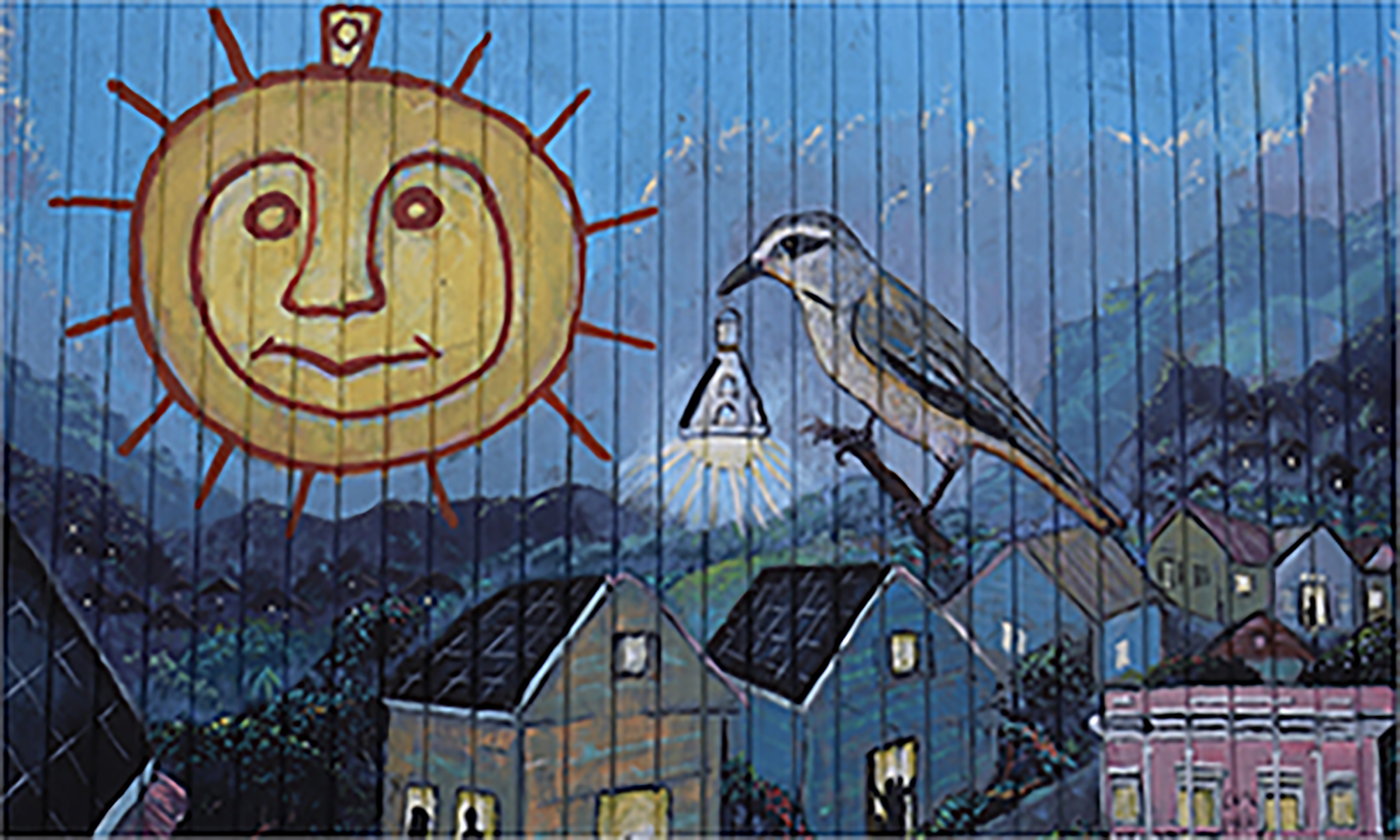
Alongside re-thinking the current reality there is also the need to re-imagine a different future. Re-imagining involves a process of self-recognition as a constitutive part of an environment to create and identify opportunities to reinvent oneself (Leff et al., 2003; Maldonado-Torres, 2017; Merlinsky et al. 2020). Casa Pueblo's murals incorporate familiar symbols, such as the “Sun of Adjuntas” (Indigenous petroglyph) and the Julián Chiví bird, 8 to foster a sense of place and belonging. These artworks also connect past worldviews and collective memories with present needs and future aspirations.
Casa Pueblo's artworks encourage people to re-imagine their community as a socially embedded territory, where the sun can lead the way and support people in the same way it did in the past. They incorporate representations of the Taíno (Indigenous people) (Figure 4) and establish the “Sun of Adjuntas” as a familiar, unlimited, and endogenous source of energy (Figure 5). The artworks also feature the “Cucubanos” 9 and the Julián Chiví bird holding a solar light bulb, mirroring those distributed in the aftermath of Hurricane Maria. These initiatives not only educate citizens on energy governance but also raise ideas for the times ahead (Figure 6).

Art intervention by youth volunteers from New Orleans and artist Jesús Ortiz. It is displayed at a local business in Adjuntas (Photo: Author).

Art intervention about the “Brother Sun” by the artist Danny Torres. It is located next to one of the main roads in Adjuntas. (Photo: Author).
Art intervention by artist Jesús Ortiz. It appears on the wall of a local business in the center of Adjuntas. (Photo: Author).
Re-build
Collective re-imagining fosters a collaborative approach to re-building the future (Leff, 2017). These artworks challenge the persistent colonial and green capitalist models of energy transitions by materializing visions for alternative realities (Post, 2023). Rooted in Puerto Rico's broader history and struggles, these alternatives emphasize the territory as a space of rich community-driven possibilities (Torres-Abreu et al., 2023).
Casa Pueblo's art interventions demonstrate how Puerto Rico's energy present and future can be rebuilt. These efforts include schematic designs of basic solar energy systems for homes, educating residents on alternatives to reduce dependence on the current energy system (Figure 7). In the Alto de Cuba neighborhood, they emphasize the critical role of organized communities and collective identity as the foundation of such initiatives (Figure 8). In spaces like the Bosque Solar, 10 now the Plaza de la Independencia Energética, 11 they showcase tangible, community-driven approaches to repurposing public and abandoned spaces. Grounded in solidarity, these initiatives strive to democratize access to renewable energy while offering viable solutions for both citizens and policymakers (Figure 9).

Schematic artwork by artist Danny Torres. It is located next to one of the main roads in Adjuntas. (Photo: Author).

Collaborative artwork created by community members, volunteers, and artists Danny Torres and Verónica Aponte at the entrance to the Alto de Cuba Solar Community, a neighborhood in Adjuntas. (Photo: Author).

Bosque Solar is a functional artwork, located near the town square of Adjuntas, created in 2022 through collaboration with various infrastructure and art partners. In 2024, it was transformed into the Plaza de la Independencia Energética, where the Sun “speaks” of solidarity and the columns convey the foundations of their efforts, including autogestión, culture, and community, among others. (Photos: 1–4 Author / 5 Casa Pueblo).
Conclusion
Art for re-existence transcends aesthetic interventions, creating spaces to challenge political realities and envision alternative ways of understanding ourselves through creativity and imagination. Casa Pueblo's artistic landscape interventions exemplify one dimension of an autogestión-driven transformation unfolding in Puerto Rico, a colonial territory where energy transitions are central to both discourse and action. Every day, in public spaces, these artworks emphasize the interconnectedness of humans and nature, integrate past worldviews, and inspire and educate all who encounter them about the possibilities for the archipelago, using local resources and embracing solidarity. Casa Pueblo's interventions embody a decolonial praxis, challenging dominant narratives on energy transitions and fostering re-existence in the face of systemic injustice and vulnerability. They provide foundations for an energy insurrection—one without arms or violence, instead brimming with communal ideas for an alternative future.
Footnotes
Acknowledgements
The author sincerely thanks Casa Pueblo, along with the volunteers, community members, and artists who generously shared their insights, knowledge, and work. Special thanks to Verónica Aponte and Danny Torres for their support in documenting the organization's artwork. Appreciation also goes to Christie Nicoson for her initial efforts in documenting the organization's artistic interventions, which helped inspire this piece. The author is also grateful to Noella Gray, Sasha Davis, Alexander Dunlap, and Carlos Tornel, as well as the two anonymous reviewers, for their valuable feedback and support.
Declaration of Conflicting Interests
The author declared no potential conflicts of interest with respect to the research, authorship, and/or publication of this article.
Funding
The author disclosed receipt of the following financial support for the research, authorship, and/or publication of this article: This work draws on research supported by the Social Sciences and Humanities Research Council of Canada (Grant Number – 430736) and the University of Guelph.
