







Abstract
This research paper investigates normative approaches to socio-ecological change through a case study of small-scale ecological farming. This paper makes the claim that a variety of normative responses and practices responding to contemporary socio-ecological crises face barriers that are internally related to the contradictions of development and market-based approaches to change. This paper will show that there are normative responses to future formations of socio-ecological relationships that arise from ecological modernism, that emphasizes technological change in agriculture such as through ‘precision agriculture’, and alternative food networks and food sovereignty, that is critical of conventional agrarian development. This paper examines these normatively based framings about agrarian futures and development, with a particular focus on practitioners in non-conventional and alternative food networks. Through in-depth semi-structured interviews with farmers, market gardeners, and other participants with knowledge and experience of the local food provisioning context in southern Manitoba, and through participant-led ‘farm walks’, this research sought to observe, examine, and contextualize the experiences and perceptions of select operators of small-scale ecological farms, and the barriers they face in practicing ecological farming.
Introduction
Research critical of capitalist development points to crisis tendencies that are expressed through social crises of affordability and unemployment, legacies and continual effects of colonial and imperialist wealth transfer, and environmental contradictions related to climate change, energy, and biodiversity loss, to name a few (Harvey, 2014; Patel and Moore, 2017; Patnaik and Patnaik, 2017). Capitalist development in the agri-food sector has also been on a trajectory of further concentration and centralization in national and global food systems (EcoNexus and Berne Declaration, 2013; ETC Group, 2017), giving rise to inequitable development and social and ecological crises (Akram-Lodhi, 2013; Albritton, 2009). These crises can generate ‘normative’ discourses, conceptualizations, and imaginations about potential future socio-ecological formations. Given the profit motive, what are potential barriers and limitations to instituting social change more attuned to social and environmental needs?
This paper contributes to literature on normative responses to socio-ecological crises with a case study of what has been termed ‘small-scale ecological farming’ from alternative food networks. This research investigates this topic through fieldwork on small-scale producers in southern Manitoba, Canada. This paper will first frame different approaches to normative ecological futures including (1) ecological modernism (Ecomodernism, 2016), that identifies the importance of new technologies like ‘precision agriculture’, and (2) the ‘food sovereignty’ and ‘alternative food networks’ movements, that contain an assortment of practices such as agroecology, small-scale and local food production which prioritize multi-scalar holistic practices to socio-ecological change (Altieri, 1995; Barbera and Dagnes, 2016; Isaac et al., 2018; Varghese and Hansen-Kuhn, 2013). Next, this paper will situate small-scale ecological farmers in alternative food networks (e.g. as opposed to the ecomodernist approach) through an investigation of the motivations, perceptions, conditions, and experiences of ecological farmers and the barriers they face linked to dynamics arising out of conventional agriculture. My findings suggest that there are limits to the expansion of this form of farming despite there being a cultural and social expression of support for socio-ecological models of agrarian production.
Methodology
This research project's methodology includes a brief review and framing of normative discourses of agrarian change and the collection of primary data through a series of in-depth, semi-structured interviews and participant-led farm walks. Fieldwork began in the spring/summer 2022 season and extended to the end of 2022. Afterwards, analysis of the fieldwork data in line with a review of normative approaches was conducted. A total of 15 in-depth, semi-structured interviews were conducted: 10 interviews with farms or market gardens that supply food for southern Manitoba and 5 interviews with others who have experience with alternative farming networks. Participants were first identified primarily through online searches, recruited through cold-contact calls, emails, and in-person introductions at select farmer markets in southern Manitoba. The smaller population size and niche characteristics of what constitutes ‘small-scale ecological farming’ limited the number of participants I recruited, for example, who defined their operations along ‘ecological farming’ practices, and who supply for local food consumption. Farm size is an important consideration given the political economy of agrarian capitalism and concentration of land, but often times defining these participants based strictly on farm size can be difficult. Bernstein (2010: 2–4) points out that terms like small-scale and family farming are dependent on context, and as other research in Manitoba points out, the designation of ‘small-scale farms’ varies by location, context, or sector (Lees, 2015: 15; see Statistics Canada, 2017, 2022a for their occasional usage in Canada). The participants I selected mostly cultivated a few acres of land (from about 1 to 6 acres, varying across years) for vegetable production, while a few produced feed or raised animals on a larger property size. The interviews with farm operators began with basic questions about the history of operations, setup, market conditions, and production practices, and included questions on their opinion on the future of the ecological model of farming. As a researcher new to Manitoba at the time, the interview questions with agrarian and food issues-related participants assisted in contextualizing the local and regional sectors. As I identify participants anonymously throughout the text; I have used the notation of (A#) to refer to those participants interviewed on their experience of running their farming or market gardening operation, and of (B#) to refer to those with knowledge and experience in the local food sector.
I also engaged in participant-led ‘farm walks’ with seven of the operations I interviewed. Farm walks were an important research instrument for this project to attain deeper insights and learning through unstructured conversations while observing the farming operation, farm setup, methods, and other notable features or discussion points. I leveraged my existing familiarity with small-scale farm models like those of this study, which I gained from my previous engagement in a 7-month intensive work-learning experience on a small farm, to probe further into emergent topics of conversation and to draw deeper insights from my observations. Additionally, I took photographs during the farm walks of aspects of the farm.
Normativity and discourses of development in the agrarian sector
Critical approaches to agrarian capitalism can be approached similarly to how Marx critiqued capitalism, with an overall critique of the pursuit of profit based on labour exploitation and extraction of non-human ecological wealth, while also considering the tendencies of various crises to emerge. Marx (1990: 636–638) in Capital Volume I provides a general outline of the contradictions of capitalist agriculture as having similar tendencies to large-scale capital accumulation: the concentration and centralization of the productive forces that releases the population from direct connections to the land. There are also ‘mixed forms’ of how capitalism can develop if we want to consider different food regimes, paths of development, or different labour formations (Bernstein, 2010: 85–88 and chapter 6; Friedmann and McMichael, 1989; McMichael, 2009; 2013), which include the proletarianization of farmers through their embeddedness in wider agribusiness (Lewontin and Levins, 2007: 329–341). Articulated forms of imperialist relationships that rely on wealth transfer from the Global South to the Global North are also part of this picture (Patnaik and Patnaik, 2017).
Literature critical of market relations highlights the importance of moving away from production and social relations based on ‘market logics’ (McNally, 1993), and to consider differentiated value systems (De Angelis, 2007). Given the trends identified in capitalist agriculture towards greater concentration and centralization of production, what are potential paths of development for alternative social and agrarian futures? I claim that social practices and ideals, along with research projects, practices, and methodologies, all contain certain normative approaches regarding ‘needs’ (Sayer, 2007). Considering normativity is also important for future modelling practices, such as in climate change action for adaptation and mitigation (Pelling et al., 2024), Murray Bookchin (1999: 210–213) interprets a ‘dialectical naturalist’ approach to understanding change and insists on defining ‘what should be’, from ‘what is’, and Escobar (1999) reminds researchers that projects of development are a form of material and discursive invention. Along these lines then, a critique of conventional agriculture, with its ‘developmentalist myths’ that have favoured large-scale and capital-intensive over small-scale, localized, and labour-intensive farming operations (Lewontin and Levins, 2007: 321–328) should be paired with a normative articulation in line with human agency (e.g. of farmers) to establish food sovereignty (Lacey, 2015).
I identify two approaches that relate to socio-ecological futures in agriculture. One approach comes from ecological modernist principles of technological progress and ‘humanized natures’, which could consider advances of ‘precision agriculture’ technologies as necessary to enact ostensibly environmentally friendly practices while also attempting to resolve past issues of environmental unsustainability from ‘productivist agricultures’. The second approach is based on non-conventional forms of agriculture through alternative food networks and food sovereignty, which prioritizes local, extra-economic and community-based forms of production.
Precision agriculture is the integration into agriculture of advances in digital technologies, data collection, artificial intelligence, and drone and robotic production (Gugganig and Bronson, 2022). It is a set of tools, technology, and farm design that transforms production and processing to become more capital intensive. The technological fix to upskill labour (e.g. from manual labour to computer programming and engineering) is reflected in a number of changes, that include but are not limited to, tools to collect and analyse data on the farm site or plant health, the use of various new farm machines such as autonomous vehicles to identify and remove ‘weeds’ to increase yields without the use of, or minimal use of, sprays, or autonomous or semi-automated robots that identify and pick fruits (for some examples, see ATP, n.d.; Carbon Robotics, n.d.; Kubota, 2022). These developments are seen as disruptive technologies transforming agriculture (Fraser and Newman, 2021), which involve an ‘affective’ politics in the usage of these technologies (Carolan, 2023). This technology has been described as designed with environmental considerations in mind (DW Shift, 2021), and it is not uncommon to see discourses of the importance of capital investments and technology adoption as a solution to farm reproducibility in the agrarian fields of both Global North and South, impelling operators to upscale their technological adoptions (Chikava, 2021; Ragasa et al., 2024). These technologies are promoted and studied in Canadian and American contexts (Agriculture and Agrifood Canada, 2022; Astill et al., 2020). A study report from RBC (2019) titled ‘Farmer 4.0’ frames structural formations of the agrarian sector and points to the necessity of investments in new machinery technologies to stay competitive in productivity output. A news release in Canada, for example, considers the development of precision agricultural tools as important to: …[help] farmers better manage their operations and become more efficient and competitive. Investing in innovative precision agriculture tools and cutting-edge approaches is a fundamental way to help the Canadian agricultural sector grow and remain competitive (Agriculture and Agrifood Canada, 2022).
This form of agrarian development has discursive framings that it can replace environmentally problematic inputs (e.g. pesticides and herbicides), with newer forms of technologies that can be diffused across farm sites and free labour from difficult work (see Clapp and Ruder, 2020 for a review). Ecomodernists (2016: 6) frame technological development as advancing so-called humanized natures, where humanity ‘… [must] shrink its impacts on the environment to make more room for nature… [while rejecting] another, that human societies must harmonize with nature to avoid economic and ecological collapse’. The Jacobin magazine in 2017 had some considerations on the importance of embracing technologically mediated futures, celebrating a certain reading of Marx's vision of free time in a future society, and Bookchin (1982: 225–227), who himself had also critiqued a certain reading of Marx's vision of a Promethean view of the labour process, also once considered development as freeing labour from necessity and giving rise to a ‘free community’. Bookchin wrote how mechanization can free human labour to spend time engaging in creative, free, and ‘liberatory’ forms of labour and activity. Dangerous work such as that commonly found in primary sectors (e.g. mining, agriculture), can be automated; in the case of agriculture, he argued that technology …[can be] intrinsically neutral: they can be used to feed immense herds or just a few hundred head of cattle; the silos may contain natural feed or synthetic, harmonized nutrients; the feeder can be employed on relatively small farms with mixed livestock, or on large beef-raising ranches, or on dairy farms of all sizes (Bookchin, 1999: 27).
My fieldwork findings show that this form of development was not found on small farms practicing ecological farming. There are indeed alternative counter-movements that strive to develop and provide Free and Open Source Software (FOSS), or hardware design and projects found on farmhack.org for farmers, striving to ‘overlap between food sovereignty and technological sovereignty’ (Farmhack, n.d.). Research on the adoption of precision agriculture has shown a scale bias and found that it can produce and entrench inequalities, showing typical trends of ‘productivist’ agricultures. Recent research in the United States’ context shows that precision agricultural technologies have primarily been adopted by large-scale producers, outpacing small-scale farms (Lim et al., 2024), and other commentaries have challenged the insistence that technological fixes can be utilized to resolve socio-ecological contradictions (e.g. Mikati, 2021). Another implication of this form of development can be linked to the rise of digital inequalities (Dyer-Witheford, 2015; Varoufakis, 2024); there is a continuing embeddedness like previous developments in agriculture of farmers in the input circuits of agribusiness (Lewontin and Levins, 2007: 329–341). In the case of precision agriculture, there is a further commodification in the form of surveillance capitalism that embeds farmers in ‘big data’ (Stock and Gardezi, 2021). Whether precision agriculture can improve sustainability has been interrogated (Clapp and Ruder, 2020) and recent research reviews how this form of development takes concrete forms that can entrench, rather than relieve, social marginalization and the competitive nature of the sector (Rotz et al., 2019).
The second approach arises from food sovereignty and alternative food networks and is the focus of my fieldwork. These approaches prioritize goals such as sustainability, community development, and a recognition of the importance of small-scale producers (Michel-Villarreal et al., 2019; Shiva, 2016; see also Netting, 1993). In the context of the Global North, a segment of small-scale producers strive to practice socio-ecological principles of land stewardship, ecological land restoration, and local food access outside of conventional agricultural food networks. The character and practices of ‘ecological farming’ are non-conventional, typically including independent and small farm operations or market gardens that employ labour-intensive and environmentally sustainable practices using relatively low-cost tools, that seek to lower input use, improve soil health, promote local biodiversity, among other practices, and establish linkages to consumers (e.g. farmer markets) (Greenpeace, 2015). For those who have the economic means to do so, these farms and market gardens intend to expand an intensive form of small-scale food production along sustainable production approaches and for which there are numerous guidebooks (see Dawling, 2013; Fortier, 2014; Henderson and Van En, 2007 as examples). This push for local food and small-scale operations can be considered a form of market-based entrepreneurial ‘activism’ that seeks to prioritize local food production over more formalistic or bureaucratic-centred agricultural systems (Salatin, 2007). Accordingly, small-scale independent farmers seek to position and market themselves as alternatives to large-scale agri-business that otherwise makes entry difficult for a small-scale farmer. This in some ways echoes Schumacher's (1993: part 2, chapter 2) recognition of non-economic value systems centred along qualitative goals of development: We can say that [hu]man's management of the land must be primarily orientated towards three goals – health, beauty, and permanence. The fourth goal – the only one accepted by the experts – productivity, will then be attained almost as a by-product.
In the Canadian context there has been research on alternative food networks that accounts for its social, ecological, and cultural characteristics (Isaac et al., 2018; Ngo and Brklacich, 2014). The principle of food sovereignty is a normative and multi-scalar framework to create alternative spaces in the food system. Agriculture and Agri-food Canada (2019) also considers policy initiatives for the inclusive and sustainable development of the agricultural and food systems. This form of agrarian production can contain with it some contradictions arising out of, for instance, the labour-intensive facets of this form of farming that can have elements of ‘populism’ within the overall political economy of farm labour (Ekers, 2019; see also Ekers and Levkoe, 2016, 2017), or barriers, such as cost or experience for younger farmers (Laforge et al., 2018; Qualman et al., 2018). Furthermore, there can be a constructed image of the ‘family farm’ and racialized geographies in this form of agrarian development (Cairns et al., 2015).
The next section will focus on this latter approach and consider the implications of these themes surrounding agricultural change, economic transformation, and the contradictions arising out of normative conceptions of agrarian change throughout market-based societies. McNally (1993) takes a critical view of social change through the market, and Albo (2007) considers limits involved in what can be termed ‘eco-localism’. As will be documented in the next section, contradictions emerge in attempting to develop alternative forms of agrarian production.
Agrarian trajectories and the case of small-scale ecological farming
The historical and contemporary structure of agriculture in Canada is one that has resulted in a crisis of the family farm (Giangrande, 1985). Historically, agrarian activism in Western Canada influenced the formation of political economic regulatory features of the sector (Sharp, 1997). The agrarian economy also emerged in the wider context of settler–colonial relationships, where cultural and ecological relationships to food and the land were transformed, articulating development on conventional agricultural principles of ‘productivity’ (Laforge and McLachlan, 2018; see also Giancarlo, 2020). Today, large capital inputs into monocultural and export-oriented production are important characteristics of Canada's overall agrarian development (Otero et al., 2013). Agriculture in Canada has also been reliant on the Seasonal Agricultural Workers Program (SAWP) to employ foreign workers on Canadian farms, about which the National Farmers Union highlights the systemic injustices that occur for migrant labourers (NFU, 2023). The overall distribution of farms by size weighted heavily in favour of large farm holdings over smaller ones (Horner, 1980: 299). Table 1 displays this general change of farm sizes and number of farms for Canada and Manitoba from 1976 to 2021. Farm Credit Canada (2024) reports price increases for cultivated farmland values, with recent yearly changes of +9.9% in 2021, +11.2% in 2022, +11.1% in 2023, and +6.5% in 2024. A recent report considers the consequences of these trends, indicative of further farmer exit (Qualman et al., 2020: 6): While local families may no longer own the grocery or hardware stores, they do still own and operate our farms. But, increasingly, appearances are deceiving. The era of broadly distributed land ownership, of food production by small and medium-sized family farms, is fading. While it remains the case that local families (rather than national or transnational corporations) do operate the vast majority of our farms, there are fewer and fewer of those families every year. (Qualman et al., 2020: 4)
Percentage change of total number of farms and farm area from 1976 to 2021, Canada and Manitoba.
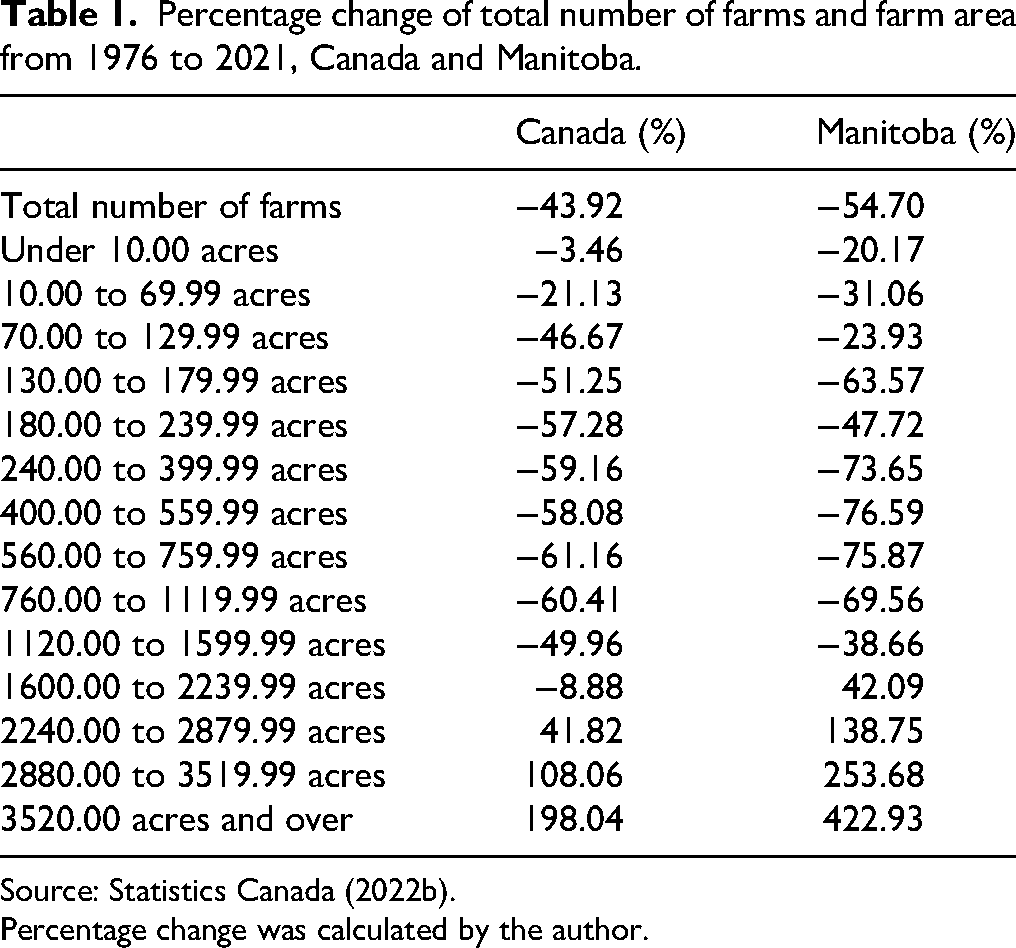
Source: Statistics Canada (2022b).
Percentage change was calculated by the author.
The Government of Manitoba (2024) previously reported that ‘In 2023, Manitoba agriculture and agri-food exports were the largest on record, with total international sales of $9.39 billion. Agricultural exports have increased 61 per cent since 2019, accounting for 44 per cent of total provincial exports in 2023’. Moreover, the costs of investments have gone up; the Government of Manitoba also reported that ‘the value of the land and buildings per acre…increased 43.8 per cent (in 2021 constant dollars) from 2016 to $2,760 per acre in 2021’ (Manitoba, 2021), and that farms are increasing their investments in modern technologies, such as in no-till farming. Costs, land price increases, and urban sprawl contribute to the general unaffordability of farming for newer entrants (The Western Producer, 2024; see also Qualman et al., 2018).
Notes from the field: The case of small-scale ecological farmers
Let us now consider the above discussion points on normative change in light of the experience of small-scale ecological farming investigated in this research. I identify contradictions in agrarian development for small-scale ecological farmers that can somewhat resemble those typically found in conventional farming, but with some unique characteristics. The fieldwork findings contribute to recent studies of the southern Manitoba context (see Lees, 2015; Sivilay, 2019), and are interpreted in light of critical political economic studies of capitalism; while farmers and other participants in the alternative food movement are motivated by social and environmental concerns, lifestyle goals, and agricultural practices they deem important for sustainable social futures, there are some barriers that arise from market-based mechanisms of social change, pointing to the scale-biased and market-based barriers. The purpose of organizing the fieldnotes as follows is to highlight particular facets of small-scale ecological farming and to identify barriers to growth.
Interview participants identified various motivational paths to learn about, participate in, and incubate and grow their farm business or market garden. Operators I spoke to considered local, agrarian food production designed along ecological and sustainable principles an important societal goal to which they sought to contribute, and which, moreover, they saw as being synchronous with their self-interests in, and preference for, a farming lifestyle. Their farming practices could be categorized in several ways, as a form of market gardening, as secondary to their main profession/income source, or as a more ‘business-oriented’ farming operation. There were varying degrees of experience. Some operators considered familial connection to farming as important, but not all operators grew up on a family farm, and those that entered the sector suggested sustainable environmental relations as an important motivator. Some pursued a post-secondary education not directly related to farming, or worked in a non-farming sector, later turning or returning to farming to practice sustainable farming. One participant explains: I guess we were like ideologues from the start… if you're not a second-generation farmer, even if you wanted to become a conventional farmer, it's not an option… you can't buy 1,000 acres and the equipment needed to farm corn or something. The ecological bit was important to us. Probably we were more obsessed with ecological concerns at that point. Now you’re kind of in it and it's not something you think about as often. But we, yeah, I was kind of obsessed with the idea of taking a bare piece of dirt and making it something very beautiful. So, there was like an aesthetic element to it too. (A04)
A relatively newer market gardener/farmer sees enjoyment in this kind of activity not just in the potential efficiencies of certain practices that contribute to overall sustainable farming (such as companion planting), but also the human enjoyment: …Planting things like squash in a place where we had a huge weed problem last year, no weeds this year. They couldn't compete with the squash, squash covered it like a blanket. There are definitely some efficiencies there in the ecological farming… Also, like if you're counting enjoyment in your efficiency, the food tastes better. Eating the food that you've grown ecologically without use of sprays, without the use of, you know, like anything wacky, it tastes so much better. So, if you believe like I do that the actual enjoyment of something should count towards the efficiencies of it, it's the most efficient way of farm because it tastes so much better. (A08)
A participant who operates a small-scale farm for over a decade told me that he did not want to expand their operations, emphasizing a certain balance for their lifestyles, also remarking to me how they caution about idealistic visions of homesteading (A05). Another participant also explained that they could start selling product to Ontario, but which would defeat their original purpose of keeping their operations small and linked to local food access (A06).
Participants were motivated to contribute to systemic change and to put socio-ecological conscious ideas into practice. Answers were mixed but lifestyle preferences and concerns about systemic breakdowns that could disrupt food production and deliveries, or other social concerns about affordability, were discussed as important motivations. Some participants reflected for instance on the general unaffordability or loss of accessible food, and participants mentioned that they try to keep prices low, with one market gardener remarking that ‘…the negative aspect is that this good food became for the elitists instead for the masses…’ (A07). This is an interesting point that I will return to in the next section regarding the limits of market expansion. Some participants also explained to me that there is an alternative currency programme set up to assist low-income individuals purchase foods directly from producers at farmer markets considering the structural barriers to food access for low-income groups. Another participant considered that small-scale ecological farming could be an important model resilient to systemic shocks and structural failures, such as during the COVID-19 pandemic, likening this farming model to ‘victory gardens’, and describing how the number of people cold-contacting them regarding their community supported agriculture (CSA) boxes increased during the pandemic (A01). Another participant who entered farming as a second career, sought to contribute to offsetting some of the systematic hiccups that can occur in a carbon-reliant world: We were becoming more concerned about the ecological environmental situation. For me a big influence was realizing and learning about the long-term availability of fossil fuels and petroleums… We were looking for a lifestyle to spend time with kids, with grounded stuff with food production…I [began] reading more and more about things like fossil fuel depletion, and feeling like, okay, there's a lot of people involved in putting plastic out of factories faster and faster 24-7… that seems to be a lot of resources but there doesn’t seem to much resources going in to produce food sustainably, so maybe I can help out there. (A05)
Participants treated small-scale ecological farming as a ‘learn-as-you-go’ and a ‘one-step-at-a-time’ approach to incubating and growing their operations, and all operators set their own pace depending on their intent of growth, but there are important investments required. Given some barriers to market conditions on which I will expand in the next section, participants explained that it makes sense to start small and incubate a farm business. Capital investments for many of these market gardeners and farmers are not substantial relative to conventional farming. Indicated as above, some wanted to limit their size, while others sought to expand into wholesale, direct sales to restaurants. There was also a relatively new and emerging food hub at the time that could be an important outlet for sales and to connect ecological farmers to consumers (B04). Off-farm income or personal connections and familial assistance were also a necessity for participants. One operator explained, reflecting much of what was said by other participants, that a conservative growth in their practices was preferable than large investment in an operation that resembles conventional farming: If you’re a large-scale farming and you want to do ecological farming you have to be organic… to get a price for your product in order to meet scale to get a big tractor… So there's no way to make enough money to have a big operation. You’re going to have a small locally based operation, that's all you can afford to have… Is it hard to make the decision to go ecologically? No, I think it's just a choice because you’re going to be starting small anyways. (A06)
This form of farming is labour-intensive but some treat ecological farming as a craft activity, and ecological farming has an assortment of meanings and practices that farmers adopt for their unique situation. For instance, one market gardener who is not large enough to hire labour but does supply to people in their community through CSAs thought it was important for them to make use of the land in their spare time: I kind of think of no dig practices as lazy [laughter] because you just put cardboard and [prepare] the soil and plant in it… You don’t have your weeding… you don’t have to add as many things to it. It's like the laziest form of gardening ever and I love it. (A01)
Farmers rely on basic tools, relatively low capital investments, and various sources of labour. I will consider some of the economic barriers in the next section, but this form of farming is dependent on very manually intensive labour, given the nature of the practice. There are different forms of labour in this model of farming (e.g. self-labour, occasional volunteer, hired labour). Many of the market gardeners or newly established farms primarily use their own labour (i.e. themselves and partners in an operation), but some of the larger business-oriented farms grow to depend on hired labour, from as low as one or two workers for certain, especially earlier, years, and up to seven workers for one of the larger operations. Many of these market gardeners limit themselves to what investments they make or ‘how large’ they seek to expand their businesses. In terms of the amount of investment needed to start and grow a business, one participant, considering the business side of the sector, put the figure in the $60,000–70,000 range. Another participant said that $40,000 is needed, excluding the cost of land, and a comfortable amount to start to be able to stay in business beyond the short term.
Farmers utilize basic tools and equipment typical of manual-intensive labour (e.g. shovels, hoes, rakes), basic infrastructure, such as season-extending hoop houses, storage, processing, and machinery like tractors with implements. Particular to small farming, there are tools that assist in labour and to reduce other costs. Figure 1 displays some tools or other features from some farms that I visited. While not found on all operations, the top left displays a tool functioning similarly to a wheel hoe (to loosen the soil and prepare a farm bed), equipped with a basic drill that can be triggered to scrape the top layers of the soil to make it easier to plant in the bed. The ‘Paper Pot transplanter’ originally from Japan uses honeycomb-like paper trays to prepare seedlings, which can then be applied in a bed, at the right spacing, and which saves on labour in field crops, as long as the soil is easy to plant into, but does require a recurrent costs with the honeycomb paper seed trays (bottom left). The bottom right shows pictures of a typical farm field in production, and the top right shows a device called the ‘coolbot’ that controls a basic air conditioning unit for refrigerated storage.

Select photographs from farm visits.
Barriers and limits to normative, market-based ecological farming
Motivations to enter the sector vary across participants, and the cost is less expensive compared to conventional and larger-scale agricultural practices. Nevertheless, there exist barriers and limits to expanding this form of food production. Challenges indicated to me varied and included market conditions that can limit the ability to grow the sector, costs of entry, and ability to practice their perception of ecological farming, assistance, and, as some suggested, an economic and structural bias towards large-scale over small-scale farming.
Land access and capital investments were seen by research participants as critical factors. Some participants speculated that these would act as barriers for new entrants to this sector. Most of the operators I interviewed had access to land either through funds accumulated in their previous or current career, being able to secure a mortgage for a house with land, or had family or other personal connections facilitating access to land; many insisted that they would not be able to practice farming, or enter the sector, without such access. There is a generational crisis in farming with younger farmers facing difficulties entering the sector (Qualman et al., 2018). Some civil society work attempts to connect new farmers to more established and even conventional operations and ageing farmers in order to help the incubation of farms, or to help train people. One participant with knowledge of these activities expressed that access to land is more socially construed and perceived, and that there can be opportunities to have farmers enter the sector through various land sharing agreements and educational opportunities (B05). General environmental and geographic features matter (e.g. location, soil type, local condition, growing season), and land access that has the right features, and that is close to the market can be a barrier to those wanting to get into the sector. One farm operator explained that land access itself is difficult, not just in terms of costs but location as well: Land is absolutely insane. In this area, if this was not in the family for four generations, there's no way I’d ever be able to get into this. No way… It's a total privilege – even if I was interested it would just be obscene… And now you’re competing with sprawl…You’re competing with somebody who just wants out of the city and is willing to pay to just look at [the landscape]… But it's cheap to rent…But you have to find somebody who's willing to rent it to you. (A03)
Another participant explained that investments in rented land could be limited since there is less incentive to invest in land one does not own: There's got to be certain check boxes. You have to have water, this and that. Again, our kind of farming you build up your garden and you’ve got the soil where you want it after three or four years, and if you’re on rented land, the landlord says ‘well not renting to you this year, see ya.’ It's kind of really horrible. Renting can work, but it's harder than if you have more control. But it doesn’t have to be… What would it cost to rent 2 acres, $500 a season? It's ridiculous, but you know… where is it though?…. How far is it?. (A05)
Assistance with their operations varies and is linked to important marketing initiatives, advocacy, education, and other support activities. Besides some general government support programmes that can be accessed, such as the Canada Summer Jobs wage subsidy, or other sectoral grants or support programmes that could benefit these operations, it appeared that government assistance had not been tailored towards this form of agrarian development compared to support for conventional agriculture. However there have been some recent changes, such as a reduction to the minimum acreage amount to qualify for vegetable acreage loss insurance with the Manitoba Agricultural Services Corporation (MASC). It was explained that small-scale farmers cultivate a diverse variety of vegetables out of necessity as a self-insurance policy rather than relying on a select few and another explained that not having insurance or other programmes catered towards them is difficult as they take larger risks in functioning in this sector (B03, B02). At the time of conducting fieldwork, it was reported that a minimum of 0.5 acres per vegetable classification (MASC, n.d.(a)) was required to qualify for insurance, but that may not be tailored towards small farms who may grow a diversity of crops instead. Recent changes have occurred, with an announcement to bundle up a variety of crops (Manitoba Co-operator, 2024; MASC, n.d.(b)), an important win as it is a fail-safe in a bad season.
Some other challenges of small-scale ecological farming relate to the very definition of what it means to be sustainable or ecological, in terms of what methods farmers want to and can practice. A challenge was knowledge and ability to function within the regulatory features of the food sector (B01), and that many ecological farmers that are non-certified organic still face challenges typical of the sector or have new ones associated with climate change (B02). One of the more established farm operations considers the definition of practicing ecological farming as subjective and based on various degrees in definition, as opposed to the organic classification which is a legal term that is regulated. Some participants explained the importance of practicing good soil management practices, such as avoiding heavy tilling of the soil, and explained their use of other practices such as cover cropping, not using conventional fertilizers, and applying manure that is sourced from a nearby operation (A09). Yet another farmer explained for instance that they wondered how self-sustaining their farm can be, rhetorically asking: Let's just say I couldn’t buy seeds anymore, and I had to save my own seeds. We’d be done. We’re not experts in that to get good clean seeds… Can I grow 40 varieties of things? No way. I could keep potatoes back, I could probably get carrots to go seed for me, few items, but it is its own specialty. (A05)
Another participant explained that despite their care for soil health and an ecologically minded farm design, they still must make decisions that may run counter to these values. For example they explained about the use of plastic in farm operations despite having reservations due to its environmental impacts: One of the other things, probably consumers don’t know about farms is how often we use plastics, for our greenhouse, for coverings, landscape fabric… It's all plastic, none of them are single use but they wear down. It's not a thing I’m incredibly fond of using. I do appreciate how well they work to kill off weeds, and I don’t they are a long-term solution for it…. (A02)
As previously mentioned my research did not find any instances of capital investments in precision agriculture. This can be explained by the fact that these technologies are mostly geared towards larger farms with economies of scale: ‘I know there are robot pickers now, robot weeders and things like that. Again…I have to completely redo the place. My beds are 80 feet long…they want to see 800 feet I guess’ (A05), though participants do seek ways to reduce costs. This participant later added that small-scale operations such as theirs would not benefit in an expanding market, but rather the larger ones who have land and capital to expand productivity, somewhat articulating some of trajectorial features of capitalist development, and highlighting that market values can run against the grain of qualitative features of agrarian production. As another farmer expressed to me: ‘Obviously you need tools to save labour, but you also don't want to take the human element out of it. So there's a bit of a balance there’ (A04), but there was, at times, admiration for the technology for a number of reasons that relate to relaxing labour pressures or automating more farming tasks.
Market conditions can also limit the kind of farm design operators can set up, like the ability to generate cash flow and the time to build up a functioning farm based on such ecological principles (e.g. permaculture). Other avenues that participants considered to expand their cash flow included entering supply chains to interested restaurants, and supplying a growing food hub for farmers to sell their produce wholesale. A farmer offered some insights about the sector, commenting about small margins and the necessity of economies of scale (e.g. to increase mechanization) to work the land. The idea of a self-containing farm is not really possible, because one cannot produce on-site all of the inputs that are needed: I’m trying to figure out how sustainable animal integration really is because when I first learned about it and studied it and started incorporating, it seemed like the most sustainable possible thing to do, and now I’m increasingly aware of my ghost acres. (A03)
In terms of labour and training, new entrants to the agrarian sector may also feel social pressures that it is not a sound financial decision. In terms of labour supply I was told that there can be difficulties in finding and training workers. While farming under the right conditions itself can be a source of enjoyment, market realities emerge. One participant explained that every year it is difficult to find labour and that they depend on previous workers trained on the farm, but that there could be a turnover as farming as a labourer is not a career path (A03). Being aware of this, they try to maintain a balance to avoid a ‘burn out’ of their employees due to the physically demanding nature of this work. None of the operations I spoke to utilized SAWP but one larger ‘business-oriented’ farm who employed seven labourers at the time of the interview, and who has a substantial CSA customer base, considered applying to this programme due to labour access difficulties, experiencing pressure of having to find workers every year (A09). In regards to training a new generation of farmers, I was told it's important for interested people entering the sector to work on a farm to get a sense of the sector, and, interestingly, a farmer who first got involved in ecological farming worked on a farm through a farmer-run work training position and considered it mostly as a source for cheap labour (A09). Further to this point, one participant explained to me that there could be perceived ideas about whether a farm is a good profession to get into, echoing a common point of view that margins are thin for expanding the business: It's kind of frustrating because I feel like it should be very easy to find people who want to do it for one to two year periods. Especially the people who want to start their own farms because if we're going to walk into some like small farm future, we're going to need like thousands and thousands and thousands and thousands of [people] farming… I feel like it should be easy. You should be able to walk it to the [University of Winnipeg] and put up an ad or walk into the [University of Manitoba] put up an ad and have 30 [students] who want to start farms that are like, yeah, we'll learn for a year, but it's not like that. (A04)
Even those with access to property and land through their family nevertheless face economic pressures in reproducing their operations: ‘I do have access to land, which a lot of people don’t, but I still have the economic struggles of securing loans for infrastructure. The economic struggles are still there, I still feel them as I suspect other new farmers will’ (A02).
Lastly, multiple market conditions influence the current feasibility of this model of farming to expand. There are clear structural issues relating food insecurity to income levels, and alternative currency programmes do exist to help respond to these barriers, but as a participant told me, access to farmer markets can be difficult for low-income groups in terms of not having the ability and time to take out of their week to visit a farmer market at particular hours (B01). It was also explained to me that small-scale farming involves a lot of work, and as one participant puts it, small-scale farming is the one where economies of scale of small margins compel farmers to mechanize and exploit the landscape, and where consumers are expecting a modern-day grocery store supply from their farm (A03). It was suggested to me that cooperative forms of organizing farm production or distribution through publicly funded programmes that can assist and relieve the burdens of operators are important pathways (A03, B01), in some ways to mimic more cooperative and non-market forms, creating economies of scale across sites. Another participant explained to me that producers are in competition with each other in local markets with a limited consumer base, which has the consequence of limiting the number of farmers that can participate in a market. The growth of small-scale ecological farmers or market gardeners can be limited because it may be a niche market, reliant on customers with disposable income to purchase expensive food products (A03, A04). One participant explains that ‘finding a place to sell your stuff can be difficult… finding one that's not overcrowded… a little competition is not bad, having multiple people grow vegetables is not bad, but if everybody brought vegetables, I would not be able to sell mine for as much as I need to sell them… to pay my bills’ (A08), and they suggest a need for better planning between vendors of what to bring to a farmer market. Another participant considered profit margins slim for many small-scale farmers and said that the market is currently not expanding enough if we want more small farmers, rhetorically joking about whether they wanted to see more competition: I don't think the consumer side of it is expanding very quickly… If for whatever reason consumers suddenly want a whole lot more local food, I'll get a benefit, but if that pie suddenly got way bigger, it won't really probably benefit people like me, it will benefit people with the automation. (A05)
Overall, participants have motivating factors and particular situations that enable them to learn about, practice and engage with ecological farming practices for local food. However, there nevertheless remain several barriers and limits emerging from the wider picture related to the competitive nature, model, and limits of market-based agricultural development.
Conclusion
This research considered how and whether discourses of certain ‘normative’ principles around sustainable farming models might prefigure in a future world by way of existing trends. The purpose of this research was two-fold. The first was to situate normative discussions of agrarian futures. I sought to contextualize these normative perceptions with general market relationships and the contradictions that arise from these positions, whether it be proponents of conventional and forms of ecomodernist agrarian practices and tools to heighten productivity, resolve labour shortages or to lessen the environmental damage caused by other previous conventional-style practices, or proponents of alternative forms of agricultural development that centres low-input, labour-intensive farming techniques for local food access. Second, this research sought to contextualize this general discussion to a particular case study of small-scale ecological farmers and market gardeners who have the economic means or connections to enter the market and practice their normative ideals tied to tenants of alternative food networks and food sovereignty, stressing local food access and environmentally sustainable practices.
My fieldwork findings situate the experiences of small-scale ecological farmers in the generality of market-based agrarian development. My fieldwork research was not particularly an in-depth study of small-scale farming in southern Manitoba but rather of how the generality of market-based relationships contains barriers that can limit the expansion of small-scale ecological farming as an ideal type for expanding sustainable farming. I show that while there is motivation and ideological commitment to practicing non-conventional agriculture, there are nevertheless signs of contradictions that emerge from market-based operations seeking to enact socio-ecological change. While there may be some instances of successful small-scale ecological farmers, there are nevertheless systemic barriers to practice ecological farming that can include certain market conditions, access to land, labour, capital, or support, and generally those related to being small operators.
In conclusion, I am not suggesting that small-scale farmers must adopt new technologies or should be replaced by more centralized and larger operations, the typical characterization of ‘productivist’ capitalist agricultures, or that small-scale farmers are ultimately the only solution to enabling food systems and that we should do away with larger operations. Rather, this paper emphasizes that the expansion of sustainable food systems faces obstacles embedded in economic relations that can block a future where de-centralized and quasi-independent but cooperative small-scale farmers can reproduce their operations and provide for local and regional communities, and one that can be expanded across scales in a diverse formation of economic units. Future research should investigate how societal changes can break free from the contradictions arising from market logics, logics that Marx sought to de-naturalize. This means striving to expand social and cooperative support and to rationally plan and organize production and consumption that prioritize the values of human, cultural, and ecological needs and relationships over the profit motive.
Footnotes
Acknowledgements
I would like to thank all the participants who took part in this study. I would also like to thank a reviewer of the draft manuscript and the anonymous reviewers of this paper for their helpful comments and suggestions. Any errors or omissions are ultimately my mistake.

Ethical considerations
This research was approved by the Brandon University Research Ethics Committee (BUREC), #23010.
Consent to participant
Based on ethics approval, written or verbal informed consent was received by participants in this research project.
Funding
The author disclosed receipt of the following financial support for the research, authorship, and/or publication of this article: This research was supported by the Brandon University Research Committee New Faculty Grant.
Declaration of conflicting interest
The author declared the following potential conflicts of interest with respect to the research, authorship, and/or publication of this article: Mizhar Mikati is an editorial board member of Human Geography.