







Abstract
"For Western women the image of gold exploits by symbolizing ownership by men; for Basotho women gold exploits through the reality of an absence of men. Signification of gold at the consumption end of the commodity chain is underwritten by the sequence of social and natural realities with consistently opposite meanings: ‘love and commitment’ at the consumption end of the gold commodity chain is opposed by apartheid, slave-like working conditions in mines, environmental degradation, abandoned women, a Third World country desperate for any kind of ‘development’, underpaid female employment in fly-by-night factories, and similar conditions along the chain. The gold windows of Tiffany's in New York are linked to gold widows in Lesotho. Geographical knowledge deconstructs the sign to show its opposites…. A politics of reconnection might use this kind of geographical information to bring into contact the web of peoples involved in consuming and producing commodities” (Hartwick 1998: 433).
Written over 25 years ago “Geographies of consumption: A commodity-chain approach” in Environment and Planning D: Society and Space (1998, vol.16, pp. 423–437) remains more relevant today than ever before in a world engaged in tariff war and a war of occupation. The unilateral tariff hikes were imposed by the United States on China as a part of the new Trump government's geoeconomic saber-rattling. In the midst of volatility in the stock market, rising concerns over inflation and panic among global investors, the Trump government backed down, a move described by the media as “chickening out.” CNN reported that the announcement on scaling back came after Trump's meeting with four major U.S. retail companies: Walmart, Target, Home Depot and Lowe's (Liu and Gan 2025). The “tariff-move” was dubbed by the Trump government as a strategy for re-building America's economy to increase revenue, protect American business, and re-inventing production at home by bringing manufacturing back to the U.S. Clearly, Hartwick was correct when she argued that geographical knowledge that understands life as a “web of people” is able to deconstruct “the sign to show its opposites.” The power of capital imbued in the commodity form is almost gravitational in sinking or elevating politico-institutional power, hence, the influence of big retail giants on the policy moves of the Trump enforced international tariffs. In other words, commodities influence a “web of people” irrespective of their class position, title, station and citizenship. The sign, or the object of desire, namely, the commodity, is also “abounding in metaphysical subtilities and theological niceties” (Marx's 1990: 165). Therefore, only an astute “geomaterialist deconstruction of the sign” can peal through the layers of “metaphysical subtilities” and go beyond the “representational politics” (p 433) and the representational economics (ethno-patriarchal Trump-tariff sensationalism) revealing the exploitation process. In revealing, we forge a politics of reconnection between “opposites,” that is, exploited people consuming commodities and exploited people producing commodities as well as, exploited people starved of food and dignity. Hartwick argues that such a “geoknowledge” of the webs of interconnections, or commodity chains must be connected with a “geoethics” (p 434) of “caring and responsibility” for the world, for each other, and for nature in our everyday mundane acts of producing and consuming. We agree today, once again, with Hartwick's advice, that in mindfully cultivating politically conscious actions, or in living a geomaterialist existence of care, we revivify our revolutionary praxis against mindless acts of consumption and mindless acts of violence. And we promise that we will be consistent in our revolutionary praxis of care irrespective of the religion, beliefs, nationality, color, gender, caste, class of the oppressed. Such geomaterialist agency complexifies our economic map/landscape/tropes/places/territories (pick a concept of your choice radical geographers), thus enabling us to dismantle toxic patriarchal capitalist structures and processes that thrive on disconnections, fearmongering, wall building, and other lustful violent acts of genocidal maniacs. Geomaterialist knowledge that deconstructs signs penetrates the cunning of megalomaniacal tariff wars, colonial occupations, anti-immigrant xenophobia, and other kinds of fundamentalisms born out of hyper-masculine representational politics and imperialistic economics that fetishizes the illusions of strong man demagogues and bully nations.
Instead, claims Hartwick, we must conceptualize and live in the world not as citizens of nations, but as web of interconnections or assemblages of ongoing struggles. In living and struggling, we decode the mode of production and the code of production, representation at consumption nodes and counter-representation at production nodes, exploitation and stupefaction as the dialectical whole of the fetishism of the commodity that hides the labor process. In that context, Tiffany's gold ring (a commodity) is as much a “social hieroglyphic” (Marx 1990: 167), as the “Trump-tariff war” and the “Gaza war.” The Tiffany ring and the “ring of power” are a phantasmagoria of “love and commitment” to each other and to the nation, a performative transactional kind of love where we extract, manipulate, impose, and control commitments and relationships between spouses, partners, friends, communities, economies, and nations. The conquest of forbidden fruits of desire (diamonds, power, territory, natural resource) are legitimized through a systemic semiotic photoshopping of colonial occupation, massacre, bombing, brutality and exploitation of labor, immigrant labor, and occupied people. The yellow halo of the gold surrounding the ring, the dust that hangs over the rubbles of Gaza, the hollowness of national economies based on super-exploitation of their labor and super-alienation of their consumers are the illusionary appearances that hide the geomaterialist reality of the continuance of capitalist-imperialist-patriarchal power. “The image of gold” (p. 433) as Hartwick points out, is the quintessence of oppressive power, a system of signification that binds and does not emancipate. The bindings happen through marriage-acts, romantic negotiations, familial relations that are based on possessive and transactional love fueled by manipulative control over each other. And the bindings also happen through the geo-economic acts of wage relations and mass massacre of people entrapped in colonial geographies fueled by racist-capitalist ideologies of apartheid and abandonment. All forms of bondage that limits and silences are manifestations of toxic capitalist power masquerading as “love and commitment.” Emancipatory power on the other hand, is rooted in a “geoethics” of caring based on delegation, dialogue and dis-alienation of labor power that creates webs of interconnections and dispels ignorance through “geoknowledge.” Here we are aligned with comrade Hartwick that how we understand the commodity form has important bearings on what kind of worldview we want to align with. As Marx (1990:167) said: Value, therefore, does not have its description branded on its forehead; it rather transforms every product of labour into social hieroglyphic. Later on, men try to decipher the hieroglyphic, to get behind the secret of their own social product …
Hartwick ends her article with a call for a “politics of reconnection” (p. 433), “A politics of reconnection might use this kind of geographical information to bring into contact the web of peoples involved in consuming and producing commodities. Crucially, this politics asks whether the power of consumers can be used as an agency of social transformation.” What might this politics of reconnection look like over twenty-five years since this article was written? The world today is even more in need of reconnection as “superpowers” wreak exclusionary semiotic-material ethno-imperial wars over people in their frenzy to gloss over their waning might. The commodity chain approach can become the essence of a humanistic consciousness that thinks in utterly liberatory ways. In controlling our consciousness existence (geomaterial knowledge), we forge politics of reconnection that exposes the bigotry of free market imperialism and ethno-western colonialism and create a deep thinking authentic intellectual global community. Democratic communism based on a politics of reconnection that emerges out of geomaterialist ethics “trumps” divisions between “opposites”: production versus consumption, man versus woman, human versus nature, nature versus environment, caring versus rationalizing, Global North versus Global South, Israel versus Palestine, thus, enacting the emancipation of humanity. Such a politics of reconnection strikes at the heart of all fundamentalisms, market fundamentalism, religious fundamentalism, identity fundamentalism, ethno-racial fundamentalism, heteropatriarchy and produces a geoethics of power that is feminist, communal and democratic because it nurtures, cooperates, enables, exposes, proposes and politicizes to empower/delegate, and not control/occupy. Commodity chain enables and consolidates as it breaks the chains of misogynistic capitalist power. In Hartwick's words “A liberative political geography of consumption thus has two urgencies. First, consumption should involve a ‘geoknowledge’ of the webs of interconnections which might be specified as commodity chains. Second, consumption should entail a ‘geoethics,’ in which geoknowledge is transformed into caring and responsibility for this world of interconnected people, practices, and environments. For political action is not about voting occasionally: it is about ethical daily praxis. And geopolitics does not just concern states: it is about reconnecting people in their everyday lives” (p. 434).
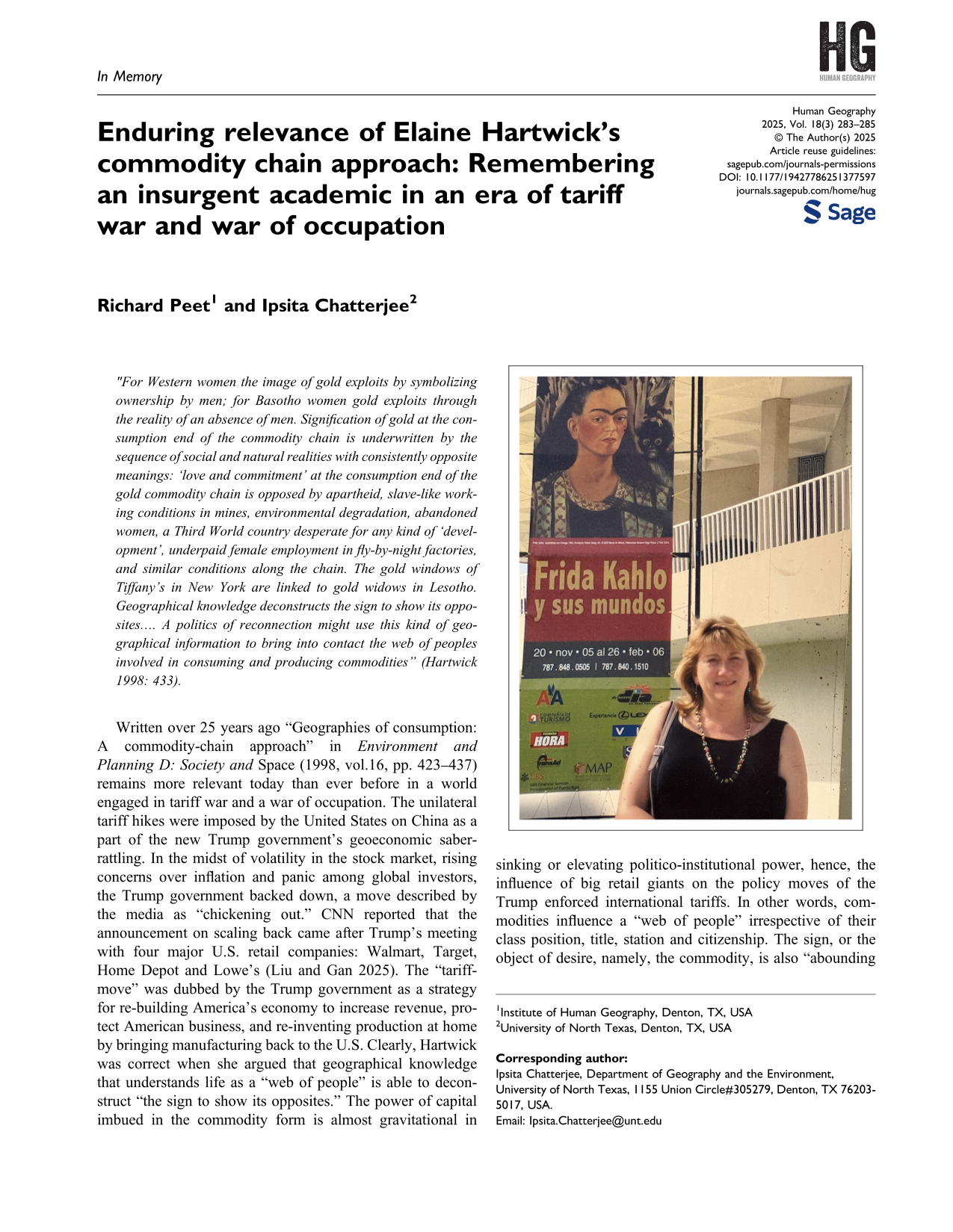
Elaine Hartwick's “Geographies of consumption: A commodity-chain approach,” published in Environment and Planning D, Society and Space in 1998, has been cited over 300 times and has been utilized by deep thinking intellectuals in their own research on nature, economic geography, resource geography, political economy and political ecology. The above reflection celebrates the silver jubilee of Elaine's towering work as we fondly remember her. Elaine left us in 2022, but she continues to intellectually inspire us. We are grateful to the publishers of EPD for giving us the permission to reuse her original article—a true act of intellectual reconnection indeed. The original article is now freely accessible to all at: Geographies of Consumption: A Commodity-Chain Approach—Elaine Hartwick, 1998. Anna, Eric, Lukas, Richard Peet, and friends all over the world remember Elaine as a compassionate human being, joyous person, passionate intellectual, generous friend, excellent host, and loving mother and wife.