






Abstract
As the extractive frontier expands out into peripheralised parts of Europe, branded as critical for the green transition, communities are resisting. Research on resistance to this extractivism has ballooned in recent years. I explore the resistance movement to a gold mining proposal for the Sperrin Mountains, North of Ireland, building on feminist and decolonial scholarship which has conceptually widened extractivism from a physical removal of resources to be understood as a logic, worldview, a way of relating in the world rooted in coloniality and specific power relations. This article contributes to discussions on the impacts of green transitions globally and on marginalised communities within Europe, particularly how these dynamics play out in the North of Ireland with a unique colonial and post-conflict setting. Drawing on a 5-year activist research project, I detail how extractive logics are manifesting in the Sperrins. These logics appear in colonial constructions of place, embodied and emotional slow violence and through social engineering of extraction. I extend critical approaches to the study of green extractivism through a detailed empirical case, bringing new insights to understandings of the social engineering of extraction, through counterinsurgency and a social licence to operate. In this context resistance to new extractivist incursions are understood as part of longer histories of resistance to oppression. I argue that in challenging these extractive logics, the resistance movement is ‘Making Relatives’ and transforming relations with the human and more-than-human world and pointing to post-extractive futures.
Introduction
In the Sperrin Mountains found across counties Tyrone and Derry in the North of Ireland, 1 local people, supported by others, nationally and internationally, have been resisting plans from Dalradian Gold Limited for a gold mine and processing plant since 2014. In November 2017, the company submitted a 10,000-page planning application, 2 one of the largest in Irish history (O’Neill, 2017), to the Department for Infrastructure (DfI) for a gold mine, processing plant and waste storage facility at Curraghinalt, where they had been exploring since 2009. The 59 m high waste pile would be located just over a kilometre from houses, a playschool, church and football field (An Taisce, 2026). Since the announcement of these plans there has been strong opposition, with over 50,000 objection letters and only 4000 letters in support (An Taisce, 2026). This mining proposal, which has not yet gained permission, but is currently subject to a public inquiry, 3 sits in the context of a global extractive boom for ‘green transitions’. Ireland has been identified as a hotspot in the ‘European mining boom’, as the EU scrambles to increase extractivism for increasing energy demand, digitisation and militarism (Global Justice Now, 2025), justified by narratives of green energy transitions. The EU Critical Raw Minerals Act promotes mining as a centrepiece of climate action and essential to the European Green Deal. In Ireland, huge areas of land have been concessioned for mineral prospecting, 25% of the North and around 27% of the South. This sits in stark contrast to figures in the United Kingdom, where only 7.7% of Scotland, 6.4% of Wales and 0.2% of England are covered by licenses (Greene, 2022).
The uneven geographies of the low-carbon transition are seen through the communities that face increased extraction around their homes (Dunlap and Riquito, 2023). 4 These communities are overwhelming Indigenous and Global South populations (Gudynas, 2021). Within Europe, areas with a history of internal colonialism see already rural, poor and indigenous marginalised communities being sacrificed to the impulses of extractive industries. Ireland sits in this context as a periphery within Western Europe, and as an Island colonised around 800 years ago. From Lithium mining in Portugal (Dunlap and Riquito, 2023), Germany (Ayeh and Rutjes, 2025) and Spain (Noever Castelos, 2023) to incursions into Sami lands in Northern Finland (Lassila, 2018), to the hunt for critical minerals throughout Ireland (Sullivan, 2021), the European Mining Boom is already impacting rural and Indigenous communities. The 2026 UK government, ‘Critical Minerals Strategy’, named Northern Ireland as a site of critical mineral exploration. In the South of Ireland, the government has noted the need for these minerals for the energy transition (Sullivan, 2021).
This article explores how extractive logics are manifesting in the Sperrin Mountains. Extractive logics do not present the same in all contexts, even within Europe. While I am speaking to Ireland's colonial history and present, Ireland is in the Global North, occupying a privileged position, and has benefited from colonial dynamics and white supremacy (Alderson, 2019; Allen, 1994). However, this colonial context still matters. Colonial legacies have a huge impact on the structure of the economy and society, impacts that are very much felt in the present and deeply entangled with extractive logics on the Island (McCabe, 2013; Mercier and Holly, 2020). Ireland occupies an unusual place within Europe as one of the first countries to be colonised, where legacies of colonialism continue to pervade ways of governing rural landscapes (Bresnihan and Brodie, 2023, 2024). Decolonial scholars have highlighted that extractivism is a continuing form of colonialism and is rooted in and enabled by coloniality (Gómez-Barris, 2017). By colonial logics I mean the power relations based on unequal exchange, dispossession and exploitation that constitute extractive capitalism (Gómez-Barris, 2017; Murrey and Jackson, 2023). I understand extractive logics to be non-reciprocal power relations which destroy, enclose and rupture relations between people and the more-than-human world. As an extension of colonialism and its material and epistemological practices, ‘[e]xtractivism erodes not only landscapes and their potential for recovery, but also relationships, cultural knowledge, and other ways of living, a process inseparable from ongoing patterns of dispossession and assimilation’ (Gobby et al., 2022: 2). Extractive logics operate through the abstract extractive gaze (Gómez-Barris, 2017), which renders people and place a sacrifice zone.
By focusing on the North of Ireland, with its unique post-conflict context, I contribute to discussions on green extractivism, energy transitions and climate justice by centring the experiences of those resisting gold mining in the Sperrin Mountains. I draw on a methodology of photovoice (participatory photography (Cirefice, 2022)), interviews, countermapping (a critical participatory cartography project (Cirefice, 2023), and walking with and activist engagement. The visual and participatory methods used in this project explored the visual politics around extractivism in Ireland and the counter-hegemonic ways of seeing and being that contest extractivism. Photovoice and countermapping not only illuminate the ways in which the movement in the Sperrins resists extractive logics, these methods also laid bare the violence(s) central to extractivism, embodied injustices at the heart of the extractive economic system.
In this article, first, I explore how participants related resistance to extractivism to longer histories of resistance, and how the Sperrins, and the people who live there, are constructed using colonial tropes of empty wildernesses and backwards populations by extractive logics. Then, I explore the social engineering of extractivism which utilises overtly violent and more subtle tactics. A key finding was that as well as the sensational violence associated with these conflicts, extractive violence plays out in invisibilised, emotional, every day and slow processes. The feminist lens I use attunes me to these scales and dimensions of impact. Further, participants were keenly aware of the relative privilege of resisting extractivism in an Irish context, frequently, referencing the danger other land and water defenders in Global South or Indigenous communities face when they resist. Conceptually, I bring together work in (feminist) political ecology and anarchist geography to widen understandings of how colonial logics and social engineering manifest in cases of extractivism. Contributing to debates around greenwashing, a social license to operate, counterinsurgency tactics and slow violence, the article outlines the colonial character of extractive logics in the North of Ireland.
Critical minerals and green extractivism
In this time of ‘green extractivism’ (Brock, 2020; Dunlap, 2019; Dunlap and Jakobsen, 2020; Riofrancos, 2019), we see extractivism rebranded as not only compatible with the climate crisis but as essential to overcome it (Voskoboynik and Andreucci, 2022). Green extractivism is closely aligned with green colonialism (Andreucci et al., 2023; Hamouchene, 2023), where the continuation of colonial extraction is reframed as needed for sustainability transitions. The proliferations of green extractivism and green growth solutions legitimised by the climate crisis narrative have been challenged by feminist political ecologists who push for system change that looks at more than carbon emissions (Cirefice and Sullivan, 2019; Ekowati et al., 2023; Harcourt and Nelson, 2015; Harcourt et al., 2023). These approaches locate the roots of the climate crisis in systems of extractivism, which is understood as entwined with colonial dynamics, imperialistic corporate power and worsening inequality (Ekowati et al., 2023).
Often ‘critical metal’ is conflated with ‘transition metal’ in what scholars have called a greenwashing move by the mining industry (Dunlap and Riquito, 2023). Critical minerals are any mineral labelled as such by the state. The main end-use of these are still military, digitisation, aviation, construction, not lower-carbon technologies (War on Want, 2021). Further, half of the minerals listed as ‘critical’ by the United Kingdom have no use in lower-carbon technologies, instead demand is driven in a large part by militarisation (Global Justice Now, 2025). There is no provision in the EU's Critical Raw Minerals Regulation to differentiate between uses for the energy transition, digitalisation or the defence sector (Corporate Europe Observatory, 2023). Evidence shows we are not transitioning from one energy source to another but adding more energy from so-called ‘renewables’ on top of increasing fossil fuel energy (Fressoz, 2024). This phenomenon is documented within the European context (Dunlap, 2023). The expanding extractive frontier knows no limits. The global mining industry is working to position itself as a leader in the energy transition, with claims of sustainable mining as central for the switch to lower-carbon technologies. However, if we leave untouched the system that created the climate crisis, without questioning the logic of extractive capitalism, we risk carrying over social, economic and environmental injustices into new structures that will supposedly save us.
Social engineering of extractive frontiers
Globally the extractive frontier from mine sites to supply chains are heavily militarised and those who resist are criminalised and violently repressed (Global Witness, 2024). Both the overt (Conde and Le Billon, 2017; Gudynas, 2021; Kirsch, 2014) and ‘softer’ (Verweijen and Dunlap, 2021) violence of extractivism on frontline communities is well-documented. Of course, physical engineering is a necessity of any extractive project, however, work within anarchist geographies and political ecology (Brock, 2020; Brock and Dunlap, 2018; Dunlap and Riquito, 2023; Huff and Orengo, 2020) argue that there is a social engineering of extraction. Counterinsurgency can be understood as, ‘a type of war “low-intensity” or “asymmetrical” combat and style of warfare that emphasises intelligence networks, psychological operations, media manipulation, security provision and social development that seeks to maintain governmental legitimacy’ (Brock and Dunlap, 2018: 35). These tactics deployed in extractive zones have been developed by the British State in colonial contexts, from Kenya and Cyprus to the North of Ireland (Kitson, 2010). In the extractive context, attempts to manufacture consent, gain a social licence to operate and suppress dissent mimic counterinsurgency strategies (Brock and Dunlap, 2018). These techniques involve less overtly violent measures, such as, Public Relations (PR), greenwashing, Corporate Social Responsibility and corporate communications, to ‘win the hearts and minds’ of populations (Verweijen and Dunlap, 2021). These ‘soft’ approaches mimic counterinsurgency and are deployed to gain a social licence to operate. Extractive corporations are known to co-opt local leaders, suppress community protests, make links with state and local authorities to criminalise those who resist (Martínez-Alier, 2023).
Manufacturing consent and gaining a social license to operate is part of a ‘mining rule book’ and draws on counterinsurgency tactics that extractive companies employ to gain control and legitimacy (Brock and Dunlap, 2018). While this literature identifies that counterinsurgency is used in almost all conflicts around extractivism, no empirical studies have been conducted in Ireland, and specifically the North of Ireland. I develop these approaches to understand resistance to extractivism in relation to unequal power and injustice by exploring how extractive logics are manifesting in the Sperrin Mountains. This article adds to important debates within Irish political ecology scholarship by demonstrating the specific ways green extractivism plays out, specifically around the social engineering of extraction, in the North of Ireland, an often-overlooked context within the Island of Ireland. These conflicts are about more than just a physical problem requiring a technological fix or managerial policy solution. I bring together literature on relational resistance and the embodied and emotional impact of social engineering of extraction to contribute new insights to this scholarship.
Political ecology of mining in Ireland
Ireland has been a site of experimentation for capital accumulation from the sixteenth century (Bresnihan and Brodie, 2021). However, since the 1960s and neoliberal reform, the Republic of Ireland government has worked hard to attract foreign direct investment. The extractive logics underpinning the forces of colonial and capitalist development on the island reshaped relations between people and the more-than-human world in drastic ways. A Comprador class was established, a core feature of colonial extraction. This involves an indigenous middleman who facilitates the extraction and export of commodities to the colonial centre, for example, beef, dairy or even minerals (Beatty and McCabe, 2024). Bresnihan and Brodie (2024) argue that there are colonial endurances to ‘green’ developments in Ireland, be that industrial wind farms, eco-modernisation through smart technology or narratives of increased mining for the green transition. This is located in a history of accumulation by dispossession. I build on this call to focus on the Sperrins as a site where rural communities are peripherialised through state and capitalist forces.
The North has its own particular economic structuring; it underwent a ‘Double Transition’ to both peace and neoliberalism (McCabe, 2012). Attracting foreign direct investment, often in the form of extractive industry has become the economic policy of the North. A favourable fiscal policy, tax incentives and lax environmental regulations facilitate the mining industry in both the North and the South. The weak regulatory system in the North makes it increasingly attractive to mining capital. For example, the North has only ever enacted one Mineral Act in 1969, thus ignoring other pieces of legislation that has come into effect since, at an EU and international level (Sullivan, 2021). Due to Permitted Development Rights, no environmental assessments are needed for exploratory works (Sullivan, 2021).
Ireland, North and South, have ranked top 10 for many years, in terms of The Fraser Institute's policy perception index, which measures how attractive a country's policy regime is to the mining industry (Cirefice et al., 2022). Bodies such as Geological Survey Ireland and Enterprise Ireland have been holding an Irish Pavilion at the mining conference PDAC (Prospecting and Developers Association Canada) since 2016, with a forum called ‘Ireland open for Business’ (Geoscience Ireland, 2019). Here, Ireland is sold to transnational mining capital as one unit, with politicians from both North and the South attending (Cirefice et al., 2022; Sullivan, 2021).
In addition to the facilitation of extractivism through this state, university and policy nexus, the mining boom in Ireland is made possible through a range of overt and subtle colonial techniques. This includes the colonial construction of people and place as empty and in need of improvement and a range of techniques that I argue fall within the remit of social engineering of extraction and counterinsurgency. These measures draw on PR, greenwashing narratives, and divide and rule tactics to sow ruptures in the social fabric (often drawing on sectarian divisions). As well as this, I argue the slow violence and emotional, embodied toll of these techniques is used to repress dissent. These are all part of moves by extractive industries to manufacture consent and these will be explored in depth in what follows.
Extractive logics as colonial legacy in the Sperrins
Bhattacharyya's analysis of racial capitalism argues that we need to look ‘in shadows where capital meets other histories of dispossession’ (Bhattacharyya, 2018: xi). In the Sperrins, this means taking seriously the legacies and present of colonialism and conflict. A settler invasion 5 is a structure not an event (McVeigh and Rolston, 2021; Wolfe, 2006), meaning a structure of power is established, a hierarchy and ideology of privilege (McVeigh and Rolston, 2021), ideas that outlive a singular event and can be revived at any time. The colonial power structures, hierarchies and ideologies live on through extractive logics that continue to enclose lands, bodies and relationships to accumulate capital around the world today. This is no different in the Sperrins.
The Crown Estate still own the royalties to precious metals in the North of Ireland, and would receive 4% of the profits if the mine proceeds. Participants identified colonial legacies and presents as central to how extractive logics play out and are resisted in the Sperrins. Struggles around land and the more-than-human world have been central to Irish history since colonialisation (Killean et al., 2024). Legacies of dispossession, displacement and land clearances remain a central part of historical memory across the island (McVeigh and Rolston, 2021).
Some participants referenced the plans for mining as a continuation of dispossession of people in the area and a new form of enclosure. Historically, after the breakdown of the rundale system the Irish Catholic population were displaced to the moorland hills of the Sperrins away from the low-lying fertile ground (McCourt, 1953). Participants mentioned the history of people ‘being pushed up into the hills’ and now being ‘pushed out of them’ due to the threat of mining, as a second wave of dispossession. Despite the clear links made to the colonial situation with land and extractivism, many participants were keen to emphasise that this should not be used in order to entrench divides between communities. Declan asks the resistance movement to remember that an analysis of power is central in these discussions. It was the landed classes during colonial times oppressing people and today it's the capitalist elites and corporations that continue a politics of erasure, enclosure and death. Declan raises important questions about how we acknowledge these colonial legacies but do not use them to further divide working people based on ethno-religious categories. Next, I explore the construction of people and place in the Sperrins across the categorisations of wilderness and wasteland.
Colonial attitudes to people and place
Extractive logics see people as disposable (Murrey and Mollett, 2023) within the extractive zone, which is constructed as a sacrifice zone, furthering a colonial politics of erasure (Lassila, 2018). Extractivism is directly related to the notion of ‘sacrifice zones’, ‘places that, to their extractors, somehow don’t count and therefore can be poisoned, drained, or otherwise destroyed, for the greater good of economic progress’ (Klein, 2014: 169). This idea has always been tied up with imperialism, as disposable peripheries are sacrificed to feed a glittering centre. How places are represented contributes to them becoming extractable, the extractive gaze is used to impose visions of land and peoples that suit the interests of private accumulation (Ferrando et al., 2020).
In the current day, participants note that colonial attitudes persevere through extractive logics in the Sperrins. Sean, a retired community worker in his 70s from Greencastle, discusses the language used when members of the community took a court case: There was an attitude behind that [comments made during legal proceedings], that we are up in the wild woods up here and we aren’t really to be taken seriously as people. And it almost gives the same attitude from reading the files from a way back during Mary's judicial review, and it was that up here in the mountains wasn’t really taken seriously. (Sean, interview)
This quote from Sean demonstrates the colonial attitude people felt the company and state were exhibiting. The association of a wild people with ‘wilderness’ has been used around the world to dispossess (Ferdinand, 2022). The construction of wilderness has been used by colonialists and environmentalists as the cry for taking land or saving ‘wild nature’, based in dualistic thinking (Cronon, 1996; Grove, 1995). However, for those targeted by colonial conservationist or extractivist schemes ‘the term wilderness has been synonymous with violence inflicted on them’ (Ferdinand, 2022: 182). This was highlighted by many participants as Sorcha, a local mother in her 30s exposes (Figure 1).
Shearing sheep at Doraville. Author's Own. [The company's] CEO described the people of this area as ‘just welly wearing sheep farmers’, as if being a welly wearing sheep farmer is an insult, he underestimated that these sheep farmers appreciate this area more than anyone and will fight to protect it, he also underestimated that as well as farmers in this area we have teachers, engineers, solicitors, community workers and much more and when we come together our appreciation for our area and will to protect it is worth more than any wage Dalradian can pay to a community liaison officer or PR Company, our will to fight comes from our connection to the land, a connection that is priceless. (Sorcha, photovoice session)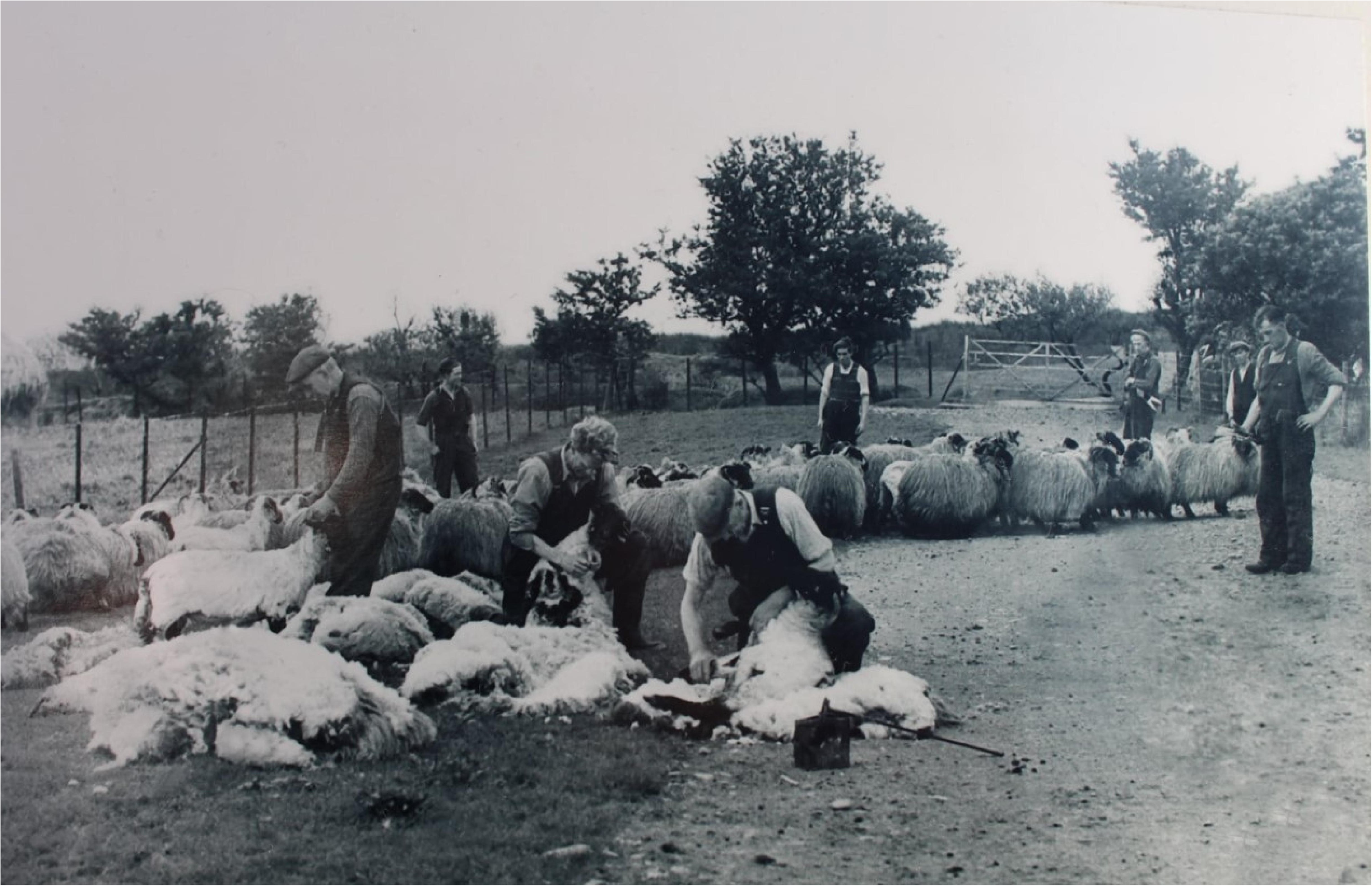
The above photo and caption from a photovoice session highlight connection to place and engagement humans and more-than-humans have had in the Sperrins for generations. Above, Sorcha mentions that the CEO of Dalradian referred to the people of the Sperrins as ‘welly wearing sheep farmers’ in an address to investors in London in 2014. Many participants noted this to highlight the disregard the company is showing for this area and the people who live there. These attitudes to rural people have much longer roots, traditional practices of agriculture, such as booleying 6 were branded ‘primitive’ by settler landlords during colonial times (Costello, 2020; Sands, 2022). Sands (2022) demonstrates the British colonial attitudes towards pastoralists around the world were one of barbarism. In Ireland they wanted pastoralists to become settled rent-paying tenants in towns and villages, to extract profit from them. Today, we witness a corporation dismissing the practices of an ‘inconvenient’ population.
Colonial mapping of Ireland rendered land as terra nullius, reducing land and people to economic units based on ‘a racial regime of ownership’ (Bhandar, 2018: 48). Those who engaged in English cultivation methods were seen as divine owners of land while those who did not were dispossessed because they supposedly left the land as unproductive wilderness (Bhandar, 2018). ‘The former ways of living in place, such as understanding land and its features through narrative memory and poetry were removed in favour of rendering land as a commercial product’ (Cirefice et al., 2022: 106). This instrumentalist view of land was central in the development of extractive capitalism in Ireland (Figure 2).
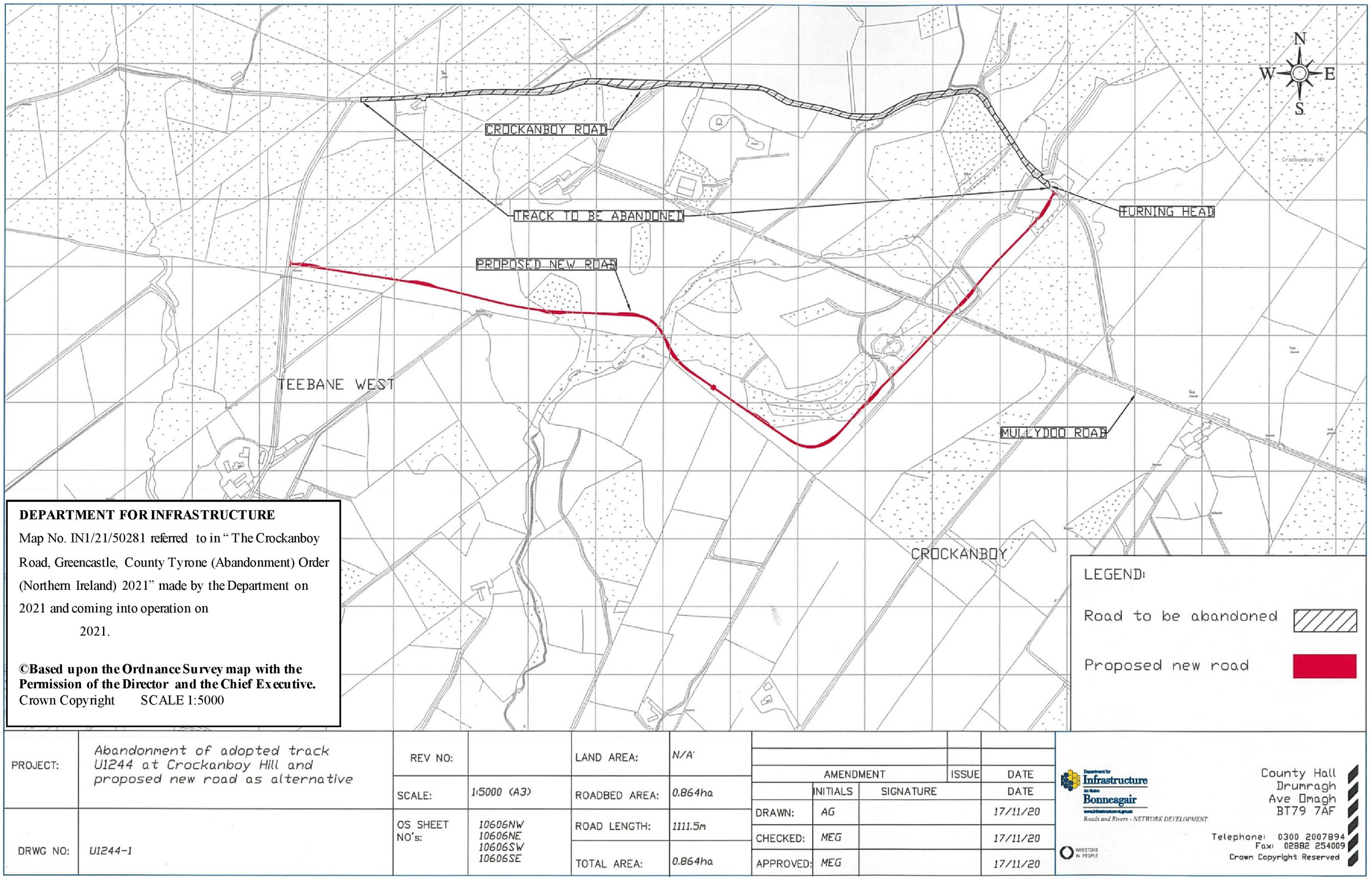
Map showing the abandonment of Crockanboy Road. Department for Infrastructure.
The above map details plans by the DfI for the abandonment of Crockanboy Road to be given to the company, which was announced in 2021 without any community consultation. The extractive gaze demonstrated in this map illustrates the colonial logics behind extractivism. A road used by local people for generations with cultural, spiritual and social significance is redrawn with a red line on an abstract map. Again, the politics of erasure are apparent. From early colonial maps of the Sperrins, labelled ‘mountains to the west’ with no detail and little more than expansive wilderness depicted, to the modern day geological survey maps that dissect the land with thick red lines, mapping has been used as a tool of erasure.
‘The troubles’: Colonial violence
Participants did not only make reference to a much longer history of colonialism, but also to the recent conflict of ‘the Troubles’ 7 , another direct and lived experience of the ongoing outworking of colonialism on the Island (McVeigh and Rolston, 2021). There is a responsibility within research to consider how the legacies of conflict and colonialism, which still express themselves in the present, impact struggles against extractivism. Below participants speak about this violence during the Troubles and the echoes of this violence in other extractive struggles (Figure 3).

Anti-mining resistance Peru. Author's Own.
In a workshop, Laura explains the significance of this photo she had taken in the Andes, Peru, where she had spent years with anti-mining resistance movements. Laura references the flag of Celandín in the picture that still had blood on it as it was used to lift people who were shot by the army for resisting mining. This moment highlighted the global nature of extractivism and reminded participants of local colonial violence. Mary, a participant, in her 60s, who had lived through ‘the Troubles’ in the Sperrins reflected: It reminded me actually about Bloody Sunday,
8
because, my uncle was a priest in Derry in the Creggan, and he had a hankie, you know, he took some people who were shot in his car to the hospital, and his car was a lot of blood, but I remember, his hankie was a lot of blood too. That's what I remember when Laura told us about the blood on the flag. (Mary, photovoice session)
Another participant joined the conversation, mentioning a friend from the civil rights movement who wore a bloodied coat from a violent ambush by Loyalist paramilitaries in 1969. The coat was referred to as a powerful symbol of resistance and the suffering people experienced. The past was constantly present in the here and now within the campaign, and echoes of ‘the Troubles’ permeated the resistance movement. Each year, participants in the resistance movement would march at the Justice for Bloody Sunday event in Derry. Grief echoes on into the present, as Saleh-Hanna articulates: That is colonialism. That is injustice. It is not contained within the moment of loss or the original acts of violence alone: injustice is all of that violence plus the living grief and enduring losses that echo across land and time, continuing to violate long after those who incurred first contact with colonial violence have gone. Colonialism is bloody, vicious, haunting, loss after loss after loss. (Saleh-Hanna, 2023: 7)
The red blood referenced in these encounters ran through participant's experiences of resisting extractivism, like the red lines found on the maps used to facilitate mining, both symbolise the violence of extractive logics on the land and people. Events have linked environmental justice to social justice, dealing with legacies of colonialism and conflict and the need to decolonise and create different, non-extractive relationships with the land and each other. 9
For many, the resistance in the Sperrins isn’t just a new environmental struggle they are taking up, but is understood clearly as part of longer histories of resistance to colonial oppression. Rachel, in her 30s, from Omagh, was at an event and someone asked her what felt like a straightforward question to them, ‘how long have you been involved in the campaign?’ And I said ‘you’ll have to define what you mean by this campaign?’ And they said ‘well you know saving the Sperrins’, and I said ‘I have probably been doing that my whole life.’ Because it's really integrated with the larger picture of oppression here. And making those links of history and it's interesting. (Rachel, interview)
This quote demonstrates that this is not just about the mining issue but part of a larger history of struggle, of injustice and of oppression in this area. While this was not the case for everyone in the resistance, and many participants, particularly from a Protestant or unionist background might not frame their resistance this way, there was a clear sense of this struggle being part of something much larger than an anti-gold mining campaign. The explicit extractive techniques used in the Sperrins are rooted in colonial mentalities that are long seated but also expressed recently during ‘the Troubles’. These include overt techniques, for example, the harassment and criminalisation faced by land defenders, but are also part of softer counterinsurgency techniques that are part of the social engineering of extraction.
The social engineering and colonial logics of extraction in the Sperrins
Participants in the Sperrins mentioned many counterinsurgency tactics as well as spectacular violence and intimidation. While in conversation with Aisling, a participant from Dungiven in her 50s, she highlighted that there is not the same level of violence in relation to extractivism in Ireland today, unlike locations in the Global South where land defenders continue to be disappeared with impunity (Global Witness, 2024). She felt that because we are in the Global North, corporations instead engage in a much subtler form of manipulation and violence which is wooing the community to manufacture consent. Aisling's analysis aligns with the scholarship in political ecology above, which has outlined that extractivism depends not only on a physical engineering, but social engineering too. These tactics take on a specific relevance in the North of Ireland context. The British general Frank Kitson (2010) brought counterinsurgency measures from Kenya to Northern Ireland which were developed further and then exported around the world, including to Iraq and Afghanistan (Williams, 2013). Central was ‘winning hearts and minds’ and using media (PR) for spreading disinformation among the population. Today we see the same tactics utilised to manufacture consent for extractive industries. In the following sections, I outline some of the more overt violence and the softer counterinsurgency approaches used in the social engineering of extraction. All of these examples illuminate how extractive logics are playing out in the context of the Sperrins.
Harassment and criminialisation
Many of the participants who live in and around Greencastle disclosed they have been followed at night, physically assaulted, verbally assaulted, faced online trolling and abuse for their resistance to the mining project. This includes death threats and threatening phone calls, surveillance, arrest and criminalisation (Greene, 2023; Ní Bhriain, 2019; Rimmer, 2019). In response to these threats, they mobilised in protests outside Police Service Northern Ireland offices in Belfast in September 2021 (Corr, 2021), and in December 2022, there was an all-night sit out outside Omagh Courthouse. Many podcasts and interviews with members of the resistance capture stories of selective policing, harassment and intimidation. 10 A recent report by Committee on the Administration of Justice calls for a review into the criminalisation and selective policing of protectors in the Sperrins (CAJ, 2024).
These are just some of the overtly threatening and violent acts of intimidation participants in the resistance movement have reported facing. Frontline Defenders 11 have been supporting the campaign, providing body cameras for people's protection. I was present at a zoom meeting with participants and Mary Lawlor, the UN Special Rapporteur on the situation of human rights defenders, where details of abuse and criminalisation were brought forward by a number of women. Participants then submitted a detailed report to the UN review of Human Rights in the UK during 2022 (Figure 4).
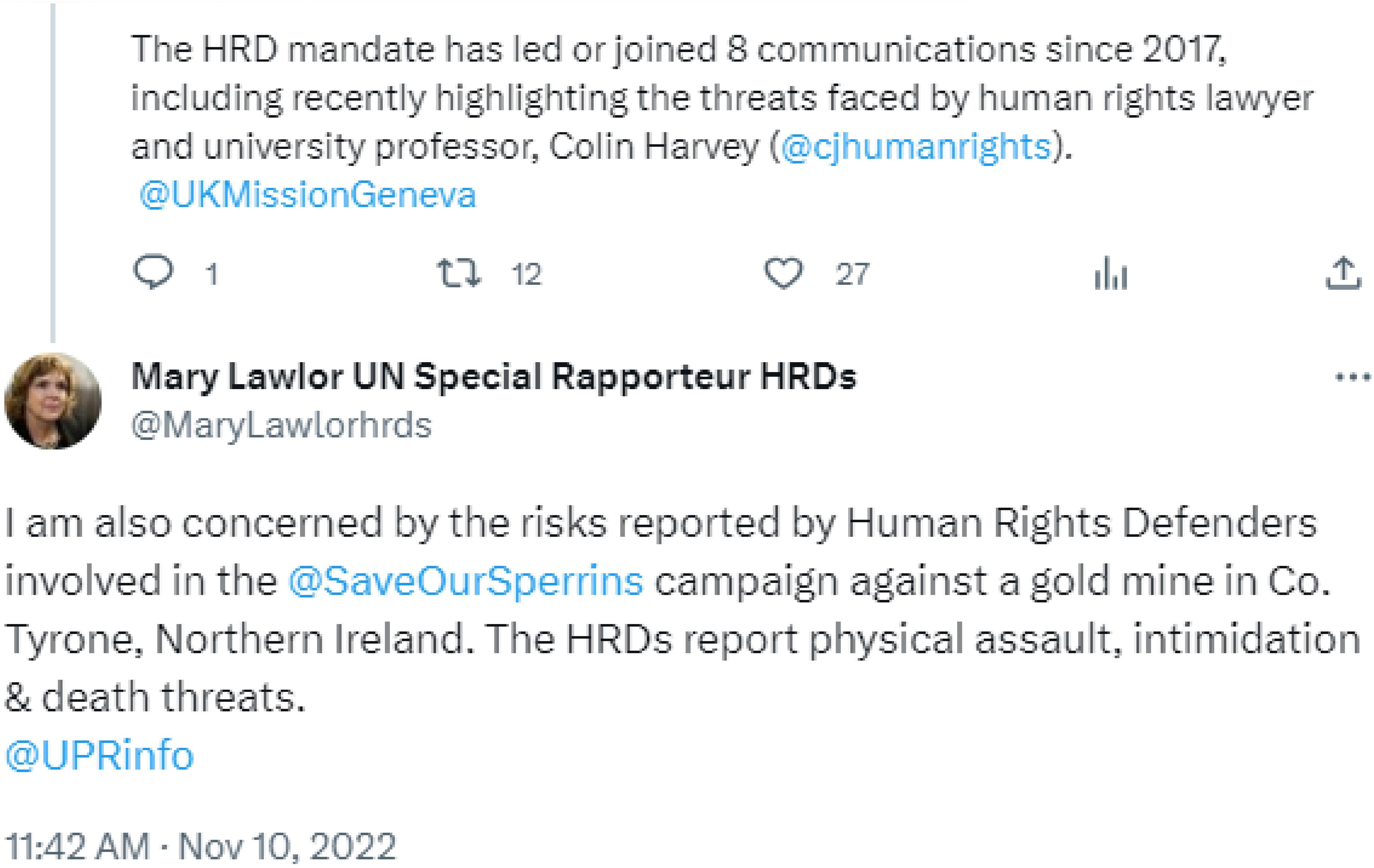
Tweet by Mary Lawlor about Human Rights concerns around resistance in the Sperrins. Save our Sperrins Facebook.
Communities are not homogenous entities and the violence of extractivism was experienced in heterogeneous ways. Taking a feminist intersectional approach, it is important to highlight the gendered element of extractive violence, which is well-documented globally (Caretta et al., 2020; Cirefice and Sullivan, 2019; Reyes, 2019; Venes et al., 2023). While the extreme violence of sexual assault, murder and disappearance is not common in struggles against extractivism in the Irish context, there are still gendered dimensions of this intimidation. Gendered violence was also experienced during the Shell to Sea campaign, when male Gardaí were recorded joking about raping protestors (Cox, 2014; Slevin, 2019). Participants in the Sperrins noted that women's cars were being followed at night in an explicit intimidation tactic.
12
Mary, a grandmother from Greencastle, recounted her experience of intimidating behaviour I was very frightened one day I was in the car and [male mine employee] tried to squish in the door, so I locked the car doors, but I thought he was going to break in and get me! He was shouting abuse, I put on my phone to take photos of him and that stopped him then. I then sent him a solicitor's letter to stop bullying and harassing me and since then he hasn’t done anything overt. I mean he has driven up behind me, and he's in a big van and I thought he would drive over me. Luckily now I have a dash cam so I feel more protected. But I mean in other countries particularly South American countries where women have been raped and murdered, what has happened to us is nothing in comparison. (Mary, interview)
Despite facing this type of harassment, Mary, like Aisling is still keen to point out that the gendered violence around extractivism in the Global South is much more extreme. There was almost a hesitancy in telling these stories of abuse because of that, but these tactics still have a material, emotional and felt impact on participant's everyday experiences. It is also important to reflect on holding this tension and discomfort while going beyond quantifiable experiences of extractive violence; to acknowledge the difference, yes, but to unite in a common struggle against a global system. Can movements move beyond extractivist logics which force communities into a competition of suffering, to see who can be prioritised and acknowledge the differences, but then go on to build solidarity?
‘Buying’ a social license to operate
Common across extractive industries globally is the tactic of buying a social license to operate, a tool to manufacture consent and legitimise their activities. In the Sperrins this tactic has been at play, as the mining company set up the ‘Tyrone Fund’ in 2015, now the ‘Dalradian Community Fund’. 13 This fund sponsored sports teams, gifted iPads to schools and donated to other community organisations. During the pandemic many mining companies and states labelled mining an essential activity and cracked down aggressively on opposition (Dressler, 2021; Mining Watch Canada, 2020). At this time many companies used the health crisis as an opportunity to gain a social license by donating to health organisations. In May 2020 the mining company donated £50,000 and 150 L of hand sanitiser to cancer support charity Marie Curie (Mining Watch Canada, 2020: 20). Save our Sperrins campaign pointed out this was a conflict of interest as gold mining is documented as a major cause of ill health globally (Hou et al., 2023). Further, the Sperrins are an area of high radon, a radioactive gas that is recognised as a carcinogen by the International Agency for Research on Cancer (Mining Watch Canada, 2020: 20). Many other examples of these actions by mining companies are recorded across the world and these tactics have been connected to counterinsurgency manoeuvers (Horowitz, 2014; Tsavdaroglou et al., 2017; Verweijen and Dunlap, 2021). The above represent tactics that are intertwined with PR initiatives.
Greenwashing extractivism
Greenwashing is a tactic used by corporations to make their operations appear environmentally sustainable. PR and advertising are often used to achieve this aim and distract the public from environmental and social harms these companies commit. Kirsch (2010) highlights that central to engineering consent of mining is the practice of corporations co-opting criticism from outside and integrating it into their discourses without actually changing. Feminist political ecologists have pointed out that, ‘[a]s the physical frontiers expand, so too do the depths of extractivist logics and relations. The narrative of climate change as a call to slowly decarbonise rather than to rapidly degrow the economy legitimises the creation of new “green” industries’ (Ekowati et al., 2023: 38). We see this in the Sperrins as the mining company aims to greenwash their operations. The company employs two PR companies and since 2017 have placed around two adverts per week in local newspapers. Other activities the mining company have engaged in to ‘green’ their public image include tree planting with local schools (Campbell, 2021). As noted above, this has special relevance as PR as counterinsurgency was developed in the North of Ireland during the conflict (Kitson, 2010).
Although originally a gold mining application the company has added silver, copper and tellurium among other ‘critical minerals’. This move could be seen in light of trying to fit the green transition narrative. Tellerium can be used for solar technology, but it is essential to the imaging, tracking and targeting technologies used in remote warfare (Govini, 2025). This mineral is also a component of the F-35 fighter jet, currently used in the Genocide in Gaza (London Mining Network, 2020). However, gold, silver or copper are listed as ‘critical minerals’ by the United Kingdom and gold is not listed by the Irish government. Despite this, 91% of the Irish prospecting licences issued by the end of 2022 include licenses for gold prospecting (McGovern, 2023). The financialisation of gold mining is not abstract but deeply rooted in places, ecologies and communities where extraction takes place. Gold mining leaves huge ‘ecological rucksacks’ requiring the removal of large quantities of earth for a few grams (Bridge, 2004).
While the ecological impact of gold mining is severe, it is hard to justify opening new gold mines. And 60% of gold extracted is used for luxury items like jewelry, 28% is kept in central banks or by private investors as holdings or investments for financial speculation. Only 12% is used for industry, such as smart phones or medical devices (The Gaia Foundation, 2021: 2). Earthworks (2015) have estimated that the 76,000 tonnes of gold stockpiled in bank vaults would be enough to meet the global industrial demand for gold for the next 186 years. Although it is established that mining virgin gold is not necessary for the green transition, the company continue to frame their operations in line with helping to solve the climate crisis. 14
Brock and Dunlap (2018) emphasise that these PR campaigns are part of the social engineering of extraction and part of winning hearts and minds. The mining company has been taken to the Advertising Standards Authority over claims that there are silver and copper deposits that will be used for lower-carbon technologies. This was investigated and proven false (ASA, 2021). The company's greenwashing includes carbon offsetting, 15 claiming they will have ‘net zero’ emissions because they will support a biomass energy scheme in Malawi. This is despite their planning application citing they will use 3.5 million litres of diesel per year on-site (Planning Portal, 2025). Participants frequently highlighted the facts above as greenwashing tactics. As Olivia, from Greencastle, reminds us, ‘Ten electric cars isn't going to make up for destroying acres of bogland!’ (Olivia, interview). The company plans to excavate peatland and abstract half a million gallons of water per day from the peatland surrounding the mine. Peatland is an important carbon store so this carbon would be lost, adding to climate change and impacting the ability to meet climate targets regionally.
Manipulation, rupturing the social fabric: Divide and conquer
Extractive logics seek to enclose mineral resources, while also enclosing and erasing socio-nature relations and other ways of knowing. Geographers and autonomous Marxists have exposed the spatial evolution of enclosure as an ongoing feature of capitalism (Federici, 2004, 2018; Midnight Notes Collective and Friends, 1990; Tsavdaroglou et al., 2017). Not only are the physical minerals enclosed but the socio-natural relations enclosed by extractive capitalism in the Sperrins. The enclosure of extractivism is a social process, dependent on recognising some and downplaying or misrecognising other social relations (Dahlin and Fredrikson, 2017). These logics work to ‘extract value from a range of different forms and areas of life not previously part of capitalist commodification and accumulation, revealing how extractivist dynamics may embrace and affect all aspects of life’ (Ødegaard and Rivera Andía, 2019: 16). With this understanding, extractive logics run much deeper than extracting materials from the earth. Part of this enclosure has been creating ruptures in the social fabric.
Many participants noted the manipulative tactics used by the mining company in early years to manufacture consent. Extractive logics depend on visual and symbolic representations too (Cayli, 2021). Spiegel et al. (2020) highlight that cartoons and simplistic visuals are used by extractive companies to convey an image as innocent and clean to the public; a visual tactic in the quest to engineer consent. In case of the Sperrins, participants noted receiving leaflets with simple cartoons and graphics on them at early public consultations. As Olivia explains, ‘it was like a child's sketch, it showed the gold being dug out and being processed by cyanide’. Participants who received these documents felt they attested to the colonial and infantilising attitude towards local people. The insinuation being that by depicting the mining operations using simplified and childlike visuals, the local people would more easily accept it.
The surveillance of the extractive gaze can be understood to be part of the social engineering of extraction. Participants noted that in May 2021, surveillance cameras were illegally placed on telegraph poles and road signs without public notification or official permission around Greencastle. When local people filed complaints, the cameras were mysteriously removed during the night. Further, the surveillance of the extractive gaze was experienced as early as 2017. It was reported that the mining company had lodged a map with their 2017 planning application pinpointing local people's homes and the initials of the head of each household (Corr, 2018). This distressed local people as they felt people who opposed the plans were deliberately targeted (Corr, 2018). These moments during the campaign relate to the mental and psychological violence of the extractive gaze, an omnipresent calculating view from above. Countering this, the resistance movement has formed their own counter-surveillance on the ground, networks of relationships facilitate a watching of the area, and an ability to share information quickly so that local people can monitor the activities of the company.
The tactics of buying a social license, greenwashing and manipulation have led to a rupturing of the social fabric. The community has suffered divisions that will leave a long legacy. These divisions exist between those who support the plans for the mine and those resisting it, although it is important to say the majority of people oppose these plans. As Sorcha, a young mother from Greencastle, outlines below, she feels the real damage done by the mining company has been the rupturing of relationships within the community, something that has already been done and will last for a long time I suppose what you are fighting for is to preserve something that you feel is important, […], and I feel what Dalradian want to do is a threat to the type of society we have in Greencastle. And I feel it already has disrupted it, the community is already not as strong as what we would have had, and that's sad, that's the legacy, you know people will talk about jobs but it's the actual breakdown in the community that is the really sad part. (Sorcha, interview)
Adding to the literature on the social engineering of extraction, I highlight the specifics of how this plays out in the North of Ireland with a very unique post-conflict context. Scholarship has highlighted that extractive industries use divisions within society to their advantage (Paarlberg-Kvam, 2021). This was pointed out by participants and experienced during research encounters. The company is using legacies of conflict and division to divide and conquer, to make the resistance weaker. Olivia explains that the most popular political party in the area was labelling the resistance as republican dissidents. 16 This was done to dissuade other communities from supporting the resistance.
One participant, Geoff, in his 50s, an experienced campaigner working for an environmental NGO noted that, ‘the industries are very clever as well and they know how to push triggers here that are very easily pushed’ (Geoff, interview). Geoff explained he had experienced the same behaviour in other anti-extractive campaigns, in both loyalist and republican areas. Geoff went on to explain, there was provocateurs put in to cement sectarian hatred, certain flags were put up or pulled down depending on who they wanted to provoke at the time […] there were many attempts to make it into an orange and green issue, deliberate attempts, so it's not that this is an undercurrent, it's a strategy by industry and facilitated by many politicians who find it convenient to sectarianize environmental campaigns, so all of us are very conscious of that and would do our best to try and avoid those conflicts. (Geoff, interview).
Again, Declan, in his 50s notes the fact that companies exploit divisions that already exist in the societies they go into. Importantly, he suggests that our attention should be on coming together across divides to resist corporations who seek to split resistance: That in essence is what a lot of these corporations are looking to do now. So the way the people battle against the landlords and the landowners in the past, I think that transferred quite nicely on to this now, but I shouldn't be personalised into sending neighbour against neighbour. That is what these companies are doing. It's not Catholic against Protestant, although they may exploit that wherever. I'm sure they will exploit that, for such a dynamic exists, because they'll go to the existing fault lines, they will exacerbate it. (Declan, interview)
This quote from Declan points towards the disruption of community cohesion and solidarity by operationalising identity politics in divisive ways. These tactics are directly related to colonial logics of division and settlement and they are felt as emotional and embodied exhaustion.
Slow violence: Emotional and embodied exhaustion
Counterinsurgency involves the emotional exhaustion of those resisting (Dunlap, 2020). This is part of the slow violence of extractive logics (Nixon, 2011). In Portugal corporations use these tactics to ‘exhaust, demoralize and defeat mining opponents in order to pacify the resistance and, consequently, access lithium’ (Dunlap and Riquito, 2023: 18). Participants in the Sperrins also identified a mental embodied and emotional impact of extractive logics; ‘That's been my life for four or five years. Always this knot in your stomach like just constant worry and who's going to be next’ (Olivia, 50s, interview).
Olivia demonstrates the emotional and mental health aspect of the slow violence inflicted by extractivism. This was a theme articulated throughout research encounters,
17
and reveals the emotional, embodied scale of extractive logics. Some violence from the extractive frontier is highly visible, some is invisible, the rifts between family and friends, the worry and emotional strain of being harassed and threatened and criminalised. Multiple participants noted the impact that criminalisation and harassment has had on the community's children. From feelings of confusion and fear as to why their parents are being called upon by the police, to disrupted friendships. Aidan, a farmer from Greencastle, describes the experience as ‘Terrible […] because in real terms, these people are coming in and they're torturing you. They're mentally torturing you’ (Aidan, 50s, interview). Participants often noted that what was happening was re-traumatising people who had lived through ‘the Troubles’. On the 20 July 2023 jeeps belonging to the mining company patrolled the Crockanboy Road with nine men with ear pieces and walkie talkies interrogating women walking on the road. The GPO blog for that day explained One woman described it as being back in the bad old days when up quiet roads you were afraid of being stopped or followed, where your every move was being watched and relayed back to whoever was on the end of a walkie talkie. We thought those days of “the troubles” were far behind us, but it would seem like Dalradian staff is now acting like Special Forces. (Greencastle People's Office, 2023)
Again, the gendered nature of resisting in a remote rural area is visible as women felt uncomfortable and intimidated by these actions. Participants noted how these tactics were a reminder of the darker days of ‘the Troubles’ and drawing communities back into times they want to move on from. Aidan, a local farmer in his 50s, notes that this remilitarisation of the Sperrins is re-traumatising for communities I think people are fed up to be really honest, this community all down through “the Troubles”, you know, was one of the areas that was heavily policed, heavily militarized. Why is it okay that everybody else in the six counties can now […] go back to normal life when it's been decided this community goes back to what it was. Because now we see police placed on the road every day, you know, victimizing the community, victimizing people that they believe, are standing in the way of progress? Yes, it's not what it was 30 years ago. But if you actually look farther back, it's propagating the thing of the civil rights all over again, only this time in relation to the environment. (Aidan, interview)
This re-traumatisation of communities who still carry the impact of conflict and marginalisation was raised during research encounters. Rachel explains But in reflection we haven’t broken the trauma addiction cycle yet. And so many people here haven’t, so many people on mass are traumatised, the support systems, although you have so many wonderful people working in communities, the system isn’t serving the needs, […]. We’ve got to start healing from the past in order for us to keep involved and fighting for our future. (Rachel, interview)
The need for healing from intergenerational trauma to be part of the struggle against extractivism is an important discussion, especially within the context of the North of Ireland. The mental and emotional toll of this campaign was a constant theme. Participants recounted how the campaign and the stress of what was happening was affecting their sleep and mental health: It's hard to know what's been the biggest challenge, I found it very hard with the judicial review, I had taken it in December 2017 and for the first six months I was a personal litigant, I was dreaming about it, not sleeping at night, trying to remember the details, being totally stressed about it. (Mary, 60 s, interview) they would talk about the harassment, the sleepless nights, the intimidation, so all of that trauma I was able to pick up on that from a qualified counsellor but also just in general because you are going to be traumatised when you don’t know the next time Dalradian are going to be in. Or if the police are going to call or what you are going to be accused of next. (Rebecca, 40 s, interview)
The above quotes demonstrate the intrusion of the struggle on the intimate space of sleep. Mary notes the burden of having to take on court cases and become experts in technical knowledge, while Rebecca, a qualified counsellor, noted the trauma people faced in the every day and night. Leanne Simpson (2017, 2021) describes how colonial violence disrupts sleep of Indigenous people in Turtle Island. The intimate space where regeneration happens, where you dream and for Indigenous people this is essential for communicating with ancestors.
The exhaustion and re-traumatisation experienced through this environmental conflict is directly related to the theory of slow violence. Extractivism works as colonial violence intruding and disrupting the most intimate, private and personal of spaces. It's a type of slow, embodied violence that manifests in the everyday and is often invisiblised. Nixon (2011) notes the disruptions to sleep as part of the processes of slow violence surrounding extractive projects, in the Ogoni land where the gas flaring of Shell makes it impossible to rest. In the Sperrins these logics work to disrupt the private spaces of resistors, wearing away at their regeneration time and causing further exhaustion. The emotional and embodied slow violence detailed here helps to answer my research question focusing on how extractive logics play out the in Sperrins. These experiences speak to the lived realities of extractivism within a post-conflict setting and contribute to understandings of these processes in the context of the North of Ireland.
Feminist and decolonial approaches expand the remit of what is worthy of study, bringing in topics which have been devalued by ‘modern knowledge’ under a Cartesian dualistic outlook (Sultana, 2015). Emotions and embodiment are two such categories which have been undervalued through dualisms of emotion/rationality and body/mind. The emotional geographies of resistance challenges extractivism's emotionless rendering of affective places into mere ‘resources’ and ‘economic outputs’, by highlighting the complex relations of people and place, human and nonhuman that are interrupted by expanding extractive incursions (Ey, 2018; Gilmartin, 2009; Liboiron, 2021; Wright, 2012). Murrey (2016) notes that emotional geographies of resistance illuminate how long-term struggles involve a collective emotional consciousness which is grounded in historical patterns of injustice, often containing echoes of collective memories to earlier colonial violence.
However, the story does not stop here, far from being passive victims of extractive logics, participants have been resisting and insisting that other non-extractive futures are within reach. The resistance movement challenges and produces counter-narratives to the extractive logics relayed here by Making Relatives with each other and the more-than-human world (Cirefice, 2022). This is achieved through practices of care, commoning and mutual aid on the land of the proposed mine and through engagement in national and translocal networks of solidarity (Cirefice, 2025). Some examples of this include an occupation on the land of the proposed mine which hosts community celebrations and cultural events as well as visitors from around the world, as well as engaging with the Rights of Nature and Rights of Communities movement (see Hwang this issue).
Concluding
This article expands the literature on ‘green extractivism’, counterinsurgency and social licence to operate by extending critical frameworks through the specific post-conflict and colonial context of the North of Ireland. Counterinsurgency is experienced differently in every context, this article sheds light on these tactics within the North of Ireland, a site where counterinsurgency was developed (Kitson, 2010). T. Colonial legacies and extractive logics are evidenced as participants note how people and place were dismissed as wild and unproductive, echoing colonial narratives about the Sperrins. The violence of colonialism and ‘the Troubles’ was a significant feature in participant's accounts of their experiences of extractivism and resistance. I expand scholarship on social engineering with an empirical study of the Sperrins, by showing the connection between the counterinsurgency measures of PR, greenwashing and dividing communities, together with slow violence and colonial constructions of place. I argue these are all measures used to manipulate and manufacture consent for extractivism from communities. In doing so, I contribute to broader discussions around green extractivism, energy transitions and climate justice by centring the experiences of those resisting gold mining in a colonial and post-conflict setting.
As the extractive frontier continues to expand globally more communities and ecologies face the violence of extractive and colonial logics outlined in this article. Critical perspectives and counter-narratives on green transitions, rooted in the experience of frontline communities, are essential for resistance. This intervention is timely and relevant, expanding debates around the social engineering of extraction as increased extractivism is pushed for the green transition. Understanding how this impacts peripheralised communities so we don’t fall into decarbonisation by dispossession (Dunlap, 2023) is a vital task. This represents an important area for future research within (feminist) political ecology. The slow violence of extractivism in the Sperrins outlined throughout represents a foreclosure of possible futures. Despite this, communities continue to resist extractive logics and, in the process, build non-extractive relationships between members of the resistance, the more-than-human world and other frontline communities around the world.
Footnotes
Acknowledgements
Special thanks to the Land and Water Protectors of the Sperrins who gave their time for this research.

Funding
The author disclosed receipt of the following financial support for the research, authorship, and/or publication of this article: This work was supported by the Irish Research Council.
Declaration of conflicting interests
The author declared no potential conflicts of interest with respect to the research, authorship, and/or publication of this article.
Ethical consideration
This research was approved by the Research Ethics Committee at the University of Galway.