






Abstract
This visual intervention explores a landscape photography series depicting Northern Virginia, the so-called “Internet Capital of the World.” The series shows how data centers, a key infrastructure of the “AI” economy, impinge on aspects of life in that region of the country. Particularly, it explores occurrences of data center development disturbing Black cemeteries and displacing features of Black life more generally on the landscape. Contextualizing the internet economy within “plantation capitalism,” the intervention explores the politics of ancestry, regional economic growth, and abolition on two key landscapes in the organization of public memory: cemeteries and internet data centers. It advocates for the construction and struggle over places for the claiming of ancestors beyond bloodline and culture within the varied material landscapes of public memory.
“I may state to all our friends, and to all our enemies, that we has a right to the land where we are located. For why? I tell you. Our wives, our children, our husbands, has been sold over and over again to purchase the lands we now locates upon; for that reason we have a divine right to the land.”—Bayley Wyat to a gathering of his fellow Freedmen on December 15, 1866 in Yorktown, VA, recorded (in dialect) by the Superintendent of Friends’ Freedmen's Schools (quoted in Rosati et al., 2023,: 220)
Landscapes of dark fiber
In a series called “Dark Fiber,” photographer Stephen Voss captures over multiple years a set of globally important landscapes in Northern Virginia (NOVA), an area west of the US capital, landscapes of internet infrastructure. 1 NOVA is known as the “Internet Capital of the World” because its landscapes host the highest concentration of data center capacity in the world. Much of this is concentrated in the Dulles area and expanding surroundings. In one photo's foreground, darkened by trees and underbrush, you can detect something unexpected: a few headstones, with a whitish one standing out amid the chiaroscuro. The names are indecipherable, and it conveys the impression that the weather has worn them for good. Typically, sites of reverence and celebrations of past lives, this landscape gives something else. Instead, except for a new-looking boundary fence, the crooked and leaning headstones convey an unsettled feeling, neglect, and clumsiness (Figure 1).

A historic cemetery containing graves from the 1700s, including that of a soldier who fought in the War of 1812, near a data center in Manassas, Virginia. Photo by Stephen Voss.
Part of what provides contrast to this darkened foreground is the brighter technical structure looming in the background. Behind the headstones, in an open field, stands an Internet data center, grayish white and shining in the light of clear skies. Data centers store and process information as “the cloud,” including services that are called “Artificial Intelligence” or AI. Many are surprised to learn that the Internet has a physical landscape in the first place. But to see it share space with a neglected graveyard adds further intrigue. Why do these two contrasting forms share space on the NOVA landscape? And what brings them together in the conditions and configurations we find them? These questions, and the cascade of others it inspires, are part of what makes Voss's landscape photos so compelling to me. We get a glimpse of life and afterlife among the data centers (see also Voss, 2025; Figure 2).

The historic Gaskins family cemetery in Manassas, Virginia, which was disturbed by nearby felled trees and toppled gravestones during construction of a nearby power substation on February 13, 2025. This was one of several historic African American cemeteries in the area that were disturbed by the construction of new data centers. Photo by Stephen Voss.
The photo's caption adds to the shock with some background: “A disturbed Freedmen's cemetery near a power substation being built for a data center in Manassas, Virginia. While under construction, contractors cut down trees within the cemetery and displaced gravestones. The cemetery is the final resting place of the Gaskins family, whose lineage can be traced back to the 1790s when they were enslaved by plantation owner Robert Carter III.” Voss visually captures a contested trend in Virginia, as African American historical sites are buried, disrupted, damaged, or destroyed by digital landscapes along with other commercial developments. In the process, they force us to think about, in a physical sense, the clashes of two forms of public memory: one, the physical memory of our digital world, the cloud and its cacophony of stories; and the other, the public story of the physical remains of our family members, neighbors, and countrypeople—our ancestors. This conflicted and visually arresting landscape is the “unwitting autobiography” (Lewis, 1979) of a larger culture war in the United States (and perhaps internationally) over the value of the history of Black lives that built our country and crucial elements of a whole global economy. What is their place in the narrative of the American nation? Will they be erased? Overwritten and forgotten? And who shall honor them as theirs, as cherished ancestors. Through his photos, Voss visually captures this ideological, more or less starkly, clash taking place, physically, on the terrain. The landscape shows the ordinariness of this conflict. Their drama is the “dark fiber”—the unlit and unused connections—of the long struggle for abolition, not just of American slavery but its “afterlives” as well.
Voss and I connected to explore this geography visually and to further elaborate on the notion of Northern VA as a “data plantation.” This visual intervention—through Voss's wider-reaching illustrations—explores occurrences of data center development disturbing Black cemeteries, and displacing features of Black life more generally on the landscape. By juxtaposing Voss's landscapes with a history of contests over the public memorialization of ancestors in the region, it invites readers to further consider the internet economy as an aspect of “plantation capitalism.” While it intentionally leaves space between text and images for interpretation, it argues that we can read the unfinished struggles over abolition on these two key but seemingly unrelated landscape forms in the organization of public memory. Thinking about the data economy's broader social implications alongside the frenetic land-hungry pressures for regional development through data centers, it argues for the production of what Black Geographies scholars call a “Black sense of place,” beyond bloodline and culture, excluding no one from the human family, within the varied material landscapes of public memory.
Virginia’s contested landscapes of ancestry
US Slavery's genotypic (“blood”-based) hierarchies, combined with its legal tolerance and economic incentivization of rape (Antebellum slavery, 1998; Eaves, 2024; Foster, n.d.), 2 spawned radically contradictory and incoherent notions of familial and national ancestry. What this showed was that ancestry can, but does not have to, adhere definitionally to blood and bloodlines. Every society continually exceeds and is eclipsed by the quantifiable relations of blood in its selection and reselection of “ancestors” and its historical ties to the dead. The iconography of money illustrates this in a banal way. And, every family—especially in the American South—decides which bloodlines they will venerate and which they will erase and forget. So, how do these memories of our ancestors collectively get made? Share patterns? Convey shared but unspoken feelings and meaning? These things are the geographical purpose and content of politics (Figure 3).

A transmission tower near Manassas National Battlefield Park in Manassas, Virginia. With data center construction comes enormous power needs and additional infrastructure to deliver that power. These towers can be over one hundred feet high, towering over adjoining neighborhoods and parks. Photo by Stephen Voss.
On May 11, 1868, the Alexandria Gazette and Virginia Advertiser reported that the previous Saturday, “some visitors from the cities of Washington and Alexandria, to witness the dedication of the beautiful cemetery, which the ladies of the Memorial Association of that place, have, with much difficulty and expense, prepared for the reception of those Confederate braves whose unconfined remains lie, for miles around that historic place, in mounds almost unhonored and unknown” ( Alexandria Gazette, 1868 ). These Ladies’ Memorial Associations and later the Daughters of the Confederacy engaged in foundational groundwork to form what would become known as the “Lost Cause” mythology for white southerners, the memory of their “ancestors,” and the distinction between theirs and others (Foster, 1987; Gallagher and Nolan, 2010; Hague et al., 2008; Janney, 2008; Richardson, 2001).
The Gazette would continue that, “[t]he ladies of Manassas deserve the thanks of every christian[sic] mother and of every brave soldier for the zeal with which they are laboring to preserve from desecration the bones of those who fell in defence[sic] of a cause which was so earnestly espoused by them, and they confidently look for the aid of every Southron in their labor of love.” Whether they included African Americans in their concept of “Southron” is not clear, though they mention the presence and interest of “many colored people from the neighborhood.”
Already by the fall of 1865, “[p]romises of federal land redistribution were quickly dashed when Andrew Johnson… [seized and returned] the Sherman land grants to former plantation owners but also lands redistributed by the federal Freedmen's Bureau” (Safransky, 2022: 299). In January 1870, Reconstruction ended in Virginia, and by the Compromise of 1877, the entire South was making concerted efforts to roll back the modicum of political and subsequent interpersonal and economic equality for Black Americans that they and so many had fought to create. And the post-Reconstruction separation of races would be built through the separation of histories and ancestors, and vice versa (Figure 4).

The wall of a data center under construction in Gainesville, Virginia. Photo by Stephen Voss.
Separate histories and mirror landscapes
In the coming decades, especially after Plessy vs. Ferguson (1892), a network of activist lawyers, artists, scientists, journalists, and others constructed this separate and unequal memory of America's Southern ancestors. As Confederate memorials spread across the United States in the 1920s, Virginia's racialists pushed the logic of this narrative of ancestry with the Virginia Racial Integrity Act of 1924, eventually struck down by Loving vs Virginia (1967). Virginia schools resisted desegregation doggedly after Brown (1954), into the early 1970s (Daugherity, n.d.). De facto segregation followed court-ordered integration. In the 1980s and 90s, Virginia debated whether it would officially celebrate the birthday of Dr Martin Luther King, Jr., deciding alternatively on “Jackson-Lee-King Day” (Gomer and Petrella, 2017; Scottie, 2020; Wheeler, 1999; Younge, 1998). After more than a century, Reconstruction and the abolition of the “afterlives of slavery” (Hartman, 2008; Jackson, 2023) remained contested in Virginia in hotter and colder forms.
Throughout the 1990s, racial segregationist activists continually proposed (and momentarily achieved) the so-called “white history” celebrations in Virginia's legislative calendar. GOP Governor George Allen signed, and then apologized for, a proclamation request by the Virginia Sons of Confederate Veterans (SCV) to make April “Confederate History and Heritage Month” (Fiske et al., 1997). Couched in terms of “diversity” and fairness, the encroaching prospect of a multiracial American ancestry represented the overturning of longstanding tradition for some.
An April 17, 1997, news article from The Roanoke Times described Governor Allen's response to VA's NAACP director calling the proclamation “deceptive, fascist and racist”: The governor said he realizes many blacks associate the Confederacy with slavery and are offended by celebrations of it. But Allen said he does not believe that was the motivation of the Sons of Confederate Veterans, the group that submitted the proclamation to his office. Allen commented, “What we need to do is celebrate the diversity of our heritage…There is not a state in the union with a richer history.”
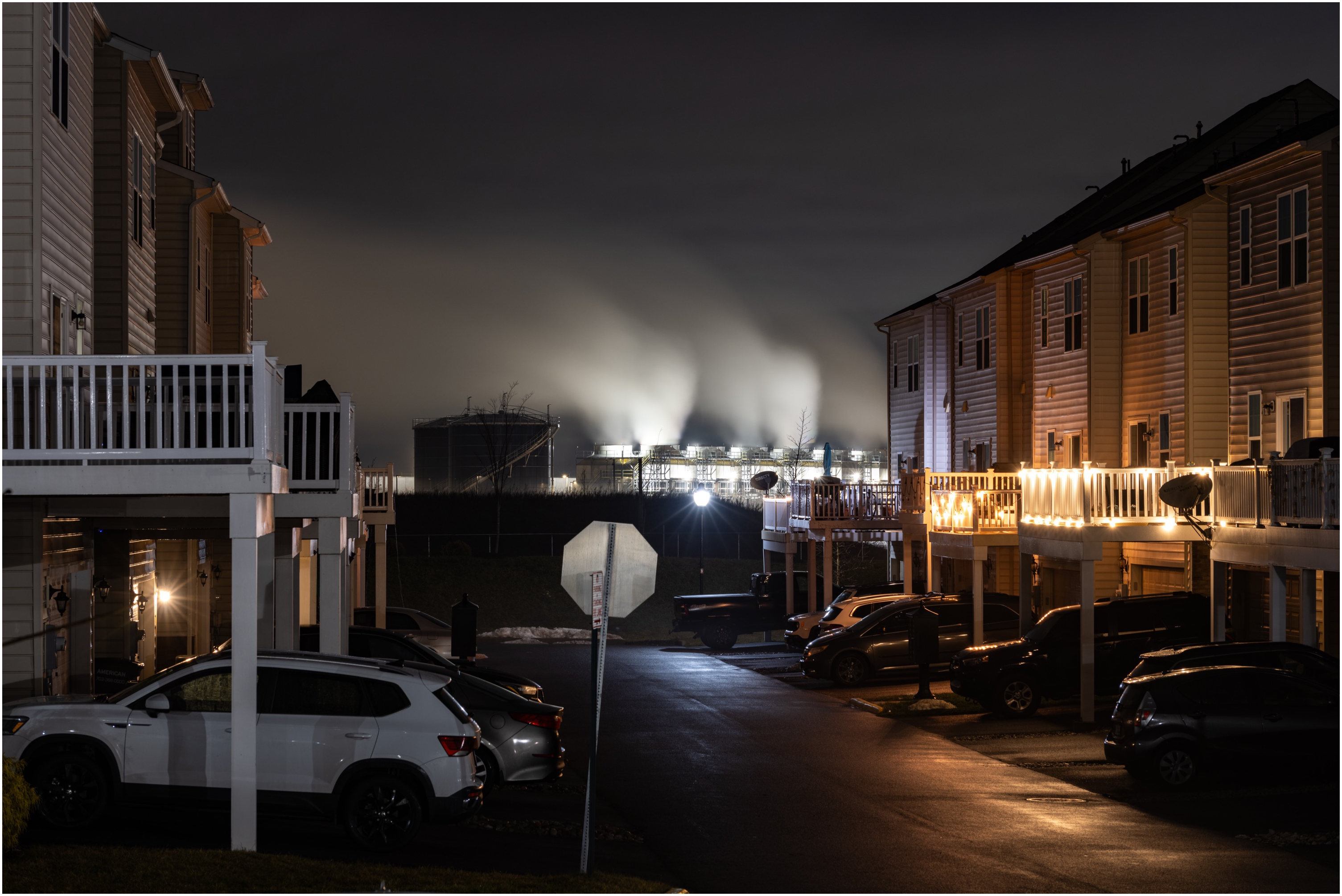
The exhaust plumes from a Google data center can be seen near a housing development in Sterling, Virginia. As much as 40% of a data center's overall energy usage can be tied to cooling. Photo by Stephen Voss.
The SCV, which The Roanoke Times noted “consider President Abraham Lincoln a historical villain and say the term ‘Civil War’…is inaccurate,” agreed obviously. To them, as the SCV leaders explained, “Confederate History and Heritage month is about their ancestors—most of whom never owned slaves—who defended their homes and families against an invading Union Army.” The nature of those historical complexities can be framed and remembered in many ways. Yet, to defend their shared views of the present, the organization's leadership looked to bind their destiny to the blood and land of the past. The president of the Roanoke SCV chapter argued passionately: “We're talking about my ancestors, my great-grandfather…Do I not have a right to my heritage and my history? I do not deny [the NAACP and the SCLC] their black history.” 3 This vision of the national community is built on a landscape of mirrors, constantly refracting ours and theirs, my ancestors and yours, through “blood” and the pseudoscience of race (Figure 6).

Fiber optics cables at a data center under construction in Manassas, Virginia. Photo by Stephen Voss.
Landscape is a way of making socially contingent things that appear natural (Olwig, 2002). And the attachment of racial belonging and ownership to bodies in the ground was—as history always is—about contemporary choices and political sides, a constant activity organizing and (re-)drawing geographies in the present. 4
Still, this organizing was active 4 years later, when in 2001, GOP Governor Jim Gilmore signed a proclamation request for “European Heritage Month” until its ties to David Duke and the KKK were exposed in The Post and elsewhere (Ayres, 2001; Lessig, 2001; O’Dell, 2001). And finally, Jackson-Lee-King Day, celebrating the achievements of the revered civil rights martyr, alongside supporters of slavery, ended in 2010. But the story did not end there.
The law of the land was changed but the mirror remained. The internet and new algorithmic cultures, powered and metabolized by data center landscapes, thrived on constructing mirrors and naturalizing “likes,” “interests,” affinities, and “engagement.” The data center landscapes forged familiar and novel transformations of public memory in the connected “Unite the Right” rally, QAnon and election conspiracies, “anti-woke” propaganda against the “radical left,” and the January 6, 2021, attempt to violently overturn the 2020 election results.
Amidst all this in 2022, Virginia's GOP gubernatorial candidate used the latest digital internet-based tools, built on the decade-long accumulation of behavioral data within platform politics and micro-targeted organizing, to initiate legal battles to ban Black history under the term, “critical race theory.” This targeting practice is the norm in politics worldwide and is a crucial technology of public memory. Whatever the underlying reasons for the growing political purchase of these narratives (which deserve more study and debate), for the last 150 or so years, Virginia has been part of an uneven but continual geographical contest to define American ancestry as racially separate and mutually antagonistic. Both cemeteries and data centers have been at the heart of this contest for public memory.
Northern Virginia, the “data plantation”
The “Internet Capital of the World's” boosters claim something like 70% of the world's internet traffic flows through infrastructure, “server farms,” 5 just like this one near the battlefields, churches, and other historical features around Manassas (Rosati et al., 2023).
Virginia's landscapes are increasingly crowded with the noise and smells of data centers. And their locations, generous tax abatements, and zoning fast-tracks are now often the subject of intense local conflict, not simply along racial lines. In this context, the politics of Black place and the plantation is instructive and even more broadly applicable (Figure 7).
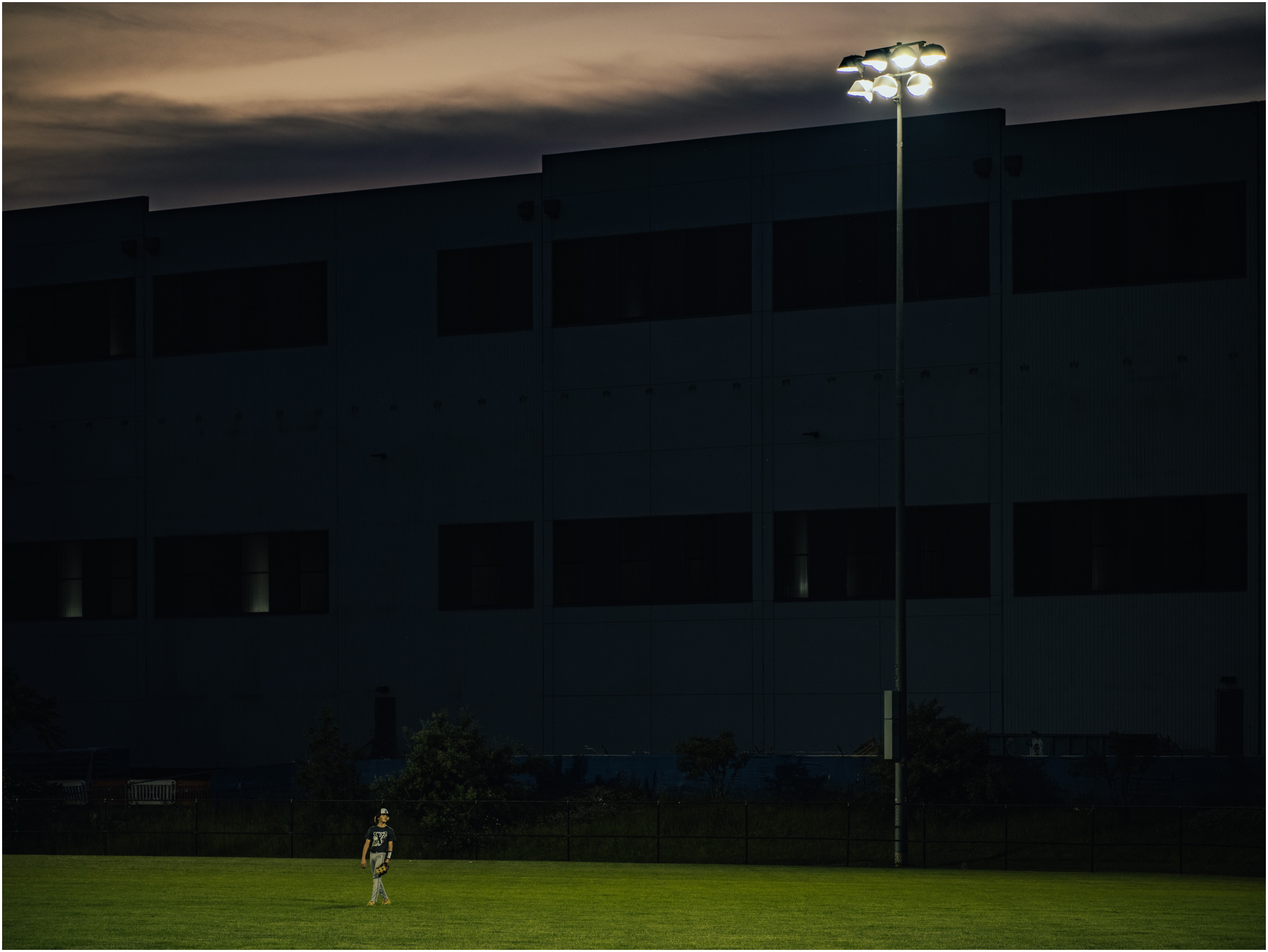
A baseball practice at Sully Highlands Field, near a data center under construction, in Herndon, Virginia. The data center is less than 50 feet from the outfield fence of the baseball field and close to other nearby athletic fields and townhouses. Photo by Stephen Voss.
“The plantation,” a concept elaborated in the field of Black Geographies, is an expansive category that pushes beyond its old connotations in agriculture alone, connecting that system's broader networks across times, places, and processes (e.g., “the prison, the city, the resort”). As the location of many former plantations, NOVA's landscapes contain a rich terrain of sites and artifacts of its Black ancestors’ lives, before and after the Civil War. My coauthors and I argue elsewhere that the construction of the Dulles, VA area, and its voracious data center economy have, in various instances, benefited from and built on top of the dispossession of African American neighborhoods and sites of Black life and labor there (Rosati et al., 2023). Disturbing and erasing cemeteries, for instance, along with other archaeological and ethnological traces of Black contributions to the nation's (and world's) history, are part of a long struggle over the value and purpose of land and landscape in Virginia (Moss, 2022; Muzyk, 2024a, 2024b, 2024c; Wessler, 2022; WTOP News, 2022).
Overlaid on top of old plantations and communities of postbellum Black life and survival, we have called these server farms “data plantations” for a number of reasons. Not least of these is their accumulation of unwaged labor to produce behavioral data, algorithmic ethnic and racial polarization, mass surveillance and mobility tracking services, monocultural land use, and their “ever-increasing monopolization and mining of an ever-decreasing supply of viable air, sea, land, subterranean, and communal resources” (Woods, 2007). Within them, we can see an ever-expanding understanding of these “communal resources”: conversations, selfies, movement and travel, heartbeats, blood sugar levels, fertility, and all manner of other practices of social life within digital civilization are “farmed” and “harvested” into data plantation processes, expropriated as the property of massive media corporations.
“Data plantations” describes these physical and ideological landscapes as elements of what some call “The Plantationocene,” a contested term (Curley and Smith, 2024) that denotes an existential crisis with a long history based on a particular ordering of property, violence, and hierarchies inside and outside of the “human family” (Haraway, 2015; Haraway et al., 2016; Jackson, 2023). Data landscapes can and should be included within understandings of the Plantationocene's specific limits and pressures on the urban problematic (what kind of city for what kind of society?) (Lefebvre, 2003) (Figure 8).

Fiber optic cable along the Washington and Old Dominion Trail in Ashburn, Virginia. The trail originally was a railroad track that passed through rural communities known for their dairy farms. Today, fiber optic cable has been laid next to the trail, connecting the massive data centers that have been constructed alongside it. Photo by Stephen Voss.
Progrowth advocates, including Governors Allen and Gilmore, in state and local government, have pushed for large-scale commercial economic development in the region, providing countless incentives to data center builders (Rosati et al., 2023). The groundwork for this was laid by the construction of Dulles Airport, which dispossessed and demolished the predominantly Black settlement of Willard in 1958 (Scheel, 2002). The 87 area landowners received condemnation letters from the federal government and deeded 9800 acres. This required the relocation of a historic Black church and its cemetery to the town of Conklin (Rosati et al., 2023: 210).
Data plantation landscapes entail both intentional and inadvertent erasure from the national public memory of its Black ancestors around notions of “value,” what something is worth in exchange, compromising or corrupting what is worth remembering or cherishing, and how. Growth and economic development have differential impacts based on which places (and people) are more economically valuable or carry other kinds of social capital (or social death) (see, e.g., Smith, 1987). This landscape process metabolizes social sentiment and inequalities. As part of capital's pressures toward difference and differentiation, this ongoing mediation of inequality can have the effect of a seemingly banal and even “color-blind” anti-Blackness (King, 2016: 1020).
In the case of Voss's “Dark Fiber” landscapes, the Prince William Times reported something more insidious: Even though the cemeteries are well known, construction activity associated with a new Iron Mountain data center and a Northern Virginia Electric Cooperative substation got within feet of some burial sites despite the county's required 25-foot buffer to protect cemeteries. Also, access to the cemeteries, which is required by Virginia law, does not appear to be maintained at either site (Muzyk, 2024c).
Black place, our ancestors, and abolition geographies
Geographic, media, and communication research on infrastructure often focuses on “the mediation, layering, alienation, and organization of systems and subjects along certain pathways potentially aligned with or in opposition to the conditions of capitalist political economy” (Bosworth, 2022: 2). Akin to (and constitutive of) “organic” memory's social processes, infrastructure networks are “constantly under repair, maintenance, expansion, and contraction as certain resources are exhausted and others are accessed, as geopolitics change, and as cost-effectiveness and political viability of various extractive technologies evolve. The network is also unevenly defined not only by exploration, extraction, transport, and delivery, but also by leakage, breakage, and sabotage” (Anand et al., 2018: 20). The intersection of memorial landscapes with computational memory, etc., is compelling, especially within the broader history of struggles over ancestry traditions and plantation capitalism. How should we struggle over the infrastructures of public memory for abolition of the plantation?
“Dark fiber” is a term often used in the data center industry, usually referring to unused (“unlit”) digital or optical cables and infrastructural capacity, wasted lines in a sense. “Fiber” invokes, literally or figuratively, threads and connections between people, places, and times. Cemeteries and the Internet are very different features on the same ground. But they are both material “fibers” of connection that build forms of public memory. Graves tell stories about a community and nation's ancestry. And if one reads the landscape carefully enough, they can even tell a global historical story. While these graves are directly meaningful fibers of connection among the Gaskins extended family and the memories of their ancestors, there is no essential reason to see them so narrowly. Meanwhile, the fiber optic cables collected behind (and perhaps on top of) those bodies are also part of the algorithmic and automated process of the Plantationocene, which narrow ancestry, driving right-wing propaganda feedback loops and renewed white nationalist digital organizing (Benkler et al., 2018; Chatterjee, 2021).
While the plantation suggests an erasure of Black life on the landscape, erasure also cannot empirically be the end of the story (McKittrick, 2011). McKittrick explains that an understanding of anti-Blackness in the plantation system must rather be “coupled with an awareness of how the land and nourishment can sustain alternative worldviews and challenge practices of dehumanization” (McKittrick, 2013: 11). Plantation critique must, more expansively, reexamine “humanization” itself. A capacious understanding of the plantation, and thus abolition, demands a spacious Black sense of place, “[one that] honors our mutually constitutive and relational versions of humanness.” This also cannot be a simple biological, cultural, or genealogical opposition to “white place.” As McKittrick explains, The plantation that anticipates the city, then, …[posits] that the struggles we face, intellectually, are a continuation of plantation narratives that dichotomize geographies into us/them and hide secretive histories that undo the teleological and biocentric underpinnings of spatiality (McKittrick, 2013: 12).
Gilmore explains that traditions “gather not by chance, nor through a natural process that would seem like a drift of tide, but rather by way of ‘the selection and reselection of ancestors.’” They are organized. In her rereading of Raymond Williams to formulate her notion of “infrastructure of feeling,” she describes how he “disavows the fixity of either culture or biology, discovering in perpetuation how even the least coherent aspects of human consciousness—feelings—have dynamically substantive shape” (Gilmore, 2017: 14). In this sense, selecting Black ancestors as “ours,” seeks not just a theory and practice of protecting cemeteries but of a broader abolitionism in the production of memory and memorialization, including massive infrastructures of data processing and communication (Figure 9).

A data center overlooks Tippett's Hill cemetery, one of the largest and oldest African American cemeteries in Loudoun County, with gravestones dating back to the 1700s, in Sterling, Virginia. This burying ground was originally located on the Tippett's Hill Plantation for the internment of the plantation's African American enslaved community. It is believed to be the largest and one of the oldest African American cemeteries in Loudoun County and remains in use to this day. Photo by Stephen Voss.
I grew up in the rural Shenandoah Valley, about 50 miles from Manassas, with several Gaskins and their relations. “Mrs. Gaskins” was my younger brother's elementary school teacher. Besides administering the curriculum (no small act), she supported him during our parents’ divorce, validated his sense of self-worth, and cared for him to the point that our immediate family still recalls her significance. I remember her as his favorite teacher—though this may be an exaggeration. One of his Black teachers is a simplistic entry point for this issue, but perhaps an identifiable one, nonetheless. Well-before Brown, white lives in Virginia and elsewhere have depended on, been cared for, nursed and nourished, and grown in a world enriched by Black lives (often invisible, in one form or another). What would it mean—that is to say, what kind of work would it take—to organize an abolitionist landscape from the shared ground we have? Is there any other way to “disavow the fixity of culture and biology,” with their landscapes of lying mirrors that beckon a death by drowning (Baldwin, 1963: 95), and as such give a “dynamically substantive shape” to a new way of selecting our ancestors? Perhaps the world's “future is precisely as bright or as dark as [theirs]” (Baldwin, 1963: 95).
And, perhaps we must all also see the confederate ancestors as ours—not through some idealized mirror but, as they are, bodies of people who struggled within the limits and pressures of their world. 6 That landscape would perhaps organize what Gilmore calls “unbounded participatory openness,” in which nobody would be excluded from the human family.
Since I was aware enough to pay attention, I have watched Virginia struggle over how its landscape will hold and transmit collective memory. Abolition is an ongoing project, not just against chattel slavery but a continuation of “the great abolition movements in American history, those that opposed slavery, lynching, and segregation” (Davis and Mendieta, 2005). This can be seen in the broader context of “plantation capitalism.” Clyde Woods explained the attributes of this context concisely: “[T]hese economic forms are designed to reproduce the basic features of […]: resource monopoly; extreme ethnic, class, racial, and gender polarization; an export orientation; and the intense regulation of work, family, speech, and thought” (Woods, 2007: 56). 7 Plantation capitalism demands specific landscape forms and ancestry relations. But it also bears a potentially different path.
The dark fiber of the Internet Capital of the World, and perhaps simply the world, is a line of ancestry within the heart of that world's identity that remains denigrated, 8 ignored, hidden, forgotten, and “unlit” in our public memory. And without aspiring to a Black sense of place in public consciousness and the construction of new landscapes of us, neglecting and excluding Black ancestors will potentially be the vanguard of excluding all ancestors (and perhaps all life in general), past, present, and future. 9 The abolitionist selection and reselection of ancestors is, as Gilmore explains, “itself part of the radical process of finding anywhere—if not everywhere—in political practice and analytical habit, lived expressions (including opacities) of unbounded participatory openness” (Gilmore, 2017: 15). If Virginia is to transform the landscape of the data plantation into an abolitionist landscape, it requires new infrastructures for the broader society, which currently sees itself as innocent and of different “bloodlines,” to do what James Baldwin insists: “to become a part of that suffering and dancing country that … armed with spiritual travelers checks, [it otherwise] visits surreptitiously after dark” (Baldwin, 1963: 96).
Voss's images of NOVA's telecommunications infrastructure and its social costs force us to ask: how—by what material-ideological processes—are our Black ancestors buried, displaced, and desecrated by our digital landscapes and self-justifying economic development? And, further, how does that foretell a future of us all, living or dead? In this, perhaps Wyat's initial words from Virginia offer an organizing torch to be carried amid today's data economy and media culture wars. As parents here and there win lawsuits over damages done to their children by social platforms’ voracious spatial appetites for attention, perhaps Wyat offers a starting point. As communities across the US West, Midwest and South organize into piecemeal struggles over the data plantation's hunger for land, power, water, and behavioral data, perhaps an abolitionist landscape can be built with Virginia in mind. And, while those communities have likely never heard of the Gaskins or Virginia's long abolitionist struggle, perhaps their growing organization against the data plantation can light anew the expansive dark fiber of abolition.
Footnotes

Acknowledgments
Clayton thanks Cheryl Bracken, Jason Bulluck, John Dowd, Aju James, Edgar Landgraf, Sidra Lawrence, Aman Luthra, Matthew Malady, Kate Metcalf, Don Mitchell, Mũmbi wa Mũgo, Livingstone Mukasa, Jackie Orr, Arthur Paris, Valeria Grinberg Pla and the Institute for the Study of Culture and Society at Bowling Green State University, and Jennifer Ward for their intellectual support, feedback, and encouragement on this project and its ideas. Thanks further to Waquar Ahmed and two reviewers whose insightful pushes were models of intellectual generosity. Of course, all short comings are my own. Finally, many thanks to Stephen for his tremendous photography and for getting this ball rolling. Stephen thanks Clayton for his enthusiasm for this story and for shepherding this paper through to publication. This work was supported by a grant from Emergent Ventures. Thanks also to Mark Murrman at Mother Jones and Chloe Coleman at The Washington Post for their interest in this work. Finally, thanks to my family for their support and encouragement over the many hours I've devoted to this project in the past three years.
Ethical consideration
The authors declared that ethical approval was not necessary for this study.
Funding
The authors disclosed receipt of the following financial support for the research, authorship, and/or publication of this article: Clayton Rosati received a faculty fellowship from the Institute for the Study of Culture and Society at Bowling Green State University, which partially supported the research and authorship of this article.
Declaration of conflicting interests
The authors declared no potential conflicts of interest with respect to the research, authorship, and/or publication of this article.