






Abstract
This article examines West Attica, Greece, as a politically produced sacrificial “backyard” for the city of Athens, offering a critical environmental justice analysis of the region's transformation into the metropolitan capital's primary waste sink. Through participatory research conducted with affected communities, we trace the political life of the Fyli landfill—one of Europe's largest waste infrastructures—to argue that its perpetual expansion is a spatial injustice engineered through multiscalar governance. We frame this within the “Wasteocene” concept, demonstrating how waste management operates as a mechanism of racial capitalism that externalizes risk onto marginalized frontiers while concealing the costs of metropolitan consumption. The analysis reveals a dual process of wasting: the material degradation of land and bodies through toxic exposure, and the symbolic violence of “toxic narratives” that normalize harm, obscure accountability, and legitimize the disposability of racialized populations, particularly Roma communities. These dynamics exemplify the political creation of urban backyards zones of abandonment where social, ecological, and health vulnerabilities are concentrated to maintain the order and economic functionality of the core city. Despite systemic pacification, emerging “guerrilla narratives” articulate resistance and demand reparative justice, challenging the very logic that renders certain places and people expendable. The case of West Attica thus contributes to broader theoretical discussions on the scalar politics of environmental injustice and the production of sacrifice zones.
Introduction (or) “wasting” West Attica
West Attica, located on the western outskirts of the Athens metropolitan area, serves as the waste hub of the Greek capital. A vast waste infrastructure—the sole legal disposal site for the entire Attica region that receives the refuse of half of Greece's population, has been operating for decades in Fyli Municipality. This extensive waste management complex of 300 hectares includes the only hazardous medical waste incinerator in Greece, a huge recycling facility, a biogas processing plant, leachate treatment units and—most notably—one of the biggest landfills in Europe, receiving 5,5 thousand tons of waste daily. In and around this massive landfill, the area has been transformed into an industrial wasteland and absorbs what the capital deems unwanted. Oil refineries, factories, warehouses, illegal dumping areas, and the constant movement of freight trucks are the signature elements of West Attica, defining its physical landscape and everyday realities (Figure 1).

Map of Fyli landfill's location in West Attica.
The (de)industrialization trajectory of West Attica spanning over one century, alongside extensive waste operations and the recent proliferation of logistic hubs, has been accompanied by numerous activities taking place on the edge of legality. The overlay of these developments sustains a legacy of long-standing environmental degradation of the area, reflected in the severe underground water pollution (Christides et al., 2011), and shapes a spatial entity with low civic cohesion and persistent social vulnerabilities. The region exhibits extremely low population density 1 and is mostly inhabited by low-income groups, industrial workers, and a comparatively large part of ethnic minorities, namely immigrants and Roma communities (Karadimitriou et al., 2021), many of whom reside in precarious, informal settlements. The Roma people, 2 are Europe's largest ethnic minority (European Commission, 2020) with a history of persecution across the continent including enslavement, forced assimilation and targeted violence. In contemporary Greece, they face systemic discrimination in housing, education, employment, and healthcare, and are frequently subjected to forced evictions and spatial segregation (Lydaki, 2017; Theodosiou, 2011; Theodosiou and Aspioti, 2015). This historical and ongoing marginalization is central to understanding their disproportionate exposure to environmental hazards in West Attica.
Despite—and because of—its crucial role in sustaining the city's undesirable, though necessary operations (waste management, industrial processing, logistic services), West Attica emerges as the “backyard” of Athens; a neglected and forgotten place, where Athenian waste is deposited and hidden from view. Like the dumping grounds and piles of garbage, communities residing in the area are rendered invisible. In one of the early analysis of environmental injustices, Bullard (1990) highlights that marginalized groups in environmentally degraded areas are refused to be seen. Instead, their neglection and exclusion are inherent to the capitalist system, which is built upon “a logic of human disposability” (Yates, 2011: 1679). The invisibilization of places and people serves as a means for materializing their disposability. This is a foundational mechanism to the spatial logic of capitalist modernity, and not merely a side effect. Bauman (2011) argues that the creation of human surplus and “wasted lives” is central in the production of modernity. In its obsession with cleanliness and order, modernity seeks to hide its waste both nonhuman and human. (Bauman, 2011). Building on the Marxist concept of surplus population and the labor theory of value, Yates (2011) further develops this idea by showing how certain people and communities become disposable, or, in her own words and thematically fitting, “humans-as-waste” (Yates, 2011: 1681). Following this understanding, wasting transcends its traditional notion; it becomes definitive for a new set of unequal relationships, as Armiero (2021) describes with the term “Wasteocene.”
In this article, we argue that the transformation of West Attica into the sacrificial “backyard” of Athens is an archetypal enactment of the “Wasteocene.” Focusing on the technical and political life of the Fyli landfill and its perpetual expansion, we analyze how waste infrastructure operates as a mechanism of multiscalar spatial sorting concentrating environmental risk in marginalized peri-urban frontiers while externalizing the costs from the metropolitan core. This process does not merely reproduce socioenvironmental inequalities; it actively produces “wasted places” and “wasted people” through intertwined material and discursive practices. We conceptualize “wasting” as a dual process: the material degradation of land, water, and bodies through toxicity, and the symbolic degradation through “toxic narratives” (Armiero et al., 2019) that normalize harm, obscure accountability, and legitimize the disposability of certain populations most acutely, the Roma communities.
In positioning our work within existing literature, we build upon but also critically extend two theoretical streams. First, environmental justice (EJ) scholarship—mainly Pulido's (2016) analyses of racism as a structuring force—provides the vocabulary for naming environmental racism in West Attica. Yet most EJ research focuses on discrete polluting facilities; we extend this by analyzing an entire regional metabolism where waste, logistics, industry, and informal settlements coproduce a sacrifice zone. Second, we ground our work in the Wasteocene framework (Armiero, 2021), which offers a powerful periodization of capitalism's toxic era. Our contribution is to thicken this concept by showing precisely how the Wasteocene is governed: through engineered forgetting, suppressed data, compensatory pacification, and the manipulation of scalar politics.
This article investigates how Wasteocene is materially forged and discursively maintained at the metropolitan periphery. With the aim to grasp the toxic discourse behind the complex long-standing history of Fyli landfill, and unravel its silenced harmful implications and emerging contestations, we focus on the invisible stories of people that live in, through and by waste in West Attica. By means of participatory action research, including in situ workshops, collective story-telling sessions and community field visits, and in-depth interviews with local actors (residents, activists, employees in the waste sector), that take the form of autobiographical place-narrations, we spotlight neglected local knowledge insights and reveal emerging counter-narratives.
To unpack these relationships, the article proceeds as follows. First, we detail our critical participatory methodology, which combines coproductive workshops, autobiographical interviews, and collective field visits to coproduce knowledge with, rather than about, the communities of West Attica. We then trace the historical–political trajectory of the Fyli landfill, revealing the events and institutional acts that engineered West Attica's sacrifice. This is followed by an analysis of the toxic politics sustaining the waste frontier, examining the mechanisms of engineered forgetting, pacification, and the embodied experiences of toxicity, with particular attention to the racialized dimensions of risk borne by Roma communities. The subsequent discussion synthesizes these threads to theorize the Fyli case within the broader Wasteocene logic of racial capitalism, evaluating our findings against debates on slow violence, scalar manipulation, and the political production of metropolitan backyards. We conclude by highlighting the spores of resistance and the transformative potential of emerging guerrilla narratives that seek to disrupt this pervasive injustice and reclaim a politics of life from landscapes of waste.
On methods: Coproducing knowledge from a waste frontier
This research is grounded in a critical participatory epistemology that seeks to understand and possibly amplify the struggles of communities resisting socioecological injustice. Given our focus on revealing the “slow violence” (Nixon, 2011) of toxic exposure and the toxic narratives that obscure it, a methodology of coproduction was essential. Our approach therefore centers the lived experiences and analytical insights of those inhabiting West Attica's waste frontier as co-producers of knowledge about their own reality (Davies and Mah, 2020), aiming to render visible the embedded violence and document the emergent “guerrilla narratives” that contest it. Therefore, we followed a methodological framework as a structure for sustained engagement, moving beyond one-off data extraction toward collaborative meaning-making. Our approach combined three interconnected methods: participatory workshops, in-depth biographical interviews, and collective field visits.
First, we organized a series of four participatory workshops in the community of Ano Liosia between spring and autumn 2024. These workshops served as collective storytelling sessions and strategic discussions, involving residents, environmental activists from groups like “West Front,” and municipal employees. The goal was to create a space for shared articulation of historical memory, present grievances, and future aspirations regarding the landfill's impact, facilitating a dialectic between individual testimony and collective analysis.
Second, we conducted ten semi-structured, in-depth interviews between fall 2024 and winter 2025. Participants were identified through purposive and snowball sampling, ensuring representation across key social positions: long-term residents, waste sector or industry workers in the area, and grassroots activists. Interviews took the form of autobiographical place-narrations, encouraging participants to trace their personal and familial histories through the transforming landscape of West Attica. This method aims to understand how toxicity and marginality are embodied and remembered over generations.
Third, to ground discourse in material reality, we facilitated a collective field visit to the Fyli Integrated Waste Management Facility in October 2024. This visit, attended by researchers and residents, allowed for a shared sensory encounter with the site. Informal discussions with facility employees during this visit provided crucial technical and operational context, triangulating resident narratives with insider perspectives.
While our participatory workshops and interviews included residents from West Attica, environmental activists, and waste sector workers, we must acknowledge a significant limitation. Beyond a cycle of workshops conducted with Roma students in a local elementary school in Spring 2025, which provided us with valuable materials and the children's visualizations of the area, the Romani communities in the settlements near the waste facility were not substantively represented in our core participatory activities. Despite repeated outreach efforts, sustained participation did not materialize. This absence is itself a finding, reflecting the structural barriers facing Romani communities and the profound distrust of institutional actors—including researchers—rooted in decades of state neglect and active discrimination. Our analysis of Roma experiences is based on observational data from the school workshops and collective field visits and secondary literature on Roma marginalization in West Attica and nationwide.
Data from workshops and interviews were transcribed and analyzed using critical narrative analysis. We coded for recurring themes of disposability, engineered forgetting, and resistance, paying particular attention to how toxic narratives were internalized or subverted. We, therefore, applied a focused coding scheme derived from our theoretical framework, specifically analyzing for: (1) narratives of disposability and wasting; (2) instances of engineered forgetting or data obscurity; (3) embodiment of toxicity and health; (4) racialized and class-based othering; and (5) counter-narratives or “guerrilla” moments of resistance. Crucially, our analysis was iterative and dialogical; preliminary themes were regularly discussed and refined with workshop participants in subsequent sessions, ensuring our interpretations remained accountable to and validated by the community's own articulations.
Fyli landfill: The creation of an ever-growing mountain of garbage
From a local dump to Attica's sole landfill site
The history of the waste management infrastructure in Fyli Municipality 3 dates back in the early 60s, when the site began operating as a local open dump. By the end of the decade, during the period of the dictatorship, uncontrolled dumping intensified with no provision for collecting leachate or biogas, marking the beginning of a long history of environmental degradation in the area. Similar to the informal structure of the economy in Greece (Hadjimichalis, 2018), waste management has been primarily based on a number of informal disposal sites. The initial siting of waste infrastructure in West Attica was not random but followed a logic of spatial expendability. In the 1960s and 1970s, the area was characterized by a thin population, agricultural land of declining productivity, and the preexisting presence of heavy industry (oil refineries and steel plants established in the 1950s as part of Greece's postwar industrialization) in the greater area. Crucially, the area lacked organized civic associations and political representation capable of mounting effective resistance. Unlike other suburbs of Athens, where similar proposals would most likely have faced immediate and well-resourced opposition, as seen in the protests regarding the suggestion for a sanitary waste disposal site in the 2000s (Botetzagias and Karamichas, 2009), West Attica's socioeconomic profile (low-income residents, migrant and Roma populations) made it a politically “soft” target. Over subsequent decades, this initial siting choice was recursively reinforced: each new expansion became easier to justify because the area was already “sacrificed,” creating a self-perpetuating cycle of environmental injustice. In the late 1970s, growing public pressure in view of Athens’ waste crisis—including local resistance in Ano Liosia against dumping—prompted the Ministry of the Interior to commission studies for the identification of future landfill sitting in the Attica region. Back then, following the closure of multiple local dumps, the landfill of Schisto in South Attica started receiving larger amounts of refuse.
In 1991, the Schisto landfill closed due to saturation and the landfill in Fyli became the exclusive waste disposal site for the entire Attica region. The Municipality of Ano Liosia agreed to receive refuse from the decommissioned Schisto landfill, in exchange for generous and loosely monitored compensatory benefits. It was decided that the remaining municipalities in the region would provide compensatory payments to the Regional Authority for Waste Management in Attica (ESDNA) to support the areas affected by landfill operations. Theoretically, compensation was issued by ESDNA to the respective local authorities for planning and implementing decontamination and environmental upgrading programs in their impacted areas. Residents and activists recall the local administration's pledge to limit the landfill's operation to five years and to implement environmental rehabilitation measures, upon signing the resolution to accept Attica's solid waste (Thomas—“West Front,” Intervention in Workshop, 2024). Despite these initial promises, this site continued to expand and has been developed into a tremendous waste management complex that still serves as the sole landfill of Attica to this day.
The agreement between the local administration of Ano Liosia and the regional authorities in 1991 is considered a milestone in the landfill's history. A local activist, who has been fighting against the landfill's operation since decades, claims that this was the starting point for “a massive operation of manipulating the local community and ‘buying off consciences’ to secure local acceptance for the establishment of what would become the largest landfill in Europe” (Thomas—“West Front,” Intervention in Workshop, 2024). He continues describing a sustaining strategy of bribery and local community pacification through financial incentives, such as temporary employment contracts in municipal positions.
The waste governance dynamics established in the early 90s gradually solidified over the following decades, continuing to shape the living conditions of future generations in West Attica. The interplay and the agreements between the local and regional governance levels allow for the landfill's development and terms of operation. An overview of decisions and institutional acts after 1991 is provided in the timeline below (Figure 2). The ESDNA, in addition to regulating waste disposal and processing across Attica, oversees the environmental assessments and the distribution of compensatory funds. The municipality plays a crucial role by granting land-use permits and bearing responsibility for the implementation of countervailing measures and environmental rehabilitation programs. In recent years, the private sector has emerged as an important player in waste operations, managing certain facilities under public-private-partnership (PPP) contracts. West Attica's waste governance framework sets the stage for understanding how successive landfill expansions have taken place and continue to do so.
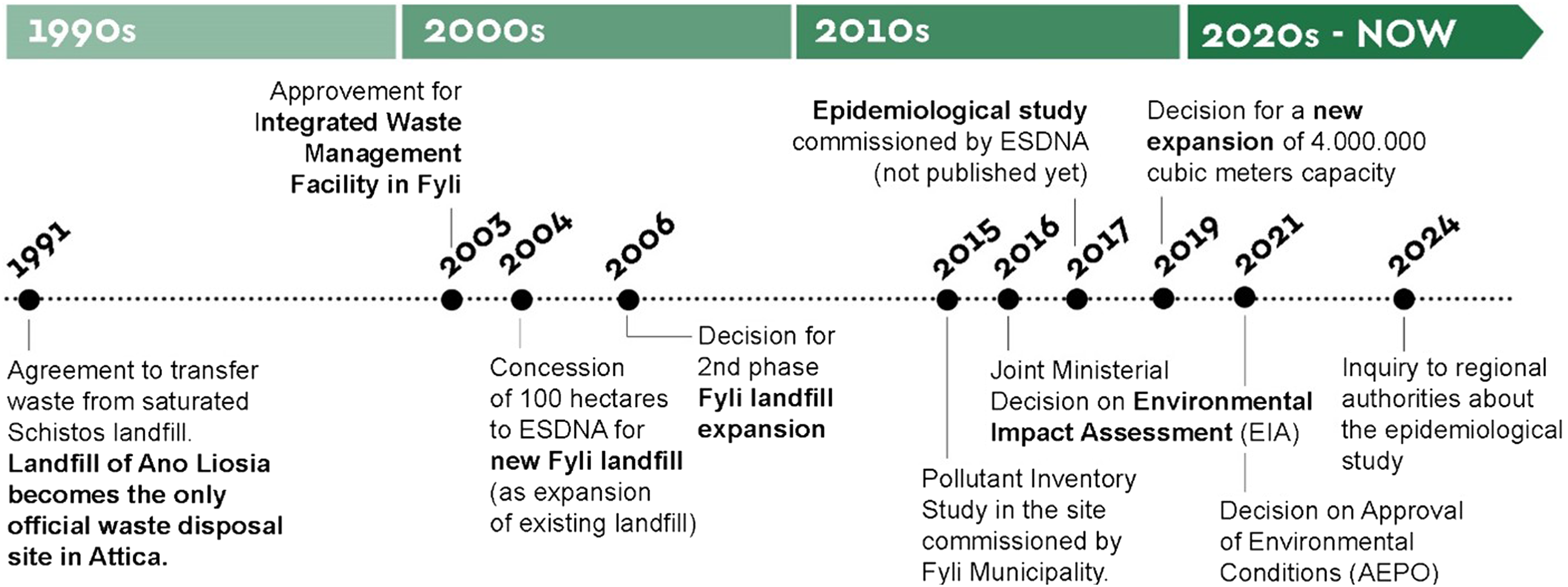
Timeline with significant institutional acts and decisions related to the landfill and the broader integrated waste management facility in Fyli, West Attic since the 90s.
Tracing the chronicle of landfill expansions
By the early 2000s, the landfill within the administrative boundaries of the former Municipality of Ano Liosia had reached full capacity, yet regional authorities failed to develop alternative waste management infrastructure elsewhere in Attica. This deliberate inaction fostered a false crisis, allowing decision-makers to justify further expansions of the landfill under the threat of public health emergencies. In this context, the landfill has undergone multiple successive expansions over the past decades (Figure 3), each time after reaching or exceeding its designed capacity. Ano Liosia landfill was developed in two major phases between 1997 and 2007. According to narrations by residents and environmental activists, its operational standards were far below acceptable levels, as evidenced by leachate leaks, underground fires, and a serious accident: a massive near-catastrophic landslide of 800,000 cubic meters of waste in 2003 (Thomas, “West Front,” Intervention in Workshop, 2024). Although the landslide fortunately caused no fatalities, as it occurred on a public holiday, it nonetheless revealed the extreme overcapacity and hazardous conditions of the site.
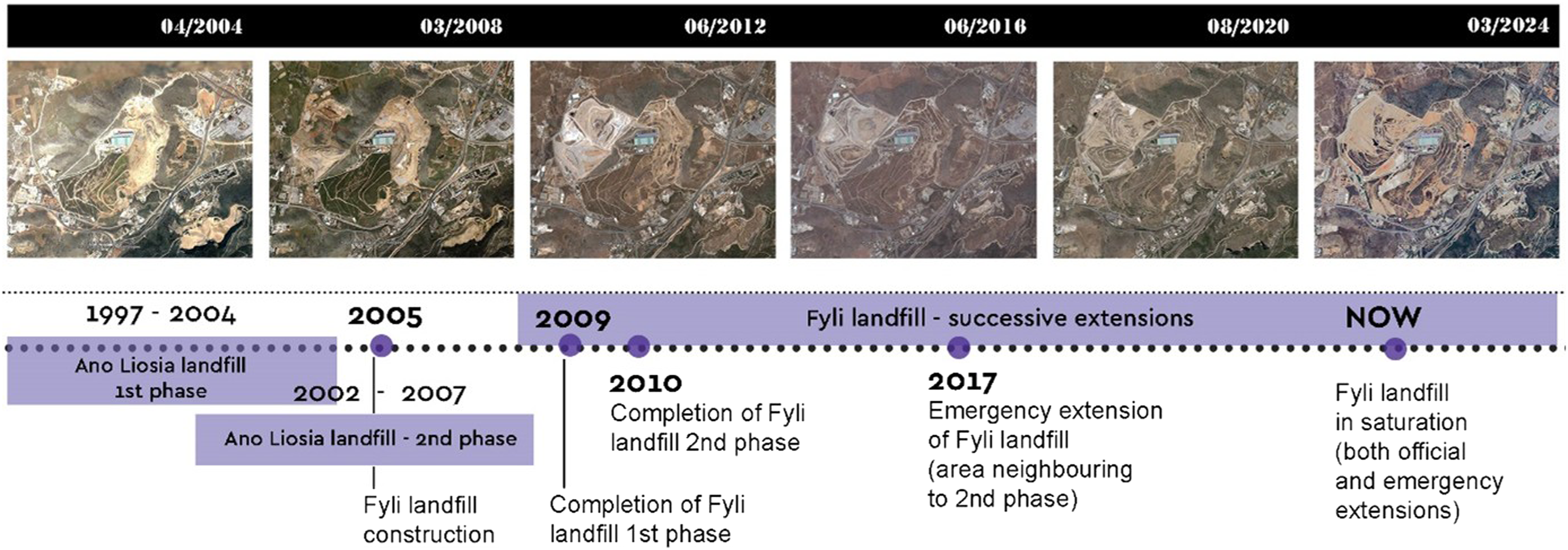
Timeline with expansions of Ano Liosia—Fyli landfill accompanied by satellite images of the landfill site over the last two decades.
In 2003, a new policy framework was enacted concerning regional planning, which designated four different sites for establishing Integrated Waste Management Facilities (OEDA) in the region of Attica (Law 3164/2003, Article 33). In practice, however, only the site in Fyli, West Attica, was further developed for final waste disposal; namely, the selected area named “Skalistiri” was located directly next to the existing saturated landfill of Ano Liosia. Meanwhile, the site in Fyli had been gradually transformed into a waste management megastructure, hosting, apart from the massive landfill, a series of large-scale waste processing facilities. Since the early 2000s an incinerator for hazardous medical waste (the only one in Greece), a mechanical recycling and composting plant, a biogas processing plant, and leachate treatment units were established at this site. Thus, the promises of decentralization made in the early 1990s were clearly abandoned, entrenching the spatial and political marginalization of West Attica as the epicenter of Attica's waste disposal system.
Under the selective implementation of the legislated Regional Waste Management Plans—applied only in West Attica—in 2004 the Municipality of Fyli agreed on the concession of 100 hectares to the respective authority, ESDNA, for the development of the new landfill site, adjacent to the saturated Ano Liosia landfill. The transition toward Fyli landfill started around 2005, with its first phase completed by 2009 and second phase by 2010, while in parallel Ano Liosia landfill was set under restoration. During the 2010s, Fyli landfill continued to grow horizontally and vertically through several “emergency” expansions. The concession was meant to last for 20 years, until autumn 2024. These post-2010 expansions coincided with Greece's deep financial crisis and the implementation of harsh austerity measures (2010–2018). The rhetoric of fiscal discipline and emergency governance—the “austerity-ecology nexus” (e.g. Hadjimichalis, 2014; Velegrakis et al., 2026, 2015)—provided a powerful justification for accelerating environmental disinvestment. Crisis narratives enabled the state to bypass environmental safeguards, fast-track permits, and present the landfill's expansion as a cost-saving necessity rather than a political choice. As we elaborate in the discussion, this logic transformed environmental injustice from a site of contestation into a perversely stabilizing feature of the local political economy.
Despite the expiration of the concession agreement, Fyli landfill continues to operate as usual. In response, local environmental activist groups have issued an official notice to ESDNA and express their concerns about current “secret negotiations on a new concession agreement in order to create yet another massive landfill expansion in the area” (Vassiliki, Interview, 2024).
The artificial mountain of waste up close
The institutional and spatial arrangements of waste management in West Attica over the past decades have led to the formation of an artificial garbage mountain, an engineered landform that blends into the landscape and, from a distance, looks like a natural hill. However, this perception changes dramatically when someone catches a glimpse behind the barbed-wire fence. Despite its magnitude, the site remains hardly accessible to the public. To gain a better understanding of the site's spatial configurations and operations, we organized a collective visit together with residents of the area in October 2024. Discussions with employees of the facility during the visit spanned from technical aspects of waste shorting, processing and landfilling to economic factors contributing to Greece's low recycling rates. In relation to the landfill's development pathway, an employee that guided us through the facilities mentioned: “I am working here since 1996 and in the next 3, 4 years the saturation was already underway. Now this site can no longer receive garbage” (Landfill employee, 2024). When one of the residents asked about future expansion plans, he pointed beyond the summit of the landfill toward the highway and added that there is plenty of space at the mountain foothills.
One of the first things we observed when approaching the Waste Management Facility was the persistent and penetrating odor, which infiltrates nearby residential areas, as a group of residents from Ano Liosia said. On the way to the landfill's summit, a massive flock of seagulls was scavenging through exposed waste. The slope's flank visibly consists of alternating layers of soil and refuse. Although it resembles the adjacent mountains, this hill is artificial and unstable in some areas. Confronted with this landscape, some visitors described it as a “desolate place,” a “tremendous” and “suffocating” site and expressed feelings of “grief and anger.” Along the dirt road a spot close to the western wall of the landfill revealed a striking view: piles of garbage in the foreground and the Roma settlement of “Nea Zoi” behind. As one of the participants noted “this scene encapsulates the reality of those who suffer the burden; (these people are treated) as if they are also disposable, mirrored in the environment they inhabit and the risks they endure” (Vassiliki, Interview, 2024).
The juxtaposition of waste and habitation illustrates the stark environmental and social injustices that are embedded in West Attica's geographies of waste. In the settlement of “Nea Zoi” located at the west side of the landfill, just 1 km away from the landfill's boundary wall, people—mostly Roma population—live in informal dwellings right next to warehouses, scrap yards and open dumps. Depending on the wind direction, the atmosphere is filled with acidic odors from the landfill, a harsh smell of burned copper, or the petrochemical fumes from the nearby oil refineries, which are located just a few kilometers away (Figures 4, 5, 6). Fyli landfill contributed decisively to the environmental and social degradation of West Athens and West Attica, serving as a magnet for hundreds of other facilities with related activities. This waste infrastructure created conditions of environmental racism in West Attica. (Thomas—“West Front,” Intervention in workshop, 2024)

Map of the integrated waste management facility in Fyli, West Attica, including the routes followed during the collective visit in October 2024.
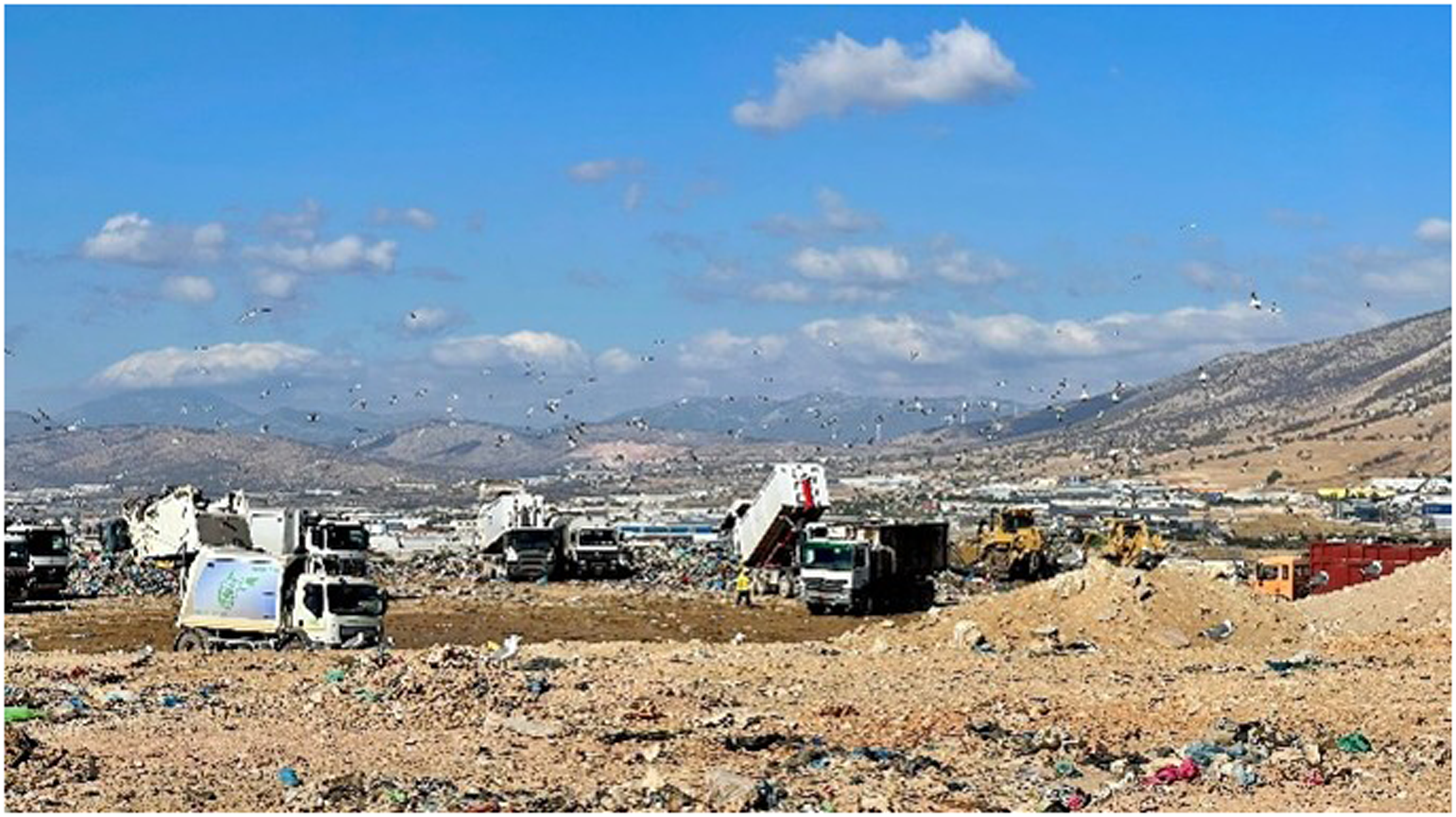
Community visit in Fyli landfill, October 2024.
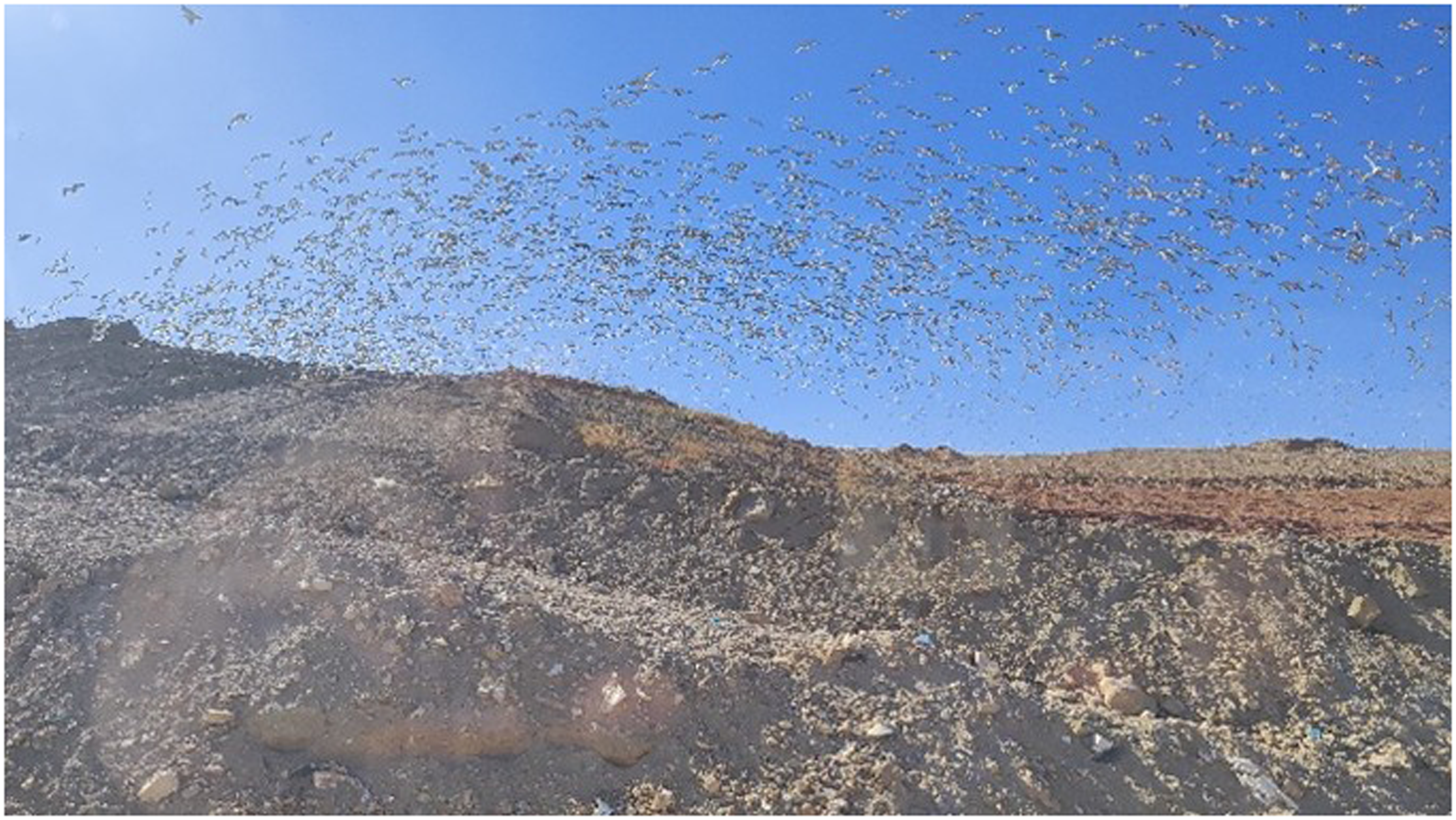
The artificial mountain of waste up close, Fyli landfill, October 2024.
Toxicity around waste in West Attica
Engineered “forgetting” through toxic politics
Western landfills are sites of forgetting made possible through legislative decision, regulative decree, risk models, community accession, and engineering practice. (Hird, 2013: 105)
The Fyli landfill case highlights how toxic infrastructures are legitimized and sustained through multiscalar governance (Kallianos, 2018). At the supranational level, the EU plays a contradictory role, criticizing environmental damage while still validating the landfill's operation. In a report following the visit to the Fyli landfill, the European Committee on Petitions (2014: 16) described the environmental damage as “a monument of environmental mayhem, sickness, and human suffering at least for the next three generations living in the area.” Despite this, the committee assesses the landfill as “[meeting] the necessary conditions for its operation” (ibid: 7). At the national level, waste management policies are anchored in the recurring claim that “there is no alternative” and framed within a perpetual state of crisis. For instance, “waste controversies have been utilized by the Greek state as a way to justify the implementation of Public-Private-Partnership (PPP) contracts around waste treatment” (Kallianos, 2018: 7). As discussed in the previous section, the interplay between regional and local authorities further complicates accountability. The transfer of waste management authority from the Prefectures to the Regions has been framed as an “institutional innovation, allowing for economies of scale and planning optimization” (Lasaridi, 2009: 266). However, this restructuring seems to exclude local population and hinder potential resistance in the local sphere. The result is the diffusion of responsibility, which ultimately allows shifting of discourse toward recycling at the source and individual responsibility.
The toxic politics behind the creation of the artificial mountain of waste in Fyli involve a key factor: the inaccessibility (or concealment) of environmental inspections (EIA) and epidemiological studies. Local activists have long fought for the publication and transparency of these findings, viewing their suppression as a strategy to obscure the health and environmental consequences of the landfill's operation. At the same time, they have voiced strong criticism of the recent approval of environmental conditions based on the environmental impact assessment EIA, arguing that it legitimizes continued harm while bypassing meaningful public scrutiny. An indicative example is the concealment of a 2015 environmental inspection of the Fyli Integrated Waste Management Facility, published only after pressure by socioenvironmental movements, which revealed leachate leakage, hazardous waste mismanagement, and medical waste contamination (Asprofos, 2015).
A large-scale epidemiological study and assessment of environmental parameters in the Integrated Waste Management Facility of Fyli and the surrounding area have been initiated in 2017, commissioned by the respective regional authority, ESDNA. Like the environmental inspection, epidemiological study has not been published yet, although the deadline was expired in 2020. 4 The delay raises concerns about whether the study was completed or if its findings are too alarming to be released. Some findings have been, however, presented in academic papers by the scientific team (Papastergiou et al., 2025; Vladeni et al., 2025) and refer to the critical implications for workers’ health. 5 The fact that the findings from the epidemiological study are not made publicly available—despite numerous formal requests by local collectives to ESDNA—but are instead only partially presented in scientific journals, contributes to the systematic attempt of “reducing a political matter to a scientific debate,” as Kallianos and Dalakoglou (2023: 856) argue, and ultimately normalizing injustice.
Toxic narratives and local community pacification
In West Attica, waste politics exert subtle yet pervasive forms of violence that manifest through the degradation of social and ecological relations. Galtung's (1969: 171) concept of “structural violence” is particularly useful here, as it highlights how institutional practices and everyday social arrangements inflict harm by producing and sustaining unequal power relations and life opportunities. According to Murrey (2015: 20), a distinct “experiential marker of structural violence is its historical persistence,” which is evident in the case of Fyli landfill's endless development. This understanding resonates with Nixon's (2011: 2) notion of “slow violence,” defined as a gradual, often invisible process of harm, “a violence of delayed destruction that is dispersed across time and space,” making it difficult to be traced and contested. Such indirect, continuous and attritional forms of violence are enabled through a multilayered and systematic construction of toxic narratives that leave enduring legacies over time.
Concerning Fyli landfill, the dominant narrative reproduced by institutional actors is built upon the argument that “there is no alternative.” The aforementioned opaque practices that diffuse responsibility and obscure the severe impacts of the waste management operations in West Attica, result in the local population's acceptance, along with the cultivation of the belief that there is no other way. As Botetzagias and Karamichas (2009: 953) examined, “all scientific studies of the past 30 years did allow for a waste treatment facility in western Attica, in the very same areas that have been used for decades, thus denying scientific credence to any opposition.” In West Attica, the resistance was comparatively lower than in other areas, and “toxic dumping and the location of locally unwanted land uses have followed the ‘path of least resistance’” (Bullard, 1990: 3). At the local sphere—particularly in Ano Liosia—the residents haven’t broadly contested the existence of the landfill. On the contrary, it is largely perceived as a “natural phenomenon” by the local population, especially by younger generations (Vassiliki, Personal Interview, 2024). As a resident of Ano Liosia argues, the decision to locate the landfill in West Attica was not a coincidence. “They placed it here because they knew they were targeting people who lacked the power to resist. Whether due to a lack of education to understand the environmental, health and social harm caused by the landfill, or because they were willing to accept the job security and financial compensation it provided,” she states (S., Personal Interview, 2024). This reminds us of the “Cerrell” report, commissioned in the 1980s by the California Waste Management Board to paint “a demographic picture of the types of communities … least likely” to resist nuisance projects like incinerators (Cerrell Associates 1984: 11; as cited by Ahmann and Kenner, 2020).
Although the landfill has devastating effects on the local environment, it is presented as an essential economic asset of the area by the authorities, and it is perceived as such by the majority of the local population. The landfill indeed provides the municipality with huge compensatory funds annually. However, the money is not invested in environmental upgrading or rehabilitation programs, as supposed. By highlighting the economic benefits that stem from hosting the landfill's operation, while in parallel hiding the harsh implications on the ecosystem and the health of the local population (through the concealment of the official studies), institutional actors in Fyli reproduce what Davies and Mah (2020: 3) have named “toxic truths.” In their words “some toxic truths are given elevated status” while certain truths are silenced, leading to toxic consequences. Regarding the compensatory funds in Fyli, the truth is distorted, since the landfill is anything but an economic privilege for the area. For many years, administrations have kept the landfill because it provides them with money for elections. Through the funds generated, they bind and manipulate people who otherwise might not easily find employment. These workers are employed at the landfill on five-month contracts with the municipality. They never secure permanent positions, and they end up depending on the municipality to constantly renew their contracts. (S., Personal Interview, 2024)
According to Auyero and Swistun (2007, 2009), in contaminated communities, toxic narratives are causing persistent uncertainty and confusion, a phenomenon they describe with the term “toxic uncertainty” (2009). The case of Ano Liosia confirms the observation that in a status of sustained uncertainty “uninterrupted routines and interactions work smoothly as blinders to increasing environmental hazards” (Auyero and Swistun, 2009: 10). Here, along with the haze in the atmosphere emerges what Ahmann and Kenner call “conceptual haze” (2020: 420), which in turn, contributes to the diffusion of discourses and toxic truths.
Embodying toxicity
By analyzing and comparing the census data on causes of death per place of residence between 1999 and 2016, Bourikos (2018: 2) observes that the rate of deaths from neoplasms in West Attica increased by 23.1%, compared to 7.6% increase in the rest of the Attica Region during the same period. Although the available statistics are insufficient to establish a causal link between the increased cancer rates and the long-standing waste treatment practices and industrial activities in West Attica, this disproportionate rise of cancer-related deaths makes us think of the area's character as the dumping ground of the region. Sometimes I am wondering about the water that people drink here (…) And of course, there are a lot of diseases, many cases of cancer and leukemia. Everyone is affected. When you inhale poison, won’t you get affected? (Vassiliki, Personal Interview, 2024)
Armiero places the human body at the very center of the Wasteocene and argues that “the body has often functioned as a detector of the Wasteocene” (Armiero, 2021: 12). In West Attica, residents detect the acrid fumes from the factories and the stench of decomposing or burning waste on a daily basis. The persistent odors serve as a constant reminder of the area's entanglement with waste and industrial operations. People make sense of the “wasting relationships” through smelling and breathing. Thus, it becomes apparent that environmental inequalities move beyond spatial representation and become embodied in people, reflecting the lived consequences of pollution, toxic exposure, and health risks. Very indicative is the example of Roma communities that live in the area. An observation from the school workshops with Roma students in the Nea Zoi settlement vividly illustrated the embodied toxicity and the forms of sensory knowledge it can produce. When the children were asked to describe their everyday surroundings, one Roma student identified the smell of “burned copper,” a sensory reference that none of us could immediately recognize. One of our interviewees points out: In Aspropyrgos (West Attica), the Roma population is one of the most disadvantaged groups in terms of health indicators. They have a much lower life expectancy. Even if these people leave Aspropyrgos, they continue to carry these inequalities and exclusions with them. (Alex, Personal Interview, 2024)
Around Fyli landfill, Roma people live in, through, and by waste. The living conditions of Roma communities in the region reveal the racialized dimension of the wasting relationships and toxicity connected to waste management operations, which remains broadly obscured and neglected. They represent what Madanipour (2015) calls social exclusion in economic, political, and cultural dimensions and its bounding with pervasive uncertainty. “In West Attica, Roma people are the last link in a production chain that starts with the industries and ends with scrap activity” (Alex, Personal Interview, 2024). Largely excluded from formal employment, they are dependent on precarious and informal forms of employment, often tied to waste (Kokoula, 2020; “Roma survey 2021,” 2023). Employment precarity often intersects with informal housing conditions, lack of access to essential services like water and electricity, and ambiguous citizenship status. (Morgan, 2023: 119). Furthermore, the severe impacts on the Roma people's health often remains unnoticed and disassociated from the nearby sources of contamination. Examined by Petraki et al. (2021), most Roma in settlements estimate their health status as “good” or “very good,” while around half of them are diagnosed with at least one chronic illness.
Paradoxically, although Roma communities in West Attica are the most marginalized group, lacking access to human rights, formal jobs, and essential services, they are highly stigmatized, due to the sanitary conditions of their settlements and their involvement in the informal waste cycle. Thus, they are largely perceived not as victims of systemic neglect, but as contributors to what is framed as the area's most pressing “environmental problem.” (Dimitris, Personal Interview, 2024). Here, a connection can be drawn to Edelstein's (2018) observations of toxic exposure on the psychological lives of affected people. Within what he terms “contaminated cultures,” marginalized groups are frequently exposed to toxic narratives that shift responsibility away from power structures and place it onto the communities themselves (ibid). In West Attica, the Romani are not simply neglected victims of environmental injustice—they are constructed as its cause, exemplifying the toxic mechanisms of victim-blaming.
Discussion: The Wasteocene as scalar politics and the production of metropolitan backyards
The case of West Attica compels a theoretical synthesis that moves beyond a singular case study to expose the interconnected logics producing urban sacrifice zones in the European periphery. Our findings, coproduced with communities on the waste frontier, resonate with but also critically extend key debates in political ecology, urban geography, and critical waste studies concerning environmental justice, the social construction of scale, and the racialized production of peri-urban space. This discussion situates the Fyli landfill within the overarching logic of the Wasteocene to argue that the wasting of West Attica is not an exception but a spatially and socially targeted outcome of metropolitan metabolism under racial capitalism. It also necessitates a reflexive consideration of the political-epistemic challenges of researching such zones of abandonment.
West Attica as an archetypal environmental injustice and sacrifice zone
The Fyli landfill exemplifies what political ecology terms an ecological distribution conflict (Martínez Alier, 2002), where the environment is the medium through which deeper social, economic, and racialized struggles are fought. This is not merely a conflict over waste management but a conflict through waste, a mechanism for enacting what Bullard (1990) identified as systemic disposability. The condition of West Attica aligns precisely with Anguelovski's (2013) formulation of environmental injustice: the denial of the right to remain in a place protected from pollution, disinvestment, and decay. Here, the “right to remain” is systematically corroded by toxic exposure, degrading infrastructure, and the stigma of being Athens’ “backyard.”
This aligns also with a global pattern where sacrifice zones (geographies deemed expendable for the economic functioning and cleanliness of core areas) are created (Lerner, 2010). These zones, often peri-urban, are characterized by the concentration of environmental bads, the spatial fix of unwanted yet essential infrastructure, and the containment of marginalized populations. In the European context, such zones are often found in the deindustrializing or infrastructural hinterlands of major cities, where the legacy of industrial pollution merges with new logistics and waste frontiers. West Attica is a calculated spatial outcome: a territory where the externalities of Athenian consumption and capital accumulation are deposited. Its role is essential yet disavowed, rendering its communities and ecologies as “wasted lives” in a stark manifestation of the Wasteocene's core logic: the simultaneous production and hiding of refuse, both material and human.
The political production of a metropolitan backyard
West Attica's designation as Athens’ primary waste repository is not a geographical coincidence but the result of a political process of sociospatial sorting. Its location reveals the strategic logic of the peri-urban frontier, a hybrid, contested zone between the metropolitan core and the countryside where capitalism's contradictions and “spatial fixes” are most violently implemented (Smith, 1992). These frontiers are characterized by ambiguous governance, fragmented landscapes of ownership, and the intentional concentration of noxious infrastructures (warehouses, logistics hubs, and heavy industry) alongside informal settlements. They function as the essential yet disavowed infrastructural hinterlands of the “competitive” global city, absorbing its metabolic waste while being severed from its circuits of wealth and political capital.
The creation of this backyard is a dual process of spatial and social marginalization. The austerity-ecology nexus provides one of the governance logics: fiscal discipline and crisis discourse justify disinvestment in environmental protection and the centralization of risk in politically “soft” targets. This is compounded by a racialized logic of disposability (Yates, 2011), where certain populations are deemed less worthy of protection. The racialized marginalization of the Roma communities in Aspropyrgos and “Nea Zoi” is not incidental but constitutive of the backyard's creation. Historical social exclusion prepositions them in the most vulnerable geographies, where they then bear the compounded burdens of the periurban frontier. Their forced reliance on the informal waste economy (scavenging, recycling, and living amidst the refuse) completes a cruel cycle of capture and blame.
The multiscalar politics of waste
The injustice in West Attica cannot be understood at a single scale. It is a multiscalar political production involving the strategic interplay of governance levels. The local suffering—the embodied toxicity, the devalued property, the everyday stench—is orchestrated by decisions taken elsewhere: regional policy that centralizes all risk, national frameworks promoting PPPs as crisis solutions, and EU directives implemented selectively to legitimize rather than rectify harmful practices. This creates a deliberate scalar mismatch: the hyperlocalized site of impact is disconnected from the metropolitan scale of benefit and the diffuse, bureaucratic scales of accountability. The perpetual “emergency” justifying each landfill expansion is a scalar narrative that masks a multiscalar political failure.
This scalar politics (Smith, 1992) extends into the realm of knowledge and representation. The “guerrilla narratives” articulated by activists from groups like “West Front” represent a conscious attempt to rescale the conflict—to connect visceral, local experience to transnational discourses of environmental racism and injustice, thereby seeking leverage and solidarity. However, our participatory engagement revealed a critical, reflexive tension: the communities bearing the brunt of the harm—especially the Roma residents of informal settlements like “Nea Zoi”—face compound scalar vulnerabilities. Their hyperlocalized, corporeal suffering exists in a void of political representation at municipal and regional scales. Their narratives are systematically marginalized, often mediated through others, or absent altogether.
Limitations of participatory research in zones of abandonment
The multiscalar marginalization process points to a significant limitation of our research and a core dynamic of the Wasteocene: it not only produces wasted people but also engineers the epistemic conditions for their silencing. The structural barriers to participation—profound distrust born of historical stigmatization, the all-consuming pressures of material precarity, and fear of institutional reprisal—are not merely logistical hurdles but constitutive elements of their marginalization. Therefore, the struggle for environmental justice in West Attica is also a struggle over whose embodied knowledge is rendered credible and actionable in the rescaling of political conflict. The partial absence of these most intimate testimonies in our own data is a sobering reminder that participatory research, however well-intentioned, can struggle to fully circumvent the very architectures of exclusion it seeks to critique.
Addressing this gap requires a fundamental rethinking of participatory methodologies when confronting historically engineered epistemic silencing and injustices. Future research must move toward long-term, trust-building partnerships initiated and led by Roma community organizations [in West Attica in our case] themselves. However, Roma communities in Greece face institutional anxiety (Theodosiou, 2010), mistrust and misbelief toward state- and university-led attempts to address their needs. This raises the question of how research can be genuinely inclusive when the very institutions conducting it are already embedded in histories of mistrust, misrecognition, and epistemic violence. To overcome this challenge, we propose the following partnership-building efforts: dedicating extended periods to relationship-building before any research activity; employing Roma community researchers as co-investigators with equitable compensation and decision-making authority; prioritizing oral history and visual methods that do not presume literacy or formal organizational affiliation; and ensuring that research outputs include community-generated action plans with direct material benefits. Only through such structural adjustments can participatory research begin to avoid reproducing the very exclusions it seeks to dismantle.
Guerrilla narratives and the seeds of rescaled resistance
Within West Attica's landscape of slow violence and manufactured consent, resistance is fragmented yet persistent. The guerrilla narratives documented in our workshops and interviews—stories of health impacts, institutional betrayal, and embodied knowledge of toxicity—serve as critical epistemic spores. They function to remember what engineered forgetting seeks to erase: the historical timeline of broken promises, the suppressed health data, the lived connection between the smell in the air and the ache in the body. These narratives are a form of counter-scale politics, as activists like those in “West Front” work to relink the local experience of Fyli to broader critiques of metropolitan metabolism, EU waste policy failures, and global patterns of environmental racism.
Their vision of decentralized waste management and reparative environmental rehabilitation is more than a technical proposal; it is a political claim to a future beyond the Wasteocene. It asserts a right to a nontoxic environment and rejects the permanent assignment of sacrifice zone status. However, the power of these guerrilla narratives is constrained by the very scalar politics they contest and by the difficulty of building a unified front across communities fragmented by differential exposure, economic dependency on the waste complex, and internalized toxic narratives.
Conclusion: Beyond the Wasteocene?
The Fyli case illuminates the Wasteocene as the socioecological regime of racial capitalism's spatial fix. It demonstrates how waste management operates as a spatial–political technology that simultaneously manages material and human surplus. It assigns differential value to lives and landscapes along racialized and class lines, creating zones where the rules of health, democracy, and ecological integrity are suspended. The “slow violence” inflicted is a required input for maintaining the cleanliness, order, and economic functionality of the metropolitan core. West Attica, in its wasted state, is the necessary dialectical counterpart to modern Athens that makes the city's visible surface possible. Understanding this relationship is crucial for any politics of environmental justice that seeks to dismantle the logic that produces sacrifice zones as a fundamental feature of our metropolitan age.
This logic operates through a temporal as well as a spatial dimension. The violence is not only slow but also intergenerational. The future generations of West Attica inherit a normalized landscape of hazard, a diminished expectation of health, and a political identity shaped by neglect. This intergenerational theft of health and opportunity is the ultimate expression of the Wasteocene's “wasting” of communities. As political responsibility shifts between multiple scales, the intensity of contamination gradually increases through landfill expansions and government-supported industrial development. Opaque attributes of slow violence consolidate a regime of “wasting” places and communities, particularly affecting the most marginalized. Toxic narratives act as instruments of “forgetting” and as suppressors of resistance. Amplified by the cyclical dependency of wasting relationships, in West Attica toxic narratives lead to widespread disillusionment and resignation. This engineered resignation is actively produced through a political economy of managed crisis. The perpetual “emergency” that justifies each new expansion (Kallianos, 2018) serves a dual purpose: it suspends normal democratic deliberation and long-term planning, while simultaneously reinforcing the toxic narrative that “there is no alternative.” This creates a closed loop where the failure to build decentralized, just waste systems is used to justify the very centralized, unjust system that caused the failure.
Against this backdrop, some local collectives try to raise their voice against the “environmental crime taking place in West Attica”—as they name it—and demand for reparation (Thomas, “West Front”—Intervention during Workshop, 2024). Shared experiences of toxicity enable the emergence of new communities that recognize themselves within the harm and new movements that strive to disrupt toxic regimes. These are the guerrilla narratives: fragmentary, situated, and often fragile, yet deeply potent in their ability to challenge wasting relationships and articulate alternative futures. In this contested terrain, knowledge sharing becomes a form of resistance, a way of making visible what was meant to be hidden, destabilizing the underlying power structures of the “Wasteocene.” A resident of West Attica and local activist argues that the first step for any movement aiming to bring real change must be to expose the truth. “The people have a right to know what is happening in their own community” she asserts (Vasiliki, Personal Interview, 2024). By breaking through the barriers of secrecy, she believes it will be possible to mobilize the public and create the momentum needed to demand genuine accountability and long-overdue reforms. For her, the challenges of Ano Liosia are a microcosm of broader societal issues, underscoring the need for collective consciousness and political engagement to rectify long-standing injustices. The question is whether the fate of this place (West Attica) can now be changed. Most likely it cannot. However, the worst can be prevented. It ultimately depends on whether civil society will accept the worst. (Thomas, “West Front”—Intervention during Workshop, 2024)
This demands a politics that operates on all the scales that created the problem. It requires local movements like “West Front” to continue their vital work of testimony and mobilization. It necessitates national political will to enforce environmental laws, reject false crisis narratives, and invest in sustainable infrastructure. And it calls for European Union institutions to move beyond auditing and admonishment to enforcing meaningful conditionality, ensuring that cohesion and environmental funds are not funneled into projects that perpetuate environmental racism. The future of Athens, and of every megacity, depends largely on the fate of their backyards.
Footnotes

Funding
The authors disclosed receipt of the following financial support for the research, authorship, and/or publication of this article: This work was supported by the European Union’s Horizon Europe research and innovation program under the grant agreement Fairville (grant number No. 101094991).
Declaration of conflicting interests
The authors declared no potential conflicts of interest with respect to the research, authorship, and/or publication of this article.
Ethical consideration
The authors declared that ethical approval was not necessary for this study.