






Abstract
The concept of Green Cities/Eco Cities has emerged as a dominant urban imagination that is seen as an ecological solution to environmental crisis without compromising economic expansion, especially, through green investments. This article critically examines Green city policies in Austin and Dallas revealing, firstly, the gaps between sustainability policy discourses and the actual lived experiences, and secondly, the class-based and racially unjust nature of green urbanism thus, strengthening environmental justice literature. Employing discourse analysis of city policy documents and semi-structured interviews with residents from diverse socioeconomic backgrounds, the study explores disparities in the distribution of environmental amenities. Findings indicate that affluent neighbors benefit from concentrated green investments, while historically marginalized communities face disinvestment, infrastructural decline, and green gentrification. Policies of both cities are rhetorically committed to equity, but because they work within the ecological modernization paradigms of capitalism, the green vision does not fundamentally alter the urban-nature dialectic as they work to preserve production-consumption-accumulation-based economic growth, therefore, in order to offset capitalism's contradictions they tend to perpetuate existing racial and class status quo in their socio-spatial practices. These results underscore how technocratic sustainability agendas shaped by ecological modernization fail to address deeply embedded structural inequities in urban governance. This article engages with degrowth literature that argues for a shift toward post-growth urban models that prioritize reparative justice, redistributive policies, participatory planning, and ecological care. The study contributes to scholarship on just urban transitions, calling for a reorientation of sustainability away from economic growth and towards fundamental societal changes that can be achieved through social and environmental equity.
Introduction
We have all these solar panels and trees going up downtown, these beautiful bike lanes—and meanwhile my neighborhood doesn’t even have consistent shade trees or a decent bus route.
So remarked a long-time resident of East Austin during fieldwork interviews for this study—a statement that in its quiet precision captures the central paradox this article sets out to examine. It foregrounds a critical question; whether contemporary cities are delivering the benefits of urban development equitably across all their residents. This question has become increasingly urgent as urbanization accelerates globally, with projections indicating that 70% of the global population will reside in urban areas by 2050 (UNDESA, 2018). The rise in urban population poses significant environmental challenges exacerbating issues of resource exploitation, urban heat islands, and a rise in pollution (Shishegar, 2014). These environmental pressures are not confined to city boundaries. Unmanaged urban development and excessive emission from cities in the developed countries have been shown to produce far-reaching ecological consequences in mountain regions (Chhetri et al., 2025). Since the late 1960s, international institutions, policymakers, and academics have become increasingly concerned about social and environmental sustainability along with climate change. Sustainable urban development has emerged as a central framework guiding global development policy (Engwicht, 1992; Tang et al., 2022).
The “Eco-City” concept is rooted to the “Garden City” movement. The term was formally coined by Richard Register in his book Ecocity Berkeley and gained global momentum following the First International Eco-City Conference in 1990 (Register, 1987; Joss and Molella, 2013). The “Green City” concept has emerged in urban planning grounded in sustainability perspectives with the vision to reconcile economic growth along with environmental responsibility. The terms “Eco” and “Green” are often interchangeably used depending on the policy path dependencies and discursive preferences of intellectuals, planners and policy makers. “Green City” or “Eco-City” emphasizes the use of renewable energy, urban forestry, public transportation which shows that cities can demonstrate “resilience” by becoming good responders to climate change in the global scenario. However, critical scholars of urban geography and environmental justice criticize this concept as a superficial technocratic solution (Bibri, 2020), which often fails to answer the question of whether Green City policies genuinely address structural inequalities or instead reproduce racialized and class-based patterns of environmental privilege (Harvey, 1996). Other than issues of inequality in distribution of the green agenda, critical scholarship argues that the Green City concept falls within the mainstream capitalist vision of “ecological modernization approach” towards sustainability that highlights capitalist interest and priorities over ecological concerns (Rapoport, 2015). Using empirical examples of Green City-based governance from Austin and Dallas in Texas, this article hopes to bring out the shortcomings of the Green/Eco-City-based urban planning visions. In probing the ecological intentionality of urban governance, this article interrogates to what extent green governance in Texan cities rooted in Green City approach effectively delivers/deploys ecological change, and whether this green ideology translates into green reality in class and racially just ways. Using qualitative interviews from the local community, we demonstrate how spatial inequality is lived and perceived by residents navigating the promises and failures of the Green City within the recent urban planning framework. We use the cases of the city of Austin and city of Dallas to investigate and analyze how green initiatives are experienced differently across socio-economically diverse neighborhoods. Our field experience reveals gaps between policy discourse and material practice in the deployment of Green City policies, and that such policies have at best become entrepreneurial environmental strategies serving as spectacles of sustainability producing symbolic greenness and city branding that obscure persistent socio-spatial inequalities (Prytherch, 2002).
In explicating the ephemerality of the Eco-City/Green City approach through the case studies of these two post-Fordist Sunbelt cities, we hope to push urban policy beyond ecological modernization approach demanding an urban governance vision that seriously engages with the concept of degrowth. Degrowth theories go beyond the Green City concept arguing that growth-driven environmental strategies mask systemic inequalities and reproduce exploitative class, racial, and colonial patterns of resource extraction, especially, when wealthier cities sustain their green credentials by externalizing environmental costs to the Global South (Foster, 2023). Degrowth theories, therefore, reject that green interventions here and there within the existing paradigm of growth-based economic accumulation can bring fundamental change. Fundamental change requires curtailing economic growth and envisioning an urban-economic system that is centered on downscaling production and consumption to enhance the ecological-social balance of life and wellbeing. Degrowth theory, therefore, aspires to relink human-nature relationships by understanding “growth” as “well-being” for all, thus, enhancing social and environmental justice through a non-production-consumption centric life (Demaria et al., 2013; Saito, 2023).
Texas has experienced rapid economic growth and urbanization in recent decades and is among the fastest-growing U.S. states, with a population increase of 1.6% between 2021 and 2022 (US Census Bureau, 2022). This growth makes Texan cities an appropriate context for examining contemporary green urban policy. This study focuses on Austin and Dallas as comparative cases to analyze green agendas, sustainability frameworks, and Eco-City initiatives. Austin is widely recognized for its progressive environmental orientation; Dallas is shaped more strongly by late-capitalist, growth-driven urbanism. Despite these differences, both post-industrial cities are actively engaged in “new age” sustainability politics making them suitable cases for examining how green policies are articulated and enacted in practice. Being a politically conservative state, Texan cities move towards an Eco-City agenda, if empirically substantiated, is particularly pertinent in demonstrating that environmental crises are here and dire, and that even the most ecologically resistant urban politics must now reconcile with environmental nurturing if not for environment's sake, at least from late-capitalist entrepreneurialism's sake. Since Texas is economically open to big corporate-entrepreneurialism, growth led expansion and so-called trickle-down economics, Austin and Dallas make interesting case studies bringing out place-based/city level textures of differences in policy discourse and material conditions between a more environmentally progressive Austin and more economically-growth focused Dallas. Cities of Texas could be assumed as templates that are furthest from ecological nurturing and closest to capitalist accumulation owing to their environmentally averse and pro-entrepreneurial politics. In that context, any class-racial and environmental injustice explored in Texan cities would be able to provide a watertight rationale for pushing urban dialectics towards degrowth approaches. Our intellectual intention here is a rethinking of green urbanism beyond ecological-modernist growth paradigms toward urban fundamental transformation grounded in a fundamental alteration between human-nature-governance relationships that is based on degrowth, justice, participation, and reparative redistribution.
From Green City/Eco-City alternatives to degrowth options?
In exploring the above issues, we first discuss the main conceptual thrust of our article, that is, critically interrogating the Green City/Eco-City visons in urban governance, and then, we provide a brief interlude to the more contemporary degrowth theory as a possible conceptual improvement on the green city/eco-city agenda.
Green City/Eco-City and environmental injustice
With a global transition to a neoliberal-entrepreneurial regime (Harvey, 2006), mainstream urban planning has become vociferously growth-oriented equating progress with economic expansion, infrastructure intensification, and rising consumption, city versus city competition (Sager, 2011) often measured through indicators such as GDP growth, real estate value, and investment inflows (Rydin, 2013). Green City/Eco-City is an urban vision that is conscious politically, socially, and policy-wise in reducing its environmental footprints as it efficiently conducts its economics. The concept of Eco-cities was introduced to balance rapid urbanization through sustainable urban development that can mitigate the ecological footprint of cities (Engwicht, 1992; Joss and Molella, 2013). This new strategy of city development enhances resource efficiency and emphasizes pollution reduction by investing in the green economy, such as investing in clean energy and green technology to enhance the quality of life of residents. An Eco-City approach was therefore committed to enhancing the economic and social well-being of citizens with the main goal of minimizing waste and emissions through green urban planning (Engwicht, 1992; Joss and Molella, 2013). This approach in the recent urban planning framework mainly focuses on advancement in technology along with development in green energy and green infrastructure (Bibri, 2020). Therefore, the concept of Eco-City was introduced as a scientific urban design/planning option following the sustainable urban development agenda.
Critiques of the green city approach indicate that what materializes is a superficial “greenwashing” (Albrechts, 2015) primarily serving as a branding strategy where “entrepreneurialism constructs nature only to promote the benefit of capital” (Prytherch, 2002, p. 787). Green governance focus is also critiqued as too narrow, with smart solutions focused on management of urban infrastructure, rather than genuine ecological or social goals (Chatterjee, 2021, 2023a; Rapoport, 2015). In addition, the Eco-City projects are seen as elitist or bourgeoisie in their impacts creating elite islands of green affluence and neglecting poor areas often causing green gentrification of racial minorities, new immigrants, and in general, displacing urban poor (Hodson and Marvin, 2010; Joss and Molella, 2013; Pepper, 1998). Tretter (2016) notes how bourgeoisie environmentalism in Austin serves as “project homeless removal” and Caprotti (2014) shows how building Eco-City projects relies on the super-exploitation of migrant labor as they exclude in-situ local labor. Chatterjee (2021, 2023a, 2023b) illustrates the contradictions of Kolkata's Green/Smart City where land reclaimed from canals and wetlands with endangered species is converted into posh, energy-efficient, and sustainable residential developments, while farmland on the city's fringe is forcibly expropriated from small farmers to create the New Town Green City. Eco-parks often planted with exotic tree species cater to elite recreational needs displacing local communities and undermining the very biodiversity the project claims to protect.
Cugurullo (2013, 2016) for instance, argues that the Eco-City approach in the case of Masdar city is a resounding failure. The Masdar city project rooted in an eco-modernization approach prioritized economic considerations over ecological sustainability. The emphasis on profit-driven sustainability initiatives by the economic interests outlined in Abu Dhabi's “Vision 2030,” resulted in an unsustainable development paradigm rendering the Eco-City initiative a utopia for the privileged few and a dystopia for the majority. The Tangshan Bay Eco-City, initially designed as an international Eco-City in 2007 with a strong emphasis on environmental aspects, faced challenges due to a change in political course in 2012 resulting in decreased prioritization and support from political leaders (De Jong et al., 2016). Despite significant initial support from the local government and a cooperative agreement with the Swedish government in 2008, the shift in political interest led to a lack of financial resources for infrastructure and investment causing the Eco-City project to become ineffective. Consequently, this shift contributed to an increase in high-carbon heavy industry in the area overshadowing the city's green technology initiatives (Joss and Molella, 2013).
Therefore, one-dimensional technocratic greening that overlooks the class dimensions of urban inequality complicates environmental racism issues as class and racial marginalization often overlap spatially. Environmental racism involves disproportionate exposure of low-income and minority communities to dangerous pollution and degraded environments (Massey, 2004), thus combining spatial ghettoization of racial minorities with environmentally hazardous conditions to create environmental injustice in capital centric urban processes. In that context, Pulido (2017) argued that environmental justice must recognize white privilege as a foundational concept in the ideology of class shaped environmental spatial disparity and seek to rectify such urban environmental inequity. Peet and Watts (1996, 2004) discuss the concept of ecological liberation within the field of political ecology, arguing that nature's degradation is not just a scientific problem but is deeply imbricated in politics and policy and requires local-global stewardship in achieving ecological justice. They highlight the importance of resistance from local communities by using local, place-based indigenous knowledge to combat environmental exploitation by corporate capitalism.
Green urbanism enacted through and within a capitalist urban logic of growth and profit accumulation is likely to gloss over structural issues of class inequality and racial marginalization. Masked class and racial inequality will (re)enact gentrification as green gentrification, and class inequality as bourgeoise environmentalism, and racism as environmental racism. Greening that does not redress systemic inequalities will reproduce/exaggerate spatial segregation and social injustice where it becomes violence rather than a fundamental alteration of the nature-society dialectic. Effective environmentalism must therefore reimagine both societal and ecological dimensions of the city addressing distributive inequalities, spatial injustices, and environmental elitism. Alternatively, degrowth theories flip urban planning visions that can offer an alternative community-focused approach as they do not rely on expansionary strategies to impose/claim Green City/Eco-City tecno-spatial reordering through social displacement and marginalization.
Degrowth as environmental-social justice?
Checker (2011) examines the intersection of environmental justice activism and state-sponsored sustainable urban development specifically asking how environmental justice activism is enabled or disabled in the context of rapid urban development. She argues that “going green” in cities can be a double-edged sword where profit-driven redevelopment masquerade as sustainability projects displacing the low-income communities of color that the environmental justice movement was meant to protect. Degrowth has emerged as a critical framework that challenges conventional urban development models, which equate progress with economic expansion, infrastructure intensification, and rising consumption, often measured through indicators such as GDP growth, real estate values, and investment inflows (Rydin, 2013). Degrowth movements from the Global North and Environmental Justice (EJ) organizations from the Global South have increasingly formed alliances rooted in shared goals and mutual trust built through long-standing struggles against hegemonic systems (Wu et al., 2022). Both movements critique the harmful expansion of the global economy, a foundational concern of ecological and advocate for democracy, justice, and systemic transformation (Sachs, 2003).
The degrowth research agenda has emerged as a heated debate in ecological concern over economics over the past few decades (Daly, 1991). The main theme of degrowth is not merely about reducing the size of the economy, but aims to change society by advocating diverse ways of living and organizing society that understands well-being as de-linked from consumption and growth-centric accumulation (Demaria et al., 2013; Saito, 2023; Schneider et al., 2010). Its core philosophy involves a fundamental rethinking of how we live and not simply cutting back on existing consumption-extraction practices, therefore, also requiring a complete and critical reconceptualization of the concept of capitalist growth-induced development. Therefore, degrowth theories challenge the dominant belief that continuous economic growth is inherently beneficial and instead, encourages the exploration of alternative societal models that are not inherently predatory, expansionary or displacement-inducing and may allow us to deeply rethink our relationship to nature (Latouche, 2004). Degrowth reorients urban development away from quantitative expansion toward qualitative improvements in human well-being, ecological integrity, and social equity. In an urban context, degrowth does not imply stagnation or decline but rather a deliberate downscaling of material and energy throughput to align city systems with ecological limits. From this perspective, urban development must be evaluated not by its capacity to attract capital or accelerate growth, but by its ability to meet residents’ needs equitably and sustainably. Degrowth principles have become visible in practice for example; Freiburg's low-car planning and community-centered design reduce resource use and Barcelona's municipal policies emphasize housing justice and participatory governance (Russell, 2019). Such examples illustrate how urban systems can be reoriented away from growth imperatives and toward social well-being and ecological balance. We argue that degrowth offers an effective answer to the limitations of the Eco-City/Green City agenda in urban planning moving us towards a more socially and environmentally just life. Unlike the technocracy of Green City agenda that emphasizes quantification of outcomes, degrowth helps us reorder governance and policy perspectives towards distributive outcomes of planning.
In the following section, we explore cases of Austin and Dallas as expanding urban centers in their individual pursuit of green identity shaped by their pre-existing geographies and histories of class and racial inequality, and the evolution of new topographical textures of green politics subsumed within a red state.
Green cities of the sunbelt: Case studies of Austin and Dallas, Texas
Austin and Dallas offer a good example to test the Green City theory under conditions of capitalist growth and political adversity. Both cities have advanced ambitious green and climate equity frameworks while operating within a state government actively dismantling local environmental authority. For instance, House Bill 2127 nullified Austin's 2010 and Dallas's 2015 heat-protection ordinances and barred all Texas cities from enacting similar measures in the future. Despite that these two cities also represent distinct stages in the evolution of green urbanism, Austin as a mature and contradictory case where environmental branding has fueled gentrification (Wolch et al., 2014), and Dallas as an emergent case where these contradictions are still taking form. Both anchor two of the fastest-growing metropolitan regions in the USA making them key sites for examining how green urbanism operates under the pressures of rapid growth. Together, they allow this analysis to ask not only whether Green City policy is superficial, but also whether that superficiality deepens or transforms when urban governance confronts a hostile state context.
Austin: “Green Capital” of Texas
The City of Austin is known as the leading eco-friendly city in the United States. The city implements different policies and strategies to achieve 50% canopy cover by 2050 in equitable distribution. With the influx of population in Austin, the city is also expanding public transit access through Cap Metro transit services, including buses, trains, and other transportation modes which cover 549 square miles of Austin.
Despite these sustainability efforts, Austin is infamous for green inequality in the USA. It is estimated that there is about 20% disparity in tree canopy coverage between East and West Austin highlighting significant environmental inequality (Thomas, 2021). Inequality is initiated historically with the discriminatory land use planning which works for rich people (mainly West Austin) segregating the poor residents on the eastern side of the I-35 highway. East Austin was subjected to toxic environmental pollution due to “unrestricted” industrial activities creating a legacy of environmental injustice (Walsh and Sletto, 2007). Furthermore, in 1928, Austin passed legislation establishing a “Negro District” in East Austin, causing over 80% of the city's Black population to relocate there which further rise the spatial inequality and racial segregation.
Racial zoning of Austin established an environmental racism in East Austin as a repository for Black and Latino communities and “objectionable” industries. This historical devaluation of land created the conditions for contemporary speculative profit. Tretter (2016) documents that green redevelopment and market-rate investment appropriated the low property values (re)produced by segregation policies transforming them into profitable opportunities for capital accumulation while displacing long-term residents of color. The result was rapidly increasing property appraisal values and tax burdens that many long-term homeowners, a large proportion of which were elderly residents of color depending on fixed incomes, could not sustain. Unable to keep pace with escalating property taxes, many fell into delinquency triggering foreclosures and distressed sales to investors. In this way, historically depressed property values, themselves products of racial exclusion were converted into speculative windfalls for developers and investors.
Dallas: emerging green city
Since 2000, the City of Dallas has made various efforts to increase green space and mitigate the urban heat island effect. Dallas has a high tree canopy cover of 32% with an aim to increase this to 37% by 2040 under its Urban Forest Master Plan. The Plan involves planting 350,000 trees to bring about the percentage increase. However, canopy cover varies significantly by the Council District (from 17% to 43%) reflecting substantial inequality in spatial distribution. The Great Trinity Forest accounts for nearly 20% of the city's total tree cover indicating that despite the city's reported 31% canopy cover, actual distribution is highly unequal (Slate et al., 2016). The City of Dallas reported the comparative canopy data, which illustrates stark inequalities within council district, for example, Council District 1 (North Dallas) records 43% canopy cover while Council District 4 (South Dallas) records only 17%—a 26-percentage-point gap that maps directly onto the north–south racial and class divide (Dallas, 2021).
Though there have been improvements in infrastructure and facilities for African American populations, persistent requests for green maintenance reveal continued city neglect. Historical data also underscores this disparity: in 1944, 320,000 white residents had access to 5000 park acres, while 60,000 African American residents had access to only 60 acres (Slate et al., 2016). In Dallas, as in many U.S. cities, race and class are deeply intertwined, with neighborhoods closely defined along these lines (Phillips, 2006; Rothstein, 2017). Krupala (2019, p.17) describes this history of Dallas as the product of “white planning,” which is a type of urban planning carried out by and in the interests of white political and economic power designed to spatially organize cities along racial lines through the deliberate segregation, containment, and disinvestment of communities of color. This type of planning produces a stark north–south divide and continues to shape inequalities through white flight and disinvestment from south Dallas and gentrification pressures in areas like State-Thomas and Uptown (Krupala, 2019).
Methodology: Interrogating green
As discussed in the introduction, our aim in this article is to use the urban governance strategies of these to Texan cities in the heart of expansionary post-Fordist capitalism to demonstrate if: (a) nature or green agenda at all finds its way within urban policy, and to what extent the discourses of greenness materialize in practice; (b) if the green practices are distributed in socio-spatially just ways given that race and class inequality infuse Green City agenda with various forms of environmental injustices. The larger conceptual-empirical purpose is to learn from (a) and (b) in Austin and Dallas specific instances to see if indeed, Green City/Eco-City perspectives tend to be superficial and unequal in practice for local inhabitants, inhabitants of color, migrants and class poor as the critical literature suggests. In grounding the larger conceptual questions posed above, we more specifically ask from our case studies, the following: Are the environmental parameters adopted by urban policy in order to qualify as a “Green City/Eco-City” evenly distributed across the city-spaces? What is the experience/perception of local people towards different environmental programs across different areas of the city? To answer the above, this article uses both discourse analysis of policies along with semi-structured interviews of residents across cities. This dual methodology helps deconstruct the intentionality behind the policy rhetoric of urban sustainability and reveal the embodied inequities in the cities thus showing the contradictions between theory and practice and the realities obscured by the technocracy of “Green City” narratives.
Discourse analysis
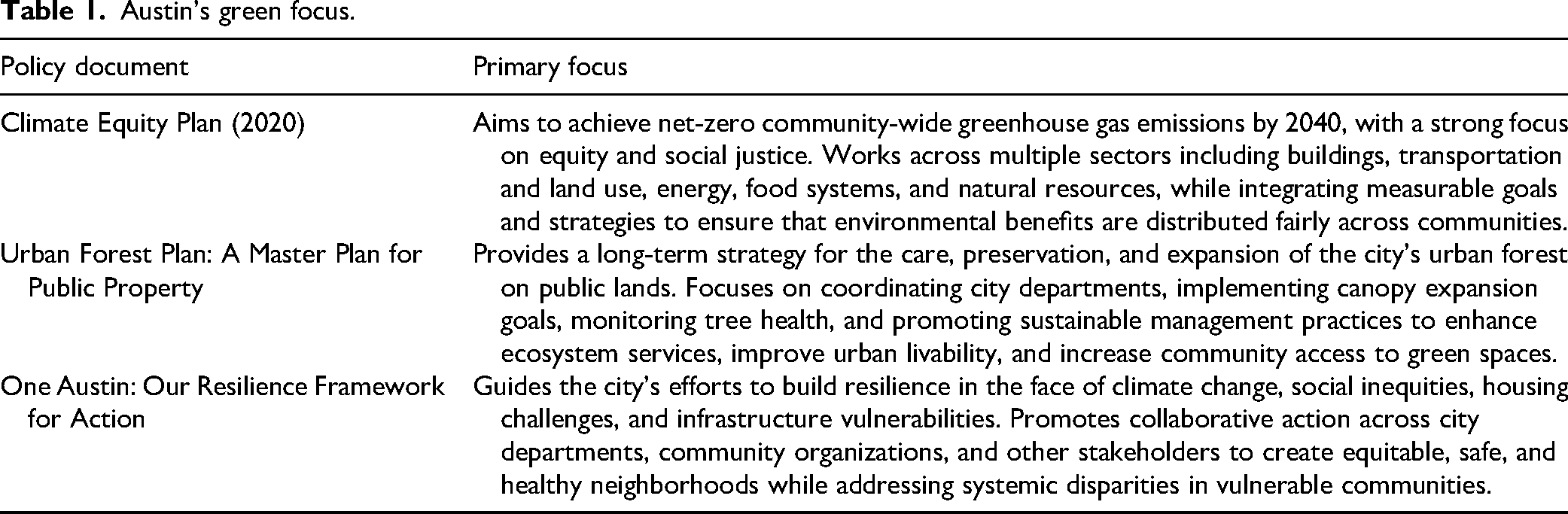
Discourse analysis of policy documents in this research involves understanding the intentionality behind stated objectives and identifying the themes embedded “between the lines” in official documents (Micozzi and Yigitcanlar, 2022). Discourse analysis also analyzes the historical evolution of language practices to examine how the cultural and political scenario influences the language. It focuses on how individuals employ language to achieve personal, social, and political aims within various contexts (Starks and Brown Trinidad, 2007). Fairclough (2013) describes discourse analysis as an important methodology to analyze the link between language and social practice. Discourse analysis thus reveals how language in planning documents encodes political choice and reproduces or challenges of inequalities. In this article, we analyze three policy documents from each city that claim to address racial inequality, urban sustainability, and the concept of a Green City. From the City of Dallas, we examine the Comprehensive Environmental and Climate Action Plan (CECAP), the Racial Equity Plan, and the Urban Forestry Master Plan—all of which have long-term goals of promoting urban sustainability and equity. Similarly, we analyzed the Climate Equity Plan, the Urban Forestry Plan, and One Austin: Our Resilience Framework for Action of Austin, all of which have long-term aims to achieve equitable and sustainable Austin.
Semi-Structured interviews
Semi-structured interviews with local people help determine to what extent the discourses of policy are materially transforming people's lives into practice. The interviews followed a semi-structured format where we prepared questions but also allowed open-ended conversation. This approach ensures that the information gathered is not restricted to a rigid question-and-answer format but allows the interviewee to add personal stories and anecdotal evidence (Longhurst, 2003). Questions included; Do you feel there has been considerable progress in the city's urban forestry program? Are the canopy cover goals realistic and attainable? Do you see any considerable progress by the city towards these goals? Has the city initiated any new urban forestry programs to support these efforts in your area?
According to Longhurst (2003), the semi-structured interview method ensures that the collected data is not restricted to a strict question-and-answer format. Community members of different socioeconomic backgrounds are selected for interviews to explore their diverse class experiences and perceptions regarding the effectiveness of green agendas. Depending on the response and engagement of the individual, the conversations lasted between 10 and 15 min, with six interviewees from each city. The shorter interview duration reflects a practical constraint of field access in communities with high levels of distrust towards researchers and significant language barriers (particularly in Spanish-dominant households in East Austin and South Dallas). Gatekeeping by community leaders and time limitations of participants in precarious employment also constrained interview length. While we acknowledge these limitations, we add that the interviews are supplemented by “community narratives”—locally circulating accounts, informal observations of neighborhood conditions, overheard conversations, and shared frames of meaning gathered through fieldwork beyond the formal interview encounters, consistent with qualitative methods (Longhurst, 2003). Together, the interviews and community narratives provide a layered qualitative dataset that compensates, at least partially, for the brevity of individual encounters. Future research should priorities longer interviews and expanded sample sizes to develop richer empirical grounding.
The interviews have been conducted with diverse ranges of community members having different socioeconomic backgrounds to gain a diverse range of experience. Participants were selected based on their length of residence (minimum 2 years), familiarity with neighborhood environmental conditions, and willingness to discuss local green initiatives. Participants included renters and homeowners, long-term residents and more recent arrivals, and a mix of gender and occupational backgrounds. In accordance with ethical research protocols, all responses were anonymized to maintain confidentiality. We did encounter difficulties while recruiting participants as many people were reluctant or apprehensive about talking about the research topic as they claimed a lack of experience with municipal projects or ignorance about urban greening and forestry initiatives. In Dallas's poor neighborhoods, a language barrier existed due to our inability to speak in Spanish making it difficult for some locals to communicate effectively in English. In the following section, we explore Austin and Dallas as case studies examining in detail green governance discourses in each city to understand the particularities of green policies through the lenses of multiple actions, projects, plans floated by each city in their march towards the “green” label.
Understanding the language of green policy
We chose three major policy documents from each city that the city governments highlighted as flagship green projects serving as empirical sites for discourse analyses to interrogate the green imaginary in the heart of economically growth-centric and politically conservative Texas. Tables 1 and 2 list and summarize the primary foci of these document-discourses.
Austin's green focus.
Dallas's green focus.
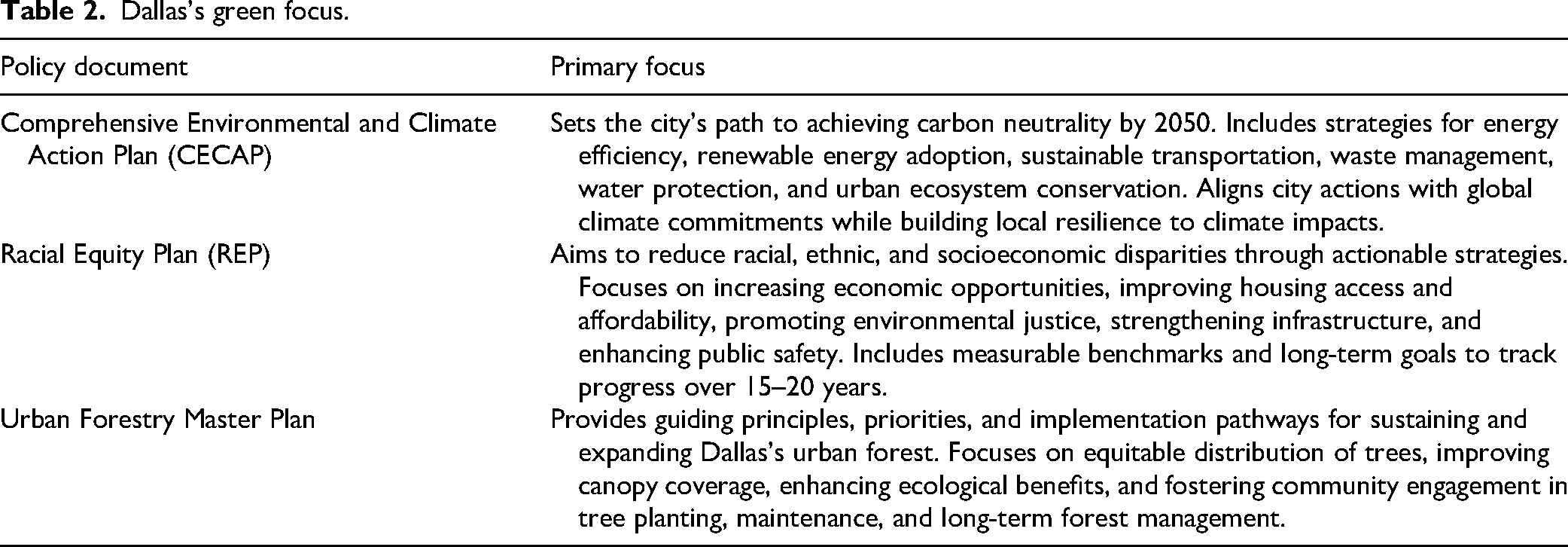
The policy initiatives explored in Tables 1 and 2 indicate that both the cities of Dallas and Austin have demonstrated commitments towards mitigation of the impacts of climate change focusing on increasing the distributional equity of natural resources and urban resilience programs. Both cities have produced different policy documents under multiple civic departments to address the above. The overall goal is to work on long-term environmental sustainability and equity issues along with a community-driven implementation process. Both cities have set ambitious goals of carbon neutrality as a long-term vision in their documents including climate, housing, and social equity as pillars in framing the carbon neutrality objective. In addition, both cities have a good environmental program in the policy to work on environmental health, racial justice, and socioeconomic well-being. The Urban Forest Plan was produced by the Parks and Recreation Department in coordination with the Office of Sustainability. Dallas's Comprehensive Environmental and Climate Action Plan was led by the Office of Environmental Quality and Sustainability under Mayor Eric Johnson with an initial implementation budget of approximately $1 million—a figure, critics argued, was modest relative to the city's stated ambitions. Dallas's Racial Equity Plan (2021) emerged in direct response to advocacy pressure following the 2020 racial justice movement and was developed with input from community organizations including the Dallas Truth, and Racial Healing and Transformation initiative. Both cities’ documents thus reflect a specific political moment—progressive mayoral administrations navigating pressure from communities of color while operating within a conservative state government that actively undermined local environmental authority (e.g., through House Bill 2127 in 2023). These political constraints help explain the gap between ambitious policy language and limited implementation.
However, both cities prioritize economic growth embedding a strong green growth discourse within planning practices, which align them with the technocratic dimensions of Green City/Eco-City imaginaries and keep them outside the rubric of degrowth perspectives discussed above. The policies of Austin and Dallas are like green policies adopted elsewhere, for example, in Södertälje municipality of Sweden, planning documents emphasize promoting growth through the expansion of housing, schools and workplaces along with the aim of maintaining a long-term sustainability vision (Tahvilzadeh et al., 2017). Here, nature is a commodity for aestheticization of the city spliced with business-as-usual planning practices that include single-family housing developments in peripheral areas, large industrial expansions erasing forest or arable land, and creating new road infrastructure that eats away natural habitats (Ruiz-Alejos and Prats, 2022). The policy discourses of the two Texan cities substantiate a vision for conventional development practices while at the same time, setting ambitious ecological goals thus, conforming to the Eco-City/Green City approaches. If Texas cities are templates that are furthest from ecological nurturing and closest to capitalist accumulation owing to their environmentally averse and pro-entrepreneurial politics, class-racial and environmental injustice stories studied here should be able to provide the deepest/richest rationale for pushing urban dialectics towards degrowth. Real estate data support this concern in the Trinity River Corridor Project, since its approval in 1998 and the acceleration of construction post-2012. The median home values in adjacent West Dallas and Trinity Groves neighborhoods have risen sharply as developers have capitalized on historically cheap land near the corridor to attract wealthier residents (Krupala, 2019). Displacement of lower-income Black and Hispanic households from Oak Cliff and West Dallas has accelerated during this same period (Krupala, 2019). This illustrates a key tension between the rhetoric of equity in policy discourse and the material outcomes experienced by local communities.
Green Policies on the ground: Community perceptions in Dallas and Austin
To determine the perception and life experience of the residents in relation to the environmental vision and policies outlined above, we spoke to people of the low-income Joppa neighborhood with a substantive Hispanic population. One resident replied: I use public transportation regularly for my daily use as I cannot afford a car. I have noticed there is a clear difference between bus stops in low-income areas and those in downtown or high-income neighborhoods. For example, the bus stop in our area lacks shelter, which causes discomfort in drastic weather conditions. Additionally, the stop is often occupied by drug users making it difficult and unsafe, especially for women and children to use public transport. He added that the city should prioritize regular maintenance of public transportation infrastructure, which would benefit frequent users and encourage more people to use the service.
To have contrasting opinions, we interviewed residents from rich neighborhoods like Meaders neighborhood in Dallas, the resident in the affluent district remarked: I see that despite the Trinity River Project being approved in 1998, there has been no considerable progress, and the delays have led to rising construction costs. This slow progress in such a high-profile costly project clearly shows mismanagement and a lack of clear direction from the city government. Regarding the electrification of vehicles, there are no significant city-led initiatives; progress is driven primarily by individual efforts. I have not seen any electric vehicles operated by the city of Dallas itself. However, the city is making satisfactory progress in street tree planting and increasing canopy cover.
Furthermore, we also spoke with community members in the poor neighborhoods like Valeria and Blackland neighborhoods of east Austin, which is considered to be low-income area within East Austin. One woman remarked: The city of Austin is making considerable progress in the downtown area and in nearby areas, while there are very few environmental initiatives in our neighborhood. We can see a clear difference in street tree planting and greening efforts in the city center, but there are no similar initiatives in our community. The primary goal is to brand the downtown area as a green, sustainable hub to attract tourism and investment. Since our neighborhood does not offer immediate economic benefits, it is a lower priority in the city's development agenda.
One resident of the affluent Westlake neighborhood in west Austin states: I have heard a lot of people talk about how much Austin has changed, and I agree with this statement. It is not just that it has gotten more expensive—it feels like the whole vibe of the city is different now. What used to feel like a green, peaceful, and calm city has started to feel more like just another big and crowded city. I met quite a few people who think that it is because of the flood of people moving in from California as it is becoming the second Silicon Valley. Austin was barely recognizable compared to what it was 10 or 20 years ago. One thing that hit me was the loss of green space, which is one of the beauties of this city, and it still feels like something special has been lost. It is not just about development; it is about losing the places tied to people's memories and the soul of the city.
Some of the key interjections from our interviews drawn from class-based neighborhoods in both Dallas and Austin presented above serve as touchstones for a more general synthesis. A synthesis of details extracted from our field interviews reveals that both city departments promote an ambitious climate and sustainability agenda and resident views on this green initiative. Low-income neighborhood residents in Dallas sum up the material conditions of existence critiquing poor public transport infrastructure, lack of basic amenities like sheltered, safe bus stops, and exclusion from major green investments such as the 325-million-dollar Trinity River Project, which they see as displacement-inducing for the poor. The realities of Dallas Green City are a distant dream for Dallas's poor where green canopy expansion is beyond their reach, for them, the rich benefit from the policy-dream, while the poor struggle in green deserts fighting green gentrification and lack of access to public infrastructure. Similarly, poor neighborhoods of east Austin report few greening projects, poor public transportation infrastructure, and a clear prioritization of downtown and west Austin for Eco branding and investment producing what they describe as a “green desert” in low-income, largely marginalized neighborhoods. East Austin interviewees question whether their areas are truly part of a “Green City” and argue that canopy targets are met on paper, while leaving their communities exposed to heat, pollution, and a lack of basic green amenities. Wealthier residents of Dallas and Austin focus more on rising costs, crowding, loss of local character, and rapid poorly managed growth linked to tech driven imagination rather than, on unequal distribution of environmental benefits.
Across both cities, wealthier voices tend to frame concerns around nostalgia, lifestyle, and place-making, while rarely naming the structural forces driving displacement and environmental inequality. Meanwhile, low-income residents foreground inadequate infrastructure, exclusion from flagship green projects, and the use of sustainability investments to catalyze capital accumulation in already privileged areas. Together, the case studies of two Texan cities substantiate the intellectual critiques around the Green City/Eco-City narratives discussed before.
Policy discourses listed under bold acronyms broadcasting “climate resilience,” “carbon-neutrality,” and “forest-expansion” fade into technocratic wordplay, in practice however, implemented policies do not challenge existing landscapes of injustice. Instead, they re-inscribe class and racial inequality, widening the gap between policy aspirations and living reality. Thus the cases of Austin and Dallas substantiate what we know from environmental justice literature, and also emphatically reveal that policy and reality lack the fervor, imagination and boldness to be something that goes beyond capitalism's sleight of hand and create a fundamental change from the production-consumption-based expansive and accumulative rhythm of capital's life process. What participants do articulate, that is, the frustrations with inadequate infrastructure, exclusion from flagship green projects, and the prioritization of capital accumulation over community need resonate with what Peet and Watts (1996, 2004) call the ecological liberation framework. Liberation from capital-centric urban modernity would be a resistance to systems of power that politically produce both nature's degradation and its unequal distribution and racial and class inequality. In this sense, the interviews offer grounded, place-based evidence for precisely the kind of community-level critique that argue for transformative environmental politics and insist towards “equitable access, material redistribution, and recognition of historical harm.” This alignment between community experience and the ecological liberation framework strengthens the article's argument for moving beyond eco-modernist approaches toward more justice-centered models of urban planning, and dare we insist de-growth strategies that re-balance social well-being and nature's well-being.
Beyond the green growth nightmare: Toward degrowth-oriented planning
Our analysis suggests that the policies of cities present an ambitious narrative of sustainability, equity, and urban resilience but often lack a clear and concrete plan to achieve these goals. There is a noticeable gap between policy rhetoric and implementation reflecting the weak integration of sustainability principles within city planning practices. In many planning documents, sustainability is framed through urban ecology and environmental aesthetics narratives emphasizing visible greening initiatives and technological solutions rather than addressing the structural drivers of ecological degradation and inequality. Latouche (2004) discussed that such framing often results in superficial end-of-pipe solutions while allowing conventional development practices to continue largely unchanged.
Similarly, in cities such as Austin and Dallas, policy frameworks including climate action plans, racial equity strategies, and urban forestry master plans highlight ambitious objectives such as carbon neutrality, equitable tree canopy distribution, and community engagement. However, evidence from semi-structured interviews indicates that low-income and historically marginalized neighborhoods continue to experience inadequate green infrastructure, limited public transit access, and exclusion from major “green” investments, which are often perceived as drivers of green gentrification rather than instruments of environmental justice. In contrast, residents in wealthier areas tend to report satisfactory environmental amenities and tree planting, but frame their concerns primarily around lifestyle disruptions, congestion, or preservation of neighborhood character, rarely engaging with the deeper structural processes that produce unequal environmental conditions.
Although both cities demonstrate strong formal commitments to climate mitigation, resilience, and racial equity, these commitments remain embedded within a development paradigm that prioritizes economic expansion and urban competitiveness. This contradiction illustrates the inherent limitations of the green growth model, which assumes that technological innovation and efficiency can reconcile environmental protection with continuous economic growth without confronting systemic inequalities and ecological limits. The experiences of marginalized communities highlight that sustainability initiatives frequently function as tools of spatial valorization rather than mechanisms of justice. At its core, environmental justice seeks to guarantee equitable access to environmental benefits regardless of socioeconomic background, yet in practice such principles often lack redistributive force.
David Harvey (1996) warns that urban environmentalism operating within capitalist growth frameworks may reproduce rather than dismantle spatial segregation, environmental racism, and social injustice. Therefore, mitigation strategies focused solely on emissions reductions or greening initiatives are insufficient; cities must move beyond carbon targets and technocratic solutions toward confronting the structural inequalities that allow wealthier, often disproportionately white communities to enjoy superior environmental conditions while marginalized neighborhoods continue to face environmental burdens. Despite the widespread rhetoric of equity and sustainability in urban policy discourses, the cases of Austin and Dallas reveal limited political willingness to challenge entrenched class and racial disparities in environmental access, underscoring the need for more transformative planning approaches that directly address the root causes of environmental injustice. Our case studies prove that “Green urbanism” enframed within a growth-oriented, capitalist model is unlikely to be “green” as it never even in the first instance aspires to interrogate our flawed relationship to nature. Environmental concerns mediated by a techno-economic system that works to keep every systemic inequality (class, race, age, gender, sexuality) intact in order to aid the consumption process are not, and will never be, nature-based. In that context, Dallas and Austin are perhaps not different in their greenwashed ephemerality and manifested environmental injustices than many other post-industrial cities, but they are perhaps more unique as they sit in the heart of a very political-economic conservative state and therefore, make the conservative aspirations for environmental conservation, preservation and expansion all the more ironic, desperate and even, grotesque. Identity differences between the more progressive, more cool, more environmentally attuned Austin and the “true-blue” (or red) growth machine of Dallas ebb, flow and melt away without making a stark difference in the life of the urban poor or minority poor. Irrespective of whether they live in Dallas or Austin, our interviewees tell us that predatory capitalism manufactures Green City/Eco-City agenda for capital and not people. A people's agenda, we claim therefore, must learn from these case studies and rethink green urbanism beyond the Green City agenda towards more radical alternatives that integrate environmental justice directly into land-use decisions, infrastructure investment, and housing policies, ensuring that green infrastructure, transit access, and environmental amenities are equitably distributed across neighborhoods.
Degrowth movements are the starting points of a more radical agenda advocating for the deliberate reduction of production and consumption, particularly in affluent regions, while redefining prosperity around equity, care, and ecological stewardship (Demaria et al., 2013). Integrating degrowth principles into urban planning would require community-led resource management, the redistribution of environmental investments, and economic models that prioritize public goods and collective well-being over corporate accumulation. From a planning perspective, this approach implies conditioning urban development within ecological and social limits where projects are evaluated at early stages for their impact on carbon emissions, ecosystem services, and social equity. Developments that exceed ecological thresholds or deepen inequalities should therefore be reconsidered or rejected, ensuring that planning decisions are guided by environmental protection and social justice rather than market imperatives. Furthermore, goal-oriented back-casting scenarios can assist cities in envisioning development pathways that align with ecological ceilings and social foundations. Instead of forecasting future growth trends, back casting begins with sustainability and justice goals and works backward to design planning strategies capable of achieving those outcomes. Dallas and Austin cases are exemplary that deeper transformation is required.
Conclusion
This article contributes to critical debates on urban sustainability by examining the Green City/Eco-City perspectives through a comparative analysis of Dallas and Austin. By integrating policy analysis and residents’ perceptions, the study reveals the contradiction between green policy aspirations and the realities of their implementation. The findings also demonstrate that under capitalist urban regimes, sustainability initiatives around canopy expansion, tree planting, green transportation initiatives often reproduce and intensify existing social and spatial inequalities rather than addressing them.
The empirical findings show clear spatial disparities in the distribution of green infrastructure and environmental amenities across both cities. In Austin, which is frequently branded as a leading “Green City,” environmental resources and green spaces are concentrated in downtown-affluent areas, while poor neighborhoods, which are also predominantly Hispanic continue to experience limited access to green cover and environmental amenities. Similarly, in Dallas, many green initiatives are concentrated in downtown and wealthier northern neighborhoods, while historically class and racially marginalized communities in south Dallas receive comparatively limited investment in environmental infrastructure. These patterns indicate that urban sustainability initiatives often function within a broader system of capitalist urban development that prioritizes economic growth, land value enhancement, and city branding. We argue that the people's agenda must move beyond the Green city framework instead of embracing more radical alternatives that integrate environmental justice directly into land-use decisions, infrastructure investment, and equitable housing and public transport access.
The findings also reveal that current sustainability policies in both cities are insufficient to produce meaningful structural change. Although policy documents emphasize environmental sustainability, they rarely address the historical and structural inequalities embedded in urban development processes. In practice, green initiatives frequently operate as a form of ecological modernization or “sustainability fix,” where environmental improvements are selectively implemented in ways that support entrepreneurial urban governance and capital accumulation. As a result, sustainability becomes a branding strategy rather than a transformative framework for achieving environmental justice. The case studies act as templates of post-industrial sunbelt spaces and moments that are deeply cleaved around class and race while at the same time, being seats of impossibly affluent lifestyle, growth-centered accumulation and thriving economic and political conservatism. On top of these cleaved layers of segregated socio-spatial experiences, a tentative yet robust, socially-blind, and yet environmentally progressive policy agenda is being secreted through “cut and paste” green policy invested in quantitative thresholds and performance targets. The result is a hack-job of a patchworked life cobbled together with slapped-on green river projects and tree planting initiatives that barely make a difference for the environment, let alone the racialized poor. We therefore argue for a fundamental systemic overhaul that go against the popular local adage, “Don’t mess with Texas!” and instead proclaim, “Mess it all up” by demanding that conservative politics should “conserve,” that is, this time, it should “conserve nature” by re-vivifying the nostalgia of a glorious America where saving and living within means was the essence of good life, and “consumption” originally meant, “consumption disease” or Tuberculosis.
The evidence from Austin and Dallas substantiates Harvey's (1996) warning that urban environmentalism embedded within capitalist growth frameworks tends to reproduce rather than dismantle the spatial and racial inequalities it claims to address. Yet Harvey's critique, while powerful, requires supplementation with a positive politics of transformation. Here, Peet and Watts’ (1996, 2004) ecological liberation framework proves indispensable as it directs us towards the place-based, community-rooted forms of resistance and knowledge production that alone can ground a genuinely transformative environmental politics. The testimonies of East Austin and South Dallas residents in their insistence on equitable access, material redistribution, and recognition of historical harm are not peripheral to this framework but are empirical and political core. Here are some possibilities for real change; First, reparative justice should play a central role in urban environmental policy. Both cities have histories of spatial injustice, including racial zoning, discriminatory investment patterns, and environmental marginalization. Addressing these legacies requires policies that recognize historical harm while promoting material redistribution and spatial transformation in historically underserved neighborhoods. In addition, community-led planning should be strengthened to ensure that marginalized communities have a meaningful role in shaping environmental policies and urban development decisions. Residents in underserved neighborhoods often possess valuable local knowledge about environmental conditions and community needs. Greater decentralization and participatory governance mechanisms can enable communities to actively participate in planning processes and ensure that environmental initiatives reflect local priorities. Furthermore, degrowth-oriented planning strategies could help cities move beyond growth-centered sustainability models. Integrating degrowth principles with environmental justice frameworks can support the development of urban policies that prioritize ecological health, equitable resource distribution, and community well-being rather than market-driven development.
Ultimately, the spatial inequalities identified in this study reflect broader patterns present in many urban areas across the United States. By embracing transformative approaches grounded in justice and ecological responsibility, cities can become liberating sites for deepening community ties through authentic (not technocratic) connections with nature.
Footnotes
Acknowledgements
We are extremely grateful to the editors of Human Geography for giving us an opportunity to showcase a slice of our research. We really appreciate the thoughtful comments the three anonymous reviewers provided; they went above and beyond and copy-edited our work sentence by sentence—their dedication to our research was a significant encouragement to keep pursuing what we set out to do. We are very thankful to the people of Austin and Dallas who took the time to answer our interview questions.

Ethical consideration
The Institutional Review Board (Full Board) at the University of North Texas approved our interviews (approval: IRB-24-298) on May 18, 2024. Respondents gave written consent for review and signature before starting interviews.
Funding
The authors received no financial support for the research, authorship, and/or publication of this article.
Declaration of conflicting interests
The authors declared no potential conflicts of interest with respect to the research, authorship, and/or publication of this article.
Data availability statement
The data that support the findings of this study are available from the open sources.