






Abstract
The mental health profession faces high levels of occupational stress and burnout, underscoring the need for innovative approaches to promote counselor well-being. Ecotherapy, or the integration of nature-based practices into clinical work, has been proposed as one such approach. This study examined the influence of ecotherapy practice on counselor burnout, with EcoWellness modeled as a mediating variable. Using a national sample of licensed mental health professionals (N = 1212), participants completed validated measures including the EcoWellness Inventory Short Form (EI-15) and the Counselor Burnout Inventory (CBI) Structural equation modeling was employed to test hypothesized relations. Results indicated that ecotherapists reported higher Social, Mental, and Environmental EcoWellness. In turn, higher mental EcoWellness related to less deterioration in personal life, and higher environmental EcoWellness related to less burnout associated with devaluing one’s clients. Findings suggest that cultivating counselors’ connection to nature may serve as a protective factor against burnout, highlighting both practical and theoretical implications for counselor training, supervision, and self-care.
Ecotherapy in Practice: EcoWellness Reduces Counselor Burnout
Mental health professionals, including counselors, psychologists, and social workers, are among the professions with high rates of burnout. Researchers conducted a comprehensive meta-analysis found that 40% of mental health professionals experienced emotional exhaustion (O’Connor, Neff, & Pitman, 2018), with those rates rising since the COVID-19 pandemic (Litam, Ausloos, & Harrichand, 2021). The burnout rates for mental health professionals are higher than those of the general population (Nigam, Barker, Cunningham, Swanson, & Chosewood, 2023), and the consequences include issues such as shortages in the workforce, quality of care, and the health of the provider (Nigam et al., 2023; U.S. Department of Health and Human Services, 2025). In response to longstanding concerns about burnout in the mental health professions, scholars and practitioners continue to explore complementary approaches to supporting well-being, including a growing body of research highlighting the role of engagement with the natural world in improving mental health (Jimenez et al., 2021; Taylor, Robertson, Lightfoot, Smith, & Jones, 2022; Twohig-Bennett & Jones, 2018). Increasingly, counselors partner with the natural world in the therapeutic process at varying levels and degrees (Swank & Reese, 2022), with many self-reporting that engaging with nature in their clinical work also enhances their own well-being (Delaney, Rian, & Owenburg, 2022; Delaney, Rian, Sacco, & Boren, 2025). Within this context, there is a growing need to explore integrative approaches that support both therapeutic effectiveness and the well-being of the clinician.
In this article, we labeled mental health professionals as counselors and those counselors who engage in nature-based clinical work as ecotherapists. For the purposes of this study, ecotherapy was defined as psychotherapeutic activities facilitated by a licensed therapist, through an ecological lens and intent, in partnership with the natural world, emphasizing the reciprocal relationship between individuals and the natural environment. If ecotherapists reported nature as helpful in their well-being, would that then affect their burnout? There is scant research that examines this phenomenon, and as such, this article explored that connection. Using the EcoWellness model (Reese, 2025) as a framework for wellness, this study examined the relation between ecotherapists and their burnout as well as the mediating factor of the counselor’s own EcoWellness.
Counselor burnout
Burnout in the mental health professions is not a new phenomenon and has been a topic for research and discussion for decades. Understandably, the work of a counselor involves layered complexity and psychologically taxing work. Counselors are privy to the feelings, symptoms, and trauma of their clients, are subject to a wide range of client issues, and can be subject to heavy workloads and long days. In addition, there is a lack of counselors in the United States, especially in rural areas, which can cause large caseloads and longer days for counselors (Dooley, 2023). Scholars examining counselor burnout have proposed multiple contributing factors, with exhaustion consistently identified as a prevalent outcome. (Chhabra & Dhingra, 2023; Fye, Cook, Baltrinic, & Baylin, 2020; O’Connor et al., 2018). Research evidence points to issues pertaining to large and mismanaged caseloads, conflicts and ambiguity in a counselor’s role and responsibilities, and poor support from supervisors or employers (Nigam et al., 2023; Papathanasiou, 2015). Individual counselor characteristics also contribute to burnout, such as low self-compassion, tendencies toward perfectionism, lack of self-care, and a lack of professional identity (Crego, Yela, Riesco-Matías, Gómez-Martínez, & Vicente-Arruebarrena, 2022; Kurşuncu, Baştemur, & İpek, 2023). Other factors include career status, such as early-career counselors being subjected to long hours, large caseloads, and low pay (Maslach & Leiter, 2016; Yang & Hayes, 2020).
Previous assessments measuring counselor burnout included emotional exhaustion, depersonalization, and personal accomplishments (i.e., the Maslach Burnout Inventory; Maslach & Jackson, 1981). When designing the Counselor Burnout Inventory (CBI), Lee et al. (2007) expanded the criteria to include five dimensions: Exhaustion, incompetence, negative work environment, devaluing clients, and deterioration in personal life. This inventory, developed specifically to assess professional counselors, added organizational stressors and personal consequences pertaining to burnout. The developers utilized the following definitions for each domain:
Exhaustion: The degree of both physical and emotional exhaustion that are due to an individual’s job as a counselor. Negative work environment: The individual’s attitudes and feelings toward his or her work environment. Devaluing Client: A person’s perception of his or her relationship with the client. Incompetence: A person’s internal feelings of incompetence (e.g., I am not confident in my counseling skills). Deterioration of personal life: An individual’s deterioration of personal life (e.g., not having enough time to spend with friends or engage in personal interests) (Lee et al., 2007, p. 151).
As such, finding methods and interventions to prevent and mitigate counselor burnout is multifaceted. Research exploring the prevention and treatment of burnout in counselors has found that approaches need to vary. Helpful interventions include making reforms at the employer level, such as caseload management, having clearly established roles and responsibilities, and access to quality supervision, as well as adequate time for self-care (Simionato, Simpson, & Reid, 2019). These interventions work best coupled with a counselor’s commitment to self-compassion, empowerment, and care (Sun, Yang, Chau, Cheong, & Wu, 2023). From an ethical standpoint, counselor well-being is tied to the quality of care provided to the client, underscoring its importance (Crego et al., 2022). Burnout prevention and alleviation are not accomplished through a singular intervention, and further exploration is warranted.
Ecotherapy
An emerging field in the counseling discipline is nature-based counseling or ecotherapy. Ecopsychology is a discipline that arose as a response to our rising disconnection from the natural world and the effects of climate change (Roszak, Gomes, & Kanner, 1995). Ecopsychologists explore the connections between humans and nature with emphasis on identity, well-being, spirituality, and reciprocity. Ecotherapy, or applied ecopsychology, promotes healing in connection to and with the protection of the natural world (Clinebell, 1996). There are numerous terms for ecotherapy, such as nature-based or nature-informed counseling, clinical-ecopsychology, or green therapies.
Ecotherapy practices invite nature into the healing process with clients utilizing a triadic relationship of ecotherapist–client–nature. Through this practice, a client explores how their relationship and connection (or disconnection) to the natural world impacts their mental health (Buzzell & Chalquist, 2009; Kahn & Hasbach, 2012). Research has found that outdoor therapy improves the connection between client and nature, enriches the therapeutic process, and strengthens the client–counselor relationship (Cooley, Jones, Kurtz, & Robertson, 2020; Lewis et al., 2022). Key therapeutic factors in ecotherapy include the healing role of nature, its capacity to create space for personal growth, fostering a sense of interconnectedness, and serving as a catalyst for self-discovery (Naor & Mayseless, 2021a, 2021b; 2021c). Counseling in nature also reduces stress, improves well-being (Van den Berg & Beute, 2021; White et al., 2021), and is comparable to cognitive behavior therapy in reducing stress (Rueff & Reese, 2023). Researchers have also explored the benefits of ecotherapy for counselors, finding that the natural world helps the counselor to promote client growth (Delaney & Malkinski, 2023; Harper, Fernee, & Gabrielsen, 2021; King & McIntyre, 2018; Revell & McLeod, 2016; Wolsko & Hoyt, 2012). Nature has been associated with counselor self-care practice, providing physical and psychological well-being for the counselor (Delaney et al., 2025; Delaney & Malkinski, 2023; White et al., 2021).
EcoWellness
EcoWellness (Reese, 2016,2025; Reese & Myers, 2012) is a construct that has been modified by incorporating the natural world into conceptualizations of human wellness. Historically, the natural world has been omitted from concepts of wellness within the counseling profession in the United States (Hattie, Myers, & Sweeney, 2004). As such, EcoWellness is a way to describe and evaluate one’s relationship with the natural world and how that contributes to holistic wellness and psychological functioning. Grounded in ecological and wellness-based frameworks, the EcoWellness model places human well-being as embedded within broader environmental, social, cultural, and systemic contexts. As such, rather than treating nature as always being a positive influence in our lives, EcoWellness recognizes that experiences with the natural world are shaped by identity, lived experience, access, and cultural and intergenerational factors. From this perspective, nature may function as a source of restoration, meaning, connection, and regulation but can also be associated with trauma, exclusion, or environmental injustice. EcoWellness therefore reframes human–nature relationships as relational, contextual, and culturally situated rather than prescriptive or universal (Reese, 2025).
EcoWellness is both an outcome of nature connectedness and a pathway for promoting mental health and resilience. The EcoWellness Inventory (Reese, Myers, Lewis, & Willse, 2015) conceptualized EcoWellness across multiple interrelated domains, including emotional and cognitive connection with nature, physical and sensory access, nature-related self-efficacy, spiritual or existential meaning, community connectedness, and environmental agency. These domains highlight that EcoWellness not only is limited to time spent outdoors but also includes a reciprocal and relational engagement with the natural world. The EcoWellness framework allows for a varied expression of engagement with nature that aligns with one’s values, cultural worldviews, and sociopolitical realities. The EcoWellness Inventory Short Form (EI-15; Reese et al., 2022) provides a three-factor assessment of EcoWellness that includes social, environmental, and mental EcoWellness. Social EcoWellness “includes the propensity to experience emotional attunement and community with others in and around natural environments” (Reese et al., 2022, p. 273). High scorers on this factor experience greater social connection, increased compassion, and deeper relationships while in nature. Environmental EcoWellness “comprises an action orientation toward addressing environmental sustainability and climate change” (p. 273). High scorers demonstrate a strong commitment to environmental issues and a caring, ethical approach to nature. Mental EcoWellness expands self-concept to “include and feel part of a larger whole in nature for reducing stress and achieving mental clarity and balance” (p. 274). Individuals with higher scores on this subscale are more likely to experience a sense of connection with nature and to find stress relief through quieter mental activity, positive emotions, and feelings of calm and peace.
Because burnout affects both counselors’ well-being and the quality of care they provide to clients, it is essential to continue exploring strategies that can mitigate this pervasive issue. Given that EcoWellness promotes deeper ecological awareness in daily life as a pathway to wellness and that ecotherapists often report feeling both connected to and supported by the natural world, the purpose of this study was to examine the relation among these constructs in association with burnout. In this study, burnout is conceptualized as “failure to properly perform clinical tasks appropriately due to discouragement, apathy toward system stress, and emotional/physical drain” (Lee et al., 2007, p. 143). Therefore, the question guiding this study was, does practicing ecotherapy and fostering EcoWellness reduce burnout in mental health professionals, and if so, what factors contribute to this effect? Findings provide further insight into counselor burnout, ecotherapy, and EcoWellness as a potential buffer to burnout.
Methods
Procedure and participants
After approval from the university’s Institutional Review Board, participants were recruited via email from lists of licensed mental health professionals obtained from several states. In order to try and create diversity in location and demographics, lists of mental health professionals were acquired from licensing boards in Florida, Nebraska, Ohio, Utah, and Vermont. The list obtained from Florida included licensed mental health professionals who lived around the country. The majority of therapists surveyed are licensed mental health/professional counselors (over 70%) with a small percentage of licensed clinical social workers, licensed family counselors, and psychologists. Participants were randomly selected and sent an email via Qualtrics that included an informed consent, demographic questions, the Counselor Burnout Inventory (CBI; Lee et al., 2007), and the EcoWellness Inventory Short Form (EI-15; Reese et al., 2022). Participants were asked to share their email only if they wanted to be included in a random drawing of 40 Amazon gift cards valued at $25 each. In total, we had a 6% response rate, with an 84% completion rate.
The final sample of participants who participated in this study was 1212. Percentage distribution among participants’ gender included 83.3% female (n = 1009), 14.5% male (n = 176), 1.6% nonbinary/third gender (n = 19), and 0.7% preferred not to say (n = 8). Age percentages among participants included 0.5% for ages 18–24 years, 18.4% for ages 25–34 years, 30.1% for ages 35–44 years, 26.2% for ages 45–54 years, 17.1% for ages 55–64 years, and 7.8% for ages 65+ years. Most of the participants identified as White (80.2%). Race/ethnicity percentages also included 7.7% as Black or African American, 6.2% as Hispanic or Latino, 3.9% as mixed race/other, 1.5% as Asian, 0.3% as Native American or Alaska Native, and 0.2% as Native Hawaiian or other Pacific Islander.
Measures
Counselor burnout inventory
Counselor burnout was assessed by the Counselor Burnout Inventory (Lee et al., 2007) and included 20 items. The 20 items are divided into five subscales, which include Exhaustion (e.g., “Due to my job as a counselor, I feel tired most of the time”), Incompetence (e.g., “I feel frustrated by my effectiveness as a counselor”), Negative Work Environment (e.g., “I am treated unfairly in my workplace”), Devaluing Clients (e.g., “I have little empathy for my clients”), and Deterioration in Personal Life (e.g., “My relationships with family members have been negatively impacted by my work as a counselor”). The CBI uses a 5-point Likert-type scale (1 = never true to 5 = always true). The total score ranges from 20 to 100, while subscale scores range from 4 to 20. Higher scores indicate greater burnout. Cronbach’s alpha across subscales ranged from 0.73 to 0.86 (Lee et al., 2007; Um & Bardhoshi, 2025).
EcoWellness inventory short form
EcoWellness was assessed by the EcoWellness Inventory Short Form (Reese et al., 2022) and included 15 items. The 15 items are divided into 3 subscales, which include Social EcoWellness (e.g., “I feel a sense of community with others when together in nature”), Environmental EcoWellness (e.g., “I am concerned about climate change”), and Mental EcoWellness (e.g., “I go to nature to find peace”). The EI-15 uses a 4-point Likert-type scale (1 = strongly disagree to 4 = strongly agree). Total score and subscale scores range from 25 to 100. Higher scores indicate a higher perception of one’s EcoWellness. Internal consistency reliabilities of the subscales ranged between 0.80 and 0.88 (Reese et al., 2022).
Construct validity evidence
We evaluated internal structure by fitting confirmatory factor analysis (CFA) for each instrument and estimating McDonald’s (1999) ω for internal consistency reliability, and we tested measurement invariance across ecotherapists and nonecotherapists using MGCFAs. Because indicators were ordered categorically, models were estimated using WLSMV with Delta parameterization. Fit was evaluated using robust fit indices and cutoffs RMSEA ≤ 0.06; SRMR ≤ 0.08; CFI ≥ 0.95; TLI ≥ 0.95 (Hu & Bentler, 1999), supplemented by DFI model-based dynamic cutoffs (McNeish, 2023; McNeish & Wolf, 2023), and invariance testing followed Wu & Estabrook (2016) recommended steps for ordinal indicators.
In the sections below, fit indices describe how well the expected factor structure aligned with the observed item responses. Reliability estimates describe the consistency of each subscale, latent factor correlations provide evidence about whether related constructs remained distinguishable, and measurement invariance tests evaluate whether the measures functioned similarly for ecotherapists and nonecotherapists.
Counselor burnout inventory
Robust fit was mixed (CFI = 0.905, TLI = 0.887, SRMR = 0.048; RMSEA = 0.089, 90% CI [0.083, 0.095]), with stronger nonrobust scaled indices; DFI supported fit better than moderate misspecification (between Level-1 and Level-2). Loadings were significant and generally large across factors (0.63–0.97), subscale reliability was good (ω = 0.745–0.917), and latent correlations were moderate-to-strong (r = 0.32–0.80). Strong invariance was supported by the MGCFAs (ΔCFI = 0.00 across thresholds and loadings constraints).
These findings suggested that the Counselor Burnout Inventory subscales were measured with acceptable-to-strong reliability and that the burnout dimensions were related but still distinguishable. The invariance results also suggested that ecotherapists and nonecotherapists interpreted and responded to the burnout items similarly enough to support group comparisons.
EcoWellness inventory short form
Robust indices indicated adequate fit (SRMR = 0.049, CFI = 0.954, TLI = 0.944), with elevated RMSEA (RMSEA = 0.079, 90% CI [0.069, 0.088]); DFI converged with the robust CFA conclusion (between Level-0 and Level-1). Loadings were significant and generally large across factors (Social 0.58–0.90; Environmental 0.65–0.93; Mental 0.78–0.90), subscale reliability was good (ωSocial = 0.867; ωEnvironmental = 0.871; ωMental = 0.874), and latent correlations were moderate (r = 0.29–0.66). Strong invariance was supported by the MGCFAs (ΔCFI = 0.00 across thresholds and loadings constraints).
These findings suggested that the EcoWellness subscales had good internal consistency and that Social, Environmental, and Mental EcoWellness reflected related but distinct dimensions of EcoWellness. The invariance results further suggested that the EcoWellness factors were measured similarly for ecotherapists and nonecotherapists, supporting their use in the mediation model.
Model
We used a two-step, structural equation modeling (SEM) approach (Anderson & Gerbing, 1988). First, we evaluated the internal structure and model-based reliability of the EcoWellness Inventory Short Form (15 items; Social, Environmental, and Mental) and the Counselor Burnout Inventory (20 items; Exhaustion, Incompetence, Negative Work Environment, Devaluing Client, and Deterioration in Personal Life) using CFA and tested measurement invariance across ecotherapists and nonecotherapists via a series of multigroup CFAs (MGCFA) with sequential constraints on thresholds and factor loadings. Second, we estimated a partial mediation SEM in which ecotherapist status (1 = ecotherapist and 0 = nonecotherapist) predicted the three EcoWellness factors, which in turn predicted the five burnout outcomes, while also estimating direct effects from ecotherapist status to each burnout factor. To reduce confounding, we estimated a propensity score for ecotherapist status and included it as a covariate on all mediators and outcomes receiving paths from ecotherapist status. Model fit was evaluated using CFI, TLI, RMSEA, and SRMR. Analyses were conducted in R (R Core Team, 2025) using lavaan (Rosseel, 2012), semTools (Jorgensen, Pornprasertmanit, Schoemann, & Rosseel, 2025), dynamic (Wolf & McNeish, 2025), and twang (Cefalu et al., 2024) (Fig. 1).
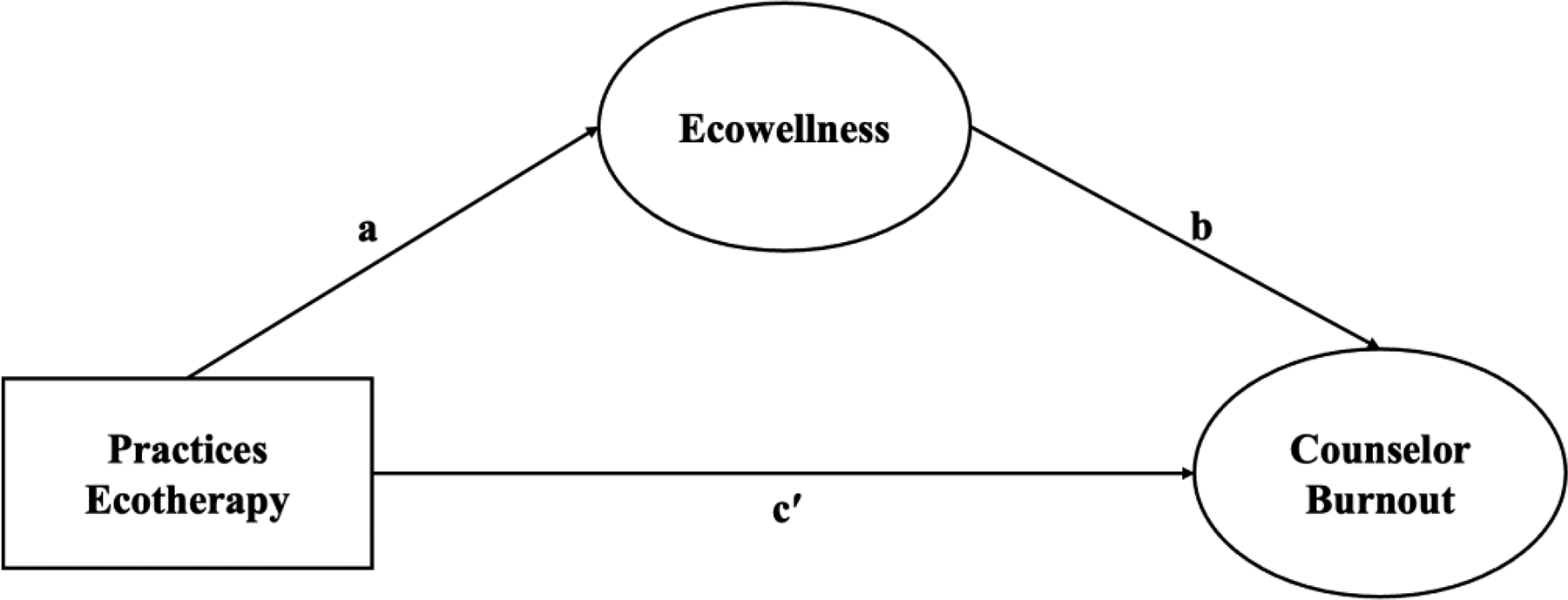
Pathway model for practicing ecotherapy to counselor burnout and mediation path of EcoWellness to counselor burnout.
Internal validity evidence
Because this was an observational study, mediation inferences are not strictly causal. To reduce selection bias due to measured covariates, we estimated a propensity score (PS) for ecotherapist status consistent with Rubin’s causal model (Rubin, 1974) and standard internal validity frameworks (Campbell & Stanley, 1963; Cook & Campbell, 1979; Shadish, Cook, & Campbell, 2002). Baseline equivalence was evaluated using standardized mean differences (SMDs), with |SMD| < 0.10 indicating acceptable balance (Austin, 2009), and by assessing common support.
Propensity scores were estimated using generalized boosted modeling (McCaffrey, Ridgeway, & Morral, 2004) with interaction depth = 4, shrinkage = 0.0005, up to 40,000 iterations with early stopping based on mean absolute SMD, and bag fraction = 1.0. Covariates included age, gender, race/ethnicity, income, region, years of counseling experience, professional license, and caseload manageability (332 ecotherapists and 880 nonecotherapists). The model optimized at 31,560 iterations and showed common support from propensity scores of 0.098–0.564 (93.1% of ecotherapists and 94.4% of nonecotherapists). Balance improved substantially (max |SMD|: 0.189→0.091; mean |SMD|: 0.074→0.029), and all 41 covariates met the |SMD| < 0.10 threshold after adjustment. In practical terms, the propensity score adjustment improved the comparability of ecotherapists and nonecotherapists on the measured background characteristics included in the model. This adjustment reduced, but did not eliminate, concerns about selection bias because unmeasured differences between groups may have remained.
Partial mediation analysis
We tested a partial mediation SEM in which ecotherapist status predicted Social, Environmental, and Mental EcoWellness, which in turn predicted five burnout factors (Exhaustion, Incompetence, Negative Work Environment, Devaluing Client, and Deterioration in Personal Life), while also estimating direct paths from ecotherapist status to each burnout factor. The PS was included as a covariate on each mediator and outcome receiving paths, from ecotherapist status, and residual covariances were estimated among the three EcoWellness factors and among the five burnout factors. Models were estimated using WLSMV with Delta parameterization and unit-variance identification. Direct effects used robust standard errors and Wald tests (α = 0.05), and indirect and total effects used bias-corrected bootstrap 95% confidence intervals (2000 resamples).
Results
Global fit
Scaled indices indicated adequate fit, N = 1212, χ2(586) = 1802.90, p < 0.001, CFI = 0.975, TLI = 0.974, RMSEA = 0.041, 90% CI [0.039, 0.044], SRMR = 0.045. These fit indices suggested that the overall mediation model provided an adequate representation of the observed relations among ecotherapist status, EcoWellness, and burnout.
Direct effects
Ecotherapist status predicted each EcoWellness mediator: Social (b = 0.525, SE = 0.079, p < 0.001), Environmental (b = 0.309, SE = 0.081, p < 0.001), and Mental (b = 0.436, SE = 0.086, p < 0.001). Ecotherapists reported significantly higher Social, Environmental, and Mental EcoWellness than nonecotherapists, after adjusting for the propensity score.
In the mediator-to-burnout paths, Environmental EcoWellness predicted lower Devaluing Client (b = −0.165, SE = 0.040, p < 0.001), and Mental EcoWellness predicted lower Deterioration in Personal Life (b = −0.156, SE = 0.049, p = 0.001). These results suggested that higher Environmental EcoWellness was associated with less devaluing of clients, while higher Mental EcoWellness was associated with less deterioration in personal life. Other mediator–outcome paths were not statistically significant.
Of the direct paths from ecotherapist status to burnout, controlling for the three EcoWellness mediators and the propensity score, only Deterioration in Personal Life was significant (b = 0.188, SE = 0.079, p = 0.017). Compared with nonecotherapists, ecotherapists reported significantly higher Deterioration in Personal Life after accounting for EcoWellness and the propensity score. No significant direct group differences emerged for Exhaustion (b = 0.124, SE = 0.079, p = 0.118), Incompetence (b = −0.039, SE = 0.083, p = 0.638), Negative Work Environment (b = 0.100, SE = 0.081, p = 0.221), or Devaluing Client (b = −0.002, SE = 0.089, p = 0.978; Fig. 2).
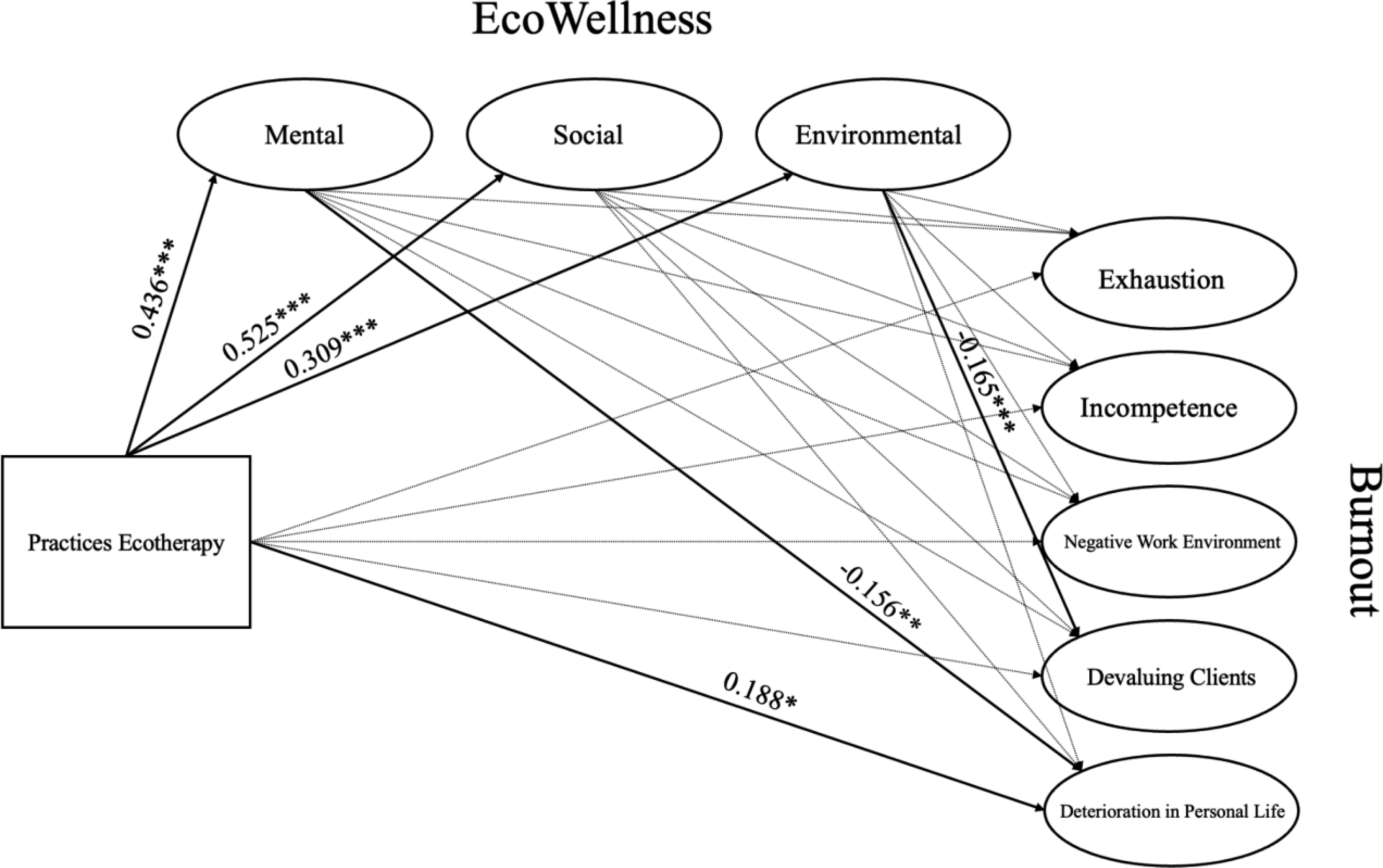
Structural equation model of ecotherapist status, EcoWellness, and counselor burnout. EcoWellness variables are displayed as mediators, and burnout variables are displayed as outcomes. *p < 0.05, **p < 0.01, and ***p < 0.001.
Indirect effects
Using nonparametric bootstrap standard errors with bias-corrected 95% confidence intervals (2000 draws), the total indirect effects of ecotherapist status through the EcoWellness mediators were significant and negative for Exhaustion (b = −0.046, p = 0.020, 95% CI [−0.089, −0.011]), Incompetence (b = −0.066, p = 0.006, 95% CI [−0.116, −0.023]), Devaluing Client (b = −0.084, p = 0.002, 95% CI [−0.143, −0.035]), and Deterioration in Personal Life (b = −0.058, p = 0.016, 95% CI [−0.112, −0.013]). The indirect effect for Negative Work Environment was not significant (b = −0.023, p = 0.277, 95% CI [−0.066, 0.016]). Ecotherapist status was associated with higher EcoWellness, and higher EcoWellness was in turn associated with lower levels of several burnout outcomes. This pattern was evident for Exhaustion, Incompetence, Devaluing Client, and Deterioration in Personal Life, but not for Negative Work Environment.
Component indirect effects indicated two specific pathways: Ecotherapist status was indirectly associated with lower Devaluing Client through Environmental EcoWellness (b = −0.051, p = 0.007, 95% CI [−0.102, −0.023]) and indirectly associated with lower Deterioration in Personal Life through Mental EcoWellness (b = −0.068, p = 0.018, 95% CI [−0.137, −0.020]). Other component indirect effects were not significant.
None of the total effects were significant. Although the indirect EcoWellness pathways were generally protective, they did not translate into statistically significant overall differences in burnout between ecotherapists and nonecotherapists when direct and indirect pathways were considered together.
Discussion
Given the well-documented mental health benefits of engagement with the natural world (Frumkin et al., 2017; Jimenez et al., 2021; Lewis et al., 2022; Taylor et al., 2022) and the relative absence of research focused specifically on counseling professionals, we examined whether ecotherapists differed from nonecotherapists in both their levels of EcoWellness and their experiences of burnout. Ecotherapists scored significantly higher on all three EcoWellness factors than nonecotherapists. As such, ecotherapists may experience nature not simply as a setting for intervention but as a shared relational space that deepens connection, attunement, and meaning. Such an orientation may reflect a broader pattern of relational engagement, one that includes openness to others, emotional presence, and a sense of ethical responsibility toward environmental systems.
At the same time, the relation between ecotherapist status and burnout was not uniformly direct. Rather, the EcoWellness construct seemed to function as a more precise pathway through which certain aspects of burnout were mitigated. Specifically, Environmental EcoWellness was associated with lower devaluing of clients, while Mental EcoWellness was associated with lower deterioration in personal life. These findings suggest that possessing an environmental ethos may reinforce relational reciprocity and reduce cynicism toward clients, while nature-based restoration processes may buffer against the spillover of clinical work into one’s personal life. The former finding is supported by prior research wherein scholars have linked prosocial behaviors and generosity with nature contact and connectedness (Capaldi, Dopko, & Zelenski, 2014; Weinstein, Przybylski, & Ryan, 2009). The latter finding aligns with broader theoretical frameworks (and their associated research) such as attention restoration and stress reduction theory, which emphasize the role of nature in replenishing depleted cognitive and emotional resources (Kaplan & Kaplan, 1989; Ulrich et al., 1991).
Collectively, these findings suggest that EcoWellness might operate less as a blanket protection against burnout and more as a targeted, domain-specific buffer. Ecotherapists were not universally less burned out; rather, their elevated EcoWellness appeared to confer modest but meaningful indirect reductions across several burnout dimensions, including exhaustion, incompetence, devaluing clients, and deterioration in personal life, although only two specific pathways were individually supported: Environmental EcoWellness to devaluing clients and Mental EcoWellness to deterioration in personal life. Notably, ecotherapist status also retained a positive direct association with deterioration in personal life, suggesting a more complex pattern than a uniformly protective effect. This distinction is important, as in, the protective value of ecotherapy may lie not in the role itself but in the extent to which ecotherapists are personally engaged in and supported by their own individual EcoWellness processes.
The present study extends our current understanding of counselor burnout by introducing EcoWellness as a relevant, yet largely unexplored, factor in the burnout process. Whereas prior research has primarily focused on organizational conditions (e.g., caseload, supervision, and role clarity) and individual traits (e.g., self-compassion and perfectionism) as key drivers of burnout (Crego et al., 2022; Nigam et al., 2023; Papathanasiou, 2015; Simionato et al., 2019), our findings suggest that a counselor’s relationship with the natural world may also function as a meaningful, domain-specific protective pathway. EcoWellness was associated with targeted decreases in devaluing clients and deterioration in personal life, two dimensions that map closely onto relational and spillover-based conceptualizations of burnout (Lee et al., 2007). This pattern is consistent with existing burnout frameworks emphasizing emotional exhaustion and depersonalization (Maslach & Leiter, 2016), while extending them by highlighting how restoration and relational orientation, facilitated through engagement with nature, may support both sustained empathic presence with clients and recovery outside of clinical work. In this way, the current findings may contribute to a more integrative model of burnout that includes not only workplace and intrapersonal factors but also ecological and relational contexts as part of the broader system influencing counselor well-being.
From a counselor preparation and supervision perspective, these findings may lend additional empirical support to the integration of ecotherapy and EcoWellness into the education and training of counselors. Our prior work suggests that ecotherapy education and coursework can shape counselors’ and counselor-in-training’s professional identity and self-care while also influencing how they view relational dynamics, including those within the therapeutic relationship (Delaney et al., 2022,2025). While additional research is needed, our findings show that strengthening one’s EcoWellness may represent accessible burnout-prevention strategies for counselors. This is particularly relevant given increasing concern about counselor burnout (Devooght & Neuer Colburn, 2024) and workforce sustainability (Nigam et al., 2023). Training in ecotherapy and EcoWellness is also suggested to ensure the proper understanding and ethical delivery of these practices.
Limitations and future research
A limitation of the present study is that the mediation model is observational and therefore does not support strictly causal inferences. Although the propensity-score procedure improved balance on the measured background counselor characteristics, it cannot eliminate the possibility of residual bias due to unmeasured differences between ecotherapists and nonecotherapists. In addition, because the data are cross-sectional, the presumed ordering from ecotherapist status to EcoWellness to burnout is theoretical rather than empirically demonstrated. Accordingly, the indirect effects are better understood as patterns of association consistent with mediation rather than as evidence of a causal mediational process.
Second, ecotherapist status was operationalized as a binary variable, which obscured meaningful variability in how ecotherapy is defined, practiced, and integrated into clinical work. The intensity, intentionality, and context of nature-based practices likely differ across ecotherapists, and future research would benefit from more nuanced measurement of ecotherapy engagement. Third, our sampling strategy introduces limitations related to generalizability. Participants were recruited via licensure lists across several states with a relatively low response rate (6%), raising the potential for self-selection bias. It is plausible that clinicians with a greater interest in nature, wellness, or burnout were more likely to participate. Additionally, the sample was predominantly White (80.2%) and female (83.3%), which may limit the applicability of findings across more diverse practitioner populations and cultural contexts across the United States.
Fourth, all data were collected using self-report measures, which may have introduced the possibility of shared method variance and response biases, including social desirability. Although both the EcoWellness and burnout measures demonstrated acceptable psychometric properties, self-perceptions of wellness and burnout may not fully capture behavioral or contextual dimensions of these constructs. Lastly, burnout and burnout prevention are complex, multifaceted processes that warrant continued and expanded research attention across therapeutic contexts. Future research could include longitudinal or experimental designs to examine whether intentional EcoWellness interventions reduce burnout over time and whether training counselors in ecotherapy and EcoWellness enhances protective effects. It would also be valuable to explore additional mediators (e.g., meaning in work, boundary management, climate anxiety, professional identity integration, stress reduction, and coping skills) to clarify the residual direct association observed.
Conclusion
The findings from this study suggest that engagement in ecotherapy and the cultivation of EcoWellness factors may foster greater resilience in response to the emotional and professional demands of clinical work. Training in and expanding facets of the EcoWellness model offers one structured framework for understanding how nature-based practices support mental health while also promoting the well-being of the practitioner and helping to preserve the integrity of the client–counselor relationship.
Statements and Declarations
This study was approved by the Institutional Review Board of Monmouth University (IRB #SP2504).
Authors’ Contributions
M.E.D. and R.F.R. contributed to investigation and writing the original draft through the literature review process. M.F. contributed to formal analysis by conducting the statistical analyses. M.T. contributed to methodology, formal analysis, and validation through study design, data analysis, and interpretation of results. All authors contributed to writing, review, and editing and the interpretation of findings and approved the final article.
Footnotes
Acknowledgments
The authors would like to thank Kevin Egler for his assistance on this project.
Consent to Participate
All participants provided written informed consent to participate in this study prior to data collection.
Data Availability Statement
De-identified data are available from the author upon request.
Author Disclosure Statement
There are conflicts of interest to report.
Funding Information
Funding for this study was received by the Urban Coast Institute at Monmouth University.