






Abstract
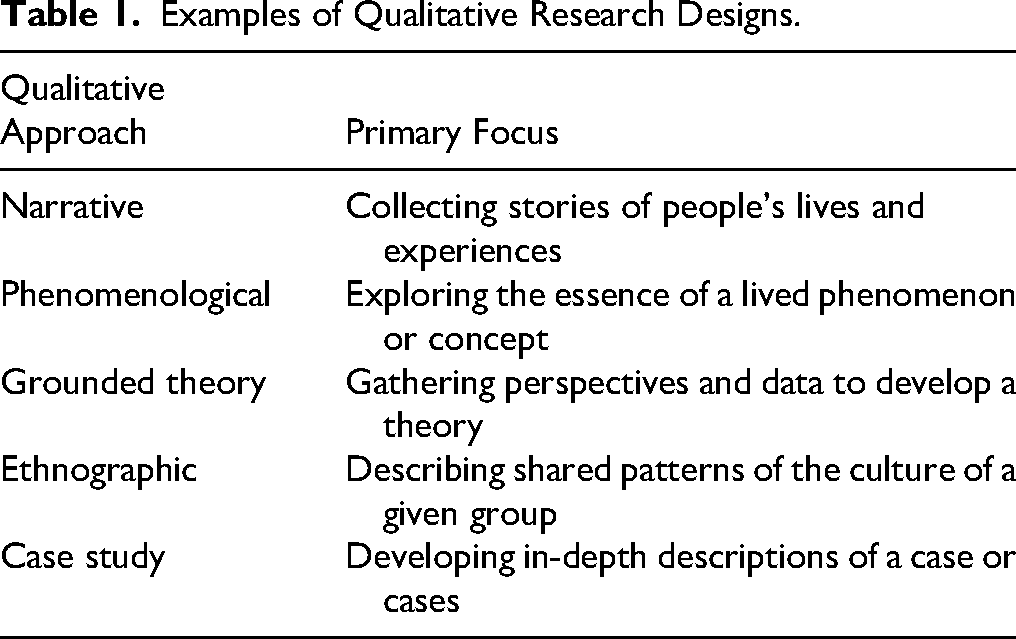
Qualitative research is a robust area of inquiry with definitions that seek to capture the vast complexity and variability of the methodologies it encompasses. Table 1 outlines common examples of qualitative research approaches. Ultimately, qualitative researchers seek to understand assumptions or phenomena through a variety of interpretive or theoretical sources, dimensions, layers, and perspectives to paint a rich and meaningful picture of multifaceted situations (Creswell, 2013; Leedy & Ormrod, 2019). When little information exists or existing theories fail to capture the essence of what is being studied, qualitative researchers shed light on the world. Qualitative researchers do not seek to simplify or quantify phenomena through numerical data but to understand the embedded nuances and varying viewpoints (Leedy & Ormrod, 2019). When qualitative methods cannot capture the full picture, researchers may employ a mixed-methods approach to answer complex queries, using both quantitative and qualitative methods to expand or confirm our understanding.
Examples of Qualitative Research Designs.
The number of qualitative articles in the American Journal of Occupational Therapy (AJOT) has increased from 4% to 6.9% of the 115 published papers in 2024 to 5.55% to 9.26% of the 108 published papers in 2025 (Reynolds, 2024, 2025). Because qualitative research aligns closely with the occupational therapy process and values, the number of submissions is expected to rise. Qualitative rigor in occupational therapy research is rooted in sound research design, richly descriptive methods, and conclusions that are neutral and free of bias, with responsibilities extending beyond the researcher's role to encompass the peer review process (Johnson et al., 2020; Krefting, 1991). Researchers, reviewers, and editors must ensure this research is rooted in rigorous methodology and reporting. Despite publications across multiple disciplines on improving qualitative reporting in recent years, clarity regarding expectations is warranted, given the range of available checklists and reporting guidelines (Amin et al., 2020; Barbour, 2001; Johnson et al., 2020; Krefting, 1991; O’Brien et al., 2014). This editorial serves to provide guidance for establishing rigor for authors, reviewers, editors, and consumers of research alike.
Key Elements of Trustworthiness and Authenticity
In an effort to create criteria congruent to those employed in quantitative research (i.e., internal validity, external validity, reliability, and objectivity), Guba and Lincoln (1989, 2001) developed two evaluative approaches to guide methodological decisions in qualitative research and to assess the completeness of scholarly products. While their conceptual alignment with positivist paradigms may constrain their ability to fully assess the quality and distinctive features of qualitative approaches, these criteria have long been regarded as standards for determining trustworthiness and authenticity (Guba & Lincoln, 2001; Sandelowski & Barroso, 2002; Sandelowski, 2014). A more comprehensive examination of trustworthiness as a positivist construct and authenticity as a constructivist construct warrants further attention; however, an in-depth discussion of these constructs is beyond the scope of this editorial.
Trustworthiness is often equated with validity and reliability, and focuses on the accuracy and applicability of research findings (Amin et al., 2020; Johnson et al., 2020). Guba and Lincoln (2001) note that key criteria include:
Credibility—Broadly consistent with internal validity, credibility is established through prolonged engagement in the field, systematic and persistent observation, iterative and reflexive auditing of assumptions, and member checks for participant-informed interpretive review. Transferability—Largely mirroring external validity, transferability refers to the degree to which research findings are sufficiently similar to other populations, contexts, or situations. Transferability is determined not only by researchers themselves but also by consumers of research. Dependability—Corresponding with reliability, dependability refers to the stability, consistency, and transparency of research findings over time, ensuring that the research process is logical, traceable, and well-documented. Confirmability—Aligned with objectivity, confirmability is determined based on the extent to which claims and constructions from the data can be traced to their sources.
Authenticity addresses contextual factors (e.g., power, accountability, representation, and pluralism) by ensuring research findings accurately reflect participants’ social realities, experiences, and perspectives (Amin et al., 2020). Evaluative standards of authenticity include:
Fairness refers to the extent to which diverse and potentially competing perspectives are meaningfully represented, examined, and integrated within the final interpretation and reporting of findings. Ontological authenticity reflects the degree to which researchers’ and participants’ understandings of their lived experiences/realities become more informed, nuanced, and sophisticated through the research process. Educative authenticity concerns how researchers and participants develop a deeper understanding of the perspectives, experiences, and meanings held by others, even in the absence of agreement. Catalytic authenticity describes the extent to which the research stimulates reflection, dialogue, or action aimed at clarifying issues, addressing inequities, or advancing meaningful change. Tactical authenticity indicates how the research process and findings support or empower participants and relevant stakeholders to take informed action based on the implications of the work.
While these inherited commitments provide a framework for producing accurate and thoughtful representations of human experience (Bochner, 2018), they are not rigid requirements. Rigor is also demonstrated through design fit and methodology. That is, rigor is a relational practice reflected in the critical alignment among the researchers’ understanding of relevant literature and prior work, the conceptual frameworks or theories guiding the current work, the research questions and aims, the methodology, methods, analyses, and reporting (Braun & Clarke, 2025; Sandelowski & Barroso, 2002).
Addressing Common Pitfalls in Manuscript Submissions
A persistent challenge in qualitative occupational therapy research is the lack of coherence between a study's epistemological assumptions, methodology, methods, and claims. Studies may, for example, identify as constructivist, phenomenological, or critical while simultaneously adopting assumptions about knowledge generation and evaluation that are more consistent with positivist and postpositivist paradigms. These inconsistencies can undermine the philosophical and methodological integrity of the research (Sandelowski, 2014). Relatedly, qualitative methodologies are sometimes engaged superficially, treated as procedural techniques rather than interpretive and theoretically grounded approaches to knowledge generation.
Methodological incoherence may also appear through the uncritical blending of multiple qualitative traditions, vague descriptions of analytic procedures, or the routine invocation of concepts such as saturation without consideration of their methodological appropriateness. Findings may be presented without contextualization, and discussion sections are often underdeveloped or insufficiently interpretive. These issues can ultimately weaken the interpretive integrity and conceptual contribution of qualitative inquiry. Below, we provide recommendations to support best practices in qualitative reporting.
Common Strategies
To enhance credibility, researchers may describe how they spend sufficient time in the field, since prolonged engagement can strengthen relationships, enable researchers to co-construct meanings, and deepen understanding of culture (Barusch et al., 2011). Additionally, researchers should use systematic data collection approaches and may consider using diverse sources (triangulation) to develop a contextualized understanding of the phenomenon of interest. Such approaches can also support the identification and description of potential biases, discrepancies, and distortions (Johnson et al., 2020). Researchers may also report how they utilize peer debriefing to interrogate taken-for-granted perspectives and assumptions, and even emergent claims about the phenomenon; analyze archived data to test the legitimacy of the findings (referential adequacy); and member checking to substantiate analytic categories, themes, and interpretations with participants from whom data were solicited. Despite its widespread use, member checking remains a contested strategy as it may lead to divergent perspectives about the data rather than consensus or true co-construction (Harvey, 2015).
Strategies to support transferability, also described as representativeness and analytical generalization, commonly involve providing sufficient contextualized data to enable the reader to assess the applicability of findings to other settings and populations (Amin et al., 2020). Qualitative research does not seek to generate universal truths transferable to other populations or settings; rather, it provides “thick descriptions” or highly detailed accounts of contextualized experience by foregrounding participants’ voices through the thoughtful integration of quotes, observations, and artifacts (Morse, 2015). This helps researchers substantiate claims that the knowledge produced is accurate and “true” using the vocabularies or language of participants. Likewise, qualitative research does not apply statistical probabilities to populations, but rather generalizes to theoretical frameworks, concepts, theories, or underlying mechanisms to make visible how and why phenomena occur (Johnson et al., 2020).
Improving dependability can be achieved with inquiry audits—the assessment of how the findings, interpretations, and research claims are supported by the data (Morse, 2015). This process would be comparable to a peer review by an outside scholar prior to manuscript submission. Audits allow the research team to address any deficiencies, assess the adequacy of their findings, and provide an opportunity to gather additional data to develop stronger, deeper claims. While there are benefits to inquiry audits, they share similar complications to member checking.
Confirmability may also be strengthened through the use of an audit trail, triangulation, and critical reflexivity to ensure that analyses were completed in depth and iteratively. Rigorous qualitative reporting should also interpret findings rather than simply illustrate them. More specifically, the discussion section of a manuscript should move beyond descriptions of behavioral patterns or themes to examine how the findings relate to one another, contribute to answering the research questions, achieve the primary aim of the research, and align with the guiding conceptual frameworks (O’Brien et al., 2014). The discussion section should also provide a more nuanced explanation and clarification of the study's findings to enhance the reader's understanding of the targeted phenomena as they relate to occupational therapy practice and research.
Strategies to enhance authenticity include providing clear and transparent descriptions of analytic processes (e.g., citing specific approaches and using audit trails), employing triangulation, and addressing reflexivity and researcher positionality. Rigor is further enhanced through deliberate sampling strategies, including sample definitions selected, size, and recruitment procedures (Johnson et al., 2020). Qualitative researchers acknowledge that some participants contribute richer and more relevant insights than others, making them especially valuable in achieving the research purpose and addressing the research questions and aims. Because data collection and analysis often occur simultaneously, determining a final sample size largely depends on reaching a point where no new information, coding, or themes emerge in the data, which is commonly referred to as data saturation (Amin et al., 2020). Consequently, predicting sample size accurately during the research planning phase can be challenging.
Researcher reflexivity is a critical component of rigor throughout all stages of the qualitative research process, recognizing that researchers’ assumptions, experiences, values, identities, and social location inevitably shape research decisions and interpretations (Braun & Clarke, 2025; Sibbald et al., 2025). Its purpose is to interrogate how one's situatedness within social, historical, cultural, and geographic contexts shapes the research. Positionality extends this process by explicitly locating the researcher and the research within the phenomenon under investigation, the participants, the research context, and the underlying ontological, epistemological, and axiological assumptions (Braun & Clarke, 2025). At the same time, scholars have argued for distinguishing between reflexivity as an ongoing critical practice or critique from positionality statements as a reporting mechanism, noting that positionality statements become problematic when raising important questions about how aspects of identity (e.g., race and gender) are signaled, interpreted, and evaluated (Sibbald et al., 2025). These critiques highlight the need for positionality declarations to move beyond performative disclosures and instead contribute to meaningful transparency, critical self-examination, and interpretation of research findings. To support more critical reflexive practice, scholars recommend maintaining a reflexive journal or memo trail to systematically record methodological decisions, emotional responses, emerging interpretations, and potential sources of bias. Further, researchers should provide a transparent positionality statement that explains relevant aspects of their background, experiences, identities, and relationship to the topic, and explicitly connects these factors to the research processes (Braun & Clarke, 2025).
The Limits of Reporting Checklists
AJOT does not require authors to use any particular qualitative research checklist or reporting standard when they are preparing submissions. However, it may be useful for readers to know more about the optional checklists and reporting guidelines available to strengthen their manuscripts prior to peer review. To improve rigor and transparency in qualitative research, various reporting standards have been developed to assist authors in preparing manuscripts and editors and reviewers in evaluating them for publication. The Consolidated Criteria for Reporting Qualitative Research (COREQ; Tong et al., 2007) and the Standards for Reporting Qualitative Research (SRQR; O’Brien et al., 2014) are commonly used and recommended by this journal. The COREQ is a 32-item checklist designed for studies using interviews or focus groups and includes items related to the research team and reflexivity, study design, analysis, and findings. The SRQR is a 21-item checklist intended for qualitative studies using a broader range of methods and is organized into sections addressing methods, results, findings, and discussion.
Although checklists can strengthen methodological transparency and help authors communicate decision making, many scholars have cautioned against their rigid or overly prescriptive application and the misapplication of criteria across diverse qualitative traditions (Barbour, 2001; Treharne & Riggs, 2015). For example, COREQ includes items related to coding and the presentation of themes, which may not align with all forms of qualitative inquiry. Requiring procedures associated with particular approaches can compromise the distinctive contributions of qualitative research and potentially reduce rather than enhance rigor. We concur with Braun and Clarke (2025), who argue that quality in qualitative research cannot be reduced to procedural checklists alone but instead depends on methodological coherence, reflexivity, and alignment between research questions, theoretical assumptions, and analytic practices. Their new guidelines, the Big Q Qualitative Reporting Guidelines, further emphasize the importance of evaluating qualitative research in ways that are responsive to diverse epistemological and methodological traditions.
Moving the Field Forward
As AJOT Associate Editors and qualitative researchers, we are delighted that an increasing number of occupational therapy investigators are choosing to employ qualitative methods to explore questions of interest. Qualitative research is an excellent fit for many research questions that will benefit our profession and also align with our values. Qualitative research amplifies human voices, centers firsthand experience, and explores how people interpret and respond to phenomena shaped by social, cultural, and environmental contexts. Further, we want to draw attention to the expanding range of resources designed to facilitate the production of rigorous, high-quality qualitative research. Checklists can be useful tools that remind authors of how to engage in qualitative data collection and analysis, and how to present findings to audiences. At the same time, because we celebrate the diversity of qualitative traditions and approaches, and acknowledge that checklists can be too rigid, we affirm that “one size fits all” and prescriptive standards are counterproductive (Braun & Clarke, 2025) and should not be employed by AJOT.
It is our hope that occupational therapy students and practitioners who wish to undertake qualitative research studies can connect with mentors and participate in training that equips them to make well-reasoned choices at every stage of their qualitative investigations. We are committed to ensuring that occupational therapy practitioners who volunteer to participate in the peer-review process as reviewers of qualitative papers for AJOT receive ample guidance so that their engagement enriches their own scholarly development. As we look to the future, we know that we will need to continually evolve our methodologies, approaches, and techniques. Just when we collectively think that we have honed our praxis to perfection is inevitably the moment when we will need to train ourselves and one another all over again to accommodate emerging practices such as data collection in virtual environments, accelerating coding using new technologies, or making active participatory approaches more feasible. We hope that occupational therapy practitioners and occupational therapy scholars will courageously pioneer new qualitative methods and, in doing so, engage in the ongoing interdisciplinary discourse on the evolution of qualitative research design, conduct, dissemination, and review.
