







Abstract
Background
Different packing materials are applied to the nose at the end of surgery to maintain drainage and sinus ventilation of the paranasal sinuses and avoid some complications such as bleeding, infection, crustations, adhesions in the middle meatus and lateralization of the middle turbinate.
Objective
The study aims to compare the clinical outcomes of two absorbable packing materials, the synthetic polyurethane, and the naturally occurring Chitosan-based polymers (CBP) nasal packs, after functional endoscopic sinus surgery.
Methods
Fifty patients with bilateral chronic rhinosinusitis with nasal polypi were operated with 100 surgical cavities. At the end of the surgery, one side was randomly packed with synthetic polyurethane and the opposite side with CBP nasal pack. Measure their outcomes at week 1, 2, 4, 8 and 12 as the presence of remnants materials in the middle meatus, crustations, adhesions, bleeding, granulations, infection, and general satisfaction of patients.
Results
CBP nasal pack shows a statistically significant advantage only in the first two weeks as regard remnants material, crusting and bleeding. All over the 12 weeks, there was no statistically significant difference between the two types of packs as regard granulations, adhesions and infection. In the first month, eight patients of the CBP group experienced bad smell and two patients had watery rhinorrhea as adverse reaction without a statistically significant difference. Patients were generally satisfied without a statistically significant difference between the two types of packs.
Conclusion
Synthetic polyurethane and Chitosan-based polymers nasal packs are safe and efficient regarding; the mucosal healing, bleeding control, and the overall satisfaction of patients. The CBP showed a higher statistically significant advantage in the first two weeks only regarding the amount of the retained material, crusting as well as bleeding. Patients packed with CBP experienced fish-like smelly odor and watery rhinorrhea but there is no statistically significant difference.
Keywords
Introduction
Nowadays, functional endoscopic sinus surgery (FESS) is the first preferable choice all over the world for chronic rhinosinusitis regardless with or without nasal polyps. Postoperative care is essential to maintain adequate drainage, through natural ostia as well as to improve outcomes.1,2
Different packing materials are applied to the nose at the end of the surgery to avoid some complications such as; bleeding, infection, crustations, adhesions in the middle meatus, and lateralization of the middle turbinate, to maintain drainage and ventilation of the paranasal sinuses. 3
Absorbable packs are more comfortable than removable packs. Nevertheless, there are no guidelines regarding the used materials with a different pattern of mucosal healing and bleeding control. Absorbable packs help to conduct a day case surgery, and the patient can be discharged the same day. 4
The study aims to compare the effects and the clinical outcomes of two absorbable packing materials after FESS, known as synthetic polyurethane nasal pack ‘Nasopore’, and the new naturally occurred chitosan-based polymers ‘Posisep X’, in terms of different norms, such as; wound healing, bleeding, adhesions and crustations. Besides, other norms that were taken into consideration, for instance; patient's satisfaction and facial pain.
Posisep X (Figure 1(A) and (B)) is a chitosan-based, non-synthetic nasal pack which is a self-dissolved and a biologically inert material that enhances wound healing, and minimizes bleeding, in addition, it can be stored in normal room temperature. Chitosan comes from a substance, known as chitin, which is an amino polysaccharide removed from the powdered shells of crustaceans. 5
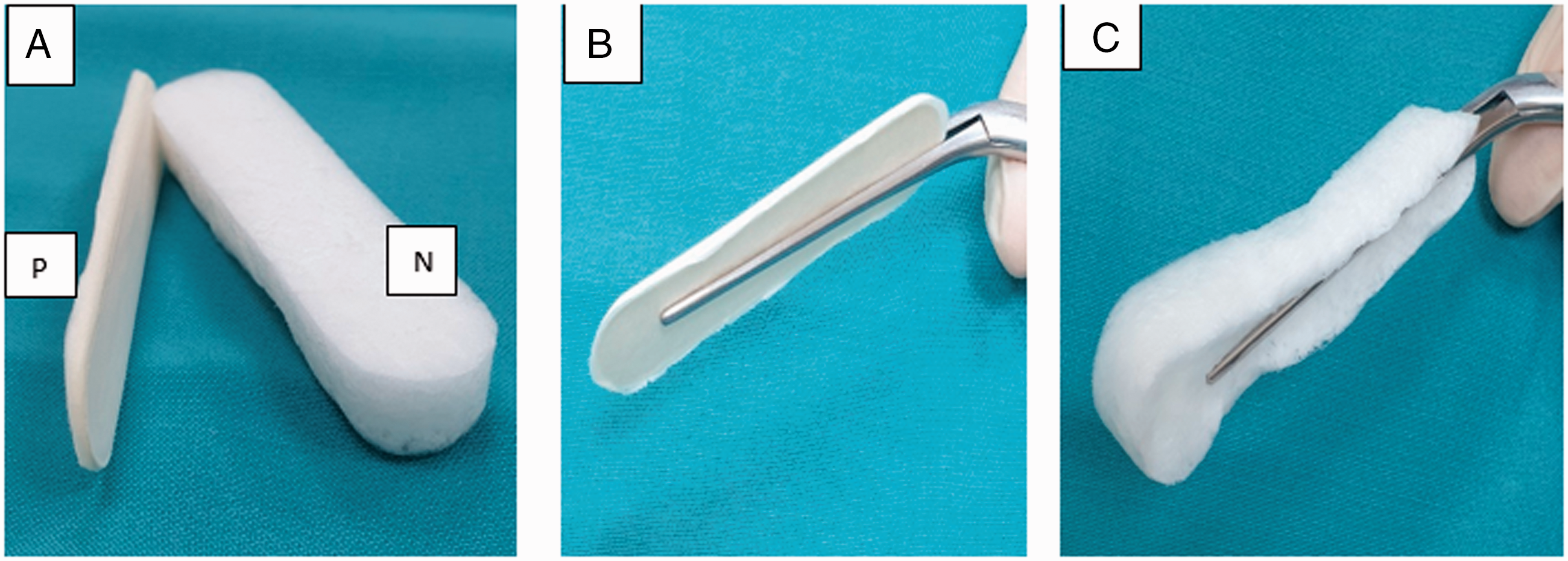
A, Posisep X (P) and Nasopore (N). B, Posisep. C, Nasopore.
Nasopore (Figure 1(A) and (C)) is biodegradable, synthetic polyurethane foam and it is associated with minimal discomfort, besides few postoperative complications. It must be stored in a refrigerator at an optimal temperature. 6
Methods
This is a prospective randomized double-blinded study, to compare the postoperative effects of two biodegradable nasal packs, Posisep X and Nasopore. The study was carried out at Magrabi ear, nose, and throat hospital in Qatar between December 2017 and December 2019 after being approved by the ethical committee. Informed written consent was collected from all patients prior to surgery. All patients involved in the study were over 18 years old, who were presented with persistent chronic rhinosinusitis with nasal polypi (CRSwNP) of the same score bilaterally according to Lund Mackay score. Patients had bilateral ethmoidal polypi (anterior and/or posterior) with or without maxillary sinusitis.
Exclusion criteria were:
Age less than 18 years. Simultaneous septoplasty and turbinectomy surgery. Previous sinus surgery. History of bleeding disorders and anticoagulant therapy. Medical disorders such as diabetes mellitus and hypertension. Unilateral polyps. Frontal and/or sphenoidal chronic sinusitis Immunological diseases. Seafood allergy (for Posisep X).
Study Design
All surgeries were operated by the main author, and they were all standardized bilateral FESS under general anesthesia using mucosal sparing technique and preservation of middle turbinate. The standard FESS was in the form of uncinectomy, anterior and posterior ethmoidectomy, and nasal polypectomy.
Before surgery, the type and side of the pack were randomly selected by a nurse who was not involved in the surgery. Furthermore, the surgeon who performed the operation was blinded to, both the type and side of packs. At the end of the surgery, one middle meatus was randomly packed with Nasopore and the other side with Posisep X.
All patients were discharged the same day, and they were prescribed oral antibiotics (Cefdinir, 300 mg daily for 10 days) besides paracetamol as an analgesic. Patients were on a nasal saline spray (low volume 100 ml) on the 2nd day of surgery, three times daily, for two months. Moreover, all patients applied one budesonide spray, 64 micrograms, nasal spray (Rhinocort) in each nostril twice daily, following the nasal irrigation. Patients were not informed of either the type of nasal packing or which side it was placed.
Subsequently, patients had a regular follow up in the outpatient clinic, by the second author, to assess the presence of remnant materials endoscopically and to measure the outcomes at weeks 1, 2, 4, 8, and 12. The second author was blinded to the type of nasal pack in each nostril. Video clips were recorded to all cases and the outcomes of postoperative endoscopic findings were re-assessed by a non-participating surgeon using the grading scales.
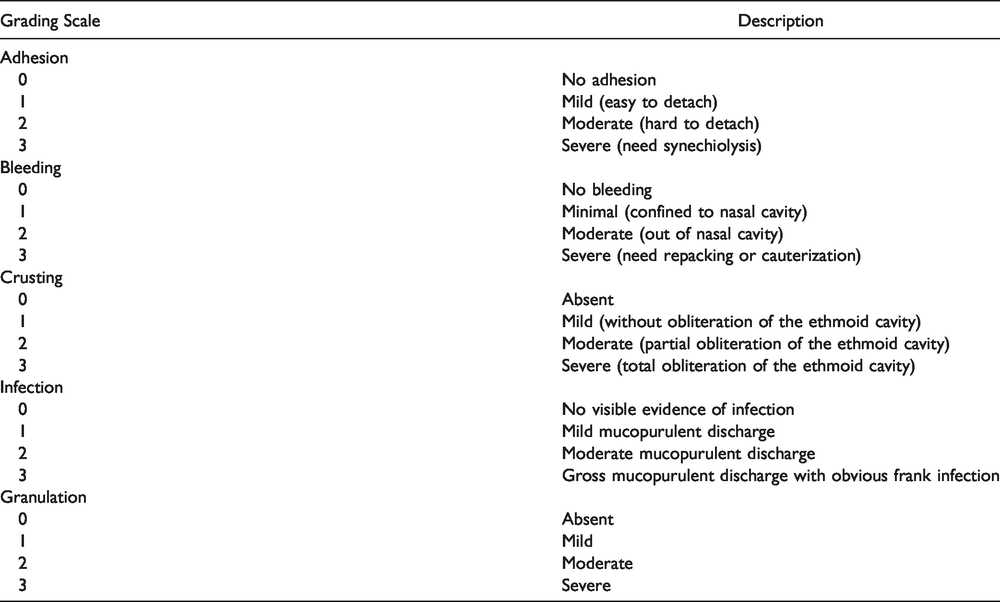
The following parameters were assessed using a grading scale adapted from a scale used by Jung et al in a study conducted in 2017 7 : assessment criteria included; adhesions in the middle meatus, bleeding, crustations, granulations, infection, and middle lateralization as shown in Table 1.
Grading Scale for Postoperative Criteria.
The postoperative questionnaire was applied to patients, four weeks postoperatively, employing a visual analog score (VAS), to assess the following subjective symptoms; facial pain and nasal obstruction on each side, and they were graded from 0 (without symptoms) to 10 (unbearable). Furthermore, the VAS score was used to evaluate patients' overall satisfaction, graded from 0 (not satisfied) to 10 (absolutely satisfied).
Statistical Analysis
Data entry, processing, and statistical analysis were carried out using Medcalc version 18.2.1 (Medcalc, Ostend, Belgium). The authors applied tests of significance, paired t-test, and McNemar. Data were presented and the type of analysis was determined based on the type of the processed data, (parametric and non-parametric) that were obtained for each variable. P-values are less than 0.05 which indicates a statistical significance.
Results
50 patients who had a bilateral CRSwNP underwent surgery using FESS with 100 surgical cavities. The baseline Lund-Mackay score for each side was 3. At the end of the surgery, one side was randomly packed with Nasopore and the other side with Posisep X. The type of the pack and which side were chosen randomly by a nurse who did not participate in the surgery. Moreover, the surgeon was blinded to the type of packs.
The mean age of patients, who participated in this study, is 41.3 (+/– 15.4) years; 23 females and 27 males. The surgeon found that Posisep X is more easily introduced in the middle meatal cavity showing a higher as well as a better view during the introduction (displayed in Figure 2).
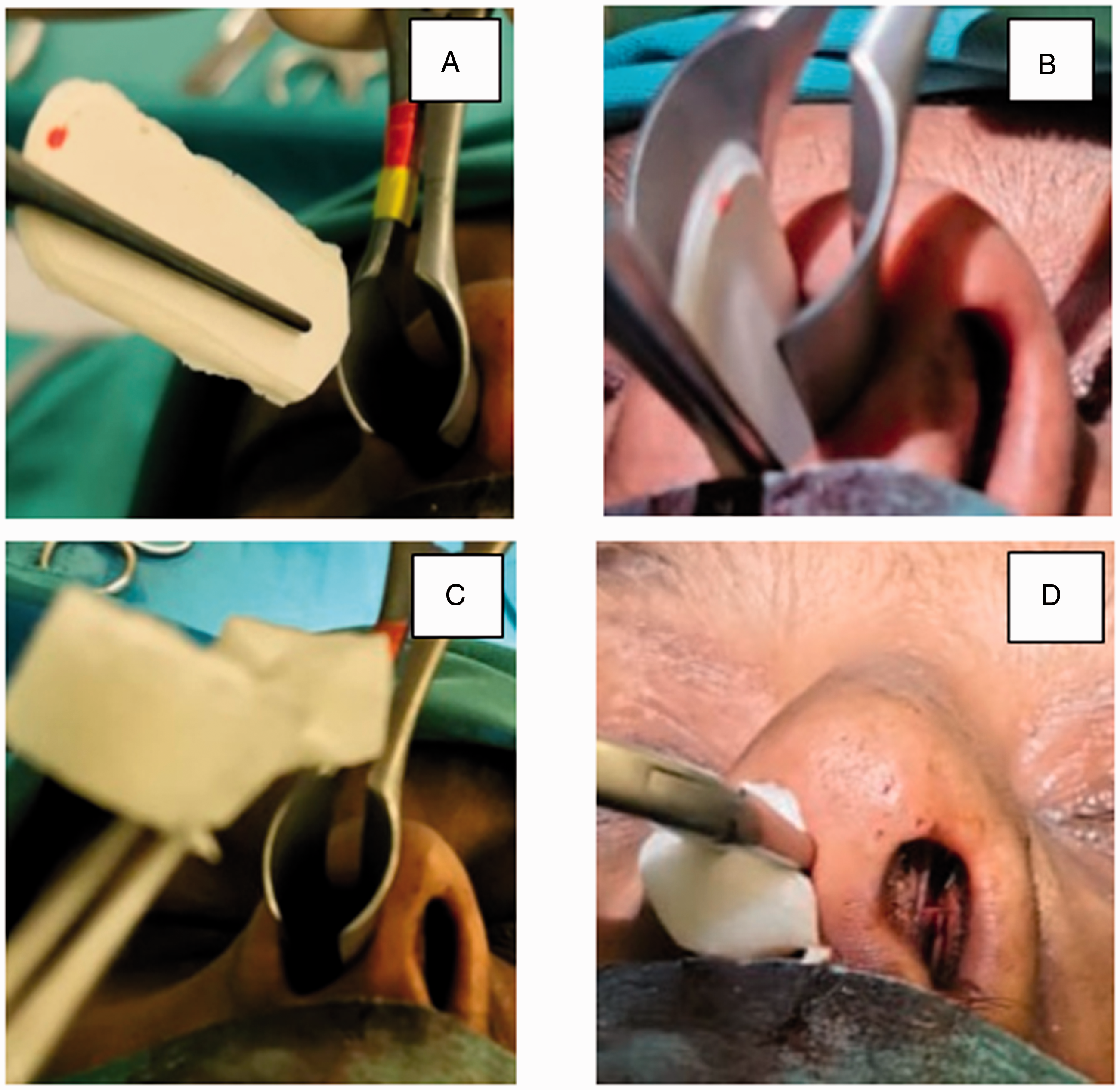
During insertion of Posisep X (A and B) and Nasopore (C and D) and visualization of the nasal cavity.
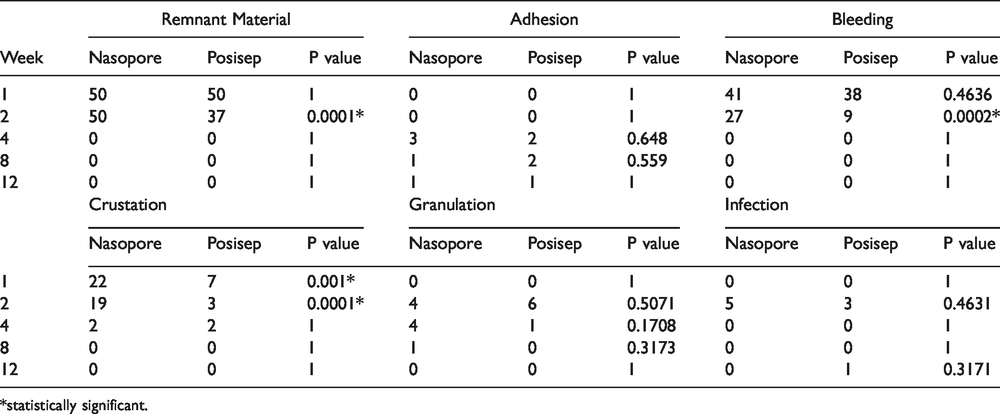
In addition, Table 2 shows a comparison between the two materials in regard to: remnants, crustations, adhesions, bleeding, granulations, and infection.
Postoperative Clinical Outcomes and Findings.
*statistically significant.
The first endoscopic examination after surgery showed remnants of both materials in all cavities at 1st week. Then, at 2nd week, it was found in 37 Posisep X treated cavity (Figure 3(A)) and in all the 50 cavities of Nasopore. Finally, there were not any remnant materials found for both types by the 4th week.
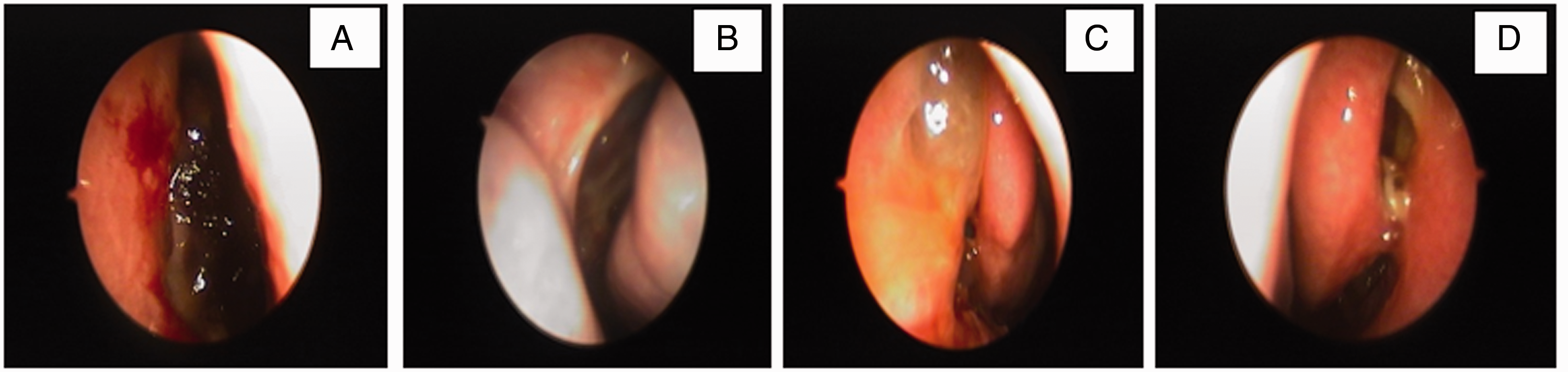
Postoperative endoscopic findings for Posisep X: A, Remnants in middle meatus in week 2. B, Completely healed mucosa + middle turbinate position in week 12. C, Mild edema and granulations in week 2. D, Mild adhesions between middle turbinate and lateral nasal wall in week 4.
Furthermore, endoscopic examination showed a highly statistically significant lower number of cavities with crustations (which was mild) in the Posisep X side, during the first and the second week (P-value 0.001 and 0.0001) respectively, and by the 8th week, all cavities were clear of crustations.
Concerning bleeding, during the 1st week, 38 cavities were treated with Posisep X while 41 cavities treated with Nasopore, experienced mild postoperative bleeding and none of the patients experienced severe bleeding that needed cauterization or packing. However, in the 2nd week, there was a statistically significant lower score in the Posisep X treated cavities (P-value 0.0002*).
Thereafter, the lateralization position of the middle turbinate was assessed (Figure 3(B)) in week 12 and showed no statistically significant difference (P value 0.1424).
The follow up showed unsuspected complications in the Posisep X side for some patients, in the form of a bad smell and watery rhinorrhea. Eight patients started to complain of annoying bad odor like fish odor which disappeared gradually. There were no complaints by the 12th week. However, two patients experienced adverse reaction in the form of severe watery rhinorrhea in the Posisep X side.
Finally, there was no significant difference between the two types of packs regarding; granulations (Figure 3(C)), adhesions (Figure 3(D)), and infection.
Subjective Symptoms
There was no statistically significant difference between both types regarding; facial pressure sensation and overall satisfaction. Nonetheless, patients complained from a nasal obstruction, which was stronger on the Nasopore sides, during the postoperative follow-up, showing a highly statistically significant difference (P-value <0.001) as displayed in Table 3.
Comparison Between the 2 Groups as Regards Subjective Symptoms Scores.

**statistically significant.
Discussion
With the wide use of ESS throughout the last 20 years, the main aim became to reduce patients' discomfort postoperatively and to improve the quality of his own life. FESS results in a lower amount of bleeding, faster healing of wounds as well as reducing patient's discomfort, which is a fundamental objective for ENT surgeons. Pain, discomfort, and bleeding resulted from the removal of non-absorbable packs can contribute to a patient's dissatisfaction. That is why absorbable packs are proved to be much more comfortable compared to the non-absorbable packs. 8
In this study, the authors compared two types of absorbable packs; the chitosan- based polymers nasal pack ‘Posisep X’, and the most widely used ‘Nasopore’, taking into consideration different pattern that affects healing and patient's satisfaction.
Even though both of the used materials were found in all cavities in the first week, no remnants of both types were found in the 4th, 8th, 12th week. 37 cavities retained Posisep X during the second week, which is a large number; however, it is statistically significantly lower than Nasopore by the end of week two. The findings of the current study differ from Peter et al. in their 2017 study, as they found that Posisep was irrigated out during the first week, but in the current study, it was irrigated completely by the 4th week. 9
It is well known that the retained material can induce different healing patterns. 10 Consequently, in the current study, crustations were detected without obliteration of the ethmoid cavities and were easily removed endoscopically in the clinic. Posisep X has significantly lower crustations in the 1st and 2nd week (P-value 0.001 and 0.0001) respectively.
It is noteworthy that adhesions and granules are the main causes of ESS failure due to their effect on wound healing.10,11 Despite the relatively large duration of the exposure of the nasal mucosa to the material (at 2nd weeks Nasopore 50 cavities, Posisep X 37 cavities), the adhesions in all cavities were mild and easily detached endoscopically, therefore this could be attributed to the mucosal sparing technique and preservation of middle turbinate without drainage which may be the reason of these mild adhesions. Besides, there was no statistically significant difference as regard granulation formation.
It is worthy to mention that, severe epistaxis is not that common following ESS, and it can lead to anxiety and hypovolemia. 12 This comes in accordance with, the findings of the current study as all patients complained of bleeding had a mild bloody nasal discharge confined to the nasal cavity. The Posisep X cavities were significantly lower in postoperative mild bleeding during the 2nd week only.
During the 2nd week of the follow-up, eight of the Posisep X treated side patients started to smell a bad odor (fish odor) as it is derived from the powdered shells of crustaceans. However, this odor gradually disappeared without any effect on patient's satisfaction. Furthermore, two patients developed adverse reaction, in the form of watery rhinorrhea on the Posisep X treated side. One of these patients had a severe recurrent attack of rhinorrhea started on the 4th day and lasted for three months while the other patient experienced a mild to a moderate discharge, which disappeared after 8 weeks. Follow up using CT scan PNS thin cuts, and B2 transferring were done to exclude skull base fracture and CSF rhinorrhea.
Nonetheless, the mild complications, the overall satisfaction of patients is excellent for both types with no statistical difference. They are satisfied with a very low pain level which they experience during dressing with the absorbable packs. Most of them had concerns preoperatively about the nasal block and the pain during the removal of nasal packs.
It may seem easy to insert the nasal packs at the end of the surgery, as the surgeon found that Posisep X is easier to be placed endoscopically and even transnasal with a maximum visualization of the middle meatal field. It looks firm, thin, and easily handled by nasal dressing forceps (Figure 2(A) and (B)), but it turned out exactly the opposite, as, during the insertion of Nasopore, it was found to be soft, spongy and needs various manipulations with minimal visualization of the field (Figure 2(C) and (D)).
The strength of this study lies in the incorporation of the prospective, double-blinded, randomized comparative design. All patients had chronic rhinosinusitis with bilateral nasal polypi of the same degree, and patients without polyps were excluded. Moreover, a standardized surgical technique employed by the first author with sparing of mucosa used for all patients. Besides, a standardized postoperative treatment applied with a regular strict follow up for twelve weeks, and the type of pack was blinded to the second author.
Conclusion
Synthetic polyurethane and Chitosan-based polymers nasal packs are safe and efficient regarding; the mucosal healing, bleeding control, and the overall satisfaction of patients. The CBP showed a higher statistically significant advantage in the first two weeks only regarding the amount of the retained material, crusting as well as bleeding. Patients packed with CBP experienced fish-like smelly odor and watery rhinorrhea but there is no statistically significant difference.
Footnotes
Acknowledgment
Marwa Abolfotouh for her effort in English revision. She is an assistant lecturer, department of applied linguistics and curriculum studies, Faculty of Women for Arts, Science and Education, Ain Shams University.
Ethical Approval and Informed Consent
Ethical approval and the consent to participate by the ethics committee at Magrabi hospital, Doha, Qatar. Reference number is ENT-7-2017Q. Besides, a written consent from all patients to participate in this study.
Declaration of Conflicting Interests
The author(s) declared no potential conflicts of interest with respect to the research, authorship, and/or publication of this article.
Funding
The author(s) received no financial support for the research, authorship, and/or publication of this article.
