






Abstract
Objective
Sublingual immunotherapy (SLIT) has been widely applied to treat patients with allergic rhinitis (AR). However, meta-analyses on the efficacy of SLIT in AR patients with asthma are still limited.
Methods
Literature without language limitation published before October 28, 2022, were retrieved from PubMed, EMBASE, and Cochrane Library. STATA 16.0 software was used for the meta-analysis of the extracted data. The results reported were symptom scores, drug scores, adverse effects rates, and cost of treatment.
Results
Ten studies involving 1722 patients met the inclusion criteria. The total rhinitis score (TRSS) (weighted mean difference [WMD] = −1.23, 95% CI: −1.39-−1.06, P < .001) and total asthma symptom score (TASS) (WMD = −1.00, 95% CI: −1.12–0.89, P < .001) were significantly lower in the SLIT group than the placebo group. The SLIT group had higher rates of treatment-related adverse events (relative risk [RR] = 2.82, 95% CI: 1.77-4.48, P < .001) and total costs of treatment (standardized mean difference [SMD] = 0.71, 95% CI: 0.45-0.97, P < .001). There was no significant difference in inhaled corticosteroids (ICS) dose (P = .195), fractional exhaled nitric oxide (FeNO) (P = .158), forced expiratory volume in 1 s (FEV1) (P = .237), and direct costs of treatment (P = .630) between the SLIT and placebo groups.
Conclusion
SLIT may be a therapeutic method for improving rhinitis symptoms and asthma symptoms in AR patients with asthma. However, as there was significant heterogeneity in results, more high-quality and well-designed studies are needed in the future to elucidate the efficacy of SLIT.
Introduction
Allergic diseases caused by abnormal reactions of the immune system to allergens are prevalent in children and adults, and the prevalence is on the increase.1,2 Allergic rhinitis (AR) is one of the most widespread allergic diseases, affecting about 10% to 30% of the global population. 3 The combined incidence of AR and asthma is very high. It is reported that 10% to 60% of patients with AR have asthma, and 28% to 84% of asthmatic patients experience symptoms of AR.4–7
AR is a global health problem with a substantial economic burden. Recurrent sneezing, runny nose, nasal congestion, itching, and itchy eyes will affect sleep, study, work, etc., thereby reducing AR patients’ quality of life. 8 Allergy to house dust mites (HDM), pollen, mold, and certain types of animal dander are the main cause of AR. 2
Allergy immunotherapy (AIT) is currently considered the only treatment for allergic diseases with potential long-term therapeutic effects.9,10 Repeated allergen administrations can increase the tolerance to causal allergens, thereby modulating the immunological response. 11 The administration routes of AIT include subcutaneous immunotherapy (SCIT) and sublingual immunotherapy (SLIT). SCIT and SLIT have been shown to have good efficacy.12,13 The mild events in the oral cavity and upper respiratory tract are the main side effects related to SLIT. Even with these adverse events, SLIT, without frequent doctor visits or injections, has become a more popular method of administration because of its comfort and convenience. 14
Several randomized controlled trials (RCTs) and meta-analyses have approved that SLIT has a palliative effect on AR.15,16 Moreover, SLIT not only reduces inhaled corticosteroids (ICS) in patients with mild to moderate allergic asthma but also improves lung function and airway inflammation in adults with asthma.17,18 To date, there is no meta-analysis of the efficacy of SLIT in AR patients with asthma. Our current meta-analysis was designed to evaluate the efficacy of SLIT on outcomes in AR patients with asthma, including rhinitis symptoms, asthma symptoms, ICS dose, adverse events, and cost of treatment.
Method
Preferred Reporting Items for Systematic Reviews and Meta-Analyses (PRISMA) was used to guide the implementation of this systematic review and meta-analysis. 19
Retrieval Strategy
PubMed, Embase, and Cochrane Library online databases were searched from inception to October 28, 2022. The search keywords were “(‘sublingual immunotherapy’ OR ‘SLIT’ OR ‘sublingual immunotherapies’) AND (‘allergic rhinitides’ OR ‘allergic rhinitis’ OR ‘allergic rhinopathy’ OR ‘rhinallergosis’ OR ‘eosinophil rhinitis’ OR ‘eosinophile rhinitis’ OR ‘eosinophilic rhinitis’ OR ‘eosinophilous rhinitis’ OR ‘allergic rhinitis’ OR ‘eosinophilia rhinitis’ OR ‘pollen allergy’ OR ‘pollen allergies’ OR ‘pollinosis’ OR ‘pollinoses’ OR ‘hay fever’ OR ‘pollen hypersensitivity’ OR ‘seasonal rhinitis’) AND (‘asthma’ OR ‘bronchial asthma’ OR ‘asthmas’).”
Inclusion Criteria
After deleting repeated articles, two researchers respectively screened out potential studies based on the titles and abstracts. The final included studies were determined via full-text review. There were no restrictions on country/region or language. The Population Intervention Comparison Outcome Study design (PICOS) strategy was used to define eligible studies. 20
Population
Reports should include patients with AR and asthma. Including patients was not limited by race, gender, age, nationality, or occupation.
Intervention
Patients received any dose and formulation of SLIT for treatment.
Comparison
The study should include a control group. Patients in the control group received a placebo or conventional medication.
Outcomes
The measured outcomes included total rhinitis score (TRSS), total asthma symptom score (TASS), ICS dose, fractional exhaled NO (FeNO), forced expiratory volume in 1 s (FEV1) predicted value, treatment-related adverse events, and cost of treatment. The TRSS is a four-point symptom scale for rhinitis, including sneezing, itching, rhinorrhea, and nasal blockage. The TASS is a four-point symptom scale for asthma including cough, wheezing, breathlessness, and dyspnea. In this study, the ICS dose was evaluated based on the average daily dose of budesonide (µg/day).
Study Design
RCTs and non-randomized controlled clinical trials (CCTs) would be selected.
Data Extraction
Data on authors, year of publication, region, study design, sample size, subject characteristics, interventions, and clinical outcomes were extracted from eligible studies. Two independent researchers used a standardized form for data extraction. If there were different opinions, the two researchers discussed or consulted a third researcher.
Bias Risk Assessment of Included Studies
For RCTs, the risk of bias was assessed according to Cochrane Collaboration Risk of Bias Tool 2.0. 21 The risk of bias was assessed according to the following five aspects, the randomization process, deviations from intended interventions, missing outcome data, measurement of the outcome, and selection of the reported result. For CCTs, the Newcastle-Ottawa Scale (NOS) was used for evaluation. 22 The scoring range was 0 to 9 points. Studies scored 6 to 9 were considered at low risk of bias, studies scored 3 to 5 were assessed at unclear risk of bias, and studies scored 0 to 2 were considered at high risk of bias. 23
Data Combination and Analysis
Statistical analysis was performed using STATA 16.0 software. Two-tailed P values less than 0.05 were used as statistical significance. Continuous variables at the same measurement scale were evaluated using the corresponding 95% confidence interval (95% CI) of weighted mean difference (WMD). The standardized mean difference (SMD) and 95% CI were calculated for continuous variables with different measurement scales. Relative risk (RR) and 95% CI were calculated for dichotomous variables.
Heterogeneity was assessed using the I2 statistic (percentage of total variability due to heterogeneity between studies). 24 I2 < 40% indicated that heterogeneity was insignificant. 40% ≤ I2 < 60% indicated moderate heterogeneity. 60% ≤ I2 < 90% indicated a considerable degree of heterogeneity, and 90% ≤ I2 < 100% indicated substantial heterogeneity. 25 We used random-effects or fixed-effects models to summarize data from studies. Subgroup analysis was conducted to investigate possible resources of heterogeneity.
Results
Studies Identification and Selection
Figure 1 shows the process of literature screening. We identified 1073 studies that may be relevant. However, 979 studies were excluded after the titles and abstracts were screened. After a full-text review of 94 studies, further 84 studies were excluded. Finally, 10 studies met our inclusion criteria, including seven RCTs2,26–31 and three non-randomized CCTs.32–34

Flowchart of literature search strategy in this systematic review and meta-analysis.
Study Characteristics and Quality Assessment
The ten studies conducted between 2004 and 2022 were confirmed, including 1722 participants. Seven studies were conducted in Europe,2,27–31,34 two in Japan,26,32 and one in China. 33 The duration of treatment ranged from 6 months to 3 years). Eight studies reported the gender of the subjects, including 265 females and 328 males. The average age of patients was 33.78 years. Five studies used SLIT tablets,2,26–28,31 one used drop, 33 one used oral lyophilization, 29 and three were not reported.30,32,34 Table 1 summarizes the essential characteristics of the included studies.
Characteristics of the Eligible Study in this Meta-analysis.

RCT, randomized controlled trial; SLIT, sublingual immunotherapy; NR, not reported; NA, not applicable; F, female; M, male.
For the bias risk assessment of CCTs, the average NOS score of the three studies was more than 6 points, indicating a low risk of bias.32–34 Bias risk assessment for seven RCTs was shown in Figure 2. Four studies were rated at low risk for the overall risk of bias,2,27,28,31 one study was considered as some concerns based on the selection of the reported result, 30 and the other two studies were considered as some concerns with the randomization process.26,29

Risk of bias assessment of included studies. Green (+), low risk of bias; red (-), high risk of bias; Yellow (!), some concerns.
Symptom Score
Two studies reported related data on TRSS. The results were shown in Figure 3A. The TRSS of the SLIT group was significantly lower (WMD = −1.23, 95% CI: −1.39-−1.06, P < .001, I2 = 0.0%, fixed-effects model) than that in the placebo group. Two studies involving 122 subjects compared the TASS between the SLIT and placebo groups. The results showed that the TASS of the SLIT group was significantly lower than that of the placebo group (WMD = −1.00, 95% CI: −1.12-−0.89, P < 0.001, I2 = 0.0%, Fixed-effects Model) (Figure 3B).

Forest plot comparing TRSS (A) and TASS (B) in patients between the SLIT group and the placebo group. TRSS, total rhinitis score; TASS, total asthma symptom score; SLIT, sublingual immunotherapy.
ICS Dose
Two studies reported ICS doses, with 156 patients in the SLIT group and 140 in the placebo group. The ICS used in the included studies were all budesonide (µg/day). The pooled WMD was −110.10 (95% CI: −276.48-56.27, P = .195, I2 = 93.5%, random-effects model), indicating that no significant difference was found in the daily ICS dose between the SLIT group and the placebo group (Figure 4). Due to the small number of included studies for the results, we did not conduct subgroup analyses to explore the sources of heterogeneity.

Forest plot comparing daily ICS dose in patients between the SLIT group and the placebo group. ICS, inhaled corticosteroids; SLIT, sublingual immunotherapy.
FeNO and Lung Function
Two studies involving 90 patients compared FeNO between the SLIT and placebo groups. The pooled results showed no difference between the two groups (WMD = −5.77, 95% CI: −13.78-2.25, P = .158, I2 = 56.1%, random-effects model) (Figure 5A). Due to the small number of included studies for the results, subgroup analyses could not be performed to explore the source of heterogeneity. We used FEV1 to assess lung function. Four studies reported FEV1. The results are shown in Figure 5B. There was no difference between the SLIT and placebo groups (WMD = 0.03, 95% CI: −0.02-0.08, P = .237, I2 = 92.3%, random-effects model). We performed subgroup analysis to explore the sources of heterogeneity. The results suggested that study design, the ratio of male to female, region, and sample size may not be the sources of heterogeneity (Table 2).

Forest plot comparing FeNO (A) and FEV1 (B) in patients between the SLIT group and the placebo group. FeNO, fractional exhaled nitric oxide. FEV1, forced expiratory volume in 1 s; SLIT, sublingual immunotherapy.
Subgroup Analysis of Length of FEV1 to Study Design, the Ratio of Male to Female, Region, and Sample Size.
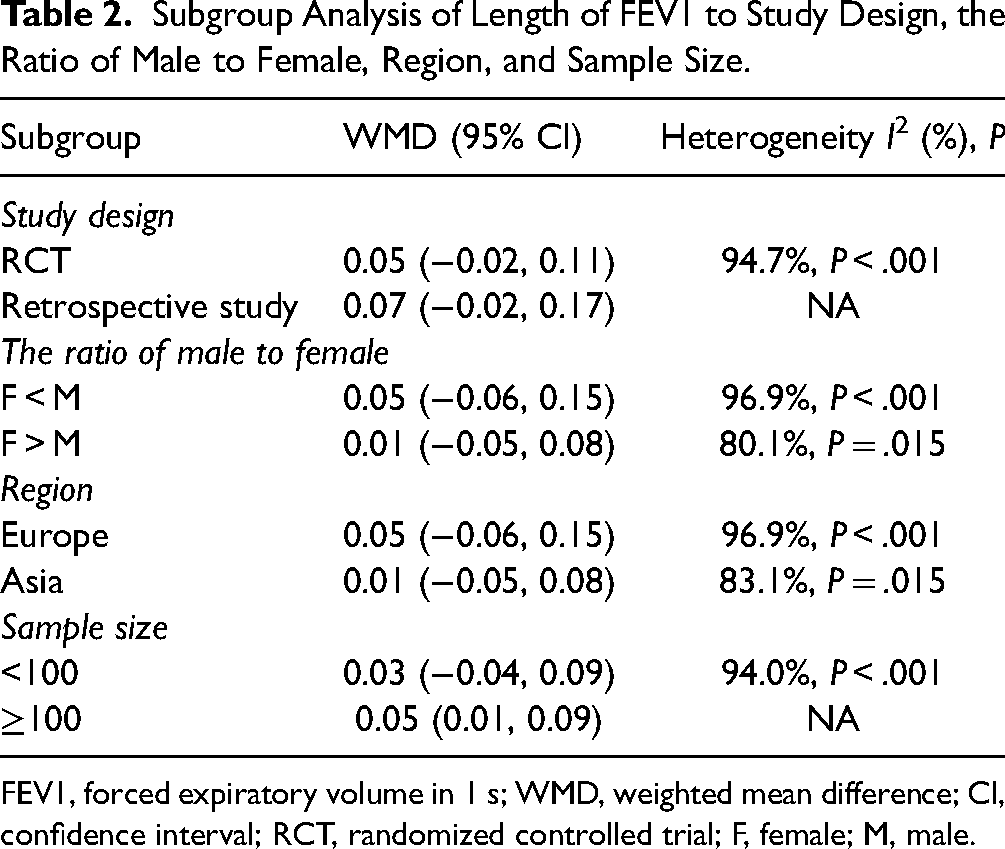
FEV1, forced expiratory volume in 1 s; WMD, weighted mean difference; CI, confidence interval; RCT, randomized controlled trial; F, female; M, male.
Treatment-Related Adverse Events
Five studies involving 1161 patients reported rates of treatment-related adverse events. The rate of treatment-related adverse events was 16.70% in the SLIT group and 6.03% in the placebo group. The pooled RR was 2.82 (95% CI: 1.77-4.48, P < .001, I2 = 27.1%, fixed-effects model), indicating that the rate of treatment-related adverse events was significantly higher in the SLIT group than in the placebo group (Figure 6). Oral pruritus, throat irritation, and mouth edema were the most commonly reported treatment-related adverse events. The incidence of oral pruritus in the SLIT group (20.42%) was higher than that in the placebo group (1.05%). The probability of throat irritation in the SLIT group (9.51%) was higher than that in the placebo group (2.28%). However, in these included studies, mouth edema occurred only in the SLIT group (8.63%).

Forest plot comparing treatment-related adverse events in patients between the SLIT group and the placebo group. SLIT, sublingual immunotherapy.
Cost of Treatment
Two studies compared the total and direct costs of treatment between the SLIT and placebo groups. The pooled SMD was 0.71 (95% CI: 0.45-0.97, P < .001, I2 = 0.0%, Fixed-effects Model), suggesting that the yearly total costs of treatment in the SLIT group were significantly higher (Figure 7A). Direct costs included testing fees, transportation fees, and pharmaceutical fees. There was no significant difference in yearly direct costs of treatment between the SLIT group and the placebo group (SMD = 0.57, 95% CI: −1.74-2.87, P = .630, I2 = 97.7%, random-effects model) (Figure 7B). Because there were few included studies for this outcome, subgroup analysis could not be performed to explore the source of heterogeneity.

Forest plot comparing yearly total cost (A) and yearly direct costs (B) of treatment in patients between the SLIT group and the placebo group. SLIT, sublingual immunotherapy.
Discussion
This systematic review and meta-analysis identified seven RCTs and three CCTs. A total of 862 AR patients with asthma receiving SLIT and 860 patients receiving placebo were included. This meta-analysis reported that SLIT treatment might improve rhinitis and asthma symptoms of AR patients with asthma. However, SLIT would increase the treatment-related adverse events and yearly total cost of treatment.
AR with allergic asthma mainly refers to allergic diseases that occur simultaneously on the nasal mucosa and bronchial mucosa. AR and allergic asthma often occur together. 33 The previous meta-analysis has shown that HDM SLIT tablets are an effective treatment for AR patients.15,16 A meta-analysis of nine studies has found that asthma symptoms in children with HDM allergy were significantly improved after SLIT treatment and steroid-saving effects were observed. 35 This meta-analysis obtained similar results, with significant improvements in rhinitis symptoms and asthma symptoms of the SLIT group compared with the placebo group.
ICS therapy is the foundation of asthma treatment in children and adults because it targets airway inflammation. 36 A large RCT using SQ HDM SLIT tablet demonstrated significantly lower daily ICS doses in asthma patients receiving SLIT compared to placebo. 37 For patients with partly controlled asthma, 6 SQ-HDM treatment for 1-year increased asthma control, reduced daily budesonide dose, and improved asthma-related quality of life. 36 In this meta-analysis, we pooled two studies to compare daily ICS (budesonide) doses in the SLIT and placebo groups. The results showed no significant differences between the daily ICS doses in the SLIT and placebo groups. This might be due to the different SLIT tablets used by patients in the two studies.
Nitric oxide (NO) plays an important role as an inflammatory mediator in upper/lower airway inflammation. Recently, a study observed a significant reduction of nasal NO (nNO) in children with AR after 6 months of treatment with SLIT. 38 They suggested that nNO could be a valuable biomarker to predict the efficacy of SLIT. FeNO is a simple and safe method for measuring airway inflammation, 39 as it is often considered to be associated with elevated FeNO. 40 An RCT by Hoshino et al found that SLIT could reduce FeNO levels in patients. 26 Another study from China reported a significant reduction of FeNO in asthmatic children undergoing SLIT. 41 However, our results showed no statistical difference in the reported FeNO levels for patients treated with SLIT and placebo. It might be due to the lack of data in the placebo group during the pollen dispersal period. 32 In terms of lung function, the pooled results showed no difference in FEV1 prediction between the SLIT and placebo groups. However, a Chinese study showed that SLIT treatment significantly improved both lung function and FeNO in AR children with or without asthma. 42 Another meta-analysis suggested that SLIT applied to HDM allergy could significantly improve allergic symptoms and FEV1. 43
The side effects associated with SLIT were mainly oral cavity and upper respiratory tract-related events. In this study, we reported a higher incidence of oral pruritus, throat irritation, and mouth edema in the SLIT group of 20.42%, 9.51%, and 8.63% than that in the placebo group. The pooled results were consistent with previous studies, with a higher rate of treatment-related adverse events reported by the SLIT group compared to the placebo group.27,31 The majority of the reported adverse events were transient mild or moderate local reactions.2,26,30 A study reported worsening respiratory symptoms in one of the SLIT-treated subjects. 27 The subject made a full recovery after treatment and discontinued the trial. In the study of Calderon et al, 31 one patient treated with placebo reported aggravated asthma. No cases of death, anaphylactic shock, or systemic allergic reactions were reported in the included studies of this meta-analysis. SLIT is safe for patients with mild to moderate asthma and well-controlled rhinitis. In clinical applications, to reduce the risk of adverse events, SLIT starts from a low dose and increases over the first few weeks to several months of treatment (cumulative dose phase) until the maintenance dose is reached. 44
Allergic diseases are related to great costs to the healthcare system and society. AR and asthma may have a considerable negative impact on patient productivity and quality of life, resulting in a substantial economic burden. The results of this meta-analysis showed that yearly total cost was significantly higher for patients in the SLIT group than in the placebo group, but there was no significant difference in direct costs between the two groups. This was probably due to the short study period (1-2 years) of the included articles. A study from China showed that the total and direct costs of treatment for 2 years were RMB 9360.19 and RMB 8323.10 in the SLIT group and RMB 8268.06 and RMB 6103.00 in the placebo group. 33 A 1-year Italian study reported a total cost of Euros 362.4 for AR patients with asthma receiving SLIT and Euros 229.6 for those receiving placebo. 34 The SLIT group had a 34% decrease in drug costs compared to the placebo group. 34 The current guidelines recommend using SLIT for at least 3 years. 45 A study with a 10-year follow-up found that the advantages of SLIT treatment began to unfold after 6 years, with direct and indirect costs of Euros 2400 and Euros 1913 in the SLIT group, and Euros 3026 and Euros 3400 in the conventional treatment group. 46 A pharmacoeconomic study concluded that SLIT significantly reduced the economic burden of asthma and AR patients from year 3 onwards and that the economic advantage was long-lasting and still present in the fifth year of the follow-up. 47
Even though more than half of the studies included in this meta-analysis were RCTs, it still involved some challenges and limitations. First, there was considerable heterogeneity in the allergens, dose of SLIT, dosage, formulation, duration of treatment, and the reports and scores of outcomes in the included studies. For some results, we could not explain the source of heterogeneity through sensitivity and subgroup analysis because of the small number of studies. The significant heterogeneity indicated that the analysis results were exploratory, so the results need to be treated cautiously. Second, even though 10 studies were included, most of them lacked data of interest for this meta-analysis, such as asthma or rhinitis symptom scores, ICS doses, and lung function-related indicators. Furthermore, because there was no restriction on the language of studies and researchers’ familiarity with different languages was different, it might lead to potential bias. In addition, the studies included were conducted only in European countries, Japan, and China, so there were limits on generalizability to other populations. These limitations highlight the need for in-depth research and carrying out higher-quality research in this field.
Although research in this field continues, evidence on the outcomes such as serum-specific IgE levels, lung function, and cost-effectiveness is still too limited. Therefore, the conclusion on the effect of SLIT in AR patients with asthma remains to be proved. The potential benefits of SLIT should be weighed against the risk of adverse events and the inconvenience and cost of a long-term treatment course. 48 Due to the different ages of the affected population and the differences in SLIT tablets and drops, future research can focus on the optimal treatment dose, frequency, and duration of treatment with SLIT. In addition, the long-term effect of SLIT should also be evaluated.
Conclusion
In conclusion, the current systematic review and meta-analysis suggested that SLIT might be a therapeutic approach to improve rhinitis symptoms and asthma symptoms in AR patients with asthma. Although SLIT had a high incidence of treatment-related adverse events, most of them were mild and temporary. Due to significant heterogeneity, the benefits of SLIT require further evidence from higher-quality studies.
Footnotes
Acknowledgments
None.
Author Contributions
MDJ, ZQL, and HWD conceived and designed the study. MDJ, ZQL, SJN, and TSJ performed the scientific literature search. MDJ, ZQL, SJN, and TSJ did literature screening. MDJ, ZQL, SJN, TSJ, and HWD extracted data. MDJ, SJN, and TSJ did quality assessment of the included studies. ZQL, SJN, and TSJ did the analyses. MDJ, ZQL, and SJN wrote the first draft. All authors contributed to interpretation and edited the draft report. All authors have approved the final version of the manuscript.
Declaration of Conflicting Interests
The author(s) declared no potential conflicts of interest with respect to the research, authorship, and/or publication of this article.
Funding
The author(s) disclosed receipt of the following financial support for the research, authorship, and/or publication of this article: This work was supported by the the Science and Nature Foundation of Ningbo, Subject of Yuyao Science and Technology Bureau, (grant number 2019A610324, 2021YPT06).
